IMY meaning in text refers to a common texting abbreviation that stands for “I miss you.” People use it to express affection or longing in a quick, casual way, without typing out the full phrase every time.
Three letters, one feeling, endless interpretations. A single “IMY” can mean butterflies from a crush, comfort from a partner, or a simple hello from an old friend, all depending on the moment it lands in your inbox.
Understanding IMY meaning in text goes beyond the definition itself. Tone, timing, and relationship context shape what those three letters truly communicate, turning a simple abbreviation into one of texting’s most emotionally layered phrases.
Quick Answer
IMY stands for “I Miss You.” It’s a short, casual way to tell someone you’re thinking about them and wish they were around. People use it in texts, DMs, and social media comments when they want to express affection without typing out the full phrase.
That’s the baseline. But like most texting abbreviations, the real meaning shifts depending on who sent it, when they sent it, and what came before it. We’ll get into all of that.
ALSO READ :https://holymeaning.com/asf-meaning-in-text/
What Does IMY Mean in Text?
At its core, IMY is one of the simplest and most widely understood pieces of messaging language out there. It doesn’t need decoding the way some newer slang does. Most people recognize it instantly, which is part of why it’s stuck around for so long.
The Literal Meaning
IMY expands to “I miss you.“ That’s it. No hidden layers, no secret acronym-within-an-acronym situation. It’s a direct, compact text message meaning that swaps four words for three letters.
Here’s how it stacks up next to the full phrase:
| Abbreviation | Full Phrase | Typical Use |
|---|---|---|
| IMY | I miss you | Casual or sincere, depending on context |
| ILY | I love you | Stronger emotional weight |
| IMYSM | I miss you so much | Intensified version of IMY |
| IMYSFM | I miss you so freaking much | Even more intense, often playful |
Texting Shorthand Roots
IMY didn’t appear out of nowhere. It’s part of a much bigger family of text abbreviations that grew out of early SMS culture, back when messages were capped at 160 characters and every letter counted. Phrases like BRB (be right back), TTYL (talk to you later), and LOL (laugh out loud) all came from the same need: say more with less.
IMY followed that same pattern. It’s one of the older, more established pieces of internet slang, and unlike a lot of trendy terms, it hasn’t really faded. If anything, it’s become even more common as texting has shifted from a device-specific habit to something people do across every platform they own.
Back in the early 2000s, when flip phones charged by the text and predictive typing wasn’t nearly as smart as it is now, abbreviations like IMY served a purely practical purpose. Fewer characters meant fewer cents spent per message for a lot of carriers. That practical origin has mostly disappeared, but the habit stuck around because it’s fast, familiar, and instantly readable.
What’s interesting is how IMY survived the shift from flip phones to smartphones to social apps largely unchanged. Compare that to slang like “sup” or “wyd,” which have drifted in and out of popularity depending on the platform. IMY has stayed remarkably stable across two decades of texting culture, which says something about how universally people relate to the feeling behind it. Missing someone isn’t a trend. It’s a constant, and the shorthand for it reflects that.
A Quick Note on Capitalization
You’ll see IMY written a few different ways: all caps (IMY), lowercase (imy), or occasionally mixed with punctuation like “i.m.y.” None of these variations change the meaning. Lowercase versions tend to show up more in casual texting between close friends, while all-caps versions are more common in quick, emphatic messages. It’s a stylistic choice, not a semantic one.
How to Use IMY in a Sentence
Reading a definition only gets you so far. Seeing IMY in real example texts is where it actually clicks. Here are several sample messages across different relationships and situations:
- “Hey, just landed. IMY already lol”
- “It’s been a rough week. IMY, wish you were here”
- “IMY 🥺 can we facetime later?”
- “Still thinking about our trip. IMY so much”
- “haven’t seen you in forever, IMY!”
- “IMY, but I get why you needed space”
Notice how the tone shifts based on punctuation, emojis, and what surrounds the abbreviation. A message with “lol” tacked on reads differently than one followed by a crying emoji. That’s not an accident. Chat examples like these show how context does most of the emotional heavy lifting, not the abbreviation itself.
Here’s a breakdown of how small changes shift the entire feel of the same three letters:
| Message | Feels Like |
|---|---|
| “imy” | Quick, low-key, almost automatic |
| “IMY.” | Slightly flat, maybe distracted or distant |
| “IMY 🥺” | Vulnerable, a little emotional |
| “IMY!!” | Upbeat, excited, enthusiastic |
| “imy so much” | Sincere, emphasized |
| “…imy” | Hesitant, thoughtful, sometimes wistful |
This is why two people can send the exact same abbreviation and mean completely different things. Punctuation and emoji choice aren’t decoration; they’re doing real communicative work, especially in a format like text where you can’t hear someone’s voice.
What IMY Really Means Depends on Who Sent It
Here’s where a lot of guides get it wrong. They’ll tell you IMY “from a girl” means one thing and IMY “from a guy” means something else, as if gender alone decides the emotional weight of a text. It doesn’t.
What actually matters is the relationship context—whether the person texting you is a friend, a partner, or a crush. That’s the real variable.
From a Friend
Between friends, IMY is usually light and easy. It’s a way of saying “I think about you” without making things weird. Friends send it after a long time apart, during a funny memory, or just out of nowhere on a slow afternoon.
Example: “omg remember that trip we took?? IMY, we need to hang out soon”
There’s rarely anything deeper going on here. It’s casual texting at its most straightforward.
From a Crush
This is where things get interesting. When someone you’re into sends IMY, your brain immediately starts running calculations. Does it mean something? Is this flirting? Should you read into it?
Usually, yes—at least a little. IMY from a crush often signals genuine interest, especially if it comes paired with follow-up questions, quick replies, or consistent texting patterns. One study on digital communication from the Pew Research Center found that people increasingly use short affectionate phrases like IMY as low-risk ways to test emotional waters before committing to something more direct (pewresearch.org).
Example: “haven’t talked in a bit, IMY tbh”
That “tbh” (to be honest) at the end adds a layer of vulnerability. It’s a small tell that this isn’t just habitual texting.
From a Partner
In a relationship, IMY is one of the most common caring messages people send throughout the day. It’s a check-in, a small reminder that someone’s on your mind even when you’re apart. Partners send it during work hours, before bed, after an argument, or just because.
Example: “meetings all day, IMY. talk tonight?”
Here’s a quick comparison to make the differences clearer:
| Sender | Common Meaning | Emotional Weight |
|---|---|---|
| Friend | Casual affection, nostalgia | Light |
| Crush | Interest, testing the waters | Medium to high, ambiguous |
| Partner | Genuine longing, routine affection | Medium to high, consistent |
The abbreviation stays the same. The person and the pattern around it? That’s where the actual meaning lives.
From Family
Family members use IMY too, and it tends to be the most straightforward version of all. A parent texting their kid at college, a sibling checking in after months apart, a grandparent who just learned how to text—these messages usually mean exactly what they say, nothing more, nothing less.
Example: “Hope work isn’t too crazy this week. IMY, call me when you get a chance”
There’s no ambiguity to decode here. It’s just love, expressed the fastest way possible.
A Quick Case Study
Consider two nearly identical texts sent under different circumstances:
Scenario A: Maria and her college roommate haven’t talked in two months because of finals. Maria sends “omg IMY so much, we need to catch up.” Her roommate replies within minutes, and they end up on a 45-minute call that night.
Scenario B: Jake has been distant for weeks, barely responding to messages. Out of nowhere, he texts “imy” with nothing else. When his girlfriend replies asking to talk, he goes quiet again for two days.
Same three letters. Completely different situations. In Scenario A, IMY functions as a genuine reconnection point, backed up by real follow-through. In Scenario B, it reads more like a gesture without substance, since nothing changes afterward. This is exactly why relationship context matters more than the abbreviation itself. The words are identical. The behavior around them tells the real story.
ALSO READ :https://holymeaning.com/ss-meaning-in-text/
Tone: How to Tell What They Actually Mean
You can’t fully understand IMY meaning without paying attention to tone. Text doesn’t come with vocal inflection, so people signal emotion through timing, punctuation, and follow-up messages instead.
Warm Sincere Signals
When someone genuinely means IMY, you’ll usually notice a few things. They send it unprompted. They follow it with something specific—a memory, a question, a plan to see each other. And they tend to reply quickly if you respond.
Signs of a sincere message:
- Sent without you texting first
- Followed by a specific reason (“IMY, that dinner last week was so fun”)
- Paired with plans (“IMY, when can we hang out?”)
- Comes with an affectionate tone—emojis, warmth, longer messages
This is the kind of IMY that carries real genuine feelings behind it, not just a reflex.
Casual Habitual Use
Not every IMY is loaded with meaning. Some people say it the way others say “lol” or “haha”—automatically, out of habit, without much thought behind it. This is casual habitual use, and it’s especially common among people who text a lot throughout the day.
You’ll notice this pattern when IMY shows up:
- At the end of nearly every conversation, regardless of context
- Without any elaboration
- In group chats or public comments as a throwaway phrase
It’s still friendly. It’s just not necessarily deep. Think of it like signing off a text—relaxed tone, low stakes, no hidden agenda.
Some people genuinely end nearly every conversation this way, the same way others always say “talk soon” or “love ya” without putting much weight behind it. If someone’s known for using IMY constantly across every relationship in their life, it probably says more about their general texting style than about how they feel toward you specifically. Watch for consistency across their conversations, not just the ones with you, before reading too much into it.
Neutral Tone
Sometimes IMY sits in a gray area that’s neither especially warm nor obviously casual. It’s just… there. Neutral IMY texts tend to show up mid-conversation, almost as a passing thought rather than the main point of the message.
Example: “yeah work’s been busy, imy though, we should grab coffee sometime”
Here, IMY isn’t the focal point. It’s tucked into a larger conversation about something else entirely, which usually means it’s genuine but not urgent.
Slightly Cold or Dry Tone
Occasionally, IMY can read as flat or distant, even when that’s not necessarily the intent. This usually happens with minimal punctuation, no emoji, and a significant gap since the last conversation.
Example: “imy” (sent alone, no other message, after weeks of silence)
Without additional context, a message like this can feel more obligatory than heartfelt, almost like checking a box. It’s worth noting that tone perception is subjective. What reads as cold to one person might just be someone’s normal texting style. If you’re unsure, the easiest fix is simply asking how they’re doing rather than assuming the worst.
When It Feels Off or Empty
Sometimes IMY lands wrong. Maybe it’s the only text you’ve gotten in days. Maybe it shows up right after they ignored you for hours. When the timing doesn’t match the sentiment, trust that instinct.
A few red flags worth noticing:
- IMY sent with zero other communication for long stretches
- Used right before or after asking for something
- Sent as a one-word text with no follow-up, even after you reply
“The words people choose in text matter less than the pattern they repeat,” says relationship communication researcher Dr. John Gottman, whose work on couples’ communication patterns has shaped decades of relationship counseling (gottman.com).
That idea applies directly here. One IMY means very little on its own. A pattern of them, paired with consistent behavior, means a lot more.
Is IMY Ever Rude, Manipulative, or a Red Flag?
IMY itself isn’t rude. It’s a warm phrase by nature. But like any affectionate language, it can get used in ways that don’t feel great, especially in situations involving inconsistent effort or emotional manipulation.
Here are a few real patterns worth knowing:
Love-bombing pattern: Someone showers you with IMY texts early in a relationship or right after meeting, before there’s been enough time to build genuine closeness. It can feel intense and flattering at first, but experts on relationship dynamics note that excessive early affection sometimes functions as a way to speed up trust rather than build it naturally.
Breadcrumbing pattern: Someone who otherwise ignores you sends an occasional IMY just often enough to keep you interested, without ever following through with real effort or plans. This one shows up a lot in situationships—relationships that hover in an undefined space between casual and committed.
Avoidance pattern: After a disagreement, some people send IMY instead of actually addressing the issue. It sounds sweet, but it can function as a way to skip an uncomfortable conversation entirely.
None of this means IMY is inherently bad; context is what turns a sweet phrase into something else. If you’re noticing a pattern where affectionate texts replace real effort, that’s worth paying attention to.
A simple gut check: does the IMY come with follow-through, or does it stand in for follow-through? Genuine affection usually leads to plans, conversations, or consistent effort over time. When IMY becomes the entire relationship rather than one small part of it, that’s less about the phrase itself and more about a mismatch in what each person is actually offering.
IMY vs Similar Texting Abbreviations
IMY belongs to a whole family of similar texting abbreviations, and knowing the differences helps you gauge intensity and tone more accurately.
| Term | Meaning | Intensity | Common Context |
|---|---|---|---|
| IMY | I miss you | Moderate | General affection, casual to sincere |
| ILY | I love you | High | Serious relationships, close family |
| MYA | Miss you already | Moderate | Right after saying goodbye |
| TMY | Text/Talk to you later, miss you | Low to moderate | Casual sign-off |
| IMYSM | I miss you so much | High | Emphasized version of IMY |
| IMYSFM | I miss you so freaking much | High, often playful | Close friends or partners, informal tone |
A quick way to think about it: ILY carries the most emotional weight, IMYSM and IMYSFM intensify the base feeling of IMY, and MYA usually shows up in specific, immediate goodbye moments rather than general check-ins.
Where You’ll See IMY (Texting vs Social Media vs DMs)
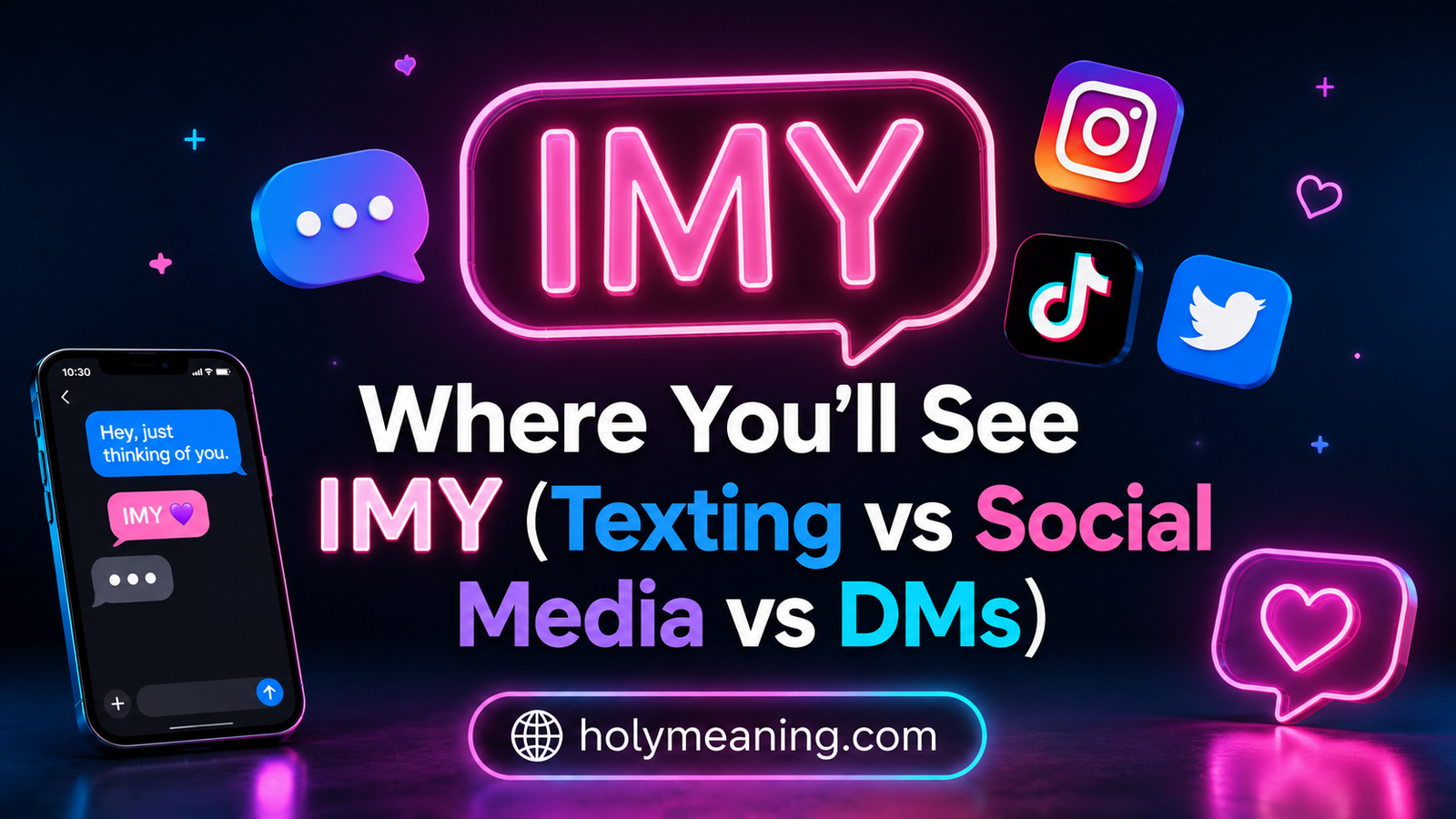
The platform someone uses to send IMY changes how you should interpret it. Private texts carry a different weight than a public comment, and that distinction matters more than people usually realize.
Private Texts
In one-on-one texts, IMY tends to be more personal. It’s part of personal chats, sent directly to you and no one else, which usually signals a bit more sincerity. Private messaging creates space for vulnerability that public platforms just don’t offer.
- More likely to reflect genuine feelings
- Usually followed by real conversation, not just left hanging
- Tends to show up during quiet, low-distraction moments (late at night, during a break at work)
Social Media Comments and DMs
Social media captions, online comments, and public-facing DMs work differently. IMY on a public post often functions more like a social gesture than a private confession. Someone might comment “IMY!!” under a friend’s photo simply to show support publicly, not because they’ve been thinking about that person nonstop.
- More performative, often meant to be seen by others too
- Common under throwback photos, milestone posts, or “haven’t seen you in forever” moments
- Less likely to carry deep emotional weight on its own
Direct messages on social platforms sit somewhere in between. They’re private in the sense that only two people see them, but they still happen on a public-facing app, which sometimes shapes a slightly more casual tone than a standard text.
Platform-by-Platform Breakdown
Different apps carry slightly different unwritten rules around how IMY typically gets used:
| Platform | Typical Use | Public or Private |
|---|---|---|
| SMS/iMessage | Sincere, personal | Private |
| Instagram DMs | Mix of casual and sincere | Private |
| Instagram comments | Supportive, social gesture | Public |
| Snapchat | Quick, casual, often habitual | Private |
| Twitter/X replies | Rare, usually joking or supportive | Public |
| Group chats | Playful, collective, low weight | Semi-private |
Group chats deserve a special mention here. When IMY shows up in a group setting, it’s almost never directed at one specific person the way it would be in a one-on-one conversation. It’s more of a group sentiment, like saying “we should all hang out again soon,” even if it’s phrased as though it’s aimed at an individual.
ALSO READ :https://holymeaning.com/gyatt-meaning/
When to Use IMY (and When to Skip It)
Knowing when IMY fits naturally makes a real difference in how your message lands.
Good times to use IMY:
- After being apart for a while (travel, moving, busy schedules)
- During a genuine emotional moment
- As a warm, low-pressure way to reconnect with someone you’ve drifted from
- Right after saying goodbye in person
Times to think twice:
- Right after a serious disagreement that hasn’t actually been resolved
- As a substitute for an apology
- Repeatedly, without any real effort to see or talk to the person
- With someone you’re not actually close to, where it might come across as too forward
The general rule: if IMY reflects how you genuinely feel in that moment, send it. If it’s filling space where a real conversation should be happening instead, hold off.
A Note on Generational Differences
Texting habits shift a bit across age groups, and IMY is no exception. Younger texters, particularly Gen Z, tend to use IMY more liberally and more often in a lighthearted way, sometimes even ironically or as a joke between friends. Millennials and older texters are somewhat more likely to reserve it for moments that feel genuinely emotional. Neither approach is right or wrong; it’s simply worth knowing the texting habits of the specific person you’re talking to before assuming too much from a single message.
How to Respond to IMY
Getting an IMY text puts a little pressure on you to reply, especially if you’re not totally sure how you feel. Here’s how to handle a few common scenarios.
If You Miss Them Too
Keep it simple and match their energy. You don’t need to overthink this one.
Reply examples:
- “IMY too! Let’s talk this weekend”
- “Aww IMY so much, been thinking about you”
- “Same!! We need to catch up soon”
If You Don’t Feel the Same
This doesn’t mean you have to be cold. You can be kind while still being honest.
Reply examples:
- “That’s sweet of you! Things have been busy on my end”
- “Appreciate you saying that, hope you’re doing well”
- “Thanks for thinking of me, how’s everything going?”
These emotional replies acknowledge the message without overcommitting to feelings you don’t share.
Neutral, Safe Responses
Not sure how you feel yet, or just want to keep things light? These neutral responses work in almost any situation:
- “Haha you too, what’s new?”
- “Aw thanks, hope you’re good!”
- A simple 🥺 or ❤️ emoji, if that fits your usual texting style
There’s no rule that says you owe someone a deep reply just because they sent three letters your way. Match the tone you’re comfortable with.
ALSO READ :https://holymeaning.com/snowball-kiss-meaning/
Other Meanings of IMY
While “I miss you” is by far the dominant meaning, IMY occasionally pops up with other definitions in specific niche contexts, like gaming usernames, forum handles, or brand abbreviations unrelated to texting entirely. In finance and business contexts, similar-looking acronyms sometimes refer to unrelated terms, but those aren’t part of everyday messaging language and won’t show up in a typical text conversation. These alternate uses are rare enough that they’re not worth building expectations around. In everyday texting, chat, and social platforms, IMY overwhelmingly means one thing: someone misses you.
It’s also worth noting that context almost always makes the intended meaning obvious. If IMY shows up in a personal text thread with a friend or partner, there’s essentially no ambiguity about which definition applies. The alternate meanings really only come into play in entirely different settings, like usernames or unrelated technical contexts, where the surrounding conversation makes the difference immediately clear anyway.
FAQs
Is IMY used more by Gen Z or older texters?
Gen Z drives most of its current use, especially on TikTok, Discord, and Snapchat. Older users still use it, just less frequently and usually more sincerely.
Are there newer variations of IMY in 2026?
Yes. IMYT (“I miss you too”) and IMYM (“I miss you more”) have become common as playful, quick comeback replies.
Can IMY mean something other than “I miss you”?
Rarely, in niche slang circles it can imply something flirtier like “I’m yours,” but this isn’t the standard meaning and depends heavily on context.
Is IMY appropriate in professional messaging?
No, it’s strictly informal and best kept to personal chats with friends, family, or partners.
Does sending IMY in a group chat mean something different?
Yes, it usually signals general closeness with the group rather than a message meant for one specific person.
conclusion
At its core, IMY meaning in text stays simple: it means “I miss you.” But the real meaning depends on who sends it, how they send it, and what happens after. Tone and timing matter more than the letters themselves.
Next time you see IMY, don’t just read the words. Look at the full picture. Understanding IMY meaning in text helps you reply with confidence, whether it’s from a friend, a crush, or a partner. Three letters, one simple message, endless ways to connect.








1 thought on “IMY Meaning in Text Ultimate Guide You Need 2026”