Inquiring minds want to know is an idiom that signals playful curiosity. Speakers use it in everyday conversation to ask for juicy details or to tease a friend about a mystery.
Picture a supermarket checkout line in 1985. A tabloid headline screams something outrageous. Then a booming voice delivers five words that nobody ever forgets.
The National Enquirer launched the slogan in its TV ads. Today it pops up in headlines, texts, and taglines across the English-speaking world. Spelling still trips people up because American English prefers “inquiring” while the original says “enquiring.”
What Does “Inquiring Minds Want to Know” Mean?
Start with the plain version. The expression meaning is simple: curious people want an answer. Nothing deeper hides underneath.
Speakers use this curiosity phrase when they crave details about something juicy. Often the topic is gossip. Sometimes it’s just a puzzling situation. Either way, the line works as a playful way of asking for information.
As a common idiom, it sits in a family of everyday expressions that sound nosy on purpose. The speaker rarely claims to be a scholar. Instead, they wink at the listener and admit they’re being nosy.
Literal Phrase Meaning
Take the words one at a time. “Inquiring” means asking or seeking. “Minds” stands in for the people who own them. “Want to know” states the goal.
Put together, the sentence says that people who ask questions hunger for answers. That reading is accurate. It’s also a little silly, which is exactly why the line works as figurative language. Nobody believes a mind literally wants anything.
Tone and Intent
Tone does the heavy lifting here. The same words can tease or demand depending on how you deliver them.
| Setting | Tone | Example |
|---|---|---|
| Group chat | Teasing | “Wait, he proposed on a ferry? Inquiring minds want to know!” |
| Blog post | Mock-serious | “Where did the missing sock go? Inquiring minds want to know.” |
| Office thread | Light humor | “Who ate the last donut? Inquiring minds want to know.” |
| Press release | Rarely suitable | Better to ask the question straight. |
A friendly tone suits the phrase best. A cold or angry delivery can make you sound sarcastic.
Grammar Breakdown
Short as it is, the line packs in several grammar rules. This table maps the sentence structure.
| Word | Part of speech | Job in the sentence |
|---|---|---|
| Inquiring | Present participle used as an adjective | Describes the minds |
| Minds | Plural noun | Subject of the sentence |
| Want | Plural present-tense verb | Agrees with the subject |
| To know | Infinitive | Completes the verb “want” |
Why “Want” Takes No S
Here’s where subject verb agreement earns its keep. “Minds” is plural. So the verb stays in its base form: “want.” Switch to the singular and the verb changes with it: “An inquiring mind wants to know.”
Both versions are correct. Mixing them is not. “Inquiring minds wants to know” is a classic verb conjugation slip. Treat subject agreement as a quick two-second check before you publish.
The Hidden Object After “Know”
The sentence feels complete. Technically it isn’t. Grammar fans point out that “know” lacks an object. The full thought would read, “Inquiring minds want to know the answer.”
English speakers drop that object all the time. Dropping it keeps the line punchy. It also preserves grammatical accuracy because the missing word is obvious from context.
Where “Inquiring Minds Want to Know” Comes From
Here’s a surprise. The line didn’t spring from Shakespeare or a dusty proverb. It began as advertising copy. A tabloid wanted shoppers to grab an issue at the register.
The National Enquirer Slogan
According to a usage FAQ at alt-usage-english.org, the slogan appeared in TV ads for the National Enquirer during the 1980s. The paper was based in Lantana, Florida. It belonged to the genre called “supermarket tabloids,” a nickname earned from its spot on racks near the checkout line.
The ads followed a tight formula:
- A voice read out eye-catching headlines from recent issues.
- Actors mimed shock at each revelation.
- A voice-over closed with the slogan.
The headlines were deliberately wild. A piece from the MIT Alumni Association lists examples such as “Adam and Eve were Astronauts.” Once the headline hooked you, the slogan gave you permission to be nosy.
“Enquiring minds want to know.”
Case Study: Why the Ad Formula Worked
The ad did three smart things. First, it opened with a hook. Second, it modeled a reaction so viewers felt the same itch. Third, it ended with a short, rhythmic line that stuck in the head.
That structure still powers modern headline writing. Grab attention. Create a gap. Close with something memorable.
1979 or 1981? What the Records Say
Sources disagree on the launch date. This is worth knowing if you plan to cite it.
- This Day in Quotes reports that the Enquirer trademarked the slogan in 1981. The U.S. trademark database lists first use on October 20, 1981.
- A history of tabloid publishing at Ad Sausage says the slogan joined the paper in 1979.
The gap may come from the difference between first use in ads and the formal trademark filing. Neither source explains the split. If exact dates matter for your project, check the USPTO database directly.
The Publisher Behind the Tabloid
You can’t separate the slogan from the man who built the paper. Generoso Pope Jr. turned a sleepy weekly into a newsstand giant. The timeline below draws on the MIT Alumni Association profile and Ad Sausage.
| Year | What happened |
|---|---|
| 1952 | Pope buys the New York Enquirer for $75,000. Circulation sits at 17,000. |
| 1956 | He pushes staff toward gruesome photos and hard-to-believe headlines. |
| 1966 | The paper becomes the National Enquirer. Circulation tops 1 million. |
| Early 1970s | Content shifts toward celebrity gossip. |
| Mid-1970s | Sales reach roughly 5 million copies per week. |
| 1977 | One September issue sells 6.7 million copies. |
| 1979 or 1981 | The slogan arrives (sources differ). |
| 1988 | Pope dies at age 61. |
| After his death | American Media buys the company for $412 million. |
Two details stand out. Pope later launched Weekly World News to carry the macabre stories the Enquirer dropped. And for more than 15 years he paid over $1 million annually to decorate a giant Christmas tree at the Florida headquarters.
From Ad Slogan to Everyday Catchphrase
Repetition did the rest. Through the 1980s the slogan ran in print, radio, and TV ads. It soon escaped the ads and became a pop culture catchphrase.
Popularity has a price. This Day in Quotes notes that the line is now a cliché. Most people also misquote it. They say “inquiring” where the original says “enquiring.” That small swap says a lot about American usage and British usage, which the next section unpacks.
Where the Word “Tabloid” Came From
The tabloid label carries its own odd backstory. The same This Day in Quotes post explains that “Tabloid” began as a trademarked name for a pill. Burroughs, Wellcome and Co., a British drug company founded in 1880, sold it. The pill packed several ingredients into one compact tablet.
In 1902 the Westminster Gazette borrowed the word for its newspaper. The drug company sued and lost. That ruling opened the door for “tabloid” to become the term we use for compact, sensational papers.
Inquiring vs. Enquiring: American vs British English
Now to the spelling puzzle. This is where American vs British English matters most. The two spellings look like twins. They aren’t quite identical in practice.
Why the Original Slogan Uses “Enquiring”
The answer is branding. The tabloid called itself the National Enquirer. So the slogan used “enquiring” to match. That’s a spelling convention chosen for a company name rather than a grammar rule.
When you quote the slogan or name the paper, keep the E. Every other case follows your audience.
American Usage
In the United States, one spelling dominates. Grammarly calls “inquire” the strongly preferred choice in all uses. Proofed goes further and tells American writers to always use “inquire” and “inquiry.”
One nuance deserves mention. Writing Explained points out that both words entered English with roughly equal frequency and carried the same meaning. The split between them is a regional difference rather than a difference in meaning. Even so, many American style guides call for “inquire” exclusively.
British Usage
British writers treat the pair more loosely but with a pattern. Grammarly explains that British English has traditionally used “inquire” for formal or official investigations. “Enquire” covers the general sense of asking.
Grammar Monster describes this as a developing distinction with plenty of leniency. In other words, you’ll find both spellings in the wild. The pattern is a guide rather than a law.
Quick examples:
- Everyday question: “I’d like to enquire about opening hours.”
- Formal investigation: “The council launched an inquiry into the flooding.”
Spelling Conventions Cheat Sheet
Use this table to pick the right form fast. It gathers the English variations into one place.
| Situation | American English | British English |
|---|---|---|
| General question (verb) | inquire | enquire |
| General question (noun) | inquiry | enquiry |
| Formal investigation (noun) | inquiry | inquiry |
| The slogan itself | Enquiring minds | Enquiring minds |
| The tabloid’s name | National Enquirer | National Enquirer |
Enquirer vs. Inquirer
Don’t confuse the tabloid with the Philadelphia Inquirer. The alt-usage-english FAQ flags this exact mix-up. The Philadelphia paper is a respected daily. The Enquirer belongs to the supermarket tabloid category. One letter separates them. Their reputations differ wildly.
Contextual Examples of “Inquiring Minds Want to Know”
Rules only go so far. Usage examples show how the line behaves in real sentences. The samples below are original sentence examples written to illustrate each setting.
Casual Conversation Examples
In casual conversation, the phrase thrives. It signals playful curiosity in everyday speech. Notice how it usually follows a juicy detail or precedes a question.
“You adopted a goat named Kevin? Inquiring minds want to know.”
“She left the party at 9 p.m. and returned at midnight. Inquiring minds want to know where she went.”
You’ll hear the same pattern in conversational English across texts, voice notes, and group chats. These conversational phrases work because both people share the joke. If you’re texting a boss you barely know, skip it.
Headline Writing Examples
Headline writing loves a hook. The phrase gives writers a ready-made second beat after a question.
Here’s a real-world example. The MIT Alumni Association headlined a story about the Enquirer’s founder this way: “Did an MIT alumnus found the National Enquirer? Enquiring minds want to know.” The headline poses a question. Then the slogan delivers the wink. Notice that the editors kept the original “Enquiring” because the story concerned the tabloid.
Case Study: Dissecting the MIT Headline
The structure follows a clear pattern:
- Question: It plants a puzzle.
- Slogan: It nods to the topic’s pop culture roots.
- Link to content: The story answers the puzzle.
Headline checklist for similar news headlines:
- Keep the question under 12 words.
- Use present tense for current relevance.
- Place the strongest keyword near the front.
- Cut filler words for concise writing.
Mind the title formatting too. AP style uses sentence-style capitalization in headlines. Many web publishers prefer title case. Pick one and apply it everywhere. This consistency belongs in your editorial style document. Shared editorial guidelines keep a whole newsroom on the same page. Here are some quick headline examples to show the range:
- “Why Did the Mayor Cancel the Parade? Inquiring Minds Want to Know”
- “Inquiring Minds Want to Know: What’s Inside the New Menu?”
- “The Mystery of the Missing Statue: Inquiring Minds Want to Know”
Taglines and Marketing Copy
Brands borrow the phrase for newsletters, quiz titles, and social posts. The tone stays light. A bakery might write, “Inquiring minds want to know what’s in the secret frosting.” A tech blog might write, “Inquiring minds want to know how the update changes battery life.”
Keep taglines short. One idea per line works best. Limit the phrase to one use per page so it doesn’t feel stale.
Formal Report Examples
A formal report demands a different content style. Formal language avoids jokes and folksy openers. The phrase rarely belongs in professional writing.
That said, you’ll sometimes need to convey the same idea. Rephrase it with neutral wording:
| Casual version | Formal report version |
|---|---|
| Inquiring minds want to know how the budget changed. | Stakeholders have asked how the budget changed. |
| Inquiring minds want to know the cause of the delay. | The committee requested an explanation for the delay. |
| Inquiring minds want to know what’s next. | Readers will want to know the next steps. |
This habit matters in business report drafting and report writing generally. An academic style is even stricter. Papers and theses reward precise verbs and neutral framing. Strong writing standards keep your communication skills credible in serious settings.
Idiomatic Expressions Similar to “Inquiring Minds Want to Know”
English is packed with idiomatic expressions that signal curiosity. Knowing a few alternatives gives you range. It also helps you avoid repeating a worn-out slogan.
The Phrase as a Set Expression
The line is a fixed phrase. Speakers rarely change the words. That makes it one of the English idioms people recognize instantly. Learners should memorize it whole rather than parse it word by word. The meaning isn’t literal, so decoding the pieces won’t help.
Among common idioms, this one stands out because its source is traceable. Most idioms have murky beginnings. This one has an ad campaign, a publisher, and a trademark record behind it.
Synonyms and Near Idioms
These alternatives carry similar energy. Each fits a slightly different language context.
| Expression | Tone | Best use |
|---|---|---|
| Curious minds want to know | Warm | Blogs, newsletters |
| I’m dying to know | Casual | Conversations, texts |
| Do tell | Playful | Replies to gossip |
| Readers will want to know | Neutral | News copy, reports |
| The question remains | Formal | Essays, reports |
Playful Variants
Writers love to remix the original. Common twists include “An inquiring mind wants to know” and “Curious minds want to know.” Humorists also swap in custom subjects, such as “Hungry minds want to know” for a recipe post.
Remixes work when the rhythm survives. Keep the three-beat shape: adjective, noun, verb.
Choosing the Right Register
Register means the level of formality. Match it to your reader.
- Informal communication: Use the original or a playful twist.
- Semi-formal writing: Choose “curious readers” or “many readers.”
- Formal settings: Skip the slogan entirely.
Good language conventions reward this kind of awareness. It also supports sentence clarity.
Common Mistakes With “Inquiring Minds Want to Know”
Short phrases attract sneaky slips. Spotting these writing mistakes protects your credibility. Think of this section as a pocket guide to usage errors and language pitfalls.
Breaking Subject-Verb Agreement
The most frequent grammar error is a mismatched verb. Look at the pair:
- Wrong: Inquiring minds wants to know.
- Right: Inquiring minds want to know.
- Also right: An inquiring mind wants to know.
Plural subject, plural verb. Singular subject, singular verb. That’s the entire rule.
Mixing Spellings in One Document
Don’t write “enquiring” in the headline and “inquire” three paragraphs later. Pick one standard unless you’re quoting the tabloid. Consistent spelling helps writing accuracy.
Creating Tense Shifts
Tense consistency keeps sentences smooth. A tense shift can happen when a writer blends past and present in one sentence.
- Shaky: The mayor resigned, and inquiring minds want to know why he left so suddenly and what will happen next.
- Better: The mayor resigned. Inquiring minds want to know why.
The second version holds to one verb tense per thought. Readers feel the difference even if they can’t name it. Good grammatical consistency reads as confidence.
Misplacing Modifiers
A dangling modifier is another sneaky culprit. Consider this sentence: “Inquiring about the delay, the report offered no answers.” The report didn’t inquire. A person did.
Fix it by naming the actor: “Inquiring about the delay, reporters found no answers in the report.” Careful sentence structure prevents these slips.
Overusing the Phrase
The line is a cliché. As noted earlier, it’s been circulating for decades. Using it once adds flavor. Using it in every post flattens your voice.
A simple rule works: one use per article. Consider it a seasoning rather than a main course.
Common Misconceptions About the Phrase
Several common misconceptions circulate online. Here are the main ones:
- Myth: The phrase is an ancient proverb. Fact: It began as a National Enquirer ad slogan in the 20th century.
- Myth: The tabloid was called the National Inquirer. Fact: The name is National Enquirer.
- Myth: “Inquiring” is the only correct spelling. Fact: The original uses “enquiring.” Both forms exist.
- Myth: It belongs in serious writing. Fact: It’s a playful line that clashes with formal contexts.
Practical Tips for Writing With “Inquiring Minds Want to Know”
Ready for action? These practical tips pull the earlier lessons together. They double as writing tips, writing advice, and editing strategies you can reuse on other phrases.
- Check agreement first. Run a quick subject agreement test before you hit publish. Plural subject needs “want.” Singular needs “wants.”
- Match your audience. Choose “inquiring” for American readers. Choose “enquiring” for British readers or when quoting the slogan.
- Keep your tenses steady. Pick present or past and stick with it. This simple habit boosts sentence clarity.
- Avoid ambiguous contractions. Write “mind’s” only as a possessive or as a contraction of “mind is.” For plurals, use “minds.”
- Place modifiers near the noun. This prevents the dangling problem.
- Use it once. Sparing use keeps the line fresh.
- Follow headline conventions. Short questions plus the slogan make strong hooks.
- Respect the register. Save the phrase for light, friendly contexts. Offer neutral wording for formal ones.
These usage recommendations work for most grammar tips posts and style handbooks. They also support broader writing standards in a team setting. For a quick final pass, use these editing strategies:
- Read the sentence out loud.
- Circle the subject and the verb.
- Check the spelling against your audience.
- Cut any word that doesn’t earn its place.
Before-and-After Revision Examples
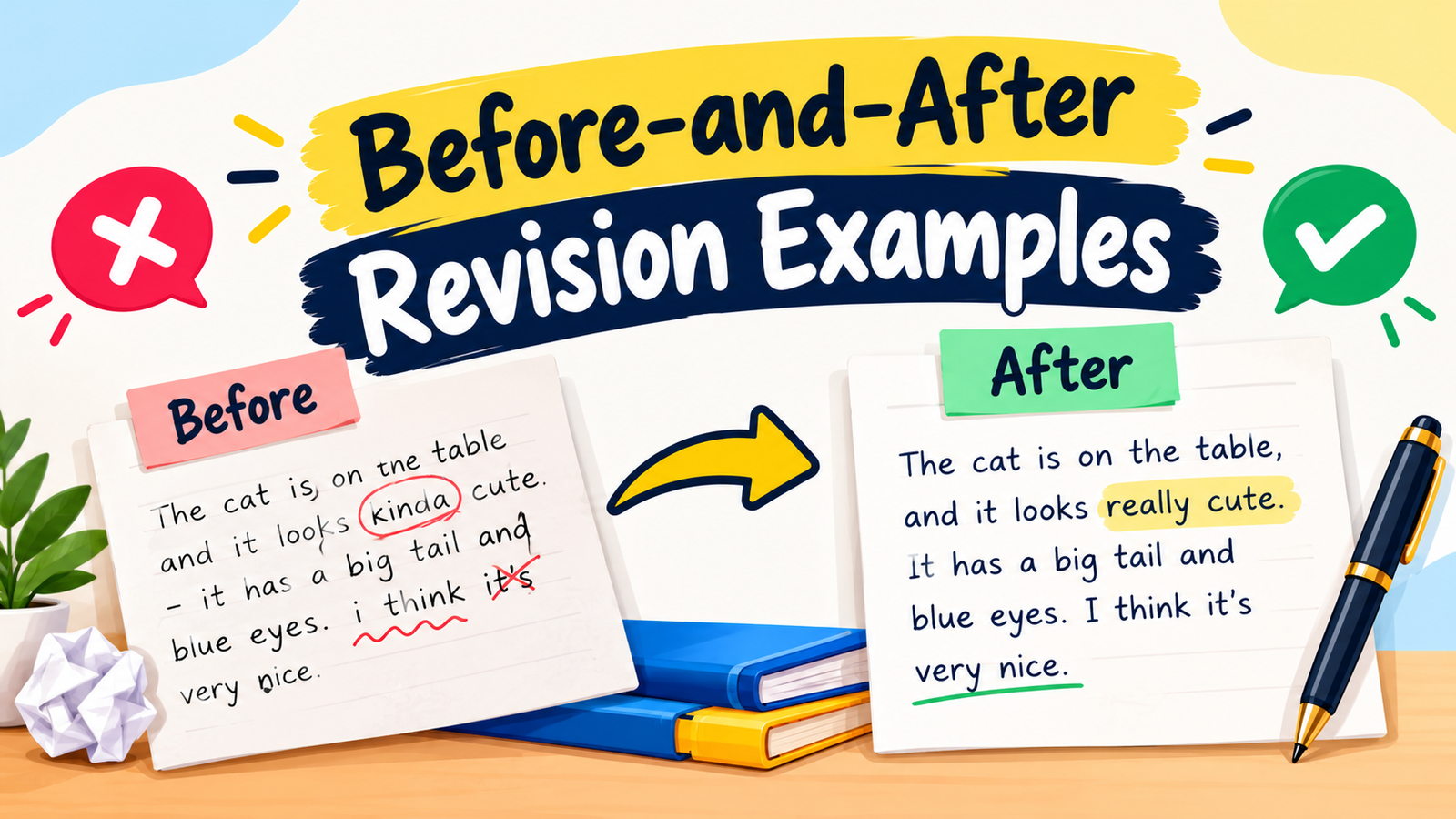
Seeing the fix beats hearing the rule. These practical illustrations show how small edits upgrade a sentence.
| Problem | Before | After | Why it works |
|---|---|---|---|
| Agreement error | Inquiring minds wants to know. | Inquiring minds want to know. | Plural subject takes a plural verb. |
| Tone mismatch | Inquiring minds want to know your quarterly earnings. | Stakeholders want to know your quarterly earnings. | Formal setting needs neutral wording. |
| Loose headline | Inquiring minds want to know all about the new park and when it opens and who built it. | New Park Opens Friday: Inquiring Minds Want to Know Why | Shorter and sharper. |
| Dangling modifier | Inquiring about refunds, the policy was unclear. | Inquiring about refunds, customers found the policy unclear. | The actor now matches the action. |
Case Study: Rewriting for a Formal Report
Imagine an analyst writes this line in a business report: “Inquiring minds want to know why sales dropped in March.”
The tone is too casual for the document. It might also confuse a global reader unfamiliar with the slogan. A stronger rewrite reads: “Stakeholders asked why sales dropped in March.”
Notice what changed. The jokey opener disappeared. The subject became specific. The verb shifted to a plain past tense. The result feels clean and trustworthy.
Frequently Asked Questions
What does “inquiring minds want to know” mean?
It’s a playful idiom for curiosity. Speakers use it to ask for juicy details or to tease someone about a mystery.
Where did the phrase come from?
The National Enquirer used it as a slogan in its 1980s TV ads. The U.S. trademark database lists first use on October 20, 1981 although another source says 1979.
Is it “inquiring” or “enquiring”?
The original slogan says “enquiring” to match the tabloid’s name. In American English, inquire is the strongly preferred spelling while British writers often use “enquire” for everyday questions.
Who owns the National Enquirer now?
The tabloid stayed with a360 Media, the former American Media. A 2019 sale to James Cohen never closed and a 2023 deal with VVIP Ventures collapsed.
Is the phrase grammatically correct?
Yes. The plural subject “minds” takes the plural verb “want,” and the object of “know” is understood from context. The singular form also works: “An inquiring mind wants to know.”
Ownership is the only fast-moving fact here. The newest reports I found date to 2023, so check a current news source before you publish that answer.
conclusion
Inquiring minds want to know has come a long way. It began as a National Enquirer ad slogan in the 1980s. Now it appears in texts, headlines, and taglines. The meaning is simple. Curious people want answers.
Using it well takes a little care. Keep the verb plural with “minds.” Match “inquiring” or “enquiring” to your readers. Save the line for friendly settings. Remember this last point. Inquiring minds want to know clear facts. Give readers those facts and your writing will shine.