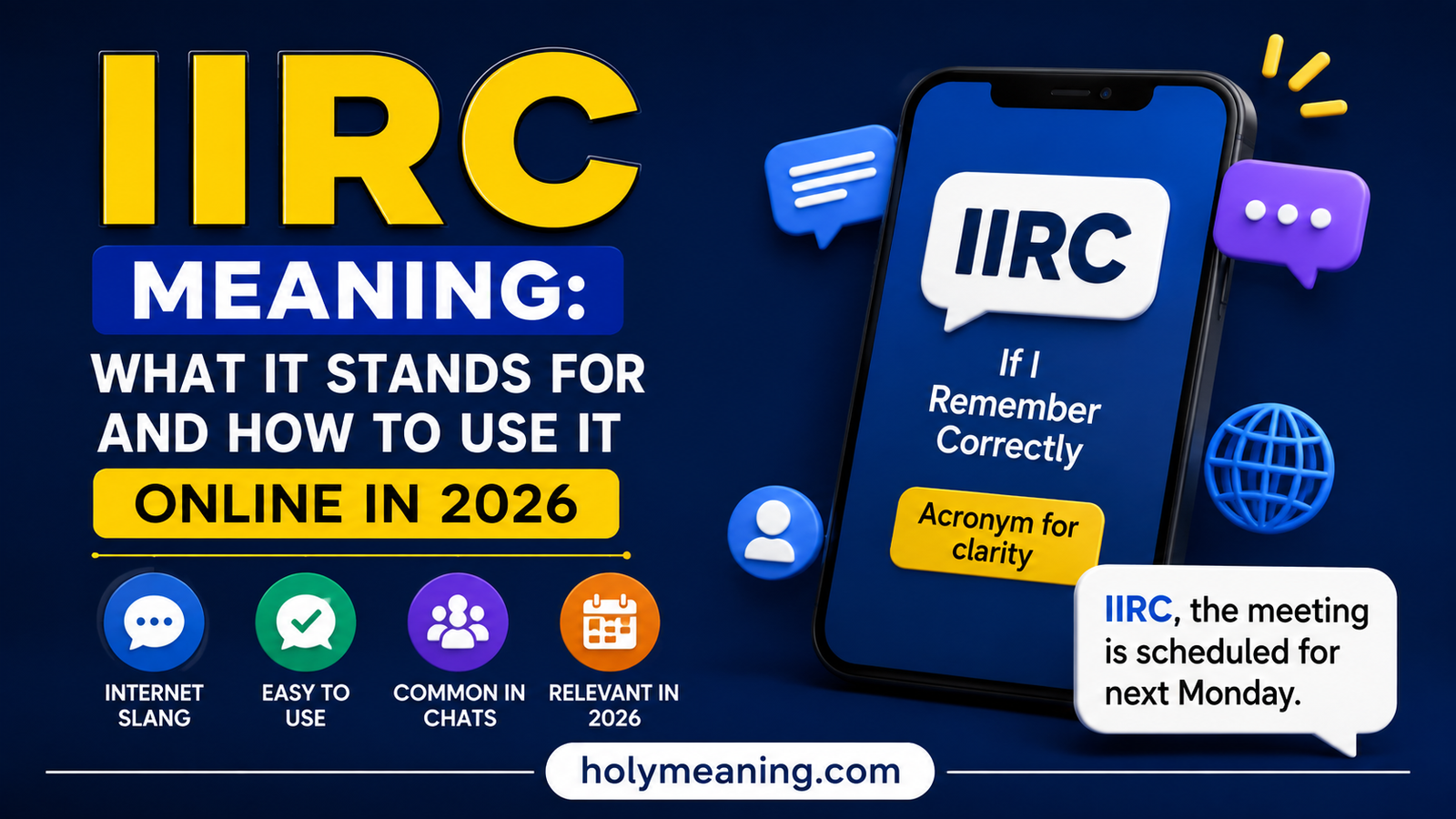
iirc meaning stands for “if I recall correctly” (or “if I remember correctly”), a shorthand people use online to flag information pulled from memory rather than a verified source. It’s less about being wrong and more about being upfront.
Picture this: you’re mid-conversation, someone drops a fact with total confidence, and it turns out they were just guessing the whole time. That’s the moment IIRC quietly prevents. It’s honesty, compressed into four letters.
Born in 1990s IRC chatrooms, IIRC has quietly survived decades of internet trends that came and went. It still shows up daily in texts, Reddit threads, and Slack messages, proving that some shorthand earns its staying power through pure usefulness, not fleeting popularity.
Quick Answer: What Does IIRC Mean?
IIRC stands for “if I recall correctly“ (or, just as commonly, “if I remember correctly”). People use it to flag that what they’re about to say comes from memory, not a source they’ve double-checked. It’s a small verbal shrug — a way of saying “I think this is right, but don’t quote me on it.”
| Question | Answer |
|---|---|
| What does IIRC mean? | “If I recall correctly” |
| Is it formal or casual? | Casual — best for chats, forums, and informal writing |
| When did it start? | Early-to-mid 1990s, in IRC and Usenet communities |
| Still used in 2026? | Yes, though usage has shifted mostly to text and forums rather than voice |
What Does IIRC Stand For?
At its core, IIRC is an initialism — not technically an acronym, since you say each letter rather than pronounce it as a word — that means “if I recall correctly.” It’s used as a hedge, a small disclaimer people attach to a memory they’re fairly confident in but not willing to swear on.
Here’s a simple example:
“IIRC, the meeting got pushed to Thursday.”
The person isn’t guessing wildly. They believe this is true. But they’re leaving themselves an exit in case they misremembered.
The Two Accepted Expansions (“recall” vs. “remember”)
You’ll see two versions floating around online:
- If I recall correctly
- If I remember correctly
Both are accepted, and both mean the same thing. “Recall” tends to show up slightly more often in written contexts because it sounds a touch more formal without actually being formal — a nice middle ground for casual-but-not-sloppy writing. “Remember” feels a bit more conversational. Neither is wrong, and no internet style guide polices which one you “should” use.
IIRC vs. iirc — Does Capitalization Matter?
Short answer: not really. You’ll see it written both ways —IIRC in all caps, or iirc in lowercase — and both are understood identically.
That said, there’s a mild pattern worth knowing:
- Lowercase (iirc) shows up more in casual texting, DMs, and quick comments, where nobody’s reaching for the shift key.
- Uppercase (IIRC) appears more often in forum posts, longer comments, and anywhere the writer is being slightly more deliberate about formatting.
Neither version signals a different meaning. It’s purely stylistic, similar to how some people type “lol” and others type “LOL” depending on mood or platform habit.
How to Pronounce or Say IIRC Out Loud
This is where IIRC gets a little clunky. Unlike acronyms such as “NASA” or “laser,” which form pronounceable words, IIRC doesn’t roll off the tongue. If you tried to say it as a word, you’d end up with something like “eye-eye-are-see,” which nobody actually does.
In spoken conversation, people almost always just say the full phrase: “if I recall correctly” or “if I remember correctly.” The abbreviation is a writing shortcut, not a speaking one. If you do hear someone say “IIRC” out loud, they’re usually saying it as a bit of a joke, letter by letter, poking fun at how text-based the phrase is.
Where IIRC Came From
To understand IIRC’s origin, you have to go back to the early internet, long before smartphones, before social media, even before most people had broadband.
Origins in 1990s IRC Channels and Usenet Newsgroups
IIRC traces back to Internet Relay Chat (IRC) and Usenet newsgroups in the 1990s. Both platforms had one thing in common: typing was slow, connections were often expensive by the minute, and brevity mattered. Long before “type faster than your thoughts” was a meme, IRC users were already compressing common phrases into initialisms to save keystrokes.
IRC itself, ironically, has nothing to do with the IIRC abbreviation — it’s a coincidence of overlapping letters. IRC (the chat protocol) predates widespread use of the phrase “if I recall correctly,” but the culture of clipped, fast typing that IRC fostered is exactly where terms like IIRC took root. Alongside it, you’d see siblings like AFK (away from keyboard), BRB (be right back), and AFAIK (as far as I know) — all born from the same need to say more with less.
Usenet, the sprawling network of discussion groups that functioned like a proto-Reddit, reinforced this shorthand. Long-running threads about tech, science fiction, and hobbyist topics were full of people citing half-remembered facts, and IIRC became the polite way to say “this is from memory, not a source.”
How It Spread From Chatrooms to Mainstream Messaging
As the internet grew beyond hobbyists and early adopters, so did its vocabulary. Instant messaging platforms like AIM and MSN Messenger in the early 2000s picked up IRC-era shorthand, including IIRC, and carried it into a much bigger audience. Forums like Something Awful, and later Reddit, kept the term alive in written form.
By the 2010s, IIRC had fully crossed over into mainstream texting and social media, appearing everywhere from YouTube comments to group chats. It never became as universally recognized as “LOL” or “OMG,” but within internet-literate circles, it’s been a steady fixture for roughly three decades — which, in internet years, is basically ancient.
Fun fact: Many internet acronyms from the 1990s have died out completely (when’s the last time you saw someone type “ROTFL”?), but IIRC has held on. That’s likely because it fills a specific, ongoing need — expressing uncertainty briefly — that never really goes out of style.
Linguists who study internet slang often point out that abbreviations survive based on utility, not novelty. Terms that describe an action or a feeling (like “brb” or “lol”) can get replaced by newer, trendier equivalents. But terms that solve a structural problem in communication — like how to flag uncertainty quickly — tend to stick around because nothing else quite replaces them. IIRC falls into that second category, which explains why it’s outlasted so many of its 1990s contemporaries.
It also helps that IIRC never picked up any baggage. Some old internet acronyms became dated or even a little cringeworthy over time (think of how rarely anyone types “ROFLcopter” anymore). IIRC stayed neutral and purely functional the entire time, which made it easy for new generations of internet users to adopt without it feeling like borrowed slang from an older era.
How to Use IIRC in a Sentence
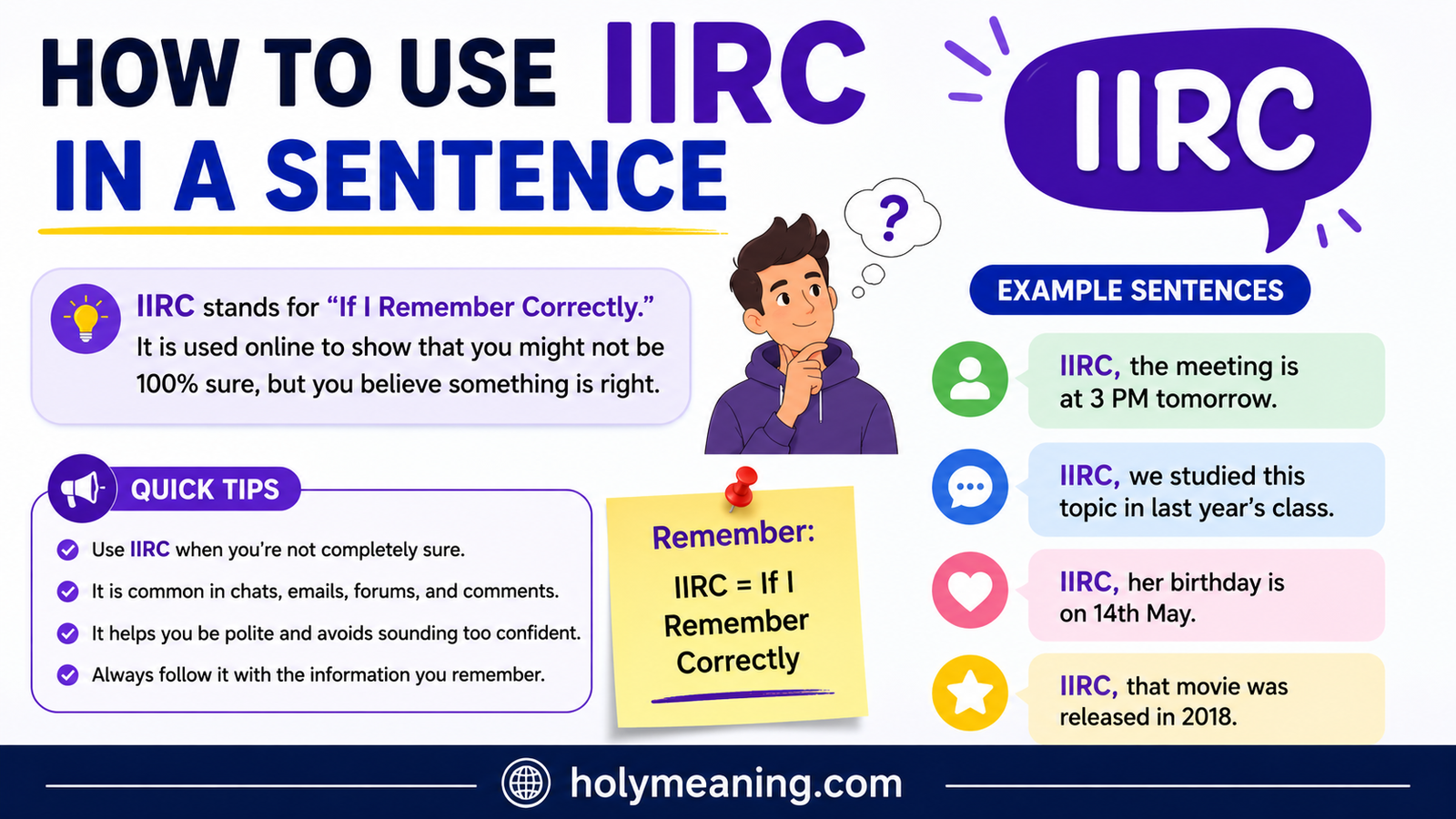
Knowing the definition is one thing. Actually using IIRC in a sentence naturally is another. Let’s break down exactly how it fits into everyday writing.
Where to Place IIRC in a Sentence
IIRC is flexible. You can drop it at the start, in the middle, or at the end of a sentence, and it still works.
- At the start: “IIRC, we’re supposed to bring snacks to the party.”
- In the middle: “The store closes, IIRC, at 9 PM on weekdays.”
- At the end: “He said he’d send the file by Friday, IIRC.”
Starting with IIRC is the most common placement, since it front-loads the disclaimer before you share the (possibly shaky) fact. Ending with it works well when you want to state something confidently first and then soften it slightly afterward, almost as an afterthought.
Real-World Examples by Tone
Here’s how IIRC shifts slightly depending on the tone of the conversation.
Casual, with friends:
“iirc that restaurant closed down last year, but don’t hold me to it.”
Slightly more formal, but still informal writing (like a forum post):
“IIRC, the patch notes mentioned a fix for that bug in version 2.3.”
Uncertain, hedging heavily:
“IIRC — and I could be totally wrong — the flight leaves at 6 AM, not 7.”
Confident but polite:
“IIRC this was already discussed in last week’s thread, so we might be repeating ourselves.”
Notice how in every case, IIRC does the same job: it tells the reader “treat this as a memory, not a verified fact.”
Punctuation and Grammar Rules
There’s no strict rulebook for IIRC grammar, since it’s internet shorthand rather than standard English. Still, a few informal conventions have emerged:
- Comma after IIRC when it starts a sentence: “IIRC, the show got renewed for another season.” The comma isn’t mandatory, but it reads more smoothly.
- No comma needed mid-sentence if it flows naturally: “The event was, IIRC, moved to a different venue.” (Commas on both sides here work well since it’s a parenthetical insert.)
- No period needed after the acronym itself — treat it like any other internet initialism (LOL, TBH, FYI).
- Lowercase is fine everywhere except the very start of a sentence, where some people capitalize it out of habit, though even that’s optional.
One small tip: don’t stack IIRC with other hedging phrases unless you’re doing it for comedic effect. Something like “IIRC, I think, maybe, possibly” reads as excessive. One hedge is usually enough to get the point across.
IIRC Across Platforms and Situations
Not every platform treats IIRC usage the same way. What feels natural in a gaming chat might feel out of place in a client email. Let’s go platform by platform.
Texting, DMs, and Group Chats
This is IIRC’s natural habitat. In one-on-one texts or group chats, it’s used constantly, especially among people who grew up online. It signals casualness and honesty at the same time — you’re sharing info while being upfront about its reliability.
“iirc you said you were free saturday? or was that sunday lol”
In this setting, capitalization, punctuation, and even full sentences are optional. IIRC blends right in with other texting abbreviations like “wyd,” “brb,” and “nvm.”
Social Media Captions, Comments, and Forums
On platforms where people write longer comments or captions, IIRC shows up as a quick credibility disclaimer. It’s especially common in comment sections where someone is correcting or adding to a post from memory.
“iirc this same story went viral back in 2019 too, just with a different city”
Using IIRC in social media captions works particularly well when you’re sharing a memory-based observation rather than a fact you looked up. It keeps you from sounding overly authoritative about something you’re not 100% sure of.
Instagram, TikTok, and Reddit-Style Captions
Each platform has its own flavor:
- Instagram captions: Tends to appear in longer, more personal captions, often paired with a throwback photo. “iirc this was the summer we drove to the coast, might be misremembering the year though.”
- TikTok captions: Shows up in text overlays or comment replies more than captions themselves, often in response to “wait is this true?” style comments.
- Reddit-style comments: This is arguably IIRC’s biggest modern home. Reddit threads are packed with people recalling details from memory, and IIRC is the community’s shorthand way of saying “I’m not citing a source here, just my memory.”
Gaming Chats and Fandom Communities
Gamers and fandom communities lean on IIRC heavily, especially when discussing lore, patch history, or past events in a game or show.
“iirc that boss was way harder before the last patch nerfed it”
“the finale iirc hinted at a sequel, but they never confirmed it”
In these spaces, being slightly wrong is low-stakes and common, so IIRC functions almost like a built-in disclaimer against nitpicky corrections. It’s a way of inviting correction without inviting an argument.
Dating Apps — Does It Work as Casual Banter?
IIRC can work on dating apps, but it’s a mixed bag. Used sparingly, it can come across as relaxed and a little playful:
“iirc you mentioned you like hiking? or was that a different conversation lol”
The risk is that some people simply won’t recognize the term, especially outside internet-heavy age groups, and a confused match might not bother asking what it means. If you’re using IIRC on a dating app, it works best with people who already text in a casual, abbreviation-heavy style. If your match writes in full, polished sentences, matching their tone (rather than dropping IIRC) is usually the safer bet.
Professional Emails and Slack — Does It Fit at Work?
This is where things get more nuanced. Professional emails generally call for clearer, more formal language, so IIRC is a bit of a gamble there. In a client-facing email or a message to someone senior, it’s better to write out “if I recall correctly” in full. It reads as more polished and avoids any chance of confusion.
Slack messages, on the other hand, are more forgiving. Slack culture, especially on smaller or more casual teams, tends to mirror texting more than email. Among coworkers you’re friendly with, IIRC in Slack is usually fine:
“iirc the deploy is scheduled for Wednesday, but let me double check”
A good rule of thumb for workplace communication: match the formality of the person you’re talking to and the channel you’re using. If your manager writes in full sentences with proper punctuation, mirror that. If your team’s Slack channel is full of GIFs and shorthand, IIRC will fit right in.
Case study — how tone shapes the choice:
Picture two coworkers, Maya and Daniel, both trying to confirm the same detail: whether a client call got rescheduled.
Maya messages her teammate on Slack: “iirc the call with Meridian got pushed to 4 PM, but let me check the calendar to be sure.” Nobody blinks. The channel is informal, the relationship is friendly, and the stakes are low enough that a quick memory-based flag is completely appropriate.
Daniel, on the other hand, is emailing the client directly to confirm the same detail. He writes: “If I recall correctly, our call was moved to 4 PM — please let me know if that’s still accurate on your end.” Same underlying uncertainty, same intent, but spelled out in full because the audience and the stakes are different.
Neither version is wrong. The lesson is that professional emails call for the expanded phrase, while internal, casual channels like Slack can handle the shorthand just fine.
Comparison Table: IIRC at a Glance
| Term | Meaning | Formality Level | Best Platform | Example Sentence |
|---|---|---|---|---|
| IIRC | If I recall correctly | Casual | Texts, forums, Slack | “IIRC the store opens at 10.” |
| AFAIK | As far as I know | Casual | Forums, group chats | “AFAIK, the update hasn’t shipped yet.” |
| IMO | In my opinion | Casual to semi-formal | Social media, comments | “IMO the sequel was better.” |
| FYI | For your information | Casual to formal | Emails, Slack, texts | “FYI, the meeting moved to 3 PM.” |
| TBH | To be honest | Casual | Texts, social media | “TBH I forgot this was due today.” |
| FWIW | For what it’s worth | Casual | Forums, comments | “FWIW, I had the same issue last week.” |
When to Avoid Using IIRC
Despite how common it is online, there are clear situations where IIRC just doesn’t belong.
- Formal writing — essays, reports, cover letters, or anything academic. Spell out the full phrase instead.
- Resumes and job applications — internet shorthand has no place here, full stop.
- Legal or medical contexts — precision matters too much for casual hedging language like this. If you’re not sure, say so directly and clearly rather than using shorthand.
- Communicating with non-native English speakers — abbreviations like IIRC can be genuinely confusing if English isn’t someone’s first language, even if their overall English is strong. Spelling it out avoids unnecessary friction.
- Talking with older or less internet-familiar audiences — not everyone has absorbed decades of internet acronyms. If there’s a real chance the other person won’t recognize it, just write the full phrase. It costs you three extra words and saves a “wait, what does that mean?” reply.
- First-time professional contact — even in casual industries, it’s smart to write more formally with someone you haven’t built rapport with yet.
IIRC vs. Similar Acronyms
IIRC doesn’t exist in a vacuum. It’s part of a broader family of hedging and information-sharing shorthand. Here’s how it compares to its closest relatives.
IIRC vs. AFAIK (“As Far As I Know”)
IIRC vs. AFAIK is one of the most common mix-ups, since both express uncertainty. The difference is subtle but real:
- IIRC is about memory. You’re recalling something you once knew or read.
- AFAIK is about the limits of your current knowledge. You’re saying “based on what I know, this seems true,” without necessarily implying you’re remembering a specific fact.
Example comparison:
“IIRC, the store closes at 9 PM.” (You remember this from a past visit.)
“AFAIK, the store is still open.” (You believe this based on general knowledge, not necessarily a specific memory.)
They overlap enough that swapping them rarely causes real confusion, but precise writers tend to pick the one that actually fits the situation.
IIRC vs. IMO / FYI
IMO (in my opinion) and FYI (for your information) serve completely different purposes than IIRC.
- IMO signals a subjective opinion, not a memory. “IMO, the movie was too long” isn’t about recalling a fact — it’s a personal judgment.
- FYI signals you’re sharing information the other person might not know, with no uncertainty attached. “FYI, the meeting starts at 2 PM” is stated as fact, full stop.
IIRC sits in a different lane entirely: it’s specifically for information you’re recalling from memory, with a built-in acknowledgment that you might be wrong.
IIRC vs. TBH and FWIW
- TBH (to be honest) signals candor, often before sharing an opinion or a slightly awkward truth. “TBH, I didn’t like the ending.”
- FWIW (for what it’s worth) signals that you’re adding information that may or may not be useful to the conversation. “FWIW, I had the same problem with my order.”
Neither of these is about memory specifically, which is what sets IIRC apart from the rest of this acronym family.
Quick-Pick Guide: Which Acronym Fits Your Situation?
- Sharing something from memory, unsure if it’s accurate? → IIRC
- Sharing general knowledge, not a specific memory? → AFAIK
- Sharing a personal opinion? → IMO
- Sharing a known fact, no uncertainty? → FYI
- Being candid or blunt? → TBH
- Adding a side note that might help? → FWIW
How to Respond When Someone Uses IIRC
When someone hedges with IIRC, it opens the door for a natural, low-friction way to confirm or correct them. A few good response patterns:
- Confirming: “Yep, IIRC is right, it’s Thursday.”
- Gently correcting: “Actually I think it was Wednesday, but I could be wrong too.”
- Adding your own uncertainty: “IIRC as well, so let’s just double-check before we commit to it.”
- Verifying together: “Let’s just look it up to be safe, since we’re both going off memory here.”
The key is matching their tone. Since IIRC already signals humility about the fact, jumping in with an aggressive correction (“No, that’s completely wrong”) feels disproportionate. A softer response keeps the conversation friendly, since the original speaker already flagged their own uncertainty.
As one longtime moderator of a large tech forum put it in a community guidelines post: “People who tag their comments with IIRC are usually the easiest to correct, because they’ve already told you they’re open to being wrong.” That’s really the whole point of the phrase — it lowers the emotional stakes of being mistaken, for both the speaker and whoever responds to them.
Common Mistakes People Make With IIRC
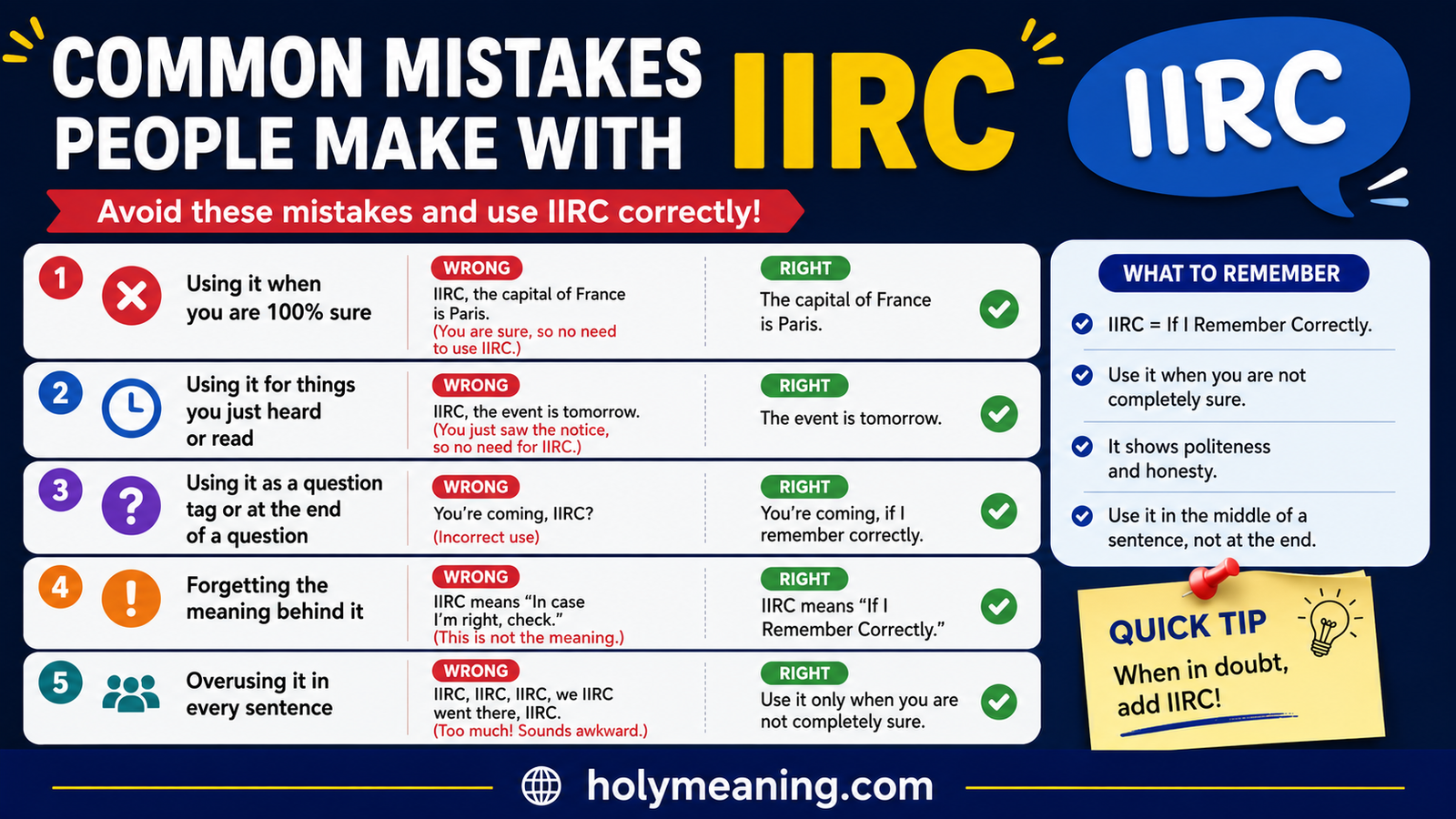
Even a simple acronym has its share of usage errors. Here are the most frequent IIRC mistakes:
- Using it to sound less accountable rather than genuinely uncertain. If you know something is true, don’t hedge with IIRC just to avoid responsibility if you’re somehow wrong. That’s a misuse of the term’s actual purpose.
- Overusing it in a single message or conversation. Hedging every single sentence with IIRC gets exhausting to read and makes you sound perpetually unsure of everything.
- Using it in contexts where precision matters. Legal documents, medical instructions, financial figures — these are not places for memory-based hedging.
- Confusing “recall” and “remember” as if they mean different things. They don’t. Don’t overthink which one to spell out if you’re writing the full phrase.
- Mixing it up with AFAIK when the context calls for general knowledge rather than a specific memory. It’s a small distinction, but precise writers notice.
- Using it with audiences unfamiliar with internet shorthand. As covered earlier, this can create confusion rather than efficiency, defeating the entire purpose of using shorthand in the first place.
- Forgetting that tone matters. IIRC in a heated argument can come across as dismissive (“well, IIRC, you’re wrong”) rather than genuinely humble. Context and delivery matter as much as the word itself.
Best Practices for Using IIRC
To wrap up the practical side of things, here are some solid usage tips for using IIRC effectively:
- Match the formality of your platform. Casual chats and forums, yes. Client emails and resumes, no.
- Use it when you genuinely mean it. IIRC should reflect real uncertainty, not function as a verbal safety net for lazy fact-checking.
- Pair it with a quick double-check when it matters. If the stakes are higher than a casual chat, look up the fact rather than relying purely on the hedge.
- Don’t stack hedges. One uncertainty marker per sentence is plenty.
- Read the room. If your audience skews older, more formal, or less internet-fluent, spell out the phrase instead.
- Keep it consistent with your own writing style. If you’re already writing casually, IIRC fits naturally. If your writing tends to be more formal, dropping in a random IIRC can feel jarring.
These writing guidelines apply just as well to similar acronyms — the goal is always clarity first, brevity second.
Is IIRC Still Relevant in 2026?
Short answer: yes, but its role has shifted a bit. Modern internet slang moves fast, and plenty of 1990s-era terms have quietly died out. IIRC has survived because it fills a specific, ongoing gap: expressing memory-based uncertainty in just four characters.
That said, a few trends are worth noting heading into 2026:
- AI chat tools have changed how people fact-check. With AI assistants readily available to verify claims instantly, some of the old “IIRC, don’t quote me” culture has faded slightly, since double-checking a fact now takes seconds rather than a trip to a library or a forum search.
- Gen Z and Gen Alpha still use it, but alongside newer shorthand. Terms like “no cap,” “fr fr,” and various emoji-based shorthand have entered the mix, but IIRC hasn’t been replaced. It occupies a specific niche (expressing memory uncertainty) that newer slang doesn’t really cover.
- Forums and long-form comment sections remain IIRC’s stronghold. Platforms built around discussion and community knowledge — Reddit being the biggest example — keep the term alive and well.
- Voice-based communication has reduced its spoken use, but that was never really where IIRC lived anyway. It’s a written-word term at heart, and written communication (texts, comments, chats) isn’t going anywhere.
So, is IIRC still relevant? Genuinely, yes. It’s not trending upward the way it did in its early internet heyday, but it’s not fading out either. It’s settled into a stable, everyday spot in online communication, the same way words like “email” or “selfie” stopped being novel but never stopped being used.
FAQs
What does IIRC mean?
IIRC stands for “if I recall correctly” or “if I remember correctly.” It signals that a statement comes from memory, not a verified source.
Is IIRC formal or informal?
It’s informal. Save it for texts, Slack, forums, or social media, and spell out the full phrase in emails, resumes, or formal writing.
Can you use IIRC in a work email?
It’s better to avoid it in client-facing or formal emails. Internal Slack messages with coworkers you’re casual with are usually fine.
What’s the difference between IIRC and AFAIK?
IIRC refers to a specific memory you’re recalling, while AFAIK (“as far as I know”) reflects the general limits of your current knowledge.
Is IIRC still used in 2026?
Yes. It remains common in texting, Reddit, and gaming chats, even as AI tools make quick fact-checking easier than ever.
conclusion
IIRC meaning boils down to one simple idea: it’s a quick, honest way to share something from memory without claiming it as fact. That small bit of humility makes conversations smoother, whether you’re texting a friend or posting in a forum.
Once you know the IIRC meaning, using it feels natural. Save it for casual chats, skip it in formal writing, and always match your tone to your audience. It’s a small habit, but it makes your communication clearer, friendlier, and a lot more human.








1 thought on “IIRC Meaning: What It Stands For and How to Use It Online in 2026”