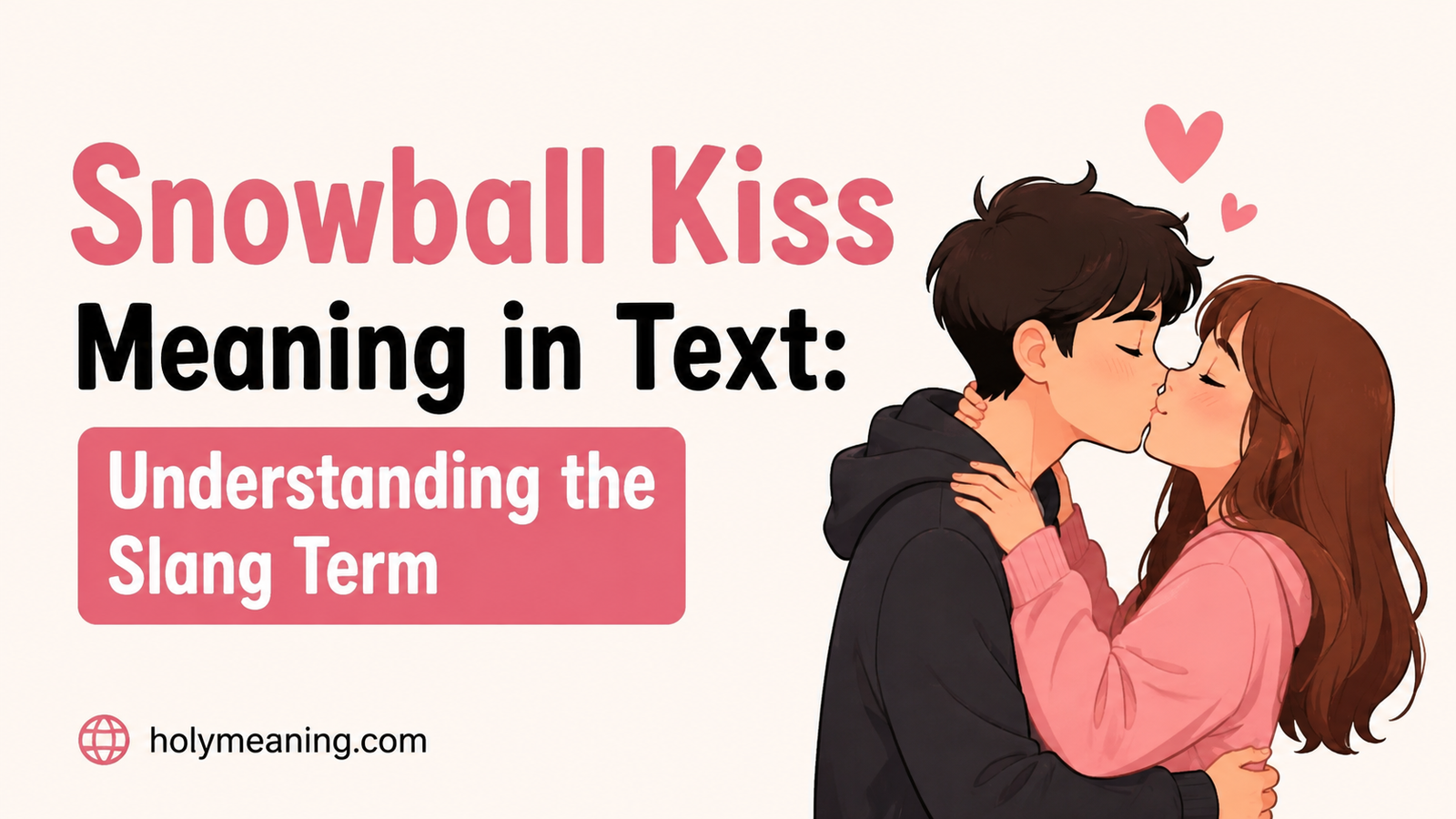
A snowball kiss meaning refers to a slang term with two entirely different meanings: one is explicit adult slang describing passing semen mouth-to-mouth after oral sex, and the other is a wholesome, literal kiss shared in falling snow, popularized through TikTok’s winter-romance trend.
Two meanings, one phrase, and a whole lot of room for mixed signals. That’s exactly why this term keeps popping up in group chats, comment sections, and confused texts between friends who swear they’re talking about totally different things.
The explicit definition traces back over two decades to adult forums, while the innocent version exploded recently through short-form video. Knowing both keeps you from misreading a caption or a text.
What Does “Snowball Kiss” Mean in Texting?
Here’s the part that trips people up: snowball kiss isn’t one term with one meaning. It’s two unrelated ideas that happen to share the same name, and figuring out which one someone means depends entirely on context.
The Sexual Slang Meaning (Snowballing)
In adult content terminology, “snowballing” refers to a sex act where one partner passes semen to the other mouth-to-mouth after oral sex, typically through a kiss. The term has circulated in adult forums, pornography discussion boards, and explicit slang glossaries for well over two decades. When someone uses “snowball kiss” in this sense, they’re referencing that specific act, not a casual peck or a romantic gesture.
This is the sexual slang meaning, and it’s the definition you’ll find first if you search the term on adult slang dictionaries like Urban Dictionary. It’s blunt, it’s explicit, and it’s the older of the two meanings by a wide margin.
The Innocent Meaning (Literal Winter Kiss / TikTok Trend)
Then there’s the innocent meaning — a literal winter kiss, usually one that happens outdoors in the snow, often filmed for social media. This version gained traction through short-form video platforms, where couples film themselves kissing during a snowfall, sometimes while holding snowballs or mid-snowball-fight, and caption the clip “snowball kiss” because, well, there’s snow and there’s a kiss.
This is the PG meaning: romantic, seasonal, and completely unrelated to the adult definition. Think winter romance content — cozy outfits, falling snow, a kiss captured at just the right moment. It’s the kind of clip that shows up in “cute couple” compilations, not adult forums.
How to Tell Which One Someone Means
Since the same three words point to two very different things, context does all the heavy lifting. Here’s a quick way to sort it out:
| Signal | Likely Meaning |
|---|---|
| Sent in a flirty or sexually charged conversation | Sexual slang (snowballing) |
| Shared as a TikTok or Instagram Reel caption | Literal winter kiss |
| Appears with snow emojis (❄️☃️) and no sexual context | Likely innocent |
| Used as a punchline or “gotcha” in a group chat | Often a deliberate reference to the sexual meaning, played for shock |
| Found in a slang dictionary or “adult slang” list | Sexual meaning, by default |
If you’re still unsure, the safest move is to ask directly or simply not engage until you have more context. Guessing wrong in either direction — assuming something wholesome is explicit, or vice versa — can lead to an awkward exchange.
Why This Particular Phrase Causes So Much Confusion
Most slang terms drift over time, but they rarely end up carrying two fully unrelated meanings that both stay active at once. “Snowball kiss” is unusual because neither meaning has faded out to make room for the other. The sexual slang meaning never disappeared from adult glossaries, and the innocent meaning never stayed confined to a small niche — it broke into mainstream social media culture through sheer visual appeal. Snow, a couple, a kiss: it’s an easy clip to make and an easy one to watch, which is exactly why it kept circulating even as the older definition sat quietly in the background.
The result is a phrase that behaves almost like two separate words that happen to be spelled the same. Linguists call this kind of overlap “polysemy,” though in this case it’s less about natural language drift and more about two unconnected communities independently landing on the same combination of words for very different reasons.
Where Did the Term Come From?
Understanding the slang origins here means tracing two separate timelines that eventually collided under one shared phrase.
Origins in Adult Content Terminology
“Snowballing” as sexual terminology predates modern texting slang by a long shot. Adult industry glossaries and internet forums were using the term as early as the late 1990s and early 2000s, well before smartphones turned slang into something that spreads in hours instead of years. It functioned as coded language — a way to reference a specific act without spelling it out, useful in forums, chat rooms, and early adult content descriptions where moderation sometimes flagged explicit wording.
This pattern isn’t unique to this one term. Explicit slang has long relied on food and weather metaphors (think of terms built around fruit, temperature, or texture) because they slip past filters and casual eavesdroppers more easily than clinical or graphic language would.
Before smartphones, this kind of coded language lived almost entirely in text-based spaces: bulletin boards, IRC channels, early adult content review sites, and forum threads where users swapped terminology as a kind of shorthand. Because these communities were relatively small and self-contained, the vocabulary stayed fairly stable for years at a time. There was no algorithm pushing the term to new audiences, no comment section pulling in people who’d never heard it before. It existed, it was understood by the people who used it, and it rarely left that world.
That stability is part of why the term still shows up in slang dictionary entries with a consistent, specific definition today. Unlike a lot of internet slang that mutates every few months, the original meaning of “snowballing” has stayed remarkably intact since it first appeared in adult content circles.
How “Snowball” Became Kiss Slang Specifically
The “kiss” addition came later, layered on as the term moved from adult forums into broader online adult language. Adding “kiss” softened the phrase just enough to make it usable in more casual settings — a euphemism stacked on top of an already-coded term. It’s a naming pattern you’ll notice across a lot of adult slang: take an act, attach a soft, innocuous word like “kiss,” “hug,” or “cuddle,” and the phrase becomes flexible enough to drop into a text message without triggering a content filter or a raised eyebrow from someone scrolling past your screen.
The TikTok Trend That Muddied the Waters
Fast forward to the 2020s, and short-form video completely reshaped how the phrase gets used. The TikTok trend of filming outdoor winter kisses — often during the first snow of the season — created a second, entirely sincere use of “snowball kiss” that had nothing to do with the original slang. Creators weren’t referencing adult content; they were describing a literal kiss, in literal snow, for a viral trend built around cozy, romantic aesthetics.
This is where the confusion really took hold. Two audiences, using the same three words for two unrelated purposes, both posting on platforms where the content overlaps in searches, hashtags, and comment sections. A search for “snowball kiss” on TikTok can surface both: wholesome couple content and comments referencing the adult meaning as a joke.
From Forums to Feeds
It’s worth pausing on just how different the journey was for each meaning. The sexual terminology version spent roughly two decades in relatively closed spaces, spreading slowly through word of mouth and niche websites built specifically around adult slang. The literal winter kiss version, by contrast, went from “someone’s cute video” to “recognizable trend” in a matter of weeks, powered entirely by short-form video algorithms designed to surface engaging content to strangers.
That speed difference matters. It’s the reason a term that used to be fairly obscure suddenly started showing up in searches from people who have no connection to adult content forums at all — they just watched a video of a couple kissing in the snow and wanted to know if the phrase had a name. In a sense, the TikTok trend accidentally reintroduced an old piece of internet slang to a brand-new audience that had never encountered its original meaning.
How It Shows Up in Real Conversations
Knowing the definitions is one thing. Recognizing the term when it actually appears in your text messages or chat slang is another.
Common Contexts
In practice, “snowball kiss” tends to surface in a handful of predictable places:
- Flirty or suggestive texting between people already comfortable with explicit language
- TikTok comment sections under winter content, sometimes used sincerely and sometimes as a joke referencing the other meaning
- Group chats, often dropped by someone who assumes (correctly or not) that everyone already knows the reference
- Slang definition sites, where it’s cataloged alongside similar texting terms
- Memes, typically built around the disconnect between the two meanings
Example Exchange and How to Read Tone
Here’s a realistic exchange showing how ambiguous this can get without context:
Person A: lmaooo did you see that snowball kiss video going around Person B: the one with the couple in the snow? yeah it was cute Person A: wait no I meant—nvm 😭
That exchange captures the core problem perfectly. Person A assumed the sexual reference; Person B interpreted it through the innocent, TikTok slang lens. Neither was wrong — they were just drawing from different corners of the internet.
Related Slang You’ll See Alongside It
“Snowball kiss” rarely travels alone. It tends to show up near a cluster of similar coded slang terms, most of which follow the same food-or-weather-metaphor pattern. A few examples that circulate in similar contexts:
- Rainbow kiss — another explicit slang term, often confused with snowballing despite referring to something different
- Snow angel — occasionally used as a softer stand-in in some slang lists
- Ice kiss — sometimes used interchangeably with the literal winter meaning
Frequency and Platforms
Not every platform hosts this phrase the same way, and knowing the difference helps explain why one person’s “everyone knows this” is another person’s “I’ve genuinely never heard that.” A rough breakdown of where the term tends to show up:
| Platform | Dominant Meaning | Typical Context |
|---|---|---|
| TikTok | Mostly the literal winter kiss | Couple content, winter aesthetic videos, comment jokes referencing the other meaning |
| Twitter / X | Mixed, leaning explicit | Often used bluntly, sometimes as a punchline or reaction |
| Mostly the literal winter kiss | Captions on seasonal couple photos | |
| Split by subreddit | Explicit in NSFW-adjacent communities, literal in relationship or wholesome content threads | |
| Group texts / DMs | Depends entirely on the relationship between people | Can go either way based on established inside jokes or flirtation |
| Slang dictionary sites | Explicit, by default | These sites document the older, established definition first |
Frequency-wise, the sexual meaning is the more established one in terms of longevity, while the innocent meaning sees higher spikes tied to winter months and viral moments. If you see the phrase trending in December or January, there’s a good chance it’s connected to actual snowfall and holiday-season couple content rather than the older slang usage.
Is It Okay to Use or Respond To?
Whether the phrase is appropriate comes down entirely to who you’re talking to, where you’re talking, and which meaning is actually in play.
Reading the Room: Audience and Platform Matter
A term like this doesn’t carry one universal appropriateness rating — it shifts with context:
- Fine in most settings: using it to caption a literal winter kiss photo with your partner, especially with visual context (snow, winter clothing, clearly romantic framing)
- Risky without context: dropping it into a mixed group chat where not everyone shares the same slang knowledge
- Inappropriate in most settings: using the sexual meaning in professional communication, family group chats, or with people who haven’t consented to that kind of conversation
How to Respond If You’re Comfortable
If someone sends it and you know exactly what they mean and you’re fine with it, there’s no need to overthink your reply. A simple acknowledgment, a joke back, or just continuing the conversation naturally all work. The key is matching their tone rather than escalating it.
How to Deflect or Change the Subject If You’re Not
If the term makes you uncomfortable or you’d rather not engage, you don’t owe anyone a detailed explanation. A few options:
- Play it neutral: “haha not sure what you mean, what’s up?”
- Redirect: change the subject outright — most people will take the hint
- Be direct: “not really into that kind of conversation, let’s talk about something else”
None of these require confrontation. They simply close the door without making the exchange more awkward than it needs to be.
Common Misconceptions
A lot of the confusion around this phrase comes down to a handful of assumptions that don’t hold up once you look closer.
“It’s Just a Winter Photo Thing”
This misconception usually comes from people who’ve only encountered the term through TikTok’s romantic winter content. In reality, the sexual slang meaning predates the TikTok trend by two decades and remains the definition you’ll find first in most slang dictionary entries. The wholesome usage is real, but it’s the newer, narrower one — not the original.
“It’s the Same as a Rainbow Kiss”
These two terms get lumped together constantly, but they’re not interchangeable. Rainbow kiss and snowball kiss are separate entries in adult slang glossaries, referencing different acts entirely. Treating them as synonyms is a common mistake, and it’s worth knowing the distinction if you ever need to understand either term accurately.
“Everyone My Age Already Knows This”
Slang doesn’t spread evenly. Someone can be extremely online and still have never encountered this specific phrase, while someone less active on social media might know it well from a completely different source, like an older internet forum. Assuming universal knowledge of any slang expression — this one included — is a reliable way to cause confusion.
“It’s a Common, Everyday Phrase”
Because it occasionally trends, people sometimes assume “snowball kiss” is in regular circulation the way terms like “ghosting” or “left on read” are. In practice, it’s a niche term with two narrow uses — either explicit adult slang or a seasonal video trend — and most people outside those two contexts will never use it in day-to-day conversation. It resurfaces in bursts tied to winter weather or a viral clip, then goes quiet again.
Why This Kind of Slang Spreads
There’s a reason terms like this end up trending on social platforms again and again, and it’s not random.
Ambiguity Is the Engine
A phrase that means two completely different things is inherently shareable. It creates a built-in “wait, what does that actually mean?” moment, and that moment is exactly what drives engagement on social media. People comment to ask, others reply to explain, and the thread grows. Ambiguity isn’t a flaw in how this slang spreads — it’s the mechanism.
Algorithm-Driven Curiosity
Short-form platforms reward content that keeps people scrolling and commenting, and a term with a hidden or surprising second meaning does exactly that. A caption that seems innocent on the surface but has an adult double meaning tends to pull more comments, more shares, and more searches than a straightforward, single-meaning phrase ever could. That’s part of why internet slang with dual meanings tends to outlive slang that’s easy to define in one sentence.
Snowball Kiss in Social Media Culture
The two meanings don’t just coexist quietly — they actively collide inside social media culture, and that collision is worth understanding on its own.
The TikTok Ice-Kiss Trend
The wholesome version of this term is tied to a broader pattern of winter-romance content: couples filming a kiss during the first snowfall, sometimes staged with falling snow or a snowball mid-throw. These clips lean on cold-weather aesthetics — scarves, hot drinks, string lights — and the phrase “snowball kiss” gets used as a caption because it’s catchy and literal at the same time. It fits neatly alongside other seasonal video trends built around a single, photogenic moment.
Two Trends, One Name
What makes this genuinely unusual is that the wholesome trend didn’t erase the older meaning; it just started operating in parallel. Search the hashtag and you’ll find sincere couple content sitting right next to comments making jokes that only make sense if you know the sexual slang meaning. Both audiences are technically using the same tag correctly, according to their own definition, which is exactly why outsiders find the whole thing confusing.
Memes, Comment Threads, and Reaction Content
A term with a hidden double meaning is prime material for comment culture. It shows up in “wait, what does that mean” reaction videos, in comment sections where someone explains the alternate definition to unsuspecting viewers, and in memes that play on the gap between the innocent caption and the explicit definition. This kind of content doesn’t require much effort to make, which is part of why it keeps circulating — it’s an easy, low-effort way to get engagement out of a phrase that already has built-in intrigue.
How to Respond If Someone Mentions It in Person
Texting isn’t the only place this comes up — sometimes it’s said out loud, in a group setting, and you need to respond in real time.
If You’re Comfortable Acknowledging It
If you know exactly what’s being referenced and you’re fine with the topic, there’s no need to make it a bigger deal than it is. A short, casual acknowledgment or a laugh is usually enough, and the conversation moves on naturally.
If You’d Rather Not Engage
You’re allowed to simply not react. Not every comment needs a response, and letting it pass without engagement often ends the moment faster than addressing it directly would.
If It Feels Inappropriate for the Setting
In a professional or mixed-company setting, the safest response is a neutral one: a quick “not sure what that means” or a subject change works fine, even if you do know what it means. You’re not obligated to confirm or explain a piece of explicit slang just because someone brought it up.
Frequently Asked Questions
Is “snowball kiss” always sexual slang? No. It depends entirely on context. On TikTok and Instagram, it usually refers to a literal kiss in the snow. In older slang glossaries and adult forums, it refers to the explicit act.
Is “snowball kiss” the same as “snowballing”? Yes — “snowballing” is the verb form of the same sexual terminology, describing the same act.
Did the TikTok trend invent the phrase? No. The explicit meaning predates the TikTok trend by roughly two decades. TikTok popularized the unrelated, literal meaning.
Is it safe to use this phrase with someone I just met? Not without context. Since the phrase carries two very different meanings, using it casually with someone unfamiliar with either definition risks a serious mismatch in tone.
A Few Related Terms Worth Knowing
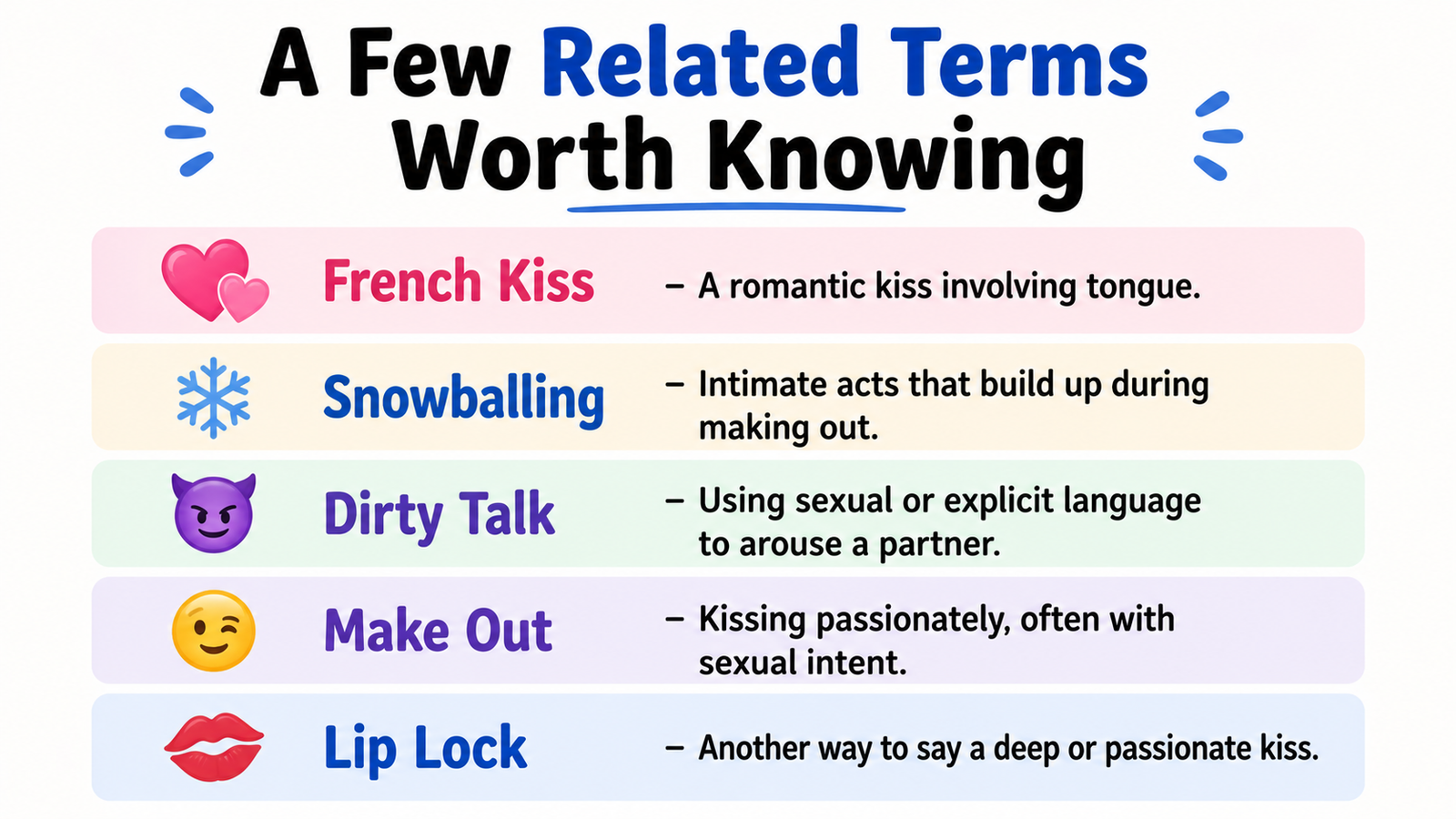
If “snowball kiss” caught you off guard, it’s worth knowing a few adjacent terms that follow the same pattern — innocent-sounding on the surface, with a separate explicit definition underneath.
| Term | Innocent Meaning | Alternate/Explicit Meaning |
|---|---|---|
| Snowball kiss | A literal kiss in the snow, popular in TikTok slang and winter content | Passing semen mouth-to-mouth after oral sex |
| Rainbow kiss | Sounds like a playful, colorful kiss | A distinct explicit act, often confused with snowballing |
| Snow angel | Lying in snow and moving your arms/legs to leave an imprint | Occasionally repurposed in slang lists, though far less common |
| Ice kiss | A cold-weather kiss, sometimes used as a synonym for the wholesome trend | Rarely used with explicit meaning, but appears in some slang glossaries |
This table isn’t exhaustive, but it illustrates a broader pattern in digital slang: seasonal, food, and nature-based metaphors get recycled constantly because they sound harmless in passing conversation while still functioning as coded language for those in the know.
How Real Conversations Play Out
Abstract definitions only go so far. Here’s how the ambiguity actually plays out in a few realistic scenarios.
The Group Chat Mix-Up
A group of five friends is planning a ski trip. One person shares a TikTok of a couple kissing during a snowstorm and captions it “goals, snowball kiss szn.” A friend who’s more familiar with the older slang definition replies with a laughing emoji and a joking comment referencing the explicit meaning. The original poster has no idea what they’re talking about, a brief “wait what” exchange follows, and someone eventually explains the second definition. Nobody’s upset — it’s just a classic case of two people pulling from different reference points.
The TikTok Comment Confusion
A wholesome winter-kiss video picks up traction, and the comment section splits cleanly into two camps: people complimenting the couple, and people making jokes referencing the adult meaning. New viewers scrolling through the comments often can’t tell which group is “in on it” and which group genuinely doesn’t know, which is part of what keeps the video circulating — the confusion itself becomes shareable content.
The Mismatched Expectation
Two people are texting, flirting casually, and one references “snowball kiss” assuming the other knows the explicit meaning. The other person, familiar only with the TikTok version, responds with genuine confusion about snow and winter weather. The mismatch isn’t dangerous, but it does illustrate how easily this specific phrase can derail a conversation that both people thought was going smoothly.
A Broader Look at Coded Slang Terms
“Snowball kiss” is a useful case study precisely because it’s not unique. Coded slang built around innocuous everyday words — food, weather, animals, colors — shows up constantly in online adult language, and the pattern is almost always the same: take something ordinary, attach it to something explicit, and let context do the work of separating the two meanings.
Understanding this pattern helps beyond just this one phrase. Once you recognize that a lot of adult slang hides behind soft, harmless-sounding words, you’re better equipped to catch context clues in future conversations rather than taking every phrase at face value. It’s less about memorizing a list of terms and more about staying alert to tone, platform, and who’s doing the talking.
What This Term Teaches Us About Digital Communication
Beyond the specific definitions, “snowball kiss” is a small window into how modern communication actually works.
Speed Over Clarity
Short-form platforms reward quick, catchy phrases over precise ones. “Snowball kiss” is short, alliterative-adjacent, and visually literal, which makes it an easy caption to reach for — clarity about which meaning is intended usually takes a back seat to how well the phrase fits the moment.
Context Collapse
Social media famously flattens different audiences into one feed. A phrase that’s perfectly clear within one specific community — adult slang forums, for instance — gets stripped of that context the moment it appears in a mainstream comment section, where a completely different audience encounters it with no shared background. That’s context collapse in action, and it’s a big part of why this particular phrase causes so much back-and-forth.
The Ongoing Cycle of Rediscovery
Slang terms with a hidden explicit meaning tend to resurface periodically as new audiences discover them for the first time. Each wave brings a fresh round of “wait, what does this actually mean” content, even though the underlying definition hasn’t changed in years. Expect “snowball kiss” to keep cycling through this same pattern for as long as both meanings remain active online.
FAQs
What does “snowball kiss” mean in texting?
It depends on context — it’s either explicit adult slang for passing semen mouth-to-mouth after oral sex, or a literal, romantic kiss shared in the snow.
Is “snowball kiss” the same as “snowballing”?
Yes, “snowballing” is just the verb form of the same explicit act — both terms refer to the identical thing.
Why does TikTok use “snowball kiss” differently?
TikTok’s version comes from a winter-romance video trend, where couples film a kiss during snowfall, with no connection to the older slang meaning.
Is “snowball kiss” the same as a “rainbow kiss”?
No, they’re two separate slang terms often confused with each other — each refers to a distinct act with its own definition.
Is it safe to use this phrase without knowing which meaning someone intends?
Not really — since the two meanings are so different, it’s best to rely on context (platform, tone, relationship) before using or reacting to it.
conclusion
At this point, the snowball kiss meaning should feel clear. It’s not one simple phrase. It carries two very different definitions, and context decides which one fits. One version is explicit slang. The other is a sweet, snowy moment from social media. Knowing both keeps you from getting confused or sending the wrong message.
Next time you see this phrase, you’ll know exactly what’s going on. The snowball kiss meaning shifts with the platform, the person, and the moment. Stay alert to context, and you’ll never misread it again. That’s really all it takes.








2 thoughts on “Snowball Kiss Meaning in Text: Understanding the Slang Term”