304 meaning shifts with context. In slang, it’s a coded insult that reads “hOE” on an upside-down calculator. In web development, it’s the HTTP 304 Not Modified status code, a routine server message.
Three little digits. Four secret lives. You’ve probably scrolled past this number a hundred times without ever realizing how much it hides.
Beyond slang and servers, 304 also marks the West Virginia area code and the most popular stainless steel grade. This guide untangles every meaning with verified facts and clear examples so you’ll know exactly which one applies to you today.
Quick Answer: What Does 304 Mean?
Here’s the short version. Skim the table and jump to the section you need.
| Context | What 304 means | Where you’ll see it | How common |
|---|---|---|---|
| Slang | Coded insult that reads “HOE” when flipped | Texts, comments, usernames, captions | Very common online |
| Web and tech | HTTP 304 Not Modified status code | Browser DevTools, server logs, APIs | Extremely common |
| Phone numbers | Original area code for West Virginia | Caller ID, business listings | Common in the state |
| Metals | Most popular austenitic stainless steel grade | Sinks, cookware, food equipment | Extremely common |
| Law | Section numbers in several legal codes | Statutes and court filings | Occasional |
Context is the whole game. A teenager’s comment section and a sysadmin’s terminal use the same number for nothing in common.
What Does 304 Mean in Slang and Text?
Let’s start with the version most people search for. It’s also the one with the most misinformation floating around.
304 Slang Definition and 304 Meaning in Text
304 slang is a coded way to write a derogatory word for a woman. The word is “hoe.” Writers swap the letters for digits so the insult looks like a harmless number.
That’s it. No hidden second layer. No secret positive reading.
Here’s what 304 meaning in text looks like in practice:
- A comment under a photo: “she’s such a 304” means the commenter is calling her the insulting word.
- A username: Someone adds “304” to a handle as a joke or a provocation.
- A direct message: “Stop acting like a 304” is name-calling. Nothing more.
The term belongs in the family of coded insults. Writers use coded text slang like this for two reasons. First, it dodges automated word filters. Second, it gives the sender a shield of deniability. “It’s just a number” works as a defense only on people who don’t know the code.
304 Slang Origin: The Upside-Down Calculator Trick
The real 304 slang origin comes from the upside-down calculator trick. Kids have played with it since the early days of LED and LCD calculators in the 1970s. The game is simple. Type a number. Flip the device over. Read the “word.”
Each digit looks like a letter when you rotate it 180 degrees. Here’s the mapping that makes 304 work:
| Digit shown | Looks like (flipped) |
|---|---|
| 3 | E |
| 0 | O |
| 4 | h |
Now there’s a catch. Flipping the calculator also reverses the order of the digits. Type 304 and flip it. The 4 appears first on the left. You read h-O-E.
This is the heart of the 304 calculator trick. It’s a classic piece of digital wordplay. The same gimmick created some of the most famous calculator words ever typed:
| Number | Flipped reading | Notes |
|---|---|---|
| 07734 | hELLO | The classic harmless example |
| 5318008 | BOOBIES | The playground favorite |
| 304 | hOE | The insult version |
| 3045 | SHOE | Harmless, and it shows the system works |
| 710 | OIL | Also harmless |
Other number word puzzles work the same way. A seven-segment display only has so many letters it can imitate. That’s why the vocabulary stays short and a bit juvenile.
You can learn more about the history of these puzzles in the Wikipedia entry on calculator spelling.
The T9 Keyboard Myth
Plenty of websites claim 304 comes from an old T9 phone keypad. It sounds plausible. It’s also wrong.
The T9 keyboard myth falls apart under a quick test. On a standard phone keypad, the letters map like this:
- H sits on the 4 key (GHI)
- O sits on the 6 key (MNO)
- E sits on the 3 key (DEF)
So H-O-E on T9 produces 4-6-3. Not 3-0-4. The digit 0 on a T9 keypad doesn’t carry the letter O at all.
Try it yourself. Grab an old flip phone or look at a photo of one. Then type the word. You’ll never get 304.
Why does the myth persist? It sounds technical and nostalgic. Plus, a lot of content sites copy each other without testing the claim. The calculator explanation matches the visual shape of the digits. The T9 explanation matches nothing.
Quick test: If an explanation of a number slang term doesn’t match the shapes or the keypad positions of the digits, it’s probably invented.
Where You’ll See 304 on Social Media
The term travels across every major platform. Because social media slang moves fast, the same code pops up in different formats.
304 meaning on TikTok comes up most in comment sections. Users drop it under videos to insult creators. Some also use it in captions as a joke. Moderation tools flag the term on and off. Creators regularly report the number being used as a workaround for banned words.
You’ll also find it in:
- Instagram comments and DMs
- Snapchat messages and group chats
- Discord servers and gaming lobbies
- Group texts and WhatsApp threads
- Dating app bios and chats
That cross-platform spread makes 304 meaning on TikTok a bit misleading as a search term. The slang isn’t a TikTok invention. It’s an internet slang meaning that rides along on every app where people type short messages.
Here are three realistic examples with plain-English translations:
| Message | What the sender means |
|---|---|
| “Ignore her, she’s a 304.” | Ignore her. The sender is insulting her. |
| “304 behavior fr” | That’s insulting behavior. The sender uses the slur label. |
| “Why is my username 304xyz?” | Possibly a mix-up with another meaning. Check the context. |
The third row matters. Not everyone who types 304 means the slang. Keep that in mind before you react.
When Did 304 Slang Spread?
Calculator words themselves date back decades. The earliest known examples circulated alongside the first handheld LED calculators in the 1970s. Kids discovered the flipping trick almost immediately.
The 304 version took longer to travel. It spread through online comments and chat apps as users looked for ways to type insults without tripping filters. It gained speed with short-video platforms and mobile messaging.
For precise first-use dates, check two sources directly:
- Know Your Meme for documented meme timelines
- Urban Dictionary for dated user submissions
Those entries show the earliest recorded appearances. Many articles quote specific dates without citing them. Verify any date you plan to repeat.
Why 304 Slang Is Controversial
The term isn’t neutral. People disagree about how to treat it. Here are the main positions.
Why Most People Read It as an Insult
Most readers see 304 slang as gendered name-calling. The target is almost always a woman. The label attacks her personal choices or reputation. Nothing about the code softens that.
Schools and workplaces generally treat it the same as the spelled-out word. A coded insult is still an insult. Moderators on most platforms agree. Reports against coded insults often succeed when a reviewer understands the context.
Reclamation Versus Harm
Some people argue that reclaiming a slur can drain its power. Linguists have documented this pattern across many groups and many words. The idea is that in-group use can change the meaning over time.
Others point out a hard limit. Reclamation works best when the targeted group leads it. It rarely works when outsiders or bullies adopt the word. Online, you can’t verify who’s speaking. A joking message to a friend and a harassing message to a stranger look identical on the screen.
So the fair summary is this: context and consent decide the impact.
Playful Use Versus Targeted Use
Tone matters. Consider two situations:
- Among close friends: Some groups use the term as a joke with mutual consent. The relationship absorbs the roughness.
- Aimed at a stranger or classmate: The same word becomes harassment. The recipient never agreed to the joke.
Here’s a rule that works: if you wouldn’t say the spelled-out word to that person, don’t type the number either.
304 in Tech: HTTP 304 Not Modified
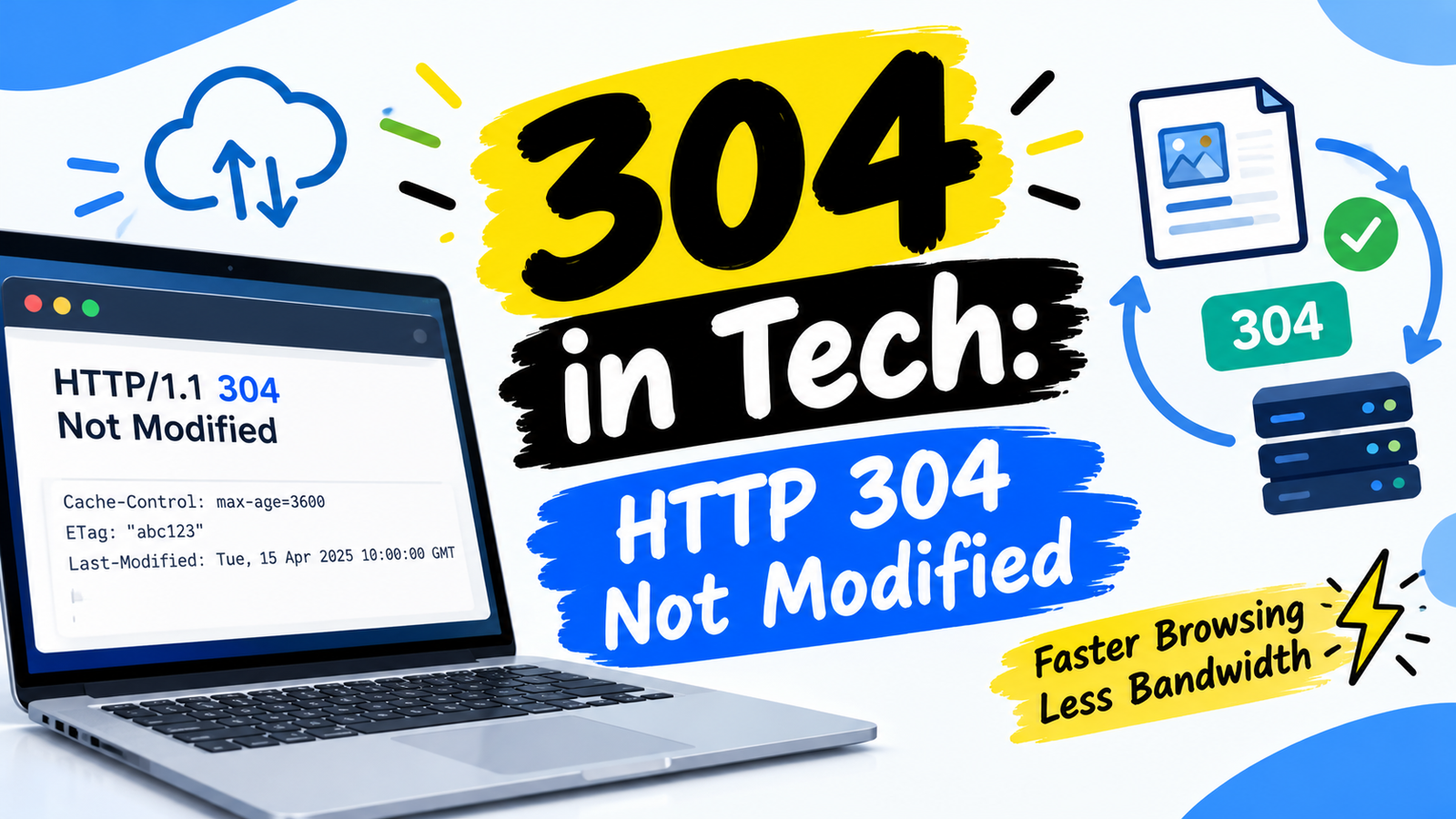
Now for a completely different world. If you work with websites, 304 is routine. It’s also one of the most helpful numbers in the web stack.
What the HTTP 304 Status Code Means
HTTP 304 Not Modified is an HTTP status code that a web server response can carry. It tells the browser one thing. The copy you already stored is still current. Use it.
The official definition lives in RFC 9110, Section 15.4.5. The spec explains that the server sends 304 when “the condition evaluated to false.” In plain terms, the file hasn’t changed since the browser last downloaded it. The MDN documentation offers a friendly walkthrough too.
Here’s the key point: a 304 isn’t an error. It’s a success of the caching system. It belongs to the 3xx family of HTTP response codes, which cover redirection and related instructions.
How the Exchange Works
The process uses a conditional request. Think of it as the browser asking, “Has anything changed since I last visited?” Here are the steps:
- The browser requests a file it already has in its browser cache.
- It adds a validator to the request. That’s either an ETag (
If-None-Match) or a date (If-Modified-Since). - The server compares the validator with the current version.
- If the file is unchanged the server returns 304 with no body.
- The browser reuses the cached copy.
This is ETag validation in action. It’s also called cache validation. When a client uses GET with these headers, developers call it a conditional GET request.
Here’s what the exchange looks like:
GET /styles/main.css HTTP/1.1
Host: example.com
If-None-Match: "33a64df5"
If-Modified-Since: Tue, 14 Oct 2025 08:12:31 GMT
And the server replies:
HTTP/1.1 304 Not Modified
ETag: "33a64df5"
Cache-Control: max-age=3600
Date: Sat, 17 Oct 2026 09:30:00 GMT
Notice what’s missing. There’s no file content in the response. The server sends only headers. The browser already holds the body.
Why 304 Matters for Website Performance and SEO
A 304 saves bandwidth. It also saves time. Both help website performance.
Consider a 400 KB stylesheet. A normal download sends all 400 KB. A 304 response sends a few hundred bytes of headers. The visitor sees the page faster. Your server does less work.
Benefits include:
- Lower bandwidth costs on high-traffic sites
- Faster repeat visits because the browser skips the download
- Reduced server load during traffic spikes
- Better crawl efficiency when search engine bots support conditional requests
Search engines can use these same headers when they crawl. Google’s crawling and indexing documentation explains how its crawlers work. Proper cache headers help bots skip unchanged pages. That leaves more crawl budget for pages that actually changed.
Fixing Common 304 Problems
Most of the time 304 works silently. Sometimes it causes headaches. Here are the usual culprits.
Stale Content After a Deploy
You push a new stylesheet. Visitors still see the old one. The cache is serving old content.
Fixes:
- Add a version or hash to filenames (
main.a1b2c3.css) - Use
Cache-Control: no-cacheso browsers revalidate on every request - Remember that
no-cachedoesn’t mean “don’t store.” It means “check before using.”
ETags That Don’t Match Across Servers
Behind a load balancer each server may generate a different ETag for the same file. Some servers build ETags from file inodes. Those values change from machine to machine. The result is constant 200 responses and no 304s.
Fix this by configuring consistent ETag generation. Or drop ETags and rely on Last-Modified.
Testing in DevTools
Open your browser’s DevTools and go to the Network tab. Look at the Status column. A 304 shows up there. To force fresh downloads, tick Disable cache. Then reload and compare.
304 Versus Other HTTP Status Codes
Here’s how the 304 status code stacks up against its neighbors:
| Code | Name | Meaning | Body sent? |
|---|---|---|---|
| 200 | OK | Request succeeded and content is attached | Yes |
| 301 | Moved Permanently | Resource has a new permanent URL | Usually small |
| 302 | Found | Temporary redirect | Usually small |
| 304 | Not Modified | Cached copy is still valid | No |
| 404 | Not Found | Resource doesn’t exist at this URL | Usually an error page |
| 410 | Gone | Resource was removed on purpose | Usually an error page |
Notice the pattern. Only 304 deliberately sends nothing. That emptiness is the whole point.
304 Area Code: West Virginia Phone Numbers
The 304 area code is a telephone area code that covers every county in West Virginia. It belongs to the original set of area codes created in 1947. That makes it a piece of area code history too.
Area Code History and the 681 Overlay Code
For decades 304 was the only code in the state. Then phone number demand grew. Cell phones, fax lines, and second lines drained the supply.
Regulators chose an overlay instead of splitting the state. The 681 overlay code arrived in 2009 and covers the exact same territory. New numbers can carry either 304 or 681. Existing 304 numbers kept their codes.
Overlays changed dialing habits too. Ten-digit dialing became the norm for local calls in the state. That’s standard in any overlay region.
For official records, check the North American Numbering Plan Administrator or the Wikipedia entry for area code 304.
Quick Reference Box
| Detail | Info |
|---|---|
| State | West Virginia |
| Created | 1947 |
| Overlay | 681 |
| Major cities | Charleston, Huntington, Morgantown, Wheeling, Parkersburg |
| Time zone | Eastern |
| Coverage | Entire state |
Because regional phone numbers carry identity, many West Virginians feel attached to the 304. Some businesses still request it over 681 for that local feel.
When the Area Code Meets the Slang
Yes, the overlap causes jokes. Residents sometimes field teasing about their area code. Most take it in stride. A few get tired of it.
If you’re a business owner in the state, here’s a practical note. Customers who know the slang may smirk at a 304 number in an ad. It rarely hurts business. Local pride usually wins.
304 Stainless Steel: Grade, Uses, and Comparisons
Now for the metal. 304 stainless steel is the workhorse of the stainless family. If you own a kitchen sink or a set of pots there’s a good chance it’s 304.
What the 304 Grade Means
It’s an austenitic stainless steel. That label describes its crystal structure. Austenitic grades are tough and formable. They’re mostly non-magnetic in the annealed state.
The recipe is built around chromium and nickel. Typical composition includes:
- About 18 to 20 percent chromium
- About 8 to 10.5 percent nickel
- A maximum of 0.08 percent carbon
- Iron as the balance
That mix explains the nickname 18/8 stainless steel. The numbers refer to the rough chromium and nickel percentages. Chromium forms a thin invisible oxide layer on the surface. That layer gives the metal its corrosion resistance. If you scratch the surface the layer reforms in air.
For detailed composition ranges, check the Nickel Institute or the Wikipedia page on SAE 304 stainless steel.
Where 304 Stainless Steel Gets Used
It shows up almost everywhere. Common steel applications include:
- Kitchen sinks and countertops
- Cookware and cutlery
- Food and beverage processing equipment
- Brewery tanks and dairy equipment
- Architectural trim and handrails
- Appliances such as dishwashers and refrigerators
It’s also considered food-grade steel. The surface is smooth and easy to sanitize. It doesn’t leach harmful substances under normal use. That’s why commercial kitchens rely on it.
304L, 316, and Other Stainless Steel Grades
Not all stainless steel grades behave the same. Here’s how the main contenders compare.
304L stainless steel is the low-carbon version. Its carbon cap is 0.03 percent. Lower carbon reduces the risk of carbide formation during welding. That makes 304L a better pick for heavy welded structures.
316 adds molybdenum, typically 2 to 3 percent. Molybdenum boosts resistance to chlorides such as salt and some cleaning chemicals.
Here’s the 304 vs 316 stainless steel comparison in table form:
| Property | 304 | 304L | 316 |
|---|---|---|---|
| Chromium | ~18–20% | ~18–20% | ~16–18% |
| Nickel | ~8–10.5% | ~8–12% | ~10–14% |
| Molybdenum content | None | None | ~2–3% |
| Carbon (max) | 0.08% | 0.03% | 0.08% |
| Corrosion resistance | Good | Good | Better, especially against chlorides |
| Weldability | Good | Best | Good |
| Cost | Lower | Slightly higher | Noticeably higher |
| Best use | Kitchens, general use | Heavy welded parts | Marine, chemical, coastal |
This corrosion resistance comparison points to a simple rule. Use 304 for everyday indoor work. Choose 316 near saltwater or harsh chemicals. Pick 304L when thick welds are involved.
Real-World Example: Coastal Railings
Picture two identical railings installed near the ocean. One uses 304. The other uses 316. After a few years salt spray leaves rust-colored staining on the 304. The 316 stays far cleaner.
That’s the practical value of molybdenum. The upfront cost difference buys years of cleaner surfaces. Many fabricators recommend 316 for any site within a short distance of the coast.
Other Places You’ll See 304
A few smaller meanings deserve a mention. Each is real and sourced.
- Indian Penal Code Section 304 covered culpable homicide not amounting to murder. India replaced the IPC with the Bharatiya Nyaya Sanhita in July 2024. Under the new code, that offense sits in Section 105. Section 304 of the new code deals with snatching. Check India Code for the current text.
- Clean Air Act Section 304 governs citizen suits in the United States. You can read it at Cornell’s Legal Information Institute.
- The year AD 304 falls in the late Roman Empire. Historians associate it with the period of the Diocletianic persecution.
These meanings rarely collide with the slang. Still, they show how many fields borrow the number.
Common Misconceptions About 304
Let’s clear up the most common mix-ups.
It doesn’t come from a T9 keypad. The keypad math produces 4-6-3. The calculator flip produces h-O-E.
It isn’t a hidden “angel number” message. Some spiritual sites assign symbolic meanings to numbers. Those interpretations have nothing to do with the slang. They also don’t change how people use it in messages.
HTTP 304 isn’t an error. Developers sometimes panic when they see it in logs. It’s a healthy sign that caching works.
Not everyone who types 304 means the slang. The number appears in addresses, product codes, and phone numbers. A sentence like “meet me in room 304” is just a room number.
304 stainless isn’t “weaker” than 316. It’s simply tuned for different conditions. In dry indoor settings it performs excellently.
How to Tell Which 304 Someone Means
When in doubt look at the setting. This table helps.
| Where you see it | Most likely meaning |
|---|---|
| Chat message or comment about a person | Slang insult |
| Browser DevTools or server log | HTTP 304 Not Modified |
| Phone number prefix | West Virginia area code |
| Product spec or steel quote | 304 stainless steel |
| Statute or legal filing | Legal section number |
| Room, address, or invoice | Plain number |
If Someone Directs It at You
Here are your options:
- Ignore it. Many bullies lose interest without a reaction.
- Block the sender. Every major app offers this.
- Report the message. Platforms treat coded insults as harassment when context is clear.
- Save evidence. Take screenshots if the behavior repeats.
- Reply calmly. Short responses work best. Don’t escalate.
A teacher, parent, or manager can help if the messages continue. Harassment is never your fault.
If You’re a Developer Seeing a 304
Relax. It’s normal behavior. Your cache works as designed. If you expected fresh content check your cache headers and ETag setup. Revisit the troubleshooting section above for fixes.
Scenario: Two Teams, One Number
Here’s a composite example based on common situations. A school counselor reads a student report that mentions “304 comments.” Meanwhile, a developer in the same district reviews server logs full of 304 entries. Each person understands the number instantly. Neither would guess the other’s meaning.
The lesson is simple. Always ask which context applies before you react.
304 Number Slang Compared With Other Coded Number Expressions
304 number slang belongs to a larger family of number-based slang. Here’s how it stacks up against well-known number slang meanings.
| Number | Meaning | Origin |
|---|---|---|
| 07734 | “hELLO” | Calculator flip. It’s the classic 07734 calculator word. |
| 5318008 | “BOOBIES” | Calculator flip. Known as the 5318008 calculator trick. |
| 304 | “hOE” | Calculator flip |
| 143 | “I love you” | Letter count of each word: 1, 4, 3 |
| 182 | “I hate you” | Mirrors 143 as its opposite |
| 420 | Cannabis culture reference | Traced to a group of California high school students in the early 1970s |
So the 143 text meaning follows a letter-counting pattern. The 182 slang meaning was built as a deliberate opposite. These are coded number expressions that rely on shared knowledge. Calculator-based ones rely on shapes instead.
For the 420 story see Wikipedia’s article on 420 culture.
Remember that a few of these expressions carry regional or group-specific variants. Treat any single definition as a common one, not a universal one.
304 Meaning in 2026: Is It Still Used?
Short answer: yes. The slang survives because the need that created it hasn’t gone away. People still want to evade filters. They still want to sound edgy without typing the full word.
Here’s what shapes the 304 meaning in 2026:
- Filter evasion remains useful. Platforms update banned-word lists constantly. Coded spellings fill the gaps.
- New users rediscover calculator tricks. Each wave of teens learns the flip game fresh.
- Moderation is catching up. Many platforms now recognize common coded language patterns.
- Search interest stays steady. People hear the term and look up the definition.
For hard numbers check Google Trends. Compare “304 meaning” with “what does 304 mean” across the past five years. Treat any trend claim from a site that doesn’t show its chart with suspicion.
The HTTP 304 Not Modified response will keep growing in raw volume. Every browser visit on the planet triggers conditional requests. The stainless steel and area code meanings stay stable for the same reason. Standards don’t change quickly.
FAQs
What does 304 mean in text?
In texts and comments, 304 slang is a coded insult. It reads “hOE” when you flip a calculator upside down.
What does HTTP 304 Not Modified mean?
It tells your browser that its cached copy is still current. The server sends no file, so pages load faster.
Which state uses the 304 area code?
West Virginia uses it statewide. The code dates to 1947, and the 681 overlay joined it in 2009.
Is 304 stainless steel food safe?
Yes. It’s a widely used food-grade steel in kitchens and processing plants. Its smooth surface resists corrosion and cleans easily.
What’s the difference between 304 and 316 stainless steel?
316 contains 2 to 3 percent molybdenum, which boosts resistance to salt and chemicals. 304 costs less and suits most indoor uses.
conclusion
The 304 meaning depends on where you see it. In chats, it’s a coded insult. In web development, it’s a harmless server message. On phones, it points to West Virginia. In metalwork, it names a trusted stainless steel. Context always decides.
Now you know the full 304 meaning. Check the setting first. Then read the number with confidence. Stay kind online and skip the coded insults. Use what you’ve learned to avoid mix-ups. It’s a small number with a big range. Remember the golden rule: context is everything.