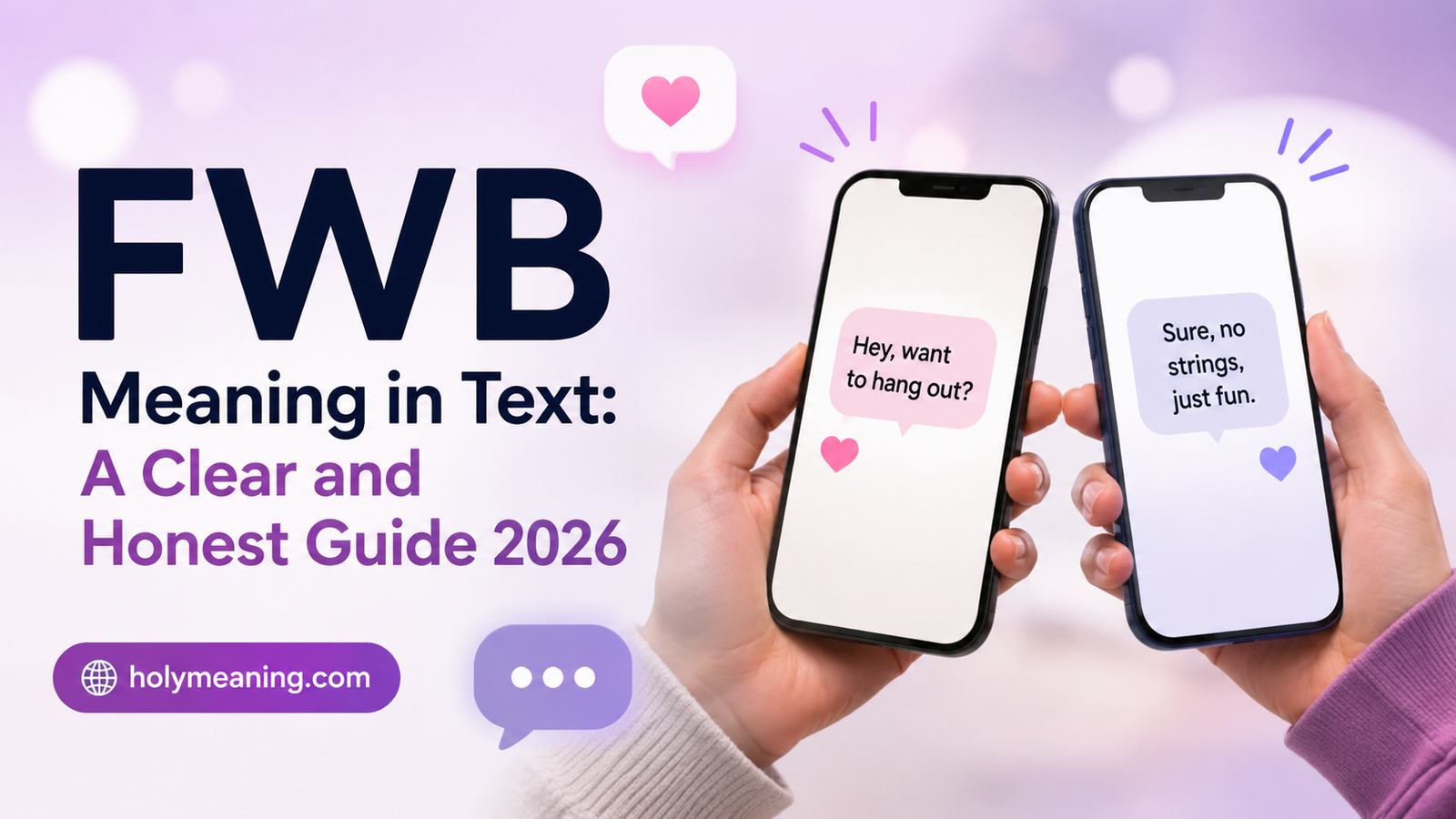
fwb meaning in text stands for “Friends With Benefits,” a text abbreviation people use to describe a relationship that mixes real friendship with a physical connection, minus the labels, titles, or commitment that come with traditional dating.
Here’s the thing about those three letters: they can flip a casual conversation upside down in seconds, turning a normal text thread into something you’ll reread five times before responding.
Understanding how FWB actually gets used in real texts changes everything. Tone, platform, and timing shape whether it’s a genuine proposal, a joke, or a quiet test. This guide breaks down every version so you’re never left guessing.
What Does FWB Mean in Text?
FWB stands for “Friends With Benefits.” It describes two people who have a sexual or physical relationship without the commitment, exclusivity, or emotional expectations that come with traditional dating.
Here’s the short version: you’re friends, and you’re also sleeping together, but neither of you is calling the other a boyfriend or girlfriend.
That’s the FWB definition in its simplest form. But like most slang, the way it lands depends entirely on tone, timing, and who’s typing it.
A few quick facts to ground this:
- FWB is almost always written in all caps or lowercase — rarely spelled out in a casual text
- It functions as both a noun (“we’re FWB”) and sometimes a verb-adjacent phrase (“wanna FWB?”)
- Google Trends data has shown consistent, steady search interest in the term for over a decade, with spikes every January and around Valentine’s Day
- The phrase crosses generations now — it’s not just Gen Z slang anymore, though usage patterns differ by age group
So when someone drops FWB into a chat, they’re not asking you on a date. They’re asking about something looser, less defined, and — depending on the person — a lot more complicated than it sounds on paper.
Where Did FWB Come From?
The term didn’t start on TikTok. It’s older than most people assume.
“Friends with benefits” as a full phrase entered mainstream American vocabulary in the early 2000s, gaining traction through pop culture references, sitcom dialogue, and eventually two major films: Friends with Benefits (2011) starring Justin Timberlake and Mila Kunis, and No Strings Attached (2011) with Natalie Portman and Ashton Kutcher. Both movies hit theaters the same year, which tells you something about how deeply the concept had already seeped into public conversation by then.
Before that, the underlying idea existed under different names — “casual relationship,” “hookup buddy,” or simply left undefined entirely. The formal phrase just gave it a label.
The abbreviation itself — FWB — became common once texting replaced phone calls as the primary way people flirted, negotiated, and set boundaries. Typing “friends with benefits” takes effort. Typing FWB takes two seconds. That’s really the whole story behind why the shorthand caught on: convenience beat formality, the way it usually does in texting meaning and internet slang.
By the mid-2010s, FWB had fully replaced the spelled-out phrase in most digital conversations. Now it’s standard vocabulary in the same category as DTF, situationship, or “u up?” — compact, direct, and instantly understood by anyone under 45.
How FWB Is Used in Real Conversations
Context changes everything here. The same three letters can mean a genuine proposition, a joke between friends, or a nervous test balloon. Below are the three main ways FWB shows up in actual message examples.
Serious / Romantic Context
When someone means it, the text usually looks calm, direct, and specific. There’s less joking around it.
Example:
“Hey, I like hanging out with you but I’m not looking for anything serious right now. Would you ever be down to be FWB?”
Notice the structure. It’s a full sentence, it states intent clearly, and it leaves room for the other person to say no without drama. This is someone genuinely proposing an arrangement, not testing the waters with a throwaway comment.
Signs a text is a serious relationship proposal disguised as casual:
- Low emoji use
- Sent during normal daytime hours, not 1 a.m.
- Includes a real question, not just a statement
- Follows an actual conversation, not a cold open
Playful / Meme Context
Sometimes FWB isn’t a proposal at all. It’s a bit. Friends throw it around ironically, often in group chats, as a joke about someone’s dating life or a reaction to unrelated content.
Example:
“lmaooo you and Jake are basically FWB at this point 💀”
Nobody in this exchange is negotiating anything. The term gets used the way you’d use “married” jokingly about two friends who bicker a lot. It’s shorthand for a dynamic, not a genuine label.
This playful context is one of the biggest sources of confusion in conversation examples online — people screenshot a joke and treat it as a real proposal, which skews perception of how often FWB texts are actually serious.
Indirect or Exploratory Context
This is the gray zone, and honestly, it’s where most FWB texts actually live. Someone’s interested but doesn’t want to commit to saying it outright, so they test the water first.
Example:
“idk what we are but I’m not opposed to something like FWB lol…unless you’re weird about it”
That “lol…unless” tag at the end? Classic hedge. It lets the sender gauge your reaction while keeping an exit ramp open. If you respond negatively, they can claim they were kidding. If you respond well, they’ll get more direct.
How to spot exploratory texts:
| Signal | What It Suggests |
|---|---|
| Vague phrasing (“something like FWB”) | Testing interest, not fully committed |
| “lol” or “jk” tacked on | Softening in case of rejection |
| Sent late at night | Lower stakes, less thought-out |
| Follows flirty back-and-forth | Genuine interest building toward a real ask |
Understanding which category a text falls into is honestly half the battle. Read the pattern, not just the word.
FWB vs. Other Relationship Types — Quick Comparison
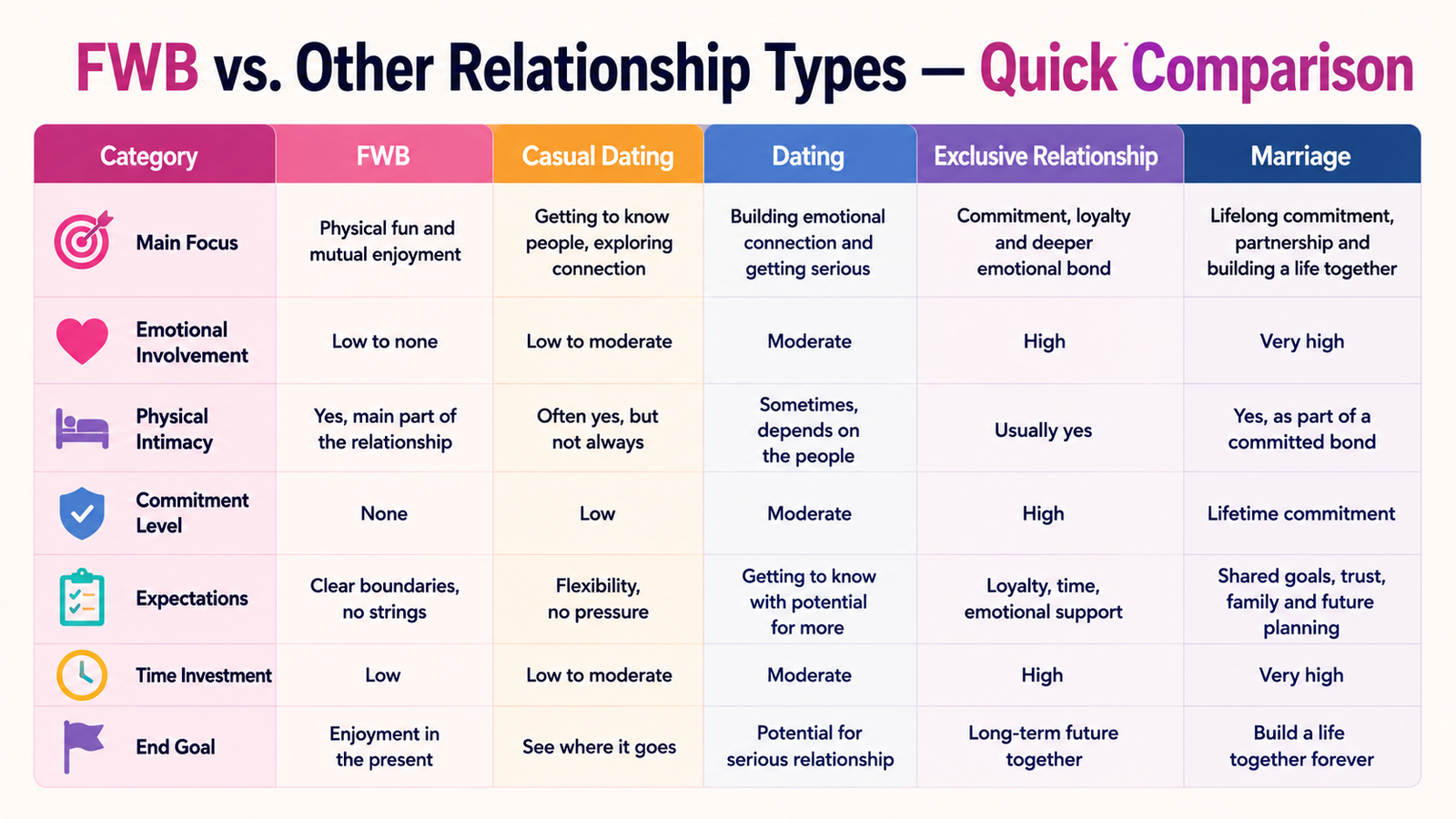
FWB doesn’t exist in a vacuum. It sits alongside a handful of other relationship types people use in casual dating culture, and mixing them up leads to real confusion.
| Term | Commitment Level | Emotional Expectation | Frequency | Exclusivity |
|---|---|---|---|---|
| FWB | Low | Minimal, friendship-based | Recurring | Rarely exclusive |
| Situationship | Undefined/ambiguous | Moderate, often confusing | Recurring | Sometimes assumed |
| Hookup | None | None | Usually one-off or sporadic | No |
| Casual dating | Low-moderate | Light, open to growth | Occasional | Often not exclusive |
| Talking stage | Very low | Building, exploratory | Frequent texting | N/A — pre-relationship |
| One night stand (ONS) | None | None | Single occurrence | No |
A few clarifications worth spelling out:
- FWB requires an existing friendship. That’s the defining feature. Strangers can hook up, but they can’t technically be “friends” with benefits until there’s an actual friendship first.
- A situationship is murkier by design — neither person has defined what it is, and that ambiguity is often the source of friction.
- The talking stage happens before any of this. It’s the getting-to-know-you phase, usually before physical involvement starts.
Knowing where FWB sits on this spectrum helps you interpret a text correctly instead of assuming the worst — or the best — case scenario.
What FWB Is NOT
Because the term gets thrown around loosely, a lot of myths have built up around it. Let’s clear a few up.
FWB is not a guaranteed path to a relationship. A common assumption — especially online — is that FWB naturally evolves into dating over time. Sometimes it does. Often it doesn’t. Research on casual relationships consistently shows that outcomes vary wildly and depend far more on communication than on the arrangement itself.
FWB is not the same as exclusivity. Being someone’s FWB doesn’t mean you’re their only partner, unless that’s explicitly discussed. Assuming exclusivity without a conversation is one of the most common boundary issues in these arrangements.
FWB is not “talking.” The talking stage is about building emotional interest before anything physical happens. FWB skips that framework entirely — it’s built around an existing friendship plus a physical component, not a slow-burn courtship.
FWB is not obligation-free. Just because there’s no formal label doesn’t mean there are no expectations. Respect, honesty, and basic consideration still apply. Ghosting an FWB partner without a word is still a jerk move, label or no label.
FWB is not always mutual understanding. This is the big one. Two people can use the same word — FWB — and mean two completely different things by it. One person might see it as strictly physical. The other might be quietly hoping it turns into something more. That mismatch is where most of the emotional fallout comes from.
The Emotional Reality of FWB
Here’s where a lot of guides get lazy and just say “communicate clearly!” without explaining what actually happens emotionally in these dynamics. Let’s go deeper.
Relationship researchers who study casual sexual relationships — sometimes labeled “casual sex relationships” or CSRs in academic literature — have found a consistent pattern: FWB arrangements work best when both people have matched, explicitly stated expectations going in. The trouble almost never comes from the arrangement itself. It comes from silence.
Common friction points:
- Mismatched expectations. One person assumes it’s purely physical. The other develops feelings and doesn’t say anything, hoping the dynamic will shift on its own.
- Jealousy. Even without a formal relationship, seeing your FWB partner with someone else can sting more than expected. Feelings don’t always follow the rules we set for them.
- Communication gaps. Because there’s no defined relationship structure, people often avoid the tough conversations that dating couples are expected to have — like “are we exclusive?” or “how do you feel about me?”
- Fading boundaries. What starts as strictly physical can slowly pick up relationship-like habits — texting good morning, spending non-sexual time together, meeting each other’s friends — without either person acknowledging the shift out loud.
One relationship therapist put it simply in an interview on modern dating dynamics: casual arrangements only stay casual if both people are honest about what they actually want, on an ongoing basis — not just in the first conversation.
Signs an FWB arrangement is working well:
- Both people check in occasionally about how they’re feeling
- Neither person feels pressure to hide seeing other people
- Conversations outside of physical meetups still feel like a genuine friendship
- Either person can say “I need space” or “let’s stop” without it becoming a fight
Signs it’s becoming complicated:
- One person starts feeling anxious before or after seeing the other
- Jealousy shows up when the other person mentions dating someone else
- Texts start feeling emotionally loaded instead of casual
- Someone avoids bringing up feelings out of fear it’ll “ruin” the arrangement
If you notice the second list creeping into your situation, that’s usually a sign it’s time for an honest conversation — not a sign to just push through and hope it resolves itself.
How to Tell If Someone Means It Seriously
Beyond the three conversational contexts covered earlier, there are a few extra clues worth watching for.
Timing matters. A text sent at 2 a.m. after radio silence carries different weight than one sent mid-afternoon during an ongoing conversation. Late-night texts often reflect impulse or loneliness rather than a well-thought-out proposal.
Follow-up behavior tells the real story. Anyone can send a text. What happens after matters more. Do they follow up the next day? Do they bring it up again, or let it disappear like it never happened? Genuine interest tends to show consistency, not a single message that goes nowhere.
Watch for direct questions versus vague statements. “Would you want to try FWB?” is a real question. “lol we should just be FWB” is a statement dressed up as a joke, often used to gauge reaction without fully committing to the idea.
Pay attention to how they talk about it afterward. If the topic comes up again in a grounded way — not as a joke, not walked back the next morning — that’s usually a stronger signal of genuine intent.
FWB Across Different Platforms
The FWB meaning in text doesn’t change much across platforms, but the context absolutely does. Where a message shows up shapes how it should be read.
On Dating Apps (Tinder, Bumble, Hinge)
Dating apps are where FWB shows up most explicitly — often right in someone’s bio before a single message is even exchanged.
- Tinder has the loosest culture of the major apps. FWB in a bio here is common and usually taken at face value. Nobody’s shocked by it.
- Bumble skews slightly more relationship-oriented in general use, but FWB still appears regularly, especially once conversations move past the initial match.
- Hinge, which markets itself as “designed to be deleted,” leans more toward relationship-seeking users. FWB mentions here tend to draw more direct, no-nonsense clarification requests from matches, since it goes against the app’s general culture.
A quick comparison of how FWB tends to land on each online dating platform:
| App | General Culture | How FWB Is Typically Received |
|---|---|---|
| Tinder | Casual-leaning | Common, low friction |
| Bumble | Mixed | Accepted, sometimes clarified |
| Hinge | Relationship-leaning | Often questioned or directly addressed |
Bio disclosure matters here. Someone who states FWB upfront on a dating platform is generally being more transparent than someone who springs it mid-conversation weeks later.
On Snapchat and Instagram DMs
These chat context environments favor ephemeral, low-stakes communication — which makes them a common place for FWB conversations to start, precisely because messages feel less permanent (even though screenshots exist, obviously).
Snapchat’s disappearing format in particular lowers the perceived stakes of bringing up something like FWB. Instagram DMs function similarly, especially between people who already follow each other and have some existing familiarity — which lines up with the “friends” part of the equation more naturally than a cold dating app match would.
On TikTok and Twitter/X
On these platforms, FWB shows up far more often as commentary than as a literal proposition. Think memes, relatable posts, jokes about situationships, or threads dissecting modern dating culture.
If someone tags you in a TikTok about FWB dynamics, they’re probably not propositioning you. They’re making an observation, a joke, or relating content to a shared experience. Context here almost always points toward humor over literal intent.
In Group Chats
Group chat usage of FWB skews heavily toward the playful category discussed earlier. It’s used to describe a dynamic between two other people, often as light teasing, rather than as a direct message between the two people involved.
Example:
“bro when did you and Mia become FWB 👀”
This is commentary, not negotiation. Nobody in the group chat is asking anyone out. It’s just group dynamics doing what group dynamics do — poking fun at an observed pattern.
In Professional or Unexpected Settings
This one’s rare, but it happens, and it’s worth a mention because the mistake can be genuinely embarrassing.
Professional settings call for a completely different vocabulary, and autocorrect or muscle memory has occasionally caused people to send slang meant for a friend into a work Slack channel or workplace communication thread by mistake. It’s not common, but it’s memorable enough that it comes up in “most embarrassing text” discussions fairly often.
The lesson here isn’t really about FWB specifically — it’s a broader reminder to double-check who you’re texting before hitting send, especially with slang that means something entirely different in formal settings than it does among friends. Office communication and professional language operate under different norms, and abbreviations like FWB simply don’t translate across that boundary.
There’s also a generational layer to this. Older colleagues or family members may not recognize the abbreviation at all, which can lead to confused follow-up questions rather than actual embarrassment — still awkward, just a different flavor of awkward.
Common Mistakes People Make With FWB Texts
A few recurring frequent errors show up again and again in how people navigate this topic, worth flagging directly:
- Assuming instead of asking. Reading too much — or too little — into a text instead of just clarifying what the other person means.
- Ignoring the follow-up. Treating a single text as the whole conversation, instead of watching how the topic develops over time.
- Skipping the boundaries conversation. Jumping straight into the arrangement without discussing exclusivity, communication expectations, or what happens if feelings develop.
- Confusing platforms. Reading a TikTok joke the same way you’d read a direct DM, or vice versa.
- Letting silence stand in for consent. Not responding to a proposal isn’t the same as a clear no — and it leaves things murkier than a direct answer would.
Avoiding these relationship mistakes and misunderstandings comes down to one repeated theme: clarity beats assumption, every time.
How to Respond When Someone Sends You FWB
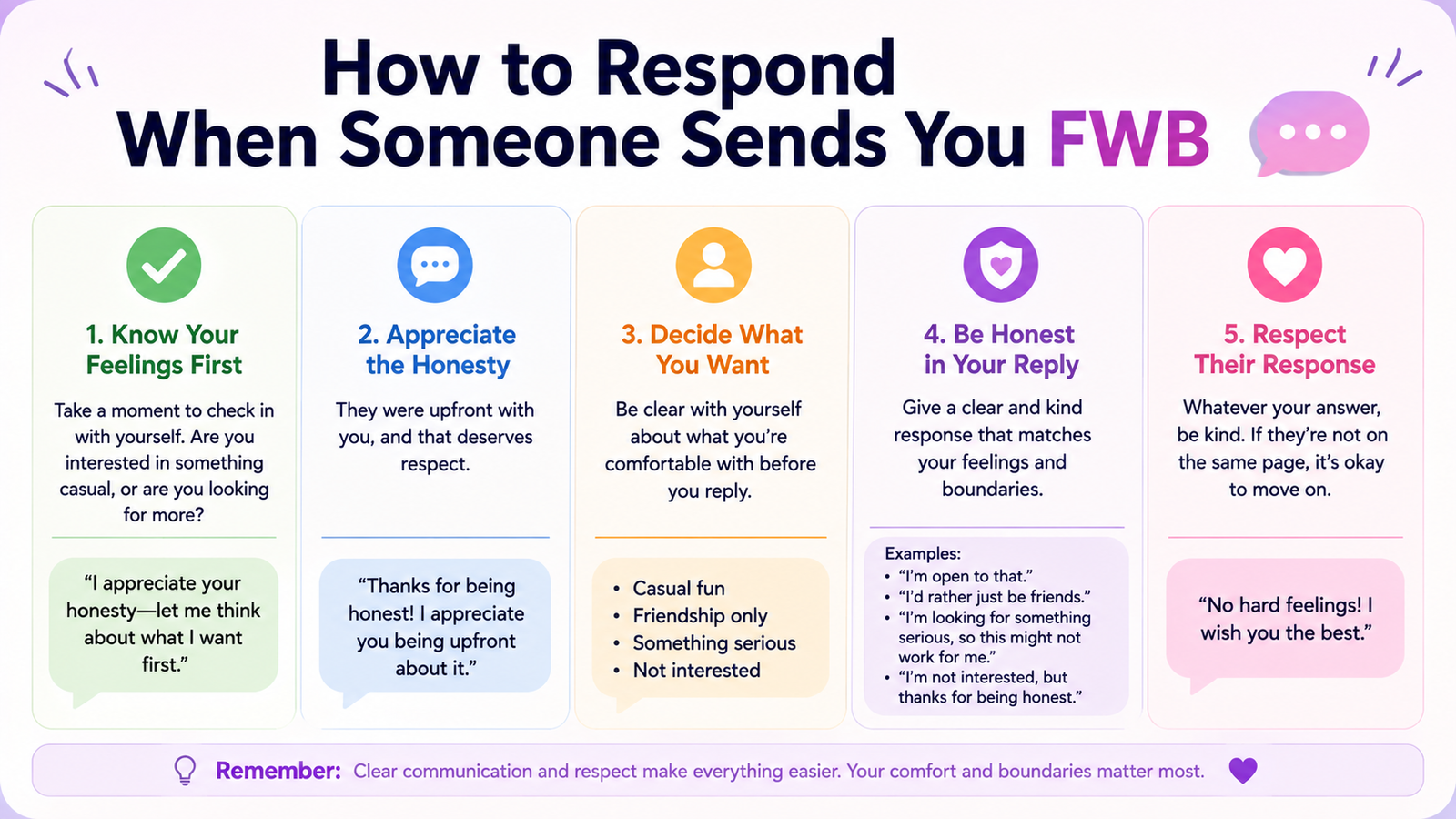
However you feel about the proposal, how you respond matters. Here’s a practical breakdown.
If You’re Interested
Don’t just say “sure.” Use the moment to set actual terms — it saves both of you a headache later.
Example response:
“I’m down, honestly. Can we talk about what that looks like for both of us first though? Like exclusivity, how often we’d hang out, that kind of thing.”
This response does three things: confirms interest, signals maturity, and opens the door for the boundary-setting conversation that so many FWB arrangements skip entirely.
If You’re Not Interested
You don’t owe a paragraph-long explanation. A short, direct, kind response works best.
Example response:
“I appreciate you being upfront, but I’m not really looking for that right now. Still cool being friends though!”
This keeps things low-drama and preserves the actual friendship, assuming that’s something both people value.
If You’re Unsure
It’s completely fine to not have an immediate answer. Ask questions before deciding.
Useful questions to ask back:
- “What made you bring this up?”
- “Are you thinking exclusive, or seeing other people too?”
- “How do you think this would affect our friendship if it doesn’t work out?”
- “What happens if one of us catches feelings?”
These questions do real work. They shift the conversation from a vague proposal into something with actual substance, which makes the eventual decision — yes, no, or “let’s talk more” — a lot easier to reach with confidence.
FAQs
Is FWB still commonly used in 2026?
Yes. It remains one of the most recognized dating abbreviations, especially on Tinder, Bumble, and Hinge bios and chats.
Do people still use the full phrase “friends with benefits,” or just FWB?
Almost everyone shortens it now. The full phrase mostly shows up in formal writing or media, not everyday texts.
Is FWB the same as a situationship?
No. FWB requires an existing friendship plus a physical dynamic; a situationship is more undefined and ambiguous overall.
Can you be FWB with someone you met on a dating app?
Technically it requires some friendship first, but many people now use FWB loosely for app matches who become regular, familiar hookups.
Is it normal for FWB arrangements to end in confusion?
Very common. Studies on casual relationships consistently show mismatched expectations, not the arrangement itself, cause most conflict.
conclusion
FWB meaning in text really comes down to one thing: context. The same three letters can be a joke, a real question, or something in between. Read the tone. Check the timing. Notice how the person follows up. That tells you more than the word itself ever will.
At the end of the day, knowing the FWB meaning in text only helps if you use it wisely. Be honest about what you want. Ask questions if you’re unsure. Clear communication beats guessing every time, no matter how casual the arrangement seems.






2 thoughts on “FWB Meaning in Text: A Clear and Honest Guide 2026”