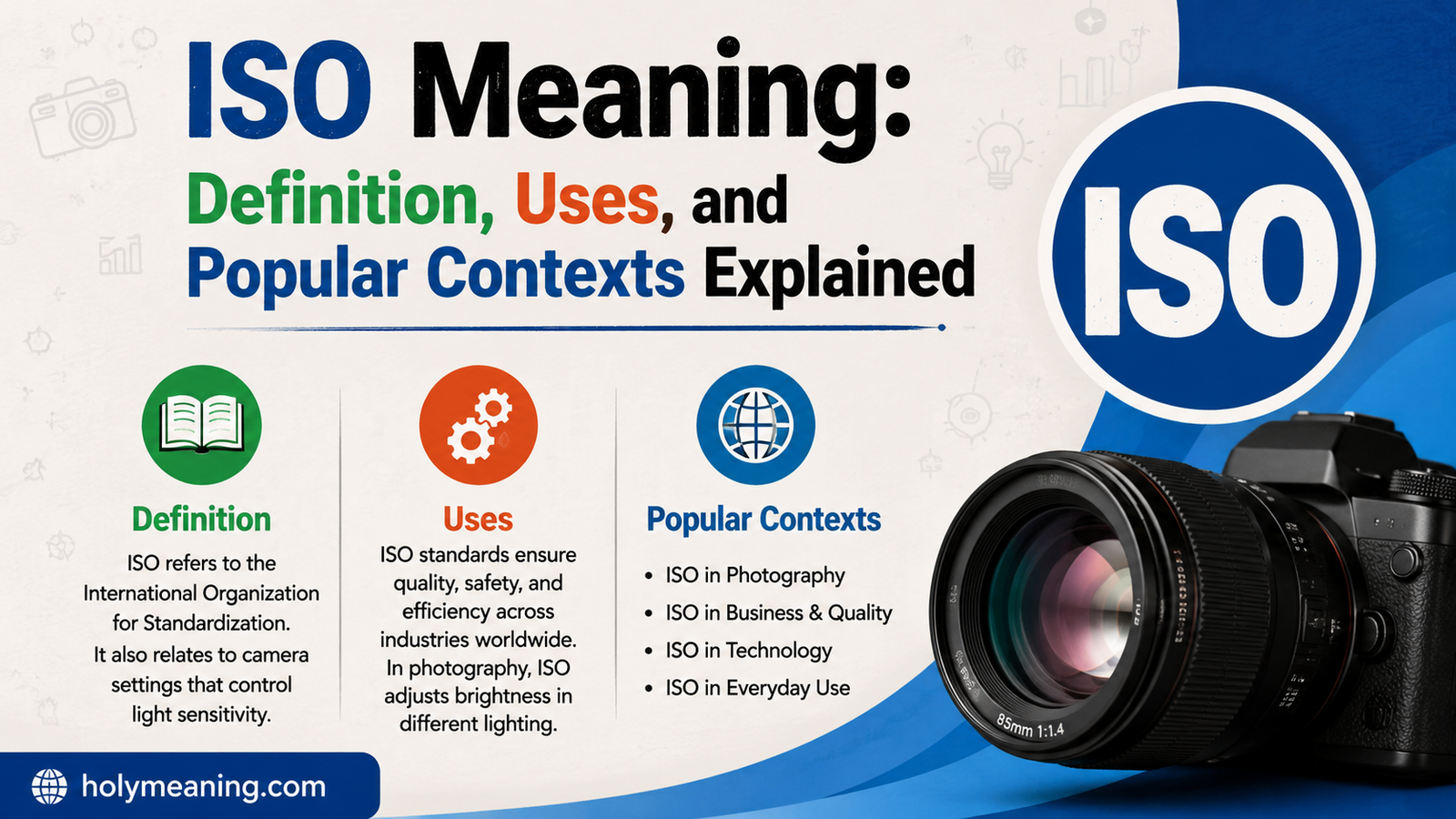
ISO meaning depends entirely on where you spot it, but at its root, ISO points to a system of standardization — most recognizably the International Organization for Standardization, the global body behind the quality, safety, and technical benchmarks industries rely on every single day.
Yet those three letters lead a double life. Flip open a camera menu, scroll a marketplace post, or peek inside a downloaded file, and ISO shows up wearing a completely different hat each time, quietly shaping things you interact with constantly.
From photography settings to date formats, currency codes, and internet slang for “In Search Of,” ISO threads through daily life far more than most people ever realize, and knowing each version turns a confusing acronym into genuinely useful knowledge.
Quick Answer Box
ISO most commonly refers to the International Organization for Standardization, a global body that creates technical and quality standards used across industries. But the same three letters also show up in photography (camera light sensitivity), computing (a disc image file format), dates (the international YYYY-MM-DD format), country and currency codes, and internet slang meaning “In Search Of.”
| Context | What ISO Means | Where You’ll See It |
|---|---|---|
| Standards body | International Organization for Standardization | Product labels, certifications, business compliance |
| Photography | Sensor light sensitivity setting | Camera settings menu, exposure triangle |
| Computing | Disc image file (.iso) | Software installers, OS downloads, game backups |
| Dates | ISO 8601 date format (YYYY-MM-DD) | Databases, APIs, international forms |
| Country codes | ISO 3166 two/three-letter codes | Shipping labels, domain names, passports |
| Currency codes | ISO 4217 three-letter codes | Banking, forex, invoices |
| Slang | “In Search Of” | Marketplace posts, forums, dating apps |
Now let’s dig into each one properly, starting with where the term actually came from.
Where the Word “ISO” Comes From
The Greek Root “Isos” and Why the Organization Chose It
Here’s a fact most articles skip: ISO isn’t technically an acronym at all. If it were, the organization would be called “IOS” in English (International Organization for Standardization) or “OIN” in French (Organisation internationale de normalisation). Different languages would produce different abbreviations, which defeats the entire point of a global standards body.
So the founders picked something else. They based the name on the Greek word isos (ίσος), meaning “equal.” It’s the same root you’ll find in words like “isometric” (equal measure) and “isosceles” (equal-legged triangle). The idea was simple and clever: no matter what country you’re in or what language you speak, the organization is always ISO — equal in name, everywhere.
Clearing Up the Myth That ISO Is an Acronym
You’ll still see people confidently claim ISO stands for “International Standards Organization.” That’s incorrect on two counts — the actual name is International Organization for Standardization, and even that full name isn’t where the short form comes from. The organization itself addresses this directly on its own site, describing the name as a play on the Greek word for “equal” rather than a literal abbreviation.
This distinction matters more than it sounds like it should, especially if you’re writing anything formal or academic. Getting the full name wrong (“International Standards Organization” instead of “International Organization for Standardization”) is one of the most common small errors people make when citing it.
The Most Common Meanings of ISO at a Glance
Before going deep into each one, here’s a side-by-side so you can jump straight to the section you need:
| Meaning | Full Term | Typical Users |
|---|---|---|
| Standards body | International Organization for Standardization | Manufacturers, auditors, quality managers |
| Camera setting | ISO sensitivity | Photographers, videographers |
| File format | .iso disc image | IT professionals, gamers, sysadmins |
| Date standard | ISO 8601 | Developers, database administrators |
| Country code | ISO 3166 | Logistics, e-commerce, government systems |
| Currency code | ISO 4217 | Banks, accountants, forex traders |
| Slang | In Search Of | Buyers, sellers, daters, collectors |
Each of these deserves its own explanation, because a shallow definition won’t help you if you’re actually trying to use the term correctly. Let’s start with the one that generates the most day-to-day confusion: photography.
ISO in Photography: Camera Settings Explained
What ISO Actually Measures
ISO in photography refers to how sensitive your camera’s image sensor is to light. The scale traces back to film cameras, where “ISO” (or the older “ASA”) described how quickly a roll of film reacted to light exposure. Digital cameras kept the naming convention even though there’s no physical film involved anymore — instead, ISO now controls how much the camera amplifies the signal coming off its sensor.
A low ISO number, like 100, means minimal amplification. A high ISO number, like 6400, means the camera is boosting that signal significantly to make the image brighter in low light.
Here’s the trade-off nobody explains well enough: amplification isn’t free. Push the ISO too high, and you introduce visible noise — that grainy, speckled texture you’ve probably noticed in dark photos taken on a phone.
“ISO is the exposure setting photographers reach for last, not first — because every stop you add above your camera’s native ISO comes at the cost of image quality.” — a rule of thumb echoed across professional photography training courses.
Low ISO vs. High ISO — When to Use Each
Choosing the right ISO setting depends entirely on your lighting conditions and what you’re willing to trade off. Here’s a practical breakdown:
| Situation | Recommended ISO | Why |
|---|---|---|
| Bright daylight, outdoor shoot | 100–200 | Maximum image quality, no noise |
| Overcast day or shade | 200–400 | Slight boost without visible grain |
| Indoor, well-lit room | 400–800 | Balances brightness and clarity |
| Indoor, dim lighting | 800–1600 | Noticeable but manageable noise |
| Night photography, no flash | 1600–6400 | Necessary trade-off for visibility |
| Astrophotography or extreme low light | 6400+ | Heavy noise, often reduced in editing |
A useful habit: always start at your camera’s base ISO (usually 100) and only raise it when your shutter speed and aperture alone can’t get you a properly exposed shot.
The Exposure Triangle: ISO, Aperture, and Shutter Speed Together
ISO never works alone. It’s one leg of what photographers call the exposure triangle, alongside aperture (how wide the lens opening is) and shutter speed (how long the sensor is exposed to light). Change one, and you often need to adjust another to keep the same overall exposure.
Think of it like balancing a see-saw with three kids instead of two. If you want a fast shutter speed to freeze a running dog mid-air, but the room is dim, you have two choices: open the aperture wider to let in more light, or raise the ISO to make the sensor more sensitive. Most photographers do a bit of both, stopping the ISO increase as soon as the shot looks acceptable.
A quick way to remember each setting’s job:
- Aperture controls how much light enters and how much of the image stays in focus (depth of field)
- Shutter speed controls how long light hits the sensor and whether motion appears sharp or blurred
- ISO controls how sensitive the sensor is to whatever light does get through
Why High ISO Causes Grain and Noise
When you crank ISO way up, the camera is essentially turning up the volume on a weak signal — and turning up volume amplifies static along with the music. That static, in image terms, shows up as random speckles of color and brightness variation, most visible in shadow areas and flat surfaces like skies or walls.
Newer cameras with larger sensors (especially full-frame models) handle high ISO noticeably better than smartphones or older compact cameras, because a bigger sensor captures more light data to begin with. If you regularly shoot in low light, sensor size matters just as much as the ISO number itself.
ISO as Internet and Marketplace Slang
Where This Usage Started
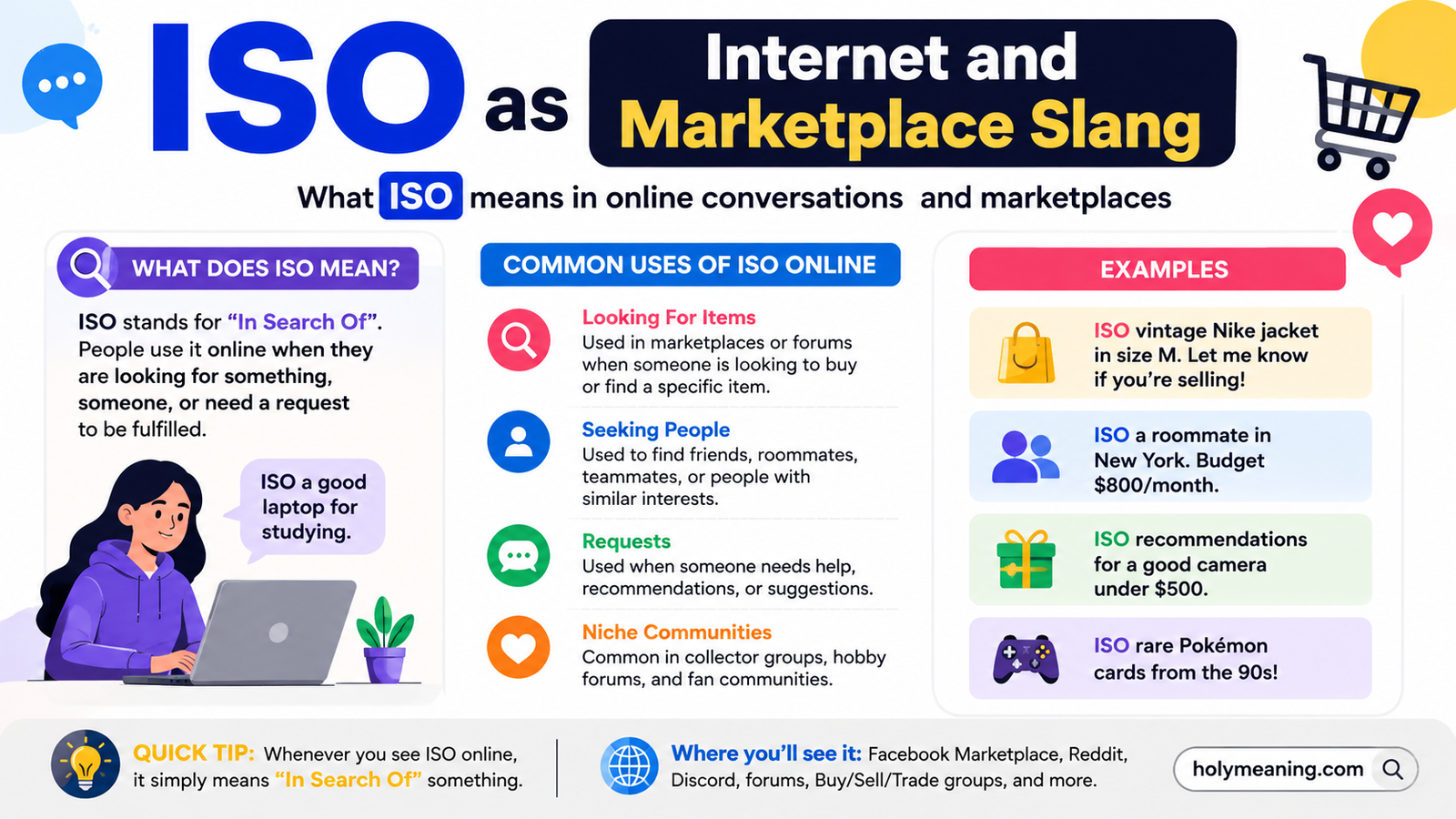
Long before Facebook Marketplace existed, collectors and traders used “ISO” as shorthand for “In Search Of” in classified ads, swap meets, and hobbyist newsletters. Coin collectors, record hunters, and comic book traders were using the abbreviation in print classifieds decades before the internet made it mainstream.
When online forums, Craigslist, and later Reddit and Discord communities took off, the abbreviation carried over naturally. It solved the same problem it always had: a short, recognizable tag that instantly signals “I’m not selling — I’m buying.”
How It’s Used on Buy, Sell, and Trade Forums
On marketplace platforms, ISO typically opens a post title, followed by the item someone wants:
- “ISO: PS5 console, willing to pay cash”
- “ISO vintage Levi’s 501s, size 32×32”
- “ISO babysitter for weekday afternoons”
It functions as the mirror image of “FS” (For Sale) or “WTS” (Want to Sell). Seeing “ISO” tells other members immediately: don’t expect to buy from this post, this person is looking to acquire something.
How It’s Used on Dating Apps and in Casual Conversation
The slang has drifted into dating culture too, where someone might write “ISO: someone who actually replies to texts” in a bio, half-joking but still communicating a genuine preference. It’s also crept into everyday texting as a compact way to say “looking for” almost anything — a job, a roommate, advice, or a specific answer to a question.
How to Write a Clear ISO Post People Actually Respond To
A vague ISO post gets ignored. A specific one gets replies. Good ISO posts on marketplaces generally include:
- The exact item — brand, model, size, or edition, not just a general category
- Condition expectations — new, gently used, or “any condition, just need it working”
- Budget or trade offer — vague pricing wastes everyone’s time
- Location or shipping willingness — local pickup only, or open to mailing
- Timeline — “need by Friday” changes how sellers respond
How to Respond to Someone’s ISO Post
If you’re on the other side, replying well matters just as much. Include a clear price, a recent photo if it’s a physical item, and your availability. Skip the single-word “interested” comment — it forces the original poster to do extra work chasing details you could have provided upfront.
ISO the Organization: International Organization for Standardization
What the Organization Does and Why It Was Founded
The International Organization for Standardization is an independent, non-governmental body that develops voluntary technical, industrial, and commercial standards. It was established on February 23, 1947, after delegates from 25 countries met in London the previous year to formalize international cooperation on standardization. The organization is headquartered near Geneva, Switzerland.
Its founding purpose hasn’t really changed: make it possible for products, services, and systems made in one country to work reliably and safely with those made in another. Screw threads, freight container dimensions, credit card sizes, paper formats — all of these exist in a predictable, universal form because of ISO’s work.
Today, the organization includes national standards bodies from roughly 170 member countries and has published more than 25,000 international standards, developed through a network of over 800 technical committees and subcommittees staffed by volunteer experts.
How a Standard Gets Written, Voted On, and Published
A new ISO standard doesn’t get written by a small internal team and handed down. It moves through a fairly rigorous, multi-stage development process:
| Stage | What Happens |
|---|---|
| Proposal | A member body or industry group proposes a new standard is needed |
| Committee assignment | A technical committee of subject-matter experts takes it on |
| Working draft | Experts draft the technical content collaboratively |
| Committee draft | Member countries review and comment |
| Enquiry draft | Wider international review and formal voting |
| Final draft | Last round of review before formal approval |
| Publication | The finished standard is published and made available |
This process can take years for complex standards, and it relies on consensus among national delegations rather than a single governing authority dictating terms. That’s part of why ISO standards carry so much credibility — they represent agreement across dozens of countries with different regulatory traditions, not one company’s internal rulebook.
ISO Standards You’ve Actually Run Into Without Knowing It
Most people interact with ISO’s work constantly without realizing it. A few examples:
- ISO 9001 — quality management systems, the most widely adopted ISO standard globally, used across manufacturing, healthcare, and services
- ISO 27001 — information security management, increasingly required by clients before they’ll trust a vendor with sensitive data
- ISO 14001 — environmental management systems, used by companies formalizing sustainability practices
- ISO 45001 — occupational health and safety management
- ISO 216 — the paper size standard behind A4, A3, and the rest of the “A” series used almost everywhere outside North America
- ISO 7810 — the physical dimensions of your credit and debit cards, which is why any card fits any card reader worldwide
What Getting “ISO Certified” Actually Means for a Business
Here’s something worth clearing up: ISO itself does not certify companies. The organization writes the standards, but independent, accredited certification bodies conduct the actual audits and issue certificates.
Becoming ISO certified — say, to ISO 9001 — generally involves:
- Implementing a documented management system that meets the standard’s requirements
- Running internal audits to check for gaps before the official one
- Undergoing a formal external ISO audit by an accredited certification body
- Addressing any non-conformities the auditor identifies
- Receiving certification, followed by periodic surveillance audits to keep it valid
For many businesses, certification isn’t optional in practice — plenty of government contracts, enterprise clients, and international suppliers simply won’t work with a company that can’t show proof of compliance standards through a valid ISO certificate. It’s become a baseline trust signal in industries ranging from aerospace manufacturing to software development.
ISO File Format (.iso)
What a .iso File Actually Contains
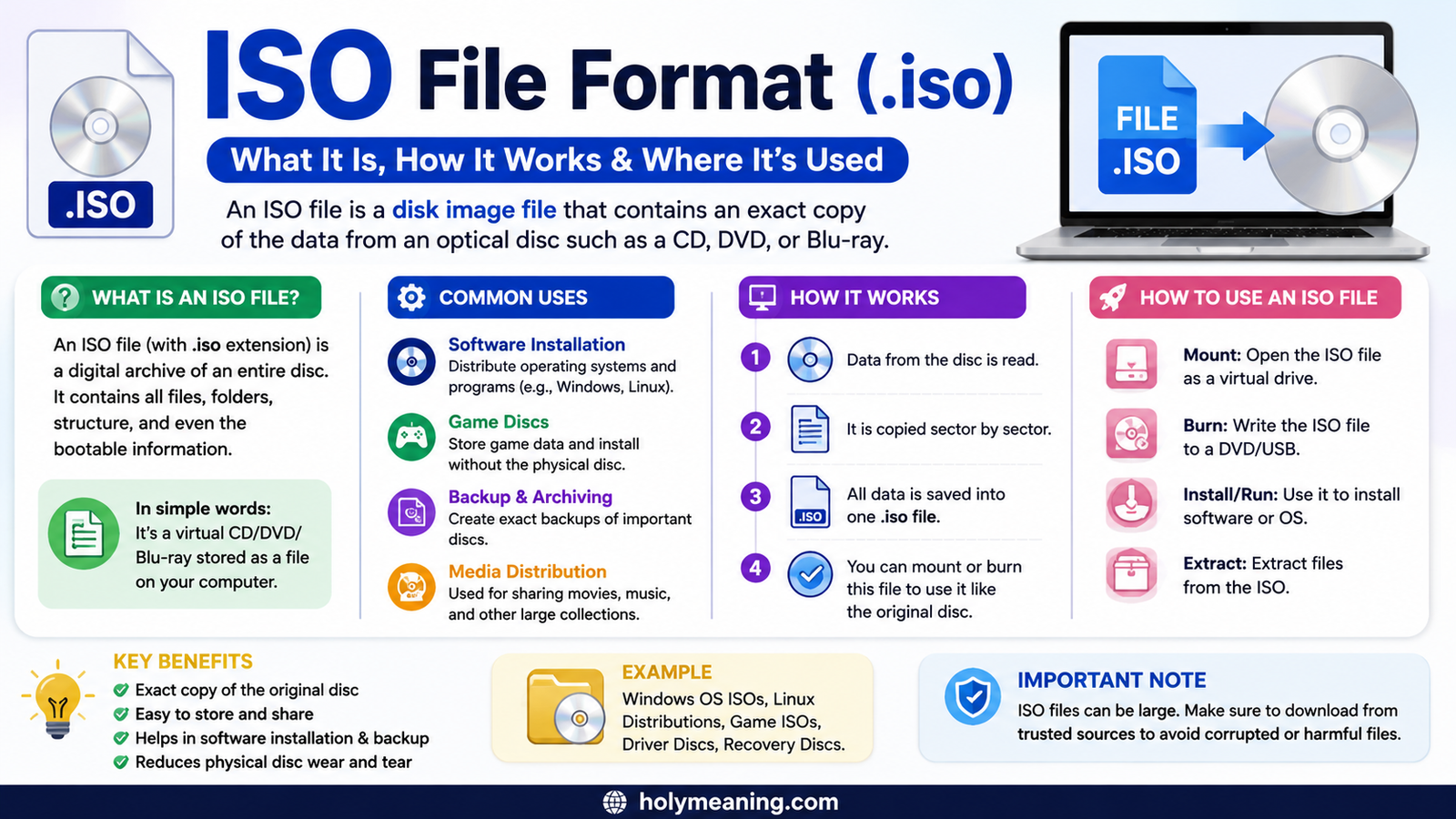
A .iso file is a disc image — a single file that’s a byte-for-byte copy of everything that would be on a physical CD, DVD, or Blu-ray disc, including the file system structure, not just the raw files themselves. The name comes directly from ISO 9660, the ISO standard that defines how file systems on optical discs should be structured, which is where the file extension originates.
Think of it as a fully packaged, self-contained snapshot of a disc. Instead of handing someone a physical DVD, you hand them one file that behaves exactly like that DVD would if you inserted it.
Where You’ll Run Into Them
- Operating system installers — Windows and Linux distributions are almost always distributed as ISO files today
- Game discs — older PC and console games get archived and shared as ISOs for emulation or backup purposes
- Software distribution — enterprise software vendors often ship large applications as a single mountable image
- Data archiving — IT departments sometimes archive old disc-based records as ISO images for long-term storage
How to Open, Mount, or Burn One
You generally have three options, and none of them require extra downloads on modern systems:
Windows (10 and later): Right-click the .iso file and select “Mount.” It appears as a virtual DVD drive in File Explorer, and you can browse or run it exactly like a physical disc.
Mac: Double-click the .iso file. macOS mounts it automatically as a virtual disk on the desktop.
Linux: Most distributions let you right-click and select “Open with Disk Image Mounter,” or you can mount it manually through the terminal with a single mount command.
If you need to turn the ISO back into a physical disc, any built-in disc-burning tool on Windows or Mac can do it directly — right-click the file and look for a “Burn disc image” option.
ISO Date Format (ISO 8601)
The YYYY-MM-DD Structure and Why It Sorts and Compares Cleanly
ISO 8601 is the international standard for representing dates and times, and it specifies the format YYYY-MM-DD — four-digit year, two-digit month, two-digit day, always in that order, separated by hyphens. So August 28, 2026 becomes 2026-08-28.
Why does this specific order matter so much? Because it’s the only common date format that sorts correctly as plain text. If you list files or database rows named with ISO dates, alphabetical sorting and chronological sorting produce the exact same order. Try that with 08/28/2026 or 28-08-2026, and you’ll get a mess the moment years roll over or ambiguous month/day ordering creeps in.
The standard also covers time formatting, typically written as HH:MM:SS, and combines with dates using a capital “T” separator — for example, 2026-08-28T14:30:00 represents 2:30 PM on that date.
Where You’ll See It
- Databases — nearly every modern database engine stores and displays dates in ISO 8601 by default
- APIs — data exchanged between software systems almost always uses this format to avoid regional ambiguity
- Log files — server and application logs use it so entries stay sortable and unambiguous across time zones
- International forms and shipping — used specifically because it avoids the U.S. (MM/DD/YYYY) versus most-of-the-world (DD/MM/YYYY) confusion that causes real logistical errors
ISO Codes for Countries and Currencies
ISO 3166 (Country Codes) With Real Examples
ISO 3166 defines standardized codes for representing countries and their subdivisions, published in two- and three-letter formats:
| Country | Two-Letter Code (Alpha-2) | Three-Letter Code (Alpha-3) |
|---|---|---|
| United States | US | USA |
| United Kingdom | GB | GBR |
| Pakistan | PK | PAK |
| Germany | DE | DEU |
| Japan | JP | JPN |
| Brazil | BR | BRA |
You’ll recognize the two-letter version instantly — it’s the same code behind country-specific internet domains like .uk, .de, and .jp. Shipping companies, immigration systems, and international databases rely on these alpha codes because a country’s full name can be spelled, abbreviated, or translated differently depending on the language, while the ISO code stays fixed.
ISO 4217 (Currency Codes) With Real Examples
ISO 4217 does the same job for money. Every recognized currency gets a consistent three-letter code, almost always built from the country code plus a letter representing the currency name:
| Currency | ISO 4217 Code |
|---|---|
| US Dollar | USD |
| British Pound | GBP |
| Euro | EUR |
| Pakistani Rupee | PKR |
| Japanese Yen | JPY |
| Indian Rupee | INR |
Why These Codes Matter for Software, Shipping, and Banking
Symbols like “$” are genuinely ambiguous — the US dollar, Canadian dollar, Australian dollar, and several others all use it. Currency codes eliminate that ambiguity entirely, which is exactly why every international wire transfer, forex platform, and accounting system uses them instead of symbols. A bank processing a transfer needs to know with certainty whether “$500” means USD, CAD, or AUD, and the ISO code removes the guesswork.
The same logic applies to country codes in shipping and e-commerce — an address field that stores “PK” instead of “Pakistan” avoids spelling variations, translation issues, and data-entry inconsistencies across systems built in different languages.
How to Tell Which “ISO” Someone Means
Context Clues by Setting
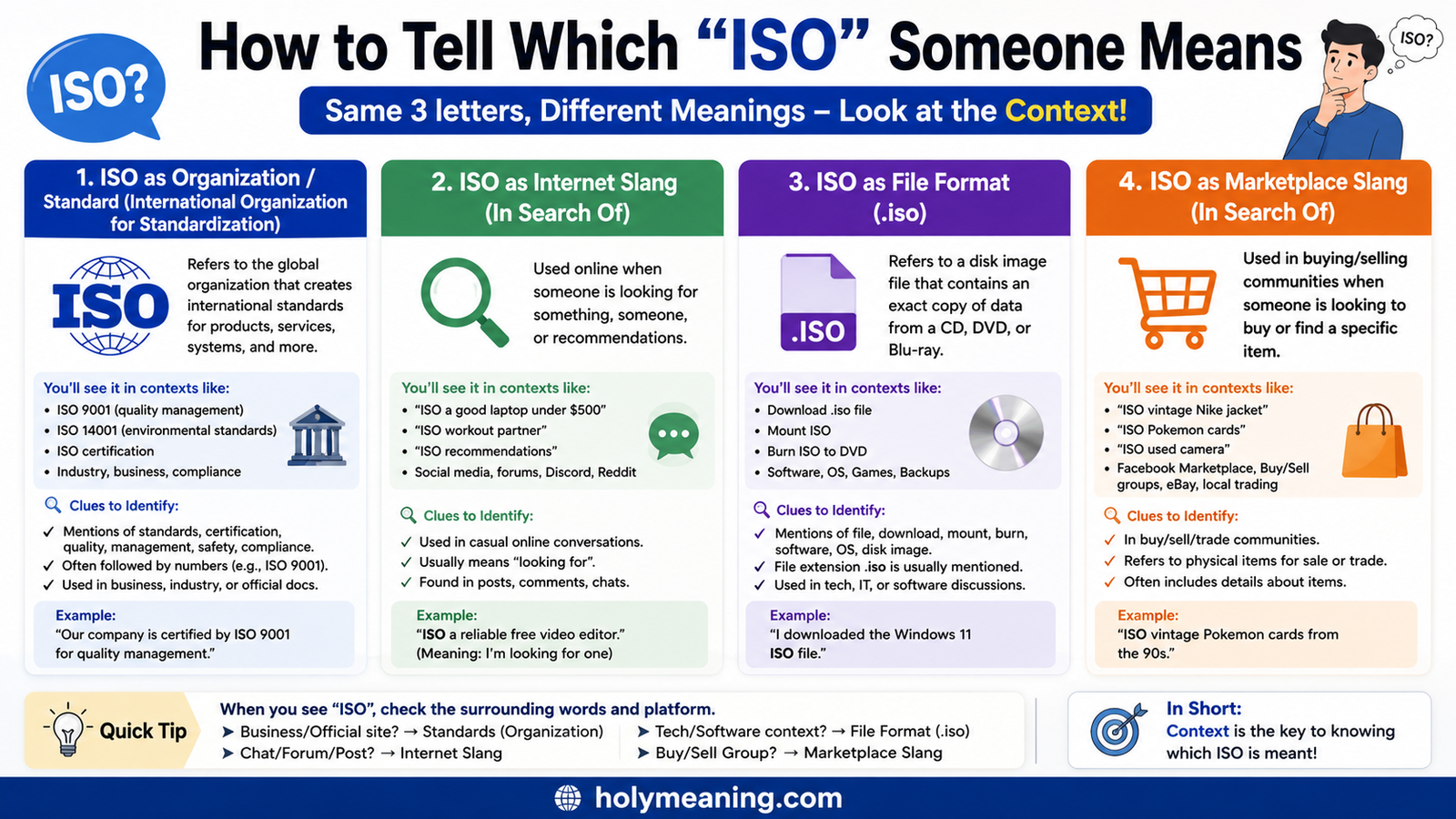
In practice, you almost never need to guess — the surrounding context gives it away instantly:
- Camera menu or photography forum → sensor sensitivity setting
- Downloaded file ending in .iso → disc image
- Database, API documentation, or timestamp → ISO 8601 date format
- Shipping label, passport, or country dropdown → ISO 3166 country code
- Bank statement, invoice, or forex chart → ISO 4217 currency code
- Marketplace listing, forum post, or dating bio → “In Search Of”
- Business certificate, audit report, or compliance page → the standards organization
A Quick Mental Checklist for the Ambiguous Cases
If context alone doesn’t settle it, ask yourself these three questions in order:
- Is it followed by a number? (ISO 100, ISO 9001, ISO 8601) — almost always the organization’s standards or a camera setting
- Is it followed by a colon and an item? (“ISO: leather jacket”) — internet slang
- Is it attached to a file, date, or code? — check the specific technical format it belongs to
FAQs
What does ISO stand for today?
It refers to the International Organization for Standardization, though the name is derived from the Greek word “isos” (equal) rather than a strict acronym.
How many countries are ISO members right now?
As of 2026, ISO has member bodies from roughly 170 countries, working through more than 800 technical committees worldwide.
How many ISO standards exist currently?
ISO has published over 25,000 international standards to date, covering everything from quality management to paper sizes.
What’s the most widely used ISO standard in business?
ISO 9001, the quality management standard, remains the most adopted ISO certification globally across industries.
What does ISO mean on Facebook Marketplace or Reddit?
It stands for “In Search Of,” signaling that the poster wants to buy or find something rather than sell it.
conclusion
ISO meaning changes with context, but that’s not something to memorize all at once. Photography, files, dates, currency codes, and internet slang each use it their own way. Once you spot the pattern, the right meaning becomes obvious fast.
So next time you see ISO somewhere new, don’t guess. Check the context, and the ISO meaning will usually be clear within seconds. From camera settings to marketplace posts, you now know exactly what it stands for, and why those three letters carry so much weight everywhere they show up.










hoxugpmqejtjdykkgufxwtggoqnflo