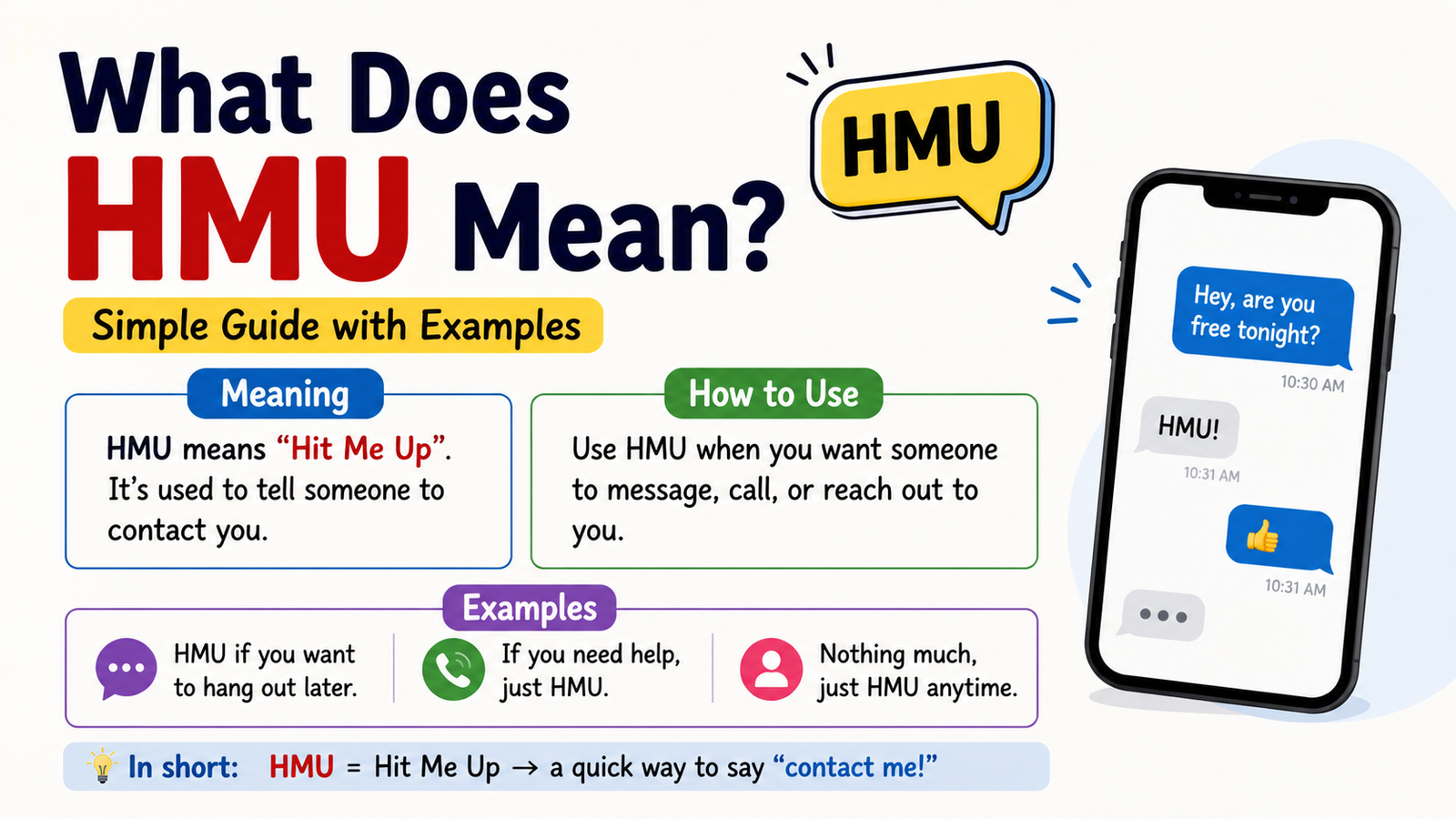
HMU stands for “hit me up,” a casual bit of texting slang that basically means “reach out to me” or “contact me whenever.” It’s one of those everyday abbreviations that shows up in texts, DMs, and social captions without carrying any real weight or urgency behind it.
Here’s the thing about HMU: two letters can carry an entire conversation’s worth of intention, whether that’s a friend inviting you out, a crush leaving the door open, or a stranger online extending a low-key invite.
Beyond the basic definition, HMU shifts meaning depending on who’s saying it and where. Understanding those subtle context clues turns a simple three-letter text into something you’ll never misread again.
What Does HMU Mean?
HMU stands for “hit me up.” That’s it. No hidden layers, no secret code. It’s a casual, friendly way of telling someone to contact you, whether that’s through a text, a call, a DM, or however you two usually talk.
Here’s the quick breakdown:
| Term | Full Meaning | Tone |
|---|---|---|
| HMU | Hit Me Up | Casual, informal, friendly |
Think of it as the digital equivalent of saying “give me a shout” or “reach out whenever.” It doesn’t demand urgency. It doesn’t require a formal reply. It just opens a door and leaves it open.
People use HMU because it’s fast to type, universally understood among texting-savvy folks, and it fits almost any casual situation. You’ll see it in texting slang, social media captions, dating bios, and group chats alike.
“HMU if you’re free this weekend, we’re doing a bonfire.”
That single sentence tells you everything: no pressure, no strict deadline, just an open invite to reach out if you’re interested.
Where Did HMU Come From?
Like most texting abbreviations, HMU didn’t come from a formal committee deciding on new slang. It grew organically out of the texting era of the early 2000s, when character limits on SMS messages (originally capped at 160 characters) pushed people to shorten everything they could.
Abbreviations like LOL, BRB, and HMU became second nature because typing full sentences on a flip phone keypad was slow and clunky. Once smartphones took over, these shortcuts didn’t disappear. Instead, they stuck around because they were fast, familiar, and honestly kind of fun to use.
By the 2010s, HMU had fully crossed over from private texts into public social media slang. It started showing up in:
- Instagram captions (“New number, HMU”)
- Twitter/X posts (“HMU if anyone’s going to the concert”)
- Snapchat stories
- Dating app bios
The jump from private messaging to public platforms is actually a big part of why HMU feels so versatile today. It works whether you’re speaking to one person or broadcasting to hundreds of followers at once.
What Does HMU Mean in Texting?
When it comes to HMU meaning texting, context does most of the heavy lifting. In a one-on-one text conversation, HMU almost always functions as a low-pressure invitation to keep the conversation going, either now or later.
Here’s what makes texting different from other platforms: it’s private, it’s personal, and it’s usually between people who already know each other at least a little. That changes how HMU lands.
Example texts using HMU:
- “Hey, I’m bored tonight. HMU if you wanna hang.”
- “Just landed. HMU when you’re up.”
- “I found that recipe you wanted. HMU and I’ll send it over.”
- “Running late, HMU if plans change.”
Notice something in all four? None of them carry urgency. Nobody’s in crisis. It’s all everyday, low-stakes communication. That’s the heart of HMU in texting: it keeps things breezy.
Quick fact: According to linguistic research on digital communication (see Crystal’s work on Internet linguistics), abbreviated slang like HMU thrives specifically because it mimics the rhythm of spoken conversation. When you say “hit me up” out loud to a friend, it sounds relaxed. The text version keeps that same energy.
What Does HMU Mean on Social Media?
HMU on social media works a little differently than it does in a private text. Because it’s often visible to a wider audience, it usually signals openness rather than a direct request aimed at one person.
HMU on Instagram
Instagram HMU typically shows up in captions, bios, or story replies. Someone might post a photo with the caption “New apartment, HMU if you want the address for the housewarming.” It’s an open call, not a personal ask, so anyone in their circle who’s interested can respond.
You’ll also see it used in Instagram bios like: “Photographer based in Austin. HMU for bookings.” Here, it doubles as a soft call-to-action, almost like a casual version of “contact me.”
HMU on Twitter/X
On Twitter/X, HMU often pops up in public callouts. Someone tweeting “HMU if you’re driving to the game Saturday, need a ride” is broadcasting to their entire following, hoping the right person sees it and responds. It’s efficient. Instead of texting five different people individually, one tweet covers it.
HMU on TikTok and Snapchat
TikTok HMU usage tends to show up in comment sections and video captions, often tied to collaborations, meetups, or casual flirting. Someone might comment “HMU, we should collab” under a creator’s video.
Snapchat slang, meanwhile, leans more personal since Snapchat itself is built around close friend groups. HMU on a Snap story often reads more intimately, closer to its original texting roots than the broader, public tone it takes on Twitter/X.
Quick Comparison Table
| Platform | Typical Use | Example |
|---|---|---|
| Texting | Personal, one-on-one invite | “HMU later, we’ll figure out dinner” |
| Bios, captions, semi-public invite | “HMU for collab opportunities” | |
| Twitter/X | Public callouts, broad audience | “HMU if you’re coming to the show” |
| TikTok | Comments, creator interaction | “HMU, let’s do a duet” |
| Snapchat | Personal, close-friend tone | “HMU if you’re around tonight” |
The pattern here is clear: the more public the platform, the broader the invitation. The more private the platform, the more personal it feels.
Is HMU Flirty or Just Friendly?
This is probably the number one question people have, and honestly, it depends entirely on context. Flirty HMU usage and friendly HMU usage look almost identical on the surface. The difference lives in tone, timing, and who’s saying it.
Ask yourself these questions when you’re trying to read the situation:
- Who said it? A close friend versus a romantic interest changes everything.
- What came before it? Flirty banter leading up to HMU signals something different than a casual group chat exchange.
- Are there emojis? A winking face or heart emoji next to HMU shifts the tone considerably.
- Is it public or private? Private DMs after flirty conversation lean romantic. Public posts usually don’t.
HMU in a Dating Context
HMU dating context usage shows up constantly on apps like Tinder, Bumble, and Hinge. You’ll see bios like “Love hiking and good coffee, HMU if you’re down for both.” In this setting, HMU functions almost like a casual green light. It’s the dating app equivalent of “I’m approachable, go ahead and reach out.”
Romantic texting situations often use HMU as a soft way to keep the door open without seeming overly eager. It carries far less pressure than “text me every day” or “I want to talk to you all the time.” Instead, it says “I’m interested, but I’m chill about it.”
What Does HMU Mean From a Guy?
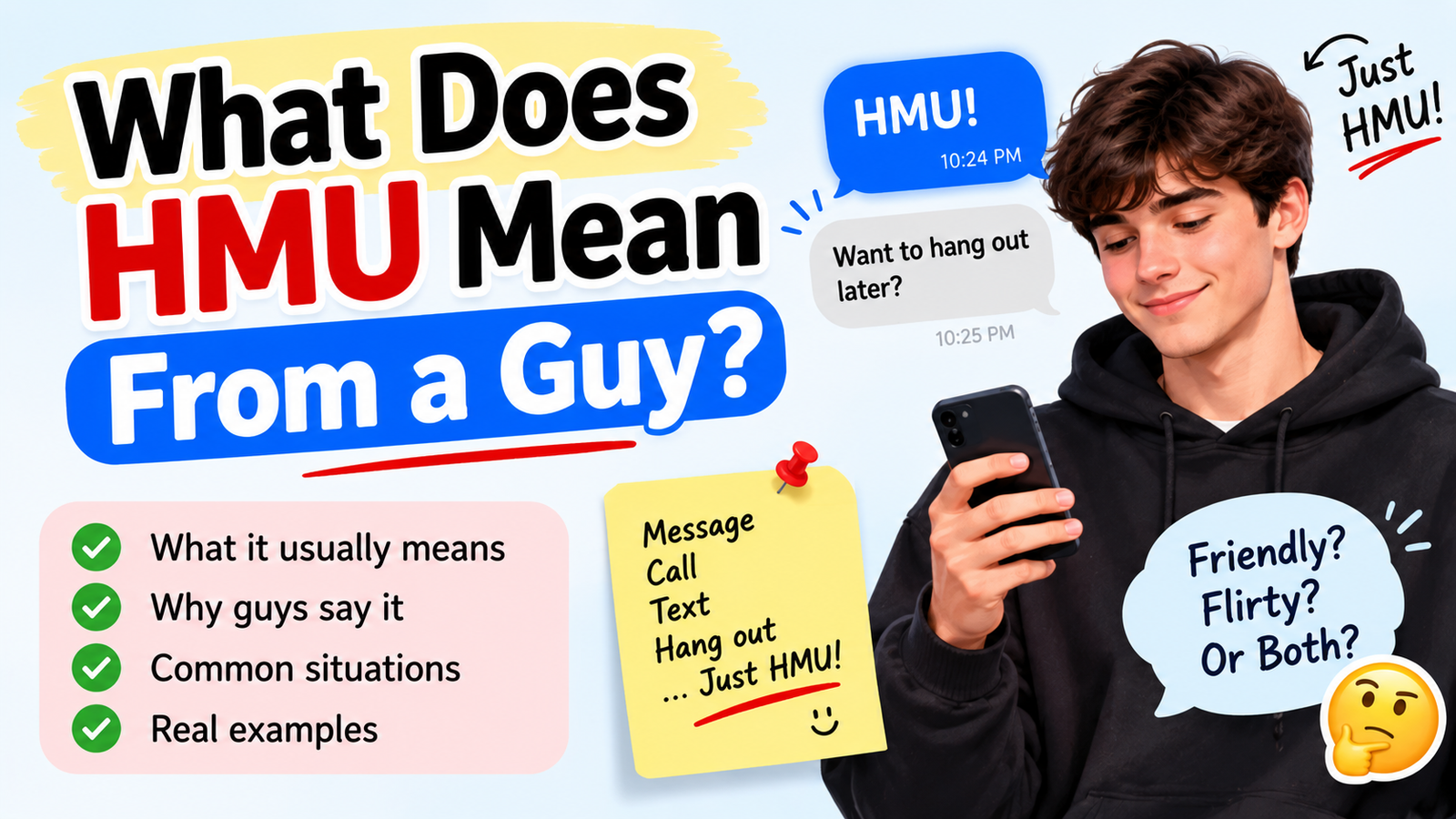
When a guy says HMU, the meaning usually mirrors everything above, but there’s a specific pattern worth mentioning: guys tend to use HMU as a low-risk way to show interest without fully committing to vulnerability. It softens the ask.
Instead of saying “I’d really like to talk to you more,” which feels exposed, HMU lets him express interest while keeping some emotional distance. It’s the texting version of playing it cool.
Common scenarios where guys use HMU:
- After getting your number: “Cool, HMU whenever”
- In a dating app match: “HMU if you’re free this weekend”
- Following a fun hangout: “That was fun, HMU next time you’re free”
None of these carry desperation or heavy emotional weight. That’s kind of the point. HMU meaning from a guy typically reflects casual confidence rather than deep romantic intensity, though obviously context and prior conversation can shift that.
How to Use HMU Correctly (With Examples)
Knowing the definition is one thing. Knowing how to use HMU naturally, without sounding forced, is another. Let’s go through real scenarios.
In Friendly Conversations
This is where HMU feels most natural and low-stakes.
- “Movie night on Friday, HMU if you’re in”
- “I’ve got an extra ticket, HMU if you want it”
- “We’re grabbing food later, HMU”
In Dating Situations
Here, HMU works as a light, pressure-free way to keep interest alive.
- “This was fun, HMU when you’re free again”
- “HMU if you want to grab coffee sometime”
- “Enjoyed talking to you, HMU whenever”
As a Simple Favor Request
HMU also works when you need something small from someone without making it feel like a big ask.
- “HMU if you find my charger”
- “HMU when you get a chance, need your opinion on something”
- “HMU if you hear back from them first”
Where It Doesn’t Belong
This matters just as much as knowing where to use it. Texting etiquette and HMU etiquette both point to the same rule: keep it casual, keep it personal. That means HMU generally doesn’t belong in:
- Professional emails — “Please HMU regarding the quarterly report” reads unprofessional and out of place
- Formal requests — job applications, official inquiries, or anything requiring a documented paper trail
- First messages to strangers in serious contexts — like reaching out to a potential employer or someone you’ve never spoken with in a professional capacity
If you’re unsure whether a setting is casual enough for HMU, a good rule of thumb: if you wouldn’t say “hit me up” out loud in that exact situation, don’t type it either.
What Should You Say Back When Someone Says HMU to You?
Getting an HMU doesn’t require an elaborate response. The whole point of the phrase is that it’s low-pressure, so your reply can match that same energy.
Depending on the context, here’s how you might respond:
If it’s casual/friendly:
- “Will do!”
- “For sure, I’ll text you”
- “Sounds good, HMU too if you’re around”
If it’s flirty/dating-related:
- “I definitely will 😊”
- “Count on it”
- “Looking forward to it”
If it’s favor-based:
- “Got it, I’ll let you know”
- “Sure thing, give me a bit”
The key is matching tone. Responding to a casual HMU with an overly formal reply, or vice versa, tends to feel mismatched and awkward. Keep it simple, keep it natural.
HMU vs. Similar Slang
Understanding HMU similar slang helps clarify exactly when to use HMU versus its cousins. They’re not interchangeable, even though they might seem that way at first glance.
HMU vs. DM Me
HMU vs DM me comes down to platform specificity. “DM me” refers specifically to Direct Messages on a platform like Instagram, Twitter/X, or TikTok. HMU vs DM essentially means HMU is the broader, platform-agnostic version, while DM me points to one exact method of contact.
- “HMU” = reach out however works for you (text, call, DM, whatever)
- “DM me” = specifically message me on this platform
LMK vs. HMU
LMK meaning stands for “let me know.” The difference here is about direction. HMU invites someone to initiate contact. LMK asks someone to respond with information you’re waiting on.
- “HMU if you want to come” = open invitation, no info owed back
- “LMK if you’re coming” = they need to actually respond with a yes or no
Ping Me vs. HMU
Ping me meaning leans slightly more professional or tech-adjacent, often used in work Slack channels or among people who work in tech-heavy environments. It typically means “send me a quick message,” often for something specific or work-related.
- “HMU later” = casual, general, social
- “Ping me when it’s done” = more task-oriented, often workplace-adjacent
Comparison table:
| Phrase | Meaning | Best Used When |
|---|---|---|
| HMU | Hit me up | Casual, general invitation to contact |
| DM me | Direct message me | Platform-specific, social media contact |
| LMK | Let me know | You need a specific answer or update |
| Ping me | Send a quick message | Work-related or tech-context requests |
Common Mistakes People Make With HMU
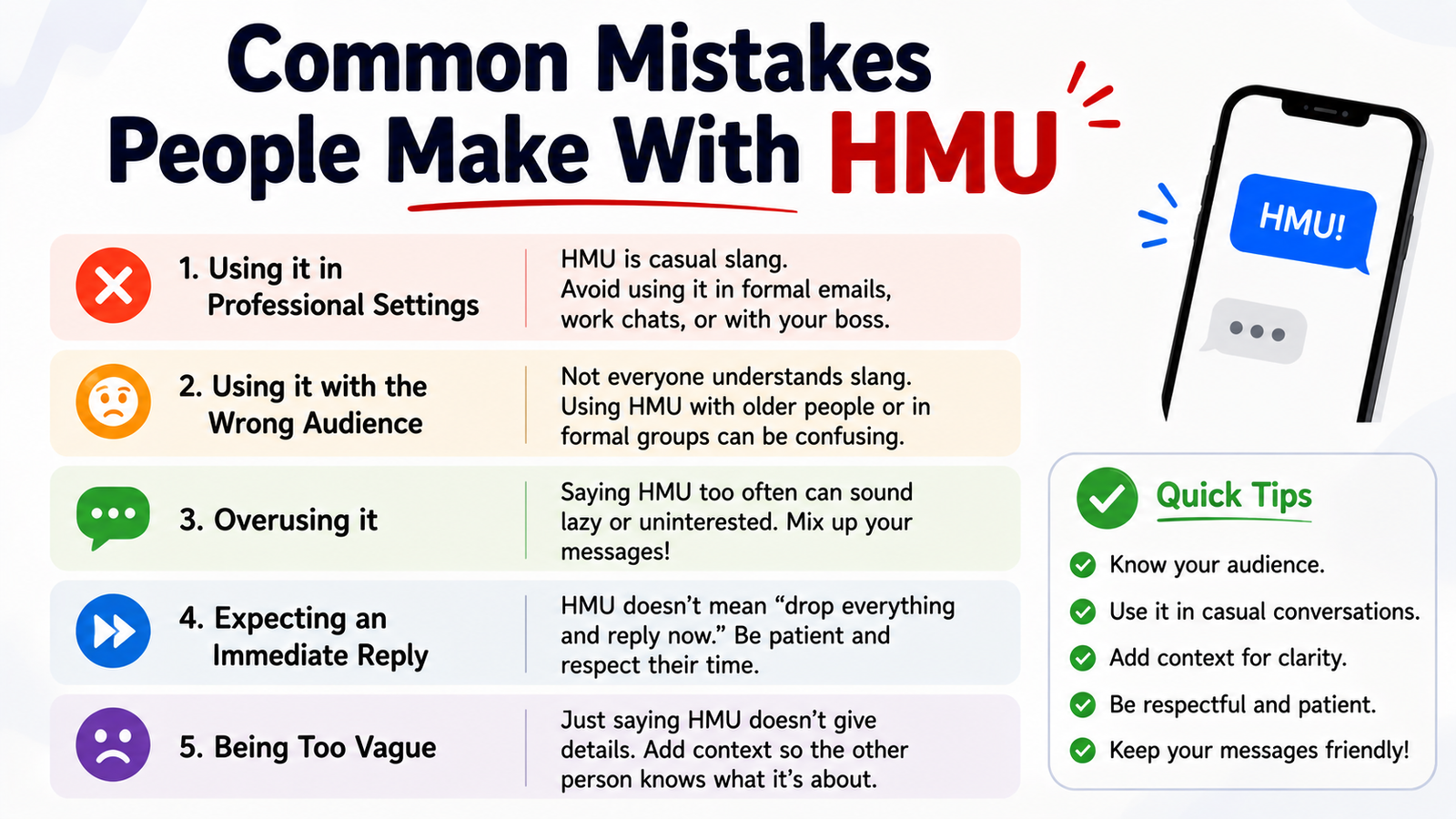
Even simple slang gets misread sometimes. Here are the most common HMU misunderstandings worth knowing about.
Mistaking It for Something Urgent
HMU is casual by nature. It’s not a distress signal, and it doesn’t imply “contact me immediately.” If someone needed urgency, they’d typically say “call me now” or “text me ASAP.” Reading panic into a relaxed HMU is one of the most frequent slang mistakes people make, especially those newer to internet slang.
Overanalyzing the Flirty Angle
Not every HMU is secretly loaded with romantic meaning. Sometimes a friend just wants to hang out. Sometimes a coworker wants to grab lunch. Assuming every HMU carries a hidden romantic subtext leads to a lot of unnecessary overthinking. Context clues (tone, history, platform) matter far more than the two words themselves.
Using It in the Wrong Setting
As covered earlier, HMU doesn’t belong in formal or professional communication. Using it in a job interview follow-up or a client email creates a mismatch between the message and the setting, which can come across as careless or unprofessional. This is one of the more common texting errors people make when they’re used to casual chat shorthand and forget to switch gears for formal situations.
Assuming It Has Multiple Hidden Meanings
HMU has one consistent meaning: hit me up. It doesn’t secretly mean something different depending on mysterious hidden rules. The flexibility comes from context, not from the phrase itself having multiple definitions. If you understand who’s saying it, where, and why, you’ll understand exactly what they mean.
FAQs
Is HMU still commonly used in 2026?
Yes, HMU remains popular across texting and platforms like Instagram, TikTok, and Snapchat, especially among Gen Z and younger millennials.
Is HMU rude or too casual for new acquaintances?
It’s not rude, but it can feel a little too casual for first-time formal contact. It works best once you’ve already exchanged a few messages.
Does HMU work the same way in group chats?
Yes, in group chats HMU usually signals an open invite to anyone interested, rather than a request aimed at one specific person.
Is there a more formal alternative to HMU for professional messages?
Yes, phrases like “reach out,” “contact me,” or “feel free to get in touch” work better for professional or formal communication.
Can HMU be used the same way across different apps like TikTok and Snapchat?
Mostly yes, though tone shifts slightly. TikTok comments tend to be more public and broad, while Snapchat use feels more personal and direct.
conclusion
So, what does HMU mean? It’s simple: “hit me up.” No hidden tricks, no confusing rules. Just a casual way to invite someone to reach out, whether that’s a friend, a match, or someone on social media.
Once you understand what does HMU mean in different settings, you’ll never second-guess it again. Context is everything. Read the tone, check the platform, and you’ll know exactly how to use it or respond to it with total confidence.







2 thoughts on “What Does HMU Mean? Simple Guide with Examples”