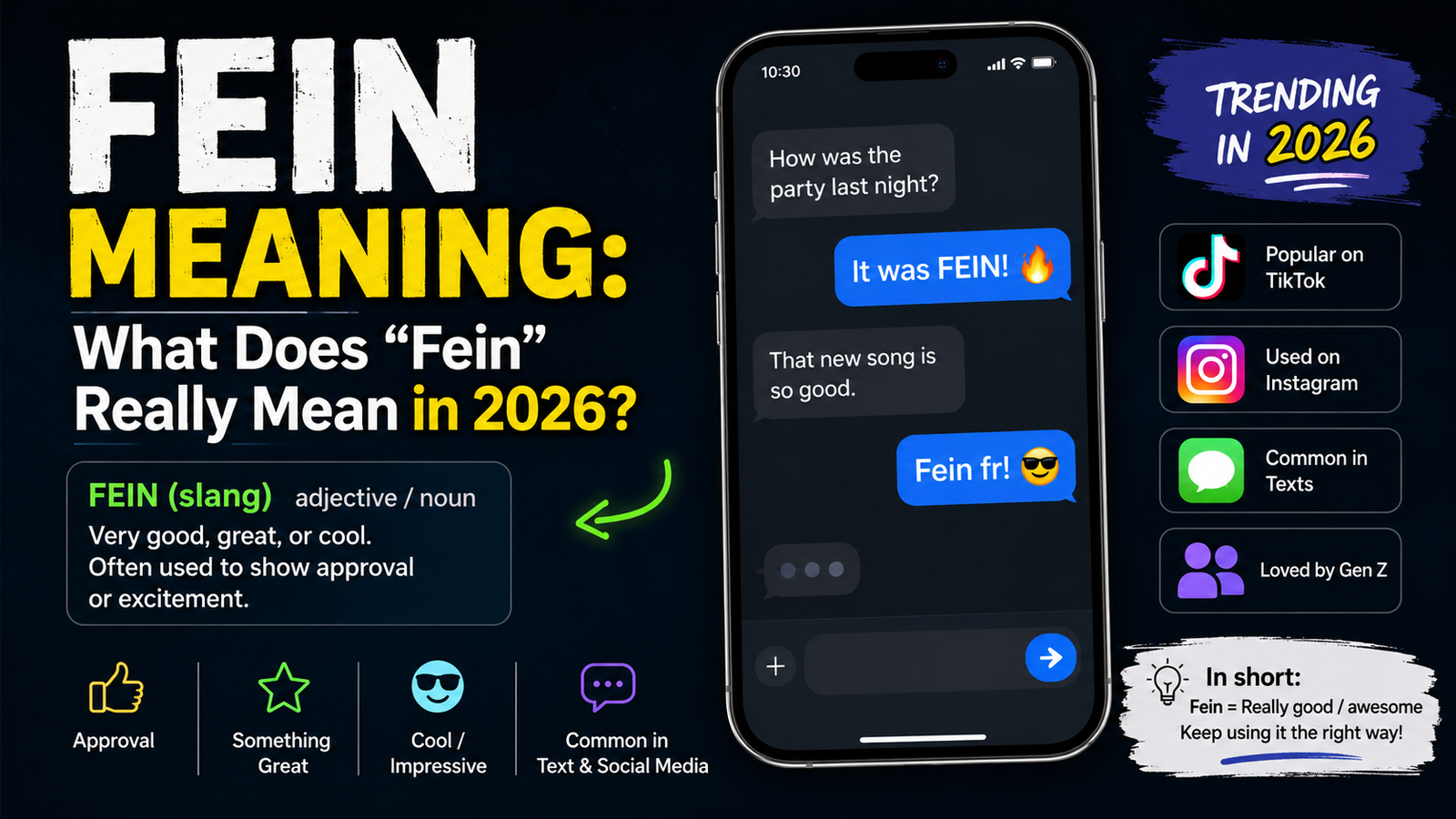
Fein meaning covers a word with four completely separate definitions: internet slang for craving something intensely, a German adjective meaning fine or refined, the Federal Employer Identification Number used on business tax forms, and a German power tool brand founded in 1867.
One word, four identities, and almost everyone typing it into a search bar only knows one of them exists.
That gap is exactly what makes this term worth unpacking. From Travis Scott’s viral track to a 150-year-old drill manufacturer, “fein” carries genuine history behind every version of it — and knowing which one applies changes how you read a text, a tax form, or a product label instantly.
Quick Answer
Here’s the direct answer, no scrolling required.
“Fein” has four distinct meanings, and which one applies depends entirely on where you saw it:
- Slang: A respelling of “fiend” or “feen,” meaning to crave something intensely or act obsessed with it. Used mostly in texts, captions, and comments.
- German word: An adjective meaning fine, delicate, refined, or high-quality.
- FEIN (acronym): Short for Federal Employer Identification Number, a business tax ID issued by the IRS.
- Fein (brand): A German power tool manufacturer, founded in 1867, known for inventing the electric hand drill and the oscillating multi-tool.
If you’re here because someone called you “a fein” online, you want the slang section below. If you’re filling out a business form, jump straight to the FEIN number section. Everyone else, keep reading — this is the full picture.
“Fein” Has Four Completely Unrelated Meanings
Before going deep on any single definition, it helps to see all four side by side. This is the key takeaway for anyone who just wants a fast comparison instead of a full article.
| Meaning | Where You’ll See It | Example | Word Origin |
|---|---|---|---|
| Craving / obsession (slang) | Texts, TikTok, Instagram, gaming chat | “I’m feinin’ for a burger right now” | Respelling of “fiend” |
| Fine / delicate / refined | German conversation, translated text | “ein feiner Wein” (a fine wine) | Old High German |
| Federal Employer Identification Number | Business tax forms, IRS paperwork | “You’ll need your FEIN to open a business bank account” | US federal tax terminology |
| Power tool brand | Product listings, hardware stores | “My Fein oscillating tool cuts through anything” | German manufacturer, founded 1867 |
Notice something important here: three of these four meanings trace back to the same German root word for “fine.” The slang usage is the outlier — it comes from a completely different word, “fiend,” and just happens to share a spelling once people started shortening it online. That coincidence is a big part of why so many people search for fein definition and get confused results mixing German dictionaries with TikTok slang glossaries.
Fein as Slang: Meaning, Origin, and How to Use It
This is almost certainly why you’re here. Fein slang dominates search interest around this word, especially among younger internet users who see it daily in captions and comments.
The Real Word Is “Fiend” — Here’s the Respelling
Strip away the internet spelling, and the word underneath is “fiend.” A fiend, in traditional English, described someone with an intense, often destructive craving — historically linked to substance addiction. That’s the heavy, serious root of this term, and it’s worth being upfront about it rather than glossing over it.
Online, “fiend” got shortened in casual speech to “feen,” and from there, spelling variations multiplied. “Fein” is one of several ways people write that same sound — you’ll also see “feenin’,” “feening,” and occasionally “fienin’.” They’re all pronounced the same way and mean the same thing. The spelling that wins out tends to shift with whatever’s trending that month, which is exactly why this word keeps resurfacing in search trends year after year.
How AAVE Shaped “Fiend” Into a Craving Word
The softened, less literal use of “fiend” has deep roots in African American Vernacular English (AAVE), where the word shifted from strictly describing addiction to describing any intense, hard-to-ignore want. This shift didn’t happen overnight, and it didn’t happen in isolation — it moved through decades of music, particularly hip-hop culture and R&B, where artists used “fiend” and “feenin'” as shorthand for desire that felt bigger than casual interest.
By the time this usage reached mainstream digital slang, the meaning had already loosened considerably. The word kept its intensity but lost most of its literal connection to substance use. That’s an important distinction: using “fein” today almost never implies real addiction. It implies strong want, dramatized for effect.
Travis Scott’s “FE!N” and the 2026 Spelling Shift
Music has repeatedly pushed slang terms into wider circulation, and this word is no exception. Travis Scott’s track “FE!N,” featuring Playboi Carti, is widely credited with pushing the “fein” spelling specifically — as opposed to “feen” or “fiend” — into mainstream captions, comments, and rap music culture more broadly.
Here’s why that spelling mattered: song titles get typed, searched, hashtagged, and quoted constantly. Once a viral track attaches itself to a specific spelling, that spelling tends to stick in a way that organic slang evolution alone rarely achieves. This is a recurring pattern in music influence on internet language — a song doesn’t invent a word, but it standardizes how millions of people type it.
Noun or Verb? Grammar and Sentence Examples
“Fein” flexes across multiple parts of speech, which is part of what makes it confusing for people encountering it for the first time.
As a verb (“to fein for” something):
- “I’m feinin’ for tacos right now.”
- “She’s been feinin’ for concert tickets all week.”
As a noun (describing a person):
- “Don’t be a fein about it.”
- “He’s such a sneaker fein.”
As a casual adjective (the “fine” crossover sense, less common but real):
- “That’s fein with me.”
This third use pulls from a totally different source — it’s closer to a playful misspelling of “fine” than anything related to “fiend.” Context is the only reliable way to tell which sense someone means, which is exactly why misreadings happen so often.
Playful vs. Harsh — How Tone Changes the Meaning
The same sentence can land completely differently depending on delivery and relationship. Calling a close friend “a fein” over their coffee habit reads as an inside joke. Calling a stranger “a fein” in their comment section can read as an insult, implying they’re desperate or embarrassing themselves.
A few rules of thumb:
- Self-directed use (“I’m feinin’ for X”) is almost always lighthearted.
- Friend-directed use tends to be playful teasing.
- Stranger-directed use carries more risk of sounding shady or dismissive.
- All-caps or exaggerated punctuation (“FEIN‼️”) usually signals hype, not hostility.
Real Examples in Texts, Captions, and Comments
Seeing the word used naturally makes the meaning click faster than any definition can. Here are real examples across different platforms and contexts:
- Text message: “omg I’m feinin’ for pizza rn, you down?”
- Instagram caption: “feening for summer already 🥵”
- TikTok comment: “the way I’m feinin’ for part 2 of this story”
- Gaming chat: “bro’s feinin’ for that new skin drop”
- Group chat, self-aware use: “ok I’ll admit it, I’m a certified iced coffee fein”
Every one of these swaps could use “obsessed” or “craving” instead, and the sentence would still make sense — which tells you exactly how the word is functioning in each case.
Mini Case Study: How One Song Moved a Spelling Across a Whole Trend Cycle
It’s worth walking through the mechanics of how a single spelling variant took over, because it’s a pattern that repeats with almost every viral slang term. Before “FE!N” existed as a song title, “feen” and “feenin'” were already common in casual speech and older hip-hop lyrics — the craving meaning wasn’t new. What changed was the typing behavior.
Once a viral track with that title started circulating, people typing captions, hashtags, and comments about the song had to type the title itself, over and over, thousands of times a day. Hashtags don’t tolerate inconsistent spelling well — a fragmented hashtag spreads slower than a unified one. So the song’s exact spelling, “FE!N,” got simplified in everyday typing to “fein,” and that simplified version carried over into unrelated sentences that had nothing to do with the song at all.
This is the same mechanism that’s pushed other slang spellings into dominance before: a piece of media standardizes a spelling through sheer repetition, and search engines, autocomplete, and algorithmic recommendation systems reinforce whichever version gets typed most. Within a few months, “fein” had outpaced “feen” and “feenin'” in general search volume — not because it’s a more logical spelling, but because it had a song attached to it that millions of people were already typing.
Common Mix-Ups: Fein vs. Fiend vs. Feign vs. Fine
Word confusion around this term isn’t limited to its four core meanings — it also gets tangled up with words that just look similar. This is one of the most common spelling mistakes people make, and it’s worth clearing up directly.
| Word | Meaning | Part of Speech | Example |
|---|---|---|---|
| Fein | Slang for craving/obsession, or the German/brand/tax-ID meanings | Noun, verb, adjective (context-dependent) | “I’m feinin’ for that new drop” |
| Fiend | The original word — intense craving, historically tied to addiction | Noun | “He was a fiend for attention” |
| Feign | To pretend or fake something | Verb | “She feigned surprise at the news” |
| Fine | Okay, acceptable, or high-quality | Adjective | “I’m fine, thanks” |
Fiend vs. fein is straightforward: same word, different spelling, same meaning. One is the traditional form, the other is the internet-native respelling.
Feign vs. fein is the pairing that actually causes real misunderstandings, because the words sound nothing alike when spoken carefully but get typo’d into each other constantly. “Feign” means to fake or pretend — “he feigned interest in the meeting.” It shares zero etymological connection to “fein” in any of its four senses. If you’ve seen a claim online that “fein means to pretend,” that claim is almost certainly a mixed-up reference to “feign,” not an actual alternate meaning of “fein.”
Fein in German: The Original Meaning
Step outside slang entirely, and “fein” is simply a German word with a long, unremarkable history in the language. It means fine, delicate, refined, or high-quality, depending on context — closely related in feeling to how English speakers use “fine” to describe something well-made or of good quality.
A few natural examples from the German language:
- “Ein feiner Wein” — a fine wine
- “Feines Gefühl” — a delicate/refined feeling or sensitivity
- “Fein gemacht!” — well done! (literally “finely made/done”)
This adjective has existed in German for centuries, tracing back to Old High German roots shared with other Germanic languages. It carries none of the craving or obsession implied by the slang usage — this is the calm, formal cousin of the word, and it’s the actual etymological root behind both meanings that follow.
It’s also worth noting that “fein” shows up as a genuine German surname, unrelated to any of the meanings above except by shared spelling. Anyone doing genealogy research or reading translated German text may run into the name attached to real people, entirely separate from the adjective, the brand, or the American tax acronym. Context — a capital letter starting a sentence versus a name in a family tree — usually makes the distinction obvious.
For anyone learning German, this word is a useful one to know early, since it appears constantly in everyday conversation, restaurant reviews, and product descriptions. A German speaker complimenting food might say “das schmeckt fein” (that tastes fine/delicate), while someone describing craftsmanship might say a piece of furniture is “fein verarbeitet” (finely made/crafted). None of these carry any hint of craving or obsession — the German meaning and the English slang meaning are, for all practical purposes, two unrelated words that happen to be spelled identically.
FEIN — Federal Employer Identification Number
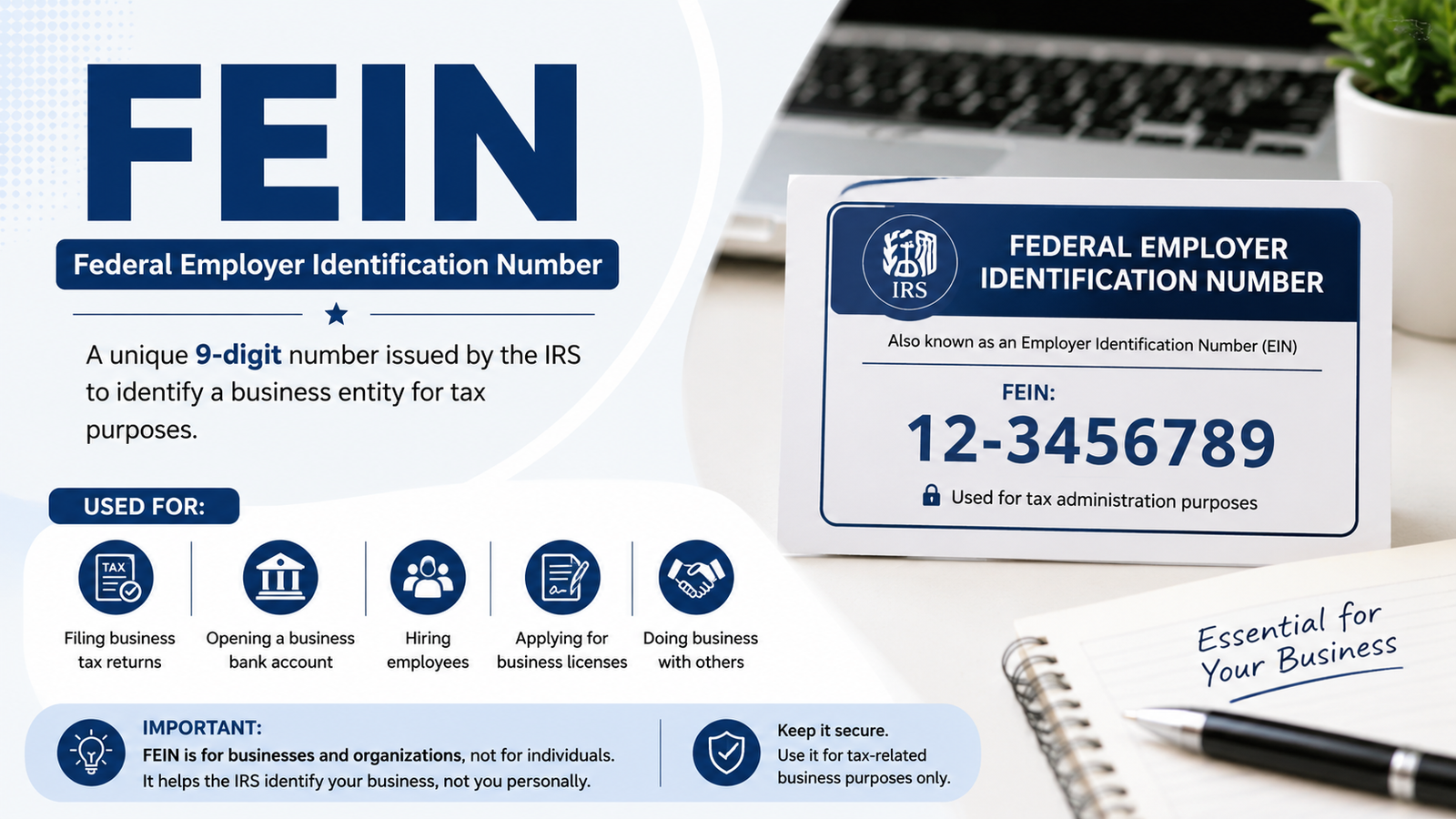
Switch contexts entirely again, and “FEIN” stands for the Federal Employer Identification Number — a nine-digit number the IRS issues to identify business entities for tax purposes. This is standard business communication and workplace language in the US, with no connection whatsoever to slang or German.
FEIN vs. EIN vs. SSN vs. ITIN
If you’ve run into this acronym, you’ve probably also run into a pile of similar-looking ones. Here’s the actual distinction:
| Term | Full Name | Who It’s For |
|---|---|---|
| FEIN | Federal Employer Identification Number | Businesses (emphasizes “federal”) |
| EIN | Employer Identification Number | Businesses (same number, more commonly used term) |
| SSN | Social Security Number | Individuals |
| ITIN | Individual Taxpayer Identification Number | Individuals who need a tax ID but aren’t eligible for an SSN |
The important thing to understand: FEIN and EIN are the same number. “FEIN” simply emphasizes the federal origin of the ID, while “EIN” is the term used more often in everyday business speech. Businesses, banks, and government agencies use these terms interchangeably without any functional difference.
Who Needs a FEIN and How to Get One
Most business structures need this business tax number, including:
- Corporations and partnerships
- LLCs with employees
- Nonprofits, estates, and trusts
- Sole proprietors who hire staff
Sole proprietors with no employees often use their own Social Security Number instead and may not need a separate FEIN. To apply, businesses file Form SS-4, which can be submitted online through the IRS website, by mail, or by fax — with online applications processing fastest. There’s no charge to apply, and once issued, a FEIN doesn’t expire under normal circumstances.
Why a FEIN Matters Beyond Tax Filing
Business owners sometimes assume a FEIN only matters at tax time, but its role stretches further than that. Banks require it to open a business checking or savings account. Payroll providers need it to process employee wages and withholdings correctly. States often require it to register for state-level tax accounts, even though states don’t issue their own version of the number — only the IRS does that. Landlords and vendors sometimes ask for it as informal proof that a business is a real, registered entity rather than an unregistered side hustle.
A FEIN is generally permanent for the life of a business, similar to how a Social Security Number stays with a person for life. The main exception is a significant structural change — converting a sole proprietorship into a corporation, for example, or merging with another entity — which can trigger the need for a new number. Outside of those specific situations, a business keeps the same FEIN from formation through closure, and it never needs to be renewed.
Fein GmbH — The German Power Tool Brand
The fourth meaning belongs to an actual company: C. & E. Fein GmbH, a German industrial brand and power tool brand headquartered near Stuttgart. This one deserves real detail, because it’s a business with genuine engineering history behind it — not just a name that happens to match.
Company Facts
| Detail | Information |
|---|---|
| Founded | 1867 |
| Founders | Wilhelm Emil Fein and Carl Fein |
| Headquarters | Near Stuttgart, Germany |
| Known for | Electric hand drill, oscillating multi-tool |
| Employees | Roughly 900 |
Wilhelm Emil Fein and his brother Carl started the company as a workshop for electrical and mechanical apparatus — not as a tool company at all. Their early work involved telephone equipment and fire alarm systems, including a system installed across the city of Stuttgart in the 1870s.
The Invention That Made Fein Famous
In 1895, the company built the world’s first electric hand drill, combining a hand drill with a compact electric motor. That single invention effectively created the modern electric tools category, and it’s the reason Fein is often cited as the oldest continuously operating power tool brand still in business.
The Oscillating Tool: A Case Study in Unexpected Innovation
Here’s a genuinely interesting case study buried in Fein’s history. In 1967 — exactly a century after the company was founded — Fein engineers developed an oscillating tool for an unlikely purpose: cutting hard plaster casts off patients without injuring their skin underneath. The oscillating motion could cut rigid material while stopping short of soft tissue.
Decades later, in 1985, Fein adapted that same oscillating technology for the automotive industry, creating a tool that could safely cut out car windows bonded in place with silicone. That automotive tool evolved into the Fein MultiMaster, a premium multi-purpose tool that stayed exclusive to Fein for years — until the company’s patent on the oscillating mechanism expired in 2009. After that, competitors including Bosch, Milwaukee, and Dremel released their own versions, and the oscillating multi-tool became a standard category across the entire power tool industry.
That’s the full arc: a medical tool for cast removal became one of the most common tools in any tradesperson’s kit today, all traceable back to one German manufacturer’s willingness to repurpose an idea across completely different industries.
Where You’ll See “Fein” Used (Platform Breakdown)
The slang sense of this word lives almost entirely in social media and casual digital spaces. Here’s where it shows up most, and how usage shifts slightly by platform.
TikTok: Captions and comment sections are the biggest driver of this word’s current visibility. Short-form video thrives on exaggerated, punchy language, and “fein” delivers a full emotional beat in one syllable.
Instagram: Common in captions expressing hype or desire — “feening for this weather,” “feening for that drop” — and frequently used in a joking, self-deprecating way in comments.
Snapchat: Less publicly visible than TikTok or Instagram since content is more private, but the word shows up regularly in captions and direct messages between friends, often in its most casual, unfiltered form.
Text messages: Typically used between people who already share slang fluency — it reads as familiar and low-effort by design, which is part of its appeal in casual texting.
Gaming chat: Used to describe obsessive want around in-game items, skins, or drops — “he’s feinin’ for that new gun skin” is a completely normal sentence in gaming communities.
Why This Word Fits Online Slang So Well
Short, expressive, and endlessly meme-able — that’s the exact combination that makes a slang term spread through online slang ecosystems and viral trends. “Fein” packs an entire emotional statement (I want this so badly it’s almost embarrassing) into a single syllable, and that efficiency matters enormously on platforms built around character limits, quick captions, and fast scrolling. Words that require explanation don’t spread. Words you can drop into any sentence without breaking stride do.
How to Respond If Someone Calls You a “Fein”
Getting called “a fein” can feel ambiguous in the moment, especially from someone you don’t know well. Reading the tone correctly matters more than the label itself.
If it’s clearly playful (emojis, exclamation points, a joking context):
- Lean into it: “guilty as charged 😂”
- Turn it around: “and proud of it”
If it’s ambiguous:
- Ask directly, lightly: “in a good way or a concerning way? 😅”
- Deflect with humor: “we all got our thing”
If it reads harsh or dismissive:
- A flat, confident response works best: “okay, and?”
- Or simply don’t engage — not every comment needs a reply
The word itself isn’t inherently negative. It’s closer to being called “obsessed” than being called something genuinely insulting, which is why most responses can stay light rather than defensive.
Fein vs. Similar Slang: Simp, Thirsty, Obsessed, Down Bad
Similar slang terms often get lumped together, but they don’t mean exactly the same thing. Here’s how “fein” compares to its closest relatives.
| Term | Intensity | Tone | Typical Context |
|---|---|---|---|
| Fein / Feenin’ | High | Hype, self-aware, sometimes teasing | Any object of craving — food, items, experiences, attention |
| Simp | Moderate to high | Often mocking | Specifically romantic devotion, usually one-sided |
| Thirsty | Moderate | Judgmental or teasing | Seeking attention, often romantic or validation-seeking |
| Down bad | High | Dramatic, self-aware | Romantic obsession specifically, often used self-deprecatingly |
| Obsessed | Moderate to high | Neutral to enthusiastic | General intense interest, least slangy of the group |
The key difference: “fein” applies broadly to anything — food, merch, a song, a concert, attention, a person. “Simp,” “thirsty,” and “down bad” skew almost entirely romantic. “Obsessed” is the most neutral and formal-adjacent term of the group, which makes it the safest substitute in situations where slang doesn’t quite fit.
Should You Use “Fein” in Professional or Formal Writing?
Short answer: not the slang version. In professional writing and formal writing, “I’m feinin’ for this project” reads as a jarring register mismatch — it signals casual internet fluency in a context that expects polish, and it can undercut credibility regardless of how accurate the sentiment is.
Safer professional usage alternatives:
- “I’m eager to start this project” instead of “I’m feinin’ to start”
- “The team is highly motivated” instead of “the team is feinin'”
- “I’m looking forward to the results” instead of “I’m feinin’ for the results”
That said, the other three meanings of this word are completely standard in professional and formal contexts:
- Referencing the German word “fein” in a translation, linguistics, or language-learning context is entirely appropriate.
- Referencing a FEIN number in tax, HR, or business formation documents is not just appropriate — it’s required terminology.
- Referencing the Fein GmbH brand in a hardware, construction, or manufacturing context is standard industry language.
The rule isn’t “avoid the word fein in professional settings.” It’s “avoid the slang sense specifically,” since that’s the only one that carries a casual, internet-native tone.
Is “Fein” Still Relevant in 2026?
Slang has a notoriously short shelf life, and plenty of terms that felt inescapable one year vanish from casual conversation within twelve months. This word has shown more staying power than most, largely because of how flexible it is — it works as a noun, a verb, and an adjective, and it applies to virtually any object of desire rather than being locked into one narrow use case.
A few factors keeping it active:
- Continued platform usage: It remains common across TikTok, Instagram, and gaming chats rather than fading to a single platform.
- Music reinforcement: Songs referencing “feenin'” or “fein” keep resurfacing the spelling in new contexts.
- Low replacement pressure: No single competing term has fully displaced it the way some slang gets replaced by newer coinages.
Slang terms with this kind of flexibility — applicable across food, entertainment, shopping, gaming, and social attention all at once — tend to persist longer than narrower terms tied to one specific trend or meme format. That flexibility is the best predictor of continued relevance going forward, more than any single viral moment.
FAQs
Does calling someone “a fein” count as an insult?
Not usually. It’s typically playful or self-aware rather than genuinely negative, though tone and relationship context still matter.
Is “fein” a noun, verb, or adjective?
All three. It works as a verb (“feenin’ for pizza”), a noun (“he’s a fein”), and occasionally a casual adjective meaning “fine.”
How do “fein” and “feign” differ?
They’re unrelated. “Fein” relates to craving, German, or business terms; “feign” means to pretend or fake something.
Should “fein” be used in professional writing?
Not the slang version — it reads as too casual for formal writing. The German, FEIN-number, and brand-name uses remain perfectly appropriate.
Who founded the Fein power tool brand?
Brothers Wilhelm Emil Fein and Carl Fein founded the company in 1867 near Stuttgart, Germany, later inventing the electric hand drill.
conclusion
Fein meaning isn’t just one thing. It’s four separate words that happen to share a spelling. Slang, German, a tax number, and a power tool brand — each one stands on its own. Context is the only clue you need. Once you spot where the word shows up, the right meaning becomes obvious.
That’s the real value of understanding fein meaning clearly. You won’t mix up a text message with a tax form again. You’ll know when to use it, and when to avoid it. Small words like this carry more history than people expect. Now you know all of it.









1 thought on “Fein Meaning: What Does “Fein” Really Mean in 2026?”