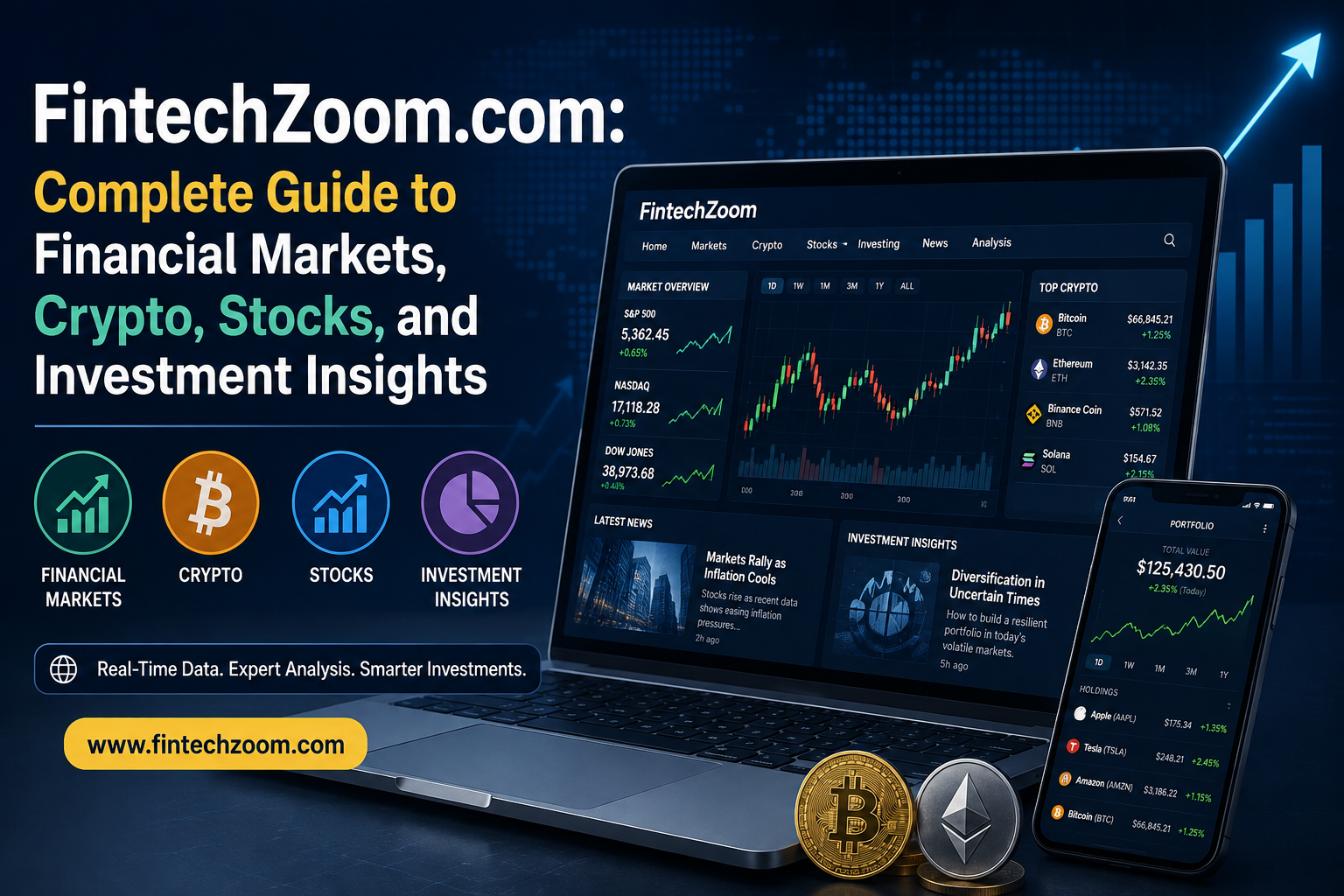
FintechZoom.com is a financial media platform that delivers news, analysis, and real-time coverage across stocks, cryptocurrency, forex, and commodities markets. It functions as an information hub rather than a trading platform, giving readers context behind market movements instead of just raw numbers.
Picture checking five different sites before your morning coffee even finishes brewing — one for Bitcoin, another for the Nasdaq, a third for gold prices. FintechZoom.com collapses that scramble into a single, fast-loading destination built for people who want clarity, not chaos.
Beyond daily price tracking, the platform digs into fintech industry trends, banking innovations, and the regulatory shifts shaping digital assets. That breadth makes it a genuinely useful starting point for beginners and seasoned investors alike, without the paywalls typical of professional-grade financial terminals.
What Is FintechZoom.com?
At its core, FintechZoom.com is a financial news site that aggregates and analyzes information across stocks, crypto, forex, commodities, and the broader fintech industry. Think of it less as a trading platform and more as a finance website built for people who want context, not just raw numbers.
That distinction matters. A lot of newcomers assume FintechZoom lets you buy and sell assets directly. It doesn’t. You can’t execute a trade there. What you can do is read market commentary, track price movement, follow breaking financial news, and get a general sense of what’s driving a stock, a coin, or an index on any given day.
Platform Overview
The site organizes its content into distinct verticals — stocks, crypto, forex, commodities, business, and personal finance — each with its own landing page and running feed of updates. This kind of structure is common across modern finance websites, and it works well because it lets a reader jump straight to the category they care about instead of scrolling through an undifferentiated news feed.
Here’s the practical upside: instead of bouncing between five or six different sources to check on your portfolio’s various asset classes, you get one dashboard-style entry point.
What FintechZoom.com Is Not
Before going further, it’s worth being direct about scope:
- It is not a licensed brokerage or trading platform
- It is not a registered investment advisor
- It does not execute trades or hold customer funds
- It should not be your only source before making major portfolio decisions
Keep that in mind as you read the rest of this guide. Everything below describes an information resource, not a financial advisory service.
Stock Market Coverage
Stock market coverage is one of FintechZoom’s most heavily trafficked categories, and for good reason — it’s where a huge share of retail investors start their day.
Major Indices
The platform tracks the major US market indices that most investors watch as a barometer for overall market health:
| Index | What It Tracks | Why Investors Watch It |
|---|---|---|
| Nasdaq | Tech-heavy composite index | Leading indicator for tech and growth stocks |
| Dow Jones Industrial Average | 30 large-cap “blue chip” companies | Broad snapshot of industrial and established firms |
| S&P 500 | 500 largest US public companies | Most widely used benchmark for the overall market |
| Russell 2000 | Small-cap US companies | Gauge of small-business and domestic economic health |
Each index page typically pairs the current number with short-form commentary explaining why it moved — a Fed rate decision, an earnings surprise, a geopolitical event. That context is genuinely useful, since a raw number on its own tells you very little.
Earnings and Company News
Beyond the indices, you’ll find coverage of individual company earnings, corporate announcements, and sector-specific trends. For investors who already understand the basics of equity markets, this layer of coverage is where the real value sits — not in the headline number, but in the explanation of what’s moving it.
Quick fact: Earnings season happens four times a year, typically starting a few weeks after each quarter closes (January, April, July, and October). Financial news sites tend to see their heaviest stock-related traffic during these windows, which is why coverage volume noticeably spikes then.
Sector and Trend Coverage
Stock coverage isn’t limited to single companies. Good stock analysis also tracks sector rotation — the tendency of money to flow from one industry into another as economic conditions shift. Tech, energy, healthcare, and financials each behave differently depending on interest rates, inflation, and consumer spending, and tracking those patterns is part of building a genuinely informed view of the market.
Cryptocurrency Coverage
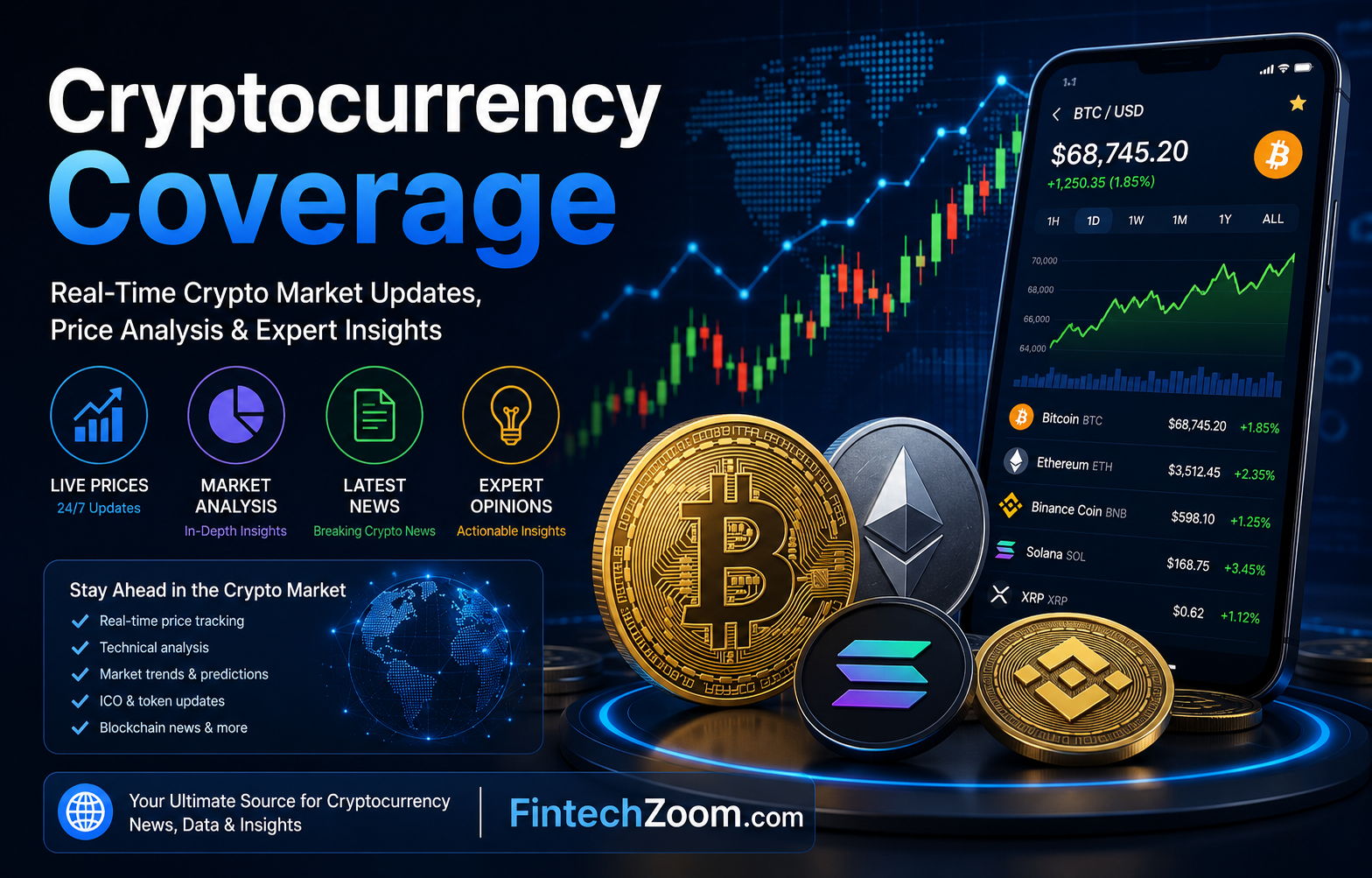
If stocks are the entry point, crypto is arguably where FintechZoom.com built its identity. Cryptocurrency coverage on the platform spans price tracking, regulatory news, and broader blockchain analysis.
Bitcoin and Ethereum Tracking
Bitcoin remains the most-watched digital asset by a wide margin, and it’s treated that way here. Bitcoin news and Bitcoin research typically cover:
- Real-time and historical price movement
- Halving cycles and their historical effect on price
- Institutional adoption (ETFs, corporate treasury holdings)
- Mining difficulty and network activity
Ethereum tracking gets similar treatment, with added focus on network upgrades, gas fees, and its role as the backbone of most DeFi activity.
“Cryptocurrency is no longer a fringe interest — it’s treated with the same seriousness as traditional equity markets.” — a sentiment echoed across most modern financial media coverage of digital assets in 2026.
Altcoins, DeFi, and Blockchain News
Beyond the two dominant coins, coverage extends into altcoins, decentralized finance protocols, and general blockchain news. This is where things get more speculative, and it’s worth treating this coverage with a bit more caution than the Bitcoin and Ethereum sections — smaller-cap crypto assets are dramatically more volatile and far more prone to manipulation.
Regulatory and Institutional Adoption Coverage
One of the more useful threads running through crypto coverage on sites like this is cryptocurrency analysis tied to regulation. Government policy has an outsized effect on digital asset prices, and tracking things like SEC actions, ETF approvals, and international regulatory shifts is genuinely important investment research — arguably more important than most day-to-day price commentary.
Key crypto metrics worth understanding:
- Market capitalization — total value of a coin (price × circulating supply)
- Trading volume — how much of an asset changed hands in a given period
- Liquidity — how easily an asset can be bought/sold without moving the price
- Dominance — Bitcoin’s share of total crypto market cap, often used as a risk sentiment gauge
Understanding these four numbers will get you further in crypto research than watching the price chart alone.
Commodities and Forex Markets
Rounding out the core markets coverage, FintechZoom.com also tracks commodities and currency markets — two categories that often get less attention from casual investors but matter enormously to the global markets picture.
Commodities Market
Commodities coverage typically centers on:
- Gold — the classic safe-haven asset, closely watched during inflation or geopolitical uncertainty
- Oil (WTI and Brent crude) — a bellwether for global economic activity and a major input into inflation data
- Silver, natural gas, and agricultural commodities — more niche, but relevant for sector-specific investors
Commodity prices tend to move on a different rhythm than stocks. They’re driven more by supply chains, geopolitics, and physical demand than by earnings reports or investor sentiment, which makes them a useful diversification signal when you’re reading the broader economic markets picture.
Forex Market
Forex market coverage focuses on currency pair movement — most commonly majors like EUR/USD, USD/JPY, and GBP/USD. Currency markets react heavily to:
- Central bank interest rate decisions
- Inflation and employment data
- Political stability and trade policy
- Relative economic strength between countries
For most retail readers, forex coverage functions less as a trading signal and more as a macroeconomic thermometer — currency strength or weakness tells you a lot about how a country’s economy is actually performing relative to its peers.
Banking, Loans, and Personal Finance
This is a category that a lot of competing guides skip over, but it’s genuinely important. Banking loans and personal finance content sits right alongside the market-focused coverage, and it tends to cover:
- Mortgage rate trends and what drives them
- Personal loan comparisons and general consumer finance guidance
- Digital banking tools and neobank trends
- Credit and savings account information
This content serves a different reader than the stock and crypto sections do. Where market coverage tends to attract active investors and traders, personal finance content tends to reach people making household-level financial decisions — refinancing a mortgage, comparing loan rates, or choosing between traditional and digital-first banks.
Why this matters for the platform as a whole: it broadens the audience considerably. Not everyone reading a finance website is trying to time the Nasdaq — plenty of readers just want to understand whether now’s a good time to refinance, or how a new digital banking app actually works.
Business and Fintech Industry News
Given the platform’s name, it makes sense that financial technology trends get dedicated coverage. This category tends to run a level above day-to-day market movement, focusing instead on the structural shifts reshaping the industry.
Startup and Funding Coverage
Fintech is one of the most heavily funded startup categories globally, and tracking funding rounds gives a useful read on where capital — and innovation — is heading. Coverage in this space typically includes:
- Venture funding rounds for fintech startups
- Notable acquisitions and mergers in the sector
- Emerging companies to watch in payments, lending, and digital banking
AI, Payments, and Digital Banking Trends
AI in finance has become one of the defining stories of the past few years, and it shows up constantly in fintech coverage — fraud detection, algorithmic trading, robo-advisory services, and customer service automation are all areas where payment technology and machine learning increasingly overlap.
A few structural trends shaping fintech right now:
- Embedded finance — financial services (like lending or payments) built directly into non-financial apps
- Open banking — regulatory frameworks that let third-party apps securely access bank data with user consent
- Real-time payments — infrastructure enabling instant transfers, replacing multi-day settlement windows
- AI-driven risk scoring — using machine learning models instead of purely traditional credit scoring
Following this layer of coverage is genuinely useful even if you’re not actively investing in fintech stocks, since these shifts eventually filter down into the everyday banking tools most people use.
How to Actually Use FintechZoom.com for Market Research
Reading about a platform’s coverage is one thing. Actually using it effectively for market research is another. Here’s a practical workflow.
A Step-by-Step Research Workflow
- Start with the category page, not the homepage. If you’re researching crypto, go straight to the crypto section rather than scrolling a mixed feed.
- Read the context, not just the number. A price or index value alone tells you almost nothing — read the accompanying analysis for the “why.”
- Cross-reference the date. Financial commentary ages fast. A three-day-old article about a rate decision may already be outdated.
- Check the underlying source. If an article references a specific data point (earnings figures, economic data), look for where that number originally came from.
- Compare against at least one other source before treating anything as a final answer. This is standard practice for financial research generally, not a knock against any one site.
Using FintechZoom for Crypto Research Specifically
Crypto research benefits from a slightly different approach than stock research, mainly because the asset class is younger, more volatile, and more prone to hype cycles. When reading cryptocurrency analysis anywhere — FintechZoom included — it helps to separate three distinct things:
- Price commentary (short-term, sentiment-driven)
- On-chain and adoption data (longer-term, harder to fake)
- Regulatory developments (often the most durable signal of all)
Weighing regulatory and adoption news more heavily than short-term price commentary tends to produce better long-term investing strategy decisions than reacting to daily price swings.
Pairing It With Other Tools
No single finance website should be your entire research tools stack. A sensible setup for most retail investors looks something like this:
| Purpose | Tool Type | Example |
|---|---|---|
| Fast market overview | Aggregator/news site | FintechZoom.com |
| Deep charting and technical analysis | Charting platform | TradingView |
| Trade execution | Brokerage | Your chosen broker’s platform |
| Primary source verification | Regulatory filings | SEC EDGAR, company investor relations pages |
| Professional-grade data | Terminal | Bloomberg Terminal (institutional use) |
The point of this stack isn’t redundancy for its own sake — it’s that each research tools category is optimized for a different job. News aggregators are fast but shallow by design. Terminals are deep but expensive and complex. Using the right layer for the right task is what separates casual browsing from actual investment research.
Is FintechZoom.com Reliable for Investment Decisions?
This is the question that actually matters most, so let’s address it directly and honestly.
Strengths
- Breadth of coverage — few free sites cover stocks, crypto, forex, and commodities under one roof
- Accessibility — no paywall for core content, unlike many professional-grade financial terminals
- Update frequency — markets move fast, and aggregator sites are generally well-suited to keeping pace
- Approachable explanations — complex movements get translated into plain-language context, useful for less experienced readers
Limitations Worth Knowing
- It’s not personalized advice. General market commentary can’t account for your specific financial situation, risk tolerance, or goals.
- It’s not a primary source. Numbers and claims should ideally be cross-checked against original filings, exchange data, or official releases.
- Aggregators can lag actual events. By the time commentary is published, market conditions may have already shifted.
- Free content models can create incentives toward high-volume publishing, which sometimes trades depth for speed. This isn’t unique to FintechZoom — it’s a structural pattern across the entire financial news site category.
A Note on Lookalike and Copycat Sites
This part deserves real attention, because it’s a genuine, practical issue rather than a generic disclaimer. There are currently multiple sites operating with near-identical names and templated content designed to mimic FintechZoom.com — subtle misspellings, alternate domain extensions, and copy-pasted “About” pages are common patterns in this space.
Before trusting any page claiming to be FintechZoom, check:
- The exact domain spelling — copycats often use extra letters or hyphens
- Whether the “About” content reads like it was templated across dozens of unrelated sites
- Whether the site is pushing you toward a third-party trading signup rather than just providing information
This is a broader problem across the financial platforms space generally — high-traffic finance brands attract imitators because financial keywords carry high advertising value. Treat it as a standard due-diligence step, not a one-off warning.
FintechZoom.com vs. Other Financial Platforms
How does this platform actually stack up against the alternatives? It depends heavily on what you’re trying to do.
vs. Traditional Financial News Sites
Compared to established outlets like Reuters, Bloomberg’s public site, or CNBC, aggregator-style finance websites tend to trade editorial depth for speed and accessibility. Traditional outlets generally have larger newsrooms, deeper investigative resources, and more rigorous editorial standards — but often present information in a denser, more jargon-heavy format that’s less approachable for casual readers.
vs. Professional Market Tools
This comparison isn’t really close, and it isn’t meant to be — the two categories serve different purposes entirely.
| Feature | Aggregator Sites (e.g., FintechZoom) | Professional Tools (e.g., Bloomberg Terminal, TradingView Pro) |
|---|---|---|
| Cost | Free | $20–$2,000+/month depending on tier |
| Data depth | Headline-level, context-focused | Institutional-grade, granular |
| Speed of raw data | Near real-time, slight delay common | True real-time, direct exchange feeds |
| Target user | Retail investors, casual readers | Professional traders, institutions |
| Trade execution | None | Often integrated |
| Learning curve | Low | Moderate to steep |
TradingView Pro and the Bloomberg Terminal exist to serve professional traders who need microsecond-level data and integrated execution. A free aggregator site simply isn’t competing in that category — and honestly, most retail readers don’t need that level of tooling anyway.
vs. Broker-Native Research Tools
Many modern brokerages (Fidelity, Schwab, Interactive Brokers, etc.) now bundle their own research dashboards directly into their trading apps. These tend to offer tighter integration between research and execution but often narrower coverage outside of what’s directly tradeable on that platform. Aggregator sites, by contrast, cover a wider net — crypto, forex, and commodities alongside stocks — without being tied to any single broker’s product lineup.
Who Should Use FintechZoom.com?
Not every reader needs the same thing from a financial news site. Here’s how different user types tend to get value from it.
Beginners
For anyone newer to investing, the appeal is straightforward: plain-language explanations without a steep learning curve. Beginners generally benefit most from the context-driven commentary — the “why” behind a price move — more than from raw data itself.
Active Investors and Traders
More experienced investors tend to use aggregator sites as a fast morning-scan tool: check overnight moves, catch any breaking news, then move into deeper charting or execution tools. It rarely functions as the only stop in an active trader’s research process, but it’s a reasonable first layer.
Business and Fintech Professionals
For people working inside the fintech industry itself — whether at a startup, a bank, or an investment firm — the business and industry-trend coverage tends to matter more than the day-to-day price data. Tracking financial innovation, funding rounds, and regulatory shifts is directly relevant to product and strategy decisions in ways that a Nasdaq quote isn’t.
FAQs
Is FintechZoom.com free to use?
Yes, its core news and market coverage are freely accessible without a subscription or paywall.
Does FintechZoom.com let me buy or sell stocks and crypto?
No, it’s a financial news and information platform, not a brokerage — you’ll need a separate exchange or broker account to trade.
Is FintechZoom.com a licensed financial advisor?
No, it provides general market information and analysis, not personalized or regulated investment advice.
How often is FintechZoom.com’s market data updated?
Prices and news are updated frequently throughout the trading day, though with a slight delay compared to real-time institutional data feeds.
Are there fake or copycat versions of FintechZoom.com?
Yes, several lookalike domains with near-identical names exist, so it’s worth double-checking the exact URL before trusting a page.
conclusion
FintechZoom.com makes financial markets easier to follow. It brings stocks, crypto, forex, and commodities into one simple place. You don’t need to jump between five different sites anymore. For beginners and busy investors alike, FintechZoom offers a fast and clear starting point.
Still, treat FintechZoom as a first step, not the final word. Always check other sources before big money decisions. Watch out for copycat sites too. Used the right way, FintechZoom stays a handy tool for anyone who wants to stay informed and make smarter investment choices.