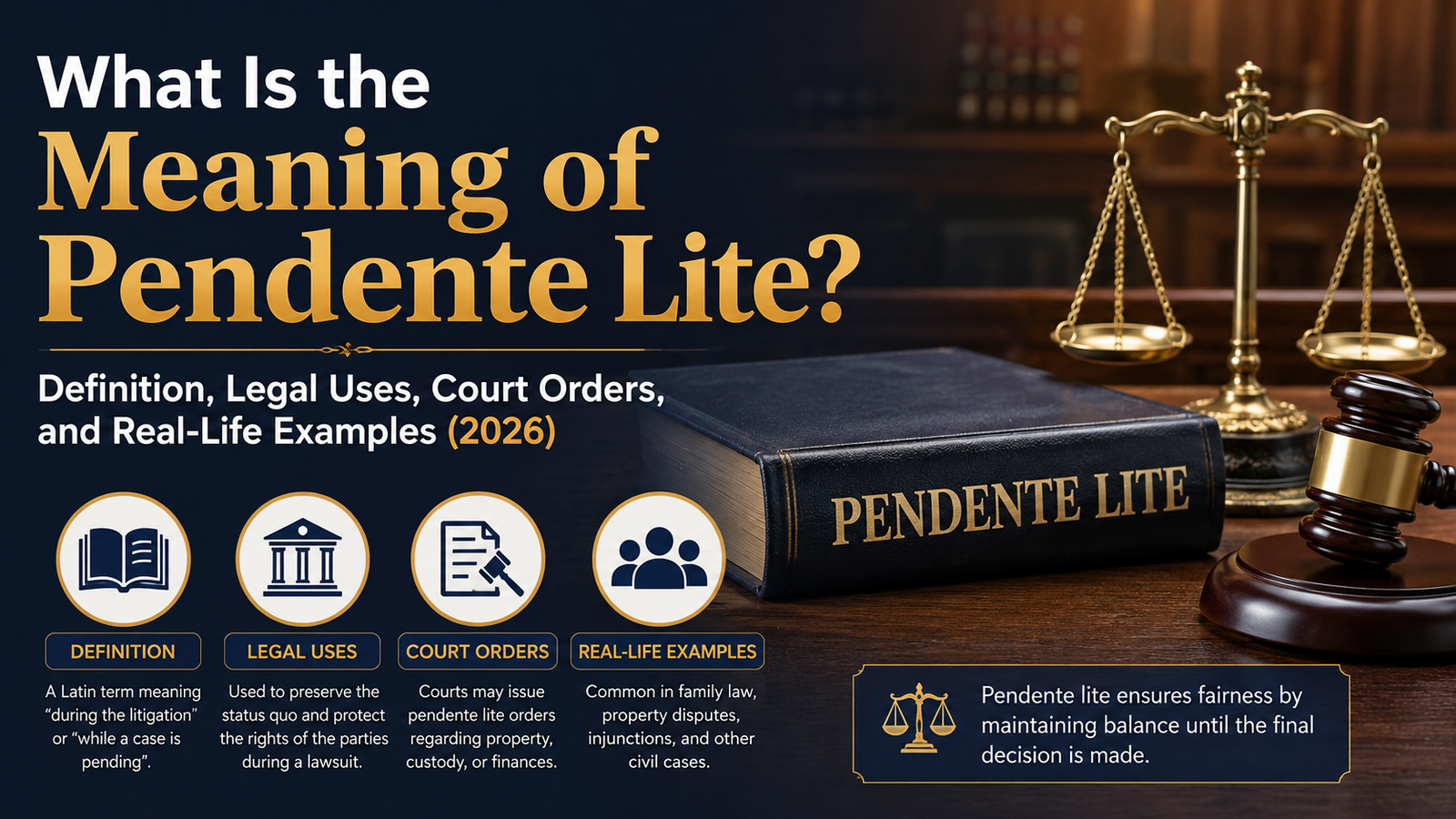
pendente lite meaning is a Latin legal term meaning “while the litigation is pending.” Courts use it to describe temporary orders that stay in effect only until a case reaches its final judgment — covering things like child custody, spousal support, and property protection.
Picture two spouses filing for divorce, both still living under one roof, both terrified of what happens to the bills next month. That gap between filing and finality is exactly where pendente lite orders step in and hold the ground.
Far from a dusty courtroom relic, this concept shapes real outcomes in divorce proceedings, civil litigation, and even business disputes. Understanding it gives you a genuine edge before you ever set foot in a hearing.
Key Takeaways
- Pendente lite is Latin for “while the litigation is pending” — it describes anything that applies only during an active case.
- Courts use pendente lite orders to provide temporary relief — support, custody, or property protection — before a case is fully resolved.
- These orders are common in family law, but they also appear in civil litigation, real estate disputes, probate litigation, and business disputes.
- A pendente lite order is not a preview of the final judgment. Judges apply a different, lower-stakes legal standard to temporary relief than they do to permanent outcomes.
- Pendente lite orders can be modified, appealed in limited circumstances, or enforced through contempt of court if violated.
- This article is for general education. It isn’t legal advice — for anything happening in your actual case, talk to a licensed attorney in your state.
What Does “Pendente Lite” Mean? (Quick Answer)
Pendente lite is a Latin legal term built from two words: pendente (“pending”) and lite (“the suit” or “the litigation”). Put together, it translates to “while the suit is pending” or, more naturally, “during the litigation.”
In practice, courts attach the phrase to any order, right, or arrangement that exists only for the duration of a pending lawsuit or pending case. Once the case ends — through settlement agreement, dismissal, or final decree — anything labeled pendente lite automatically expires. It was never meant to last.
Pronunciation and Latin Translation
Most attorneys pronounce it pen-DEN-tay LEE-tay, though you’ll also hear the anglicized pen-DEN-tee LY-tee in everyday courtroom conversation. Neither is “wrong” — Latin legal terms absorbed into English common law rarely keep their classical pronunciation intact.
| Latin Word | English Meaning |
|---|---|
| Pendente | Pending, hanging, undecided |
| Lite | The lawsuit, the litigation |
| Pendente Lite (combined) | “While the litigation is pending” |
Where the Phrase Comes From
Latin terminology survived in Western courts because early legal proceedings in England and, later, the American colonies were recorded and argued in Latin well into the 1700s. Phrases like pendente lite, lis pendens (a related term meaning “pending suit,” often used in real estate disputes to flag a property tied up in litigation), and res judicata stuck around because they described legal concepts precisely — and because the legal profession, for better or worse, is slow to let go of tradition.
Today, pendente lite isn’t reserved for divorce lawyers. You’ll find it in civil lawsuit filings, probate court dockets, and even commercial contract disputes. Anywhere a court needs to decide something now rather than wait for the whole case to wrap up, this term tends to show up.
How Pendente Lite Orders Work
A pendente lite order is a form of temporary relief — sometimes called an interim order or provisional order — issued by a trial court while a divorce case or other lawsuit is still working its way through the judicial process. Think of it as a bridge: it holds things steady between the moment a case is filed and the moment it’s finally decided.
When a Party Can Request One
Either side in a case can file a motion for temporary relief. Common triggers include:
- One spouse moves out and stops paying shared bills
- A parent needs a clear parenting time schedule while custody is being litigated
- A business partner fears the other side will drain a shared account before trial
- A party in a real estate dispute needs to prevent a property from being sold mid-case
- A lower-earning spouse can’t afford an attorney without some form of interim attorney’s fees
There’s no requirement that both sides agree — pendente lite motions are frequently contested, and that’s exactly why a court hearing exists to sort them out.
The Process: Filing to Ruling
The path from court filing to ruling follows a fairly predictable sequence, though timing varies significantly by jurisdiction and how backed up the local family court docket is.
- Filing the motion — The requesting party files a formal motion for temporary relief, often paired with a financial affidavit or sworn court affidavit detailing income, expenses, and assets.
- Serving the other party — The opposing side receives notice and a chance to respond, usually within a set number of days.
- Scheduling the motion hearing — Courts calendar an evidentiary hearing or a shorter argument-only hearing, depending on complexity and local rules.
- The hearing itself — Both sides present evidence: pay stubs, tax returns, bank statements, sometimes witness testimony.
- The judge’s decision — The court issues a court-issued order that takes effect immediately, or sometimes retroactive to the filing date.
In many jurisdictions, this entire cycle takes anywhere from two to eight weeks, though emergency situations can move much faster through an emergency court order process.
What Judges Look At Before Ruling
Judges aren’t guessing. Most jurisdictions apply specific statutory factors and court considerations, which typically include:
- Each party’s income and earning capacity
- The standard of living established during the marriage or relationship
- Immediate needs — housing, health insurance, childcare
- Which party has physical control of shared property
- Any documented risk of asset dissipation or emergency safety concerns
Because pendente lite hearings move quickly, judicial discretion plays a bigger role here than it might at trial. Judges are working with an incomplete record and have to make a reasonable call based on what’s in front of them — not a fully litigated set of facts.
What Pendente Lite Orders Can Cover
Pendente lite orders aren’t one-size-fits-all. In a divorce litigation context specifically, courts can address almost every major issue that will eventually appear in the final order — just on a temporary basis.
Temporary Child Custody and Parenting Time
A temporary custody order establishes legal custody (who makes decisions about health, education, and religion) and physical custody (where the child actually lives) while the case is pending. This can look like:
- Joint custody with a shared parenting plan
- Sole custody to one parent with a defined visitation schedule for the other
- A detailed temporary parenting plan covering holidays, school pickups, and communication rules
Courts prioritize child welfare above all else at this stage, and most domestic relations statutes require judges to apply a “best interests of the child” framework even in a temporary hearing.
Child Support
Child support payments ordered pendente lite usually follow the same state guideline formula used for a final judgment — meaning the number rarely changes dramatically once the case concludes, unless income circumstances shift. This is one of the more predictable areas of temporary financial support, since most states use a fixed calculation based on both parents’ incomes and the custody schedule.
Spousal Support (Alimony Pendente Lite / APL)
This is where the term “pendente lite” gets its most literal legal life. Alimony pendente lite, often abbreviated APL, is a distinct category of temporary alimony paid by one spouse to the other strictly during an active divorce case.
Pennsylvania is a good example of how specific this can get. Under 23 Pa.C.S. § 3702, APL is calculated using a set formula rather than open-ended judicial discretion — and unlike ordinary spousal support, marital misconduct generally isn’t a defense against paying it. That means even a spouse accused of fault in the marriage can still be ordered to pay alimony pendente lite, because the point of APL isn’t to punish or reward behavior — it’s to make sure both spouses can afford to actually litigate the case on equal footing, according to Pennsylvania family law attorneys.
APL is not the same thing as post-divorce alimony. Once the final decree is entered, APL automatically stops — it’s replaced (if at all) by whatever permanent or rehabilitative alimony arrangement the court or settlement establishes going forward, per FindLaw’s overview of Pennsylvania alimony law.
Quick comparison — support types during a Pennsylvania divorce:
| Support Type | When It Applies | Fault Matters? |
|---|---|---|
| Spousal Support | Before divorce is filed, during separation | Yes — misconduct can bar it |
| Alimony Pendente Lite (APL) | After divorce complaint is filed, until decree | No |
| Post-Divorce Alimony | After final decree | Sometimes, depending on the state |
Other states don’t always use the “APL” label — many just fold this into general temporary alimony or spousal maintenance orders — but the underlying concept (support that exists only during pending litigation) is close to universal.
Use of the Marital Home
Courts frequently grant one spouse exclusive use of the marital home while the case is pending, especially where children are involved and stability matters. This doesn’t decide who eventually keeps the house in property division — it just answers the immediate, practical question of who lives where tonight.
Protection of Marital Assets
Pendente lite orders often include provisions restraining marital assets — sometimes informally called freezing assets — to stop one spouse from selling property, draining joint accounts, or taking out new debt without the other’s knowledge. This kind of asset protection language is standard in most divorce process filings and is designed purely to preserve the status quo, not to punish anyone.
Attorney’s Fees
Because legal fees can be a serious barrier to a fair fight in court, judges can order one party to pay the other’s interim attorney’s fees pendente lite — particularly when there’s a significant income gap between spouses. This ensures both sides have real representation instead of one party being forced to negotiate from a position of financial desperation.
Pendente Lite in a Divorce: A Realistic Timeline
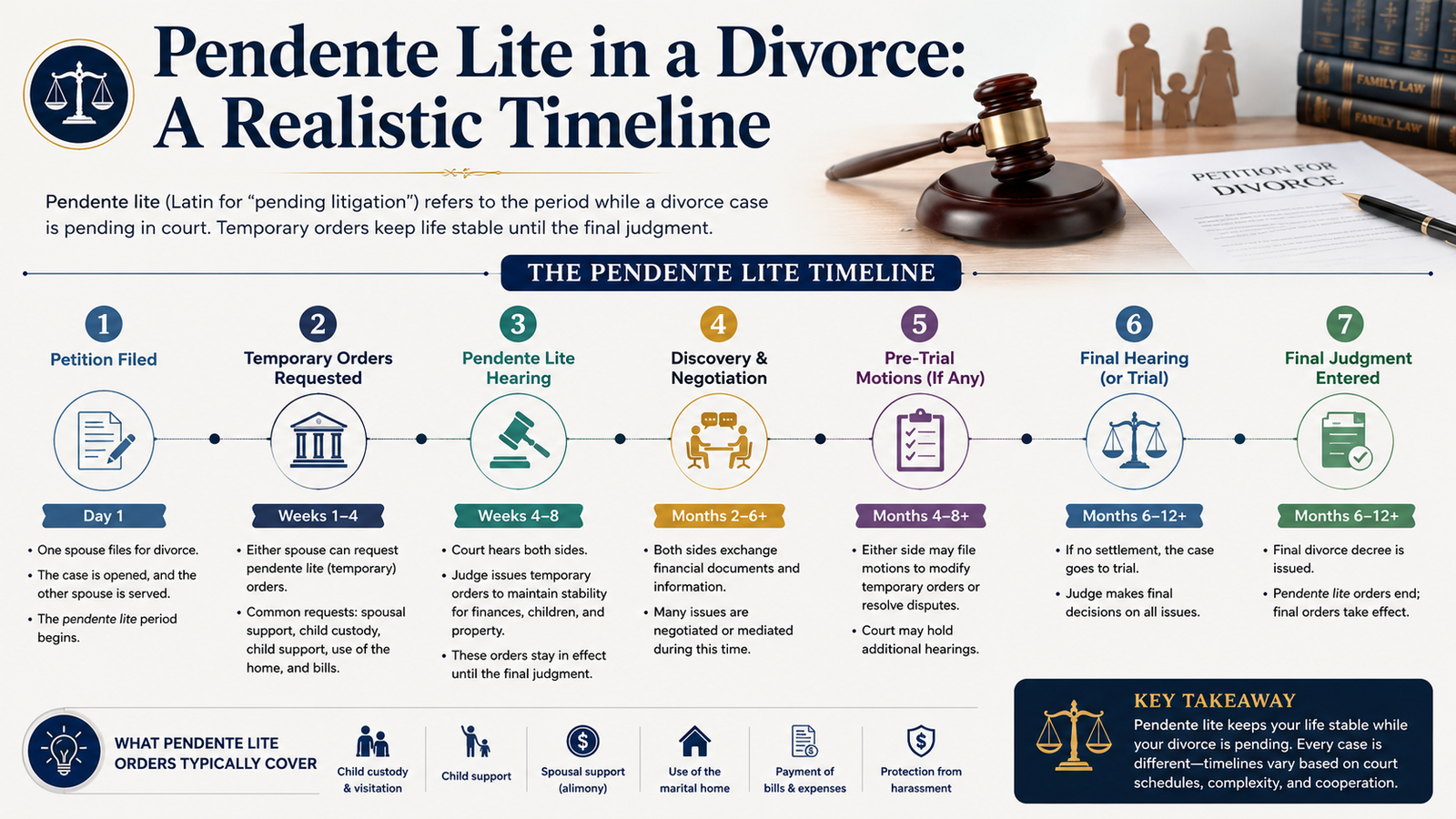
Numbers and definitions only go so far. Here’s a hypothetical case example — not a real case, just a composite built from how these situations typically unfold — to show what a pendente lite order looks like in motion.
Sample Scenario
Imagine a married couple, “Maria” and “Daniel,” who’ve been married for eleven years with two children, ages 7 and 10. Daniel earns significantly more than Maria, who left full-time work years ago to manage the household. Daniel files for divorce and moves into an apartment. Two weeks later, Maria — worried about rent and the kids’ routine — files a motion for temporary relief.
What the Temporary Order Included
After a motion hearing, the court issues a pendente lite order that includes:
- Temporary custody: Maria has primary physical custody during the school week; Daniel has parenting time every other weekend and one weeknight dinner.
- Child support: Calculated under the state guideline formula based on both incomes and the custody split.
- Alimony pendente lite: A monthly support payment from Daniel to Maria, reflecting the income gap, to last only until the divorce is finalized.
- Exclusive use of the marital home: Maria and the children remain in the house; Daniel is responsible for the mortgage pendente lite.
- Restraining provision: Neither party may sell, transfer, or borrow against joint accounts or property without written consent or court approval.
- Interim attorney’s fees: Daniel is ordered to contribute a set amount toward Maria’s legal costs, given the income disparity.
What Changed at Final Judgment
Fourteen months later, the case settles. The final decree includes permanent custody terms closely resembling the temporary arrangement (courts often favor continuity for children), a property settlement dividing the marital home and retirement accounts, and a rehabilitative alimony award — lower than the pendente lite amount and time-limited, since Maria has since returned to part-time work.
This is a typical pattern: temporary custody arrangements often do carry over into the final order, simply because judges are reluctant to disrupt a routine that’s already working for kids. Support numbers, by contrast, frequently shift once both parties’ full financial pictures and long-term earning potential are on the table.
Pendente Lite Outside of Divorce
Family court gets most of the attention, but pendente lite relief is a fixture across nearly every area of civil litigation.
Civil Litigation and Injunctive Relief
In a general civil case, a party might request a preliminary injunction — a form of injunctive relief or equitable relief that orders someone to do or stop doing something while the lawsuit is pending. Classic examples include stopping a former employee from violating a non-compete agreement, or halting construction on a disputed piece of land until the underlying dispute is resolved.
Property and Real Estate Disputes
Real estate disputes and title disputes frequently involve pendente lite protections, most notably through a lis pendens filing — a public notice recorded against a property to warn buyers that there’s an active land ownership dispute attached to it. This doesn’t resolve the underlying disagreement over real property, but it does prevent the property from being sold to an unsuspecting third party mid-litigation.
Probate and Estate Litigation
In probate litigation, courts sometimes appoint a temporary administrator or freeze estate distributions pendente lite when heirs are actively contesting a will. This keeps assets intact and prevents anyone from spending down an estate before the court decides who’s actually entitled to what.
Commercial and Business Disputes
Commercial litigation and business disputes sometimes call for a temporary receivership — a court-appointed person or entity that manages a business’s assets or operations while ownership or control is being litigated. This tool shows up in partnership disputes, shareholder disagreements, and situations where one party fears mismanagement or fraud will cause irreversible damage before trial.
How Long Does a Pendente Lite Order Last?
There’s no fixed calendar length. A pendente lite order lasts exactly as long as the pending case does — it dissolves automatically at case resolution, whether that comes through a settlement agreement, a court ruling at trial, or dismissal of the case entirely.
That said, “temporary” doesn’t always mean short. Complex divorce litigation or multi-party commercial litigation can stretch on for a year or more, meaning a pendente lite order can end up governing someone’s life far longer than the word “temporary” suggests. This is one of the more misunderstood aspects of the process — people expect a few weeks; they sometimes get well over a year.
Can a Pendente Lite Order Be Changed, Appealed, or Violated?
Modifying the Order
Pendente lite orders aren’t locked in place. Either party can request an order modification if there’s a genuine change in circumstances — a job loss, a health crisis, a change in the child’s needs. Courts generally require the change to be substantial and not just a temporary dip or a tactical inconvenience.
Appealing the Order
This is where pendente lite orders differ sharply from a final judgment. Because they’re temporary by design, many jurisdictions restrict or outright bar an interlocutory appeal — an appeal filed before the case is fully resolved. The general logic: appellate courts don’t want to get pulled into reviewing every interim decision a trial judge makes along the way. Some states allow narrow exceptions, particularly where a temporary order causes irreparable harm, but as a rule, pendente lite rulings are much harder to appeal than a final decree.
Consequences of Violating an Order
A pendente lite order is a court order, full stop — violating it carries real consequences. Court order enforcement typically involves:
- A contempt of court finding, which can lead to fines or, in serious cases, jail time
- Wage garnishment for unpaid support
- Modification of custody or support terms in favor of the compliant party
- Additional legal fees awarded against the violating party
Court compliance matters even though the order is “just temporary” — courts treat non-compliance seriously precisely because these orders exist to prevent harm right now, not eventually.
Pendente Lite vs. Related Legal Terms
The legal world is full of overlapping vocabulary, and pendente lite gets confused with several similar-sounding concepts.
| Term | What It Means | How It Differs from Pendente Lite |
|---|---|---|
| Temporary Order | General term for any short-term court ruling | Pendente lite is a specific type of temporary order tied to active litigation |
| Interim Order | Often used interchangeably with pendente lite | Functionally identical in most contexts; “interim” is more common in civil/commercial law |
| Ex Parte Order | Emergency order issued without the other side present | Pendente lite orders usually require notice to both sides; ex parte orders don’t |
| Final Order / Final Decree | The court’s permanent resolution of the case | Ends the case entirely; pendente lite orders expire the moment this is entered |
| Lis Pendens | Public notice of pending litigation affecting property | A notice mechanism, not a support or custody order |
Key Difference
The one distinction worth remembering: pendente lite orders are provisional by definition. They carry legal force, but they carry no precedential weight over what the court eventually decides at final judgment. A judge is not bound by their own earlier temporary ruling when deciding the permanent outcome.
What a Pendente Lite Order Does — and Doesn’t — Decide
What It Accomplishes
- Keeps children in a stable routine while parents litigate custody
- Prevents a lower-earning spouse from being financially crushed mid-case
- Preserves marital assets and disputed property from being sold or drained
- Gives both sides a fair shot at legal representation through interim attorney’s fees
- Provides temporary legal protection without forcing the case to trial immediately
What It Does Not Determine
- It does not set the final custody arrangement, though it often influences it
- It does not guarantee the same support amount will apply after final judgment
- It does not resolve legal rights and legal obligations permanently — everything remains open until the case concludes
- It carries a lower burden of proof and less procedural formality than a full trial, meaning it’s not meant to be treated as the court’s “real” decision
Common Myths About Pendente Lite
Myth: Temporary Custody Automatically Becomes Permanent Custody
It’s true that judges often maintain continuity for children, so a temporary schedule frequently resembles the final one. But “frequently” isn’t “automatically.” Courts can and do change custody arrangements substantially at final judgment, especially when new evidence, a child welfare concern, or a parent’s changed situation comes to light during the case.
Myth: Every Lawsuit Gets a Pendente Lite Order Automatically
Nothing happens without someone asking. A party has to file a motion for temporary relief — courts don’t issue these orders on their own initiative. If neither side requests temporary relief, the case simply proceeds toward final judgment without one.
Myth: Temporary Support Sets the Final Support Amount
Alimony pendente lite and temporary support figures are often recalculated once the case fully resolves. APL, for instance, uses a different formula and different underlying purpose than post-divorce spousal maintenance — expecting the numbers to match is a common and understandable, but incorrect, assumption.
How to Request a Pendente Lite Order (Practical Steps)
- Consult an attorney first. Pendente lite motions involve real deadlines and specific local court rules — this isn’t a strong area for a DIY approach, especially where support formulas or custody are involved.
- Gather financial documentation. Pay stubs, tax returns, bank statements, and a completed financial affidavit are typically required before a court will even schedule a hearing.
- File the motion. Your attorney submits a formal court filing requesting the specific relief you need — custody, support, exclusive home use, or asset protection.
- Serve the other party. The opposing party must be formally notified and given time to respond under your jurisdiction’s rules.
- Prepare for the hearing. Some pendente lite hearings are argument-only; others involve live testimony. Your attorney will tell you which to expect.
- Attend the hearing. Judges typically rule same-day or within a short window afterward, given the time-sensitive nature of temporary relief.
- Comply immediately once the order issues. Pendente lite orders take effect on the timeline the court sets, and court order enforcement mechanisms apply from day one.
Is Pendente Lite the Same in Every State?
Not quite. The underlying idea — temporary relief during pending litigation — is universal across US courts, but the terminology and formulas shift depending on where you file.
| State/Jurisdiction | How It’s Typically Labeled | Notable Feature |
|---|---|---|
| Pennsylvania | Alimony Pendente Lite (APL) | Calculated by statutory formula under Pa.R.C.P. 1910.16-4; fault isn’t a defense |
| New Jersey | Pendente lite support | Courts weigh the marital standard of living heavily in the interim calculation |
| California | Temporary spousal support | Often calculated using local county guideline formulas (e.g., the “Santa Clara” or “Alameda” formulas) rather than a single statewide standard |
| New York | Temporary maintenance | Governed by a statutory guideline formula under the Domestic Relations Law |
| Texas | Temporary spousal support | More discretionary; Texas caps post-divorce alimony tightly, so pendente lite support carries extra weight during the case |
The takeaway: if you’re trying to estimate what a pendente lite order might look like in your own case, generic national averages won’t get you very far. Family law is state-specific almost everywhere, and even neighboring states can calculate temporary support completely differently. A local family law attorney — or at minimum, your state bar association’s public resources — is the right place to check the actual statutory factors that apply where you live.
It’s also worth noting that not every state uses “pendente lite” as a formal legal label. Many simply refer to “temporary orders” or “interim orders” in their court rules and never use the Latin phrase at all, even though the legal function is identical. If your state’s paperwork doesn’t say “pendente lite” anywhere, that doesn’t mean the concept doesn’t apply — it just means your jurisdiction uses different terminology for the same temporary legal arrangement.
Why Courts Rely on Pendente Lite Relief in the First Place
It’s worth stepping back and asking why this mechanism exists at all. Legal proceedings — especially contested ones — can take months or years to reach a final judgment. Without some form of provisional order, people would be left in limbo: children without a clear schedule, spouses without income, disputed property sitting in legal purgatory while lawyers argue.
Pendente lite relief solves a practical problem, not just a legal one. It recognizes that life doesn’t pause just because a lawsuit is ongoing. Rent still comes due. Kids still need to get to school. A business still needs someone making day-to-day decisions. Courts built this framework specifically so that the judicial process doesn’t force people to simply wait out months of uncertainty with no support and no structure.
That’s also why the legal standard applied at a pendente lite hearing is intentionally lighter than what’s required at trial. Judges aren’t expected to have the full picture yet — they’re expected to make a fair, reasonable call based on the information available right now, with the understanding that the full evidentiary hearing and complete record will come later, at trial or through settlement agreement negotiations.
FAQs
Is alimony pendente lite the same in every state?
No. Pennsylvania uses a fixed formula (40% of the income gap under Pa.R.C.P. 1910.16-4), while Virginia uses 27% of the payor’s income minus 50% of the payee’s income (Va. Code § 20-103). Each state sets its own rules.
Can a pendente lite order be appealed?
Rarely. A 2024 Maryland appellate ruling (Adelakun v. Adelakun) confirmed that an order denying pendente lite alimony and child support isn’t a final judgment and generally can’t be appealed on its own.
Does adultery affect pendente lite support?
Usually not. In Virginia, proven adultery can bar final spousal support but doesn’t block pendente lite support, since courts focus on need and ability to pay during the case, not fault.
Does pendente lite support automatically become permanent alimony?
No, but it can influence it. Courts treat the pendente lite amount as a factor, not a guarantee — final alimony is recalculated based on the complete financial picture at judgment.
Is pendente lite support granted automatically once you file for divorce?
No. The requesting spouse must file a motion and prove financial need with income documentation — courts don’t issue it on their own.
conclusion
Pendente lite meaning comes down to one simple idea: temporary support while a case is still open. It covers custody, money, and property until the final ruling. It’s not permanent. It’s a bridge, not the destination.
Understanding pendente lite meaning helps you plan ahead. You’ll know what to expect during your case. You’ll know your rights don’t disappear while you wait. And you’ll know these orders can change once the court decides everything for good. Talk to a lawyer early. It makes the process much less scary.