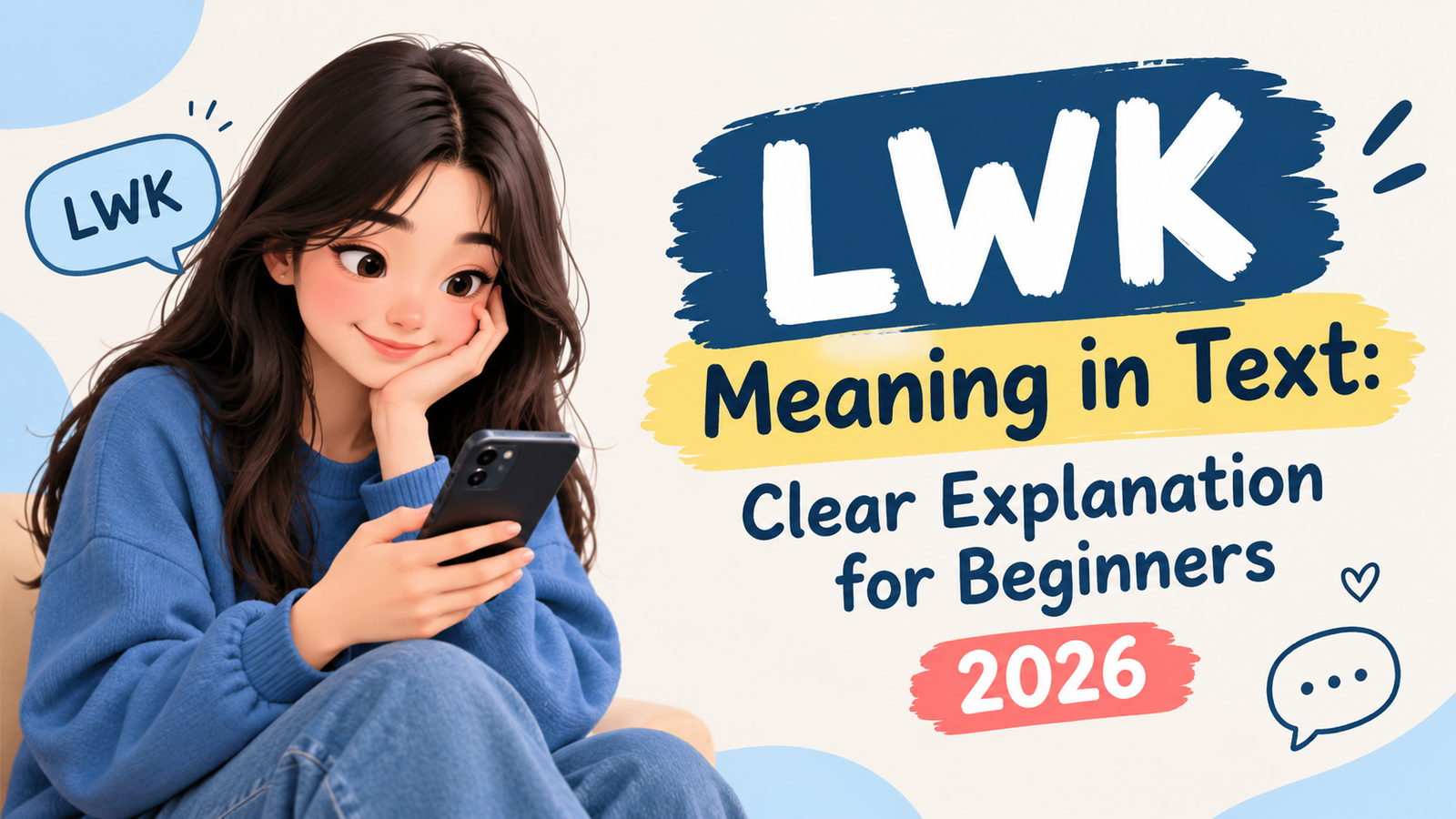
LWK stands for “low-key,” a texting abbreviation people use to soften a statement, downplay excitement, or admit something without making a big deal out of it. It shows up constantly in casual texts, captions, and group chats, working almost like a verbal shrug typed into three letters.
Here’s the thing: those three letters carry more emotional weight than they let on. One tiny abbreviation can turn a blunt confession into a quiet, low-pressure admission, and that subtle shift changes everything about how a message lands.
This guide breaks it all down. You’ll learn where LWK came from, how it stacks up against HWK and other slang, and exactly when to use it (or skip it) so your texts always hit the right tone.
What Does LWK Mean in Text?
Let’s not bury the answer. You came here for it, so here it is.
The Quick Answer
LWK stands for “low-key.” It’s a texting abbreviation people use to soften a statement, admit something casually, or express a feeling without going all-in on it emotionally. Think of it as a verbal shrug you type instead of say.
Someone might text “lwk that movie was mid” instead of “I honestly thought that movie was pretty disappointing.” Same basic message. Very different energy.
Breaking Down the Letters — L-W-K
The abbreviation itself is about as literal as internet slang gets:
| Letter | Stands For |
|---|---|
| L | Low |
| W | (represents the hyphen sound, sort of a placeholder) |
| K | Key |
Okay, that’s a bit of a cheat. The “W” doesn’t technically stand for anything semantic. It’s there because “low-key” gets abbreviated phonetically rather than by strict initials, similar to how “idk” doesn’t spell out “I don’t know” in a clean one-letter-per-word way either. Language shorthand often bends the rules for speed, not precision.
What “Low-Key” Actually Means Before Texting
Before it ever showed up in a text bubble, “low-key” was already a phrase in everyday English. It described something subtle, restrained, or intentionally kept quiet. A “low-key event” meant a small, understated gathering. A “low-key crush” meant feelings you hadn’t announced to the world yet.
That original meaning didn’t disappear when texting culture picked it up. It just got compressed and repurposed for digital conversations, where brevity matters more than grammar.
How LWK Differs From Typing “Low-Key”
Here’s something a lot of guides skip over: functionally, LWK and “low-key” mean the same thing. The difference is tonal, not definitional.
Typing out “low-key” in full can read as slightly more deliberate or even a little dramatic, depending on the sentence. Abbreviating it to LWK feels quicker, more casual, almost thrown away on purpose. It’s the texting equivalent of mumbling something under your breath versus saying it clearly. Both get the message across. One just feels more offhand.
Where Did LWK Come From?
“Low-key” has roots that go back further than most people assume. Linguists trace informal use of “low key” (as two separate words, without the hyphen) to describe subdued or restrained things back to at least the mid-20th century, often in music and social contexts where “keeping it low key” meant deliberately avoiding attention.
The phrase picked up serious steam in hip-hop and R&B culture through the 1990s and 2000s, where “low-key” became shorthand for quiet confidence or a subtle vibe. From there, it slid naturally into everyday slang, especially among younger speakers who used it constantly in casual speech.
Texting abbreviation culture did what it always does: it took a popular spoken phrase and compressed it for faster typing. Once smartphones and instant messaging exploded, “LWK” started showing up as a natural next step, especially once similar structures like “HWK” (high-key) and “TBH” became normalized.
Fun fact: unlike a lot of internet slang that can be traced to a single viral post or platform, LWK doesn’t have one clean origin story. It evolved gradually, following the pattern that most abbreviations follow: spoken phrase first, digital shorthand second.
The Emotional Tone Behind LWK
This is where a lot of beginners get tripped up. LWK isn’t just a shortcut. It’s doing emotional work in the sentence.
Emotional Restraint as a Social Tool
Texting doesn’t carry tone of voice, facial expressions, or body language. That’s a real limitation, and slang like LWK exists partly to patch the gap. When you add “lwk” to a sentence, you’re signaling: I mean this, but I’m not going to make a big deal out of it.
That restraint matters socially. It lets people admit things, complain, or express excitement without sounding overly intense or vulnerable. In a lot of ways, LWK functions as emotional padding. It cushions the statement so it lands softer.
The Psychology of Hedging in Digital Conversations
Linguists call this kind of language a “hedge.” Hedging softens a claim so the speaker doesn’t seem overly committed to it, which matters a lot in casual online communication where people want to protect themselves from seeming too eager, too sensitive, or too dramatic.
“LWK” works similarly to phrases like “kind of,” “sort of,” or “I guess,” except it does the job in three characters instead of a full phrase. That efficiency is part of why it caught on so fast. It’s not just about typing speed. It’s about managing emotional tone without writing an essay.
LWK vs HWK — Two Ends of the Spectrum
If LWK dials emotion down, HWK (high-key) cranks it all the way up.
| Term | Meaning | Emotional Volume |
|---|---|---|
| LWK | Subtly, quietly, understated | Low |
| HWK | Openly, obviously, full commitment | High |
LWK vs HWK isn’t just a vocabulary comparison. It reflects two completely different social postures. Saying “lwk I’m nervous” downplays the feeling. Saying “hwk I’m nervous” practically shouts it. Same underlying emotion, opposite delivery.
Here’s a quick example pair:
LWK: “lwk I’ve watched this show like four times already” HWK: “hwk I’ve watched this show like four times already, no shame”
Notice how the HWK version practically dares you to judge them, while the LWK version tries to slide the confession past you quietly.
LWK Examples in Real Text Conversations
Theory only gets you so far. Let’s look at how LWK actually shows up in real text conversations.
Casual Admissions
People use LWK constantly to admit small, slightly embarrassing, or unplanned things without making a production out of it.
- “lwk I never finished that book you lent me”
- “lwk I’ve had a crush on him since sophomore year”
- “lwk I forgot we had plans tonight”
Each of these confesses something, but the tone stays light. Nobody’s bracing for a dramatic reaction.
Understated Complaints
LWK also softens complaints, which keeps them from sounding like full-blown grievances.
- “lwk this weather is depressing me”
- “lwk my roommate is getting on my nerves”
- “lwk I’m tired of this group project”
Compare that to typing the complaint without any softener at all. “My roommate is getting on my nerves” reads more direct, maybe even a little sharp. Adding “lwk” takes the edge off.
Quiet Excitement
Not every use of LWK is negative or embarrassing. It shows up plenty in positive contexts too, especially when someone doesn’t want to seem overly enthusiastic.
- “lwk this might be my favorite song rn”
- “lwk I’m actually excited for finals to be over”
- “lwk that outfit looked really good on you”
There’s a subtle coolness to phrasing things this way. It lets someone express genuine excitement while still sounding relaxed about it, rather than gushing.
LWK vs Similar Texting Slang
LWK doesn’t operate alone. It shares space with a handful of similar texting slang terms that beginners often confuse with each other.
| Abbreviation | Meaning | Best Used For |
|---|---|---|
| LWK | Low-key / subtly | Softening a statement or admission |
| HWK | High-key / openly | Emphasizing a statement without hiding it |
| TBH | To be honest | Prefacing an honest opinion, often blunt |
| NGL | Not gonna lie | Admitting something slightly surprising or against expectation |
| Kinda/Sorta | Somewhat, partially | General hedging, less specific tone than LWK |
Here’s the key distinction most people miss: TBH and NGL signal honesty, almost like a disclaimer before an opinion. LWK, on the other hand, signals restraint, more about how quietly you’re saying something than whether you’re being truthful.
For example:
“tbh I don’t think that plan will work” (I’m being straightforward with you) “lwk I don’t think that plan will work” (I’m saying this quietly, almost reluctantly)
They can technically fit the same sentence, but the emotional undertone shifts depending on which one you pick. Getting this distinction right is part of what separates natural slang use from something that reads slightly off.
How LWK Is Used on Social Media
Social media platforms each shape LWK slightly differently, depending on the format and audience.
LWK on TikTok
TikTok comment sections use LWK constantly, often for quick, semi-sarcastic reactions. Captions also lean on it heavily, especially for confessions dressed up as jokes: “lwk didn’t expect to relate to this so hard.”
LWK on Instagram
On Instagram, LWK shows up in captions and DMs alike. Captions tend to use it for a self-aware, slightly ironic tone: “lwk proud of this fit.” DMs use it more like texting does, softening personal admissions between friends.
LWK on Snapchat and iMessage
This is where LWK feels the most natural and conversational, since Snapchat and iMessage are built for one-on-one, casual back-and-forth. Usage here mirrors real spoken slang almost exactly, since these platforms function as digital replacements for face-to-face chatting.
LWK on Twitter/X
X tends to use LWK for dry, deadpan humor, often paired with an observation that’s meant to sound understated on purpose, even when the point being made is pretty bold. “lwk this entire timeline needs therapy” is a good example of using LWK almost sarcastically to downplay a strong opinion.
Is LWK Positive, Negative, or Neutral?
Short answer: it can be all three, depending entirely on context.
Positive Uses
LWK often softens compliments or genuine enthusiasm, letting someone express something nice without sounding over-the-top.
- “lwk you’re one of the funniest people I know”
- “lwk this might be the best meal I’ve had all month”
Negative Uses
It also cushions criticism or disappointment, keeping things from sounding harsh.
- “lwk that was kind of rude”
- “lwk I expected better from that restaurant”
Neutral Uses — The Category Most People Miss
Here’s the part most explanations skip entirely: a huge chunk of LWK usage is neither positive nor negative. It’s just casual observation.
- “lwk it’s already September, wild”
- “lwk traffic was insane today”
These statements don’t carry strong emotional weight in either direction. LWK just gives the sentence a relaxed, conversational rhythm. If you only think of LWK as a tool for confessions or complaints, you’ll miss a huge amount of how it’s actually used day to day.
Common Misreadings of LWK
Misunderstanding slang happens fast, especially across generations or unfamiliar group chats. Here are the most frequent common mistakes people make when reading or using LWK.
- Mistaking it for sarcasm. LWK is usually sincere, even when the tone sounds casual. Reading it as sarcastic can completely flip the intended meaning.
- Overusing it until it loses meaning. Slapping “lwk” onto every single sentence dilutes its purpose. It works best when used selectively, on statements that actually benefit from a softer tone.
- Confusing it with filler words like “literally.” LWK carries actual semantic weight tied to subtlety and restraint. It’s not just verbal padding.
- Assuming it always signals hesitation or doubt. Sometimes people use LWK confidently, just quietly. It doesn’t automatically mean someone’s unsure.
- Missing the sincerity behind small confessions. Because LWK statements sound casual, readers sometimes brush them off, missing that the person might genuinely mean what they said.
How to Respond When Someone Uses LWK
Responding well isn’t complicated, but matching tone matters more than people realize.
If someone texts “lwk I’ve been kind of stressed lately,” mirroring their tone with something equally low-pressure works better than an intense, heavy response. Try: “lwk same, this month’s been a lot” rather than launching into a full emotional check-in they didn’t necessarily ask for.
That said, don’t assume LWK always means someone wants a light response. If the underlying content sounds genuinely concerning, respond to the substance, not just the tone. LWK softens delivery. It doesn’t mean the feeling underneath is small.
A few solid response templates:
- Mirror the tone: “lwk relatable” or “lwk I feel that”
- Ask gently: “wait fr? what’s going on”
- Validate without overdoing it: “that’s fair honestly”
When to Use LWK — And When to Leave It Out
Context decides everything here.
Use LWK When:
- Texting friends, close family, or casual group chats
- Writing social media captions with a relaxed tone
- Softening an opinion you don’t want to state too bluntly
- Making a quiet confession without a big emotional buildup
Skip LWK When:
- Writing professional messages or workplace communication
- Messaging someone you don’t know well, especially in a formal context
- Sending business texting where clarity matters more than tone-softening
- Writing anything meant to be taken seriously by a wide, mixed audience
Professional writing and formal language generally avoid abbreviations like LWK altogether. If you’re drafting an email to a manager, client, or someone outside your casual circle, spell things out plainly instead. “I think we should reconsider the timeline” reads far more appropriately in a work context than “lwk we might need more time.”
LWK Across Different Conversation Types
Not every chat calls for the same tone, and LWK adapts (or doesn’t) depending on who’s on the other end.
| Conversation Type | Does LWK Fit? | Why |
|---|---|---|
| Close friends | Yes | Casual tone matches the relationship |
| Family group chat | Usually | Depends on age range and family texting habits |
| New acquaintance | Sometimes | Works once rapport starts feeling casual |
| Coworker (casual) | Rarely | Risky unless the workplace culture is very relaxed |
| Manager or client | No | Reads as unprofessional in workplace messages |
| Social media caption | Yes | Matches the informal tone most captions use |
The pattern here is simple: the more casual and familiar the relationship, the more naturally LWK fits. The more formal or unfamiliar it is, the more it risks sounding out of place.
FAQs
Is LWK still commonly used in 2026?
Yes. LWK remains one of the most actively used texting abbreviations in 2026, especially on TikTok, Snapchat, and Instagram among Gen Z and younger millennials.
Does LWK ever mean something other than “low-key”?
Almost never in standard texting. Alternatives like “let’s work” or “let’s kick” aren’t recognized slang, and the low-key interpretation is what shows up in the vast majority of real conversations.
Do people combine LWK with other slang terms?
Often, yes. Younger texters frequently stack LWK with terms like “ngl,” “fr,” or “no cap” in a single sentence, blending several shorthand terms into one casual thought.
Does emoji or punctuation change how LWK reads?
It can shift the tone significantly. A wink emoji after “lwk” reads very differently than a plain period, since punctuation and emojis signal how seriously to take the statement.
Is LWK used the same way outside English-speaking chats?
Not always. LWK has spread into non-English texting slang too, including German youth slang, where it’s often borrowed directly from English usage.
conclusion
LWK meaning in text really comes down to one simple idea: saying something without making it a big deal. It softens confessions, quiet excitement, and small complaints alike. Once you spot the pattern, it’s easy to read and even easier to use.
Understanding LWK meaning in text helps you text with more confidence. Use it with friends. Skip it at work. Match the tone, and you’ll never misread it again. It’s a small abbreviation, but it says a lot when you know how to use it right.








1 thought on “LWK meaning in text: Clear Explanation for Beginners 2026”