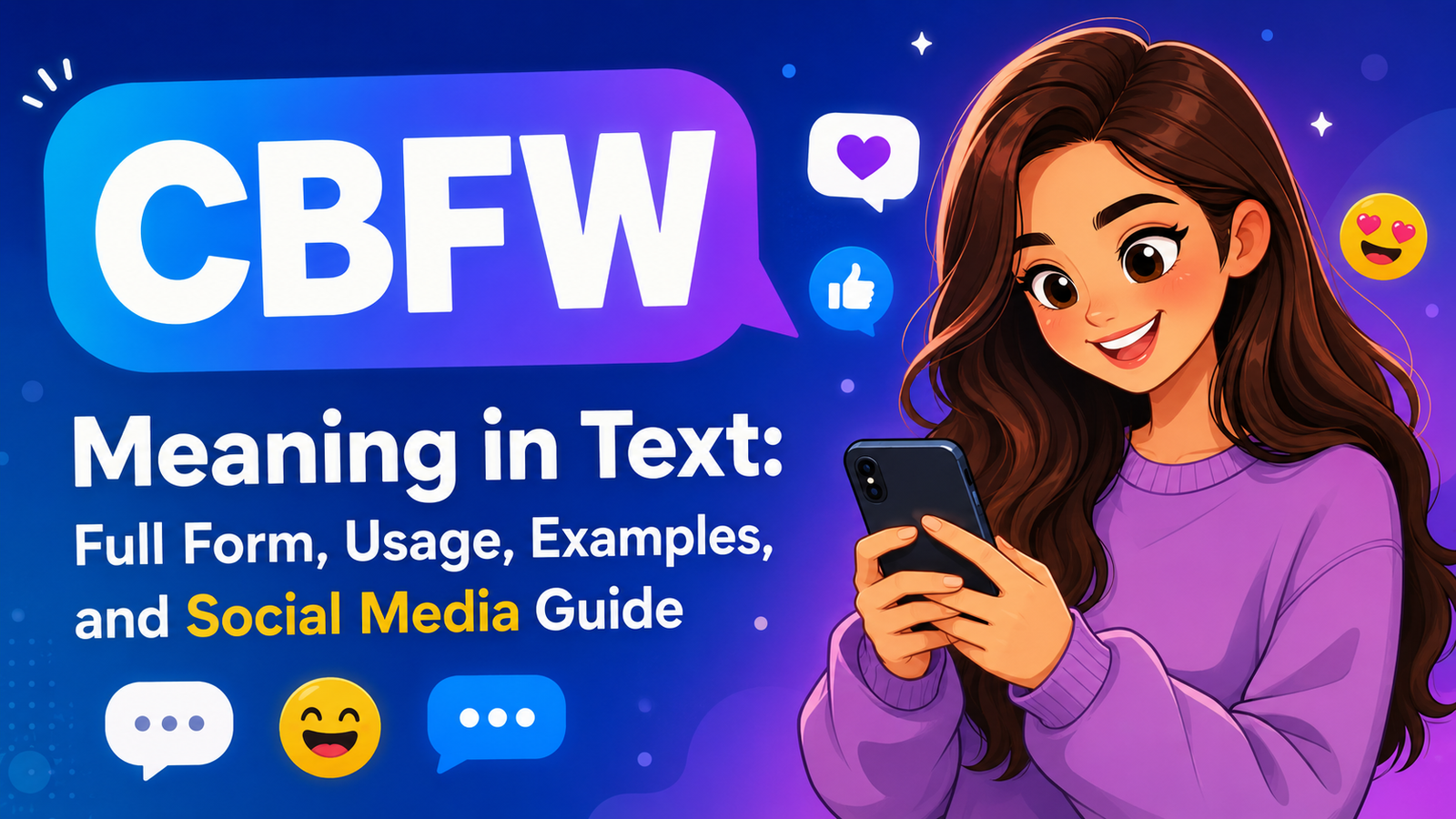
CBFW meaning in text usually points to “Can’t Be F***ed With,” a bold slang phrase people use to sound confident, untouchable, and completely unbothered by drama.
Four letters, one huge attitude shift. That’s the real pull behind this term. One caption can flex pure power, and another, sent an hour later, can quietly say “I’m exhausted, leave me alone.” Same acronym, two totally different moods hiding inside it.
That’s exactly why CBFW meaning in text trips people up online. It shows up in Instagram captions, TikTok comments, and quick group chat replies, each one carrying its own tone. This guide breaks down every version, so you’ll never misread it again.
What Does CBFW Mean in Text?
Here’s the short version, since you probably want the answer before anything else: CBFW stands for “Can’t Be F*ed With.”** It’s a bold, confident phrase people use to say they’re untouchable, unbothered, or simply not in the mood to deal with nonsense.
That’s the full meaning most people mean when they type it. But here’s where it gets a little messier — and where most explainer articles stop short. A second reading floats around too: “Can’t Be Bothered With.” Same four letters, different energy entirely. One version says “I’m powerful, don’t test me.” The other says “I’m tired, leave me alone.”
So which one is it? Honestly, it depends on the sentence around it. Context does the heavy lifting here, not the acronym itself. If someone posts CBFW next to a gym transformation photo, they mean confidence. If someone texts “CBFW today, everything’s going wrong,” they mean exhaustion. You’ll get much better at spotting the difference as you read through the examples below.
Quick breakdown, so you’ve got it at a glance:
| Reading | Full Phrase | Vibe | Typical Use |
|---|---|---|---|
| Confidence | Can’t Be F***ed With | Bold, self-assured, untouchable | Glow-up captions, flexing, self-hype |
| Frustration | Can’t Be Bothered With | Tired, indifferent, over it | Venting, avoiding drama, low motivation |
Both readings are valid. Neither one is “more correct.” The CBFW acronym simply carries two lives depending on who’s typing it and what mood they’re in.
Where Did CBFW Actually Come From?
Most slang explainers wave their hands here and say something vague like “it grew out of internet culture and hip-hop.” That’s not wrong, exactly, but it skips the one piece of this story that’s actually traceable.
A big chunk of CBFW’s current visibility connects back to rapper Lil Baby, whose record label shifted its branding from “4PF” toward “CBFW.” That rebrand didn’t happen quietly — it spread fast through fan edits, interview clips, and short-form video captions, the kind of content that circulates on TikTok and Instagram Reels within hours. Once a label name starts showing up in captions and comment sections, the phrase behind it stops being industry jargon and turns into everyday slang.
Detroit rapper Veeze gets tangled into the same clips, sometimes asked directly on camera to explain what the term means, which — ironically — added more confusion than clarity to the public conversation around it. You’ll also find searches connecting CBFW to Young Thug, but that link seems to come from a broader assumption that any rap slang traces back to him, since he’s known for coining his own vocabulary. There’s no solid evidence tying him to CBFW specifically.
Here’s the honest caveat: there’s no single, official birth certificate for CBFW as general internet slang. Nobody can point to one tweet and say “this is where it started.” What we can say is that the label-rebrand moment accelerated its spread in a very specific, documented way, layering on top of an older pattern where online communities compress long phrases into quick-typing shorthand. “Can’t be bothered” becoming “CBB,” and “can’t be f***ed” becoming “CBF,” follow the exact same logic — CBFW just adds one more letter and one more layer of attitude.
Key takeaway: treat CBFW as a term with a traceable acceleration point (the label rebrand) rather than a mysterious phrase that “just appeared.” That distinction matters if you’re trying to actually understand CBFW in texting rather than just memorize a definition.
CBFW Meaning on Different Platforms
Here’s something worth knowing: the CBFW meaning doesn’t shift dramatically from platform to platform, but the tone absolutely does. Where you see it changes how you should read it. Let’s walk through the big ones.
Instagram Captions
On Instagram, CBFW leans hard toward the confident reading. Instagram captions using CBFW tend to sit under glow-up photos, success announcements, or just a really good outfit shot. Think of a caption like “New job, new energy, CBFW 🔥” — there’s no ambiguity there. It’s a flex, plain and simple.
Instagram slang in general trends toward self-presentation — people curate their feed to look good, so slang that shows up there tends to skew toward confidence rather than complaint. CBFW fits that pattern neatly.
TikTok Comments and Captions
TikTok comments and captions use CBFW in a slightly wider range of ways. You’ll see it stamped under transformation videos (“before vs after, CBFW now” type content), but you’ll also catch it in reaction videos where someone’s venting about a bad day. TikTok slang moves fast and mutates constantly, so CBFW gets remixed into all sorts of formats — duets, stitched reactions, even meme templates layering the text over unrelated video clips.
Because TikTok content is often short-form and reaction-driven, viewers pick up the tone from the video itself (facial expression, music choice, editing style) rather than the caption alone. That’s actually a good rule of thumb: on TikTok, don’t judge CBFW by the letters — judge it by the video.
Twitter/X
Twitter slang tends to run blunter and quicker than Instagram’s polished captions. On Twitter/X, CBFW shows up more often in the frustration lane — quick, punchy tweets like “CBFW with this weather” or “CBFW today, I’m logging off.” The platform’s fast-scroll, text-heavy format rewards short venting statements, and CBFW fits that mold well.
That said, you’ll still spot the confident version here too, especially in reply threads where someone’s clapping back at criticism. Context inside the specific tweet or thread still matters more than the platform itself.
Group Chats and Discord
This is where the softer reading dominates the most. In group chats and on Discord, CBFW usually means “I can’t deal with this right now” more than “I’m untouchable.” Someone might drop it after a long meeting, a bad exam, or a group project falling apart. Online chats move at conversational speed, closer to how people actually talk out loud, so the phrase tends to land closer to its original, more casual “can’t be bothered” root.
Here’s a simple side-by-side to keep the platform differences straight:
| Platform | Typical Reading | Common Context |
|---|---|---|
| Confidence | Glow-ups, success posts, flex captions | |
| TikTok | Mixed (context-dependent) | Transformations, reactions, memes |
| Twitter/X | Frustration, sometimes confidence | Venting tweets, reply threads |
| Group Chats / Discord | Frustration | Casual complaints, low-motivation moments |
Is CBFW Positive or Negative?
Neither, really — and that’s the honest answer, even if it’s less satisfying than a clean yes-or-no. Whether CBFW reads as positive or negative comes down almost entirely to tone, punctuation, and what surrounds it in the sentence.
A few signals that tip it toward the positive, confident side:
- Celebratory context — new job, new relationship, a win of some kind
- Emojis like 🔥, 💅, or ✨ attached to the message
- Short, declarative phrasing — “CBFW” standing alone as a statement of fact, not a complaint
- Capitalization for emphasis, like “CBFW!!” rather than a flat lowercase mention
And the signals that push it toward the frustrated, negative-leaning side:
- Complaint-adjacent language nearby — “ugh,” “ngl,” “ong,” or similar venting words
- Emojis like 😩, 😤, or 🙄
- A sentence structure that names a specific annoyance: “CBFW with traffic,” “CBFW with this app crashing again”
- Lowercase, tired-sounding phrasing without exclamation points
Here’s the same acronym, two completely different emotional readings:
“Finally got the promotion. CBFW. 🔥”
That’s confidence. Pure self-assurance, no complaint attached.
“CBFW dealing with this Wi-Fi today 😩”
That’s frustration. No confidence implied at all — just a person who’s over a small daily annoyance.
Same four letters. Completely different emotional tone. That’s the whole trick to reading CBFW correctly: don’t decode the acronym, decode the sentence.
CBFW vs Similar Slang Terms
CBFW doesn’t exist in a vacuum. It’s part of a whole family of similar slang terms and comparable acronyms that all circle the same general idea: not being bothered, not being messed with, or generally radiating “don’t test me” energy. Knowing the differences helps you use the right one — and helps you avoid mixing them up when you’re reading someone else’s message.
| Term | Full Meaning | Vibe | Example |
|---|---|---|---|
| CBFW | Can’t Be F***ed With | Untouchable, confident or exhausted | “New car, CBFW 🔥” |
| CBF | Can’t Be F***ed | Flat indifference, no energy for something | “CBF going out tonight” |
| CBB | Can’t Be Bothered | Mild apathy, low motivation | “CBB replying to that email” |
| IDGAF | I Don’t Give A F*** | Blunt, dismissive, don’t-care attitude | “IDGAF what they think” |
| Unbothered | (full word, no acronym) | Calm, composed indifference | “Staying unbothered this year” |
| Built Different | (full phrase) | Uniqueness, standout confidence | “You’re built different fr” |
Here’s the distinction that actually matters: CBFW adds the word “With,” and that one small addition shifts the meaning toward untouchability rather than plain indifference. CBF and CBB describe not caring about a task or situation. CBFW describes not being able to be affected, challenged, or messed with by a person or force — it’s more relational, more about power dynamics than simple apathy.
That’s why you’ll rarely see CBFW attached to boring logistics (“CBFW doing laundry” sounds odd), but you’ll see it constantly attached to people, drama, or personal wins (“CBFW with the haters,” “CBFW, watch me win”). The slang alternatives listed above overlap in spirit, but CBFW carries a slightly sharper edge.
Why Do People Use CBFW?
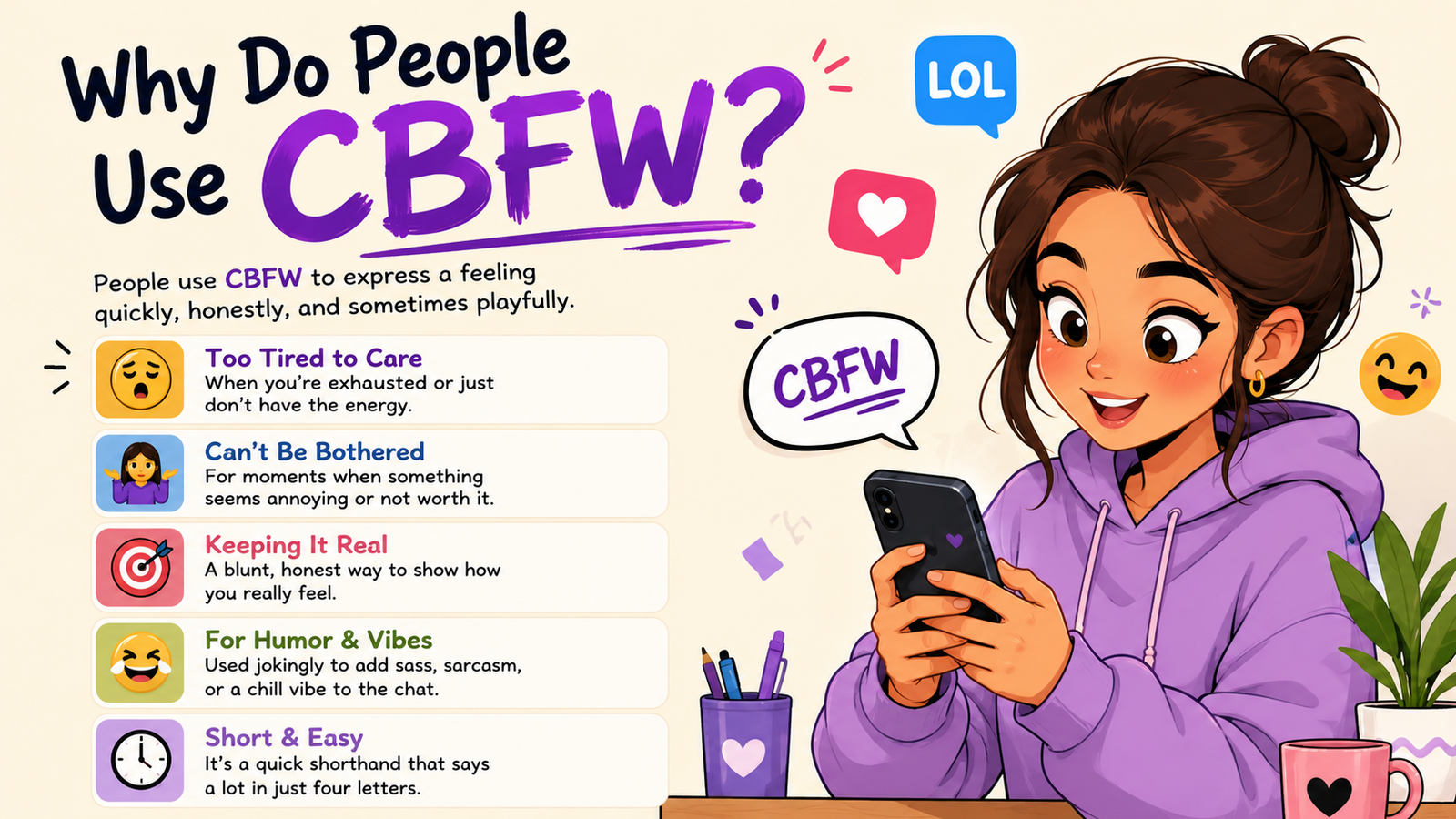
A few real reasons drive the popularity of this term, and none of them are particularly mysterious once you break them down.
First, it’s fast. Typing four letters beats typing out “I refuse to let anyone or anything get to me right now.” Digital communication rewards speed, and slang compression is basically the entire engine behind online slang in general.
Second, it signals belonging. Using current slang correctly, at the right moment, on the right platform, tells your audience you’re plugged into internet culture. That’s a real social function, not just laziness.
Third, it carries emotional weight efficiently. Four letters can convey confidence, exhaustion, defiance, or triumph depending on the wrapper around them. That flexibility is actually a feature, not a bug — one term, multiple emotional registers, minimal typing required.
Finally, frustration is universal. Whether someone means the confident or tired version of CBFW, both readings tap into something everyone feels at some point: the desire to not be affected by outside noise, whether that’s haters, bad days, or just general chaos.
Examples of CBFW in Sentences
Seeing the term in realistic context makes the two readings click much faster than any definition can. Here’s a spread covering both sides:
Confidence-leaning examples:
- “Landed the internship today. CBFW, let’s go.”
- “New house, new city, CBFW energy only 🔥”
- “They talked about me the whole time and I still won. CBFW.”
- “You’re lucky I CBFW right now, don’t push it 😏”
Frustration-leaning examples:
- “CBFW with this group project, I’m doing it all myself again”
- “Woke up late, missed the bus, CBFW today 😩”
- “Not today, CBFW with the drama”
- “CBFW replying to three group chats at once”
Notice the pattern: confidence-leaning examples pair with wins, exclamation points, and fire emojis. Frustration-leaning examples pair with complaints, tiredness, and a flatter tone. Once you’ve seen a handful side by side, the distinction stops feeling tricky.
How to Respond When Someone Says CBFW
Getting a CBFW response right depends on catching which version you’re dealing with. Here’s a simple framework.
If it reads as confidence:
- Match the energy. A simple “let’s gooo” or “that’s the energy” works fine.
- Hype them up rather than question the term. Nobody flexing wants a grammar lesson mid-celebration.
- Use an emoji-heavy reply if that matches the tone of their original message — 🔥, 👏, or 💯 all land well here.
If it reads as frustration:
- Check in, don’t joke it off. A quick “you good?” goes a lot further than matching the slang back at them.
- Give space if the message sounds genuinely tired rather than performative.
- Avoid piling on with more slang — sometimes a plain, sincere reply reads better than trying to stay “on brand” with the conversation’s tone.
One more practical note on replying to CBFW: asking “what does that mean?” mid-conversation can kill the momentum, especially in a fast-moving group chat. If you’re unsure which reading applies, a safe middle-ground reply — something like “okay say less” — works in both directions without committing you to the wrong tone.
Here’s a quick text replies cheat sheet:
| Their CBFW Reading | Good Reply | Reply to Avoid |
|---|---|---|
| Confidence | “Let’s gooo, proud of you” | “What does CBFW mean lol” |
| Frustration | “You good? Here if you need to vent” | Ignoring it completely |
| Unclear/ambiguous | “Okay say less 😌” | Overanalyzing in the group chat |
Is CBFW Used Worldwide?
Here’s an honest answer instead of an inflated one: CBFW is primarily a U.S.-rooted, English-language slang term, with its clearest documented spread tied to American hip-hop culture and platforms popular in the U.S. and other English-speaking countries. You’ll find it used across the UK, Canada, and Australia too, largely because social platforms like TikTok and Instagram don’t respect borders — a viral clip in Atlanta can show up in a teenager’s feed in London within a day.
That said, there’s no strong evidence of CBFW achieving the kind of truly global, multi-language penetration that some slang terms (like “lol” or “OMG”) eventually reach. It remains concentrated in English-language online conversations, particularly among younger users active in short-form content ecosystems. If you’re chatting with someone outside an English-speaking country, don’t assume they’ll recognize it without context.
Is CBFW Appropriate to Use?
Context is everything here, same as most slang built around a censored curse word.
Fine to use in:
- Casual messaging slang between friends
- Comment sections on personal social media accounts
- Group chats with people your own age or social circle
Worth avoiding in:
- Professional emails or workplace chat slang
- Conversations with older relatives or unfamiliar audiences who might not know the term
- Formal writing, obviously, given the uncensored CBFW phrase underneath the acronym
One small but useful detail: people almost always write out the word behind the acronym with asterisks, “f***ed,” even when spelling out CBFW itself. That censoring convention exists because the full phrase includes profanity, and even casual internet culture tends to soften it visually, even while using it constantly.
Why Slang Like CBFW Keeps Spreading
Two forces drive this, and they’re the same forces behind basically every viral slang term of the last decade. Compression — the human tendency to shrink a mouthful of a phrase into something quicker to type — and platform virality, where a single clip, tweet, or caption can push a phrase into millions of feeds within days.
CBFW benefits from both. It’s short by nature (only four letters), and it rode a very real, traceable moment (the label rebrand) into wider visibility. Add in TikTok’s algorithm, which rewards short, punchy, easily-repeated phrases, and you’ve got a recipe for a term that spreads fast and sticks around in viral slang rotation for a while.
A Quick Look: How One Caption Gets Read Two Ways
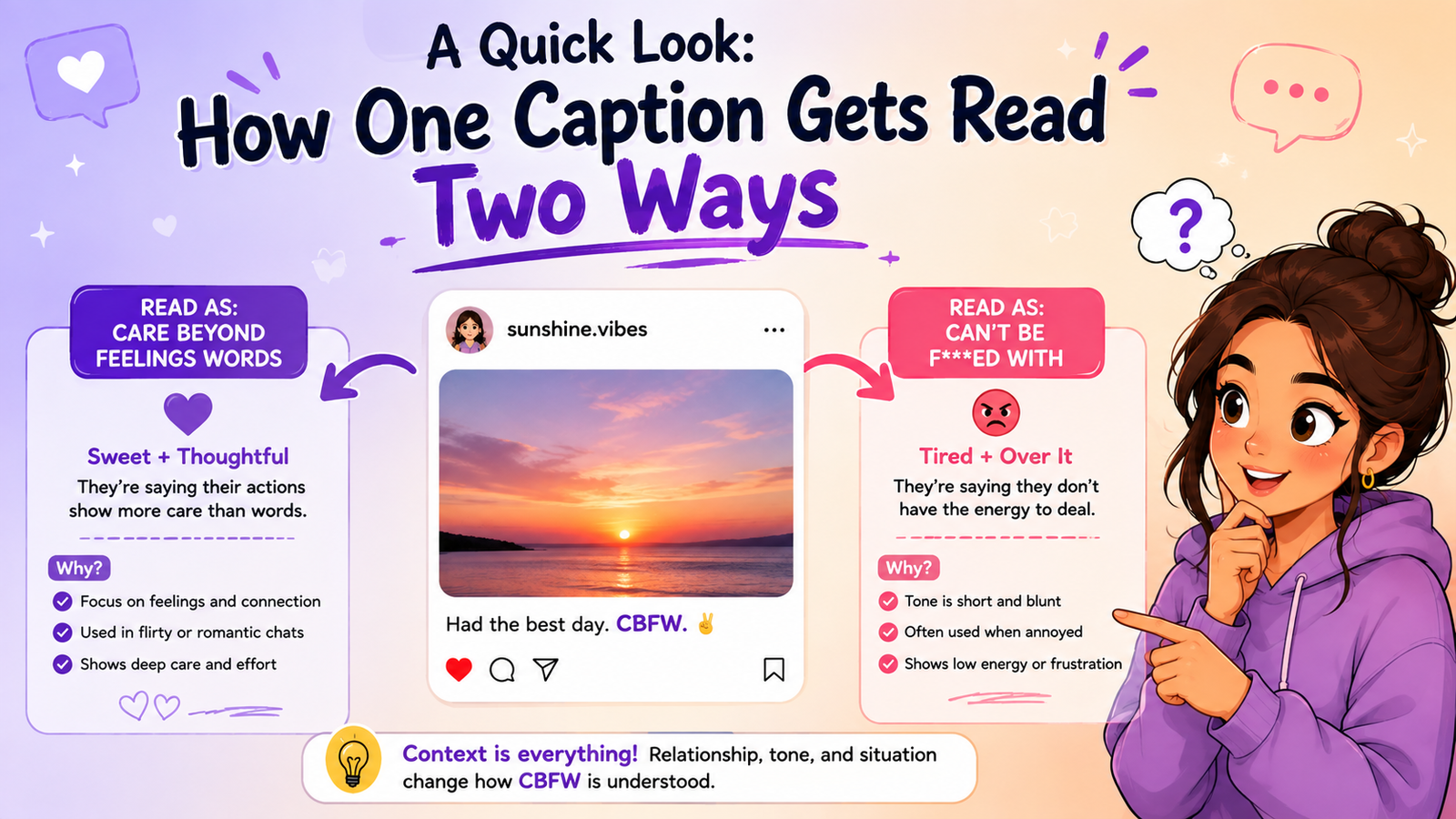
Picture this: someone posts a photo captioned simply, “CBFW.” No other text, no obvious context clue in the image itself — just a person, a plain background, and four letters.
Read one: they just got great news, and the caption is a quiet flex. No further explanation needed because their confidence speaks for itself.
Read two: they’re having a rough week, and the caption is a tired shrug directed at everyone in their comments asking if they’re okay.
Both readings are completely plausible from the caption alone. What actually resolves the ambiguity? The comments underneath, the person’s recent posting history, or a follow-up story. This single example captures the entire challenge of decoding CBFW: the acronym never tells the whole story on its own.
FAQs
Is CBFW still trending in 2026?
Yes — it’s still active across TikTok and Instagram captions, largely sustained by continued reposts and clips tied to the Lil Baby label-rebrand moment.
Does CBFW mean the same thing as “unbothered”?
Not exactly — “unbothered” implies calm indifference, while CBFW leans more toward untouchability or power, especially in its confident reading.
Can CBFW be used in a flirty context?
Sometimes, but only because of the joking tone in a conversation — the acronym itself doesn’t carry romantic meaning on its own.
Is there an official dictionary definition of CBFW?
No formal dictionary entry exists yet; most definitions come from slang-tracking sites and Urban Dictionary-style crowdsourced explanations.
Does CBFW ever get shortened further or combined with other slang?
Yes — it often pairs with terms like “TBH” or “fr fr” in captions, and sometimes appears as “CBFW energy” to describe a general mood rather than a direct statement.
conclusion
That’s really the whole story behind CBFW meaning in text. It’s not one fixed idea. It’s confidence in one caption and tiredness in the next. The letters stay the same. The feeling behind them changes.
So next time you see it, don’t panic. Look at the sentence around it, not just the acronym. That’s the real trick to understanding CBFW meaning in text in any chat or caption. Once you get that habit down, slang like this stops feeling confusing. It just becomes another part of how people talk online.