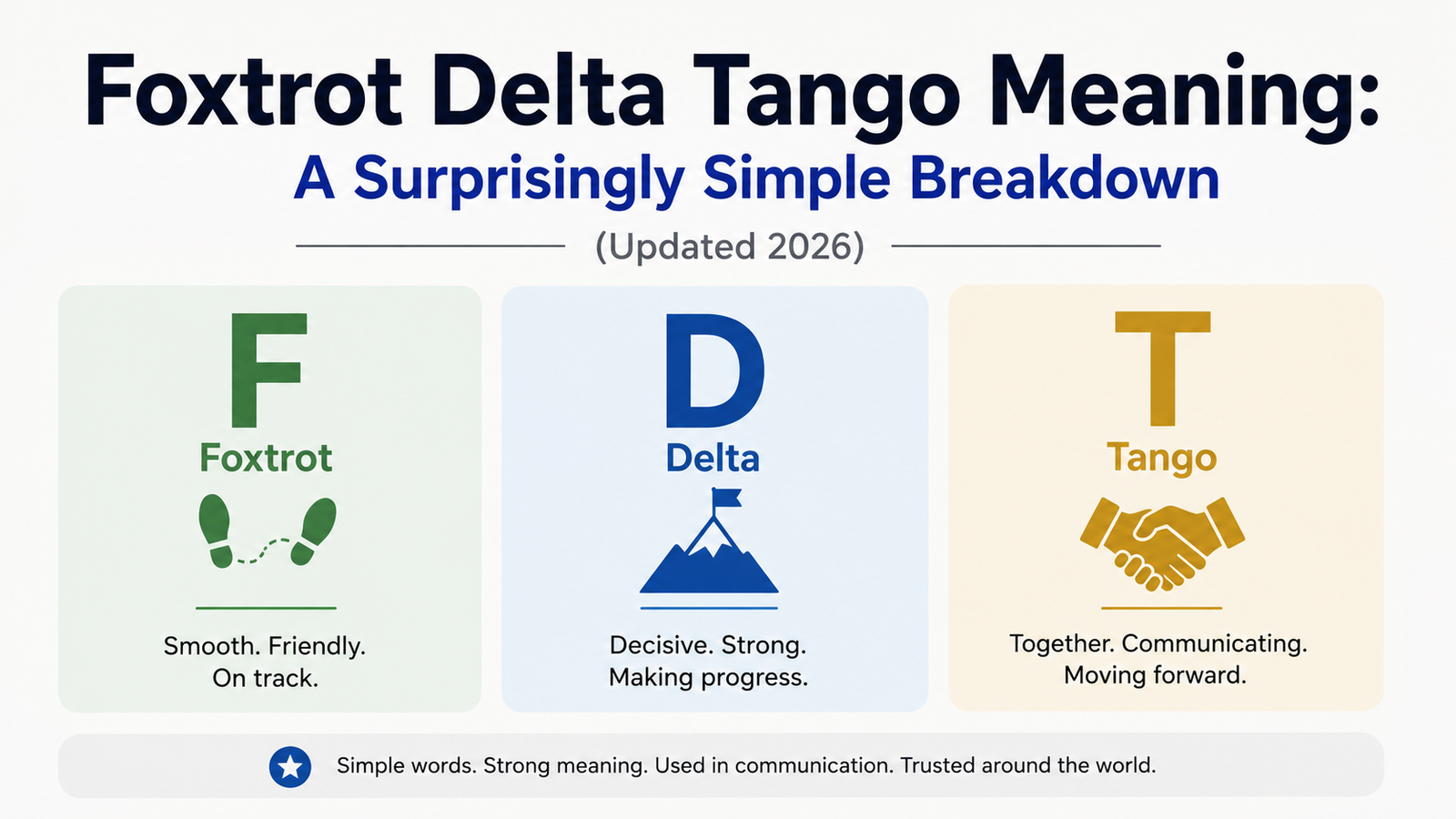
Foxtrot Delta Tango is the phonetic spelling of the letters F, D, and T, borrowed straight from the NATO phonetic alphabet. Online, those three letters almost always stand for FDT, a blunt piece of political slang aimed at Donald Trump.
Three innocent-sounding words. Zero profanity. One unmistakable message once you know the trick. That’s the quiet genius behind this phrase, and it’s exactly why it keeps slipping past filters that were built to catch everything else.
The phrase traces back to a 2016 protest anthem, resurfaced hard through 2026 alongside the viral FDT 8647 controversy, and still splits neatly between military radio jargon and internet code, depending entirely on who’s saying it.
What Does Foxtrot Delta Tango Mean?
In plain English, Foxtrot Delta Tango is a phonetic spelling of the letters F, D, T. Put those letters together in the context most people are searching for, and you get FDT, an abbreviation for “F*** Donald Trump.”
That’s the FDT meaning the overwhelming majority of people encounter online today. It’s a coded expression, meaning the words themselves (“Foxtrot,” “Delta,” “Tango”) sound completely harmless. There’s no cursing, no explicit language, nothing that trips an obvious filter. But anyone who recognizes the NATO phonetic alphabet can decode it instantly.
A few quick facts to anchor the Foxtrot Delta Tango definition before we go deeper:
- FDT acronym: Stands for F, D, T — read aloud using NATO phonetic words
- Most common meaning: “F*** Donald Trump,” used as political slang
- Origin: Traced to a 2016 song, which we’ll cover in detail below
- Tone: Can be blunt, sarcastic, humorous, or dead serious, depending on where you see it
- Context matters: The exact same phrase means nothing political at all in military and aviation contexts
That last point trips a lot of people up, so we’ll spend real time on it later in this article. For now, just know that Foxtrot Delta Tango is really two different things wearing the same outfit: a political abbreviation online, and a totally neutral piece of radio alphabet vocabulary everywhere else.
The NATO Phonetic Alphabet, Explained
To understand the Foxtrot Delta Tango phrase, you first need to understand the system it’s built on: the NATO phonetic alphabet, also called the ICAO alphabet, the radio alphabet, or sometimes simply the military alphabet.
Here’s the problem this alphabet was built to solve. Say the letter “B” over a scratchy radio connection, and it can easily be mistaken for “D,” “E,” “P,” “T,” or “V.” Say “M” and it can blur into “N.” In everyday conversation, a mix-up like that is a minor annoyance. In aviation or military communication, it can be dangerous.
So instead of spelling words letter-by-letter using the letters themselves, radio operators, pilots, and military personnel spell them out using assigned code words. Each code word starts with the letter it represents, and each one was chosen specifically because it sounds distinct from every other word on the list, even through poor audio quality, heavy accents, or a noisy environment. That’s the whole idea behind phonetic communication: remove ambiguity, keep the message clear no matter how bad the connection is.
Foxtrot represents F. Delta represents D. Tango represents T. None of the three words have any inherent connection to profanity, politics, or protest. They’re just clean, unmistakable stand-ins for three letters of the alphabet.
Why the NATO Code Exists
The NATO phonetic alphabet wasn’t invented for internet slang, obviously. It exists because clear operational communication can be a matter of life and death.
Here’s the actual history in brief. Phonetic alphabets go back further than most people assume, with early versions used by armed forces and telegraph operators well before NATO ever existed. But the version most of the world uses today, the one that gave us “Foxtrot,” “Delta,” and “Tango,” was standardized by the International Civil Aviation Organization (ICAO) in the 1950s and adopted by NATO for military radio use shortly after. It was designed jointly with input from aviation authorities and linguists, specifically tested across multiple languages and accents to make sure each word stayed recognizable no matter who was speaking or listening.
This is why the same alphabet is used across:
- Military terminology and battlefield coordination
- Aircraft radio communication between pilots and air traffic control
- Maritime and emergency services communication
- Amateur (ham) radio operators
- Customer service reps confirming spellings (“that’s B as in Bravo”) over the phone
The goal was never secrecy. It was the opposite: total clarity. That’s part of what makes its adoption into coded slang so interesting. A system built for maximum clarity got repurposed by internet culture for the exact opposite reason, to say something without saying it directly.
NATO Phonetic Alphabet Table
Here’s the complete, official NATO phonetic alphabet, all 26 letters. This is the same list pilots, dispatchers, and military radio operators use every single day, completely unrelated to any political meaning.
| Letter | Code Word | Letter | Code Word |
|---|---|---|---|
| A | Alfa | N | November |
| B | Bravo | O | Oscar |
| C | Charlie | P | Papa |
| D | Delta | Q | Quebec |
| E | Echo | R | Romeo |
| F | Foxtrot | S | Sierra |
| G | Golf | T | Tango |
| H | Hotel | U | Uniform |
| I | India | V | Victor |
| J | Juliett | W | Whiskey |
| K | Kilo | X | X-ray |
| L | Lima | Y | Yankee |
| M | Mike | Z | Zulu |
Notice that “Alfa” and “Juliett” use non-standard spellings on purpose. That’s intentional, done so that non-native English speakers wouldn’t mispronounce them based on their own language’s spelling conventions. It’s a small detail, but it shows how much thought went into making this phonetic code work reliably worldwide.
Where Foxtrot Delta Tango Actually Comes From
The Foxtrot Delta Tango origin isn’t some mysterious internet mystery. It traces back to a specific, documented moment: 2016, and a song literally titled “FDT.”
Rapper YG, featuring the late Nipsey Hussle, released the track during the 2016 U.S. presidential election cycle. The song title itself was the abbreviation, and its subject matter was blunt political criticism of then-candidate Donald Trump. The track became a rallying anthem at protests and campaign-season gatherings, and the abbreviation “FDT” spread right alongside it.
That’s the real FDT origin, and it matters because it explains something people often get backwards. The phonetic spelling, “Foxtrot Delta Tango,” came after the abbreviation was already culturally established. People didn’t start with the NATO alphabet and stumble into a political meaning by accident. They started with an existing, well-known abbreviation and later began spelling it out phonetically as a stylistic and evasive choice.
Here’s a simple timeline of the internet history behind the phrase:
| Year | Development |
|---|---|
| 2016 | YG FDT single released featuring Nipsey Hussle, tied to the 2016 election |
| 2016–2020 | “FDT” abbreviation used widely at protests, on merchandise, in social captions |
| 2020–2024 | Phrase resurfaces around subsequent elections and political flashpoints |
| 2025–2026 | Phonetic spelling “Foxtrot Delta Tango” gains traction as a way to say the same thing while dodging content moderation filters |
So while the underlying acronym meaning has stayed remarkably consistent since 2016, the phonetic spelling itself is a newer layer, added specifically to keep the message circulating on platforms that increasingly flag or restrict the direct abbreviation and explicit language.
Why People Spell It Out Phonetically Instead of Just Typing FDT
This is where things get genuinely clever, and it’s worth slowing down to understand the mechanics.
Typing “FDT” outright, or worse, the full uncensored phrase, is an easy target for algorithm filters. Most major platforms run automated moderation systems that scan captions, comments, and hashtags for flagged terms tied to profanity or political incitement. An abbreviation that’s been circulating since 2016 is exactly the kind of term those systems learn to catch over time.
Spelling it out using Foxtrot, Delta, and Tango sidesteps that entirely. Here’s why this specific trick works so well:
- No profanity in the text itself. Every individual word is a completely normal, dictionary-safe term.
- No flagged abbreviation. “FDT” as three letters together might get caught by keyword filtering; three unrelated-looking words rarely do.
- Sounds deliberate, not accidental. Using a recognizable phonetic system signals to in-the-know readers that this isn’t random word choice, it’s a wink.
- Doubles as a shibboleth. If you know the NATO alphabet, you get the joke instantly. If you don’t, it just looks like a strange, vaguely official-sounding phrase.
This pattern isn’t unique to FDT, either. It’s a broader trend across online terminology: people constantly find workarounds for censorship avoidance, whether that’s using unusual spelling, emoji substitutions, or, in this case, borrowing an entire alphabet system built for a completely different purpose. It’s a small but genuinely clever piece of modern internet slang engineering.
Foxtrot Delta Tango on Reddit and Social Media
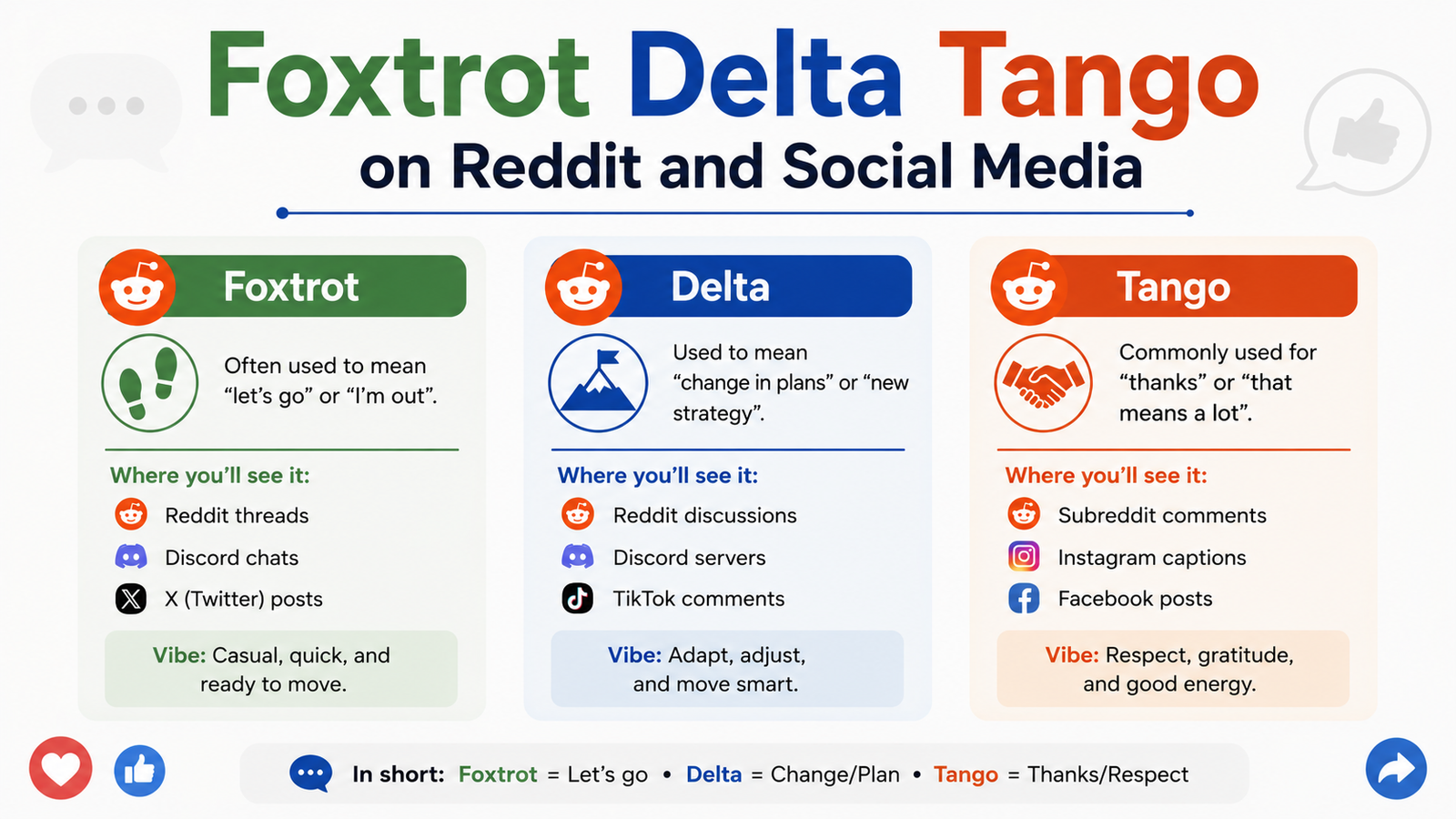
Reddit and social media are where most people first encounter this phrase, and the way it shows up varies a lot depending on the platform and the community.
Political Threads
In political subreddits and comment sections, Reddit discussions using “Foxtrot Delta Tango” tend to be straightforward. People use it as a stand-in for direct criticism of Trump, often in threads reacting to news coverage, policy announcements, or campaign events. It reads almost like a wink to other commenters: everyone in the thread already knows what it means, so spelling it out phonetically becomes a shared inside joke as much as a political statement.
Moderation Filters
This is where the phrase gets practical rather than just symbolic. Many subreddits and platforms have platform filters set up specifically to catch profanity-adjacent political language, especially language that could be read as hostile toward a public figure. Communities that want to avoid getting posts removed, or avoid triggering moderation systems that could result in a temporary ban, lean on the phonetic version specifically because it slides past automated review while still getting the message across to human readers.
Joke and Meme Threads
Not every use is dead serious. A huge portion of the phrase’s spread through meme culture has nothing to do with heated political debate at all. People use “Foxtrot Delta Tango” as a punchline, a caption on an unrelated video, or a tongue-in-cheek comment completely divorced from any real political statement. In these cases, it’s less about the politics and more about the cleverness of the code itself. Saying something “the long way around” has its own comedic value, similar to how people use exaggerated corporate-speak ironically.
As linguist Nicole Holliday has pointed out in commentary on the related “8647” numeric code, meaning in language is always shaped by context, and outside actors can reframe the same term differently depending on their own narrative goals. That observation applies just as well to FDT: the words themselves are neutral, but the surrounding conversation decides how loaded they feel.
FDT 8647: What the Number Combo Means
If you’ve spent any time in these same online spaces, you’ve probably also seen FDT 8647 paired together, on shirts, stickers, and social posts. This number combination has its own distinct backstory, and it’s tightly linked to the political code conversation around FDT.
Breaking down the 8647 meaning requires splitting it into two parts:
- “86”: This is old slang, dating back to at least the 1930s diner and soda-counter culture, where it meant an item was sold out or, more broadly, that something (or someone) should be gotten rid of. This is the 86 slang root that gives the number its “get rid of” connotation.
- “47”: This refers to Donald Trump as the 47th president of the United States, following his second, non-consecutive term.
Put together, “8647” functions as a silent numeric protest slogan: get rid of the 47th president. It’s designed to be subtle enough that plenty of people who see it have no idea what it means, while anyone in the know reads it immediately.
This combo became a genuinely major news story in 2026. Former FBI Director James Comey posted a photo of seashells arranged to spell “8647” on Instagram, which set off a firestorm. Critics on the political right interpreted it as an implied threat against the president, while Comey stated afterward that he hadn’t realized the numbers carried that connotation and removed the post. The controversy escalated further when he was later indicted, with prosecutors arguing the post amounted to a threat, a characterization his legal team has disputed.
The phrase kept resurfacing throughout the year. Giant “8647” markings appeared on the National Mall in Washington, D.C., prompting a federal investigation and a strong public statement from the Interior Department calling the incident unacceptable vandalism. Around the same time, a New Jersey driver’s personalized “FDT 8647” license plate went viral after a conservative advocacy group flagged it publicly, and the state’s Motor Vehicle Commission ultimately moved to recall the plate under regulations restricting certain letter-number combinations.
Here’s a quick summary table of the 8647 meaning controversy:
| Element | Detail |
|---|---|
| “86” | Slang for “get rid of” or “reject,” dating to 1930s diner culture |
| “47” | Refers to Trump as the 47th U.S. president |
| Combined meaning | A silent signal calling for Trump’s removal from office |
| Notable 2026 incident | James Comey’s Instagram post and subsequent federal indictment |
| Public incident | “8647” markings found on the National Mall, investigated by Park Police |
| Everyday incident | A New Jersey “FDT 8647” vanity plate recalled by the state MVC |
It’s worth being precise here: linguists and commentators covering the story have generally described “8647” as a viral phrase signaling political opposition, not a literal call for violence. That distinction has been central to the public debate, since the interpretation of the numbers has become politically contested in itself, with different groups reading very different intent into the same four digits.
Non-Political, Everyday Uses of the Phrase
Not everyone using “Foxtrot Delta Tango” is making a political statement. Once a phrase goes viral, it almost always drifts away from its original meaning, and FDT is no exception.
Plenty of everyday non-political uses exist alongside the political ones:
- Using it as a general, edgy way to say “no” or “absolutely not,” disconnected entirely from politics
- Using it as a stylized nickname, clan tag, or inside joke within a friend group or online community
- Referencing it purely as a piece of cultural reference trivia, the kind of thing people bring up because it’s an interesting fact about language and coding, not because they have a political point to make
Case Study: How Gaming Culture Helped the Phrase Spread
Gaming culture deserves specific credit here, because it played a real role in normalizing phonetic alphabet usage in casual online chat long before FDT went viral in its current form. Voice chat in team-based games has relied on the NATO alphabet for years, since spelling out usernames, coordinates, or call-outs clearly matters just as much in a competitive match as it does on a real radio channel.
Because so many gamers were already fluent in call signs and phonetic spelling from years of match communication, adapting that same fluency into political or comedic slang was a small leap, not a big one. A player already used to saying “Tango” instead of “T” during a callout has zero learning curve when they see “Foxtrot Delta Tango” used as slang elsewhere. This overlap between gaming culture and general internet slang is a big part of why the phrase spread as fast and as widely as it did, especially among younger, terminally-online audiences who move fluidly between gaming voice chat and social media commentary.
Foxtrot Delta Tango in Military and Aviation Contexts
Here’s the part that trips a lot of casual searchers up: in an actual military aviation context, “Foxtrot Delta Tango” means absolutely nothing political. It’s just three letters.
A pilot confirming a tail number, an air traffic controller reading back a clearance, or a soldier relaying a grid reference over military radio might use any combination of NATO phonetic words in the course of totally routine, unremarkable radio procedure. If those three particular letters happen to come up together, say, confirming a call sign that happens to contain F, D, and T, there’s no hidden message whatsoever. It’s coincidence, not code.
This is a genuinely important distinction for anyone researching military terminology or aviation phraseology, since search results can easily blur the political slang meaning with the professional, operational one. A few concrete examples of neutral phonetic usage:
- An air traffic controller confirming “Foxtrot Delta Tango, cleared to land runway two-seven” while reading back a plane’s call sign
- A soldier radioing “Foxtrot, Delta, Tango” to confirm the spelling of a location name or unit designation
- A dispatcher spelling out a license plate or reference code using standard aviation alphabet terminology during an operational report
In every one of these cases, the words are functioning exactly the way they were designed to: eliminating ambiguity, nothing more. The operational communication use of these words long predates the political slang meaning, and it will keep existing completely independent of it. Context is genuinely everything here. A pilot saying it into a headset and a commenter typing it under a political post are using identical words for two entirely unrelated purposes.
Common Misconceptions About Foxtrot Delta Tango
Because the phrase straddles two totally different worlds, professional radio communication and internet slang, it’s easy to walk away with the wrong idea about what it means or how seriously to take it. Here are the biggest misunderstandings worth clearing up.
It’s Not Secret Spy Language
Despite how mysterious it can sound to someone hearing it for the first time, there’s nothing covert or classified about the NATO phonetic alphabet itself. It’s publicly documented, taught in pilot training, printed on reference cards, and used openly by everyone from air traffic controllers to customer service agents. The only thing that’s “coded” about Foxtrot Delta Tango is the political meaning layered on top of it by internet users, not the alphabet system underneath.
It Doesn’t Always Mean Politics
As covered above, plenty of everyday non-political uses exist. Gamers, casual commenters, and people just enjoying the novelty of the phrase use it without any political intent whatsoever. Assuming every single instance of “Foxtrot Delta Tango” is a political statement is one of the more common false assumptions people bring to this topic.
It’s Usually Not Aggressive
This is probably the most important factual clarification to make, especially given how the related “8647” number combo became legally significant in 2026. The overwhelming consensus among linguists and commentators covering these stories has been that phrases like this represent political opposition or frustration, not literal calls for violence. The Comey case specifically became a flashpoint precisely because of this exact debate: is a coded political phrase a threat, or just a coded political phrase? Reasonable people, and apparently federal prosecutors and defense attorneys, disagree. But the linguistic consensus leans toward reading these as symbolic protest language rather than literal threats. That said, context, tone, and the specific platform still matter enormously when judging any individual use.
Here’s a simple table separating fact from common confusion:
| Myth | Reality |
|---|---|
| It’s secret military code | It’s a public, openly-taught alphabet with no hidden layer |
| It always means something political | Plenty of non-political, casual, and gaming-related uses exist |
| It’s a violent threat | Linguists generally frame it as symbolic protest language, not literal violence |
| It’s a new invention | The underlying alphabet dates to the 1950s; the FDT slang traces to 2016 |
| Everyone who uses it knows the full backstory | Many people repeat it as a meme without knowing its 2016 origin |
Is Foxtrot Delta Tango Still Popular in 2026?
Yes, and if anything, 2026 has been one of the phrase’s biggest years yet, mostly thanks to the 8647 controversy running in parallel with it. The Comey indictment, the National Mall markings, and the New Jersey license plate story all pushed both “FDT” and “8647” back into mainstream news coverage, well beyond the corners of Reddit and TikTok where the phrase usually lives.
That mainstream attention has had an interesting side effect: more people who had never heard the phonetic version before are now actively searching for the Foxtrot Delta Tango meaning, precisely because it’s showing up in news headlines rather than just protest signs and social captions. The phrase has effectively graduated from purely internet slang into something journalists now have to explain to a general audience, which is a pretty unusual trajectory for a decade-old rap lyric abbreviation.
At the same time, the meme culture side hasn’t gone anywhere either. Casual, non-political usage continues alongside the more serious political and legal conversations, which is honestly typical of how viral slang behaves once it’s been around long enough to become part of the internet’s shared vocabulary rather than a fresh, single-purpose term.
Quick Facts Summary
If you only remember a handful of points from this entire guide, make it these:
- Foxtrot Delta Tango spells out the letters F, D, T using the NATO phonetic alphabet
- The most common meaning today is political slang for “F*** Donald Trump”
- The FDT origin traces to a 2016 song by YG featuring Nipsey Hussle
- The NATO phonetic alphabet itself was standardized by ICAO in the 1950s for aviation communication and military radio clarity, unrelated to any political meaning
- FDT 8647 combines the phrase with “86” (get rid of) and “47” (Trump as the 47th president)
- 2026 saw the number combo become a major news story through the Comey indictment, National Mall markings, and a recalled New Jersey license plate
- People spell the phrase out phonetically largely to avoid content moderation filters and algorithm filters
- Plenty of everyday non-political uses exist, especially in gaming culture and general meme contexts
- In genuine military and aviation contexts, the same words carry zero political meaning whatsoever
FAQs
What does Foxtrot Delta Tango mean?
It’s the phonetic spelling of F, D, T, and online it almost always stands for “F*** Donald Trump.”
Where did Foxtrot Delta Tango come from?
It traces back to YG’s 2016 song “FDT” featuring Nipsey Hussle, released during that year’s election cycle.
What does FDT 8647 mean?
“86” means to get rid of something, and “47” refers to Trump as the 47th president, together signaling opposition to him.
Is Foxtrot Delta Tango still relevant in 2026?
Yes — it resurged heavily this year after James Comey’s Instagram post led to a federal indictment and after “8647” markings appeared on the National Mall.
Does Foxtrot Delta Tango mean anything in aviation or the military?
No political meaning at all — pilots and radio operators use those same words purely as neutral letter codes for F, D, and T.
conclusion
Foxtrot Delta Tango looks mysterious at first. But it’s really just three NATO letters spelling out a blunt political message. Once you know the code, the whole thing makes sense fast.
The story behind Foxtrot Delta Tango keeps growing. A 2016 song turned into a lasting piece of internet slang. In 2026, it made real headlines through the 8647 controversy. Whether you spot it in a meme or hear it on a cockpit radio, you now know exactly what it means, and why the context always matters.