IGH meaning in text boils down to a shortened, casual spelling of “aight,” itself short for “alright.” People use it to show agreement, though the tone can range from relaxed and friendly to reluctant and resigned, depending entirely on context.
Here’s the thing about three tiny letters: they carry way more emotional weight than they look like they should. One word, two totally different vibes, zero warning about which one you’re getting.
This guide breaks down both core meanings, shows real examples across TikTok, Instagram, and SMS, and clears up the slang so you’ll never second-guess a lone “igh” again.
ALSO READ:https://holymeaning.com/lwk-meaning-in-text/
What Does IGH Mean in Text ?
At its core, IGH is a casual texting abbreviation for “aight,” which itself is a shortened, phonetic spelling of “alright.” Say it out loud a few times fast: alright, aight, igh. You can hear the letters falling away.
So when someone texts you “igh,” they’re usually saying one of two things:
- Okay / alright — plain, neutral agreement
- I guess — reluctant or half-hearted agreement
That’s the quick answer. But like most chat slang, the real meaning depends heavily on tone, punctuation, and what came before it in the conversation.
Here’s a simple way to think about it: IGH sits on a spectrum. On one end, it’s a relaxed “sure, sounds good.” On the other, it’s closer to a shrug, like saying “fine” when you’re not thrilled but not going to argue either. Nobody uses a dictionary to decide which one they mean. Context does that work for you.
Quick definition box:
| Element | Detail |
|---|---|
| What it stands for | Shortened form of “aight” / “alright” |
| Primary meaning | Okay, sure, agreed |
| Secondary meaning | I guess (reluctant agreement) |
| Tone range | Friendly to mildly annoyed |
| Common platforms | TikTok, Instagram, Snapchat, Discord, SMS |
| Formality level | Strictly casual |
This is one of those terms where the letters matter less than the delivery. And that’s true of a lot of internet slang — the words shrink, but the emotional range stays wide.
Here’s why that matters more than it seems. Chat language works differently than spoken conversation. When you talk to someone in person, your voice, pace, and facial expression carry half the meaning. Texting strips all of that away and leaves you with letters on a screen. So words like IGH end up doing double duty: they carry the message and they have to imply the emotion behind it, all without a single extra character to spare.
That’s part of why IGH caught on in the first place. It’s efficient. One quick word replaces an entire sentence like “I mean, sure, I guess that works” or “yeah, that’s fine with me.” Casual language thrives on that kind of shortcut, and IGH is a textbook example of it.
If you’re trying to place IGH in your head next to other slang you already know, think of it as living in the same family as “meh,” “sure I guess,” and “whatever works.” It’s not rude. It’s not enthusiastic either. It sits in that comfortable middle ground most casual conversations actually live in.
Where Does IGH Come From ?
Slang doesn’t usually have a clean origin story, and IGH is no exception. But you can trace the shape of it pretty clearly if you follow the word backward.
It starts with “all right,” a completely standard, formal phrase. Over time, casual speech smoothed that into “alright” — still correct-ish, just less stiff. Spoken language kept sanding it down further into “aight,” which drops the “l” sound entirely and leans into how people actually say it out loud.
Texting culture took it one step further. Once “aight” became common in chat, people started typing it fast and loose, and somewhere along the way, the “a” disappeared too. What’s left is “igh”: three letters, one syllable, same meaning as the much longer phrase it came from.
A few things drove this shift:
- Speed. Fewer letters means faster typing, especially on a phone keyboard.
- Phonetics. People often type words the way they sound, not the way they’re spelled.
- Group influence. Slang spreads through repetition. Once a few accounts or creators use a spelling, it sticks.
- Platform culture. Fast-moving comment sections and captions reward short, punchy text over full sentences.
This pattern isn’t unique to IGH. Texting language has a long history of stripping words down: “you” becomes “u,” “because” becomes “bc,” “though” becomes “tho.” IGH just takes that same instinct and applies it to a word that was already informal to begin with.
It’s also worth noting that IGH borrows heavily from speech patterns rooted in African American Vernacular English (AAVE), where “aight” has long been a common, natural way to say “alright.” A lot of mainstream online slang — not just IGH — traces back to language patterns that started in Black communities and spread through music, social media, and everyday conversation. Understanding that origin helps explain why the word sounds the way it does, and why it carries the relaxed, conversational tone it does.
There’s no single moment or app where IGH “started.” It grew the way most chat expressions grow: gradually, through repetition across texts, comments, and captions, until enough people recognized it that it stopped needing an explanation.
A short case study: how slang actually spreads
Think about how a word like IGH moves from a small group chat to millions of screens. It usually follows a pattern:
- Someone types it first, often without thinking twice, because it’s just how they’d say the word out loud anyway.
- A small group picks it up, usually friends or followers who see it repeated enough times that it starts to feel normal.
- It shows up in public content — a comment, a caption, a video — where a much wider audience sees it for the first time.
- People search for it, because context clues alone don’t fully explain it, which is exactly how so many “what does X mean” guides (this one included) come to exist.
- It becomes normalized, at which point nobody stops to define it anymore. It’s just part of the vocabulary.
IGH followed roughly that same path. It didn’t arrive with an announcement. It just slowly became common enough that not knowing it started to feel like missing an inside joke.
This pattern also explains why texting culture moves so much faster than formal language ever could. There’s no committee approving new words. There’s just repetition, and repetition is a powerful thing online.
The Core Meanings of IGH (And How to Tell Them Apart)
This is where most confusion happens. IGH isn’t a one-note word. It carries two core meanings, and picking the right one depends on reading the room, or in this case, reading the message.
Meaning 1: “Alright” or “Okay”
This is the simplest, most neutral read. Someone suggests a plan, asks a question, or confirms something, and you reply “igh” to mean “sounds good” or “understood.”
Example texts:
Friend: “Wanna grab food around 7?” You: “igh, see you then”
Coworker: “I’ll send the file over in a bit.” You: “igh sounds good”
In both cases, there’s no tension. IGH here just replaces “okay” or “sure,” and it reads as relaxed, not reluctant.
Meaning 2: “I Guess”
The second common interpretation carries a lot more hesitation. It’s what you use when you’re agreeing, but not exactly excited about it. Think of it as the texting version of a sigh.
Example texts:
Sibling: “Mom wants us to clean the garage this weekend.” You: “igh… fine”
Friend: “Bar’s closed, we’re just staying in tonight.” You: “igh, guess that works”
Notice the difference in delivery. Adding an ellipsis, a lowercase “fine,” or a flat one-word reply signals low enthusiasm. The letters are identical to the first example. The feeling behind them isn’t.
Side-by-side comparison:
| Version | Example | Meaning |
|---|---|---|
| Neutral IGH | “igh let’s do that” | Plain agreement |
| Reluctant IGH | “igh… I guess” | Resigned agreement |
| Quick IGH | “igh” | Could be either, depends on context |
| Emphasized IGH | “IGH.” | Often signals mild frustration |
The takeaway: don’t assume. If the context doesn’t make it obvious, ask. A quick “you good?” clears up more misunderstandings than guessing ever will.
Sample conversation: same word, two different meanings
To really see the difference, look at these two nearly identical exchanges. Same opening question, same one-word reply, completely different emotional weight.
Exchange A Friend: “You down to switch movie night to Sunday instead?” You: “igh works for me”
Reading: Easy, no hesitation, plain agreement.
Exchange B Friend: “Movie night’s actually cancelled, rescheduling to next month.” You: “igh… okay”
Reading: Mild disappointment, still agreeing, but clearly not thrilled.
Notice that the only real difference is the ellipsis and the second word tacked on. That’s the entire mechanism behind how IGH shifts meaning. There’s no grammar rule doing the work here, just tone signals layered on top of three letters.
This is also why texting with someone new can occasionally feel tricky. You haven’t built up a shared sense of how they type yet, so a flat “igh” from a stranger reads very differently than the same message from a close friend whose texting habits you already know by heart.
IGH Meaning by Tone: Reading the Emotion Behind It
Texting strips out tone of voice, facial expressions, and body language, which is exactly why three letters like IGH can be read five different ways depending on how they’re typed. Here’s how to decode it.
Friendly or neutral tone
Lowercase, no extra punctuation, sent quickly after a normal question. This is the most common version, and it’s the one you’ll see most often in everyday casual texting.
Mild annoyance or resignation
Often paired with an ellipsis, a period at the end, or a delayed response. “igh.” hits very differently than “igh!” The period adds weight, almost like a verbal exhale.
Sarcastic or joking use
Sometimes IGH shows up in memes or joking exchanges where nobody actually means “I guess” or “okay” literally. It’s used for comedic effect, often paired with an exaggerated reaction GIF or emoji.
Emoji and punctuation cues
| Style | Likely Tone |
|---|---|
| “igh 😭” | Playful, dramatic, often joking |
| “igh 🙄” | Annoyed or unimpressed |
| “IGH???” | Shocked or caught off guard |
| “igh.” | Flat, possibly annoyed |
| “igh :)” | Genuinely fine with something |
A good rule of thumb: the more effort someone puts into the punctuation or emoji around IGH, the more emotional weight the message is carrying. A bare, lowercase “igh” with nothing else usually means exactly what it looks like: simple, low-stakes agreement.
Why capitalization changes everything
Texting has its own unwritten grammar, and capitalization is one of the biggest tone signals in that system. Lowercase text generally reads as calm, casual, or relaxed. Full caps almost always reads as louder, whether that’s excitement, frustration, or emphasis.
Apply that to IGH:
- “igh” — relaxed, low-effort, everyday tone
- “Igh” — slightly more deliberate, sometimes used for emphasis at the start of a sentence
- “IGH” — loud, either excited or annoyed depending on what follows
- “IGHHHH” — stretched out for extra emotion, usually dramatic or joking
None of these change the dictionary definition. All of them change how the message feels to the person reading it. That’s the real skill behind decoding online expressions like this one: reading formatting as carefully as you’d read the actual words.
ALSO READ:https://holymeaning.com/poignant-meaning/
IGH Across Different Platforms
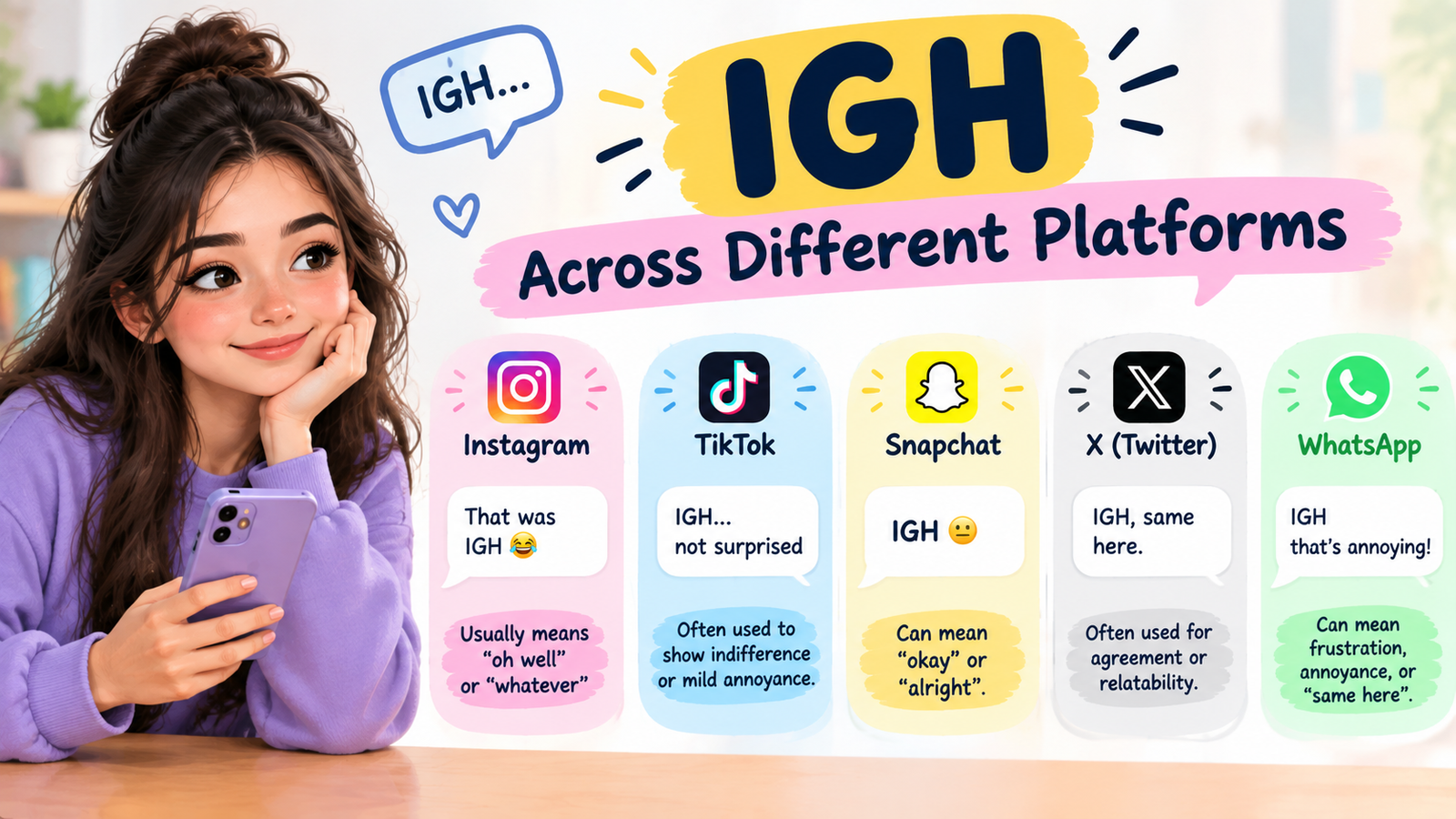
IGH doesn’t stay in one lane. It shows up across social media platforms and messaging apps in slightly different ways, even though the core meaning stays fairly consistent. Here’s how it plays out on the platforms where you’re most likely to run into it.
TikTok
TikTok comment sections move fast, and IGH fits right into that rhythm. You’ll see it dropped into replies and captions as a quick reaction, often paired with humor. A caption like “igh this trend got me” reads as relaxed buy-in, not literal reluctance.
On Instagram, IGH shows up most in DMs, story replies, and comment threads. It works well here because Instagram conversations tend to be short and casual by nature, and IGH fits that low-effort, high-context style of chatting.
Snapchat and SMS
Snapchat and regular text messaging are where IGH probably feels most “native.” These are one-on-one, real-time conversations, and IGH slots in as a natural, quick reply, similar to how you’d use “aight” if you were speaking out loud.
Discord and gaming chats
In gaming communities, speed matters. Players are often multitasking between a match and a conversation, so short replies like IGH let people confirm plans, agree to strategies, or accept an outcome without breaking focus.
Platform usage snapshot:
| Platform | Common Use Case | Typical Tone |
|---|---|---|
| TikTok | Comments, captions | Playful, casual |
| DMs, story replies | Relaxed, quick | |
| Snapchat | One-on-one chats | Natural, conversational |
| SMS | Everyday texting | Simple agreement |
| Discord | Gaming, group chats | Fast, functional |
Here’s the honest truth: the meaning of IGH doesn’t dramatically shift from platform to platform. What changes is the speed and context of the conversation. TikTok comments are public and quick. SMS is private and personal. Discord is often mid-activity. IGH adapts to each of those settings without needing a different definition every time.
Public vs. private use
There’s one meaningful distinction worth calling out: public platforms versus private messaging apps. On public online platforms like TikTok and Instagram comments, IGH is often performative. People use it to sound relaxed, funny, or relatable in front of an audience, even a small one. In private messaging apps like SMS or Snapchat, IGH tends to be more sincere. It’s less about how the message looks to outsiders and more about actually communicating a real reaction to the person you’re talking to.
That distinction matters if you’re trying to figure out someone’s real intent. A public “igh” under a viral video is closer to a caption choice than an emotional statement. A private “igh” in a one-on-one thread is much more likely to reflect how that person genuinely feels in the moment.
A quick note on regional and generational differences
Slang doesn’t spread evenly. Younger users, particularly teens and people in their early twenties, are far more likely to use IGH regularly across every platform listed above. Older users who do use texting slang tend to default to the fuller spelling, “aight,” rather than the trimmed-down “igh.” Neither version is more correct. It’s simply a generational and regional pattern in how messaging habits evolve over time.
Other Things IGH Can Stand For
Slang acronyms often overlap with completely unrelated abbreviations, and IGH is no exception. If you’ve searched this term and landed on something about hotels, business, or an entirely different industry, you may have actually been looking at IHG, not IGH.
IHG stands for InterContinental Hotels Group, a major global hospitality company that operates well-known hotel brands. It has zero connection to the texting slang covered in this article; it’s simply a different set of letters in a different order. This mix-up shows up often enough in searches that it’s worth clearing up directly: if you’re chatting with a friend, IGH is slang. If you’re reading a business or travel article, double-check whether it’s actually referencing IHG.
Outside of that mix-up, IGH doesn’t have widely recognized alternate meanings in mainstream use. It’s a fairly narrow term: born from texting, used in texting, and rarely appearing in professional, academic, or industry contexts under its own name.
IGH vs. Similar Texting Slang
IGH belongs to a small family of short, agreement-style texting terms. Here’s how it stacks up against the words people most often confuse it with.
IGH vs. Aight
These two are practically siblings. Aight is the fuller, slightly more traditional spelling, while IGH is the trimmed-down, faster-to-type version. They mean the same thing, and most people use them interchangeably depending on how quickly they’re typing.
IGH vs. Okay
Okay is the neutral, universally understood version. It works in almost any setting, casual or formal. IGH is the more relaxed, insider version of the same idea, best kept to casual conversations with people who already use texting slang regularly.
IGH vs. Idk
Idk (“I don’t know”) expresses uncertainty about a fact or decision. IGH expresses agreement, even if it’s reluctant agreement. They’re not really interchangeable; one shows not knowing, the other shows accepting.
IGH vs. Meh
Meh signals indifference, like “I don’t really care either way.” IGH, even in its more reluctant form, still leans toward agreement. Meh doesn’t commit to anything. IGH usually does.
Comparison table:
| Term | Meaning | Tone | Best Use Case |
|---|---|---|---|
| IGH | Okay / I guess | Neutral to reluctant | Agreeing to plans, casual replies |
| Aight | Alright | Relaxed, friendly | Same as IGH, slightly more common in speech-to-text |
| Okay | Yes, understood | Neutral, versatile | Casual and semi-formal settings |
| Idk | I don’t know | Uncertain | Responding to a question you can’t answer |
| Meh | Indifferent | Unenthusiastic | Expressing lack of preference |
Knowing where IGH fits among similar texting slang helps you pick the right word for the right moment instead of defaulting to IGH out of habit.
IGH vs. Bet
Bet is another short, punchy agreement word, but it carries more confidence and enthusiasm than IGH. If someone says “wanna run it back?” a reply of “bet” signals eager agreement, while “igh” signals a more neutral or even reluctant yes. They’re both casual abbreviations, just tuned to different energy levels.
IGH vs. Fr (For Real)
Fr isn’t an agreement word at all. It’s used to confirm sincerity, as in “that’s crazy fr.” It doesn’t overlap much with IGH in meaning, but the two often show up in the same sentence, like “igh that’s crazy fr,” stacking casual tone on casual tone.
Extended comparison table:
| Term | Core Function | Enthusiasm Level |
|---|---|---|
| IGH | Agreement or reluctant agreement | Low to neutral |
| Bet | Confident agreement | High |
| Aight | Alright, agreement | Neutral |
| Okay | Confirmation | Neutral |
| Idk | Uncertainty | N/A |
| Meh | Indifference | Very low |
| Fr | Emphasis on sincerity | N/A |
How to Respond to IGH
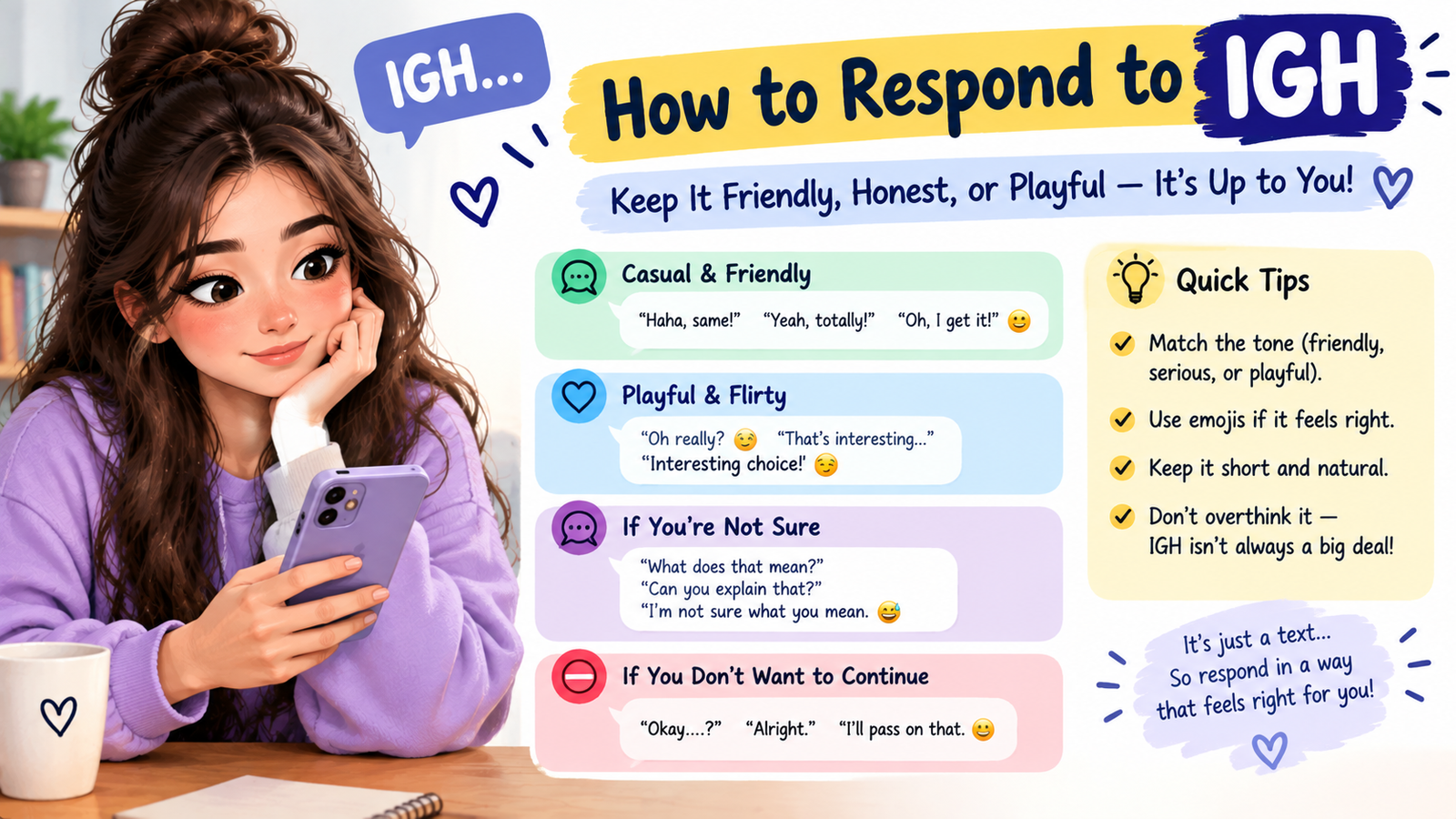
Getting a solo “igh” back can feel like a conversational dead end, especially if you’re not sure which meaning the other person intended. Here’s how to handle it depending on the situation.
If it seems neutral:
Just move forward with the plan. No need to overanalyze a friendly, low-key “igh.”
Them: “We still on for tomorrow?” You: “yep, 6pm work?” Them: “igh” You: “perfect, see you then”
If it seems reluctant:
Acknowledge it, and give them room to say more if they want to.
Them: “igh… guess I’ll come” You: “you don’t have to if you’re not feeling it”
If you’re genuinely unsure:
Ask directly. It’s a low-stakes question and it clears up any confusion fast.
You: “wait, are you good with that or just going along with it?”
Response examples by scenario:
| Their Message | Likely Meaning | Good Reply |
|---|---|---|
| “igh let’s go” | Neutral agreement | “bet, see you soon” |
| “igh.” | Mild annoyance | “you sure? we can change plans” |
| “igh i guess” | Reluctant agreement | “no pressure, we can do something else” |
| “IGH???” | Surprise | “yeah for real, crazy right?” |
A good text reply doesn’t need to be complicated. Match their energy, and if the tone feels off, a quick check-in almost always smooths things over.
ALSO READ:https://holymeaning.com/cbfw-meaning-in-text/
When to Avoid Using IGH
IGH works great in casual conversations, but it’s not built for every setting. Knowing where to leave it out matters just as much as knowing how to use it.
Skip IGH in these situations:
- Professional emails or work Slack messages. IGH reads as too casual and can come across as dismissive in a workplace setting, even if that’s not the intent.
- Conversations with people unfamiliar with slang. Parents, older relatives, teachers, or non-native English speakers may not know what IGH means, and typing it can create confusion instead of clarity.
- Formal or serious conversations. If someone’s sharing bad news or asking something important, a flat “igh” can feel careless, even if you meant it as simple agreement.
- First-time conversations with new contacts. Until you know someone’s texting style, sticking with clearer words like “okay” avoids any risk of misreading.
Here’s a simple gut check: if you’d hesitate to say “aight” out loud in that exact conversation, skip typing “igh” too. Formal communication calls for full words and clear tone, not shorthand that depends on context to land correctly.
Quick Recap: IGH Meaning at a Glance
Here’s the short version, if you just need the essentials.
- IGH is a shortened, casual spelling of “aight,” which comes from “alright.”
- It has two core meanings: plain agreement (“okay”) and reluctant agreement (“I guess”).
- Tone depends heavily on punctuation, capitalization, and context, not the letters themselves.
- It’s common across TikTok, Instagram, Snapchat, SMS, and Discord, with only minor differences in how it’s used per platform.
- It’s easily confused with IHG (InterContinental Hotels Group), which is a completely unrelated term.
- Compared to similar slang like aight, okay, idk, and meh, IGH specifically leans toward agreement, just with flexible enthusiasm.
- Reply to it based on tone: match energy for neutral use, offer an out for reluctant use, or just ask directly if you’re unsure.
- Avoid it in professional messaging, formal conversations, or with anyone unfamiliar with texting slang.
At the end of the day, IGH is a small piece of a much bigger pattern in digital communication: language keeps shrinking to match how fast we type and how casually we talk. Once you know how to read it, it stops being confusing and starts being just another normal part of the conversation.
FAQs
What does IGH mean in a text?
IGH is a casual, shortened spelling of “aight” (alright), used to show agreement — from a relaxed “okay” to a reluctant “I guess.”
Is IGH still used in 2026, or has it faded out?
It’s still active, especially in TikTok comments, Instagram DMs, and group chats among teens and young adults.
Does IGH mean the same thing as “ugh”?
No. “Ugh” is pure frustration with no agreement attached, while IGH still implies you’re going along with something, even reluctantly.
Is it okay to use IGH at work?
No — keep it out of emails, Slack messages, or client texts. It’s strictly casual and reads as too informal for professional settings.
Does IGH mean something different depending on the platform?
Not really. The core meaning stays the same on TikTok, Instagram, Snapchat, and SMS — only the pace and formality of the conversation shift.
conclusion
That’s IGH meaning in text in a nutshell. It’s not complicated once you break it down. It’s just “aight,” trimmed way down, used to show agreement. Sometimes it’s easy and relaxed. Sometimes it’s a little reluctant. The tone lives in the punctuation, not the letters.
Next time someone texts you a plain “igh,” you’ll know exactly what’s going on. Understanding IGH meaning in text helps you read chats better and avoid awkward mix-ups. Use it with friends, skip it at work, and you’re set. Small word, real meaning, easy to master.








1 thought on “IGH Meaning in Text: What It Really Means in Chat Language”