RS in text most often stands for “real sh*t” or its softened cousin, “real stuff,” a slang expression people use to confirm honesty, back up a claim, or show strong agreement without sounding fake or exaggerated.
That tiny two-letter reply has sparked more confused double-takes than almost any other slang term floating around group chats and comment sections right now, quietly reshaping how an entire generation signals sincerity online.
Beyond that main definition, RS shifts meaning depending on context, sometimes pointing to rupees, RuneScape, or even a respectful nod in a workplace message. Understanding these layers turns a puzzling text into an easy, natural read.
Quick Answer: What Does RS Mean in Text?
Here’s the short version, since you probably want it fast: RS most commonly stands for “real sh*t” (often softened to “real stuff” in polite company). People use it to back up a statement, confirm something is genuine, or express strong agreement with what someone just said.
Think of it as a stamp of authenticity. When someone adds RS to the end of a sentence, or replies to your message with just “rs,” they’re telling you the emotion or the statement behind it is real. No sarcasm. No exaggeration. Just honesty.
That said, RS isn’t a one-trick abbreviation. Depending on the platform, the community, and even the country you’re texting from, this text abbreviation RS can mean something completely different — from a currency symbol to a video game. We’ll get to all of that. But if you only remember one thing from this article, remember this: context decides the meaning, and nine times out of ten, that context points to “real sh*t” or “real stuff.”
Why Do People Use RS in Text Messages?
Texting rewards speed. Nobody wants to type “I completely agree with you, and I mean that genuinely” when three letters do the same job. That’s really the whole story behind most internet slang: efficiency wins.
There’s also an emotional layer here that’s easy to miss. When you say “I agree,” it can sound flat, almost robotic. But when you drop “rs” into a chat, it carries a certain rawness — like you didn’t have time to polish your words because what you’re saying matters too much to dress up. That’s part of why casual texting culture leans so heavily on abbreviations like this one. They feel less rehearsed than full sentences.
A few other reasons RS caught on:
- Speed — typing two letters beats typing two or three words every time.
- Tone-matching — it fits naturally into fast, back-and-forth conversations without breaking the rhythm.
- Group identity — using current slang signals that you’re plugged into a particular online culture, whether that’s TikTok comment sections or gaming Discord servers.
- Ambiguity as a feature — a short, punchy reply like “rs” lets the reader fill in the emotional tone themselves, which can feel more personal than a fully spelled-out response.
There’s a deeper pattern at work too. Texting has always pushed language toward compression, whether that’s “u” instead of “you” or “brb” instead of “be right back.” What makes RS a little different is that it doesn’t just save keystrokes, it also carries an emotional signature that longer phrases sometimes lose. Say “I promise I’m being honest” and it can sound almost defensive, like you’re overexplaining. Say “rs” instead, and it lands with less effort and somehow more weight. That’s the paradox behind a lot of slang expression: shorter often reads as more sincere, not less.
It also helps that RS is easy to type without thinking. Your thumbs barely have to move. In a conversation that’s moving fast, that matters more than it sounds like it should. A term that requires zero mental friction to type is a term that survives, and RS cleared that bar early on.
The Main Meaning of RS: “Real Sh*t” Explained
Let’s dig into the core RS slang meaning, since this is the one you’ll run into most in day-to-day texting.
When someone types “rs” after a statement, or sends it as a standalone reply, they’re emphasizing that what they said (or what you said) is true, serious, and not exaggerated for effect. It works almost like an exclamation point for honesty. Where “!!!” adds excitement, “rs” adds sincerity.
Here’s a simple breakdown of how it functions grammatically:
| Position in Message | Function | Example |
|---|---|---|
| End of a sentence | Confirms the statement is genuine | “That interview went horribly, rs” |
| Standalone reply | Signals strong agreement or shared feeling | Friend: “Today was rough.” You: “rs 😔” |
| Start of a sentence | Sets an honest, unfiltered tone for what follows | “Rs, I don’t think that plan is going to work” |
Notice that RS rarely functions as a question or a request in this main usage. It’s a genuine emphasis marker — it doesn’t ask anything of the reader, it just confirms the emotional weight of what’s already been said.
One nuance worth flagging: because “real sh*t” contains profanity in its full form, plenty of people quietly treat it as “real stuff” instead, especially when texting family members, coworkers, or anyone who might raise an eyebrow at the uncensored version. Functionally, both mean the same thing. The softened version just trades a little edge for a little more politeness.
“RS isn’t about information, it’s about tone. It tells the reader: don’t read this as a joke.” — a pattern echoed across nearly every major slang-tracking source covering Gen Z texting habits in 2026.
It also helps to understand what RS is not. It isn’t really used to soften bad news, and it isn’t a substitute for sympathy phrases like “I’m sorry to hear that.” Instead, it’s closer to a verification stamp. If a friend tells you something surprising and you reply “rs?” with a question mark, you’re not asking for clarification on the words, you’re asking whether they’re actually serious. Drop the question mark, and “rs” flips into confirmation instead of a question. That small punctuation shift changes the entire function of the word, which is a good reminder that texting context includes far more than just the letters themselves.
A short case in point: one popular thread that circulated widely in 2026 involved someone texting their roommate “the landlord is selling the building.” The roommate replied with a single “rs??” — genuinely unsure if it was a joke. The sender’s follow-up, “rs, no cap, packing starts this weekend,” cleared it up instantly. That back-and-forth captures the entire function of RS in one exchange: it turns uncertainty into confirmation in as few characters as possible.
Other Possible Meanings of RS in Text
Here’s where things get interesting. RS is a two-letter combination, and two-letter combinations get recycled constantly across different communities. Below are the other meanings of RS you’re likely to run into, depending on where the conversation is happening.
Rupees
In South Asian English, especially across Pakistan, India, Bangladesh, and Sri Lanka, RS is shorthand for Rupees — the currency used in several of these countries. This usage has nothing to do with slang or internet culture. It’s a long-standing written abbreviation that predates texting entirely, showing up on price tags, receipts, and formal documents for decades.
Example: “That bag costs rs 2,500” simply means the bag costs 2,500 rupees. If you’re texting someone from this region about prices, shopping, or bills, this is very likely the intended meaning, not “real sh*t.”
RuneScape
In gaming circles, particularly among players who grew up with (or still play) the long-running MMORPG RuneScape, “RS” is just shorthand for the game itself. You’ll see this constantly in gaming Discord servers, Reddit threads, and YouTube comment sections.
Example: “You still play rs?” is asking whether someone still plays RuneScape — not whether something is “real stuff.”
Right Side / Reset
In more technical or gaming-adjacent contexts, RS occasionally stands in for “right side” (used in directional or positional instructions) or “reset” (common in tech support threads, gaming lobbies, or troubleshooting chats). These usages are far less common than the “real sh*t” meaning, but they do pop up, especially in niche communities where abbreviations get repurposed for convenience.
Respectfully
In more formal or semi-formal messages, particularly emails or workplace chats, some people use “RS” as informal shorthand for “respectfully,” typically placed before a statement of disagreement. Example: “RS, I think we should revisit this decision.” This usage is rare compared to the slang meaning, but it does show up, especially among people who’ve picked up the habit of prefacing pushback with a softening word.
Here’s a quick side-by-side so you can scan these alternate meanings at a glance:
| Meaning | Common Setting | Example Phrase |
|---|---|---|
| Real Sh*t / Real Stuff | Texting, social media, casual chats | “That was rs, ngl” |
| Rupees | South Asian commerce, pricing | “It’s rs 500 for two” |
| RuneScape | Gaming communities | “Logging into rs tonight” |
| Right Side / Reset | Tech, gaming instructions | “Push the rs button” |
| Respectfully | Formal or workplace messages | “RS, I disagree with this plan” |
How to Tell Which Meaning Is Being Used
Given how many RS definitions exist, how do you figure out which one applies without asking? Three quick context clues usually settle it.
1. Check the platform. A comment under a TikTok video is almost certainly using the slang meaning. A message in a gaming Discord server is more likely referencing RuneScape or a technical reset. A WhatsApp thread involving prices in South Asia is probably talking about rupees.
2. Check who’s texting you. Someone who regularly uses slang like “fr,” “ngl,” or “no cap” is very likely using RS the same way. Someone in a professional email thread is more likely using the “respectfully” shorthand, if they’re using it at all.
3. Check what came right before it. RS almost always follows or precedes a statement with emotional weight, a price, a game reference, or a point of disagreement. The sentence around it usually gives away which category you’re dealing with, even before you consider the platform or sender.
If you’re still unsure after running through these three checks, it’s completely fine to just ask. A quick “wait, what do you mean by rs?” clears things up faster than guessing wrong and replying to the wrong thing entirely.
RS Meaning by Context: Quick Reference Table
Since RS meaning by context shifts so much, here’s a condensed table you can come back to any time you’re unsure.
| Context | Likely Meaning | Confidence Level |
|---|---|---|
| Texting a friend about something emotional | Real Sh*t / Real Stuff | High |
| TikTok, Snapchat, or Instagram comments | Real Sh*t / Real Stuff | High |
| Gaming chat (Discord, in-game messages) | RuneScape or Reset | High |
| South Asian shopping or pricing conversation | Rupees | High |
| Formal email or workplace disagreement | Respectfully | Moderate |
| Tech support or troubleshooting thread | Reset / Right Side | Moderate |
RS in Everyday, Non-Slang Situations
It’s worth pausing here, because plenty of people encounter “RS” in contexts that have nothing to do with online slang at all. Financial documents, invoices, and price lists across South Asia use RS constantly, and it would be a mistake to assume every instance of the abbreviation is Gen Z shorthand.
Businesses operating internationally also sometimes use RS as a standard currency abbreviation in spreadsheets, receipts, and customer-facing communication. If you’re reading a message from a business account, a delivery confirmation, or a formal invoice, RS is doing accounting work, not emotional work. This is a good reminder that context clues matter more than the letters themselves.
How RS Is Used on Social Media
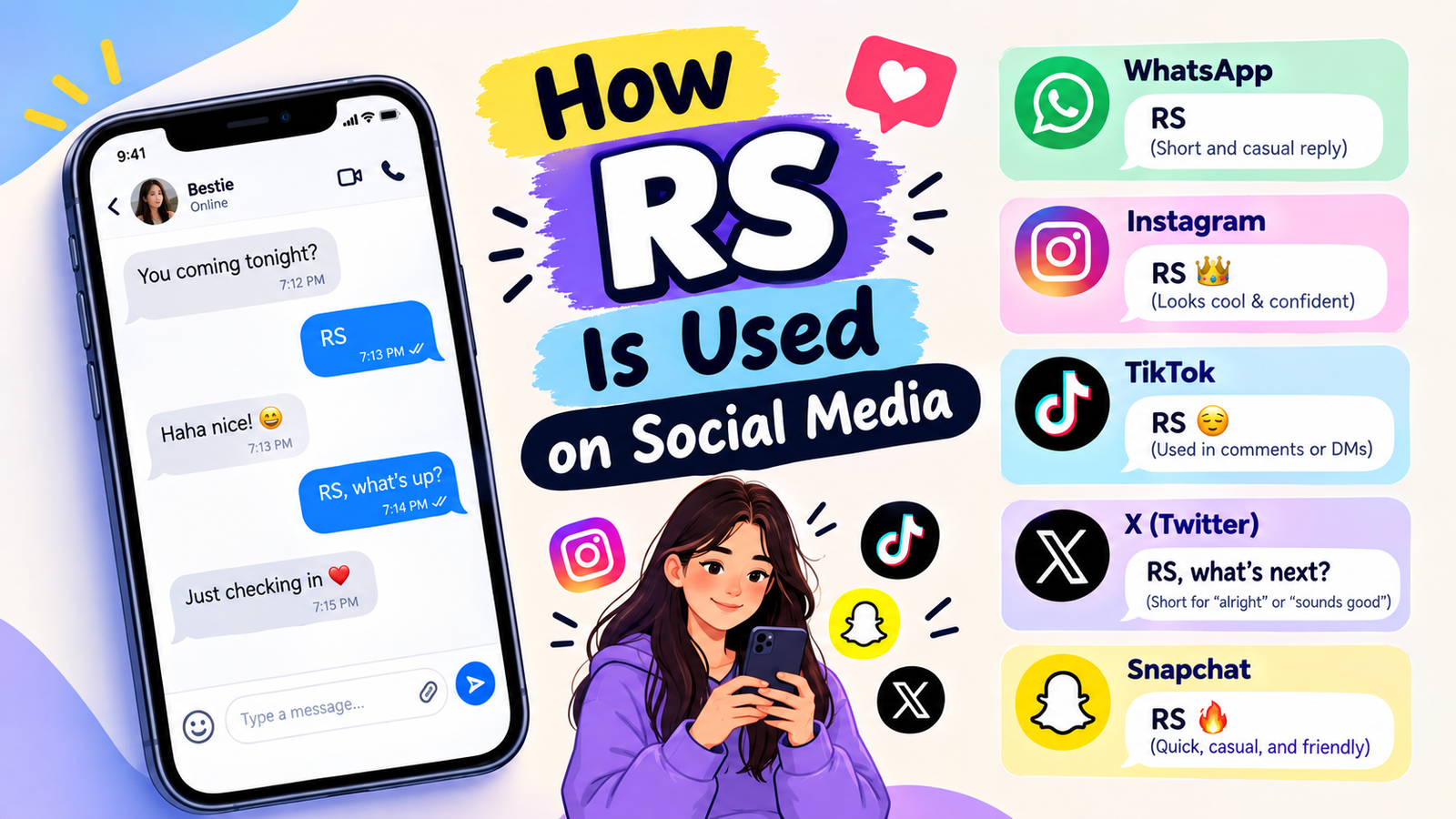
Social media is where the slang meaning of RS really took off, and each platform has its own flavor of usage.
On TikTok, RS shows up constantly in comment sections responding to emotional or relatable videos. Someone posts about a rough day, and the top comment reads “rs, felt this in my soul.” It’s short, it’s sincere, and it fits the scroll-fast culture of the platform.
On Snapchat, RS tends to show up in direct replies rather than public comments, since Snapchat is built around private, back-and-forth messaging. A friend sends a Snap complaining about their day, and the reply is a simple “rs” with a matching expression.
On Instagram, you’ll see it most in comment threads under posts that touch on relatable struggles, funny observations, or callout-style captions. It functions almost like a shorter, more emotionally loaded version of “same” or “this.”
Across all three social platforms, the pattern holds: RS shows up where authenticity matters more than eloquence. It’s not really built for long captions or polished posts. It thrives in quick exchanges where speed and sincerity matter more than grammar.
Real-Life Examples of RS in Text
Seeing RS used correctly makes it much easier to use yourself. Here are several real-life text examples across different scenarios.
Scenario 1: Texting a close friend
Friend: “Ngl, I’ve been feeling really burnt out lately.” You: “rs. same here honestly”
Scenario 2: Reacting to something surprising
“Bro just told me he’s moving to another country next month, rs”
Scenario 3: Gaming context
“You trying to play rs tonight or nah?”
Here, RS clearly refers to RuneScape, not the emotional slang meaning, based on context.
Scenario 4: Price conversation
“The delivery fee is rs 150 extra”
Scenario 5: Semi-formal disagreement
“RS, I think we should push the deadline back a week.”
Here, RS softens a workplace pushback with a nod toward respectfulness.
These chat examples show exactly why context does so much heavy lifting. The letters never change, but the meaning shifts completely depending on what surrounds them.
When Not to Use RS
Slang has a place, and that place isn’t everywhere. Here’s when it’s worth skipping RS entirely.
- Formal writing — reports, cover letters, academic work, and official documents should never include texting slang, period.
- Professional messages to people you don’t know well — a first email to a new client or manager is not the place to test out casual abbreviations.
- Texting someone unfamiliar with current slang — older relatives, new coworkers, or anyone outside your usual social circle may not catch the meaning, and misreadings can cause real confusion.
- Contexts where the profanity matters — if “real sh*t” would be genuinely inappropriate given the setting, even the abbreviated version can read as careless.
For business communication and formal communication generally, plain, full language always reads as more professional. Save RS for the group chat, not the group email.
Origin of RS: Where Did It Come From?
Pinning down an exact origin for internet slang is almost never possible, and RS is no exception. What we do know is that it fits squarely within a broader wave of urban slang roots, much of it tracing back to AAVE (African American Vernacular English), which has shaped a huge share of modern internet expression — think “no cap,” “fr fr,” “lowkey,” and “bet.”
RS follows the same pattern as these terms: a phrase that starts in spoken, everyday speech, gets adopted into texting and social media, and eventually spreads far beyond its original community through memes, comment sections, and viral posts. As texting culture pushed people to compress full phrases into abbreviations, “real sh*t” naturally shortened to “rs,” following the same logic that turned “for real” into “fr” and “no cap” into just “cap” or “no cap.”
This is standard slang history — abbreviations rarely have a single inventor. They emerge from thousands of small, repeated uses until they become recognizable enough to spread on their own.
What’s worth noting is how much of today’s most common online slang traces back to the same handful of linguistic patterns: compression (shortening phrases), emphasis through repetition (“real real”), and borrowed intensity from spoken vernacular that gets typed exactly as it sounds. RS checks every one of these boxes. It compresses “real sh*t” into two characters, it carries the emphatic tone of spoken speech, and it spread the same way most viral phrases do, through repeated exposure in comment sections, group chats, and short-form video captions until it became second nature to a huge chunk of internet users.
It’s also worth remembering that slang doesn’t move in a straight line. A term can spike in usage, fade for a stretch, then resurface with a slightly different flavor once a new platform or subculture picks it up again. RS has followed roughly that pattern, staying relatively steady in gaming and South Asian commercial contexts for years, while its slang usage has ridden the waves of whatever short-form video platform happens to be dominant at the time.
RS vs. Similar Slang Terms
RS doesn’t operate alone. It belongs to a small family of agreement-and-honesty slang that overlaps in meaning but carries slightly different tones. Here’s how it stacks up against the most common similar slang terms.
| Term | Meaning | Tone Difference |
|---|---|---|
| RS (“real sh*t”) | Confirms honesty or strong agreement | More emotional, often used in serious or heartfelt moments |
| fr (“for real”) | Confirms truth or agreement | Lighter, works in both serious and casual/joking contexts |
| ngl (“not gonna lie”) | Prefaces an honest admission | Used before a statement, not after — sets up honesty rather than confirming it |
| ong (“on god”) | Strongly swears something is true | More emphatic and dramatic than RS |
| no cap | Confirms something isn’t exaggerated | Playful, frequently used in bragging or hype contexts |
The clearest distinction: RS tends to show up in moments that carry real emotional weight, while terms like “fr” and “no cap” get used more loosely, even in jokes or exaggerated bragging. If you’re looking for the slang closest to RS in both function and tone, “fr” is the nearest match, but RS generally lands a little heavier.
Who Uses RS Most Often
RS shows up most in everyday texting among teens and young adults active on TikTok, Snapchat, and Instagram, since these platforms are where the term spread fastest. It’s also common in gaming communities, though there it frequently refers to RuneScape rather than the slang meaning. Outside of these groups, usage drops off quickly. Older generations and people outside youth-driven social platforms are far less likely to use or immediately recognize RS in its slang sense, which is exactly why context and audience matter so much when deciding whether to use it.
Common Mistakes People Make With RS
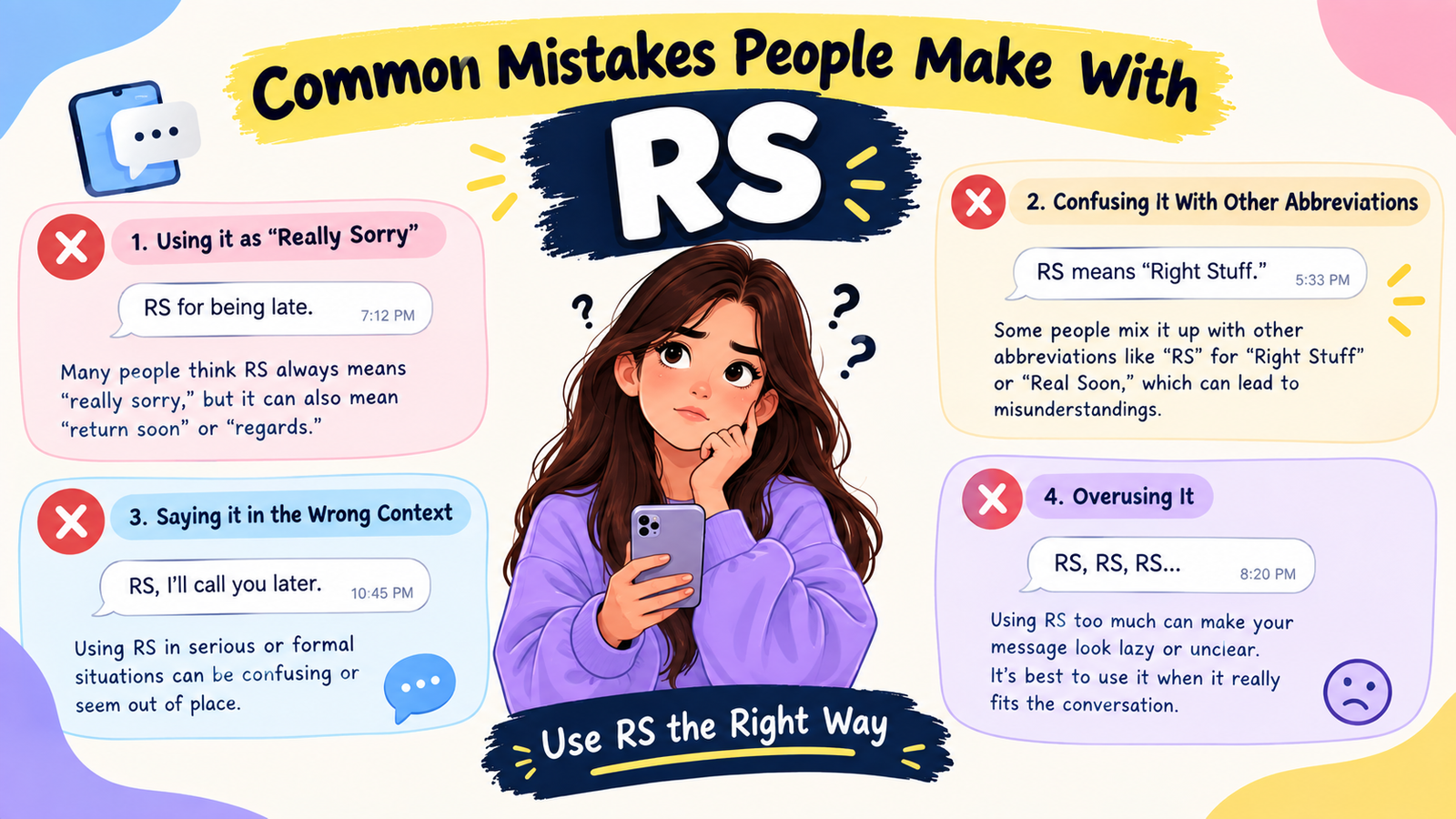
Even once you understand the RS abbreviations and their range of meanings, it’s easy to misuse the term or misread it. Here are a few mistakes worth watching for.
Assuming it always means the slang version. If you’re texting someone about a purchase, a delivery, or a bill, and they type “rs,” don’t automatically assume they’re being emotionally sincere. Check whether a number follows it. “rs 300” is almost certainly rupees, not an emphatic statement.
Using it in the wrong emotional register. RS is built for sincerity, not sarcasm. Tacking it onto a clearly joking statement can confuse the reader, since the whole point of the term is to signal genuineness. If you’re joking, other slang like “lol” or “no cap fr” fits better.
Overusing it until it loses meaning. Slang that gets repeated in every single message starts to lose its emphasis. RS works best as a deliberate addition, not a verbal tic dropped into every sentence. Used sparingly, it still carries weight. Used constantly, it starts to blend into background noise.
Forgetting your audience. Sending “rs” to someone who’s never encountered the term before can leave them more confused than if you’d just typed the full sentence. Slang only works as shorthand when both people share the same reference point.
RS Definitions Side-by-Side: A Simple Comparison
Because so many RS definitions exist depending on setting, it helps to see them laid out by how formal or informal each one tends to be.
| Formality Level | Meaning | Typical Users |
|---|---|---|
| Very informal | Real Sh*t | Teens, young adults, social media users |
| Informal | Real Stuff (softened version) | Same audience, more cautious phrasing |
| Neutral / niche | RuneScape, Reset, Right Side | Gamers, tech-focused chats |
| Neutral / regional | Rupees | South Asian commerce and daily conversation |
| Semi-formal | Respectfully | Workplace or professional messaging |
Scanning this table before replying to an ambiguous message can save you from an awkward misinterpretation, especially in mixed group chats where multiple meanings could realistically apply.
Age isn’t the only factor, either. Region plays a huge role, given how differently RS gets interpreted depending on where someone grew up texting. Someone based in Pakistan or India might type “rs” in a shopping conversation dozens of times a week without ever intending the slang meaning, while someone in the US or UK might never encounter the currency usage at all. That regional split is one of the clearest examples of why a single abbreviation can mean two almost entirely unrelated things depending on who’s typing it.
Platform habits shape usage too. Someone who spends most of their screen time on TikTok and Snapchat is far more likely to reach for the slang meaning instinctively, since that’s the environment where the term gets reinforced daily through comments, captions, and replies. Someone whose main online community is a gaming server is more likely to type “rs” and mean the game itself, simply because that’s the dominant association within that particular space. Understanding your own conversation’s “home base” — which platform or community it grew out of — is often the fastest way to guess correctly before you even need to ask.
FAQs
Is RS still commonly used in 2026?
Yes, RS remains widespread across TikTok, Snapchat, and Instagram, especially in comment sections and quick replies where sincerity matters.
What’s the difference between RS and “fr”?
RS leans more emotional and serious, while “fr” (for real) works in both lighthearted and serious moments.
Does RS always mean “real sh*t”?
No, it depends on context. It can mean rupees, RuneScape, or “respectfully” outside casual slang settings.
Is RS appropriate for workplace messages?
Generally no. Stick to full words in professional communication unless your workplace culture is already very casual.
Can RS be used sarcastically?
Not typically. RS is built to signal genuine honesty, so pairing it with sarcasm usually just confuses the reader.
conclusion
So, what does RS mean in text? Most of the time, it means “real sh*t” or “real stuff.” People use it to sound honest and sincere. It’s quick, casual, and packed with emotion. Context always decides the exact meaning, whether that’s rupees, RuneScape, or something else entirely.
Now that you know what RS means in text, you can read messages with confidence. Check the platform, the sender, and the sentence around it. That’s really all it takes. Slang like this keeps evolving, but you’re ready for whatever comes next.









1 thought on “What Does RS Mean in Text Must-Know 🔥 2026”