Poignant describes something that’s deeply moving in a way that carries real weight behind it — not just sad, but emotionally sharp because it touches on truth, memory, or loss. That’s the poignant meaning at its core: feeling plus meaning, combined.
Picture a single photograph, a handwritten note, or five quiet seconds of silence that says more than an entire speech ever could. That’s poignancy in action, and once you notice it, you’ll see it everywhere.
This guide breaks the word down completely: its centuries-old origin, its real difference from “sad,” “touching,” and “heartbreaking,” and exactly how to use it so your own writing lands with genuine emotional impact.
What Does “Poignant” Mean? (Quick Definition)
Let’s start simple. At its core, the poignant meaning describes something that’s deeply moving in a way that stings a little. Not “sad” in a flat, one-note sense — more like a feeling that hits you in the chest because it’s true, or because it reminds you of something you can’t get back.
The Dictionary Definition, Plain and Simple
Dictionaries describe poignant as something that’s keenly distressing to the feelings, or something that’s touching, affecting, or emotionally sharp. The poignant definition always circles back to two things: emotional intensity and a sense of meaning behind that emotion. It’s not just “this made me feel something.” It’s “this made me feel something because it revealed a truth.”
A quick way to remember it: if something makes you feel a lump in your throat because it captures a real, human truth, that’s poignant. If it just makes you feel bad, that’s closer to plain old sadness.
Part of Speech, Pronunciation, and Word Forms
Here’s a quick grammar reference, since a lot of people get tripped up on the word forms:
| Word Form | Part of Speech | Example |
|---|---|---|
| Poignant | Adjective | “It was a poignant speech.” |
| Poignancy | Noun | “The poignancy of the moment silenced the room.” |
| Poignantly | Adverb | “She spoke poignantly about her father’s illness.” |
Pronunciation-wise, poignant is said as POY-nyuhnt (two syllables, not three — a lot of people mistakenly try to pronounce every letter). The poignant adjective always describes a noun — a moment, a memory, a scene, a reminder — never a person’s general mood on its own.
The One-Sentence Version You Can Actually Remember
If you only remember one line from this whole guide, make it this one: poignant means emotionally sharp and meaningful — not just emotional. That distinction is the whole ballgame, and it’s what the next section digs into.
The Real Meaning Behind Poignant — Why “Sad” Isn’t Enough
This is where most people get it wrong. They treat poignant as a synonym for sad, slap it into a sentence, and move on. But the poignant vs sad comparison actually reveals a lot about why one word feels so much richer than the other.
Poignant vs. Sad: The Key Difference
Sad describes an emotional state. It’s simple, direct, and doesn’t require context. You can be sad about losing your keys or sad about a death — the word covers a huge emotional range without discrimination.
Poignant, on the other hand, requires context. Something is poignant because of what it represents. A grandmother’s handwriting on an old recipe card isn’t sad by itself — it’s poignant because it represents a person, a time, a relationship that’s now gone. The emotional difference between the two words is the difference between raw feeling and feeling with meaning attached.
Here’s a simple way to separate them:
- Sad = an emotional state, often without much explanation needed
- Poignant = an emotional state plus the reason it matters
A funeral can be sad. A specific detail at that funeral — say, the deceased’s reading glasses still sitting on their nightstand — is what makes the moment poignant. It’s the specificity, the small human detail, that pushes plain sadness into something sharper.
The Bittersweet Quality — When Joy and Grief Show Up Together
One of the most interesting things about poignant and bittersweet as concepts is how closely they’re tied together. A huge number of truly poignant moments aren’t sad at all — they’re joyful and sad at the same time.
Think about a parent watching their child leave for college. There’s real happiness in that moment (pride, excitement for what’s ahead) sitting right next to real loss (the end of a chapter, an empty bedroom). That’s bittersweet meaning in action, and it’s often exactly what makes something poignant rather than just sad or just happy.
This is the emotional complexity that gives poignant its power. It doesn’t ask you to feel one thing. It asks you to hold two feelings at once — mixed emotions, sitting side by side, neither one canceling the other out.
Why Poignant Always Points to Something Deeper
Here’s the pattern worth remembering: poignant moments almost always connect to a bigger truth. Time passing. Love. Mortality. Change. The poignant emotion isn’t random — it’s tied to something universal that the reader or viewer recognizes in their own life.
That’s why a poignant scene in a movie can hit you even if you’ve never lived through anything close to what’s happening on screen. You’re not just responding to the plot. You’re responding to the underlying truth the scene is pointing at.
Where Poignant Comes From (Etymology)
Understanding where a word comes from often explains why it means what it means today. And the origin story behind poignant is genuinely a good one.
The Latin Root “Pungere” — Literally “to Prick” or “to Sting”
The word traces back to the Latin verb pungere, meaning “to prick, pierce, or sting.” That’s the same root that gave us the word “pungent” (as in a pungent smell). In fact, poignant and pungent are etymological siblings — they come from the exact same Latin ancestor.
Interestingly, the two words actually swapped meanings over time. Poignant originally described something sharp to the taste — think spicy or biting food — while pungent originally described something painful. Somewhere along the way, they traded places, and poignant settled into describing something that’s emotionally sharp instead of literally sharp on the tongue.
How It Traveled Through Old French Into English
From Latin, the word moved into Old French as poignant, a present participle of the verb poindre (“to prick” or “to sting”). It carried meanings like sharp, biting, pointed, and — in a figurative sense — wounding or cruel. English borrowed the word directly from French in the late 14th century, keeping much of that original “sharpness” baked in.
How the Meaning Shifted From Physical Pain to Emotional Impact
For a long stretch of its history, poignant described physical sensations — sharp tastes, piercing pain, biting cold. Over the following centuries, English speakers started applying the word more and more to emotional experiences instead of physical ones. By the time the word settled into its modern usage, the “sting” had moved from the tongue and the skin to the heart.
That shift matters, because it’s baked right into the poignant word meaning we use today: something that pierces you emotionally the way a sharp taste or a physical prick once did literally.
First Known Use in English
The earliest documented English use of poignant dates to the late 14th century, showing up in Middle English as poynaunt. Geoffrey Chaucer’s writing contains some of the earliest recorded examples, meaning this word has been part of contemporary English — in one form or another — for well over six hundred years. Few words hang around that long without losing their punch, and poignant is proof that a well-built word can survive centuries of usage without going stale.
How to Use Poignant in a Sentence
Knowing the definition is one thing. Knowing the correct use of poignant in actual writing is another. Let’s get practical.
Grammar Basics — What Poignant Can and Can’t Modify
Poignant is an adjective, so it modifies nouns. It works well with:
- Moments, scenes, and memories
- Speeches, letters, and eulogies
- Reminders, symbols, and objects tied to a memory
- Stories, films, songs, and artwork
It does not typically modify people directly in a natural-sounding way. You wouldn’t usually say “she is poignant” — you’d say “her speech was poignant” or “it was a poignant moment when she spoke.” This is a small but important piece of adjective usage that separates fluent, natural writing from writing that sounds like it came out of a thesaurus.
10+ Real Example Sentences
Here are example sentences across different tones and contexts, showing use poignant in a sentence in a variety of natural ways:
- The documentary ended with a poignant moment: the last known photo of the species before it went extinct.
- His retirement speech was surprisingly poignant, touching on how much the team had shaped his career.
- Finding her mother’s old grocery lists tucked in a drawer felt like a poignant reminder of ordinary days now gone.
- The final scene of the film was quiet, almost wordless, and all the more poignant for it.
- There’s something poignant about watching your childhood home get sold to strangers.
- The obituary included a poignant detail about the man’s daily walk to feed the neighborhood cats.
- It was a poignant moment when the entire stadium fell silent for the player who had passed away.
- Her letter was short but poignant, saying more in three sentences than most people manage in three pages.
- The old photograph of the empty classroom felt strangely poignant, a snapshot of a school that no longer existed.
- The comedian’s set took a poignant turn when he spoke about losing his father.
- There’s a poignant irony in building a monument to peace on a former battlefield.
- The song’s lyrics grew more poignant with every replay, once you understood who they were written about.
Common Collocations — Words That Naturally Pair With “Poignant”
Certain word pairings show up again and again in real writing. Learning these collocations will make your own poignant usage sound far more natural:
| Collocation | Typical Context |
|---|---|
| Poignant reminder | Objects, symbols, or events that recall a memory or loss |
| Poignant moment | A single, emotionally sharp scene or event |
| Poignant scene | Film, television, or theater |
| Poignant irony | A situation where the contrast between expectation and reality stings |
| Poignant speech | Eulogies, farewells, graduation addresses |
| Poignant detail | A small, specific fact that carries emotional weight |
| Poignant silence | A pause that communicates more than words could |
Formal vs. Casual Usage — Does It Sound Too Fancy for Everyday Speech?
Poignant sits comfortably in both formal and semi-formal writing — journalism, essays, reviews, speeches — but it can feel a little heavy in casual conversation. That doesn’t mean you should avoid it in everyday speech; it just means context matters. Saying “that was a poignant moment” after watching a poignant ad or short film sounds completely natural. Dropping it into small talk about your weekend, on the other hand, can come off as trying too hard.
The rule of thumb: use it when the moment actually earns it. Poignant is a word that works best when it’s rare.
Poignant vs. Similar Words — Side-by-Side Comparison
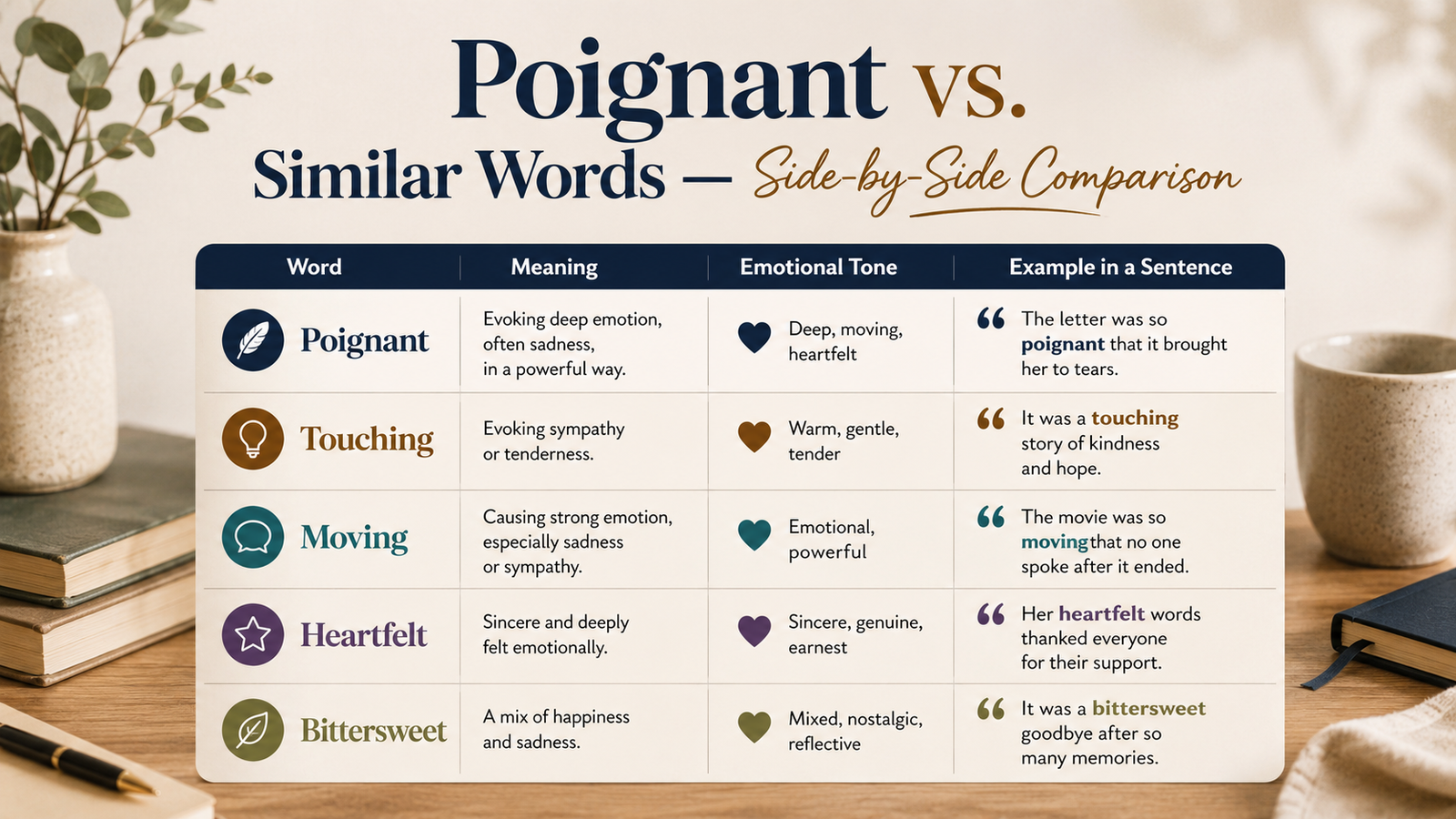
English has plenty of words in this same emotional neighborhood, and it’s easy to blur the lines between them. Here’s how poignant actually compares to its closest relatives.
Poignant vs. Touching
Poignant vs touching is probably the closest comparison on this list. Both words describe something emotionally affecting, but touching is broader and gentler. A card from a kid to their teacher is touching. A poignant moment usually carries a sharper edge — more bittersweetness, more of a sting, more connection to loss or the passage of time. Touching is warm; poignant is warm and a little painful.
Poignant vs. Heartbreaking
Heartbreaking meaning leans hard into pure sorrow. It’s devastating, tragic, and usually one-note — pure emotional pain without much complexity attached. Poignant is more layered. A heartbreaking story might leave you in tears with no relief in sight. A poignant story might leave you in tears and smiling, because it captures something beautiful alongside the sadness.
Poignant vs. Bittersweet
These two overlap a lot, which is why poignant and bittersweet so often appear together. Bittersweet describes the combination of positive and negative feelings existing at once. Poignant describes the emotional sharpness of a moment, which is very often (but not always) bittersweet in nature. Think of bittersweet as one common ingredient in a poignant moment, not a perfect synonym for it.
Poignant vs. Moving
“Moving” is a general term — almost anything that stirs an emotional response counts as moving, from a wedding toast to an inspiring sports comeback. Poignant is more specific: it implies the emotion connects to something meaningful, often tinged with loss, nostalgia, or mortality. All poignant things are moving. Not all moving things are poignant.
Poignant vs. Evocative
Evocative meaning centers on triggering vivid memory or sensory recall — a certain smell, a piece of music, an old photograph that pulls up emotional imagery from the past. Evocative is about the mechanism (something that calls up memory or feeling); poignant is about the result (something that hurts a little, meaningfully). A song can be evocative without being poignant — it might just remind you of summer. But when that reminder carries real emotional weight, it crosses over into poignant territory.
Comparison Table: Meaning, Intensity, and Best Use Case for Each
| Word | Core Meaning | Emotional Intensity | Best Used For |
|---|---|---|---|
| Poignant | Emotionally sharp and meaningful | High | Meaningful moments tied to loss, memory, or truth |
| Touching | Gently emotionally affecting | Moderate | Kind, warm, sentimental gestures |
| Heartbreaking | Devastating, sorrowful | Very high | Tragic, one-note sad events |
| Bittersweet | Joy and sadness combined | Moderate to high | Moments mixing happiness with loss |
| Moving | Generally emotionally stirring | Moderate | Broad emotional experiences, positive or negative |
| Evocative | Triggers vivid memory or association | Moderate | Sensory or nostalgic recall |
Poignant in Literature, Film, and Everyday Culture
Poignant is a word that critics, writers, and journalists reach for constantly — but it works best when it’s earned, not slapped onto every emotional scene as filler.
Examples From Classic Literature
Literature has always leaned on poignant moments to land its biggest emotional beats. Coming-of-age novels frequently build toward a poignant realization — a character understanding, often too late, what they’ve lost or what they’ve taken for granted. War novels use poignant details (a soldier’s unfinished letter home, a photograph carried in a breast pocket) to humanize large-scale tragedy in a way that statistics never could. Memoirs about grief often build their most powerful chapters around a single poignant object: a voicemail never deleted, a coat still hanging by the door.
How Screenwriters and Critics Use It
Film critics use “poignant” so often it’s practically a genre marker for a certain kind of ending — the quiet, understated scene that lands harder than a dramatic one ever could. You’ll see it constantly in reviews of dramas, documentaries, and character studies. It rarely shows up in reviews of big action movies, because poignancy depends on stillness and specificity, not spectacle.
Screenwriters build poignant moments deliberately, usually by combining three ingredients: a quiet pace, a small specific detail, and a connection to something the audience already understands emotionally (loss, aging, love, regret).
One Real Scene Broken Down — Why Critics Call It Poignant
Take the closing scene of an old family video played at a funeral — a device that shows up constantly in film and television. Why does it land as poignant rather than just sad?
- Specificity: It’s not a generic clip. It’s a real person’s voice, laugh, or mannerism.
- Contrast: The person is alive and ordinary in the footage, while the room watching it is grieving.
- Irretrievability: The footage is the last of its kind — there won’t be more of it.
- Universality: Almost everyone watching has lost someone, so the scene taps into personal memory even if the story isn’t their own.
Strip out any one of those four ingredients, and the scene gets weaker. Keep all four, and you’ve got a textbook poignant moment.
How the Word Shows Up in Journalism, Obituaries, and Eulogies
Journalists reach for poignant constantly, especially in obituaries and human-interest stories. A poignant reminder shows up in headlines about anniversaries of tragedies, community memorials, and personal essays about loss. Eulogies almost always contain at least one poignant detail — a specific habit, phrase, or object that captures who the person really was, rather than a generic list of accomplishments.
Common Mistakes to Avoid When Using Poignant
Even strong writers misuse this word. Here’s what to watch for.
Using It as a Fancy Substitute for “Sad”
This is the number one mistake. If a sentence would work fine with “sad” swapped in and lose nothing, poignant probably isn’t the right word. Poignant needs meaning attached — a reason the moment matters beyond the sadness itself.
Overusing It Until It Loses Its Punch
Poignant is a strong word precisely because it’s rare. If every third sentence in an article calls something poignant, the word stops carrying any weight. Save it for the moments that genuinely earn it, and use plainer words (touching, sad, moving) for everything else.
Applying It to Situations That Are Just Mildly Emotional, Not Meaningful
A sentimental Instagram caption about a nice brunch isn’t poignant — it’s pleasant. Poignant requires some real emotional stakes: loss, time passing, a truth revealed. Reserve it for moments that carry actual weight, not everyday niceness.
Mixing Up “Poignant” and “Poignancy”
Poignant is the adjective; poignancy is the noun. “The poignant of the scene” is grammatically wrong — you’d say “the poignancy of the scene.” Small mix-up, but it’s a common one, especially in fast writing or first drafts.
How Poignant Appears in Everyday Language Today
The word has genuinely grown in popularity in recent years, especially online.
Modern Usage in Journalism, Social Media, and Streaming Criticism
Streaming platforms have produced an entire wave of quiet, character-driven dramas, and critics reviewing them lean on “poignant” constantly to describe the small, human moments that define the genre. Social media has picked up the word too — captions describing a grandparent’s old letter, a childhood photo, or a final voicemail frequently use “poignant” to explain why the post matters, rather than just calling it sad.
This is part of the updated definition of how the word functions today: it’s become shorthand online for “this small thing means more than it looks like,” which fits neatly with the original, centuries-old sense of the word — something sharp, something that leaves a mark.
Why the Word Still Matters in 2026
Language changes fast, but poignant has held its ground because there isn’t really a good substitute for it. Sad is too broad. Touching is too soft. Heartbreaking is too heavy. Poignant occupies a very specific emotional register that keeps it useful, which is exactly why it keeps showing up in modern meaning discussions and current usage guides like this one, even centuries after it first entered English.
How to Write Something Poignant (Without Just Saying the Word)
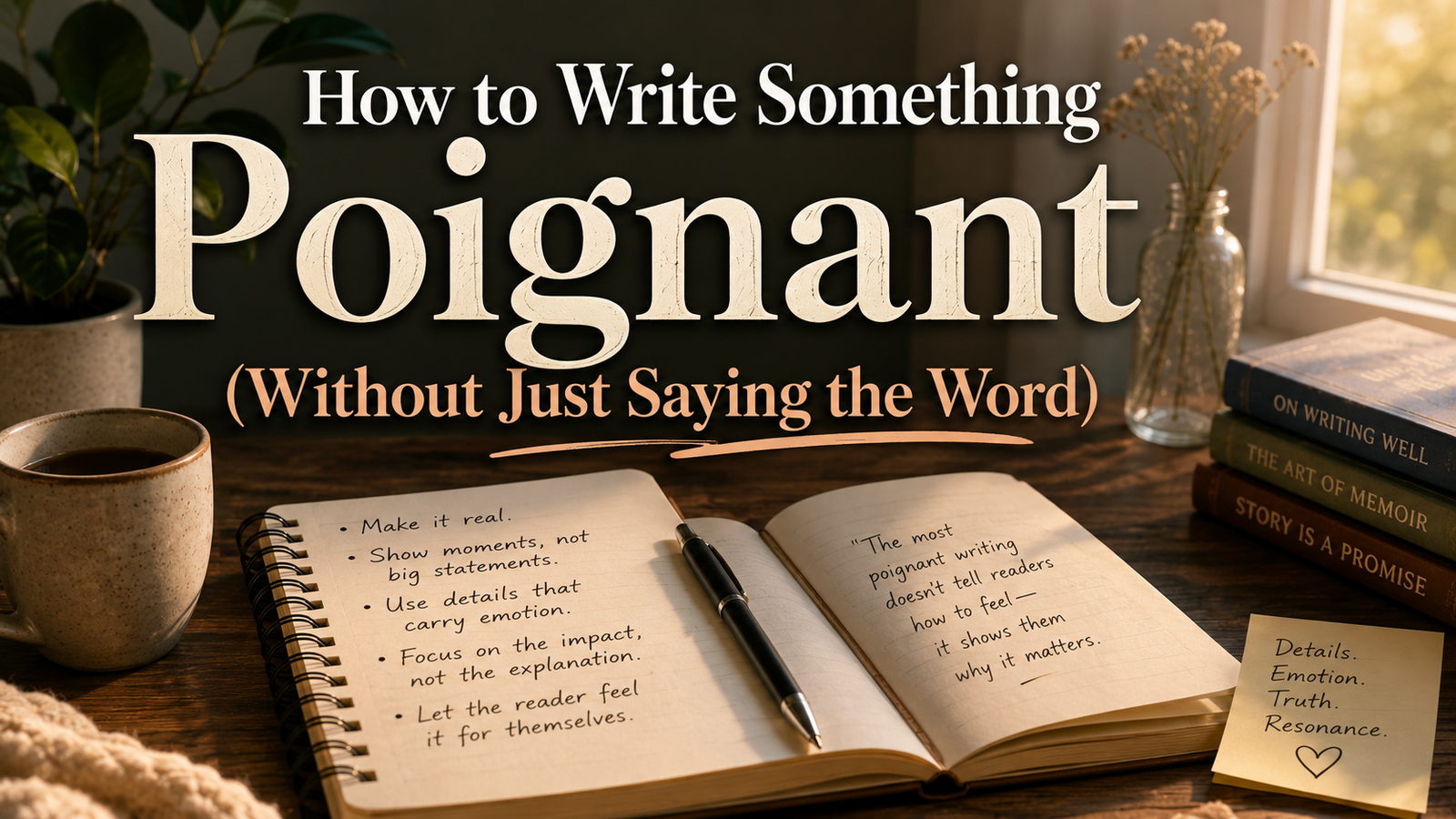
Here’s the twist: the best poignant writing rarely uses the word “poignant” at all. It creates the feeling through technique instead of naming it directly.
Show, Don’t Label — Specific Detail Beats General Emotion
Telling a reader “it was a poignant moment” does very little work. Showing them the specific detail that makes it poignant does all the work. Compare these two:
- Weak: “It was a poignant moment when she looked at her mother’s photo.”
- Strong: “She found the photo tucked behind a grocery receipt from 2004, her mother’s handwriting still visible on the back: Don’t forget milk.“
The second version never uses the word poignant, and it doesn’t need to. The descriptive language and specific detail do the heavy lifting.
The Power of Contrast
Poignant moments almost always rely on contrast: joy sitting next to grief, ordinary life sitting next to loss, past sitting next to present. When you’re writing, look for that contrast deliberately. A birthday candle blown out for someone who’s no longer there. A voicemail greeting still recorded in a voice that’s gone. The contrast is what creates the sting.
Sentence Rhythm — Why Short Sentences Often Land the Emotional Beat
Long, winding sentences dilute emotional impact. Short sentences concentrate it. Notice how the shift in rhythm below changes the effect:
“After the funeral, everyone went back to the house, and there was food everywhere, and people were talking quietly, and his coat was still on the hook by the door.”
versus:
“After the funeral, everyone went back to the house. There was food, quiet talk, small comfort. His coat still hung on the hook by the door.”
The second version, with its shorter final sentence, lands with more weight. That’s not an accident — it’s a technique. Save your shortest sentence for the detail that matters most, and let it sit there without explanation.
One Before-and-After Example
Before: “It was really sad when I found my grandpa’s old watch in a drawer because it reminded me he was gone.”
After: “The watch was still set five minutes fast, the way he always kept it. He’d been gone two years, and somehow, it was still keeping his time.”
Nothing in the “after” version says the word poignant, sad, or emotional. It doesn’t have to. The specific detail (the watch running five minutes fast, a habit tied directly to who he was) does all the emotional work on its own.
FAQs
Is poignant the same as emotional?
Not exactly — “emotional” is broad and covers any strong feeling, while poignant specifically means emotionally sharp and meaningful. Something can be emotional without being poignant.
What part of speech is poignant?
It’s an adjective, used to describe nouns like moments, scenes, speeches, or memories — for example, “a poignant reminder.”
Why do critics and journalists use “poignant” so often in 2026?
Streaming dramas, memoirs, and human-interest journalism have leaned heavily into quiet, character-driven storytelling, and poignant remains the go-to word for describing small, meaningful details rather than big dramatic moments.
Does poignant always relate to loss or death?
No — it’s commonly tied to loss or nostalgia, but it also applies to joyful moments layered with bittersweetness, like watching a child grow up faster than expected.
What’s the opposite of poignant?
Words like “trivial,” “flat,” or “unaffecting” work as opposites, since they describe something emotionally empty rather than sharp or meaningful,
conclusion
The poignant meaning comes down to one simple idea. It’s emotion plus truth. Not just sad. Something that stings a little because it’s real.
Now you know the poignant meaning behind the word. You know where it came from. You know how to use it right. Use it when a moment truly earns it. Save it for the details that matter. That’s what makes your writing hit harder, and stay with people longer.








1 thought on “Poignant Meaning: What It Really Means and How to Use It 2026”