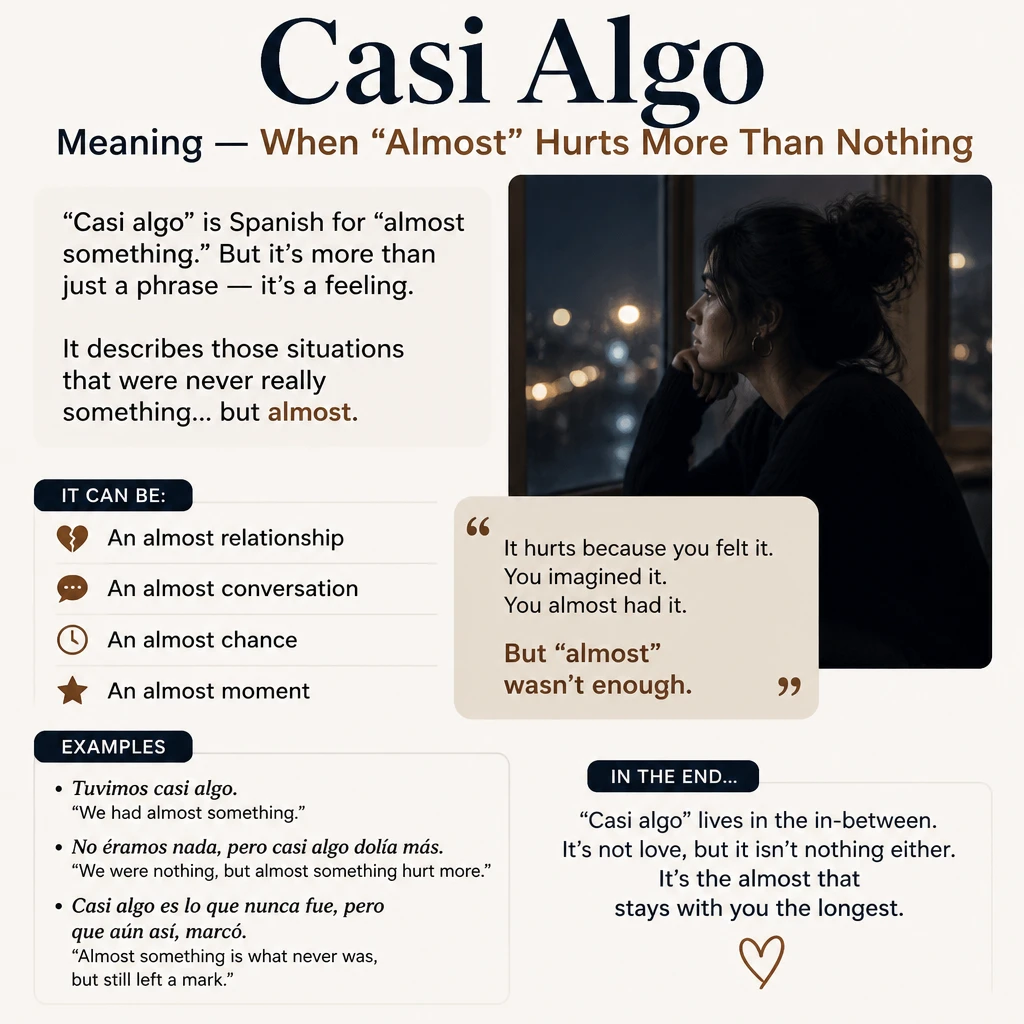
casi algo meaning is Spanish slang that translates to “almost something” — a relationship, connection, or moment that felt real but never became official. It’s the space between nothing and something, where feelings existed but a label never did.
Picture this: late-night texts, inside jokes only the two of you shared, a bond that looked like love from the outside — yet somehow, it never had a name. That’s casi algo, and it’s a feeling millions quietly carry.
The phrase exploded online thanks to Xavi’s viral hit “Tu Casi Algo,” turning a simple Spanish expression into a global anthem for unfinished connections. This guide breaks down exactly what it means, where it came from, and why it hurts more than a clean goodbye ever could.
What Does Casi Algo Mean
Let’s start with the basics, since this is the part most people are actually looking for.
Casi algo translates directly to “almost something” in English. It’s a popular modern term used to describe a relationship that goes beyond friendship but never becomes official — a romantic connection that ends before it truly begins.
Break the phrase down word by word and it gets even clearer:
- Casi = “almost”
- Algo = “something”
Put together, you get a phrase that sits right in that uncomfortable middle ground. Not nothing. Not quite something. Just… almost.
This is why the English translation, “almost something,” always feels a little flat by comparison. In Spanish, the phrase carries a rhythm and emotional shorthand that native speakers instantly recognize. Say “we were kind of a thing” to a friend and they’ll nod along politely. Say “éramos casi algo” and you’ll usually get a knowing look — maybe even a sympathetic sigh.
That’s the real power of Spanish slang: it often compresses a complicated emotional experience into two or three words, and casi algo is a textbook example.
A Quick Working Definition
If you only remember one line from this whole article, make it this one:
Casi algo describes any connection, romantic or otherwise, that had real potential but never fully arrived — close enough to feel meaningful, undefined enough to leave you without closure.
That’s the casi algo definition in its simplest form. Everything else in this article builds on that idea.
Where Casi Algo Comes From
Here’s something a lot of articles gloss over: casi algo isn’t a phrase someone invented for TikTok. It’s everyday Spanish — the kind of casual, colloquial phrase people have used in conversation for a long time, long before it became internet shorthand.
In informal Spanish, “casi” attaches itself to all kinds of situations to soften or qualify a statement:
- Casi llego — “I almost made it”
- Casi lo compro — “I almost bought it”
- Casi te llamo — “I almost called you”
“Casi algo” follows that same pattern, just applied to relationships and connections. It’s grammatically simple but emotionally loaded, which is honestly the sweet spot for slang that sticks around.
Why It Works Better in Spanish Than English
English has plenty of words for failed relationships. Ex. Breakup. Fling. But none of them quite capture the specific ache of something that never got a label in the first place. “Situationship” comes close, and we’ll get into that comparison shortly, but even that term sounds more like a dating-app buzzword than a genuine expression of feeling.
Casi algo, by contrast, sounds like something a friend would say to you over coffee, not something you’d read in a listicle about modern dating trends. That authenticity is a big reason the phrase resonated so widely once it started spreading online.
The Song That Pushed Casi Algo Into the Mainstream
You can’t talk about this phrase without talking about the song that turned it into a viral moment.
“Tu Casi Algo,” by Xavi featuring Fabio Capri, released in October 2024 as part of Xavi’s broader catalog of regional Mexican music. If the name Xavi sounds familiar, it should — the American singer-songwriter had already broken through with earlier singles that gained massive traction on TikTok, building an audience primed to pick up his next release fast.
“Tu Casi Algo” leans into a familiar heartbreak narrative: someone finally calling out a partner who kept things undefined, dragging the relationship along without ever committing to it. The song doesn’t dress up the frustration. It’s direct, a little bitter, and extremely relatable to anyone who’s lived through the exact situation it describes — which is probably why it spread the way it did.
Here’s what made the track catch fire beyond just streaming numbers:
| Factor | Why It Mattered |
|---|---|
| Relatable subject matter | Nearly everyone has experienced an undefined relationship at some point |
| Catchy, quotable hook | Short phrases work well as captions and audio clips |
| TikTok audio trend | The song became a soundtrack for personal stories, not just a song people passively listened to |
| Cross-generational reach | Both Spanish speakers and non-Spanish speakers picked it up, since the emotion translates even when the language doesn’t |
| Genre momentum | Xavi’s existing fanbase from prior regional Mexican hits gave the song an audience from day one |
A word of caution if you’re researching this topic elsewhere: several sites online attribute the viral casi algo moment to different artists or songs entirely, and some of those claims conflict with each other. The most consistently documented and verifiable source is Xavi and Fabio Capri’s “Tu Casi Algo.” When you see other names attached to the trend, treat that with some skepticism unless the source backs it up clearly.
Why Songs Like This Spread So Fast
Music has always been one of the fastest vehicles for slang. A phrase that might take years to spread through regional conversation can go global in weeks once it’s attached to a song people are lip-syncing, remixing, and quoting in captions. TikTok trend culture especially rewards short, emotionally specific phrases — and “casi algo” fits that mold perfectly. It’s short enough to fit in a caption, emotional enough to feel personal, and vague enough that almost anyone can apply it to their own life.
What the Feeling Behind Casi Algo Actually Is
Here’s where this phrase gets genuinely interesting, and where a lot of surface-level explanations fall short.
Casi algo isn’t really about sadness in the traditional sense. It’s something closer to unresolved grief — the kind you can’t fully process because there’s no clean event to point to. No one broke up with you. Nothing was “official” enough to mourn in the usual way. And yet, something real is missing.
Psychologists sometimes describe this as ambiguous loss — a type of grief that occurs when there’s no clear resolution or closure. You can’t grieve a breakup that never technically happened. You can’t process a rejection that was never explicitly stated. You’re left holding an emotional attachment to something that, on paper, was never even real.
That’s the emotional core of the phrase. Not heartbreak exactly. More like standing in a doorway that never fully opened or closed.
Casi Algo Beyond Romance
Most content about this phrase focuses entirely on dating, and understandably so — romantic ambiguity is where the phrase gets used most often. But limiting it to romance actually undersells how useful the term is.
Think about these situations:
- A job offer that got delayed, then quietly disappeared, with no formal rejection
- A friendship that had all the makings of something closer, before life and distance got in the way
- A creative project — a manuscript, a demo, a business pitch — that got close to acceptance and then stalled out
- A move to a new city that felt certain until circumstances changed
Every one of these carries the same emotional signature as a romantic casi algo: real potential, no clean ending, and a lingering “what if” that doesn’t fully go away. The romantic version just gets the most attention because it’s the one people talk about most publicly.
How People Actually Use Casi Algo
Language only means something once people actually use it, so let’s look at real patterns of usage rather than just theory.
As a Noun
People often use the phrase to describe a person directly:
- “He was my casi algo for almost a year.”
- “She’s not my ex. She’s more like my casi algo.”
As a Description of a Stage
Sometimes it describes the relationship phase itself, similar to how people talk about a “talking stage”:
- “We were stuck in a casi algo for months before it just fizzled out.”
- “I don’t think we were ever official — just casi algo, really.”
As Social Media Shorthand
On social media, the phrase shows up constantly as a caption, a comment, or a way to summarize a complicated situation without writing paragraphs about it.
Example Instagram caption:
“3am calls, inside jokes, zero clarity. Just a casi algo. 🖤”
Example TikTok text overlay:
“when he calls you his ‘persona favorita’ but won’t call you his girlfriend… classic casi algo”
A Sample Conversation
Here’s a realistic exchange showing how naturally the phrase fits into everyday conversation between friends:
Friend 1: “So are you two together now or what?” Friend 2: “Honestly? No idea. We talk every day, he’s met my friends, but nothing’s official.” Friend 1: “Sounds like a casi algo.” Friend 2: “Yeah. Exactly that.”
That last exchange captures something important: the phrase often gets introduced by someone else first, as a way of naming a situation the person living through it hasn’t quite been able to articulate.
Common Use Cases at a Glance
| Use Case | Example Phrase |
|---|---|
| Describing a person | “You were my casi algo.” |
| Describing a relationship stage | “We’re in a casi algo right now.” |
| Reflecting after the fact | “Looking back, it was never real — just casi algo.” |
| Social media caption | “#casialgo” paired with a nostalgic photo or video |
| Comforting a friend | “That sounds like it was a casi algo, not a real breakup — but it still hurts.” |
Casi Algo vs. Situationship — Worth Knowing the Difference
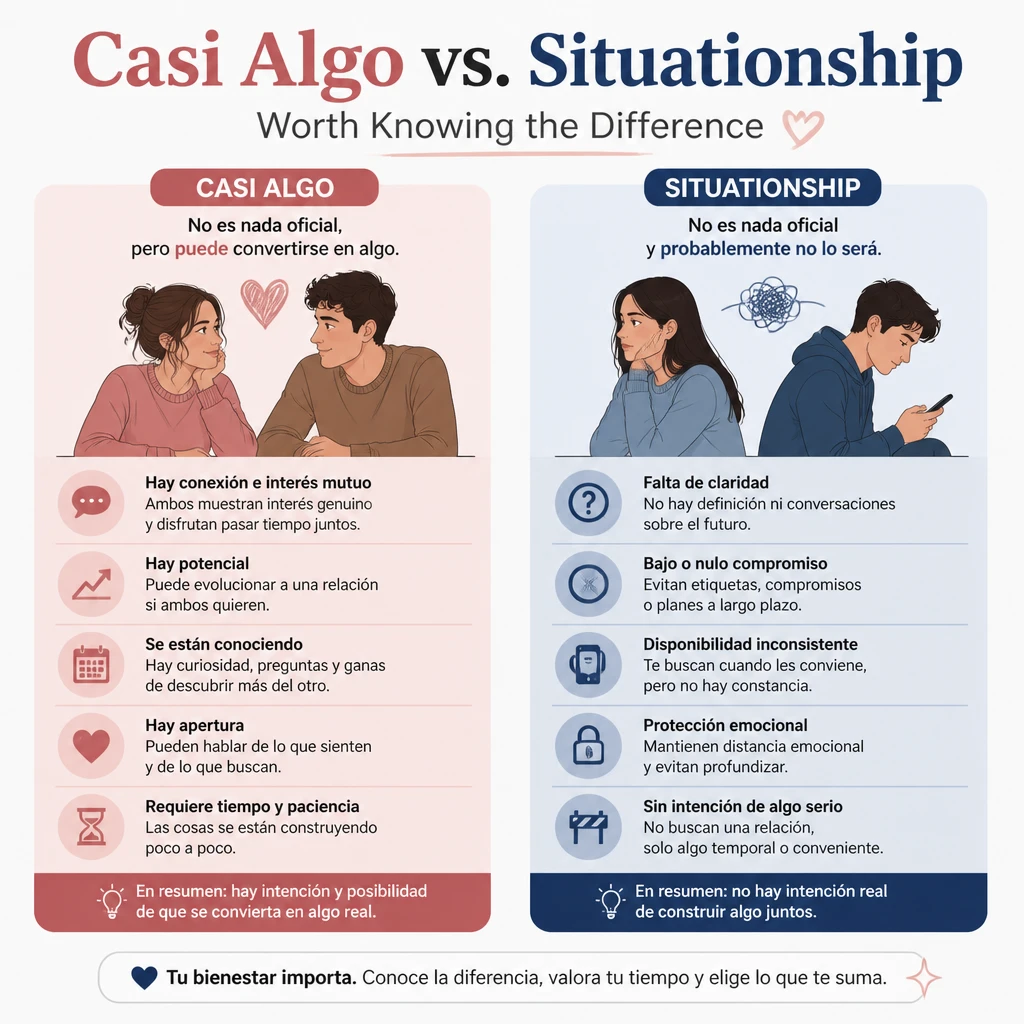
This comparison comes up constantly, and for good reason. Both terms describe the same general territory: an undefined romantic connection. But they’re not perfectly interchangeable, and understanding the situationship difference actually helps you use both terms more accurately.
“Situationship” is an English-language dating term that emerged from Western dating-app culture. It’s descriptive and a little clinical — almost like a category you’d find in a relationship-status dropdown menu. It’s useful, but it doesn’t carry much emotional texture on its own.
Casi algo carries more warmth. It leans nostalgic, even wistful, and it applies more broadly than just dating — as covered earlier, it stretches into friendships, career near-misses, and other undefined life outcomes.
Here’s a direct comparison:
| Feature | Casi Algo | Situationship |
|---|---|---|
| Language origin | Spanish | English |
| Tone | Warm, reflective, nostalgic | Neutral, descriptive |
| Scope | Romance, friendship, career, opportunities | Primarily romantic |
| Typical usage | Looking back on something that ended | Describing a current undefined relationship |
| Cultural context | Rooted in everyday Spanish, amplified by music | Rooted in English dating-app culture |
| Emotional weight | Heavier, more personal | Lighter, more clinical |
If you’re trying to decide which term fits your situation, ask yourself this: are you describing an ongoing, undefined relationship status? “Situationship” probably fits better. Are you reflecting on something that already ended, something that felt meaningful even though it never became official? That’s casi algo territory.
When Casi Algo Doesn’t Belong
Slang works best when it’s used in the right context. Casi algo is casual, personal, and emotionally loaded — which means there are places it simply doesn’t fit.
In professional settings. This is personal slang through and through. Keep it far away from work conversations, LinkedIn posts, or anything remotely formal. It won’t land the way you want it to.
As a reply to someone actively hurting. If a friend is genuinely upset over someone and you respond with “sounds like a casi algo,” you might mean well, but it can come across as dismissive. Sometimes people need to feel heard before they need a label slapped on their experience.
Publicly tagging someone else’s relationship. Commenting “lol casi algo” on someone else’s post, where the actual person involved can see it, is a fast way to make things awkward. What feels like relatable slang to you might feel like a public gut-punch to them.
With people who don’t know the phrase. Sending “casi algo” to someone who doesn’t speak Spanish or isn’t plugged into the trend is just going to confuse them. Context matters just as much as the words themselves.
How to Say It Without Using the Phrase
Not every audience or every conversation calls for casi algo, even if the concept fits perfectly. Here are natural English alternatives depending on the tone you’re going for:
- “It never got off the ground.”
- “We never made it official.”
- “Close, but not quite there.”
- “It was more than nothing, but never fully something.”
- “We had a connection, but it just… didn’t happen.”
- “It ended before it really started.”
None of these carry quite the same punch as the original Spanish phrase, but they’re useful when you’re writing or speaking to an audience unfamiliar with the term, or when you need a more formal way to describe the same idea.
Common Misconceptions About Casi Algo
A few misunderstandings show up constantly in how people talk about this phrase, so let’s clear them up directly.
Misconception 1: It always means someone was leading the other person on. Not true, and honestly, that’s part of what makes the phrase feel emotionally honest rather than accusatory. Sometimes both people were scared to define things. Sometimes timing was genuinely bad — a move, a breakup that hadn’t fully healed, conflicting priorities. Casi algo doesn’t automatically assign blame the way a term like “ghosting” does.
Misconception 2: It’s exclusively romantic. As covered earlier, this phrase applies far beyond dating. Careers, friendships, creative pursuits — anything with real potential that didn’t fully materialize fits under this umbrella.
Misconception 3: It’s brand-new slang invented for social media. The phrase existed in casual, everyday Spanish long before it became a viral trend. The song and the online spread didn’t create the phrase; they amplified something that already existed.
Misconception 4: “Caso algo” is an alternate version of the phrase. This one shows up a lot in search queries, and it’s worth clarifying directly: “caso algo” is a common mishearing or misspelling of “casi algo.” It doesn’t carry a distinct meaning of its own in Spanish. If you’re searching for it, casi algo is almost certainly the phrase you’re actually after.
How to Pronounce Casi Algo
Pronunciation trips people up more than you’d expect, especially non-Spanish speakers encountering the phrase for the first time through a song or a caption.
Here’s a simple phonetic breakdown:
“KAH-see AHL-go”
A few pronunciation notes:
- The stress falls on the first syllable of each word.
- Keep it relaxed rather than over-enunciated — this is casual spoken Spanish, not a formal recitation.
- If you’ve heard the Xavi track, just match the natural rhythm of how the phrase is delivered in the song. That’s the most reliable reference point for getting the cadence right.
Casi Algo in Digital Culture and Online Platforms
It’s worth zooming out for a second to look at why a phrase like this spreads the way it does across online platforms.
Short emotional phrases travel well because they compress a complicated feeling into something shareable. A caption doesn’t have room for three paragraphs explaining an undefined relationship — but it has plenty of room for “just a casi algo.” That efficiency is exactly why digital communication trends favor phrases like this one over longer, more explanatory language.
Once a phrase like casi algo becomes attached to a piece of viral content — in this case, a song with real staying power — it tends to spread across platforms in a predictable pattern:
- Origin platform (TikTok, in this case) — the phrase gets attached to audio, memes, and personal stories.
- Cross-platform spread — Instagram captions, Twitter/X posts, YouTube comments pick it up.
- Search behavior spike — people who hear the phrase but don’t fully understand it start searching for the definition, which is likely how you found this article.
- Normalization — the phrase becomes common enough that people use it without needing to explain what it means.
Casi algo has moved through all four of these stages at this point, which is part of why it’s stuck around rather than fading out as a short-lived trend.
Real Examples and Case Studies
Concrete examples make abstract feelings a lot easier to recognize. Here are a few composite scenarios, drawn from common patterns people describe when talking about this phrase, that illustrate how casi algo shows up in daily life.
Scenario One: The Almost-Relationship Two people meet, hit it off immediately, and spend the next several months texting daily, spending weekends together, and acting like a couple in every practical sense. Neither one brings up the label directly. Eventually, one person moves for a job, and the connection quietly fades without ever having an actual conversation about what it was. Years later, it’s still the relationship they think about the most — even though, technically, nothing “ended,” because nothing was ever defined in the first place.
Scenario Two: The Career Near-Miss Someone interviews for a role they’re genuinely excited about. Three rounds in, the hiring manager tells them they’re the top candidate. Then the offer stalls. Weeks pass. Eventually, the role gets cancelled internally, and no formal rejection ever comes. That entire process — the excitement, the momentum, the eventual quiet disappointment — mirrors the emotional arc of a romantic casi algo almost exactly.
Scenario Three: The Faded Friendship Two people meet at a class or event and click instantly — the kind of connection that feels rare. They exchange numbers, have a couple of genuinely great conversations, and then life gets busy. No falling out happens. No conflict. The momentum just quietly dies. That friendship was, in every meaningful sense, a casi algo.
What connects all three scenarios isn’t romance specifically — it’s the shared emotional signature of unrealized potential without a clean resolution.
FAQS
Is casi algo used more by younger generations?
Yes — it’s most common among Gen Z and younger Millennials, largely because of its spread through TikTok and Spanish-language music since late 2024.
Does casi algo have a negative or positive connotation?
It’s mostly bittersweet rather than strictly negative — it acknowledges real feelings existed, even though the connection never became official.
Is casi algo slang recognized outside Spanish-speaking countries?
Yes, especially among non-Spanish speakers who encountered it through TikTok trends and Xavi’s song, even without understanding Spanish fluently.
What genre is the song that popularized casi algo?
“Tu Casi Algo” falls under regional Mexican music, a genre Xavi was already known for before this single’s release.
Should you use casi algo in professional writing?
No — it’s informal slang best suited for casual conversation and social media, not formal or workplace communication.
conclusion
At its core, casi algo meaning points to something almost everyone has felt. It’s that connection that never got a label. The friendship that faded too soon. The “what if” that still lingers. Understanding casi algo meaning helps put real words to a feeling many struggle to explain.
So next time you’re stuck between something and nothing, you’ll know exactly what to call it. That’s the beauty of casi algo meaning — it turns a quiet, confusing feeling into something honest and shared. Sometimes, almost is still worth remembering.