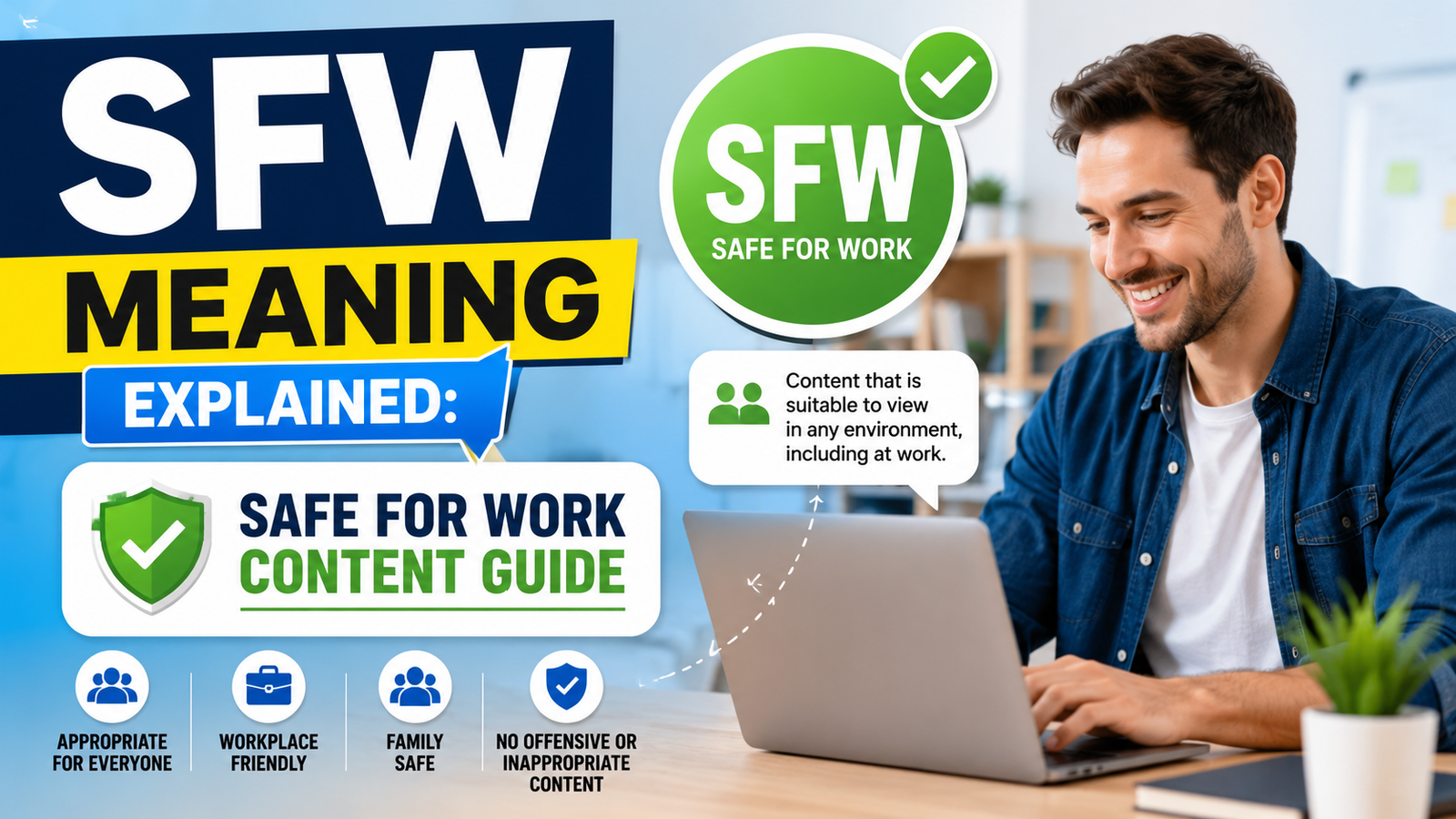
sfw meaning stands for Safe For Work — a simple label people attach to content that’s perfectly fine to open on a work laptop, in a shared office, or with a coworker glancing over your shoulder. No nudity, no gore, no explicit language, nothing that’ll spark an awkward HR conversation.
Picture this: you’re two coffees deep, scrolling during lunch, and someone drops a link with sfw meaning attached. That tiny tag just saved you from a very public, very red-faced moment.
That’s the real power behind this small acronym. Born on early internet forums, SFW quietly became the internet’s unofficial etiquette rule, now shaping everything from Reddit tags to Slack messages, keeping shared spaces comfortable for everyone scrolling alongside you.
What Does SFW Mean?
SFW stands for Safe For Work. It’s a label people attach to a piece of content — a photo, a video, a link, a meme — to signal that it’s fine to open at your desk, on a work laptop, or in front of a coworker glancing over your shoulder.
That’s the short version. The longer version matters more: SFW isn’t a legal category or a formal rating system like you’d find on a movie poster. It’s a social shorthand, built by internet users, for internet users, with no official rulebook behind it. One person’s SFW meme is another person’s “please don’t let my manager see this open on my screen.”
Here’s a plain-English example of how the phrase gets used:
“Here’s that article on productivity hacks — SFW, so go ahead and open it during lunch.”
Simple as that. The tag tells the reader they don’t need to check their surroundings before clicking.
What SFW content typically avoids:
- Nudity or sexual content
- Graphic violence or gore
- Heavy profanity
- Illegal activity
- Content that could embarrass someone in a professional setting
What SFW content typically includes:
- News articles
- Educational material
- Most memes and jokes
- Product reviews
- General entertainment (music, mainstream movie trailers, sports clips)
The tricky part? “Professional setting” isn’t the same everywhere. A joke that’s perfectly fine at a scrappy startup might raise eyebrows at a law firm. Keep that in mind — we’ll come back to it later in this guide, because workplace content standards vary a lot more than most people assume.
Where the Term Came From
Internet slang rarely has a birth certificate, but SFW’s origin story is easier to trace than most. The phrase started showing up on early message boards and forums in the late 1990s and early 2000s — places like Something Awful, early Usenet groups, and later Reddit and 4chan — where users needed a fast way to warn each other before posting a link.
Back then, most people browsed the internet from shared computers: work desktops, university labs, family computers in the living room. A mislabeled link wasn’t just embarrassing — it could mean an actual conversation with your IT department or, worse, your mom. The stakes were real, and the community solved it the way online communities usually do: with a shorthand everyone agreed to use.
A few things pushed the term into wider use:
- Slow internet connections meant thumbnails often loaded before full images, so a text warning gave people a heads-up before anything rendered.
- Shared and monitored networks (offices, schools, libraries) made mislabeling genuinely risky.
- Forum culture rewarded shorthand. Communities like 4chan and early Reddit already leaned heavily on chat acronyms and text slang, so SFW fit right in alongside terms like IMO, TL;DR, and AFAIK.
By the mid-2000s, SFW had jumped from niche forum jargon into mainstream internet language. Today it shows up on Reddit, X, TikTok, Discord, corporate Slack channels, and pretty much anywhere people share links with people they don’t fully control.
SFW vs. NSFW: The Real Difference
Here’s where most explanations get lazy. They’ll tell you SFW is “safe” and NSFW is “not safe,” and leave it at that. That’s technically true but practically useless — it doesn’t tell you where the line actually sits.
NSFW (Not Safe For Work) marks content that could get someone in trouble, embarrassed, or in violation of workplace policy if opened in a professional setting. It’s the direct opposite of SFW, and together the two terms form the backbone of how online communities self-moderate.
What Makes Content “Safe”
Content generally earns the SFW label when it’s:
- Non-sexual — no nudity, no explicit sexual references
- Non-graphic — no gore, no depictions of serious injury or death
- Low-profanity or profanity-free
- Free of illegal activity — drug use, weapons trafficking, and similar content don’t qualify
- Contextually neutral — nothing that targets a group, promotes hate, or reads as harassment
What Pushes Content Into NSFW Territory
On the flip side, content usually gets tagged NSFW when it includes:
- Nudity or sexual imagery, even artistic or non-pornographic
- Graphic violence, including some news footage and war coverage
- Explicit language used heavily or as the focal point
- Drug use or paraphernalia shown directly
- Content that’s legal but still inappropriate for a shared screen — think dark humor about death, disturbing medical imagery, or extreme body horror
Gray-Area Content
This is where things get genuinely difficult, and it’s the part most guides skip entirely. Plenty of content doesn’t fit neatly into either box:
| Content Type | Why It’s Gray Area |
|---|---|
| Classical art with nudity | Historically significant, but still nudity |
| Medical or educational anatomy content | Non-sexual, but visually explicit |
| War journalism and photojournalism | Newsworthy, but often graphic |
| Dark comedy and edgy memes | Legal and common, but not universally “safe” |
| Non-sexual but suggestive fashion photography | Depends entirely on context and platform |
| Horror movie trailers | Fictional violence, but genuinely disturbing to some viewers |
The honest answer here: when content sits in the gray zone, the safer move is to tag it as NSFW or add a content warning anyway. Over-labeling annoys people slightly. Under-labeling gets people in trouble, or worse, gets you reported. It’s not a close call.
Quick Reference Table: SFW and Related Labels
SFW and NSFW aren’t the only content warning labels floating around online. Different communities have built out their own systems, and knowing the difference helps you both read and apply them correctly.
| Label | Meaning | Severity | Common Platforms |
|---|---|---|---|
| SFW | Safe For Work — fine for any professional setting | None | Reddit, Discord, forums, group chats |
| NSFW | Not Safe For Work — sexual, graphic, or explicit content | Moderate to high | Reddit, X, Tumblr, Discord |
| NSFL | Not Safe For Life — extremely graphic, disturbing, often violent content | High | Niche forums, some Reddit communities |
| Spoiler Tag | Hides plot details, not related to explicit content | None (context-based) | Reddit, Discord, fan communities |
| CW (Content Warning) | Flags emotionally difficult topics — trauma, self-harm, abuse | Varies | Twitter/X, Tumblr, mental health spaces |
| Age Restriction / 18+ Gate | Platform-enforced age verification before viewing | High | YouTube, TikTok, Instagram, Reddit |
| Mature Content Tag | Broader catch-all for adult themes, sometimes non-sexual | Moderate | TikTok, Instagram, YouTube |
Notice how severity climbs from left to right in that middle column. SFW sits at the calm end of the spectrum. NSFL sits at the far opposite end — a label most casual users will thankfully never need to apply.
How SFW Tagging Actually Works, Platform by Platform
Knowing the definitions is one thing. Actually using them correctly on the platform in front of you is another. Social media platforms, forums, and chat apps each built their own version of the SFW/NSFW system, and they don’t always work the same way.
Reddit runs one of the most mature tagging systems on the internet. Individual posts can be marked NSFW by the poster, and entire subreddits can be flagged as NSFW communities by their moderators. Once a subreddit or post carries that tag:
- It gets blurred by default for logged-out users
- It requires an account with mature content enabled to view
- It won’t show up in default search results or the front page for new accounts
Reddit doesn’t have a formal “SFW tag” the way it does NSFW — the absence of an NSFW tag is effectively the SFW default. That’s an important distinction: on Reddit, safety is assumed unless flagged otherwise.
X (Twitter)
X uses a sensitive content toggle rather than a direct SFW/NSFW label. Users can mark their own posts as containing sensitive media, which places a warning screen over images and videos before they load. Viewers can also set their account-wide media preferences to automatically blur sensitive content, adding a second layer of filtering on top of individual post labels.
Discord
Discord’s system operates at the server and channel level, not just the individual post level. Server owners can:
- Mark entire channels as age-restricted
- Enable server-wide explicit content filters that scan uploaded images
- Set different filter levels depending on whether a member is a friend, a server member, or unverified
This makes Discord a bit different from Reddit or X — the tagging responsibility often falls on server moderators rather than individual posters, though members are still expected to respect channel purpose and avoid dropping NSFW material into SFW-only channels.
TikTok and Instagram
Both platforms lean heavily on age restrictions and automated content moderation rather than user-applied SFW tags. Content flagged as mature gets:
- Removed if it violates community guidelines outright
- Age-gated if it’s borderline but permissible
- Limited in reach through algorithmic downranking, even if it’s not removed
Users on these platforms rarely type “SFW” the way Reddit or Discord users do. Instead, the platform’s own moderation system does the labeling behind the scenes.
Slack, Teams, and Group Chats
This is the category most people actually need day-to-day, and it’s the least formal of them all. Messaging apps used for work — Slack, Microsoft Teams, WhatsApp groups, iMessage threads with coworkers — generally have no built-in SFW tagging system whatsoever. It’s entirely on the sender to self-police.
That informality is exactly why so many workplace incidents trace back to group chats rather than public social platforms. There’s no blur screen, no age gate, no algorithm catching the mistake before it happens. Just you, a send button, and hopefully good judgment.
How to Tag Your Own Content Correctly
Good intentions aren’t enough — proper content tagging takes a few consistent habits, whether you’re posting to a massive subreddit or dropping a link in a five-person work channel.
Step-by-Step by Platform
On Reddit:
- When creating a post, look for the NSFW toggle in the post-creation menu.
- If your content includes any nudity, sexual content, or graphic material, enable it before posting — not after.
- Check the subreddit’s own rules; some communities require additional tags like [Spoiler] or [Discussion] alongside NSFW.
On X:
- Open your media settings and locate “Mark media as sensitive.”
- Apply it to any post containing violence, adult content, or graphic imagery.
- Double-check your own account-wide sensitive content settings so you know what you’re seeing, too — the label protects other users, but your own filter settings affect your feed.
On Discord:
- Server admins should mark relevant channels as age-restricted in channel settings.
- Enable the explicit content scanning filter under server safety settings.
- Members posting in general or SFW-only channels should default to safe content, and use direct messages or explicitly labeled NSFW channels for anything questionable.
In group chats and messaging apps:
- Say it before you send it. A simple “heads up, NSFW” text sent before the link gives people a chance to wait until they’re not at their desk.
- When in doubt, send a description instead of the media itself and let people opt in.
- Never assume “everyone in this chat is cool with it” — company laptops get shared, screens get glanced at, and chat histories get audited more often than people expect.
Common Tagging Mistakes That Get Content Flagged
- Tagging after the fact. Editing a post to add NSFW after it’s already been seen (and reported) doesn’t undo the exposure.
- Under-tagging borderline content. Gray-area material, as covered earlier, should lean toward over-labeling.
- Ignoring platform-specific rules. A tag that works on Reddit doesn’t automatically apply on Discord or X — each platform enforces its own system.
- Assuming private chats don’t need labels. Screenshots exist. Group chats get forwarded. Treat “private” as a courtesy, not a guarantee.
- Mislabeling spoilers as NSFW (or vice versa). These serve completely different purposes, and mixing them up confuses readers and undermines the point of tagging in the first place.
SFW at the Actual Office (Not Just Online)
Everything above covers the internet’s version of SFW. But the term’s original purpose — the reason it exists at all — is the literal workplace. Let’s talk about how the concept actually plays out at the office, because it’s more layered than “don’t look at inappropriate stuff on your work computer.”
How Companies Actually Define “Acceptable”
There’s no universal legal standard for acceptable content at work. Instead, most companies build their own definition through a mix of:
- Employee handbooks
- Code of conduct policies
- Anti-harassment training
- Industry-specific compliance requirements
A creative agency and a regional bank will land in very different places. The agency might tolerate edgy memes in a team Slack channel; the bank almost certainly won’t, especially given how tightly regulated the finance industry is around workplace conduct. Neither approach is “wrong” — they’re just calibrated to different office communication cultures and different legal exposure levels.
IT Filters, HR Policy, and Where They Overlap
Two systems usually work together (whether employees realize it or not):
IT filters operate at the network level. These are automated tools that block access to entire categories of websites — adult content, gambling, sometimes even social media — based on compliance requirements and productivity concerns. They catch a lot, but they’re not perfect. A filter built to block explicit websites won’t necessarily catch an inappropriate GIF shared in a private Slack DM.
HR policy covers what filters can’t. This is the human layer — the part that deals with content shared directly between coworkers, whether through email, chat, or in person. When something slips past IT (which happens constantly, since filters can’t scan private messaging content the way they scan web traffic), HR policy is what determines the consequences.
| System | Catches | Misses |
|---|---|---|
| IT Filters | Explicit websites, known adult domains, flagged categories | Private chats, screenshots, content shared off-network |
| HR Policy | Interpersonal conduct, harassment claims, reported incidents | Anything nobody reports |
That gap in the middle — the stuff IT can’t technically block but HR can absolutely act on — is where most real workplace incidents happen.
Legal Exposure Tied to Shared Content
This part deserves real attention, because it’s the least understood piece of the whole topic. Sharing NSFW content at work isn’t just an awkward-moment risk. Depending on the content and context, it can create genuine legal exposure for both the individual and the company:
- Hostile work environment claims can arise from repeatedly shared explicit or offensive content, even if it was “just a joke” or sent to a small group.
- Discrimination and harassment lawsuits sometimes cite shared content as supporting evidence, particularly if it targeted a protected characteristic.
- Data and device policies at many companies specify that anything sent on a work device or work network is subject to review — meaning “I sent it privately” doesn’t always hold up during an internal investigation.
One HR consultant summarized it this way in an interview about workplace communication risk:
“The content itself is only half the problem. The other half is what a pattern of that content says about the culture a manager is allowing to exist underneath them.”
That’s a useful way to think about it. A single mistaken link is rarely career-ending on its own. A pattern of poor judgment around workplace content is a very different story.
Sharing Content at Work Without Getting in Trouble
None of this means work has to be humorless. A few practical habits keep things safe without killing the vibe:
- Default to SFW unless you know the audience extremely well — and even then, use your own device, not your company’s.
- Avoid group-wide shares for anything borderline. A one-on-one conversation carries far less risk than a channel with fifty people in it.
- Never use official company channels (Slack, Teams, company email) for anything you wouldn’t want printed out and shown to your manager.
- Assume screenshots happen. Whatever you send can outlive the conversation it was sent in.
- When someone flags something as inappropriate, don’t argue the semantics. Apologize, stop, and move on. Doubling down turns a minor mistake into a bigger HR conversation.
What Happens When Content Is Mislabeled
Mislabeling — whether accidental or lazy — carries consequences on both the platform side and the workplace side. Understanding both helps explain why the SFW/NSFW system exists in the first place.
Platform Consequences
Most social media platforms and forums enforce mislabeling penalties that scale with severity and repetition:
- First-time, minor mistakes usually result in a content removal or a warning.
- Repeated mislabeling often triggers temporary posting restrictions or reduced visibility (shadowbanning).
- Severe or repeated violations — especially involving illegal content — can lead to permanent account suspension and, in serious cases, referral to law enforcement.
Reddit, for example, relies heavily on moderation teams at the subreddit level, meaning consequences can vary depending on which community caught the mislabeled post. A missed NSFW tag in a small hobby subreddit might just get a friendly reminder from a moderator. The same mistake in a larger, stricter community can result in an immediate ban.
Workplace Consequences
On the employment side, consequences depend heavily on company policy, the severity of the content, and whether it’s a first offense:
| Severity | Typical Response |
|---|---|
| Minor, accidental (e.g., an ad with suggestive imagery) | Verbal reminder, no formal record |
| Repeated carelessness | Written warning, HR meeting |
| Deliberate sharing of explicit content | Formal disciplinary action, possible suspension |
| Content contributing to a hostile environment claim | Termination, potential legal liability |
The pattern here matters more than any single incident. Company guidelines exist precisely because a workplace culture is built from dozens of small decisions, not one dramatic one.
Best Practices for Posting and Sharing Content
Here’s the condensed version of everything above — the habits worth actually remembering.
When in Doubt, Label It
If you’re unsure whether something qualifies as SFW, treat that uncertainty as your answer. Over-tagging costs nothing. Under-tagging costs trust, and sometimes a job.
Read the Room (Group/Channel Rules) Before Posting
Every community, server, and workplace channel has its own unwritten (and sometimes written) standard. What’s fine in one Discord server can get you kicked from another. What’s normal at one company can trigger an HR meeting at the next. Five minutes of reading pinned rules or a company handbook beats an awkward apology later.
Use Browser Extensions and Filters for Extra Safety at Work
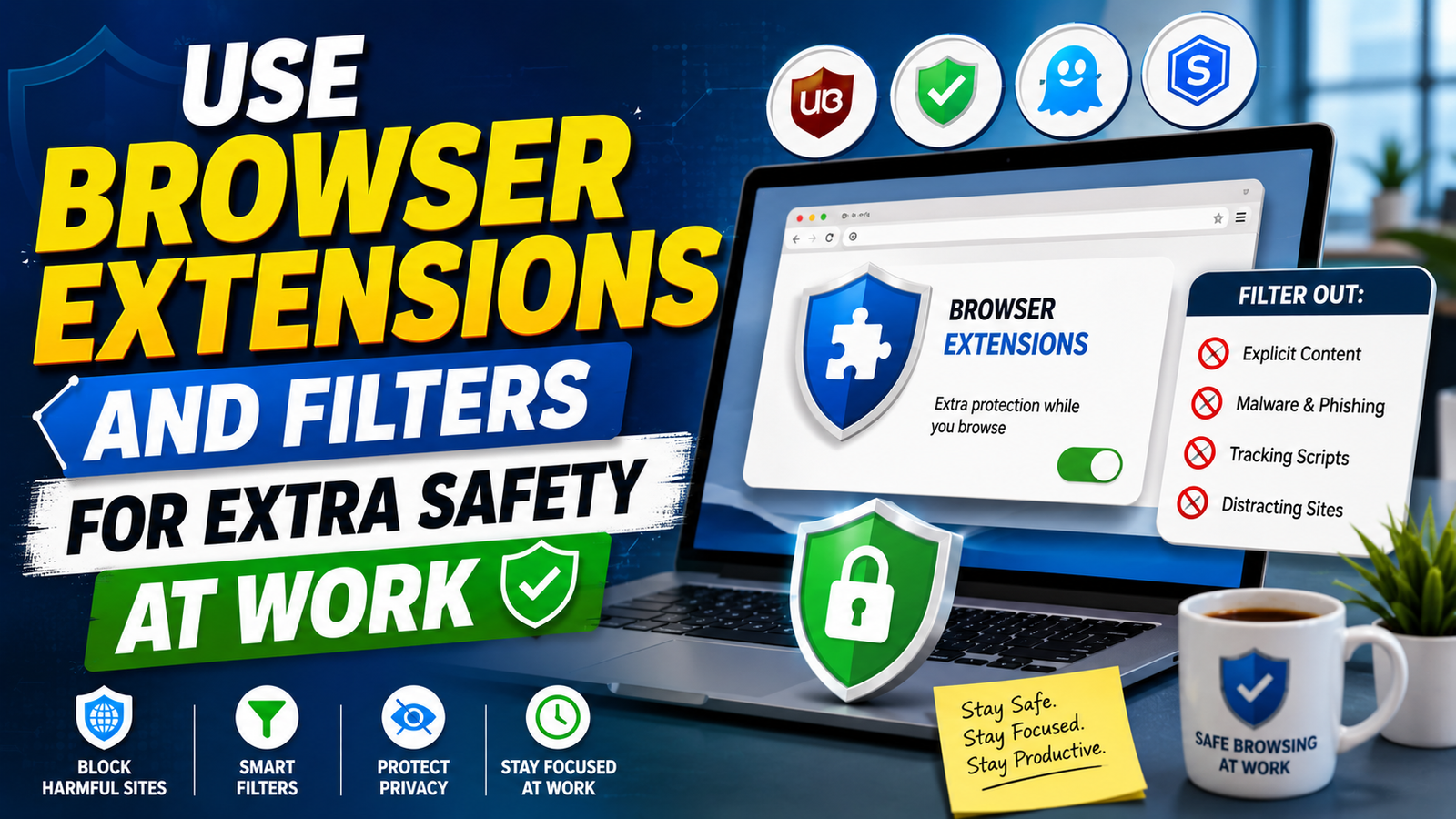
For anyone who wants an extra layer of protection beyond just personal judgment, a few practical tools help:
- Browser-level content filters (available as extensions for Chrome, Edge, and Firefox) that blur or block flagged content automatically
- Built-in “safe mode” or “restricted mode” settings on platforms like YouTube, Google, and Reddit
- Company-managed device policies that IT departments configure by default — worth checking rather than assuming they don’t exist
None of these tools replace good judgment. But they add a buffer for the moments when judgment isn’t enough — a mislabeled thumbnail, an autoplay preview, a link that looked SFW in the preview text but wasn’t once it actually loaded.
FAQs
Is SFW still commonly used in 2026?
Yes, it’s more relevant than ever, especially across Discord, Reddit, and workplace chat tools like Slack and Teams.
Do platforms automatically detect SFW content, or do users tag it themselves?
Most platforms rely on a mix of both — user-applied tags plus AI-driven moderation that flags mature content automatically.
Is there an official SFW rating system, like movie ratings?
No. SFW has no legal or standardized rating body — it’s community-driven and varies by platform and workplace policy.
Can AI tools help identify whether content is SFW or not?
Yes, many platforms now use AI image and text scanners to auto-flag potentially NSFW content before it’s even posted.
Does SFW apply only to images, or text and links too?
It applies to all content types — images, videos, links, memes, and even text-based jokes or messages.
conclusion
SFW meaning really comes down to one simple idea: keep it safe, keep it comfortable, keep it appropriate for shared spaces. It’s not a strict rule. It’s more like online common sense. Once you understand the SFW meaning, tagging content correctly becomes second nature, whether you’re posting online or chatting at work.
At the end of the day, knowing the SFW meaning protects you and everyone around you. It builds trust in group chats, keeps workplaces professional, and avoids awkward moments. So next time you share something, pause for a second. Ask yourself if it’s truly SFW. That small habit goes a long way.