GNG meaning in text refers to a shortened slang term that stands for “gang,” “going,” or occasionally “good night gang,” depending on where it appears in a message. It’s built through vowel deletion, a common shorthand pattern used across texting and social media.
Three letters, three possible meanings, one simple trick to tell them apart — and once you know it, you’ll never misread a text again.
Beyond the basics, GNG shows up everywhere from group chats to gaming servers to TikTok captions, shifting meaning based on context, platform, and tone. This guide breaks down every version so you can decode it instantly, every single time.
What Does GNG Mean in Text?
At its core, GNG is a text abbreviation built by stripping vowels out of a longer word — a shortcut that’s been part of online slang for as long as people have been typing on tiny keyboards. The letters themselves don’t carry one fixed meaning. Instead, GNG functions more like a container that gets filled in by context.
Here’s the breakdown of what does GNG mean, ranked by how often each version actually shows up in real conversations:
ALSO READ:https://holymeaning.com/tw-meaning-in-text/
| Meaning | Approximate Usage | Common Setting |
|---|---|---|
| GNG = Gang | Most common | Captions, group chats, gaming |
| GNG = Going | Very common | One-on-one texts, quick replies |
| GNG = Good Night Gang | Occasional | Late-night group chats, streaming sign-offs |
Notice that none of these are wild guesses or stretches. Each one is a natural, phonetic shorthand of a real word or phrase, which is exactly why the term spread so fast. It doesn’t require decoding a hidden joke or knowing insider lore — once you see the pattern, it clicks.
A good way to think about GNG in text is the same way you’d think about “brb” or “idk.” Nobody stops to wonder what those mean anymore because repetition made them automatic. GNG is getting there, but it’s slightly younger and slightly more context-dependent, which is exactly why it still trips people up.
Every Meaning of GNG — Full Breakdown
Let’s go through each definition properly. This is the part most guides rush through, but the GNG definition actually shifts in tone and function depending on which version is being used.
GNG = Gang (The Most Common Meaning by Far)
When someone uses GNG to mean “gang,” they’re not talking about anything criminal. In modern texting slang, “gang” lost its harder connotations years ago and now mostly means friend group, squad, or close circle. Saying “gng” is basically a faster way of saying “my people” or “my crew.”
This meaning shows up constantly in:
- Captions addressed to followers (“What’s good, gng?”)
- Group chat greetings or check-ins
- Comments expressing solidarity or agreement
- Sign-offs that acknowledge a shared community
The linguistic mechanism behind this is called vowel deletion, a common feature in digital shorthand. “Gang” becomes “gng” the same way “please” becomes “plz” or “you” becomes “u.” It’s not random — it follows a predictable pattern that makes the shortened version easy to recognize even without the vowels.
Example text: “Late night snack run with the gng, who’s in?”
In that sentence, GNG clearly refers to a friend group, and the tone is warm, casual, and inclusive. This is the version people mean when they talk about loyalty slang — using GNG signals that someone belongs, that they’re part of an in-group, without needing a longer explanation.
GNG = Going
The second major meaning is far more literal. Here, GNG is simply a clipped version of “going,” used when someone is about to leave, is currently in motion, or wants to signal action without typing out a full sentence.
This version tends to show up in:
- Quick one-on-one replies (“gng to the store, need anything?”)
- Status-style updates mid-conversation
- Fast exchanges where typing speed matters more than grammar
Example text: “gng now, talk later”
There’s no ambiguity in a message like that. Nobody reads “gng now, talk later” and thinks it’s about a friend group — the surrounding words make the going meaning obvious immediately. This is the pattern that matters most when you’re trying to decode GNG in messages: the meaning rarely lives in the abbreviation itself. It lives in the words next to it.
GNG = Good Night Gang
This is the least common of the three, but it’s real and worth knowing, especially if you spend time in late-night group chats, livestream chats, or Discord servers that stay active into the early hours.
Good Night Gang works as a combined sign-off — part farewell, part acknowledgment of the group. It’s the digital equivalent of waving to a room before you leave, aimed specifically at people you’re close with rather than a general audience.
Example text: “Alright, gng, heading to bed. Love you all.”
You’ll notice this version almost always appears at the end of a message rather than the middle, which is one of the easiest tells for identifying it.
A Quick Note on Other Claims You Might See
Some sites list additional meanings like “Gotta Go Now” as a common definition. In reality, there’s little evidence this version is widely used — it’s the kind of guess that sounds plausible but doesn’t hold up against actual conversation data. When researching GNG slang meaning, it’s worth being skeptical of any guide that lists five or six “common” definitions. Slang doesn’t usually fragment that much in real use; it tends to cluster around one or two dominant meanings, which is exactly what’s happening here.
Where Did GNG Come From? The Real Origin Story
There’s no single inventor, no viral post that started it, and no secret backstory — and that’s actually the honest answer, even though it’s less exciting than a dramatic origin tale. GNG grew out of the same broader trend that gave us dozens of other text abbreviations: the drive to type less while communicating just as much.
Here’s the pattern in plain terms:
- Vowel removal shortens typing time without losing recognizability (wknd, thx, plz, gng).
- Repetition across platforms — TikTok, Snapchat, Discord, group texts — normalizes the shorthand.
- Context does the heavy lifting, so the same three letters can carry different meanings without causing real confusion once people learn the pattern.
“Gang” as a word for a friend group has roots going back decades in hip-hop and youth culture, long before texting existed. What changed is the delivery method — the meaning stayed familiar, but the spelling adapted to fit a phone screen. Similarly, “going” is one of the most commonly abbreviated verbs in casual texting because it shows up constantly in day-to-day plans and check-ins.
So when people ask about the GNG abbreviation’s origin, the honest answer is: it’s not one story, it’s a merger of two very ordinary trends — shorthand typing habits and existing slang for friend groups — that happened to collide into the same three letters.
How Vowel Deletion Actually Works
It helps to understand the mechanics behind this kind of shorthand, because it explains why GNG feels intuitive rather than arbitrary. Vowel deletion strips the vowels out of a word while keeping the consonant skeleton intact, since consonants carry most of a word’s recognizable shape. Compare these side by side:
| Full Word | Shortened Form | Vowels Removed |
|---|---|---|
| Going | gng | o, i |
| Gang | gng | a |
| Please | plz | ea, e |
| Weekend | wknd | e, e, e |
| Thanks | thx | a, an |
Notice something interesting here: “going” and “gang” both collapse into the exact same shorthand, gng, once the vowels disappear. That’s not a coincidence, and it’s actually the entire reason this term causes more confusion than most other text abbreviations. Most shortened slang maps back to a single source word. GNG is one of the rare cases where two completely unrelated words happen to land on the identical abbreviation, which is precisely why context has to do so much of the work.
A Brief Timeline
Tracking exactly when a piece of slang “starts” is nearly impossible, since terms like this spread organically across thousands of private conversations before ever showing up in a searchable post. But the general pattern looks like this:
- Early stage: “Gang” as a term for a close friend group was already common in music and youth culture, used in its full spelling.
- Texting era: As SMS character limits and typing speed became a bigger part of daily communication, shortened spellings of common words became routine.
- Social media acceleration: Platforms like TikTok and Instagram normalized casual, abbreviation-heavy captions, which pushed shorthand like gng in front of far larger audiences than private texts ever could.
- Cross-platform standardization: By the mid-2020s, enough overlap existed between gaming chats, group texts, and captions that GNG stopped needing an explanation for most active social media users.
That last stage is where things sit today. The term isn’t “new” anymore in any meaningful sense — it’s simply matured into the same category as other long-standing pieces of internet language.
GNG in Real Conversations — Examples That Actually Make Sense
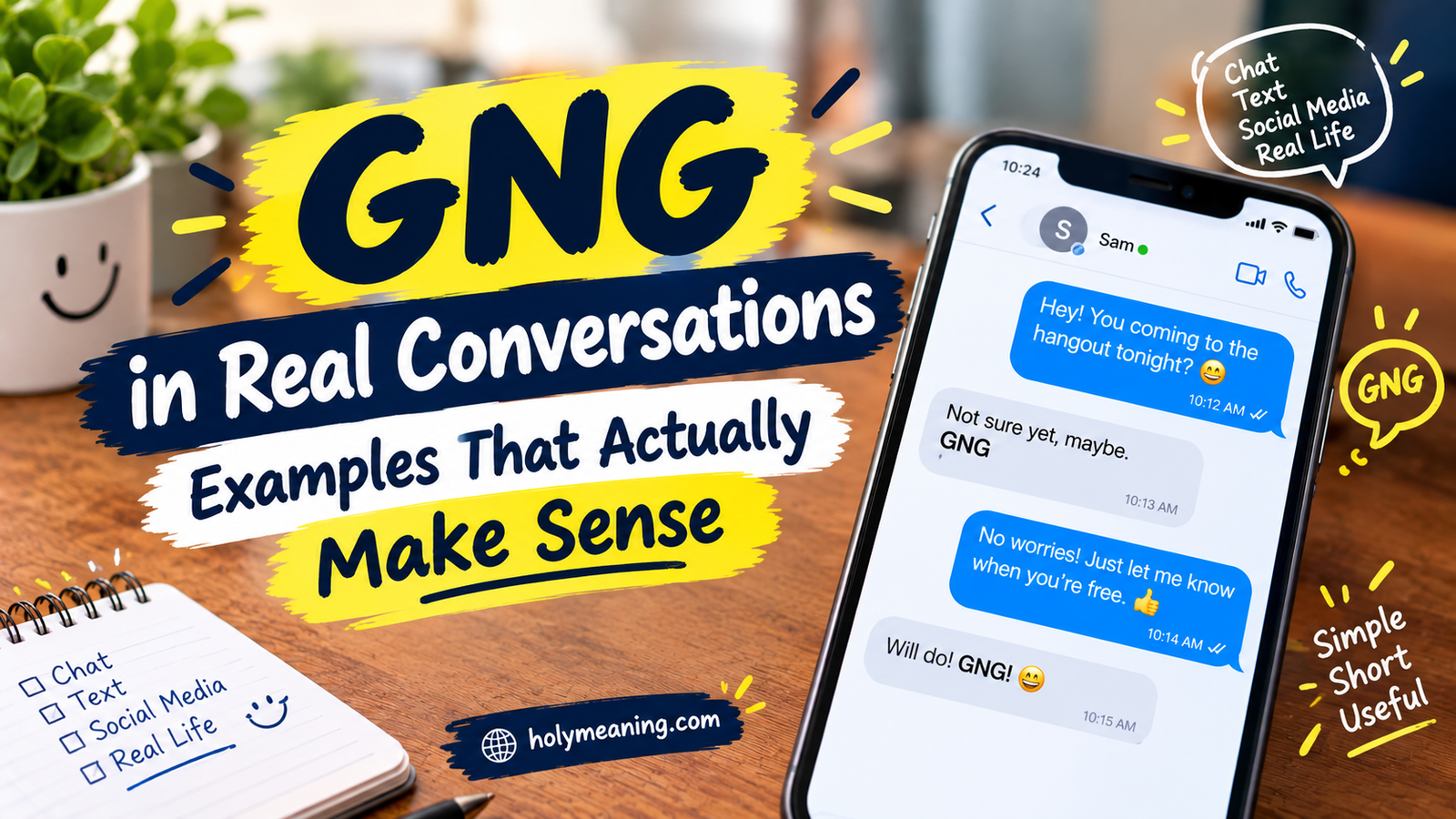
Theory is useful, but nothing clarifies GNG usage faster than seeing it in the wild. Below are realistic examples across the settings where this term shows up most.
GNG in Group Chats
GNG in group chats almost always leans toward the “gang” meaning, since group chats are, by definition, a gathered circle of people.
- “Movie night at mine, gng pulling up?”
- “Gng, does anyone have notes from today’s class?”
- “This gng never lets me down lol”
In each case, GNG functions almost like a nickname for the group itself — a way of addressing everyone at once without listing names.
GNG on Social Media Captions
GNG social media captions tend to serve a slightly different purpose: they’re addressed outward, to followers rather than a private circle.
- “New video is live, gng — go check it out”
- “Y’all are the best gng a creator could ask for”
- “Shoutout to my gng for the support this year”
Here, “gang” takes on a community-building tone. Creators use it to make an audience feel like an inner circle rather than a faceless follower count, which is a small but effective piece of digital communication strategy.
GNG in Gaming and Discord
GNG gaming Discord usage is genuinely mixed, more so than any other setting, so this is the one place where context matters the absolute most.
- “gng, who’s queuing up for ranked?” → refers to the friend group
- “brb, gng grab water real quick” → refers to “going”
- “gg gng, that was a close one” → refers to the friend group, paired with “gg” (good game)
Gaming culture already leans heavily on abbreviations (gg, brb, afk, ff), so GNG slots in naturally, but it also means the abbreviation gets used more loosely and quickly, increasing the odds of ambiguity for anyone new to a server.
A Quick Case Study: Same Word, Two Conversations
To show just how much context changes everything, look at these two nearly identical messages:
Conversation A (Friend Group Meaning):
Person 1: “We still on for tonight?” Person 2: “Yeah, gng’s already heading over”
Conversation B (Going Meaning):
Person 1: “Where are you?” Person 2: “gng, be there in 5”
Same three letters, completely different jobs. In Conversation A, “gng’s” refers to a group of people already in motion. In Conversation B, “gng” describes the speaker’s own action. Neither sentence is confusing to a native reader of casual online texting, because the surrounding grammar naturally points to the correct meaning.
ALSO READ:https://holymeaning.com/dih-meaning/
GNG Across Every Platform — It Doesn’t Mean the Same Thing Everywhere
Social media slang doesn’t behave uniformly, and GNG is a good example of why platform context matters as much as sentence context.
| Platform | Typical Meaning | Why |
|---|---|---|
| TikTok | Gang | Creators address followers as a collective |
| Gang | Captions and comments favor community tone | |
| Snapchat | Gang or Going | Mixed — depends on streaks vs. captions |
| WhatsApp / SMS | Going | Personal, one-on-one texting favors literal use |
| Discord | Gang or Going | Mixed — fast typing increases ambiguity |
| Twitch chat | Gang or Good Night Gang | Streaming culture leans communal, especially late-night streams |
This table matters more than it might seem at first glance. If someone is trying to interpret GNG in text and they know which platform the message came from, they’ve already narrowed down the likely meaning before reading a single surrounding word. Platform habits shape chat terminology just as much as individual conversations do.
GNG vs. Similar Text Slang — What’s the Difference?
GNG similar slang terms often get lumped together in casual conversation, but they don’t all serve the same function. Here’s how GNG compares to some of the other texting abbreviations people frequently confuse it with.
| Term | Meaning | Function | Tone |
|---|---|---|---|
| GNG | Gang / Going / Good Night Gang | Group reference or action | Casual, friendly |
| FR meaning (“for real”) | Emphasizing sincerity | Agreement/emphasis | Casual |
| ONG meaning (“on god”) | Swearing something is true | Emphasis/agreement | Casual, emphatic |
| SMH meaning (“shaking my head”) | Disapproval or disbelief | Reaction | Mildly negative |
| WYD meaning (“what you doing”) | Asking about someone’s activity | Question/conversation starter | Neutral, casual |
The key difference is that FR, ONG, and SMH are almost entirely reaction-based — they express a feeling about something someone else said. WYD is a direct question. GNG, on the other hand, is unusual because it can function as a noun (referring to a group), a verb (referring to movement), or a farewell, all depending on where it lands in a sentence. That flexibility is part of why it causes more confusion than most other texting abbreviations on this list.
How to Read Context Like a Pro — Decode GNG Every Time
If you want a repeatable method for figuring out the meaning of GNG in any message, use this three-step check:
- Look at sentence position. GNG at the start or middle of a sentence often addresses a group (“gng, we outside”). GNG right before or after a verb usually means “going” (“gng to bed”).
- Check for a farewell nearby. Words like “night,” “bye,” or “logging off” near GNG almost always signal the good night slang version.
- Consider the platform. A caption favors “gang.” A private one-on-one text favors “going.” A Discord message could genuinely go either way, so lean on steps one and two more heavily there.
Here’s the same logic as a quick decision list:
- Does it come with a farewell word? → Good Night Gang
- Does it come before a location or action? → Going
- Does it address multiple people or a community? → Gang
This isn’t a perfect science, but it covers the overwhelming majority of real-world cases, because GNG usage genuinely does follow these patterns rather than being truly random.
Is GNG Formal or Informal?
Short answer: informal, no exceptions worth noting.
GNG belongs firmly in the category of casual abbreviation, alongside terms like “lol,” “brb,” and “idk.” It has no place in professional emails, academic writing, formal messaging, or any context where you’re expected to communicate clearly to someone outside your social or gaming circle.
A quick way to gut-check this: if you wouldn’t say “what’s up, gang” out loud to a manager or professor, you shouldn’t type “gng” to them either. The tone doesn’t shift just because it’s shortened — if anything, abbreviations tend to read as more casual than their full-word counterparts, not less.
ALSO READ:https://holymeaning.com/bbj-meaning/
Why People Use GNG — The Real Reasons Behind the Shortcut
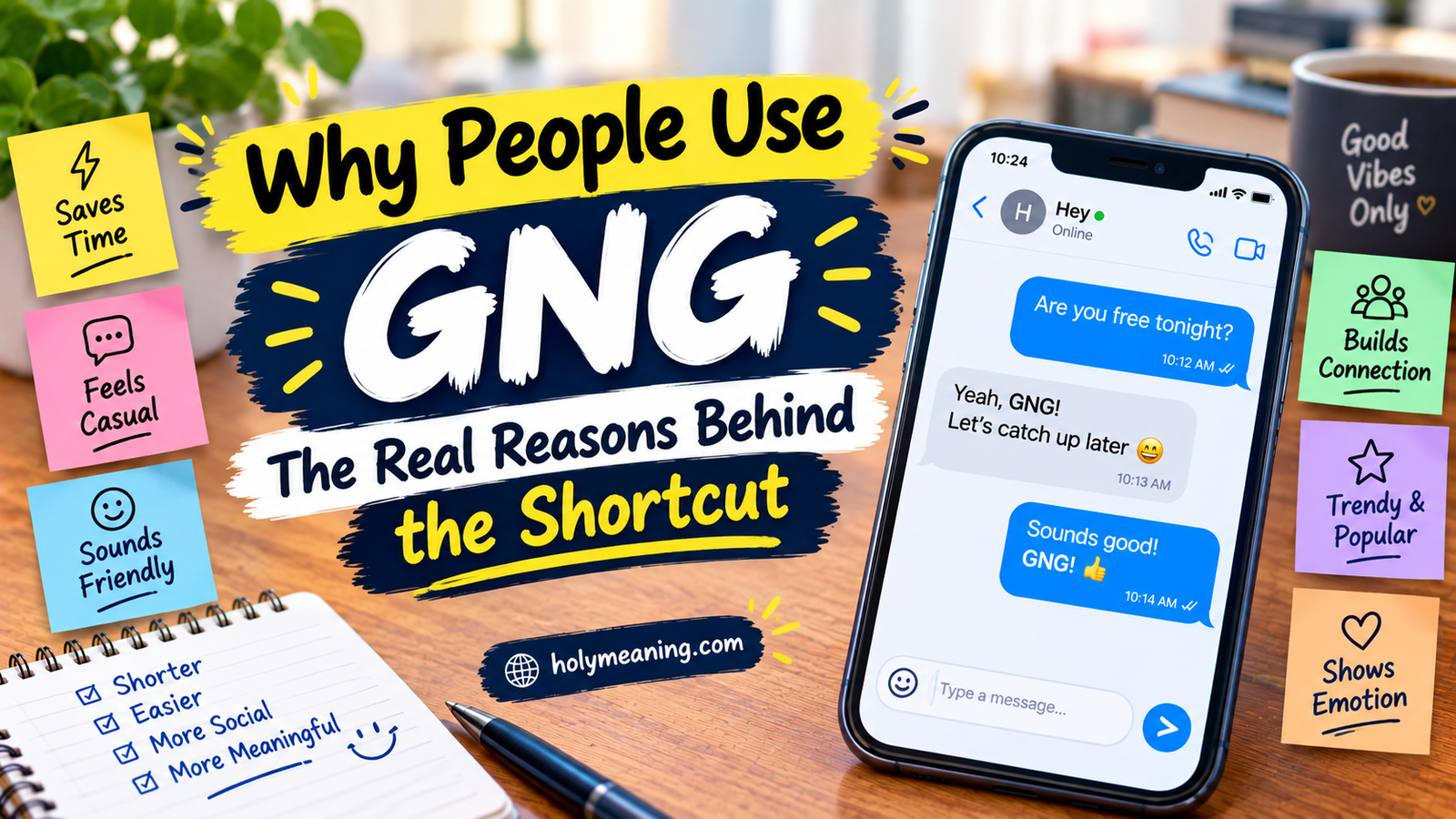
There are two practical drivers behind why GNG caught on, and neither one requires overcomplicating things.
Speed. Typing three letters instead of five (“going”) or four (“gang”) adds up across dozens of daily messages. Text shorthand exists because fast-paced conversations reward brevity, especially on mobile keyboards where every extra keystroke costs time.
Belonging. Group-specific slang creates a subtle sense of insider status. Using GNG to mean “gang” signals familiarity and closeness in a way that typing out “my friend group” simply doesn’t. It’s efficient and social — which is a big part of why it spread through group chat slang and creator culture so effectively.
Those two forces — speed and social signaling — explain almost every piece of modern texting shorthand, not just this one term. GNG isn’t a special case; it’s a clear example of a pattern that’s been repeating in digital communication for over a decade.
Generational and Regional Differences
Not everyone reaches for GNG the same way, and age plays a bigger role here than most guides mention. Younger users, particularly teens and college-age groups who grew up texting on smartphones from an early age, tend to use GNG fluidly and switch between meanings without a second thought. Older millennials and Gen X users are far more likely to encounter the term for the first time through a child, younger coworker, or social media comment, and often default to asking directly what it means rather than guessing from context.
There’s also a modest regional pattern worth noting. In online spaces where hip-hop-influenced slang has a stronger cultural footprint, the “gang” meaning tends to dominate almost entirely, with “going” showing up far less often. In text-heavy, function-first messaging environments — quick logistics texts between coworkers, classmates, or family members — “going” is far more likely to be the default read, simply because those conversations revolve around plans, timing, and location rather than group identity.
None of this is a hard rule. It’s closer to a set of leanings that make the GNG explanation slightly easier to predict once you know who’s sending the message and where.
FAQs
1. What does GNG mean in text?
It usually means “gang” (a friend group) or “going,” with the correct meaning depending entirely on the sentence around it.
2. Is GNG still used in 2026?
Yes, it’s a steady part of everyday texting, captions, and gaming chats rather than a fading trend.
3. Is GNG appropriate for professional messages?
No, it’s strictly casual slang and doesn’t fit workplace emails or formal communication.
4. Does GNG mean something different on gaming platforms like Discord?
It can — Discord and gaming chats use both “gang” and “going” interchangeably, so context there matters more than usual.
5. Is GNG considered rude or negative slang?
No, it’s neutral and friendly in tone, similar to terms like “squad” or “crew.”
conclusion
GNG meaning in text really comes down to two words: “gang” or “going.” Read the sentence around it, and the answer becomes clear almost every time. It’s not a trick or a hidden code. It’s just fast, casual shorthand people use every day.
Once you understand GNG meaning in text, you’ll never pause on it again. Check the words nearby. Check the platform. That’s it. This little abbreviation isn’t going anywhere in 2026, so knowing it puts you one step ahead in every group chat, caption, or gaming server you scroll through.






1 thought on “GNG Meaning in Text Shocking Truth Explained for Curious Readers 2026”