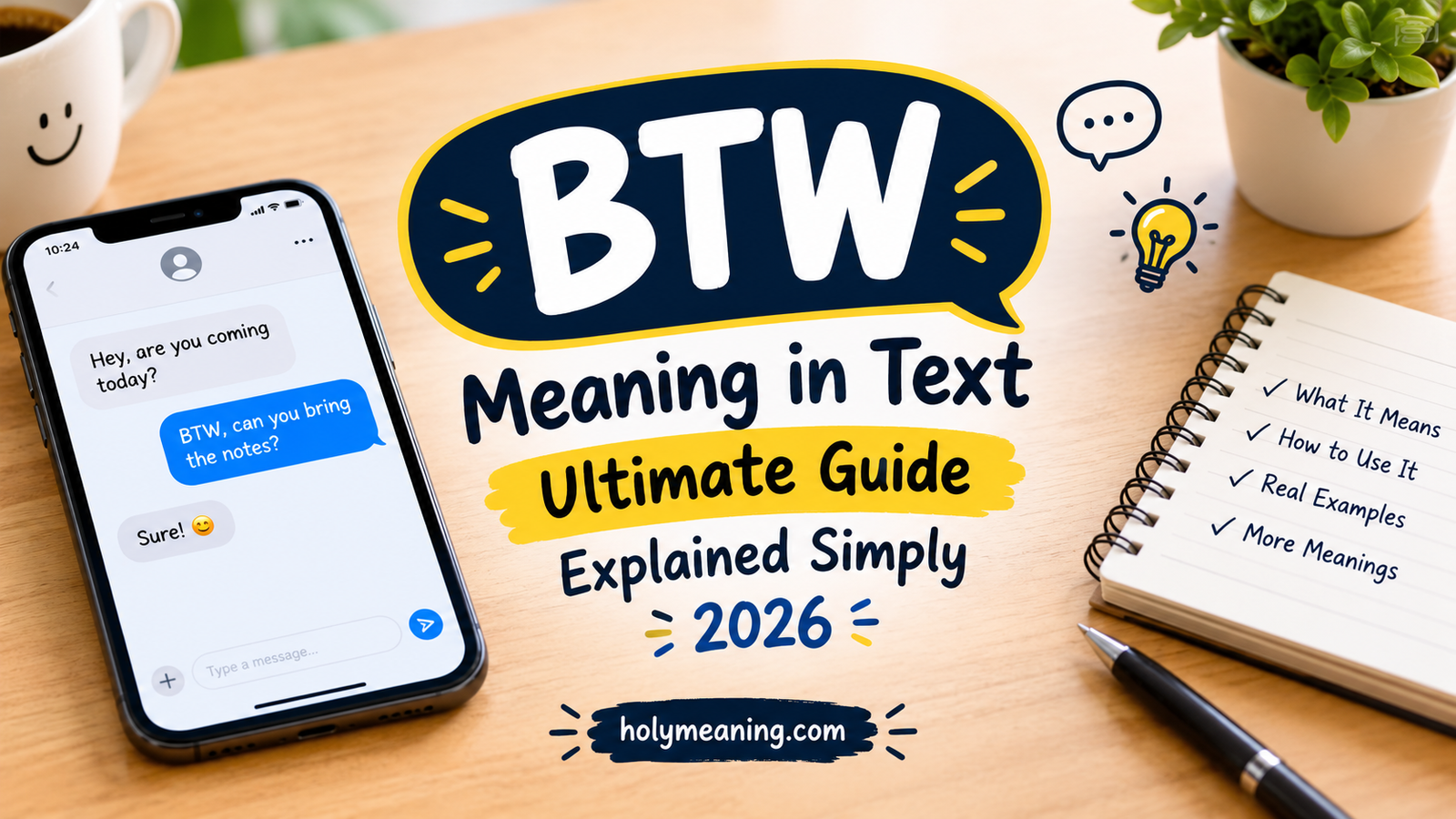
BTW stands for “by the way,” a simple acronym that’s become one of the most widely used pieces of texting slang on the internet. People drop it into conversations to add a quick side note, shift topics smoothly, or slide in a gentle reminder without breaking the flow.
Here’s the thing: this tiny three-letter word has survived nearly four decades of internet trends while flashier slang faded into obscurity. That staying power says a lot.
From late-80s internet forums to today’s group chats and Slack threads, BTW has quietly shaped how people communicate online. This guide breaks down its meaning, history, and proper use, giving you everything you need to use it naturally and confidently.
What Does BTW Mean in Text?
BTW stands for “by the way.” It’s one of the most common pieces of texting slang out there, and chances are you’ve used it without even thinking twice.
At its core, BTW works as a transition phrase. It signals that you’re about to add something — a thought, a fact, a question — that doesn’t quite fit into the main flow of the conversation but still feels worth mentioning. Think of it as a verbal shoulder tap. You’re not derailing the conversation; you’re just tossing in something extra.
Here’s a simple example:
“I finished the report. BTW, did you see the email from Marcus?”
In that sentence, BTW signals a subject shift — a smooth pivot from one topic (the report) to another (Marcus’s email) — without making the change feel abrupt.
The BTW definition hasn’t changed much since it entered mainstream use, but how people use it has evolved. It shows up in texts, emails, social captions, and even spoken conversation now (yes, people genuinely say “bee-tee-dubs” out loud, only half-joking).
Quick Facts About BTW
| Fact | Detail |
|---|---|
| Full phrase | By the way |
| Word count saved | 2 words → 1 acronym |
| First documented digital use | Early Usenet and BBS forums, late 1980s |
| Common capitalization | BTW, btw, or Btw (all accepted) |
| Formality level | Casual to semi-casual |
Origin of BTW: Internet Slang History
To understand the slang origins of BTW, you have to go back further than texting. Way further, actually.
The phrase “by the way” itself dates back centuries in English, used as a way to introduce a tangential remark in formal writing and speech. But the abbreviation BTW is a product of the digital age.
BTW first appeared in online spaces in the late 1980s, largely on Usenet newsgroups and bulletin board systems (BBS) — the precursors to modern forums and social media. Typing speed mattered on these platforms. Every keystroke cost time, especially on slow dial-up connections, so users developed shorthand to communicate faster. BTW was one of dozens of internet abbreviations born out of that necessity, alongside terms like FYI and ASAP.
By the 1990s, as AOL Instant Messenger (AIM) and early chat rooms exploded in popularity, BTW moved from niche tech circles into mainstream online language. Teenagers and young adults picked it up fast — it fit perfectly into the rapid-fire, informal rhythm of instant messaging.
Then came the 2000s and the rise of SMS texting. Phone keypads (remember pressing “2” three times to type a “C”?) made every saved character valuable. BTW slotted right in as a staple of conversational shorthand.
“The internet didn’t invent shorthand — it just gave it a much bigger stage and a much faster clock.”
Here’s a rough timeline of how BTW spread across communication platforms:
- Late 1980s – Appears on Usenet and BBS forums among early internet adopters
- 1990s – Popularized through AIM, IRC, and early chat rooms
- Early 2000s – Becomes a staple of SMS texting thanks to character limits
- 2010s – Crosses into social media captions, comments, and even brand marketing
- 2020s–2026 – Fully mainstream; used across texting, email, Slack, and voice conversation, often ironically or for emphasis
What’s interesting is that BTW never really faded the way a lot of early internet slang did (nobody says “ROTFL” anymore, let’s be honest). It stuck around because it fills a genuinely useful gap in digital communication — there’s no better one-word substitute for “oh, and one more thing.”
How to Use BTW Correctly
Knowing the meaning is one thing. Knowing how to use BTW correctly in a sentence is where a lot of people trip up. Let’s fix that.
Capitalization Rules (BTW vs btw vs Btw)
Good news: there’s no strict rule here. All three versions are grammatically acceptable in casual writing:
- BTW — most common in professional or semi-formal texts, emails, and Slack
- btw — the default in casual texting, especially among younger users
- Btw — occasionally used at the start of a sentence, treated like a regular capitalized word
Style guides don’t have an official position on this because BTW is slang, not standard grammar. That said, capitalization tends to signal tone. All-caps versions can read as slightly more emphatic or formal, while lowercase feels relaxed and conversational.
Punctuation (Comma After BTW?)
This one trips people up constantly. Do you need a comma after BTW?
Short answer: it’s optional, but a comma usually makes the sentence read more naturally, especially at the start of a sentence.
- ✅ “BTW, I moved the meeting to 3pm.”
- ✅ “BTW I moved the meeting to 3pm.” (also fine in casual texting)
- ❌ “I moved the meeting, BTW to 3pm.” (awkward placement, avoid mid-sentence breaks like this)
In texting and chat apps, people often skip the comma entirely because speed matters more than writing conventions. In emails or anything semi-professional, adding the comma looks cleaner.
Sentence Placement
BTW is flexible. It can go at the beginning, middle, or end of a sentence, and each placement changes the emphasis slightly.
| Placement | Example | Effect |
|---|---|---|
| Start | “BTW, are we still on for lunch?” | Signals a new thought right away |
| Middle | “I saw your message, btw, and I’ll reply soon.” | Feels more like an aside |
| End | “I’ll send the file later, btw.” | Softens the statement, feels casual |
There’s no wrong answer here — it really depends on the rhythm of the sentence and how casual you want it to sound.
The 3 Main Ways People Use BTW
Once you understand the mechanics, it helps to look at BTW’s actual function in BTW in conversations. There are basically three jobs this little acronym does.
Adding an Afterthought or Extra Info
This is the most common use. You’re already talking about something, and you toss in an extra detail — an afterthought, a bit of supplementary detail that adds context but isn’t the main point.
“The party starts at 7. BTW, bring a jacket, it gets cold there at night.”
The extra information here (bring a jacket) isn’t essential to the main message (party time), but it’s genuinely useful extra context.
Changing the Subject Smoothly
BTW is also a go-to transition phrase for pivoting topics without it feeling jarring. Instead of abruptly switching gears, BTW softens the topic change.
“That movie was great. BTW, did you finish the assignment yet?”
Without BTW, that sentence would feel like a hard left turn. With it, the subject shift feels intentional and natural — almost like a conversational speed bump instead of a wall.
Reminding Someone of Something
The third common use is as a gentle nudge — a reminder wrapped in casual phrasing so it doesn’t feel like nagging.
“BTW, you still owe me $20 from last week.”
This softens what could otherwise sound like a demand. It’s a subtle but effective communication tool, and it’s a big reason BTW has stuck around in everyday communication for decades.
Real Examples of BTW in Conversation
Seeing BTW used in different formats helps cement how flexible it really is. Here’s a breakdown across texting, email, and group chats.
Texting Examples
- “Omw! Btw, can you grab milk on the way?”
- “That’s hilarious lol. Btw did you see what Jake posted?”
- “Running 10 min late, btw, sorry!”
Email Examples
- “Attached is the revised proposal. BTW, I also cc’d Sarah for visibility.”
- “Thanks for the quick turnaround. BTW, let’s plan to sync early next week.”
- “The invoice is ready to send. BTW, the client asked about a discount for early payment.”
Group Chat / Slack Examples
- “Standup moved to 9:30. BTW, does anyone have the design file link?”
- “Deploy went smoothly 🎉 btw, don’t forget to update the changelog.”
- “Lunch order is in. BTW, new hire starts Monday, someone should show them around.”
Context Comparison Table
| Context | Example | What It Signals |
|---|---|---|
| Texting | “Omw, btw traffic is bad” | Casual, quick aside |
| “BTW, I attached the file” | Semi-formal addition | |
| Slack/Work Chat | “Btw standup moved to 10” | Informal team update |
| Social Media Comment | “Love this! Btw where’d you get that jacket?” | Friendly curiosity |
These text examples and chat examples show just how adaptable BTW really is — it flexes to match the tone of whatever platform you’re on.
BTW on Social Media vs. Texting
Usage of BTW shifts depending on the platform, and understanding those differences matters if you’re writing social media slang for a brand, a caption, or your own personal posts.
On Instagram and TikTok, BTW often shows up in captions as a way to sneak in a secondary message without cluttering the main hook.
“New video is up! Btw, link in bio 🔗”
On Twitter/X, BTW frequently appears in replies and comments, functioning almost like a quick footnote to someone else’s post.
“Great thread. Btw, you should also check out [related resource].”
There’s also a hashtag version — #BTW — though it’s less common and typically used ironically or for emphasis rather than as a functional transition.
Here’s how usage tends to differ by platform:
| Platform | Typical Use | Formality |
|---|---|---|
| Instagram captions | Adding bonus info or CTA | Casual |
| TikTok captions | Quick asides, humor | Very casual |
| Twitter/X replies | Tangential comments | Casual |
| Rarely used, considered too casual | Avoid | |
| Facebook comments | Friendly additions | Casual |
The pattern across social platforms is consistent: BTW works great for online communication in relaxed settings but doesn’t translate well to more polished or professional social spaces like LinkedIn.
Common Mistakes With BTW
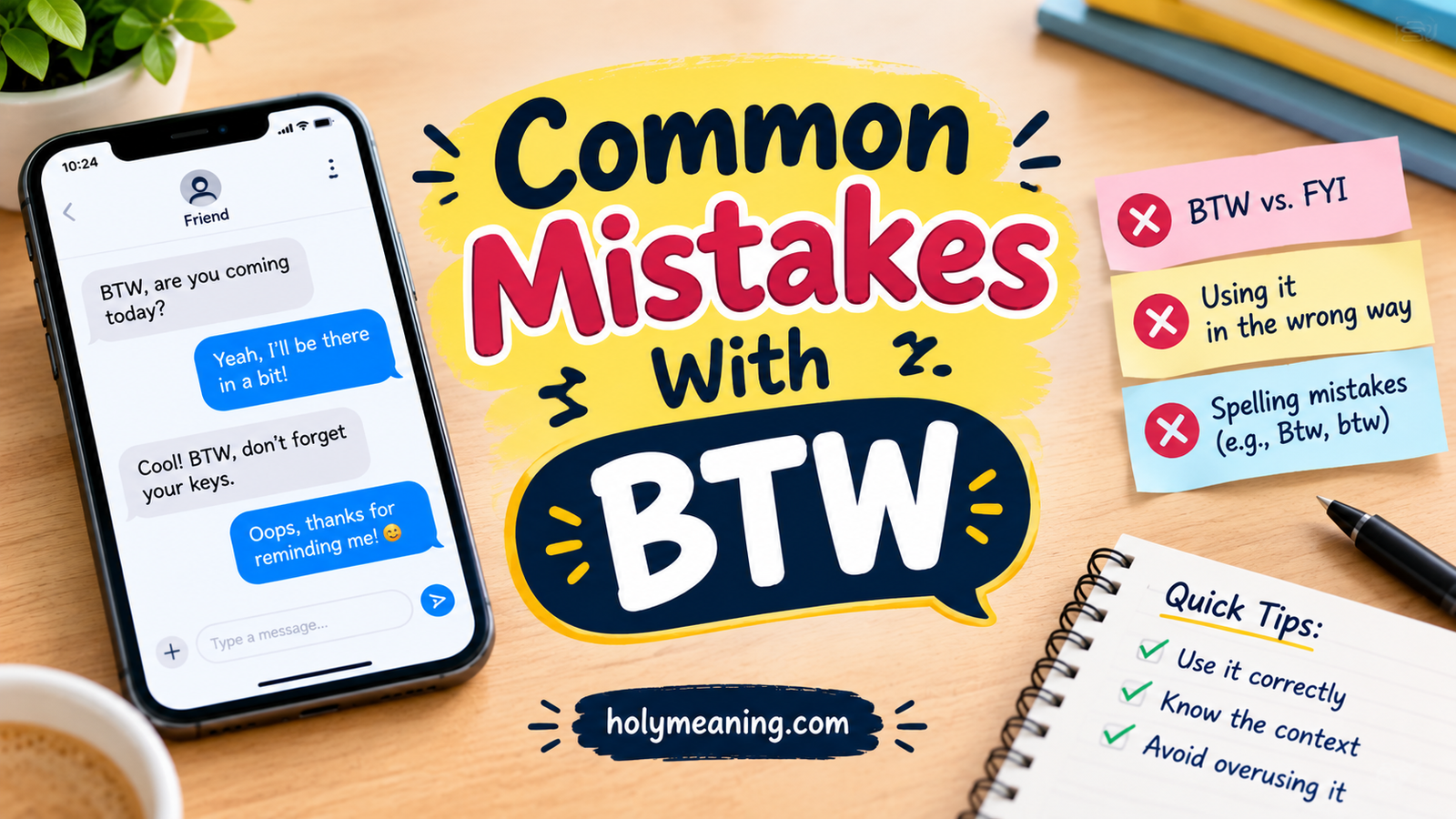
Even simple texting slang has pitfalls. Here are the most frequent communication mistakes people make with BTW.
Overusing It
Using BTW multiple times in one message or conversation dilutes its impact. If everything is introduced as an aside, nothing actually feels important.
❌ “Btw I finished the report. Btw I also called the client. Btw lunch is at noon.”
That reads exhausting. Save BTW for moments where the added detail genuinely feels secondary.
Using It to Soften Bad News Awkwardly
BTW can come across as dismissive when it’s used to deliver something that actually deserves more weight.
❌ “Btw, we lost the client account.”
That’s not an afterthought — that’s a big deal, and BTW makes it sound like an afterthought, which can read as careless or tone-deaf.
Confusing It With Similar Acronyms
People sometimes mix up BTW with FYI, TBH, or PS, even though each one carries a different implied meaning. More on that in the next section.
Using It in Contexts That Need More Formality
Dropping BTW into a formal report, a cover letter, or a client-facing legal document is a mismatch. It instantly casualizes the tone in a way that can undercut credibility.
Quick mistake checklist:
- Don’t stack multiple BTWs in one message
- Don’t use it to downplay serious news
- Don’t confuse it with FYI, TBH, or PS
- Don’t use it in formal or legal documents
- Don’t assume every reader knows the acronym (some older or non-native English speakers might not)
BTW vs. Similar Acronyms
BTW isn’t alone out there. A handful of similar acronyms get used in overlapping situations, but they each carry a slightly different implied meaning. Here’s an acronym comparison to clear up the confusion.
| Acronym | Meaning | Best Use Case |
|---|---|---|
| BTW | By the way | Adding a side note or changing topic smoothly |
| FYI | For your information | Sharing something the reader needs to know, often more important than a BTW aside |
| TBH | To be honest | Prefacing an honest or blunt opinion |
| ICYMI | In case you missed it | Reminding someone about something they may have overlooked |
| PS | Postscript | Adding a note after the main message, typically in emails or letters |
The key distinction: FYI tends to carry more weight or urgency than BTW. If you write “FYI, the deadline moved up,” that reads as important. “BTW, the deadline moved up” reads more casually, even though the information is identical. Choosing the wrong one can genuinely change how seriously your message gets taken.
TBH and ICYMI serve totally different purposes — TBH signals honesty or opinion, while ICYMI works as a callback to something already shared. BTW, by contrast, is purely a transition tool.
Is BTW Appropriate for Work Emails and Slack?
This is one of the most searched questions around BTW, and the answer is: it depends on your workplace culture.
When It’s Fine
In internal chat tools like Slack, Teams, or casual workplace communication with close colleagues, BTW fits naturally. Most modern offices, especially in tech, media, and creative industries, treat Slack and internal messaging as a casual space where full sentences and formal tone aren’t expected.
“Standup’s at 10. Btw, can someone review my PR before then?”
When to Avoid It
For client emails, external business emails, or communication with senior leadership you don’t know well, BTW can come across as too informal. First impressions matter, and an acronym-heavy email might read as unprofessional, especially in industries like law, finance, or consulting where office language still leans traditional.
Safer Alternatives for Professional Settings
If you want the same function without the casual tone, try:
- “Additionally,”
- “One more note —”
- “Also worth mentioning,”
- “On a related note,”
Case study snapshot: A 2023 internal communication study by workplace culture platform Slack found that casual tone and shorthand use correlate strongly with team size and industry — smaller, younger teams use significantly more informal language (including acronyms like BTW) than larger, more hierarchical organizations. The takeaway: read the room before you type it.
Alternatives to BTW by Tone
Not every situation calls for BTW, even when the function — adding a side note — stays the same. Here’s how to match your tone and intent to the right phrase.
| Tone | Alternative Phrase |
|---|---|
| Very casual | “Oh yeah,” / “Also,” |
| Casual | “By the way,” / “Quick thing —” |
| Neutral | “One more thing,” / “Also worth noting,” |
| Semi-formal | “Additionally,” / “On a related note,” |
| Formal | “I also wanted to mention,” / “Separately,” |
Swapping BTW for a more formal alternative doesn’t change the message — it changes how the message lands.
What BTW Really Signals (Tone and Intent)
Beyond the literal meaning, BTW carries an emotional and social undertone that’s worth understanding.
Why It Softens Statements
BTW acts as a cushion. It takes a statement that might otherwise feel abrupt or demanding and wraps it in casual tone, making it easier to hear.
“BTW, you left the lights on again.”
Compare that to:
“You left the lights on again.”
The second version reads sharper, almost like a complaint. The BTW version feels lighter, more like a friendly heads-up than a criticism.
How It Signals Casualness and Familiarity
Using BTW with someone also communicates familiarity. It’s shorthand you’d typically reserve for people you’re comfortable with — friends, close coworkers, family. Using it with a stranger or in a formal first-contact email can feel presumptuous, almost like you’re skipping a step in the relationship.
Cultural and Generational Differences
Usage does shift by generation. Gen Z and younger Millennials tend to use BTW liberally across nearly every messaging context, including in group chats with acquaintances. Older generations, particularly those who adopted digital communication later in life, tend to reserve it for closer relationships and may associate it more strongly with written correspondence than spoken language.
Non-native English speakers sometimes take longer to adopt casual acronyms like BTW, since they’re rarely taught in formal English instruction and mostly get picked up through immersion in online slang and pop culture.
Does BTW Still Matter in 2026?
Short answer: yes, and it’s not going anywhere soon.
Despite decades of internet slang churning through fads (remember when everyone said “on fleek”?), BTW has remained remarkably stable. A few reasons why:
- It fills a real linguistic gap. There’s no single common word in English that means “by the way” — you either use the full phrase or the acronym, and the acronym is simply faster.
- It transcends platforms. Unlike slang tied to a specific app or meme cycle, BTW works everywhere: texting, email, voice, social media.
- AI chat and voice assistants haven’t replaced it. If anything, the rise of AI-powered messaging and voice-to-text tools has reinforced BTW’s presence — predictive text and autocomplete features often suggest it, keeping it in constant rotation.
- It’s generationally durable. Unlike slang that skews heavily toward one age group, BTW gets used by teenagers and grandparents alike at this point.
As of 2026, BTW remains one of the most universally understood pieces of conversational shorthand in the English-speaking internet, and there’s little indication that’s changing anytime soon.
FAQs
Is BTW still commonly used in 2026?
Yes, it remains one of the most widely used texting acronyms, appearing across texting, email, Slack, and social media captions.
Is BTW appropriate for professional emails?
It works fine in casual internal chats like Slack, but it’s best avoided in formal client emails or official documents.
Do you need a comma after BTW?
It’s optional, but adding one—especially at the start of a sentence—makes it read more naturally.
What’s the difference between BTW and FYI?
BTW introduces a casual side note, while FYI signals information the reader actually needs to know.
Can BTW be used to deliver serious news?
It’s not recommended—using BTW for big news can make it sound dismissive or careless.
conclusion
BTW meaning in text really comes down to one simple phrase: “by the way.” It’s a small acronym, but it does a lot of work. It softens statements, adds quick side notes, and keeps conversations flowing naturally without feeling abrupt.
Nearly four decades after it first appeared online, the BTW meaning in text hasn’t changed much. What’s changed is how often we use it—across texts, emails, and social media. Keep it casual, use it wisely, and you’ll never misuse this tiny but powerful piece of internet slang again.