PTSO meaning starts in the classroom. It stands for Parent Teacher Student Organization, a local group where parents, teachers, and students team up to support one school through fundraising, events, and volunteering.
Four letters. Two very different messages. The same abbreviation can announce a bake sale in your inbox one minute and hype a friend’s outfit in your comments the next.
PTSO also names a UK trading standards job and a university student club. Context matters. Check who sent it and where you saw it. Once you know those clues, you’ll decode any version in seconds.
PTSO Meaning at a Glance: What PTSO Means in Plain English
Context decides everything. Use this table to match where you saw the term with its likeliest meaning.
| Where you saw it | Most likely meaning of PTSO | Confidence |
|---|---|---|
| School email, flyer, or website | Parent Teacher Student Organization | Very high |
| Parent group chat about a bake sale | Parent Teacher Student Organization | Very high |
| Comment under an outfit photo | Put That Shit On | High |
| UK council or consumer protection news | Principal Trading Standards Officer | Medium |
| University department page | Physical Therapy Student Organization | Medium |
Here’s the simple rule. If adults are talking about a school, it’s the organization. If someone is hyping a look, it’s the slang.
By the Numbers: Key Facts About PTSO Organizations
These figures give you the big picture before we dig deeper.
| Fact | Detail |
|---|---|
| Founding of the National PTA | The National PTA has advocated for children and families since 1897. |
| National PTA per-member share | For 2025–26, $3.25 per member goes to National PTA. |
| Typical PTO dues | Some groups charge $5 to $20 a year. Others are free. |
| Insurance partner reach | AIM insures more than 23,000 parent-teacher groups. |
| PTO vs. PTA counts | PTO Today estimates independent PTOs outnumber PTA units by more than two to one. |
| Small-group IRS form | Form 1023-EZ runs three pages, against 26 pages for the standard Form 1023. |
PTSO in Schools: Parent Teacher Student Organization Explained
PTSO in schools is the meaning you’ll meet most often. Parents, teachers, and sometimes students join forces to support one school. Nearly every community has a group like this. Most public and private elementary and middle schools have a PTA, a parent–teacher organization, or an equivalent local group.
The PTSO Definition and Abbreviation
The PTSO abbreviation spells out as Parent Teacher Student Organization. The extra “S” signals that students have a seat at the table. That makes the group both a student organization and a parent teacher group.
Here’s the part most articles skip. A PTSO isn’t a special legal category. The name “PTO” isn’t trademarked or regulated, so an independent group can call itself a PTO, PTSO, HSA, or Parent Club. Another guide notes that groups go by names like Parent Teacher Group, Home and School Association, or Parent Teacher Student Organization, while the core idea stays the same.
In plain terms, what PTSO means is a name choice. The group behind it sets its own rules unless it has joined a national network.
A Short History of the School Parent Group
Parent groups have deep roots. The National PTA dates to 1897. It stayed active in child welfare, helping introduce inoculation programs and school lunches nationwide. Today it runs out of Alexandria, Virginia, and keeps a Washington, D.C., office to pursue a public policy agenda.
The idea also spread worldwide. Australia, for example, has parents and citizens’ associations overseen by state and national bodies. The student-inclusive model grew from the same impulse. Schools wanted the people affected by decisions to help shape them.
What a PTSO Organization Actually Does
Every school-based organization works a little differently. Still, most PTSOs focus on five jobs.
Fundraising
Money is the most visible job. A walk-a-thon, a book fair, or a gala night can raise money that goes straight back to the school. Groups also run fun runs, restaurant nights, auctions, and grant applications.
School Activities and Events
School activities build a sense of belonging. Think family movie nights, teacher appreciation lunches, and holiday fairs. These events strengthen the school community in ways a budget line never could.
Parent Involvement and Volunteers
Parent involvement is the engine. A PTSO recruits volunteers for classrooms, lunch duty, and field days. Strong parent participation also gives busy families an easy way to plug in.
Student Involvement and Voice
Student involvement adds a fourth voice alongside parents, teachers, and staff. Students can suggest events, run service projects, and speak up on issues that affect them.
Communication With the School Community
A PTSO gives families, teachers, and administrators a shared channel. It can relay principal updates, gather feedback, and answer newcomer questions. That role matters most at the start of the school year.
Where You’ll Find a PTSO: Elementary, Middle, and High School
Most groups cluster in younger grades. PTOs appear mainly in elementary schools, middle schools, and K-8 schools. They exist less often at high schools and preschools.
Student-inclusive models fit older grades best. A PTSA, for instance, is more common in middle and high schools, where students can take leadership roles. That logic applies to a PTSO too.
Case Study: Briggs and Oakridge PTSOs Raise Money With Clothing Drives
Real groups show how this works. Both Briggs and Oakridge PTSO partnered with Clothes for the Cause, a fundraising company that collects clothes in exchange for cash. The money funds school activities.
Notice how simple that model is. Families clean out closets. The school gets cash. Nobody sells wrapping paper. Low-effort fundraisers like this help a PTO group raise money while keeping parent participation high.
Case Study: California State PTA Builds in Student Voice
California shows what student inclusion looks like at scale. The California State PTA incorporated as the California Congress of Parents, Teachers, and Students to reflect its support for student participation. Its toolkit also encourages student participation in both PTA and PTSA units.
The lesson applies to any PTSO. Adding students to the name works best when students also get real roles.
PTSO vs PTA: Understanding PTA vs PTSO
PTSO vs PTA is the most common comparison. The core difference is affiliation.
A PTA is a chartered member of the National PTA. Members pay dues, and part of that money goes to the state and national organizations. A PTSO, in contrast, usually stands alone. Here’s how PTA vs PTSO compares side by side.
| Feature | PTA | PTSO |
|---|---|---|
| PTA affiliation | Chartered with state and National PTA | Usually none |
| Name protected | Yes. Only dues-paying members can use “PTA.” | No |
| Bylaws | Follows PTA standards | Written by the group |
| Membership dues | Portion goes upstream | Set locally, all stays local |
| Nonprofit status | PTAs must hold 501(c)(3) status. | Optional |
| Student seat | Varies | Common, set by bylaws |
| Insurance | Available through a National PTA partner | Group finds its own |
PTA Affiliation and PTA Membership: What You Get
PTA membership buys support. In return for following guidelines, the National PTA provides resources for family engagement programs, fundraising, training, and access to program grants. The PTA also carries a public policy agenda in D.C., and most state units advocate at their state capitals.
That advocacy is a real selling point for some groups. For others it’s a drawback. Some members prefer that dues stay local instead of funding positions they don’t share.
A PTSO buys freedom. Neither choice is wrong.
PTSO vs PTO: PTO vs PTSO Compared
PTSO vs PTO has a shorter answer. Functionally, there’s no difference. A PTSO is a parent teacher organization that adds students to its name.
What Is an Independent PTO?
An independent PTO has no national parent body. It writes its own bylaws, keeps all its funds local, and handles its own nonprofit status and insurance. Outside local, state, and federal law, a PTO has no guidelines it must follow.
That freedom cuts both ways. Volunteers handle everything themselves, including the 501(c)(3) application and financial controls. Good documentation matters more when nobody upstream checks your work.
Common Names for a Parent Teacher Group
PTO works as an umbrella term for all independent school parent groups. Think of it like tissues. Kleenex is one brand, but the word covers them all. You’ll also see names like PCC (Parent Communication Council), HSA (Home and School Association), or PTG (Parent-Teacher Group).
That’s why PTO vs PTSO searches lead to the same advice. Both are independent organization models. Both write their own rules. The only real gap is the name.
PTSO vs PTSA: Why One Letter Matters
Here’s where people slip. PTSA stands for Parent Teacher Student Association. It differs from a PTSO in one crucial way.
National PTA encourages PTSAs under conditions each state PTA sets. That places a PTSA inside the PTA family. In Washington, joining a local PTA or PTSA makes you part of the state association and the National PTA.
PTSAs also show what student roles can look like. National PTA describes PTSAs elevating student voices in advocacy, hosting voter registration drives, and joining the Reflections arts program through the state PTA.
Costs vary. Meadowcreek High School’s PTSA lists a $10 membership fee and welcomes anyone who supports the PTA mission.
Key takeaway: A PTSA belongs to the National PTA. A PTSO usually doesn’t. One letter, big difference.
How Money, Insurance, and Legal Status Work
Money questions come up early. Answer them before your first fundraiser.
Membership Dues
Membership dues vary widely. Some PTOs charge $5 to $20 a year, while others are free. A PTA sends part of each membership up the chain. The rest stays local.
Free membership encourages parent participation. Small dues fund basics like supplies and insurance. Pick the model that fits your community.
Insurance
Insurance protects volunteers. AIM, the National PTA’s insurance partner, advertises general liability limits of $1 million to $2 million and directors and officers coverage of $1 million with no deductible. It lists local unit pricing from $85 a year, compared with about $500 a year on the open market.
Those numbers come from a vendor guide. Confirm current quotes before you decide. An independent group can still find comparable rates. It just has to search.
Booster clubs add another wrinkle. A booster club usually focuses on one program, while a PTA or PTO supports the whole school. Many schools run both.
Tax Status and 501(c)(3)
Tax-deductible donations require 501(c)(3) status. A PTO can apply for it through the IRS, but not every PTO takes that extra step. Another source says each PTO is an independent nonprofit corporation that must apply for tax-exempt status.
Small groups may qualify for the short form. Most organizations with gross receipts of $50,000 or less and assets of $250,000 or less are eligible for Form 1023-EZ. You must answer “No” to every question on the eligibility worksheet. A group expecting to raise more than $50,000 should plan on the full Form 1023.
Fees and rules change. Check IRS.gov before you file. Once a group has status, anyone can verify it through the IRS Tax Exempt Organization Search.
How to Join a PTSO: Joining a Parent Group Step by Step
You can join a PTSO the same way you’d join any local parent group. The process is easy. Most schools want you there.
Steps to Join
- Ask the school office. Staff usually know the president’s name and meeting schedule.
- Check the school website. Look for a “Parents” or “Get Involved” page.
- Read the bylaws. They explain who can join and who can vote.
- Pay dues if required. Some groups charge nothing.
- Attend one meeting. You’ll learn more in an hour than from any flyer.
Who Can Join
PTOs are open to parents, teachers, staff, and administrators. Community members can help form them too. Many groups also welcome grandparents, guardians, and neighbors. In a PTSO, students often count as members. The bylaws decide.
What PTSO Membership Costs
PTSO membership costs less than most people expect. Expect $0 to $20 a year at many schools. School membership in a group often includes voting rights and newsletter access.
How to Get Involved Without Overcommitting
Not every parent has time for weekly meetings. That’s fine. Try these low-effort options:
- Donate supplies for one event
- Volunteer for a single two-hour shift
- Join a committee that meets twice a year
- Share flyers in your neighborhood group
- Offer a skill, such as design or bookkeeping
Joining a parent group doesn’t demand a heavy commitment. A small, steady contribution beats a burst of enthusiasm that fades in October.
How to Start a PTSO: Create a PTSO From Scratch

No PTSO at your school? You can start a PTSO with a few motivated parents. These steps also work if you want to form a PTSO from an informal parent club.
Before You Form a PTSO
Talk to your principal first. A group works best when the school supports it. Ask about meeting space, calendar access, and communication channels. Then recruit a few allies. The basic path is to gather a few interested parents, win the principal’s support, draft bylaws, and elect officers.
Steps to Create a PTSO
Here’s a fuller roadmap.
- Recruit a core team. Aim for four to six people.
- Meet with the principal. Confirm expectations and boundaries.
- Choose your structure. Decide between chartering with your state PTA or staying independent.
- Draft PTSO bylaws. Write the rules before disputes appear.
- Elect PTSO officers. Fill key roles at an opening meeting.
- Open a bank account. Require two signers.
- Buy insurance. Cover events and volunteers.
- Decide on tax status. Apply for 501(c)(3) if you want tax-deductible gifts.
- Announce the group. Use newsletters, flyers, and back-to-school night.
PTSO Bylaws: What to Include
Bylaws prevent fights. A solid set covers these items:
- The group’s name and purpose
- Who can be a member and whether students vote
- How officers get elected and how long they serve
- How meetings run and what counts as a quorum
- How the group spends and tracks money
- How members can amend the bylaws
- What happens to leftover funds if the group closes
Borrow a sample from another school. Then adapt it to fit yours.
What to Cover at Your First Meeting
Keep the opening meeting short. A useful agenda looks like this:
| Time | Agenda item |
|---|---|
| 5 minutes | Welcome and purpose |
| 10 minutes | Principal’s priorities for the school |
| 15 minutes | Bylaws overview and vote |
| 15 minutes | Officer elections |
| 10 minutes | First event ideas |
| 5 minutes | Next meeting date |
Scenario: A Middle School Weighs Its Options
This is a hypothetical example.
Maria, a parent at a 600-student middle school, wants to create a PTSO. She finds five volunteers. They meet the principal, who agrees to host monthly meetings.
The team compares two paths. Affiliating with the state PTA as a PTSA gives them training and insurance. Staying independent keeps every dollar local. They choose independence because they expect to raise about $20,000 a year. They draft bylaws, elect officers, and file Form 1023-EZ.
Notice what drove the choice. Their size and priorities decided it. No rule forced their hand.
PTSO Roles and PTSO Officers: Who Does What
PTSO roles follow a familiar pattern. Your PTSO bylaws will spell out exact duties. The usual lineup looks like this.
| Role | Main job |
|---|---|
| President | Leads meetings, sets agendas, and represents the group to the principal |
| Vice president | Backs up the president and often oversees committees |
| Secretary | Records minutes and handles correspondence |
| Treasurer | Tracks money, pays bills, and reports finances |
| Committee chairs | Run events such as the book fair or auction |
| Teacher or staff liaison | Connects the group with faculty needs |
| Student representative | Brings student ideas and feedback |
These PTSO officers usually serve one- or two-year terms. Your bylaws set the exact length.
Why Committee Chairs Matter
Committee chairs turn big events into manageable pieces. A book fair chair, for example, can recruit ten volunteers without ever touching the treasury. That structure spreads the workload and reduces burnout.
Financial Safeguards for Treasurers
Money needs guardrails. Follow these basics:
- Require two signatures on checks or approvals
- Give the treasurer a monthly report deadline
- Have someone other than the treasurer review bank statements
- Keep receipts for every expense
- Present finances at each meeting
Tip: Write a one-page job description for every role. Handoffs get much smoother.
PTSO Slang: PTSO Meaning in Text and on TikTok
Now for the second PTSO meaning. Outside school, PTSO slang pops up in comments, captions, and DMs. It’s TikTok slang at its most casual.
PTSO Meaning in Text: Put That Shit On
The slang meaning is Put That Shit On. It works as an outfit compliment. Urban Dictionary entries define it that way and give examples praising someone’s look.
The phrase is profane. Some websites soften it to “Put That Stuff On.” The source entries use the stronger word.
One user-submitted example shows the tone:
“All my fits be drip, I really ptso !!”
Media picked it up too. A 2023 article described it as one of the most prevalent TikTok interpretations, tied to complimenting stylish, well-dressed people.
How to Use PTSO Slang in Texts and Comments
Here’s how PTSO meaning in text looks in practice. These examples are illustrative.
- “Fit check: new jacket and sneakers. PTSO.”
- “You showed up today. PTSO.”
- “Prom look was elite. PTSO fr.”
Keep it casual. Use it with friends, under photos, and in group chats where everyone knows the tone.
PTSO Slang Origin: What’s Verified and What Isn’t
Here’s the correction most articles miss. Nobody has documented where the slang began.
Some sites tell a tidy story. One claims it grew from African American Vernacular English and hip-hop, appeared on Twitter and Instagram around 2018 and 2019, and exploded on TikTok by 2020. Another says it started in the U.S. music scene before spreading. Neither points to a dated source.
What can you verify? The Urban Dictionary entries I found carry August 2021 dates. That’s the earliest confirmed evidence. Treat older origin claims as unproven until someone shows a dated post.
Fake PTSO Slang Meanings to Ignore
Search results overflow with invented definitions. Three examples show the pattern.
- One page claims PTSO means “Please Take Some Offers” and describes it as an invitation to bid on items for sale.
- Another says it means “Please Turn Something Over.”
- A third lists “Post Traumatic Stress Order” among its meanings.
None of these hold up. They contradict each other and cite nothing. The last one is also wrong on its face. The clinical term is PTSD, or post-traumatic stress disorder. PTSO isn’t a diagnosis.
Automated rewriting makes things worse. Compare two copies of one page. One correctly says PTSO represents Parent-Teacher-Student Organization on TikTok. Another version garbles the same text into nonsense phrases. Someone ran the article through a word-swapping tool.
How to Tell Real Slang From Made-Up SEO Slang
Use this checklist before you trust any PTSO explained page.
- Look for dated entries. Real slang leaves timestamps on sites like Urban Dictionary.
- Search real usage. Find actual comments and posts, not blog claims.
- Check for sources. Good pages link to evidence.
- Spot the template. Repeated phrases and awkward wording signal automated content.
- Compare across sources. Real meanings agree. Fake ones scatter.
- Test the logic. Does the claimed meaning fit how people actually write?
What to Do If Someone Texts You “PTSO”
Don’t panic. Read the situation.
| Situation | Likely meaning | Smart response |
|---|---|---|
| Message from a teacher or school parent | Parent Teacher Student Organization | Reply normally or ask which event |
| Friend reacts to your outfit photo | Put That Shit On | Say thanks |
| Group chat about a fundraiser | Parent Teacher Student Organization | Ask how to help |
| Unknown sender, no context | Unclear | Ask what they mean |
Asking is always fine. A quick “Do you mean the school group?” beats a wrong guess.
Keep the slang in casual spaces. It doesn’t belong in a school newsletter or a work email.
Other Meanings of PTSO: Alternative Definitions and Acronym Meanings
Acronyms rarely have one owner. The other meanings of PTSO are less common but real. Most acronym meanings directories list several.
Principal Trading Standards Officer
This is a UK job title. Trading standards officers enforce consumer protection law for local councils. A news quote from a Vale of Glamorgan council officer shows the title in action. She said illegal dumping of carcasses “will not be tolerated” in the area.
The Principal Trading Standards Officer leads a team of these enforcers. If you see PTSO in UK council news, this is the likeliest answer.
Physical Therapy Student Organization
Universities use this one. AcronymFinder lists Physical Therapy Student Organization for various locations. A Physical Therapy Student Organization is a club run by students in a physical therapy program. It often hosts study groups, guest speakers, and community service events. Look for it on a college department page.
Other Acronym Meanings in the Directories
AcronymFinder also records Parent Teacher School Organization and Put That Stuff on Paper, a polite request for documentation. The first is the school meaning with a different third word. The second belongs in offices, not group chats.
Directories vary in reliability. AcronymFinder shows six definitions for PTSO. Acronym Attic marks its four meanings as unverified. Treat any directory as a starting point, not a final answer.
Alternative Definitions to Skip
Some claims lack support. One blog lists “Public Transport Security Officer,” but I couldn’t confirm it elsewhere. Leave it out until a primary source appears. The “Post Traumatic Stress Order” claim, as covered earlier, isn’t real.
Common Mistakes People Make With the PTSO Abbreviation
A few slips show up again and again. Avoid these.
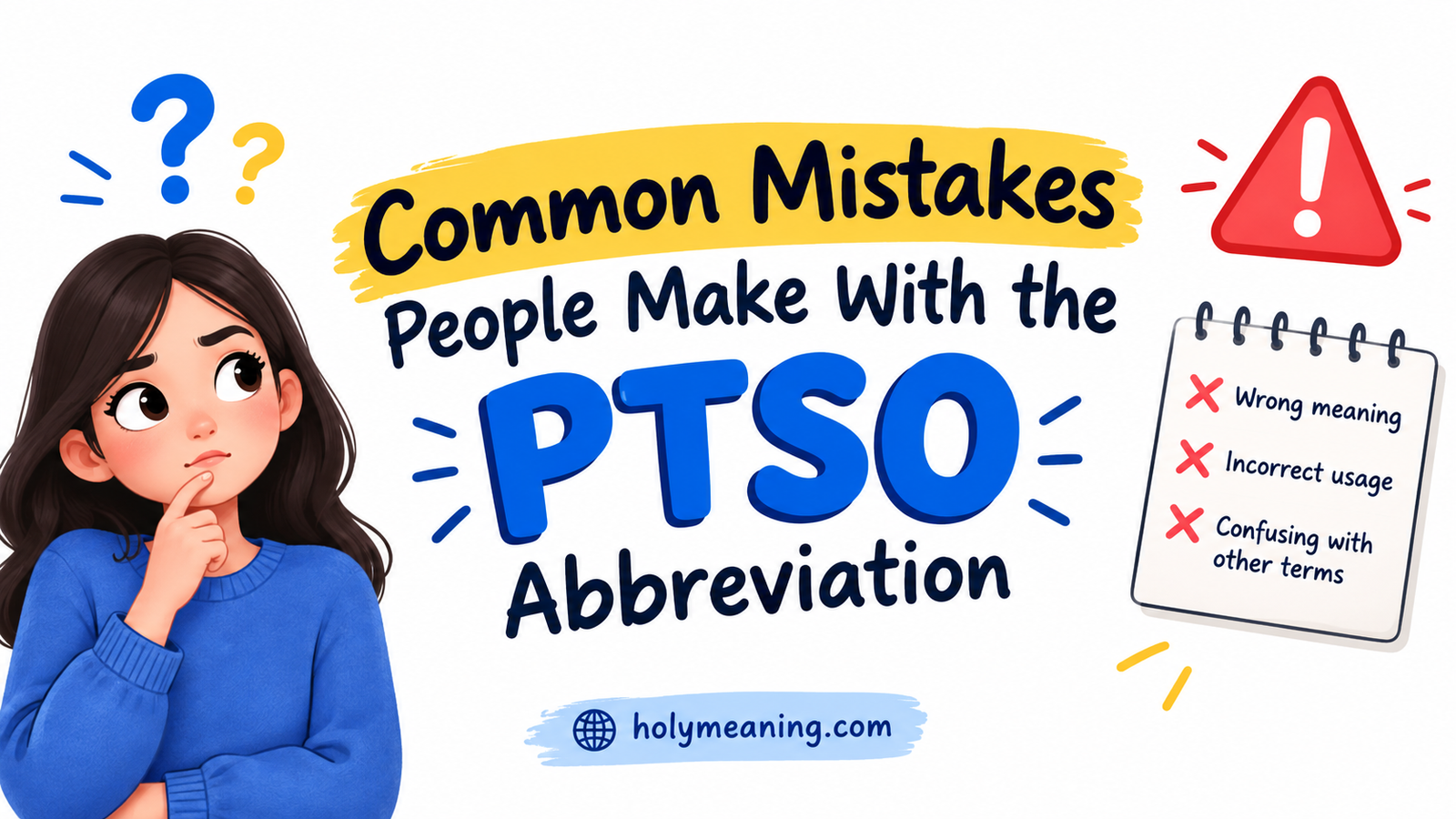
- Treating a PTSO as an official structure. It’s a name, not a legal category.
- Assuming a PTSO belongs to the National PTA. Most don’t.
- Calling an independent group a “PTA.” The PTA protects its name.
- Assuming donations are tax-deductible. That requires 501(c)(3) status. Check first.
- Using the slang in school messages. The two meanings collide awkwardly.
- Trusting invented definitions. Verify before you repeat them.
- Guessing instead of asking. A quick question saves embarrassment.
Best Practices for Using and Interpreting PTSO Correctly
Follow these habits and you’ll rarely get it wrong.
- Spell it out once. Write “Parent Teacher Student Organization (PTSO)” on first use.
- Check the source. Who sent it, and where?
- Read the bylaws. Know who votes and how money moves.
- Verify tax status. Use the IRS search tool before you donate large amounts.
- Save slang for friends. Keep it out of formal channels.
- Ask when unsure. Clarity beats confidence.
Quick Comparison Table: PTSO Meanings at a Glance
Here’s the full PTSO meaning picture in one place.
| Meaning | Where you’ll see it | Confidence |
|---|---|---|
| Parent Teacher Student Organization | School emails, parent group sites | High |
| Put That Shit On | Comments, DMs, captions | Medium (dated entries from 2021) |
| Principal Trading Standards Officer | UK local government | Medium |
| Physical Therapy Student Organization | University programs | Low to medium |
| Parent Teacher School Organization | Individual schools | Low to medium |
| Put That Stuff on Paper | Office requests | Low |
| Post Traumatic Stress Order, Please Take Some Offers | SEO pages | None. Ignore these. |
FAQs
What does PTSO mean?
PTSO stands for Parent-Teacher-Student Organization, a school parent group. As slang, it stands for “Put That Shit On,” an outfit compliment.
Is a PTSO the same as a PTO or a PTA?
A PTSO works like a PTO. The PTO name isn’t regulated, so independent groups can use PTSO, HSA, or other names. A PTA differs because it’s a chartered member of the National PTA.
What does PTSO mean in text?
Between friends, it usually praises someone’s look. A 2023 article described it as a common TikTok interpretation for complimenting stylish outfits.
How do I join or start a PTSO?
To join, ask the school office for meeting details. To start one, gather interested parents, get your principal’s support, draft bylaws, and elect officers.
How much does PTSO membership cost?
Some groups charge about $5 to $20 a year, while others are free. PTA-affiliated groups also send money upstream, as $3.25 per member goes to National PTA for 2025–26.
conclusion
The PTSO meaning depends on context. At school, it stands for Parent Teacher Student Organization. It’s a local group that supports students through events, fundraising, and volunteering. Among friends, it’s slang for an outfit compliment. Rare uses exist too.
Now you know the PTSO meaning in every setting. Check who sent it. Look at where you saw it. Those clues give you the answer fast. If you’re still unsure, just ask. You can also join a PTSO at your school. It’s an easy way to help your community.









1 thought on “PTSO Meaning: What It Really Stands For and How to Use It in 2026”