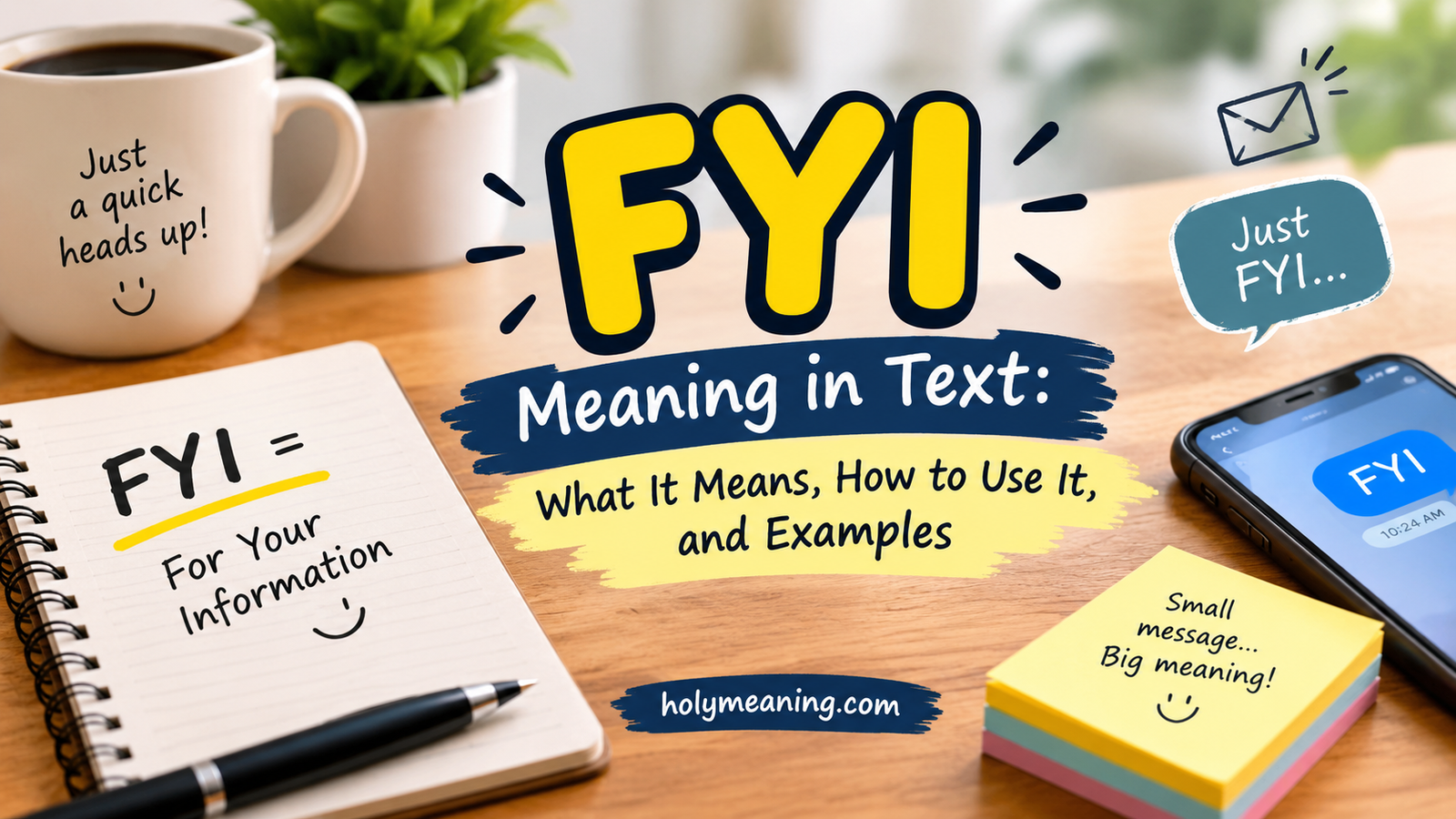
FYI meaning in text is simple: it stands for “For Your Information,” a short abbreviation people use to share a quick fact without asking for a reply or action.
Here’s the thing — those three little letters carry way more personality than most people realize. Depending on how it’s framed, FYI can sound friendly, businesslike, or downright blunt, and getting that balance wrong can quietly change how a whole message lands.
This guide breaks down everything worth knowing: where FYI actually came from, how to punctuate it, when it works beautifully, when it backfires, and how it stacks up against lookalikes like BTW and ASAP.
What Does FYI Mean?
FYI stands for “For Your Information.” That’s it. No hidden agenda, no secret code. It’s one of the most common texting acronyms out there, and its whole job is to flag information the reader might want or need, without demanding anything back.
Think of it as a verbal tap on the shoulder. You’re not asking a question. You’re not making a request. You’re just saying, “Hey, thought you should know this.”
Here’s the FYI definition in plain terms:
FYI (abbreviation): Used to introduce a statement that provides information the recipient may find useful, but that doesn’t require a response or action.
A simple example:
“FYI, the meeting got moved to 3 PM.”
No question mark. No “please confirm.” Just information, delivered and done. That’s the entire meaning of FYI in a nutshell — it’s an informational message, not an instructional one.
You’ll see it everywhere: texts, emails, Slack messages, Instagram captions, even the sticky note someone leaves on the office fridge. It’s one of the most versatile chat acronyms in the English language, mostly because it does one small job really, really well.
Where Did FYI Come From?
Believe it or not, FYI didn’t start out as internet slang. It’s actually older than the internet by decades.
The abbreviation dates back to the early-to-mid 20th century, when it showed up in office memos and government correspondence. Back then, memos would get routed through several people before landing on the right desk, and someone needed a quick way to say, “This isn’t for you to act on — just keep it on file, or read it and move along.”
A few points on its history worth knowing:
- Military and government origin: Some etymologists trace early uses of FYI to military communications, where clarity and brevity weren’t just nice-to-haves — they were operational necessities.
- Office memo culture: By the 1940s and 50s, FYI had become a staple of American business writing, stamped at the top of internal memos to separate “read and act” documents from “read and file” ones.
- The email era: When workplace email took over in the 1990s, FYI came along for the ride. Suddenly, forwarding a message “for your information” became one of the most common actions in a professional inbox.
- The texting era: Once SMS and instant messaging exploded in the 2000s, FYI shrank even further into pure shorthand — no punctuation required, no capital letters needed.
What’s interesting is that FYI never really changed its meaning across all these jumps. Unlike a lot of internet acronyms that mutate or pick up sarcasm over time (looking at you, “k”), FYI has stayed remarkably stable. It meant “heads up, no action needed” in a 1950s memo, and it means the same thing in a 2026 text message.
That kind of staying power is actually pretty rare. Most chat shorthand either fades out within a decade or morphs into something else entirely. FYI managed to skip both fates, mostly because it filled a genuine gap in written communication — there wasn’t really another short phrase doing exactly this job. “For informational purposes” works fine in a formal memo, but nobody’s typing that out in a group chat. FYI became the compact, portable version, and it just never got replaced.
There’s also a practical reason it caught on so widely: it’s easy to say, easy to type, and impossible to misread. Three letters, one clear job. Compare that to something like “NP” (no problem), which can occasionally read as a little flat or even sarcastic depending on context. FYI doesn’t carry that risk. It’s about as close to a “safe” abbreviation as internet acronyms get.
How to Punctuate and Format FYI
This is one of those small details that trips people up more than you’d expect. Do you need a comma? Does it need to be capitalized? Can it start a sentence?
Here’s the short answer: FYI is flexible, but a few conventions make your text meaning clearer.
| Format | Example | When to Use |
|---|---|---|
| FYI, (comma after) | “FYI, I’ll be late tomorrow.” | Most common in formal or semi-formal writing |
| FYI (no punctuation) | “FYI I’ll be late tomorrow” | Common in casual texting, no comma needed |
| fyi (lowercase) | “fyi im running late” | Very casual chats, texting friends |
| FYI: | “FYI: office closed Friday” | Announcements, bulletin-style messages |
| (FYI) | “The report is done (FYI, it’s a bit longer than usual)” | Mid-sentence clarification |
A few quick rules of thumb:
- In professional emails, capitalize it and follow it with a comma: “FYI, the client pushed the deadline.”
- In casual texts, lowercase is totally fine and honestly more common: “fyi im gonna be 10 min late lol”
- Starting a sentence with FYI is completely acceptable in both casual and semi-formal writing — it’s actually the most natural placement.
- Mid-sentence use works too, usually tucked in parentheses or set off by commas, when you’re adding a side note to something you’re already explaining.
There’s no official grammar rulebook for abbreviations like this — texting abbreviations tend to follow social convention more than formal grammar. So really, the punctuation matters less than matching the tone of whoever you’re talking to.
How to Use FYI Correctly
Now for the practical part: using FYI correctly in real conversations. The good news? It’s genuinely hard to mess this one up. But there are a few patterns worth knowing so it always lands the way you intend.
Where FYI Usually Goes in a Sentence
FYI most often sits at the very beginning of a message, acting like a little flag that tells the reader, “heads up, information incoming.” Less commonly, it shows up at the end, functioning more like an afterthought or footnote.
Here’s how to use FYI across a few different placements:
- Start of sentence: “FYI, the printer’s out of toner again.”
- Mid-sentence: “I sent the file over — FYI, it’s a pretty large attachment.”
- End of sentence: “The store closes early on Sundays, FYI.”
- Standalone: “FYI.” (usually followed by an attachment, screenshot, or link)
Real FYI Examples in Context
To really nail FYI usage, it helps to see it in action across different everyday situations:
- “FYI, I moved your dentist appointment to Thursday.”
- “Just an FYI — parking’s closed on Main Street this weekend.”
- “FYI, your package shipped early, so it might arrive tomorrow instead of Friday.”
- “Heads up, FYI the wifi password changed. It’s on the fridge.”
- “FYI: the client meeting has been moved to Zoom instead of in-person.”
- “fyi I’m not gonna make it to dinner, something came up”
Notice something? None of these examples ask a question. None of them demand action. They’re all doing the exact same job — delivering a piece of information and letting the reader decide what, if anything, to do with it.
Is FYI Formal or Informal?
Here’s the honest answer: FYI sits right in the middle. It’s one of the rare abbreviations that works comfortably in both casual conversation and professional work settings, which is a big part of why it’s stuck around for so long.
In Casual Conversation
Among friends, family, or in group chats, FYI is about as low-stakes as it gets. It’s the texting equivalent of tapping someone on the arm to mention something in passing.
Examples of casual texting FYI use:
- “fyi ur car alarm has been going off for like 10 min”
- “FYI I ordered pizza, come whenever”
- “just fyi, tom’s bringing his new gf to the party”
In this context, tone barely matters. Nobody’s going to read a casual FYI text and think you’re being cold or distant — it’s just how everyday chat works.
In Professional/Work Settings
In professional texting and business communication, FYI carries a bit more weight, mostly because tone is harder to read in a work context. A quick FYI email or Slack message is one of the most common tools for workplace communication, especially when looping someone in without assigning them a task.
Examples in work chat or email:
- “FYI, I’ve CC’d Sarah on this thread so she’s aware of the timeline.”
- “FYI, the vendor contract renews automatically unless we cancel by the 15th.”
- “FYI — I’ll be out of office next Monday, so ping Dana if it’s urgent.”
The key difference between casual and professional FYI use isn’t the phrase itself — it’s the surrounding context and word choice. A professional FYI tends to come with more detail, a clearer reason for sharing it, and slightly more formal sentence structure around it.
One manager put it well during a workplace communication workshop:
“FYI is one of the few phrases that lets you share information without implying blame or urgency. That’s exactly why it works so well in a fast-moving team — it keeps people in the loop without adding to their to-do list.”
That’s really the core value of FYI in a professional setting. It respects the reader’s time. Nobody has to wonder, “wait, do I need to do something with this?” The phrase itself answers that question before it’s even asked.
It’s also worth noting that some workplaces develop their own informal rules around FYI. In email-heavy industries like law or finance, an FYI often signals that a document is being archived or filed for record-keeping, not necessarily read in depth. In faster-paced environments like tech or media, FYI in a Slack channel might just mean “skim this when you get a second.” The word stays the same, but the expected level of attention shifts depending on the team culture.
FYI in Different Contexts
FYI in different contexts changes shape depending on the platform. The core meaning stays the same, but how it’s typically formatted — and how much explanation surrounds it — shifts quite a bit.
In Texting and Chat Apps
On texting and chat platforms like iMessage, WhatsApp, or group texts, FYI is almost always short, lowercase, and unpunctuated. It’s built for speed. Nobody’s proofreading a text to their sibling about grabbing milk.
- “fyi the store’s closed today”
- “FYI running 5 min behind”
In Email
FYI email use is a bit more structured. It often shows up either in the subject line itself or as the opening word of the message body. It’s also extremely common when forwarding a message to someone who doesn’t need to act on it but should still see it.
Common email patterns:
- Subject line: “FYI: Updated Project Timeline”
- Body opener: “FYI, I’m forwarding this from the vendor in case you need it for your records.”
- Forward note: “FYI — sending this your way, no action needed on your end.”
In Social Media Captions/Comments
On social media, FYI often takes on a slightly more expressive or even humorous tone. It’s used to add context to a photo, clarify something in a caption, or drop a quick aside in the comments.
- Caption: “FYI this cake took 6 attempts to get right 😅”
- Comment: “fyi this restaurant is closed on Mondays, learned the hard way”
In Work Documents and Meeting Notes
FYI also shows up constantly in work documents, shared docs, and meeting notes — usually as a quick annotation flagging something worth noting without derailing the main content.
- In a shared doc: “FYI — updated numbers as of Q3, previous version is archived.”
- In meeting notes: “FYI, budget approval is pending until next week’s sign-off.”
Does FYI Sound Rude?
This is probably the most searched question about FYI, and honestly, the answer is: it depends entirely on tone and context. FYI itself is neutral. It’s the words around it — and sometimes the situation it’s used in — that shift how it lands.
Friendly Tone
When paired with warmth or extra context, FYI reads as thoughtful and helpful. Adding a small qualifier like “just” or “quick” tends to soften it even further.
- “Just an FYI, your favorite show got renewed for another season! 🎉”
- “Quick FYI — I left extra snacks in the break room if you want any.”
Neutral Tone
Most FYI messages fall here. They’re not warm, but they’re not cold either — just plain, functional information-sharing.
- “FYI, the delivery window is between 2 and 5 PM.”
- “FYI, the report has been updated.”
Passive-Aggressive Tone
This is where things can go sideways. When FYI gets used to point out someone’s mistake, or drop information that feels like a jab, it can absolutely come across as curt or even a little smug.
- “FYI, you were supposed to send that yesterday.”
- “FYI, this isn’t the first time this has happened.”
Notice the difference isn’t the word FYI itself — it’s the content that follows it. When FYI introduces a correction, a complaint, or an “I told you so,” the phrase inherits that sharper tone by association.
Communication tip: If you’re worried a message might come off cold, try softening it with a quick lead-in like “Just wanted to flag” or “Heads up” instead of a bare FYI, especially in written text where tone doesn’t always translate.
Here’s a side-by-side look at how the exact same information can land differently depending on the framing around it:
| Blunt Version | Softer Version |
|---|---|
| “FYI, the report has errors.” | “FYI, I found a couple of small errors in the report — happy to walk through them.” |
| “FYI, you missed the deadline.” | “FYI, looks like this one slipped past the deadline. Want help getting it back on track?” |
| “FYI, that’s wrong.” | “FYI, I think there might be a small mix-up here — worth double-checking.” |
Notice how the actual information barely changes between columns. What shifts is the framing, the added context, and a touch of warmth. That’s really the whole trick to keeping FYI from sounding rude — it’s never really about the word itself, it’s about what you build around it.
Written text also strips out tone of voice, facial expression, and pacing — all the cues that soften spoken language automatically. That’s precisely why a perfectly innocent FYI can misfire over text even when the sender meant nothing by it. When in doubt, adding one extra sentence of context almost always fixes the problem.
When to Use FYI (and When Not To)
Knowing when to use FYI — and when to skip it — makes a real difference in how your messages land.
Situations Where It Works
- Sharing logistical updates: schedule changes, location changes, deadline shifts
- Looping someone in on info they should have but don’t need to act on
- Flagging something minor that doesn’t require a full explanation
- Forwarding emails to someone who just needs visibility
- Adding a quick side note to a longer message
Situations Where It Backfires
- Delivering bad news: “FYI, you didn’t get the job” feels abrupt and impersonal
- Sensitive or emotional topics: FYI strips away warmth exactly when warmth is needed
- Replacing an actual explanation: using FYI as a lazy shortcut instead of giving real context
- Correcting someone publicly: it can read as calling someone out rather than informing them
- Urgent situations: FYI signals “no action needed,” so it undersells anything time-sensitive
A good rule of thumb: if the information you’re sharing could hurt someone’s feelings, change their plans significantly, or requires a real conversation, FYI probably isn’t the right tool. Save it for the low-stakes stuff.
FYI vs. BTW vs. ASAP
People often lump FYI in with other common chat shorthand, but each of these has a distinct job. Here’s a full FYI comparison against the abbreviations it gets confused with most.
| Abbreviation | Full Meaning | Purpose | Example |
|---|---|---|---|
| FYI | For Your Information | Shares info, no action needed | “FYI, the office is closed Monday.” |
| BTW | By The Way | Adds a related, often minor point | “BTW, did you see the new menu?” |
| ASAP | As Soon As Possible | Signals urgency, action needed now | “Send this ASAP, the client’s waiting.” |
| NVM | Never Mind | Cancels or retracts a previous point | “NVM, I figured it out.” |
| TBH | To Be Honest | Introduces a candid opinion | “TBH, I didn’t love the movie.” |
| FWIW | For What It’s Worth | Offers a mild, possibly unsolicited opinion | “FWIW, I think you made the right call.” |
FYI = For Your Information
As covered, FYI’s whole purpose is delivering info without expecting a reply. It’s a one-way flag.
BTW = By The Way
BTW meaning (“by the way”) is closely related but has a slightly different function. FYI vs BTW comes down to structure: BTW usually introduces a tangent — something related to the current conversation but not the main point. FYI, on the other hand, often stands on its own, unrelated to whatever was just being discussed.
- FYI: “FYI, the store’s closed today.” (standalone info)
- BTW: “That reminds me — BTW, did you ever find your keys?” (tangent within a conversation)
Main Difference
The clearest way to separate them: FYI shares new, often unrelated info. BTW adds a side note connected to what’s already being discussed.
FYI vs. ASAP
FYI vs ASAP is really a contrast in urgency. FYI explicitly signals “no rush, no action required.” ASAP signals the exact opposite — “this needs attention right now.” Mixing them up can send the wrong message entirely. Telling your boss “FYI, submit this by noon” undersells the urgency; you’d want “ASAP” there instead.
Similar Abbreviations Worth Knowing
Beyond BTW and ASAP, there’s a whole family of similar abbreviations and common acronyms that show up alongside FYI in everyday messaging terms:
- IMO / IMHO — In My Opinion / In My Humble Opinion
- TL;DR — Too Long; Didn’t Read (summarizes a longer message)
- NP — No Problem
- WFH — Working From Home
- OOO — Out of Office
- ETA — Estimated Time of Arrival
- RSVP — Répondez S’il Vous Plaît (please respond)
- PSA — Public Service Announcement (often used jokingly for casual heads-ups)
Interestingly, PSA functions almost identically to FYI in casual use, though PSA tends to carry a slightly more dramatic or humorous flair: “PSA: the vending machine ate my dollar, beware.”
Do You Need to Reply to an FYI Message?
Short answer: no, not really. That’s actually the entire point of an FYI message — it’s designed to be read and absorbed without requiring a formal response.
That said, context still matters:
- In casual texting, no reply is expected at all. A thumbs-up emoji reaction is more than enough, if anything.
- In professional settings, a brief acknowledgment is considered polite, especially if the FYI came from a manager or teammate who might wonder if you saw it.
Good acknowledgment examples:
- “Got it, thanks!”
- “Noted, appreciate the heads up.”
- “👍 thanks for letting me know.”
There’s an unwritten rule in communication etiquette: FYI doesn’t obligate a response, but a quick one still builds goodwill. It shows the other person their message landed, even if there’s nothing more to say.
How Businesses and Teams Use FYI

In business communication, FYI plays a genuinely useful structural role. It helps separate action items from background information, which keeps inboxes and chat threads from turning into chaos.
A few common ways teams use it:
- CC’ing for FYI purposes: Adding someone to an email thread with a note like “CC’ing Jordan for FYI” tells everyone that Jordan doesn’t need to respond — they just need visibility.
- FYI-tagged messages in Slack/Teams: Many teams start messages with “FYI:” specifically so people can skim and decide instantly whether it needs their attention.
- Status updates: “FYI, the deployment is scheduled for 9 PM tonight” keeps stakeholders informed without turning it into a discussion.
- Documentation and meeting notes: FYI notes in shared docs flag context without cluttering the main content.
Case in point: A project manager sending a weekly update might write, “FYI, we’re on track for the Friday deadline. No action needed from anyone right now — just wanted to keep you posted.” This single sentence does a lot of work: it reassures the team, sets expectations, and explicitly signals that no one needs to drop what they’re doing.
This is exactly why FYI has become such a staple of office messages — it lets information flow freely through a team without generating unnecessary back-and-forth.
A quick real-world scenario: Imagine a customer support team handling a product outage. The lead engineer sends a message to the whole channel: “FYI, we’ve identified the issue and a fix is rolling out over the next hour. No action needed from support — just wanted everyone aware in case customers ask.” That one FYI does three things at once. It informs the team, it prevents ten different people from asking “what’s going on,” and it explicitly tells everyone they don’t need to drop what they’re doing. Multiply that across a whole organization, and it’s easy to see why FYI messages save so much time.
Some companies even build this habit into their internal style guides, encouraging employees to use FYI (or similar tags like “No action needed”) explicitly so recipients can triage their inbox faster. It sounds like a small thing, but across hundreds of emails a week, that little bit of clarity adds up to real time saved.
Common Mistakes People Make With FYI
Even though FYI is simple, there are a handful of FYI mistakes and communication errors that come up again and again. Here’s what to watch for.
Using It for Questions
FYI is for statements, not questions. Using it to introduce something that actually needs an answer creates confusion.
- ❌ “FYI, are you coming to the party?”
- ✅ “Quick question — are you coming to the party?”
Overusing It
Sprinkling FYI into every other sentence dilutes its usefulness fast. If everything is flagged as important information, nothing stands out as actually important.
- ❌ “FYI I’m hungry. FYI it’s cold outside. FYI I forgot my umbrella.”
- ✅ Save FYI for information that’s genuinely worth flagging, not every passing thought.
Using It in Sensitive or Emotional Conversations
This is probably the most common improper usage of FYI. Because it’s so blunt and businesslike, it can feel jarring or even hurtful when applied to emotional topics.
- ❌ “FYI, I think we should break up.”
- ✅ A sensitive topic deserves a real conversation, not a clipped one-liner.
Using It as a Substitute for a Real Explanation
Sometimes people lean on FYI to avoid giving proper context, which can leave the reader more confused than informed.
- ❌ “FYI, things changed.” (Changed how? What now?)
- ✅ “FYI, the project deadline moved from Friday to next Wednesday because of the vendor delay.”
Avoiding these texting mistakes is mostly about matching the tool to the moment. FYI is fantastic for quick, low-stakes information. It’s the wrong tool the second real explanation, urgency, or emotional care is required.
FAQs
Is FYI still commonly used in 2026, or has it become outdated?
Yes, FYI remains one of the most widely used texting and workplace abbreviations today, holding steady across email, Slack, and casual chat.
Does FYI mean the same thing in professional emails as it does in texts?
Yes, the meaning doesn’t change — it’s always “For Your Information.” Only the tone and formatting shift slightly between casual and formal settings.
Is it appropriate to use FYI in Slack, Teams, or other workplace chat apps?
Absolutely. FYI is a standard way to flag information in modern workplace messaging tools without requiring the recipient to respond.
Can FYI be used in formal business writing, like reports or official emails?
It’s acceptable in semi-formal business emails, but for formal reports or official documents, phrases like “for informational purposes” read better.
Is there a more modern alternative to FYI that younger generations use instead?
Not really — FYI has stayed the standard choice across generations, though casual alternatives like “just so you know” or “heads up” are also common.
conclusion
That’s really the whole story behind FYI meaning in text. It’s simple. It’s quick. And it does one job well: sharing information without asking for anything back. Once you know the meaning, using it feels natural in any chat or email.
Keep the tone in mind, though. FYI meaning in text stays the same everywhere, but how it lands can change. Add a little warmth when it matters. Skip it for sensitive news. Used the right way, FYI keeps your messages clear, honest, and easy to read.