“MB” in text usually stands for “my bad,” a quick, casual way people admit to a small mistake without turning it into a big apology. It shows up constantly across texting and social media, from group chats to Instagram DMs.
Picture this: you send a text to the wrong person, and before panic sets in, a single “mb” fixes everything. That’s the magic of this tiny abbreviation—it smooths over awkward moments in two letters flat.
Beyond texting slang, “mb” leads a double life. It means megabyte in tech, millibar in weather reports, and even shows up in medical lab results. Context always decides which meaning wins.
The Quick Answer
In casual mb meaning in texting, MB almost always stands for “my bad.” It’s a quick, low-stakes way to own a small mistake without turning it into a whole apology speech. Think of it as the texting equivalent of a shrug and a half-smile.
But that’s not the only job these two letters do. Here’s a fast breakdown before we go deep on each one:
| Meaning | Context | Example |
|---|---|---|
| My bad | Texting, DMs, group chats | “mb, wrong chat lol” |
| Megabyte | Tech, file sizes, storage | “The PDF is only 2 MB” |
| CK-MB | Medical lab results | “CK-MB levels came back normal” |
| Myoglobin | Medical lab results | “MB test ordered alongside troponin” |
| Millibar | Weather and meteorology | “Pressure dropped to 998 MB” |
| Manitoba | Canadian province abbreviation | “Shipping to MB takes 3 days” |
| Maxwell-Boltzmann | Physics and chemistry | “The MB distribution models molecular speeds” |
Notice the pattern: capitalization, punctuation, and the sentence around it do most of the heavy lifting. A doctor doesn’t mean “my bad” when they mention CK-MB, and your friend definitely isn’t referencing a cardiac enzyme when they text “mb, running late.” Context is everything here, and we’ll show you exactly how to read it.
“MB” as “My Bad” — The Most Common Texting Meaning
If you’ve ever gotten a text that just says “mb” out of nowhere, you already know the drill. It’s short, it’s casual, and it does the job of an apology without making a big production out of it. This is by far the most common mb abbreviation you’ll run into in day-to-day messaging, and it’s worth understanding where it came from and why it stuck around.
Where This Meaning Came From
“My bad” as a full phrase has been floating around American slang since at least the 1970s and 80s, with roots often traced back to basketball courts and pickup games, where players would call out “my bad” after a missed pass or a blown play. It caught on in mainstream pop culture through the 90s and 2000s, and once texting became the default way people talked to each other, shortening it to “mb” was the obvious next step. Fewer keystrokes, same meaning.
This is a classic case of texting abbreviations evolving the same way spoken slang does: usage drives the shortcut, not the other way around.
What Tone It Carries
Here’s the thing people sometimes get wrong: “mb” isn’t a formal apology, and it’s not meant to be one. It’s a casual apology, the texting version of “oops” or “my mistake.” You wouldn’t send “mb” after forgetting your friend’s birthday or missing a big deadline at work. You’d send it after:
- Texting the wrong group chat
- Forgetting to reply to something small
- Getting a minor fact wrong mid-conversation
- Showing up five minutes late to hang out
If the mistake carries real weight, “mb” alone can actually read as dismissive. Save it for the small stuff, and use actual words for anything that matters.
Real Example Texts Using MB
Seeing it in context helps more than any definition. Here are a few realistic exchanges:
Friend group chat: Person A: “yo did you grab my charger by accident” Person B: “omg mb yeah I have it, bringing it tomorrow”
Casual work-adjacent chat (Slack-style, not formal email): “mb, meant to send that file this morning — here it is now”
Dating app conversation: “mb, I totally read your last message wrong lol”
Group chat mix-up: “mb wrong chat 😂”
In every one of these, the mistake is small, the tone stays light, and nobody’s expecting a paragraph of explanation.
Who Uses MB Most?
Younger texters, particularly teens and people in their twenties, use “mb” the most, and it shows up constantly in casual texting among friends, classmates, and gaming groups. It’s less common in professional emails or messages to someone you don’t know well, since it can come across as too informal in those settings. That said, it has crept into casual Slack messages and internal team chats at more relaxed workplaces, especially among younger employees who already text this way outside of work.
If you’re texting a boomer relative, don’t assume they’ll know what it means. If you’re texting a friend under 30, they’ve probably used it themselves this week.
A Mini Case Study: Watching MB Spread Through One Group Chat
Picture a college friend group of six people, all in their early twenties. Over the course of a single semester, “mb” goes from something only two members of the chat use to something everyone types without thinking. It starts small: one person uses it after sending a photo to the wrong thread. Someone else picks it up a week later after showing up late to a study session. By midterms, it’s become the group’s default response to literally any minor slip-up, from forgetting to Venmo someone back to double-booking a study room.
This kind of organic spread is exactly how chat shorthand works in real life. Nobody sits down and decides to adopt an abbreviation. It just gets absorbed through repeated exposure, the same way regional accents or catchphrases spread through friend groups. Linguists sometimes call this kind of pattern “linguistic contagion,” and texting abbreviations are a textbook example of it playing out in real time, inside a single group chat.
How “MB” Shows Up Differently by Platform
Here’s something worth clearing up right away: mb meaning social media doesn’t actually shift much from platform to platform. “My bad” is “my bad” whether it’s in a DM, a comment, or a Snap. What does change is the vibe and speed of the conversation, which affects how the abbreviation gets used.
MB Meaning on Instagram
MB meaning on Instagram shows up mainly in two places: Instagram DMs and comments under posts. In DMs, it works exactly like a regular text conversation — someone sends a wrong photo, tags the wrong friend, or double-texts by accident, and “mb” smooths it over. In comments, you’ll sometimes see it used publicly, like when someone corrects a typo in their own comment or clarifies something they said. Instagram’s fast, visual nature means people lean on shorthand like this constantly to keep conversations moving without breaking the scroll.
MB Meaning on Snapchat
On Snapchat, speed is the whole culture. Snaps disappear, streaks matter, and nobody wants to type out full sentences when a quick reply keeps things moving. Snapchat slang leans hard into abbreviations, and “mb” fits right in alongside other Snap messages shorthand. If someone sends a Snap to the wrong person or replies late and breaks a streak, “mb” is often the entire response. It’s efficient, it’s understood instantly, and it matches the throwaway, fast-paced nature of the platform.
MB Meaning on TikTok
MB meaning on TikTok mostly lives in the comment sections rather than direct messages, since that’s where most of the platform’s public conversation happens. TikTok comments move fast, and TikTok slang overlaps heavily with general internet slang, since trends spread across platforms so quickly now. You’ll see “mb” used when someone corrects a claim they made in an earlier comment, misidentifies a song or trend, or just wants to acknowledge a small mistake without derailing the thread. Because TikTok comment sections can get argumentative fast, a quick “mb” is sometimes the fastest way to de-escalate and move on.
MB in WhatsApp Group Chats
WhatsApp is where MB meaning WhatsApp gets a little more layered, mainly because WhatsApp is used globally and across a wider age range than apps like Snapchat or TikTok. In WhatsApp group chats, especially family groups, friend groups, or work teams using WhatsApp casually, “mb” pops up for the same small mix-ups: sending the wrong voice note, forgetting to answer a question, or replying to the wrong message thread. Because WhatsApp groups often mix generations, you’ll sometimes see older users pick up the abbreviation from younger family members, which isn’t something you see as often on more youth-dominated apps.
MB on X (Twitter)
On X messages and public posts, “mb” functions almost identically to how it works in comments elsewhere. Character limits used to make abbreviations like this even more practical, and even though X now allows longer posts, the habit of using social media abbreviations stuck. You’ll see it after someone posts an incorrect fact, misquotes something, or replies to the wrong thread in a public conversation.
The bottom line across platforms: the meaning barely changes, but the speed of the platform shapes how often people use it. Faster, more disposable platforms like Snapchat lean on it more heavily than something like a formal LinkedIn message, where “mb” would look out of place.
“MB” as Megabyte — The Tech Meaning

Step outside of casual texting, and MB as megabyte takes over almost entirely. This is where things get technical, but stick with it, because understanding this one will actually help you make sense of your phone’s storage, your Wi-Fi bill, and every “file too large” error you’ve ever seen.
What a Megabyte Actually Measures
A megabyte is a unit of digital storage, used to measure how much space a file, app, or piece of data takes up. One megabyte equals roughly one million bytes (technically 1,048,576 bytes if you’re being precise about binary math, but “about a million” is close enough for everyday use). It’s a core part of how data measurement and computer storage work, right alongside kilobytes, gigabytes, and terabytes.
Here’s a simple way to picture it: a byte is basically one character of text. A megabyte holds around a million of those. So a short text message might be a few hundred bytes, while a decent-quality photo runs somewhere between 2 and 8 megabytes.
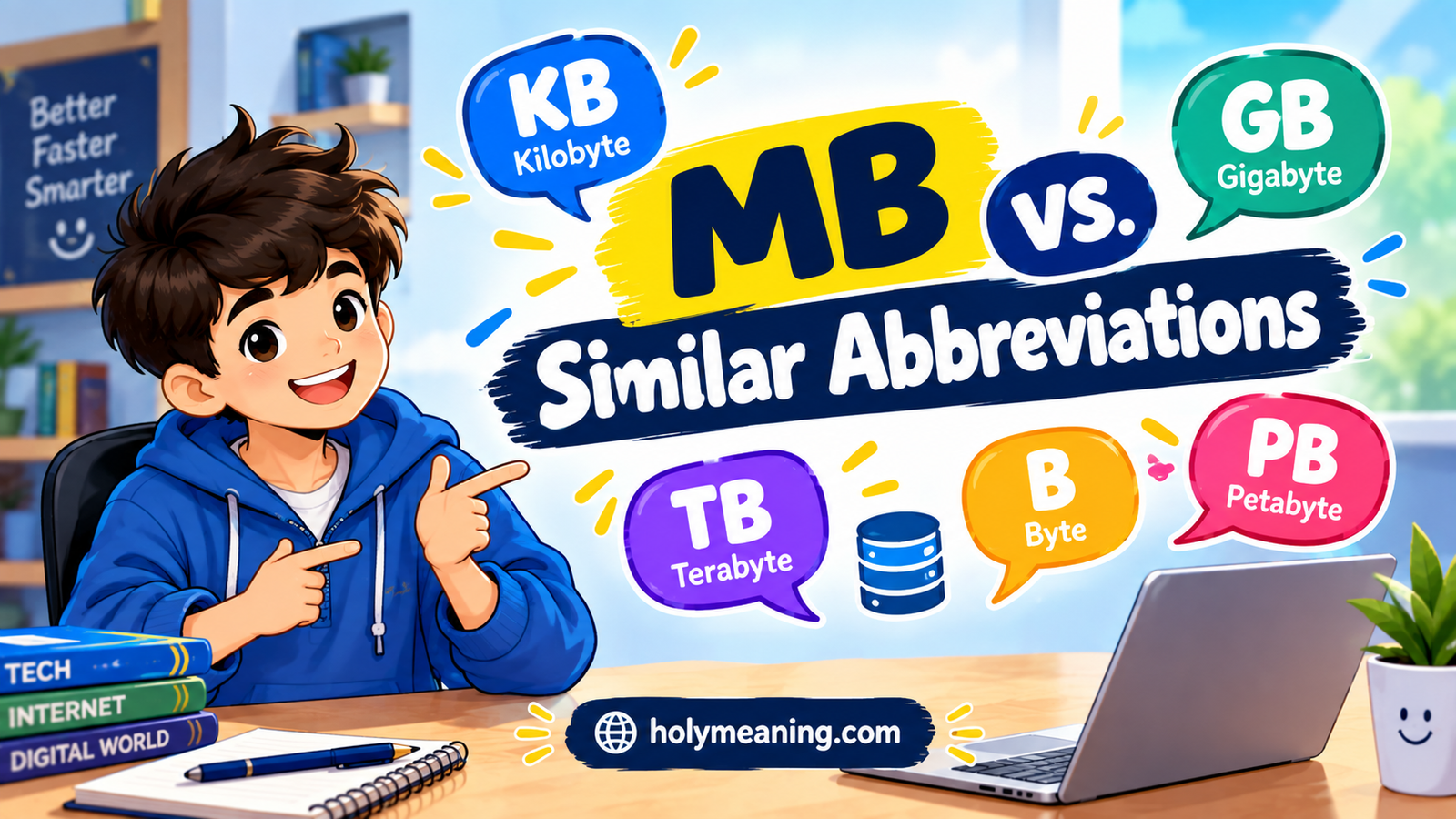
MB vs. GB vs. KB — Quick Reference
Storage units scale up in a pretty consistent way, and once you see them side by side, the whole system clicks:
| Unit | Abbreviation | Size | Common Use |
|---|---|---|---|
| Kilobyte | KB | ~1,000 bytes | Short text files, tiny icons |
| Megabyte | MB | ~1,000 KB | Photos, songs, PDFs |
| Gigabyte | GB | ~1,000 MB | HD movies, apps, phone storage |
| Terabyte | TB | ~1,000 GB | External hard drives, large backups |
Each step up is roughly 1,000 times bigger than the one before it. That jump is why a movie file (measured in GB) is so much larger than a text document (measured in KB).
Real-World File Size Examples
Numbers on a chart only mean so much until you connect them to things you actually use. Here’s roughly what different file types weigh in at:
- A text message: under 1 KB
- A basic Word document: 20–100 KB
- A high-resolution smartphone photo: 2–8 MB
- An MP3 song: 3–5 MB
- A short smartphone video (1–2 minutes): 50–150 MB
- A full HD movie download: 1.5–4 GB
- A modern video game install: 30–150 GB
This is why sending a quick photo over text barely makes a dent in your data plan, but streaming or downloading video eats through it fast. File size adds up quickly once video enters the picture.
MB vs. Mb — Don’t Mix These Up
This one trips up more people than it should, and it’s a genuinely important distinction if you’re shopping for internet plans or troubleshooting slow downloads. Here’s the difference between MB vs Mb:
- MB (capital B) = Megabyte, used for file size and storage
- Mb (lowercase b) = Megabit, used for internet speed and data transfer
There are 8 bits in a byte, which means 1 megabyte equals 8 megabits. So when your internet provider advertises “100 Mbps” (megabits per second), your actual download speed in megabytes per second is closer to 12.5 MB/s, not 100. This single letter-case difference explains why your download speed always looks slower than the number on your internet bill, and it’s a genuinely useful thing to understand next time you’re comparing plans or wondering why a “fast” connection doesn’t feel that fast.
Quick memory trick: capital B is Bigger (byte), lowercase b is smaller (bit). Eight bits make one byte, so megabits will always be a smaller number’s worth of data than megabytes for the same amount of actual information.
Why This Distinction Actually Costs You Money
This isn’t just trivia. Internet providers advertise speeds in megabits because the number looks bigger and more impressive on a billboard or a bill. A plan advertised as “500 Mb” sounds a lot faster than the roughly 62.5 MB per second you’d actually get when downloading a file, even though it’s the exact same connection. Understanding MB vs Mb means you can actually compare plans accurately instead of assuming a bigger advertised number always means a meaningfully faster download experience. Streaming services, cloud backup tools, and file-sharing apps all report speeds differently depending on which one they’re measuring, so this single letter-case rule is worth committing to memory.
“MB” in Medical and Scientific Contexts
Step into a hospital, a lab report, or a science classroom, and mb in medical context or academic settings takes on an entirely different life. None of these meanings have anything to do with texting slang or tech storage, so if you’ve spotted “MB” on a medical form, this is the section for you.
CK-MB: A Cardiac Biomarker That Saves Lives
CK-MB stands for creatine kinase-MB, and it’s a specific enzyme that doctors test for when they suspect someone’s had a heart attack. This cardiac biomarker rises in the bloodstream when heart muscle gets damaged, which makes it a useful piece of evidence alongside other tests like troponin levels.
Here’s why it matters: CK-MB isn’t the only marker doctors look at anymore, since troponin tests have largely become the gold standard for diagnosing heart attacks in emergency settings. But CK-MB still gets used in specific situations, particularly when doctors want to track whether a heart attack is recent or ongoing, since CK-MB levels rise and fall on a more predictable timeline than troponin. If you’ve ever had bloodwork done after chest pain or heart-related symptoms, there’s a real chance CK-MB was part of that laboratory test panel.
A typical CK-MB reading gets interpreted alongside a reference range, and results outside that range prompt further testing rather than an immediate diagnosis on their own. Doctors usually order it more than once over several hours, since tracking how the level changes over time tells them more than a single snapshot ever could. As one common way doctors explain it to patients: a single high number raises a question, but a rising pattern across multiple tests gives a much clearer answer.
MB as Myoglobin
Myoglobin, sometimes abbreviated as MB in lab contexts, is a protein found in heart and skeletal muscle tissue. Like CK-MB, it gets released into the bloodstream when muscle tissue is damaged, which makes it another early indicator doctors sometimes check for after a suspected heart attack or significant muscle injury. It rises faster than CK-MB and troponin after an injury, but it’s less specific to the heart alone since skeletal muscle damage can raise it too. That’s why it’s typically used alongside other tests, rather than on its own, as part of a broader medical abbreviation picture doctors piece together.
Maxwell-Boltzmann Distribution in Physics
Switch gears entirely, and you’ll find MB showing up in physics and chemistry classrooms as shorthand for the Maxwell-Boltzmann distribution. This is a statistical model that describes the range of speeds particles move at within a gas, based on temperature. It’s a foundational concept in thermodynamics and kinetic theory, and students studying chemistry or physics will run into “MB distribution” constantly in textbooks and lecture notes. It has zero connection to texting slang, medical tests, or file sizes, it just happens to share the same two letters.
Millibar in Meteorology
If you’ve ever watched a weather report during hurricane season, you’ve probably heard millibar mentioned, often abbreviated as MB (or sometimes mbar). A millibar measures atmospheric pressure, and it’s a key number meteorologists track when predicting storm intensity. Lower pressure readings, measured in MB, generally signal stronger storms, which is why you’ll hear a hurricane’s central pressure reported in millibars right alongside its wind speed. A major hurricane might register a central pressure in the low 900s MB, while typical sea-level pressure on a calm day sits closer to 1013 MB, giving you a quick sense of just how dramatic that pressure drop really is during a severe storm.
Other Real Meanings of “MB”
A handful of other legitimate meanings round out this list, and while they’re less common in everyday conversation, they’re worth knowing so you’re not caught off guard.
- Manitoba: the two-letter postal abbreviation for the Canadian province of Manitoba, used constantly in shipping addresses, business filings, and Canadian government paperwork.
- Master’s-level business shorthand: in some professional bios or LinkedIn-style summaries, MB can appear as informal shorthand tied to business degrees or titles, though this is far less standardized than something like an MBA and usually needs surrounding context to make sense.
- Gaming and niche community use: in some gaming communities, MB can refer to specific in-game terms or clan tags, though these meanings are usually hyper-specific to that community and won’t translate anywhere else.
None of these are as common as “my bad” or “megabyte,” but they’re real enough that you might run into them depending on where you spend your time online.
“MB” in Dating Apps and Flirty Texting
Dating app conversations move fast, and small mistakes happen constantly, wrong matches, autocorrect fails, forgetting who said what. In this world, mb shows up almost exactly the way it does in regular texting, but the stakes feel a little different since first impressions matter more.
When It Shows Up
You’ll typically see “mb” on dating apps in situations like:
- Accidentally sending a message meant for a different match
- Taking a while to respond and wanting to smooth it over quickly
- Misreading a joke or comment and course-correcting
Since dating conversations are still relatively new and a little more delicate than chats with old friends, “mb” works well as a light, low-effort way to move past a small stumble without making the moment awkward.
How to Use MB Without Killing the Vibe
The key is proportion. A quick “mb” after a small mix-up keeps things breezy, but leaning on it too often can make you seem careless or disengaged. If you’re genuinely interested in someone, save the effort for a slightly warmer follow-up after the “mb,” something like “mb, got distracted, but I’m back — what were you saying about that trip?” This keeps the casual tone while showing you’re actually paying attention.
How to Tell Which “MB” Someone Means
By now you’ve seen how wildly different these meanings can be, so how do you actually figure out which one applies in the moment? Run through this quick context clues checklist:
- Who sent it? A friend, a doctor, a coworker, or a stranger online all point toward different meanings.
- What platform is it on? Texting and social media almost always mean “my bad.” A lab report or weather app means something else entirely.
- What came right before it? Look at the sentence or conversation leading up to the abbreviation. Mistakes, mix-ups, and casual tone point to “my bad.” Numbers, measurements, or technical terms point to megabyte, millibar, or a medical term.
- Is it capitalized? MB versus Mb matters specifically in tech contexts involving file size or internet speed.
- Does it stand alone or come with numbers? “2 MB” is almost certainly a file size. A lone “mb” with no numbers nearby is almost always “my bad.”
Running through these five questions takes about two seconds once it becomes habit, and it’ll save you from any awkward misunderstandings.
How to Respond to “MB”
Once you’ve confirmed someone’s using the “my bad” meaning, responding is simple, and honestly, most of the time you don’t even need to say much. Here are a few natural options depending on the situation:
- For a tiny, forgettable mistake: “all good” or “no worries” does the job.
- For something slightly more annoying but still minor: “haha it’s fine, just don’t do it again 😂” keeps things light while still acknowledging the hiccup.
- For a mistake that actually affected you: it’s okay to say so. Something like “it’s fine, just wish I’d known earlier” is honest without being harsh, and it signals that “mb” alone doesn’t fully cover it if the mistake had real consequences.
The goal is matching your response to the actual size of the mistake, not just mirroring the same casual energy back every time.
“MB” vs. Similar Abbreviations
Texting shorthand is full of overlapping, similar-sounding abbreviations, and it helps to see how “mb” stacks up against its closest relatives:
| Abbreviation | Meaning | Tone |
|---|---|---|
| MB | My bad | Casual, small mistake |
| MY B | My bad (alternate spelling) | Identical meaning, just spelled out slightly differently |
| NP | No problem | Response to an apology or thanks |
| IMO | In my opinion | Adding a personal take |
| SRY | Sorry | More direct apology than “mb” |
| OOPS | Mistake acknowledgment | Similar tone to “mb,” slightly more expressive |
“MY B” deserves a quick mention since it’s essentially identical to “mb,” just written with a space and stylized slightly differently. Both mean the exact same thing, and which one someone uses usually just comes down to personal texting habits.
FAQs
Is “mb” the same as “my bad” in every text message?
In casual texting and social media, yes, it almost always means “my bad.” Context still matters if numbers or technical terms surround it.
Does capitalization change what “mb” means?
Yes. Lowercase “mb” in a text usually means “my bad,” while “MB” (capital B) in tech contexts refers to megabyte, a unit of file size.
What’s the difference between MB and Mb when talking about internet speed?
MB (megabyte) measures file size and storage, while Mb (megabit) measures internet speed. There are 8 megabits in every megabyte, so a “500 Mb” plan delivers roughly 62.5 MB per second.
Is “mb” still commonly used in 2026, or has it faded out?
It’s still widely used, especially among younger texters on Instagram, Snapchat, and TikTok, though newer slang terms sometimes get mixed in alongside it depending on the platform and age group.
Can “mb” mean something medical or scientific outside of texting?
Yes. In healthcare, MB can refer to CK-MB (a cardiac enzyme test) or myoglobin, both used in diagnosing heart-related issues through bloodwork.
conclusion
So, what does “mb” mean in text? Most of the time, it’s just “my bad.” It’s quick. It’s casual. It smooths over small mistakes without any fuss. You’ll see it everywhere, from Snapchat to group chats.
But don’t stop there. The meaning of “mb” in text can shift fast. It might mean megabyte, millibar, or even a medical term. Always check the context first. Look at who sent it and where. Once you know the setting, the real meaning becomes obvious every time.









1 thought on “What Does “MB” Mean in Text? A Complete Guide to Its Uses and Interpretations”