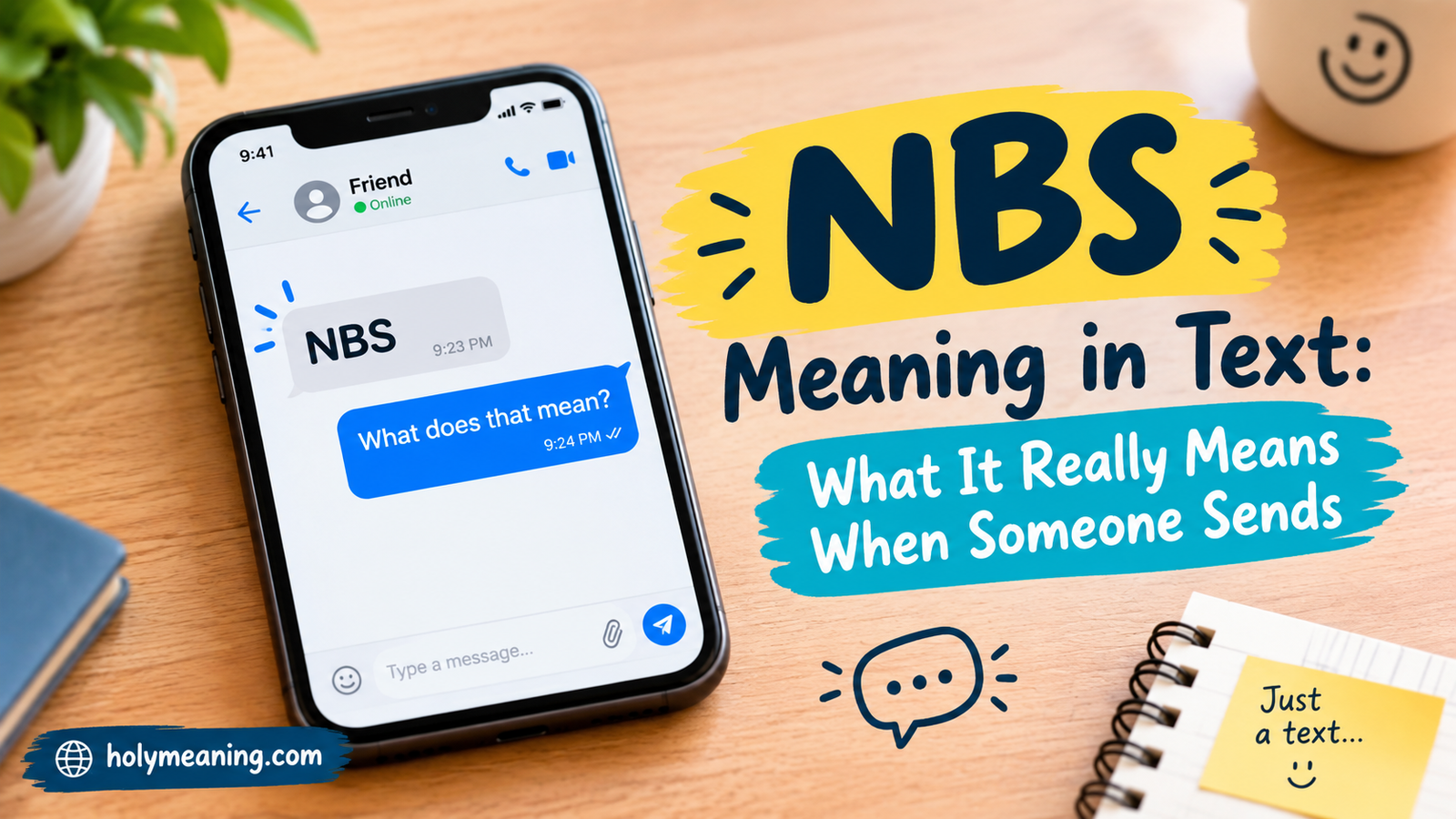
NBS meaning in text comes down to one simple phrase: no bullshit. It’s texting slang people use to flag that a message is completely honest, direct, and free of exaggeration or sugarcoating.
Picture this: a text lands, three letters deep, and suddenly the whole conversation feels more real. That’s the quiet power of NBS — it turns an ordinary sentence into something you can actually trust.
Unlike most internet acronyms, NBS has barely changed meaning in over two decades. From old-school forums to today’s group chats, dating apps, and TikTok comments, it’s stayed the same reliable signal of sincerity worth understanding.
Quick Answer: What Does NBS Mean in Text
NBS means “no bullshit.” It’s a piece of texting slang used to signal honesty, sincerity, or seriousness. When someone types NBS, they’re telling you: I’m not exaggerating, I’m not joking, and I mean every word of this.
Here’s the quickest way to understand the NBS meaning texting carries:
| Element | Detail |
|---|---|
| Full phrase | No bullshit |
| Tone | Sincere, direct, sometimes blunt |
| Primary use | Emphasizing honesty or seriousness |
| Common placement | Start or end of a sentence |
| Typical senders | Friends, gamers, daters, social media users |
A simple example: “You looked really good today, NBS.” That single tag turns a casual compliment into something the sender wants you to take at face value — no hidden agenda, no flattery for flattery’s sake.
Why NBS Confuses People More Than Other Texting Abbreviations
Not all texting abbreviations are created equal. Some practically explain themselves. Say “LOL” out loud, and you’re already halfway to “laugh out loud.” Same with BRB, or TTYL. Your brain fills in the blank almost instantly.
NBS doesn’t work that way. Say it out loud — “en-bee-ess” — and nothing clicks. There’s no obvious phonetic bridge to “no bullshit,” which means people either guess wrong or give up and Google it. That’s the first reason this NBS abbreviation trips people up.
The second reason is messier: bad information. A handful of low-effort slang websites have started listing NBS as short for “No Biggie, Seriously” or “Nothing But Serious.” Neither of those shows up in any long-standing internet slang archive, and neither matches how people actually use the term in real conversations. They’re guesses dressed up as definitions.
Why this matters: If you take those secondhand guesses at face value, you can misread an entire message. Treating “NBS, I love your work” as no biggie, seriously flattens what was meant to be a heartfelt compliment. Read the wrong definition, and you’ll miss the emotional weight the sender was trying to add.
This is exactly why getting the NBS definition right isn’t just trivia. It changes how you interpret tone, intent, and sincerity in a conversation — three things that are already hard to read over text without a voice or a face attached to them.
Where NBS Came From
NBS isn’t a brand-new invention from TikTok or Gen Z Discord servers, even though that’s where a lot of people first encounter it. The acronym has roots that stretch back much further, into older internet and hacker-forum culture, where no bullshit got shortened for speed in text-based communication long before smartphones existed.
Back then, message space and typing speed actually mattered. Dial-up connections were slow, keyboards weren’t optimized for thumbs, and forum culture rewarded people who could say something efficiently. Acronyms weren’t just style — they were practical. NBS fit right into that world alongside other clipped, no-nonsense abbreviations that valued getting to the point over sounding polished.
Here’s a rough timeline of how the term evolved:
- Early internet forums and IRC chats (1990s): NBS circulated as quick shorthand among tech-savvy users who valued brevity and directness. It sat alongside other early acronyms in a culture that treated abbreviation as a kind of dialect.
- Early-to-mid 2000s instant messaging: The abbreviation carried over into AIM, MSN Messenger, and similar platforms as texting culture picked up speed and moved from desktop chat rooms into everyday teenage and young-adult conversation.
- Late 2000s to early 2010s SMS boom: As flip phones and early smartphones made texting a daily habit rather than an occasional one, character limits gave abbreviations like NBS a second practical reason to stick around.
- 2010s smartphone texting culture: SMS and group chats gave NBS a steady presence, especially among users who grew up treating abbreviated chat abbreviations as a first language rather than a shortcut they had to learn.
- Recent resurgence via TikTok and short-form video: Creators and commenters brought NBS back into heavy rotation, often pairing it with confessions, opinions, or reaction videos where a caption needs to land fast and land hard.
What’s genuinely interesting about NBS, compared to most internet slang, is how stable its meaning has stayed. Words like “sus” or “cap” have drifted, been reinterpreted, or picked up new layers of meaning as they moved through different online communities — “cap,” for instance, has shifted registers multiple times depending on the platform and generation using it. NBS hasn’t done that. The core idea — honesty, stated plainly — has held steady across roughly two decades of internet culture.
That consistency matters for a practical reason: it means you can trust the definition once you learn it. You won’t need to re-learn NBS in two years the way you might have to re-learn a term that’s still actively shifting meaning across platforms.
A Brief Note on Why Some Slang Sticks and Some Doesn’t
Linguists who study internet slang definition patterns often point out that terms tied to a single, useful function — rather than group identity or humor — tend to survive longer with their meaning intact. NBS is a good example. It doesn’t signal belonging to a particular online subculture the way some slang does. It just does one job: flag sincerity. Because that job hasn’t changed, the word hasn’t needed to change either.
Where You’ll Actually See NBS Today
The NBS meaning slang carries doesn’t change much across platforms, but how it gets used absolutely does. Context shapes tone, and tone shapes whether NBS reads as sincere, playful, or a little too intense.
Text Messages and Mobile Chat
This is home base for NBS. In one-on-one texting or group chats, it typically shows up attached to a personal opinion, a compliment, or a confession. Because texting between friends already assumes a casual register, NBS tends to land softer here than almost anywhere else.
Example: “NBS, that was the best meal I’ve had all year.”
Gaming Chats
In Discord servers and in-match chat, NBS often follows a bold claim or a moment of genuine surprise. Gamers use it to separate real talk from trash talk — two things that, in competitive gaming spaces, sound almost identical without a clear signal.
Example: “NBS, that clutch play was actually insane.”
Dating Apps and Dating Chat
NBS meaning dating contexts is where the term carries the most emotional weight. Early-stage dating conversations are full of guesswork about whether someone’s being genuine, so NBS acts as a verbal (well, textual) underline. It tells the other person: I’m not playing games with you right now.
Example: “NBS, I don’t usually feel this comfortable talking to someone this fast.”
Work Chats and Professional Settings
This is where NBS gets risky. Professional writing and workplace messaging generally expect a polished, filtered tone, and NBS — along with the word it stands for — doesn’t fit that mold. Even in relaxed workplace Slack channels, it can read as unprofessional or, worse, mildly confrontational.
Social Media
On platforms like Instagram, TikTok, and X, NBS shows up in comments and captions to stamp a strong opinion as genuine rather than performative. It’s a small way of saying “this isn’t just content, this is how I actually feel.”
Video captions are a particularly common home for it. A creator might post a vulnerable story and caption it “NBS, this was the hardest year of my life,” using the tag to preempt any assumption that the post is exaggerated for views. In comment sections, NBS often follows a strong take on someone else’s post — a way of backing an opinion without writing three extra sentences to justify it.
Snapchat and Ephemeral Messaging
Worth a separate mention: on platforms where messages disappear, like Snapchat, NBS tends to carry extra weight. Because the format already feels private and low-stakes, adding NBS on top of that signals the sender wants you to remember what they said even after the message vanishes. It’s less about volume of use and more about the specific moments people choose to deploy it.
A Quick Snapshot of Platform Tone
| Platform | Typical Tone of NBS |
|---|---|
| Texting / SMS | Warm, personal, often reassuring |
| Group chats | Playful but still sincere |
| Gaming chat (Discord, in-match) | Confident, competitive |
| Dating apps | Vulnerable, emotionally loaded |
| Work chat | Risky — generally best avoided |
| Social media captions | Declarative, sometimes dramatic |
| Snapchat / disappearing messages | Private, weighty despite the format |
This table is a useful reference if you’re ever unsure whether NBS fits the moment. As a rule of thumb: the more personal or emotionally charged the conversation, the more naturally NBS fits.
What NBS Changes in a Sentence
NBS doesn’t just add extra letters to a sentence. It changes how the entire sentence should be read. Compare these pairs:
| Without NBS | With NBS |
|---|---|
| “That’s a great idea.” | “That’s a great idea, NBS.” |
| “You did well today.” | “NBS, you did well today.” |
| “I’m not upset with you.” | “I’m not upset with you, NBS.” |
Notice what happens in each pair. The base sentence stays the same, but adding NBS strips away any possible sarcasm, hesitation, or social-nicety filler. It’s functioning as an emphasis marker — doing the same job as phrases like “for real,” “I mean it,” or “deadass.” The difference is efficiency: three letters do the work of an entire clause.
This is also why NBS tends to show up right before or right after the most important part of a message. Senders aren’t randomly sprinkling it in; they’re pointing at the one thing they most want you to believe.
NBS Examples From Real Conversations
Reading definitions only gets you so far. Seeing NBS in real conversations makes the pattern click. Here’s a table of message examples across different contexts, along with what the tag is actually signaling in each one.
| Message | What NBS Signals Here |
|---|---|
| “NBS, you’re one of the smartest people I know.” | A sincere compliment, not flattery |
| “That test was brutal, NBS.” | Genuine frustration, not exaggeration |
| “NBS, I think you should apply for that job.” | Honest encouragement, not politeness |
| “I don’t think this is working out, NBS.” | A difficult truth, stated without softening |
| “NBS, that goal was the cleanest thing I’ve seen all season.” | Real admiration in a gaming or sports context |
| “NBS, I’ve been thinking about you all day.” | An earnest, vulnerable dating message |
Notice how the tag shifts weight depending on what surrounds it. Attached to a compliment, NBS reads warm. Attached to bad news, it reads sobering. The word itself doesn’t change — the emotional temperature around it does.
Case Study: Same Word, Three Different Chats
To really see how much context shapes the NBS meaning in text, look at how the exact same three letters land across three separate conversations.
Conversation 1 — Two friends texting after a rough week:
“Hey, I know things have been hard lately. NBS, you’re handling it better than you think.”
Here, NBS softens the delivery of encouragement. It reassures the recipient that the compliment isn’t just something friends say out of obligation.
Conversation 2 — A gaming Discord after a close match:
“NBS that ranked game was the closest one we’ve played all season.”
In this setting, NBS reads competitive and energized. It’s less about emotional vulnerability and more about validating a genuinely impressive moment.
Conversation 3 — Early texting between two people on a dating app:
“I don’t usually open up this fast, NBS.”
Here, the same three letters carry the most emotional risk of the three examples. The sender is signaling vulnerability and asking, implicitly, to be taken seriously rather than brushed off.
Same acronym, same definition, three completely different emotional registers. That’s the core skill in reading NBS correctly: the word tells you the sender is being honest, but the surrounding context tells you what kind of honesty you’re dealing with.
Common Mistakes About NBS
Even once you know the basic definition, there are a handful of common mistakes that trip people up. Here’s what to watch for.
Mistake 1: Assuming It Means “No Biggie, Seriously”
This is the single most common usage error floating around online, and it’s worth repeating: that definition doesn’t come from any credible slang source. If you take it at face value, you’ll misread the intensity of a message. “No biggie, seriously” softens a statement. “No bullshit” reinforces it. Those two readings point in opposite directions.
Mistake 2: Using It in Professional Chat
Dropping NBS into a work email or a formal Slack message can land badly. Even if your workplace culture is fairly casual, the underlying phrase — bullshit — isn’t something most colleagues or managers expect to see spelled out, even abbreviated. If you want the same effect in professional writing, swap it for something neutral: “genuinely,” “honestly,” or “to be direct.”
Mistake 3: Reading It as Automatically Aggressive
Because NBS is blunt by design, some readers assume it always carries an edge. That’s not accurate. Context does most of the work here. “NBS, I’m proud of you” isn’t aggressive at all — it’s tender. The word choice is direct, but directness and hostility aren’t the same thing.
Mistake 4: Confusing It With Unrelated NBS Meanings
NBS isn’t exclusively slang. It’s also a real abbreviation in non-slang contexts, and mixing those up causes genuine confusion outside of casual chat. More on this in the section below.
Mistake 5: Overusing It
Like any emphasis marker, NBS loses power the more often you use it. If every third message ends in NBS, the tag stops meaning “this one’s important” and starts meaning nothing at all. Save it for moments that actually call for it.
This is the same phenomenon linguists sometimes call “emphasis inflation.” Think about how the word “literally” has been used so often as filler that it’s lost most of its original meaning of exactly, precisely, without exaggeration. NBS can suffer the same fate if it’s dropped into every other sentence rather than reserved for genuinely important moments.
A Few More Small Missteps Worth Knowing
Beyond the five core mistakes above, a couple of smaller usage errors show up often enough to mention:
- Pairing it with obvious sarcasm. Writing “NBS, sure, I totally believe you” cancels itself out — the sarcasm and the honesty marker send opposite signals at once, which just confuses the reader.
- Using it to soften genuinely harsh criticism. NBS signals honesty, not tact. Tacking it onto an unkind comment doesn’t make the comment land more gently; it just confirms the sender meant every word.
- Assuming everyone knows it. Not every reader — especially outside of texting-heavy age groups — will immediately recognize the NBS acronym. If you’re texting someone unfamiliar with current texting slang, it might be worth spelling it out the first time.
How to Reply When You Get an NBS
Getting an NBS text puts a small amount of pressure on your response — the sender just told you they meant something sincerely, so a flippant reply can feel dismissive. Here’s how to match the tone depending on what kind of NBS you received.
If It’s a Compliment or Reassurance
Match sincerity with sincerity. Don’t deflect with a joke unless the conversation’s overall tone has been playful throughout.
- “That means a lot, thank you.”
- “NBS back at you — I mean that too.”
- “I really needed to hear that today.”
If It’s a Serious or Difficult Statement
Slow down before responding. An NBS attached to hard news or a tough opinion deserves acknowledgment before you jump to problem-solving or defense.
- “I appreciate you being straight with me.”
- “That’s hard to hear, but I’m glad you told me.”
- “Can we talk more about this when you have time?”
If It’s Used Playfully or Casually
Not every NBS carries deep emotional stakes. In gaming chats or lighthearted group texts, you can match the same energy.
- “NBS, that was actually impressive.”
- “Okay NBS, I didn’t expect that.”
- “Real talk, same.”
A General Rule for Replying
Across all three scenarios, one principle holds steady: don’t undercut sincerity with a joke unless the sender clearly wants that energy back. Reading the room — or in this case, the thread — matters more than picking the “correct” reply from a list. If you’re not sure how serious the NBS was meant to be, a short, genuine acknowledgment is almost always a safe choice.
How to Use NBS Yourself, the Right Way
If you’re thinking about adding NBS to your own texting slang vocabulary, a few guidelines will help it land the way you intend.
- Use it sparingly. Save it for statements you genuinely want someone to sit with, not every passing comment.
- Pair it with something specific. “NBS, you’re great” lands softer than “NBS, that thing you said to me last week actually changed how I think about this.” Specificity makes the honesty feel earned.
- Match your relationship with the recipient. NBS reads naturally between friends, casual acquaintances, or people you’re dating. It reads oddly in formal or unfamiliar relationships.
- Avoid it in writing meant to be reread later. Emails, official messages, and anything with a paper trail call for formal communication, not shorthand.
- Don’t use it to soften bad delivery. If a message is going to sting, NBS won’t cushion it — it’ll just confirm you meant to say it that way.
NBS vs Other Honesty Slang
NBS belongs to a small family of texting terms that all point at the same general idea — honesty, sincerity, and truthful communication — but each one carries a slightly different weight and rhythm.
| Term | Meaning | Intensity | Typical Context |
|---|---|---|---|
| NBS | No bullshit | Medium-high | Statements, compliments, confessions |
| No Cap | Not lying | Medium | Casual claims, bragging, opinions |
| For Real (FR) | I mean it | Medium | Reinforcing a statement |
| On God | I swear it’s true | High | Strong emphasis, often dramatic |
| TBH | To be honest | Low-medium | Softening an honest opinion |
| Deadass | Completely serious | High | Blunt, unfiltered statements |
A useful way to think about the differences: TBH is the gentlest of the group — it often precedes an opinion someone’s slightly nervous to share. No cap sits in the middle, mostly used to shut down doubt about whether something’s true. NBS and deadass sit closer together at the higher-intensity end, both signaling that the speaker wants zero ambiguity about their sincerity. On God is the most dramatic of the bunch, often used for effect as much as for actual emphasis.
Knowing where NBS sits on this spectrum helps you calibrate how seriously to take it relative to similar honesty slang you might already recognize.
Other Meanings of NBS
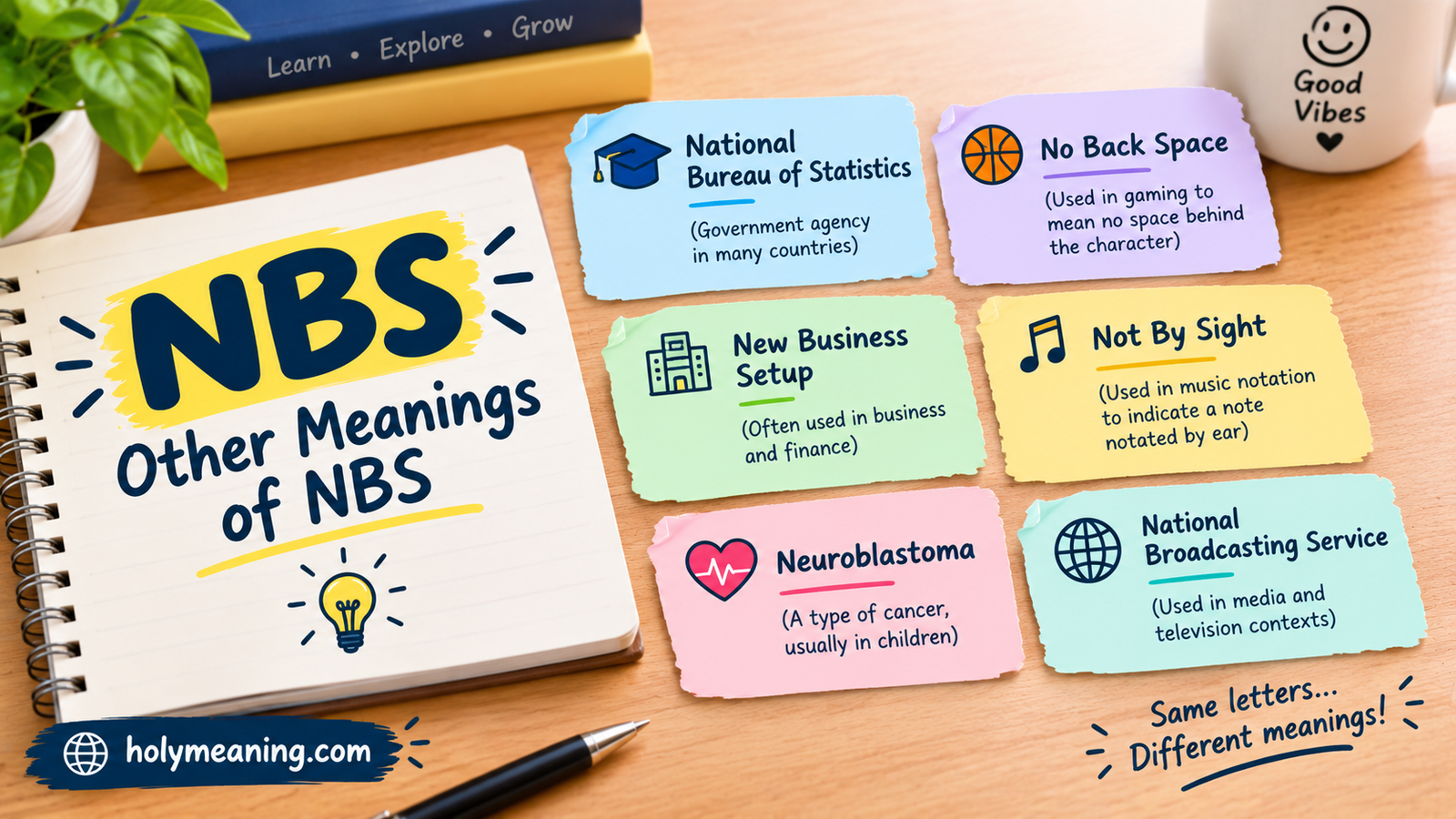
Slang isn’t the only place NBS shows up. Outside of texting and social media, the same three letters point to entirely different things — and mixing them up in the wrong setting causes real usage errors, especially in written or professional contexts.
- National Bureau of Standards — the former name of what’s now the National Institute of Standards and Technology (NIST), a U.S. federal agency historically responsible for measurement standards and technology research. You can read more about the agency’s history on NIST’s official site.
- National Bank Surveillance System — a monitoring framework used in banking oversight.
- Naive Bayes (Statistics) — occasionally abbreviated informally in technical shorthand, though “NB” is more common.
- Nominal Bore — a pipe-sizing term used in engineering and manufacturing.
None of these alternate meanings show up in casual texting, so context almost always makes the intended meaning obvious. If you’re reading a government document, a banking report, or an engineering spec, NBS isn’t slang — full stop. If you’re reading a text message, a Discord comment, or a TikTok caption, it’s almost certainly no bullshit.
It’s worth noting that acronym overlap like this is extremely common in English. Short combinations of letters get reused across completely unrelated fields simply because there are only so many three-letter combinations available, and different industries develop their shorthand independently. The National Bureau of Standards, for example, existed long before texting culture gave NBS a second, unrelated life — the two meanings developed in entirely separate worlds and never really cross paths outside of the occasional confused Google search.
If you ever land on a search result about NBS that talks about metrology, banking regulation, or federal agencies when you were expecting texting slang, that mismatch is exactly why: you’ve stumbled into one of these non-slang meanings instead of the casual chat definition this guide focuses on.
FAQs
Is NBS still commonly used in 2026?
Yes, it’s seen a strong resurgence through TikTok, Discord, and everyday texting. It remains one of the more consistent slang terms, holding its “no bullshit” meaning without drifting like other internet slang.
What does NBS mean in a dating chat?
It signals genuine honesty or vulnerability, often used when someone wants their message taken seriously rather than as a casual line.
Is NBS appropriate for work chats?
Generally, no. Even in relaxed workplace messaging, it’s better to use “honestly” or “genuinely” instead of NBS.
Does NBS mean the same thing as “no cap”?
They’re related but not identical. “No cap” mainly counters doubt (“I’m not lying”), while NBS leans more direct and slightly more serious in tone.
Can NBS mean something other than slang?
Yes. Outside of texting, NBS can stand for the National Bureau of Standards (now NIST) or the National Bank Surveillance System, depending on context.
conclusion
So that’s the NBS meaning in a nutshell. It stands for “no bullshit.” People use it to show they’re being honest. No games. No sugarcoating. Just the truth.
Next time you see NBS in a text, you’ll know exactly what it means. Read the context around it. Match the tone in your reply. Understanding the NBS meaning helps you catch real emotion in every chat, dating message, or gaming thread. It’s a small word with a big impact.