YK meaning is simple: it stands for “you know.” People type this two-letter chat abbreviation in texts, DMs, and comments to check understanding, assume shared context, or fill a quiet beat.
Two tiny letters can flip a whole message. One “yk” sounds warm. Another sounds vague. A third can sink a work email. Get it wrong and the chat gets awkward fast.
Linguists call the spoken version a discourse marker and tie it to thoughtful speech. Tone, punctuation, and platform shape what it says. This guide covers its roots, real examples, dating app pitfalls, and the zipper brand YKK that trips people up.
Quick Answer: What Does YK Mean in Text?
YK means “you know.” This chat abbreviation lets a writer check in with the reader, assume shared understanding, or fill a beat mid-sentence. People type it in text messages, DMs, captions, and group chats.
- What it stands for: you know
- Where it shows up: casual texting, social media, group chats, dating conversations
- Where it doesn’t belong: professional emails and other formal communication
- What it isn’t: YKK, the zipper company
YK Meaning and Definition
The Core YK Definition: “You Know”
The YK abbreviation is a typed shortcut for “you know.” Some people write it as “y’know.” Others drop the apostrophe and keep it short.
Think of how you talk. You say “you know” all day without noticing. “It’s been a long week, you know.” Nobody expects an answer. The phrase just smooths the sentence.
YK in text works the same way. It carries the rhythm of spoken English into a screen. That’s why YK slang feels so natural in casual messages. It reads like a person talking rather than a person typing.
ALSO READ:https://holymeaning.com/wtm-meaning-in-text/
Three Jobs YK Does in Conversation
YK meaning in chats shifts with context. Still, the abbreviation usually does one of three jobs.
| Job | What it does | Example |
|---|---|---|
| Checking in | Asks whether the reader follows | “It’s kind of a weird plan, yk?” |
| Assuming shared context | Signals both people already understand | “Same old Monday, yk.” |
| Filling a beat | Softens or pauses a sentence | “I was, yk, kind of tired.” |
Research backs this split. A Pacific Standard summary of language studies notes that speakers use “you know” to ask listeners to make inferences. Other studies suggest it confirms that the listener understands. The written version keeps both jobs.
How Tone and Punctuation Change the YK Text Meaning
The letters never change. The punctuation around them does. That’s the whole trick behind YK text meaning.
| Form | Example | How it reads |
|---|---|---|
| “yk?” | “That was awkward, yk?” | Friendly check-in; invites a reply |
| “yk.” or “yk” | “That was awkward, yk.” | Assumes you agree; no reply needed |
| Mid-sentence | “It was, yk, kind of weird.” | Hedge or pause |
| “yk yk” | “It’s fine, yk yk.” | Emphasis or playful brush-off |
| “YK” in caps | “It’s just SO tiring, YK.” | Stronger emotion |
YK as a Statement vs. YK as a Question
A question mark turns YK into a soft prompt. “Long day, yk?” quietly asks, “Am I right?” The other person usually answers with “yeah” or “totally.”
Without the question mark, YK works like a shrug. The writer assumes you get it. Answering is optional.
Mid-Sentence YK vs. End-of-Sentence YK
Placement matters just as much as punctuation. When YK sits at the end, it acts as a check-in or a wrap-up. When it sits in the middle, it works as a verbal filler, the written version of a small pause.
Compare these two lines:
- “I’m just tired, yk?” (checks for agreement)
- “I’m just, yk, tired.” (hesitates before the point)
Same letters. Different feel.
Spelling and Capitalization of YK
Every version carries the same meaning. “yk,” “Yk,” “YK,” and “y’know” all point to “you know.”
Lowercase reads as relaxed. All caps reads as louder or more dramatic. Treat that as a habit you’ll notice in informal texting, not a rule. Nobody enforces it.
Where YK Comes From: Spoken English to Texting Language
Roots in Spoken English and Conversational English
People said “you know” long before phones existed. Linguists call it a discourse marker. That’s a small word or phrase showing how one idea connects to the next. It can also reveal how the speaker feels about the idea.
The discourse marker overview lists common examples in the English language. These include “you know,” “actually,” “basically,” “like,” “I mean,” and “okay.” Scholars have studied them for decades. Deborah Schiffrin’s 1987 book Discourse Markers became a standard reference.
Researchers now tie these markers to jobs like changing topics, rephrasing, hedging, and stressing a point. They also help signal that the listener is still engaged.
The old view treated them as sloppy talk. That view has faded. An abstract from linguist Ludivine Crible, hosted by Bielefeld University, says of the “poor performance” label: “Those days are over.” Research shows these markers help speakers structure thoughts and help listeners follow them.
That’s the heritage behind YK. It’s everyday speech in short form.
Case Study: What Research Says About “You Know”
A University of Texas study offers the best real-world look at how people use words like “you know.” Researchers analyzed 263 transcripts of everyday conversations. Speakers ranged from 17 to 69 years old. Devices captured their speech as they went about daily life, so the talk was truly spontaneous.
The results, reported by HuffPost and The Swaddle, surprised some readers:
- People who used markers like “you know” and “I mean” scored as more conscientious.
- Discourse markers were more common among women, younger participants, and conscientious people.
- “Um” and “uh” behaved differently. Those fill pauses rather than send signals.
Cognitive neuroscientist Christian Jarrett, quoted in the HuffPost piece, called these fillers “a sign of more considered speech.”
The Swaddle adds a social angle. It notes that markers soften awkward moments. A decline wrapped in “um, well, you know, sorry” sounds kinder, and the article says it makes the refusal “much more polite.”
Takeaway: A verbal filler like “you know” isn’t lazy. It’s a tool for conversational English. YK inherits that tool.
How Texting Shorthand Took Shape
Character limits shaped texting language early on. The SMS standard capped messages at 160 characters. The first text message went out in December 1992. Twitter capped posts at 140 characters until it doubled the limit to 280 in 2017.
| Constraint | Effect on writing |
|---|---|
| 160-character SMS cap | Pushed people toward texting abbreviations |
| Small phone keyboards | Rewarded short words and fewer taps |
| 140-character early Twitter | Made brevity a habit on social networks |
Now for an honest note. No credible source pins down the first appearance of “yk.” Anyone claiming an exact date or platform is guessing. What’s clear is the pattern. Online shorthand shrinks phrases people already say all the time. “You know” is one of the most common.
How YK Spread Across Social Platforms
YK doesn’t belong to one app. Its meaning stays the same across online platforms. Only the tone shifts.
| Platform type | How YK tends to read |
|---|---|
| Text messages | Casual and friendly |
| Instagram and Snapchat DMs | Relaxed; often paired with emojis |
| TikTok and YouTube comments | Conversational; sometimes sarcastic |
| Discord and group chats | Quick filler between fast messages |
| Slack and Teams | Fine among peers; risky with clients |
Short-form social media rewards brevity. Two letters beat two words when you type on a phone. That’s why digital communication keeps favoring compact fillers.
How YK Is Used in Real Conversations
Real conversations happen in messy, quick bursts. YK fits that pace perfectly. Here’s how it plays out across different settings.
YK in Casual Texting Between Friends
Casual texting is YK’s home turf. Friends already share jokes, history, and context. So “yk” works as a nudge that says, “You get what I mean.”
Typical patterns:
- Venting: “Work was insane today, yk.”
- Confirming plans: “We’re meeting at 7, yk?”
- Softening a complaint: “I’m not mad, yk, just tired.”
Since friends know each other’s voices, YK rarely causes confusion. It just keeps the chat flowing.
YK on Social Media and Online Platforms
On social media, YK shows up in captions and replies. A caption like “Sunday reset, yk” sets a mood without explaining it. A comment like “this song hits different, yk” invites fans to agree.
Public posts add an audience. That changes the effect. In a caption, “yk” quietly says, “Those who get it, get it.” It builds a small sense of belonging among followers.
YK in Group Chats and Gaming
Group chats move fast. Messages stack up. In that setting, YK acts as a quick rhythm marker. “That last round was rough, yk” fits neatly between longer messages.
Gaming chats often run even faster. Players type between actions. A two-letter filler costs almost nothing. That efficiency explains why chat slang lives happily in these spaces.
YK in Workplace Chats and Office Messaging
Workplace chats sit in a gray zone. Many teams use Slack, Teams, or similar tools in a casual tone. Among peers, a “yk” is usually harmless. “Meeting ran long, yk” won’t raise eyebrows.
The risk climbs with distance. Clients, executives, and new colleagues expect professional communication. In work messages aimed at them, workplace texting habits can seem careless. When in doubt, spell it out.
Quick rule: If you’d say “you know” out loud to that person in a meeting, you can type “yk.” If you’d feel awkward saying it, skip it.
Texting Examples and Chat Examples of YK
Seeing YK in action clears up most questions. These texting examples and chat examples are illustrative. They show typical patterns rather than quoting real users.
Text Message Examples
| Message | What it means | Best reply |
|---|---|---|
| “Traffic was horrible, yk?” | Looking for sympathy | “Ugh, yes. Worst commute.” |
| “I’m not really in the mood, yk.” | Assumes you’ll understand | “All good. Rain check?” |
| “We should get food, yk, somewhere cheap.” | Casual suggestion | “Yes. Tacos?” |
| “It’s giving Monday, yk.” | Shared joke | “Totally.” |
| “I told her already, yk?” | Seeking backup | “Yep, you did.” |
Comment Section Examples
Public comments lean shorter and punchier.
- “That ending, yk.” (shared reaction to a video)
- “Best coffee shop in town, yk?” (invites agreement)
- “Not gonna lie, yk, I cried.” (a hedge before an admission)
Notice the pattern. In every case, YK creates a small handshake between writer and reader.
YK on Dating Apps
Dating apps put every word under a microscope. Tiny cues carry extra weight. So YK deserves a closer look here.
What YK Signals in Dating Conversations
In dating conversations, YK signals ease. The writer sounds relaxed and assumes you’re on the same wavelength. That can feel flirty and warm.
It can also create distance if the message stays vague. “You’re cool, yk” says little. The reader has to guess what “yk” points to.
Treat this as a reading of dating slang and habits, not a rulebook. Each person interprets tone differently.
Example Dating Messages and Replies
Illustrative scenario: Two matches trade dating messages after a few days.
| Message | Tone | Possible reply |
|---|---|---|
| “I’m terrible at small talk, yk?” | Honest and disarming | “Same. Favorite dumb movie?” |
| “Long week, yk. Want to grab coffee Saturday?” | Casual invite | “Yes. Saturday works.” |
| “I’m kind of a homebody, yk.” | Sharing a trait | “Perfect. I’ve got a great couch.” |
In each case, YK softens a personal detail. It signals comfort. That’s why it works well after a few messages of warm-up.
When YK Backfires in Online Dating
Online dating punishes vagueness. These patterns tend to backfire:
- Opening with it: “hey yk” gives the other person nothing to answer.
- Using it as the whole point: “you seem cool yk” feels empty.
- Stacking it: Three “yk”s in one app chat can read as filler with no substance.
- Using it to dodge: “I’m just busy, yk” can seem evasive.
Better approach: pair YK with something specific. “I’m terrible at small talk, yk. Ask me about hiking.” That gives the other person a hook.
Similar Slang Terms and Look-Alikes
YK has several relatives. Mixing them up causes language confusion. This table sorts out the similar slang terms.
| Term | Stands for | Example |
|---|---|---|
| YK | you know | “Long day, yk.” |
| YKW | you know what | “yk what? Let’s just go.” |
| YKWIM | you know what I mean | “It’s complicated, ykwim?” |
| IYKYK | if you know, you know | Caption on an inside joke |
| y’know | you know | “It’s, y’know, fine.” |
| YKK | Yoshida Kogyo Kabushikikaisha | Letters on a zipper |
YK vs. YKW and YKWIM
These three share a root. YK is the shortest and lightest. YKWIM adds “what I mean,” so it asks for agreement more directly. YKW starts a new thought (“you know what?”).
If you’re deciding which to use, the rule of thumb is simple. Use YK for a soft nudge. Use YKWIM when you really want confirmation.
YK vs. IYKYK
IYKYK means “if you know, you know.” It’s internet slang for an inside joke or shared knowledge that outsiders won’t get. YK is nothing like it. YK invites the reader in. IYKYK deliberately leaves some people out.
Some pages online write “IKYK” for this phrase. That looks like a usage error. The standard form is IYKYK.
YK vs. Other Verbal Fillers
Other slang expressions play in the same space but signal different attitudes.
| Term | Stands for | What it signals |
|---|---|---|
| ngl | not gonna lie | Honest admission |
| tbh | to be honest | Frank opinion |
| fr | for real | Agreement or emphasis |
| idk | I don’t know | Uncertainty |
| yk | you know | Shared understanding |
Only YK assumes the reader already gets it. The others frame the message. That difference makes YK the friendliest of the group.
ALSO READ:https://holymeaning.com/ptso-meaning/
Does YK Mean Anything Else?
“You’re Kidding”: A Rare, Context-Dependent Reading
A few pages claim YK can mean “you’re kidding.” That reading appears mostly on low-quality sites. No dictionary or major language source backs it.
Treat it as a rare guess. If someone replies “yk?” to shocking news, the context might suggest disbelief. Even then, you can just ask. A quick “wait, are you kidding?” clears things up.
Case Study: YK vs. YKK, the Zipper Giant
YKK is the clearest example of language confusion around this abbreviation. It isn’t slang at all.
| Fact | Detail |
|---|---|
| Full name | Yoshida Kogyo Kabushikikaisha |
| Founder | Tadao Yoshida |
| Founded | 1934 in Tokyo |
| Trademark | Adopted in 1946 |
| Current name | YKK Corporation, since 1994 |
| Market share | Roughly 45% of global zipper production |
| Revenue | ¥920.2 billion in fiscal 2023 |
| Employees | About 45,363 as of March 2024 |
The company’s name loosely translates to “Yoshida Company Limited.” HowStuffWorks reports that YKK produces more than 7 billion zippers, about half the world’s supply.
So if you see “YKK” on a jacket, nobody is asking whether you know something. It’s just a zipper brand. The extra K is the giveaway.
Common Mistakes With YK
Common mistakes with YK usually come from context, not the letters themselves. These texting mistakes and abbreviation mistakes show up again and again.
Assuming YK Always Means “You’re Kidding”
This is one of the top common misconceptions. The overwhelming default is “you know.” Start there. Only shift if context strongly suggests something else.
Confusing YK With YKW, YKWIM, or IYKYK
These are different shorthand terms. Mixing them up can change your message. Writing “IYKYK” when you mean “you know” would confuse readers. Match the term to your intent.
Using YK in Formal Writing or Professional Emails
This is the usage error with real consequences. Formal communication calls for full words. A YK in a proposal or resume can make you look careless. The next section covers safer alternatives.
Overusing YK Until It Loses Meaning
Too much of a good thing backfires. A message with four “yk”s reads like nervous stammering. Use it once per message at most.
Ignoring Age Differences in Texting Habits
Not everyone reads online slang the same way. Some readers find YK natural. Others find it confusing. Age differences in language habits are real, so know your audience.
YK in Formal Writing and Professional Communication
Formal writing follows different rules. The looseness that makes YK charming in a chat becomes a problem in a report.
Why YK Doesn’t Belong in Business Writing
Business writing prizes clarity. Readers scan professional emails quickly. Anything vague slows them down. “Yk” adds no information. It just gestures toward shared context the reader may not share.
Clients and executives also judge tone. A casual abbreviation can seem unpolished. In professional writing, precision earns trust.
Casual vs. Professional Rewrites
Swap YK for clearer wording in written English meant for work.
| Casual | Professional |
|---|---|
| “The deadline is tight, yk.” | “The deadline is tight.” |
| “Can you send that file, yk, the one from Monday?” | “Can you send Monday’s file?” |
| “yk what I mean?” | “Does that make sense?” |
| “It’s a lot, yk.” | “The workload is heavy this week.” |
Pro tip: Cut the filler first. Most sentences read better without it.
A Safe Middle Ground for Office Chats
Not every office chat needs stiff language. Among close teammates, a light tone builds rapport. A practical guideline:
- Fine: peer-to-peer chats, informal team channels
- Risky: messages to clients, leadership, or new hires
- Never: proposals, contracts, reports, resumes
How to Respond to YK
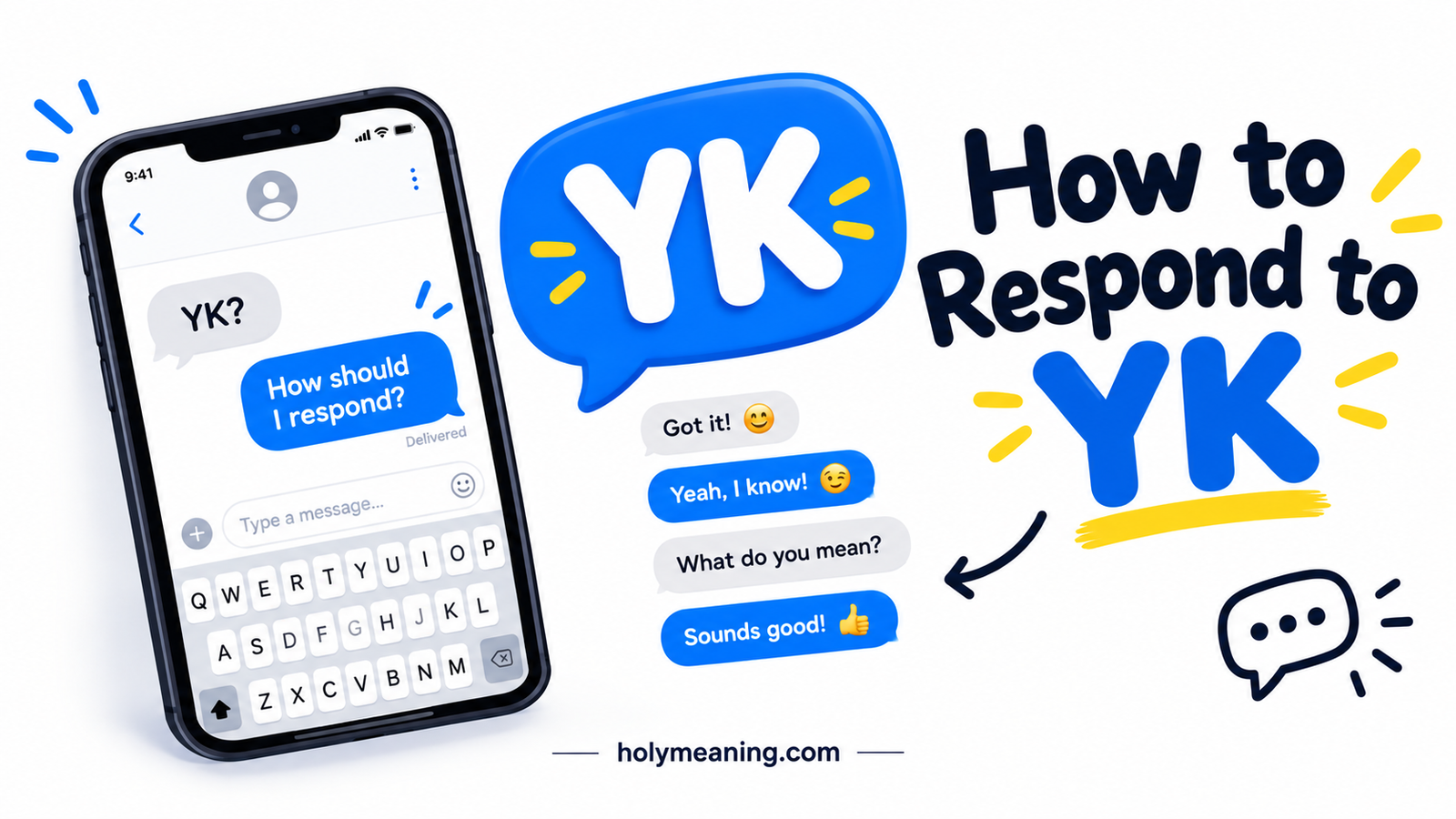
Replying to YK is easier than it looks. Most of the time, a short answer works.
Casual, Low-Effort Replies
When someone sends a rhetorical “yk,” a light response does the job.
- “Yeah, totally.”
- “For sure.”
- “I feel you.”
- “100%.”
Matching the Tone
Mirror the sender’s energy. If they type in lowercase with a relaxed vibe, keep yours relaxed. If they sound stressed, add warmth. “Ugh, that sounds rough” beats a one-word reply.
ALSO RAED:https://holymeaning.com/what-does-ts-mean-in-text-2/
When a Real Reply Is Expected vs. When It’s Just Filler
Look at the sentence around the abbreviation. It tells you what to do.
| What they sent | What they want | Your move |
|---|---|---|
| “Long day, yk.” | Acknowledgment | Short nod: “Same.” |
| “You coming Friday, yk?” | Actual answer | “Yes, I’ll be there.” |
| “It was, yk, weird.” | Nothing; filler | Respond to the point |
| “yk what I mean?” | Confirmation | “Yep” or ask a follow-up |
A Quick Response Cheat Sheet
- Agree: “Yep.” / “Totally.”
- Empathize: “That sounds exhausting.”
- Not sure: “Wait, what do you mean?”
- Move on: Answer the actual question in the message.
If you don’t understand the point, say so. Clarifying beats guessing.
Generational Use: Is YK Still Used in 2026?
Generational use shapes how people write. Language moves with age groups. YK still appears in daily texting language, though nobody publishes a precise usage count.
Gen Z, Millennials, and Age Differences
Researchers define generations by birth years. According to Pew Research Center, Millennials were born 1981 to 1996 and Gen Z 1997 to 2012.
| Generation | Birth years | Texting context |
|---|---|---|
| Baby Boomers | 1946–1964 | Adopted texting later in life |
| Gen X | 1965–1980 | Moved from email to messaging |
| Millennials | 1981–1996 | Grew up with SMS and early social networks |
| Gen Z | 1997–2012 | Smartphone-first; short-form online platforms |
The University of Texas research found markers like “you know” were more common among younger speakers. That finding covers speech. It doesn’t cover text. Still, it suggests Gen Z slang and Millennials’ habits both lean on these small fillers.
The age differences matter most in tone. A younger writer may use “yk” as a light touch. An older reader might take it more literally. Neither is wrong.
Why Simple Fillers Like YK Outlast Trendier Slang
Some slang burns out fast. It depends on a meme, an event, or a moment. YK doesn’t. It shortens a phrase people say every day. As long as spoken English keeps “you know,” its typed twin has a reason to stay.
Three traits help it survive:
- It’s short. Two letters cost almost nothing.
- It’s flexible. It works as a question, a pause, or a shrug.
- It’s rooted in speech. People already understand it.
Those traits explain why language trends rarely erase simple fillers.
What Sits Beside YK Right Now
Generational language keeps adding new options. Terms like “ngl,” “tbh,” and “fr” now sit beside YK in many chats. They don’t replace it. Each signals something different, as the earlier table shows.
To check current interest yourself, run a five-year comparison on Google Trends. Type “yk meaning” and see how search interest moves over time.
Key Takeaways
- YK meaning: “you know,” a chat abbreviation from conversational English.
- Punctuation matters: “yk?” invites a reply; “yk” usually doesn’t.
- Research supports it: linguists treat “you know” as a useful discourse marker.
- Dating context: pair it with something specific to avoid vague messages.
- Formal settings: skip it in professional emails and business writing.
- YKK is different: a zipper company founded in 1934, not slang.
- Reply simply: match the sender’s tone and answer the real question.
FAQs
What does YK mean in text?
YK stands for “you know.” People use it in texts, DMs, and comments to check understanding, assume shared context, or fill a pause.
What does “yk?” at the end of a message mean?
The question mark turns it into a soft check-in. The sender wants a quick acknowledgment, so “yeah” or “totally” works.
Is YK the same as YKK?
No. YK is chat slang for “you know.” YKK is the Japanese zipper maker Yoshida Kogyo Kabushikikaisha, founded in 1934 and holding about 45% of the global zipper market.
Is it okay to use YK in work messages?
It’s fine in casual chats with close teammates. Skip it in client messages, professional emails, and formal writing.
Is YK still used in 2026?
Yes. It shortens “you know,” a phrase people say every day, so it keeps its place in casual texting. For current interest, check “yk meaning” on Google Trends.
Conclusion
The yk meaning is easy to remember. It stands for “you know.” People use it in texts, DMs, and comments to check in, share context, or fill a pause. Tone and punctuation change how it feels. A question mark invites a reply. A plain “yk” simply assumes you agree.
Knowing the yk meaning helps you chat with confidence. Use it with friends and peers. Add details on dating apps. Skip it in formal writing and professional emails. Don’t confuse it with YKK, the zipper brand. Do that and every message will land the way you intend.