TW in text almost always stands for Trigger Warning, a short heads-up placed before content that touches on trauma, violence, or other heavy topics. It gives readers a moment to prepare before diving in.
Picture scrolling through your feed and stumbling straight into something that knocks the wind out of you, no warning, no buffer, just impact. That tiny abbreviation is the difference between bracing yourself and getting blindsided.
Beyond its emotional-safety role, TW carries other meanings too, shifting from gaming slang to shorthand for Taiwan depending on where you spot it. Knowing which one applies, and using it correctly, says a lot about how you show up online.
What Does TW Mean in Text? (The Short Answer)
TW stands for “Trigger Warning.” It’s a short heads-up placed before content that might upset, distress, or emotionally trigger someone, usually because it touches on trauma, violence, self-harm, abuse, or other heavy topics.
Here’s the quick version:
TW = Trigger Warning. It tells readers, “Hey, what follows might be tough to read. Proceed if you’re ready.”
That’s the meaning of TW in about 95% of the places you’ll run into it. But TW isn’t a one-trick abbreviation, and if you’ve seen it used in a totally different context (say, a gaming Discord or a shipping manifest), you weren’t imagining things. There’s more going on here, and we’ll walk through all of it.
Every Meaning of TW — A Complete Breakdown
Context changes everything. The same three letters shift meaning depending on where you spot them, so let’s break down every legitimate use of this TW abbreviation you’re likely to encounter.
| Meaning | Where You’ll See It | Example |
|---|---|---|
| Trigger Warning | Social media, forums, mental health spaces | “TW: discussion of disordered eating below” |
| Taiwan | Business, shipping, tech, international contexts | “Manufactured in TW, shipped to the US” |
| Total War | Gaming communities (strategy game series) | “Just picked up the new TW: Pharaoh Dynasties expansion” |
| Team Wipe | Gaming slang, raid and PvP shorthand | “That boss caused a TW on our third attempt” |
| Text War | Rare, niche online slang | Used informally in some younger gaming or chat circles |
Of these, Trigger Warning dominates by a wide margin, especially in the context of online communities, mental health spaces, and content moderation. If you’re searching for “TW meaning” without any other context, it’s almost certainly this one.
Still, don’t assume. If a friend from a gaming group texts “TW just wrecked my weekend,” they might mean the video game, not an emotional warning. Context is everything with acronym meaning, and TW is a textbook example of why you shouldn’t guess blindly.
The History and Evolution of TW
Understanding where TW came from helps explain why people use it the way they do today. This wasn’t invented as internet slang for fun. It has real roots in trauma support work.
Where It All Started
Before TW existed as internet shorthand, the concept behind it existed in clinical and peer-support settings. PTSD forums and trauma recovery groups in the early 2000s used full phrases like “trigger warning” or “content note” to flag material that might trigger flashbacks, panic responses, or dissociation in trauma survivors. This wasn’t casual. It was a practical tool built by people managing real psychiatric symptoms, for other people managing the same thing.
The word “trigger” itself comes from clinical psychology. It describes a stimulus, something you see, hear, or read, that sets off a trauma response. So when someone typed “trigger warning” in an early 2000s support forum, they meant it literally: this content could set off a trauma reaction, so brace yourself or skip it.
Tumblr Blew It Up
Fast forward to the early 2010s, and Tumblr became the place where TW exploded into mainstream internet culture. The platform’s community, heavy on fandom, mental health discussion, and personal blogging, adopted TW tags constantly. You’d see posts tagged “#tw suicide” or “#tw abuse” as a courtesy before someone shared something personal or triggering.
Tumblr users didn’t just use TW. They built an entire tagging culture around it, similar to how Archive of Our Own (AO3) later built structured content warning systems for fanfiction. This era cemented TW as the abbreviation for content sensitivity online.
Twitter, Reddit, and the Mainstream
As Tumblr’s influence spread, so did its vocabulary. Twitter (now X) picked up TW usage heavily around 2013 to 2016, particularly in activism circles, mental health advocacy spaces, and fandom communities that migrated over from Tumblr.
Reddit took a slightly different path. Many subreddits, especially those focused on mental health communities, self-harm recovery, or trauma support, built TW directly into their posting rules. Some communities require it. Others recommend it. A few have moved on to more specific tagging systems altogether.
2020–2026: TW Goes Everywhere
Here’s where things get interesting. Between 2020 and 2026, TW usage didn’t just persist, it diversified. A few real shifts happened:
- Platform-native tools replaced manual tagging on several major apps. Instagram, TikTok, and X all rolled out sensitive-content screens that blur or hide flagged posts automatically, reducing the need for manual TW text in some cases.
- Discord communities built TW conventions into server rules, often requiring spoiler tags (||text||) combined with a TW label for anything graphic.
- Podcasts and video content adopted verbal TWs, where hosts say “quick trigger warning” before discussing something heavy, borrowing directly from the text-based convention.
- News and journalism outlets began experimenting with content advisories that function almost identically to TW, even when they don’t use the exact term.
So no, TW hasn’t gone anywhere. If anything, it’s more embedded in digital communities now than it was a decade ago, even as platforms build automated tools around the same idea.
Here’s a rough timeline, if you like things laid out chronologically:
| Era | What Happened |
|---|---|
| Early 2000s | “Trigger warning” used in clinical and peer-support trauma forums |
| 2010–2013 | Tumblr popularizes TW as a tagging convention across fandom and personal blogs |
| 2013–2016 | Twitter and Reddit adopt TW; activism spaces embrace the term widely |
| 2016–2020 | Debate grows over TW’s role in academia and media; CW and CN gain traction as alternatives |
| 2020–2023 | Discord servers formalize TW rules; platforms add automated sensitive-content screens |
| 2024–2026 | TW coexists with AI-assisted content moderation, while manual TW tags remain the norm in trauma-focused and fandom spaces |
One thing worth noting: TW didn’t spread because a platform mandated it. It spread because it filled a genuine gap. Before automated moderation existed, the only way to protect a reader from unwanted exposure to heavy content was a plain-text heads-up, typed by another human being who cared enough to add it. That grassroots origin is part of why the convention has stuck around this long.
How to Use TW Correctly in 2026
Knowing what TW means is one thing. Knowing when to use TW, and how to format it properly, is where a lot of people trip up.
The Right Format
Keep it simple. The standard TW format looks like this:
TW: [specific topic]
For example:
- “TW: self-harm”
- “TW: discussion of a recent death in the family”
- “TW: graphic descriptions of violence”
Notice the pattern? Proper TW usage always names the specific trigger. A vague “TW: sad stuff” doesn’t help anyone decide whether to keep scrolling. Specificity is the entire point.
Placement matters too. Put your TW at the very top of the post, before any other content, ideally on its own line. On platforms with character limits (like X), some people place it in the first line and add more detail in a reply thread.
When You Should Use TW
Use a trigger warning when your content includes:
- Detailed descriptions of self-harm or suicide
- Graphic violence or abuse (physical, sexual, or emotional)
- Eating disorder specifics, including numbers, methods, or routines
- Death, especially sudden or traumatic death
- Substance abuse and addiction, particularly detailed accounts
- Sexual assault or harassment
- Medical trauma, including graphic injury or illness descriptions
The common thread: content that could realistically trigger a panic response, flashback, or acute distress in someone with related trauma. That’s the bar. It’s not about mild discomfort, it’s about genuine psychological risk.
When You Probably Don’t Need TW
Here’s where a lot of internet debate happens. TW has been stretched, sometimes to the point of losing meaning, over topics that don’t carry the same clinical weight:
- Mild spoilers for a TV show (use “spoiler” tags instead)
- General negativity or venting about a bad day
- Political opinions you simply disagree with
- Topics that are uncomfortable but not trauma-adjacent
Overusing TW dilutes its usefulness. If everything gets tagged, people stop paying attention to the tag altogether, which defeats the purpose. Save it for content that genuinely warrants it.
Platform-Specific TW Usage
Different social media platforms have developed their own norms:
| Platform | Common TW Convention |
|---|---|
| Tumblr | Manual tags, often “#tw [topic],” embedded in post tags |
| Twitter/X | Text-based TW at the start of a tweet or thread |
| Subreddit-specific rules, sometimes with built-in post flair for TW | |
| Discord | Spoiler tags combined with written TW, often required by server rules |
| Sensitive content screens plus optional caption TW | |
| TikTok | Verbal TW in videos, plus platform-applied content warnings |
If you’re active across multiple social platforms, it’s worth learning each community’s specific expectations rather than assuming one format fits all.
A useful habit: before posting heavy content on a new platform or in a new community, spend five minutes checking pinned rules, community guidelines, or a few recent posts from regular members. Most spaces that care about TW guidelines will make their expectations obvious pretty quickly. If nothing is stated explicitly, default to the standard “TW: [topic]” format at the top of your post. It’s rarely wrong, even if it’s not the local convention.
It also helps to think about TW as a two-part tool: the tag itself, and the placement of any graphic detail after it. Even with a warning in place, it’s good practice to keep the most graphic specifics further down in a post rather than in the first line, giving readers an extra buffer between the warning and the content it’s warning them about.
Common Misconceptions About TW (Busted)
A lot of confusion swirls around this simple abbreviation. Let’s set the record straight on a few things.
Misconception 1: TW is about censorship. Not true. A trigger warning doesn’t hide or restrict content. It gives readers a choice about when and whether to engage with it. That’s autonomy, not censorship.
Misconception 2: TW guarantees someone won’t be upset. Also false. A TW is a heads-up, not a shield. It reduces the chance of someone being blindsided, but it can’t eliminate every possible emotional reaction. Nothing can.
Misconception 3: Using TW makes you look weak or overly sensitive. This one gets thrown around a lot, and it misses the point entirely. Adding a trigger warning isn’t about the person posting; it’s a courtesy to the person reading. It costs the writer nothing and can spare a reader real distress.
Misconception 4: TW is only for extremely graphic content. Not necessarily. Plenty of valid trigger warnings cover topics that aren’t graphic in a violent sense, grief, chronic illness, family estrangement, but still carry real emotional weight for specific readers.
Misconception 5: Everyone agrees on what deserves a TW. They don’t, and that’s actually fine. One reader’s “definitely needs a warning” is another reader’s “why is this tagged at all.” Individual trauma histories vary enormously, so no universal checklist will satisfy everyone. The goal isn’t perfect consensus; it’s giving people enough information to make their own call.
As one longtime moderator of a mental health support forum put it in a community guidelines post: “A trigger warning isn’t a judgment on how strong someone is. It’s just information. What people do with that information is up to them.” That sentiment captures the whole philosophy behind proper TW usage better than any rulebook could.
TW vs. CW vs. CN — What’s the Difference?
This is one of the most searched comparisons related to TW, and honestly, the answer is less dramatic than people expect.
| Term | Full Meaning | Common Usage |
|---|---|---|
| TW | Trigger Warning | Mental health spaces, fandom, general social media |
| CW | Content Warning | Often preferred in academic, activist, and some fandom circles |
| CN | Content Note | Common on AO3 and in more clinical or neutral framing |
The Emotional Distinction
Technically, TW vs. CW comes down to intent. A trigger warning implies a clinical connection to trauma responses, while a content warning is broader and can cover anything sensitive, not just trauma triggers. CW meaning, in practice, often gets used for things like spoilers, explicit language, or mature themes that don’t necessarily relate to psychological triggers at all.
TW vs. CN follows a similar pattern. A content note tends to feel more neutral and descriptive, less emotionally loaded than “trigger warning.” Some writers prefer CN specifically because it doesn’t imply the reader has a diagnosed trauma response; it just flags what’s ahead.
Community Preferences
In practice, most people use these terms interchangeably, and warning terminology varies more by community habit than by strict definition. Academic and activist spaces have gradually shifted toward CW, partly because some critics argued “trigger” over-medicalizes a term that gets applied to lots of non-clinical situations. Fanfiction spaces, especially AO3, lean toward CN for a similarly neutral tone.
If you’re not sure which term a community prefers, look at pinned rules or recent posts. Following local convention matters more than picking the “technically correct” term.
It’s worth adding that none of these three terms are legally or clinically standardized. There’s no governing body that defines exactly where TW ends and CW begins. What you’re really navigating is community etiquette, not a fixed rulebook, which is why the safest approach is always to observe first and post second.
TW in Specific Online Communities
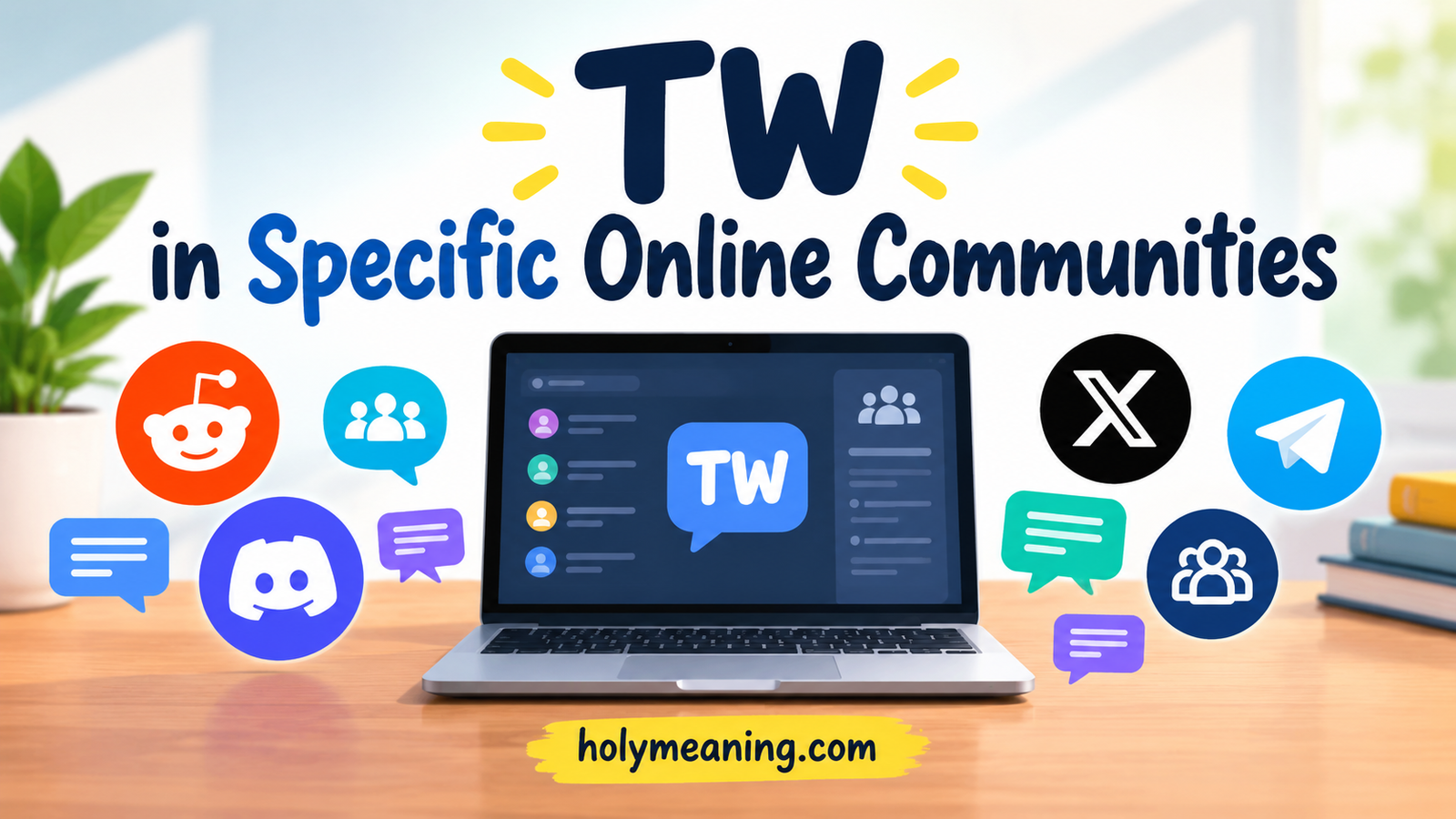
TW doesn’t function the same way everywhere. Context shapes both the format and the expectations.
Mental Health Communities
In mental health spaces, TW carries real weight. These are communities built specifically around trauma support, recovery, and peer accountability, so a trigger warning isn’t optional courtesy, it’s often a hard rule. Many subreddits and Discord servers dedicated to trauma recovery, self-harm support, or eating disorder recovery will remove posts that skip the TW entirely.
Peer support groups in particular rely on TW as a functional safety tool, not a social nicety. Moderators in these spaces often enforce specificity too, rejecting vague tags in favor of exact descriptions.
Fandom and Fanfiction Spaces
Fandom took TW and built entire tagging ecosystems around it. AO3’s tagging system lets writers flag everything from major character death to specific trauma themes, letting readers filter content before they even click a story. Tumblr fandom culture still relies heavily on manual TW tags in post captions, especially for fan art or personal essays tied to canon events.
Dating Apps
TW shows up less formally here, but it exists. Some users add brief content notes in bios when discussing sensitive personal history, grief, chronic illness, sobriety, as a way of setting expectations before a conversation starts. It’s less standardized than fandom or mental health spaces, but the underlying courtesy is the same.
Gaming Communities
This is where TW takes on an entirely different identity. Among gaming communities, TW frequently means something unrelated to emotional content altogether:
- Total War, referring to the long-running strategy game franchise
- Team Wipe, meaning an entire party or raid team got defeated in one encounter, common PvP shorthand in MMOs and competitive multiplayer titles
If you see “TW” in a gaming Discord without any emotional context around it, there’s a good chance it’s gaming slang, not a trigger warning. Reading the surrounding conversation usually clears up which meaning applies.
News and Journalism
Traditional media has been slower to adopt the exact term “TW,” often preferring formal language like “content advisory” or “viewer discretion advised.” That said, digital-first outlets and independent journalists covering trauma-heavy stories (abuse cases, mass violence, disaster coverage) increasingly use TW-style language directly in headlines or opening lines, borrowing the convention from social media norms.
Broadcast journalism took a related but separate path. TV news has used verbal disclaimers (“viewer discretion is advised”) since long before TW existed as internet slang, so the concept predates the abbreviation by decades in that industry. What’s changed recently is the specificity. Older disclaimers were vague (“some viewers may find the following images disturbing”), while newer digital content advisories, influenced by internet-era TW culture, tend to name the exact issue: violence, self-harm, graphic injury, and so on. That shift toward specificity is arguably TW’s biggest influence on mainstream media practice.
Regional and Cultural Differences
TW usage isn’t uniform across the English-speaking internet, and regional differences show up in some interesting ways.
In the US, TW tends to be closely tied to mental health advocacy and is common across Gen Z and younger Millennial spaces. In the UK, “content note” and “CW” show up more frequently in academic and activist circles, partly reflecting broader institutional adoption of the term following debates in British universities over trigger warnings in coursework.
Generational differences matter too. Gen Z users, having grown up with TW as a default internet norm, often use it more casually and more frequently than older users, sometimes applying it to lighter content as a habit rather than strict necessity. Millennials who witnessed the Tumblr-era rise of TW tend to reserve it for more serious topics, reflecting the term’s original clinical weight.
Language variation also plays a role outside English-speaking spaces. Non-English online communities have developed their own equivalent phrases and abbreviations, though English TW has been adopted as a loanword in several multilingual online spaces, particularly among younger users active on international platforms like Discord and Twitter/X.
Australian and Canadian online spaces sit somewhere between the American and British approach, often mixing TW and CW depending on the specific community rather than favoring one term nationally. This isn’t surprising when you consider how much cross-pollination happens between English-speaking internet cultures; a Reddit thread, a Discord server, or a Tumblr tag doesn’t respect national borders, so terminology tends to blend rather than split cleanly along country lines.
There’s also a practical side to regional variation worth mentioning: time zones and platform demographics shape which TW conventions dominate at different hours of the day. A subreddit popular with a largely American user base might show heavier TW use during US evening hours, while the same space might lean toward more formal CN-style tagging when European or Australian users are more active. It’s a subtle effect, but it’s real, and it’s one more reason a single “correct” global standard for TW has never really taken hold.
How to Respond When Someone Sends You TW
Simple rule: respect the pause it creates. If someone sends you a message or post with a TW attached, you have three reasonable options.
- Read it anyway, if you feel prepared and the topic doesn’t pose a risk to you specifically.
- Skip it for now, and circle back later if you want to, with zero explanation required.
- Ask a clarifying question if the TW is vague and you need more information before deciding.
What you shouldn’t do: dismiss the warning as unnecessary, or pressure the person to remove it. It cost them nothing to add, and it might have saved you from a rough moment.
TW in Professional Settings — Should You Use It?
This question comes up more than you’d think, especially as workplace communication increasingly happens over Slack, email, and internal chat tools instead of face-to-face conversation.
Short answer: use it sparingly, but don’t rule it out entirely. Professional settings call for a more formal version of the same idea. Instead of a casual “TW,” consider:
- “Content advisory: this report includes graphic case details.”
- “Please note: the following section discusses workplace violence.”
- “Heads-up: this document covers sensitive medical information.”
Fields where this actually matters include HR (handling complaints or investigations), journalism, healthcare, education, and legal work, anywhere sensitive human experiences get documented in writing. Business communication in these industries increasingly includes formal content advisories, functionally identical to TW, dressed in more formal language for formal writing standards.
Casual TW slang in a professional Slack message to a close colleague? Probably fine. TW slang in a formal client-facing document? Swap it for full, professional phrasing instead.
There’s a good business case for this too, beyond simple kindness. HR investigations, employee wellness communications, and internal training materials increasingly touch on topics like harassment, discrimination, and mental health. Companies that handle these topics carelessly, without any kind of content advisory, risk making already-difficult conversations worse for employees who’ve experienced related trauma firsthand. A short, professional advisory line costs almost nothing to include and can meaningfully reduce that risk. Think of it as a small addition to workplace communication standards, not a big lift.
Hidden, Ironic, and Misused Meanings of TW
Not every use of TW is sincere. Internet culture being what it is, the abbreviation has picked up some tongue-in-cheek applications too.
Sarcastic or Ironic Use
Sometimes people slap “TW” on something mundane for comedic effect: “TW: I’m about to overshare about my Sunday grocery run.” It’s a joke that borrows the format of a genuine warning to add self-deprecating humor before a rambling or slightly embarrassing post.
Using TW as Mockery
Less charitably, some users have used exaggerated or sarcastic TWs to mock the convention itself, implying that trigger warnings are overused or unnecessary. This usage tends to show up in arguments about whether TW culture has gone too far, and it’s often a flashpoint in broader debates about online sensitivity norms.
The Bottom Line
Ironic use isn’t going away, and honestly, it’s not inherently harmful as long as it’s clearly a joke and not aimed at undermining someone’s genuine need for a warning. Context, as always, tells you which one you’re dealing with.
Quick-Reference Summary
Here’s everything in one place, for a fast refresher.
| Question | Answer |
|---|---|
| What does TW mean? | Most commonly, Trigger Warning |
| Other meanings? | Taiwan, Total War, Team Wipe (context-dependent) |
| Correct format? | “TW: [specific topic],” placed at the top of a post |
| TW vs. CW vs. CN? | Mostly interchangeable; slight differences in tone and community preference |
| Where did it start? | Trauma support forums, popularized by Tumblr |
| Use in gaming? | Usually means Total War or Team Wipe, not trigger warning |
| Use at work? | Rare informally; formal content advisories preferred |
| Overused? | Sometimes, especially for mild content, which can dilute its meaning |
FAQs
Does TW mean the same thing as a spoiler warning?
No. TW flags emotionally distressing content, while a spoiler warning just protects plot details from being revealed early.
Is TW still commonly used in 2026?
Yes, though many platforms now pair it with automated sensitive-content screens rather than relying on manual tags alone.
What’s the difference between TW and NSFW?
NSFW flags content inappropriate for work, usually sexual or explicit, while TW flags potentially psychologically distressing material.
Do all online communities require TW?
No. Mental health and trauma-focused spaces often enforce it strictly, while general communities usually treat it as optional courtesy.
Can TW mean something other than Trigger Warning?
Yes, in gaming spaces it often means Total War or Team Wipe, and in business or shipping contexts it can mean Taiwan.
conclusion
At the end of the day, TW meaning in text comes down to one simple idea: give people a heads-up before something heavy. Most of the time, it stands for Trigger Warning. But context matters, so always check before you assume.
Understanding TW meaning in text helps you communicate with more care, whether you’re posting on Tumblr, chatting on Discord, or writing at work. Use it when it counts, keep it specific, and skip it when it’s not needed. That’s really all there is to it.



1 thought on “TW Meaning in Text: What It Really Stands For & How to Use It Correctly (2026)”