OTP meaning in text refers to an abbreviation that stands for one true pairing, one-time password, or one trick pony. Fans use the first for a favorite fictional couple. Banks and apps use the second for a short-lived security code.
Three little letters can carry a love story, a bank alert, or a gaming brag. Misread them and you might swoon over a login code or hand a stranger your account.
Context settles the matter every time. Words like ship, canon, and couple point toward fandom slang. Digits, login, and expires signal a security code. This guide breaks down each meaning and shows you how to reply.
What Does OTP Mean in Text? The Quick Answer
The OTP meaning in text depends on who sent the message and what you’re talking about. Most of the time, it means one of two things: one true pairing (fandom slang) or one-time password (a security code). A third meaning, one trick pony, shows up in gaming chats.
ALSO READ:https://holymeaning.com/tmb-meaning-in-text/
Here’s the fast version:
| Meaning | Full form | Where you’ll see it | Common clue words |
|---|---|---|---|
| OTP slang (fandom) | One true pairing | Fan chats, TikTok, fanfiction sites | ship, couple, canon, episode, fanfic |
| Security meaning | One-time password | Bank texts, app logins, email | code, login, verify, expires |
| Gaming slang | One trick pony | Game lobbies, Discord, forums | champion, main, ranked, lobby |
| Rare use | On the phone | Casual texts between friends | call, busy, can’t talk |
Some definition sites list the “on the phone” version, but it’s uncommon and poorly documented. Treat it as a long shot unless the conversation clearly points that way.
OTP Meaning in Text Slang: One True Pairing
Let’s start with the slang version, since it’s the one that confuses people most. If a friend texts you about a favorite couple from a show, book, or game, one true pairing is almost certainly what they mean.
OTP Definition in Fandom Culture
OTP stands for one true pairing, a term for a person’s favorite fictional romantic relationship. It belongs to fandom culture, where fans invest heavily in couples they want to see together. Fanlore, a fan-run wiki, defines an OTP as a fan’s favorite pairing within a given fandom.
Think of it like a favorite song. You might like dozens of tracks. One sits at the top of your playlist. That’s your OTP.
What Does “My OTP” Mean?
When someone says “my OTP,” they’re claiming one favorite pairing as their personal number one. It signals deep loyalty. The person will rewatch scenes, defend the couple in comment sections, and probably write or read fanfiction about them.
Here’s how you might spot it in the wild:
“Okay, but Elizabeth and Darcy are my OTP. Nobody else comes close.”
“That finale destroyed me. My OTP finally kissed!”
Notice the pattern. A named fictional couple shows up, and the emotion runs high. That’s the signature of the fandom meaning.
Where the Term Came From
The history of OTP is older than most people guess. Some web posts claim it started in the early 2010s. The record says otherwise.
| Year | Milestone |
|---|---|
| 1967 | Fanfiction showing Kirk and Spock in a romantic relationship was first published, an early example of the shipping impulse. |
| Mid-1980s | The phrase “one true pairing” may have appeared in Star Trek fanzines. |
| 2002 | OTP appeared on LiveJournal. |
| 2003 | Urban Dictionary logged its first definition of the term. |
The word “shipper” has its own story. Early fans called themselves “relationshippers,” then shortened it to “R’shipper,” and finally just “shipper.” That’s where the verb shipping comes from.
Can You Have More Than One OTP?
Yes. The wording says “one,” but practice says otherwise. In the early days of single-fandom fans, OTP meant the only pairing a person cared about. As multishipping spread, the term shifted toward a favorite pairing within each fandom. Today, a fan might hold a separate OTP for each show they follow.
Related Fandom Terms Worth Knowing
Fandom terms travel in packs. If you see OTP, you’ll likely run into its cousins:
- Ship: Any pairing a fan supports.
- Shipper: A person who ships couples.
- Canon: What the creators officially make true in the story.
- OT3: A riff on OTP meaning “one true threesome.”
- BrOTP: A favorite platonic friendship, often spelled with “bro” in place of the romance.
- NOTP: A pairing a fan strongly dislikes.
BrOTP and NOTP are fan-coined spin-offs, so spellings and usage vary a bit between communities.
OTP vs Ship: Are They the Same?
Short answer: no. They’re related but not identical. The easiest way to remember the difference is by scope.
| Feature | Ship | OTP |
|---|---|---|
| Meaning | Any pairing you support | Your single favorite pairing |
| How many you can have | Unlimited | Usually one per fandom |
| Part of speech | Noun and verb (“I ship them”) | Noun only |
| Strength of feeling | Anywhere from mild to intense | Top priority |
A ship that a fan prefers over all others gets the OTP label. So every OTP is a ship. Not every ship is an OTP.
An analogy helps here. Think of ships as all the restaurants you enjoy. Your OTP is the one place you’d take a visiting friend. You’d say “I like that taqueria” about many spots. You’d only say “that’s my place” about one.
Fans sometimes use the two words loosely in casual chat. A few Fanlore contributors even note that “ship” often works as the verb while OTP works as the noun. Still, in careful use, OTP vs ship comes down to ranking.
Is OTP Meaning Romantic?
In the slang sense, yes. The OTP meaning romantic angle is baked right into the definition. The standard definition centers on a favorite fictional romantic relationship.
However, two wrinkles matter:
- It describes characters, not you. If a friend says “Anna and Elsa are my OTP,” they aren’t hinting at anything about your relationship. They’re talking about a story.
- Some people stretch it to friendships. Certain references describe an OTP as a favorite romantic or platonic pairing. Many fans use BrOTP for that purpose instead, which keeps the meanings cleaner.
So if someone texts “you’re my OTP” to you directly, treat it as a compliment about your chemistry as a duo. Context and tone will tell you whether it’s flirty or friendly.
Can OTP Refer to Real People?
It can. Fans apply the label to celebrity couples, content creators, and athletes. A relationship pairing between real people can become someone’s OTP in the same way a fictional one would.
That said, the term grew up around fictional romance and characters. Many fan communities treat real-person shipping with more caution, because real people have real private lives. If you’re unsure whether a community welcomes it, watch how others talk before you join in.
ALSO READ:https://holymeaning.com/dw-meaning-in-text/
OTP Meaning in Text: One-Time Password (Security Meaning)
Now for the other heavyweight. If your phone buzzes with digits instead of drama, you’re looking at the security meaning.
What Is a One-Time Password?
A one-time password is a password or PIN that stays valid for only one login session or transaction. Once you use it, or once its timer runs out, it’s worthless.
Other names for the same thing include:
- Verification code
- Security code
- Authentication code
- Login code
- Temporary password
Banks, shopping apps, email providers, and social platforms all use them. The goal is simple: prove that the person holding the password also holds the phone or email tied to the account.
How Does an OTP Work?
The flow looks like this:
- You enter your username and password.
- The service sends a short code to your phone or email.
- You type the code into the login screen.
- The system confirms the match and lets you in.
Most codes run four to eight digits, and many expire within minutes. That short life span is the whole point. A stolen code from last week can’t open anything today.
SMS Codes vs Authenticator Apps
Not every OTP arrives by text. Here’s how the main delivery methods compare:
| Method | How it arrives | Strength | Weak spot |
|---|---|---|---|
| SMS code | Text message | Easy to use | Can be intercepted or socially engineered |
| Email code | Inbox | Convenient | Only as safe as your email account |
| Authenticator app | Generated on your device | Works offline | Phone loss needs a backup plan |
| Hardware key | Physical device | Very strong against phishing | Costs money and can be misplaced |
Authenticator apps typically use a time-based method standardized in RFC 6238. The app and the server share a secret and calculate the same short-lived code at the same moment. That’s why those codes keep refreshing every 30 seconds or so.
Real Message Examples for Verification Codes
Legitimate message examples tend to be short and boring:
“Your verification code is 482916. It expires in 10 minutes. Never share this code with anyone.”
“Use 735201 to log in to your account. If you didn’t request this, ignore this message.”
Look at what these messages don’t do. They don’t ask you to call a number. They don’t ask you to reply with the code. They don’t create panic.
Why You Should Never Share Your OTP
Here’s the part that matters most. The account security of your bank, email, and social profiles can hinge on one text message.
The FTC states plainly that you should never share a verification code, and that no caller, including someone claiming to work in your bank’s fraud department, will ever ask for one. The FTC explains that if you hand over the code, the scammer can use it to prove they’re you.
Think of your password as the front door key. The OTP is a second key that proves you’re really the owner. A scammer with a stolen password still needs that second key. Your job is to never hand it over.
How an OTP Scam Unfolds
This is a common pattern, laid out step by step:
- A scammer tries to log in to your account using stolen credentials.
- The service sends a real code to your phone.
- The scammer contacts you, posing as support or security.
- They claim they need the code to “verify you” or “stop suspicious activity.”
- You share it, and they finish the login.
This can happen within minutes, and it may not feel suspicious until you’ve already lost access.
The Google Voice Variation
Another well-documented trick targets marketplace sellers. A scammer sends a Google Voice verification code to your phone and asks you to read it back. If you do, they try to link a Google Voice number to your phone number, then use it to cheat other people while hiding their identity. The FTC warned about this scam in a 2021 consumer alert.
Quick Safety Rules
- Never share a code with a caller, a buyer, a seller, or a “support agent.”
- Treat unexpected codes as warnings. If you didn’t request the code, the text is a warning sign rather than an instruction.
- Call back on your own. Use the phone number printed on your statement, never the one the caller gives you.
- Report fraud at ReportFraud.ftc.gov.
- Change your password right away if you shared a code by mistake.
OTP Meaning in Gaming: One Trick Pony
Gamers use the same three letters in a completely different way. In a lobby or a Discord server, OTP usually means one trick pony.
The term refers to a player who mainly plays the same character and doesn’t try out other champions. You’ll hear it most in team-based games like League of Legends.
Here’s how it might look:
“That Riven is an OTP. She’s got over a thousand games on one champion.”
Why OTPs Exist
An OTP trades breadth for depth. Players who stick to one champion learn its matchups so well that they often beat opponents in direct duels after hundreds of matches.
The Downside
The risk is obvious. If the champion gets banned, an OTP must switch to something unfamiliar or leave the lobby. That puts teammates in an awkward spot.
Related Gaming Terms
| Term | Meaning |
|---|---|
| Main | A player’s preferred character, though not the only one they play |
| Flex | A player who handles many roles or characters well |
| Comfort pick | A character a player feels most at ease with |
| One-trick | Another way to say OTP |
The phrase “one trick pony” predates gaming and originally described a circus act with just one impressive feature. Gamers borrowed it, shortened it, and made it their own.
ALSO READ:https://holymeaning.com/imk-meaning-in-text/
Other OTP Meanings You Might Run Into
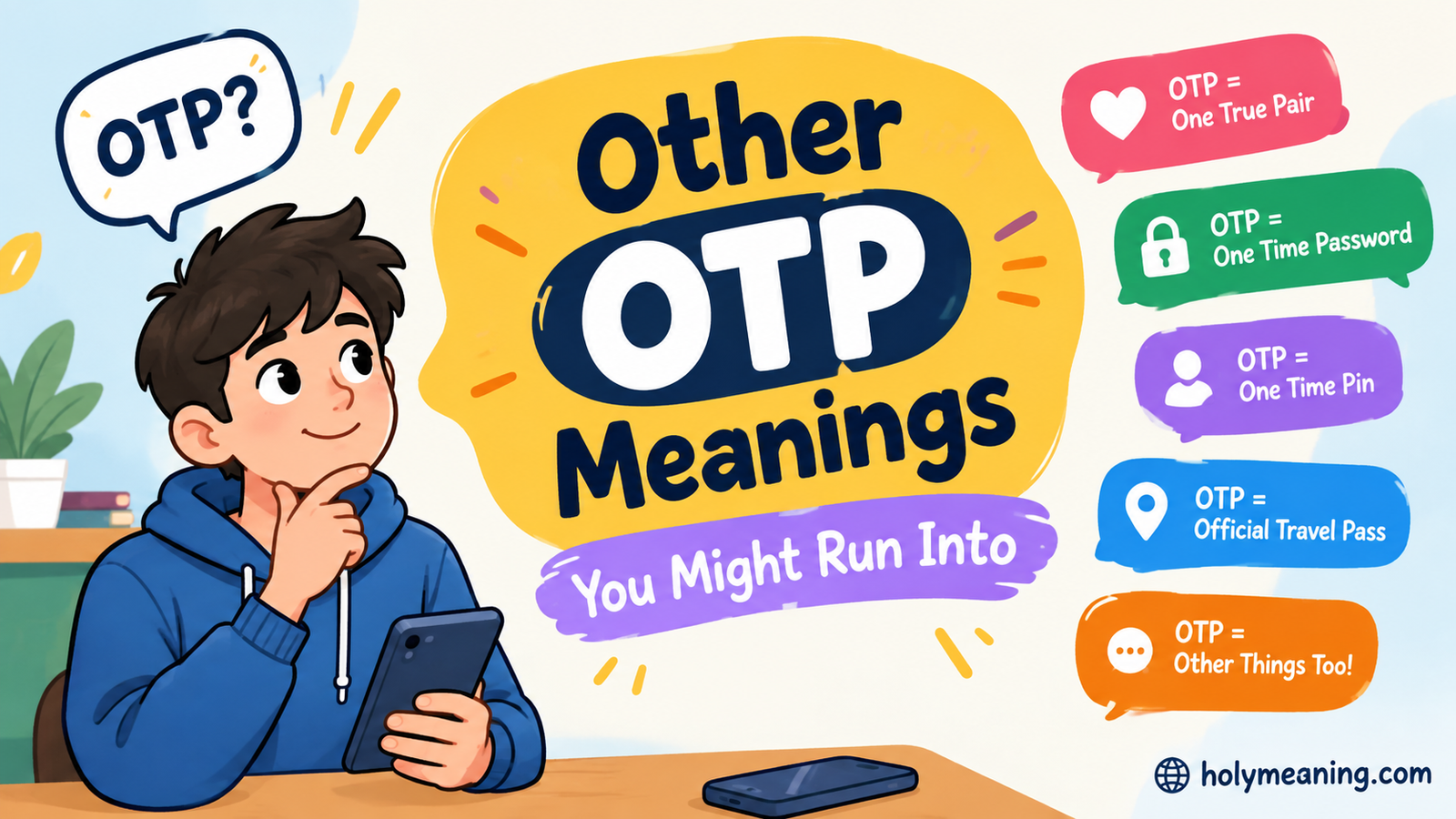
OTP is a busy abbreviation. Outside texting, it covers a surprising range of topics. Wikipedia’s disambiguation page lists everything from a Hungarian bank to a cryptography method.
| OTP | Field |
|---|---|
| OTP Bank | Financial services in central and eastern Europe (originally Országos Takarék Pénztár) |
| One-time pad | Cryptography |
| One-time programmable memory | Electronics |
| Open Telecom Platform | Programming (Erlang tools and libraries) |
| Opioid Treatment Program | Healthcare designation |
You won’t see these in everyday texting. However, they explain why searching for OTP alone can return odd results.
What About “On the Phone”?
One definitions site lists “on the phone” as a fourth meaning for OTP in chats. You might see it in a text like “can’t chat, OTP with my boss.” Still, this usage is rare and lightly documented. If the rest of the message involves calls or meetings, it’s a fair guess. Otherwise, rule it out first.
OTP Meaning in Text Examples
Real OTP examples teach faster than definitions. Here are sample messages across all four meanings, with the logic behind each.
| Message | Likely meaning | Why |
|---|---|---|
| “Wanda and Vision are my OTP forever.” | One true pairing | Named couple plus emotional tone |
| “Your OTP is 391844. Don’t share it.” | One-time password | Digits plus a security warning |
| “Our jungler is an OTP. He only plays Lee Sin.” | One trick pony | Game role and a single character |
| “Can’t talk, OTP with my landlord.” | On the phone | Unavailable plus a call context |
| “OTP?? send it, I’m locked out.” | One-time password | Login problem plus a request for a code |
| “That ship is cute, but Jon and Sansa aren’t my OTP.” | One true pairing | “Ship” appears next to the term |
More Texting Examples in Context
Fandom chat:
Sam: Did you see the finale?
Jo: YES. My OTP is finally canon!
Bank alert:
“Use code 628403 to confirm your transfer. This code expires in 5 minutes.”
Gaming lobby:
“Don’t ban Yasuo. He’s an OTP, and he’ll dodge.”
Each example gives you a context clue you can use. We’ll sharpen that skill below.
OTP Meaning in Casual Texting
Casual texting runs on shortcuts. Friends shorten phrases, drop punctuation, and lean on shared jokes. That’s how a texting abbreviation like OTP slips into informal texting without any explanation.
Here’s how people use it in everyday messaging:
- Excited reactions: “That scene! OTP!!!”
- Group chat debates: “Whose OTP wins this season?”
- Quick signals: “OTP, call you later” (the rare phone meaning)
A few habits make the slang easier to read:
- Capital letters (OTP) are most common, though lowercase “otp” appears too.
- Hype punctuation like multiple exclamation marks leans toward fandom.
- Numbers attached to the message lean toward a security code.
Remember that text slang shifts with the audience. A phrase that’s clear in a fan server may confuse a coworker. In a professional message, write out “one-time password” or “one true pairing” to stay clear.
OTP Meaning on Social Media
Social media has become the main stage for OTP slang. Internet language moves fast on these platforms, and fandoms push it faster.
OTP Meaning on TikTok
On TikTok, OTP almost always points to fandom couples. Creators feature favorite pairings in edits and captions. A typical post pairs clips of two characters with a song and a caption like “my OTP never misses.”
Here’s what you’ll usually notice:
- Video edits built around two characters
- Captions that include the pairing’s combined name
- Comments where fans argue over rival ships
- TikTok slang like “ship,” “canon,” and “endgame” in the same thread
Other Social Platforms and Hashtags
TikTok isn’t alone. Fans also use the term on Tumblr, X, Instagram, Reddit, and Discord. Common tags include #OTP, #OneTruePairing, #ShipIt, and #Endgame. These online trends help fans find each other and trade edits, art, and stories.
Gamers use the other meaning on social platforms like Reddit and Discord, so clues from the community matter. A League of Legends thread points to “one trick pony.” A fan art board points to “one true pairing.”
Why the Fandom Meaning Dominates Online
Short videos reward emotion. A two-character edit with strong music creates quick attachment. That’s a big reason why TikTok messages and social media slang keep feeding the fandom meaning.
ALSO READ:https://holymeaning.com/what-does-ts-mean-in-text-3/
How to Tell Which OTP Meaning Someone Intended
You don’t need to guess from the letters alone. Use context clues, and the answer usually jumps out.
Context Clues Table
| If you see… | It probably means |
|---|---|
| ship, couple, canon, romance, episode, fandom, fanfic | One true pairing |
| code, login, verify, expires, bank, account | One-time password |
| champion, main, ranked, lobby, banned | One trick pony |
| call, meeting, can’t talk, busy | On the phone |
Words like ship, couple, character, or episode usually point to the fandom meaning.
A Simple Two-Question Test
Ask yourself two things:
- Who sent it? An automated number or a company almost always means a password. A friend in a fan group means a pairing.
- What’s the topic? Media and couples point to fandom. Accounts and logins point to security. Games point to ponies.
If both answers line up, you’re done. If they clash, slow down and ask.
When It’s Still Unclear
Sometimes a message is genuinely ambiguous. “OTP?? send it” could mean a password or something else entirely. In that moment, one short question beats a wrong guess. Try: “Do you mean the login code or something else?”
How to Reply to OTP
Knowing how to reply to OTP keeps conversations smooth. The right text replies depend on the meaning.
Replying to One True Pairing
Match the energy. Fans love when you engage with their favorite.
“No way, I ship them too! Who’s your second favorite?”
“Okay, I need the full case for why they’re your OTP.”
If you don’t know the show, say so kindly: “I haven’t watched it, but sell me on them!”
Replying to One-Time Password Requests
Slow down. Check who’s asking.
- If you requested the code, use it yourself. Don’t forward it.
- If a stranger asks for it, don’t reply at all.
- If a friend asks for it, call them to confirm. Their account could be compromised.
Here’s a safe message response to a suspicious request:
“I don’t share verification codes. I’ll contact the company directly.”
Replying to One Trick Pony
Gamers love banter.
“Fair, but if they ban your champ, what’s the backup plan?”
“Respect the dedication. Show me that Riven combo.”
Replying When You’re Not Sure
Keep it light and curious:
“Wait, OTP like the couple, the login code, or the champion?”
A conversational reply like that rarely offends anyone. Most people enjoy explaining their slang.
Common Mistakes with OTP
Common mistakes with OTP tend to cluster around assumptions. Each one creates OTP confusion that’s easy to avoid.
Mistake: Assuming OTP Has Only One Meaning
Many people lock onto the first definition they learned. A parent might see only the bank code. A teenager might see only the fandom term. Neither is wrong, but each can misread messages. Keep all the options open.
Mistake: Reading a Fandom OTP as a Personal Message
“Peter and MJ are my OTP” talks about characters. It doesn’t comment on you or your relationship. Over-reading it creates awkward moments.
Mistake: Treating OTP and Ship as Identical
They overlap, but they aren’t twins. Calling every pairing your OTP can irritate fans who reserve the label for one favorite. Use “ship” for casual support.
Mistake: Replying to Unexpected Code Requests
This is the costly one. Replying with a code, even once, can hand over account access. These texting errors are the ones scammers count on.
Mistake: Guessing From the Letters Alone
Three letters carry too little information. Abbreviation mistakes happen when people skip the context. Read the full message, check the sender, and then decide.
Mistake: Using Slang in the Wrong Setting
In a work email, “OTP” may confuse readers. Spell it out. That small step avoids misunderstanding slang in professional spaces.
Case Studies: OTP in Real Situations
These are illustrative scenarios based on common patterns. They show how the meaning shifts with context.
Case Study: The Group Chat Mix-Up
Situation: Maya texts her cousin, “Okay but they’re my OTP and I won’t hear otherwise.” Her cousin, who just changed banks, panics and thinks Maya is asking about a code.
Clues missed: Maya never mentioned an account. She referenced “they,” a plural pronoun that points to characters.
Outcome: A quick “which show?” cleared it up. The takeaway: pronouns and emotion point to fandom.
Case Study: The Fake Fraud Call
Situation: Daniel gets a call from someone claiming to be the bank’s fraud team. A text arrives with a six-digit code. The caller says, “Read it to me so we can block the thief.”
Clues: Real codes come with a warning not to share them. The caller created urgency. No legitimate bank caller will ask for a verification code.
Outcome: Daniel hung up and called the number on his debit card. His account stayed safe. The takeaway: urgency plus a code request equals a scam.
Case Study: The Banned Champion
Situation: In a ranked lobby, a teammate types, “Don’t ban Yasuo, I’m OTP.” The other players groan.
Clues: The game setting and the champion name point to one trick pony.
Outcome: The team banned something else and won the match. The takeaway: game context settles it instantly.
Is OTP Meaning in Text Still Used Today?
Yes, and both major meanings remain active.
- The fandom meaning has stayed in circulation for more than two decades. Records show use as early as 2002 on LiveJournal. Short-form video platforms keep it fresh.
- The security meaning is growing. More services now ask for a verification step during login, which puts OTP messages in front of more people each year.
- The gaming meaning remains standard in competitive communities.
Because all three persist, digital communication will keep producing OTP confusion. The best fix is the habit of checking context before responding.
FAQs
What does OTP mean in text?
OTP most often means one true pairing, a fan’s favorite couple in a story. It also stands for one-time password in security texts and one trick pony in gaming chats.
What does OTP mean on TikTok?
On TikTok, OTP almost always refers to a favorite fictional couple shown in edits and captions. Fans pair it with tags like #OTP and #OneTruePairing.
What’s the difference between OTP and ship?
A ship is any pairing a fan supports. An OTP is the single favorite, so every OTP is a ship but not every ship is an OTP.
Is it safe to share an OTP code?
No. The FTC says to never share a verification code, since scammers use it to prove they’re you. No legitimate caller, including your bank’s fraud team, will ask for it.
How do I reply when someone texts OTP?
Check the context first. Answer fandom talk with enthusiasm. Ignore unexpected code requests. If the meaning is unclear, ask a quick question like “Do you mean the couple or the login code?”
conclusion
The otp meaning in text changes with the situation. It can mean one true pairing, one-time password, or one trick pony. Fans use it for a favorite couple. Banks use it for a security code. Gamers use it for a player who sticks to one character.
Now you know how to read the otp meaning in text. Check who sent the message. Look for clue words. Then reply with confidence. Never share a verification code with anyone. When you feel unsure, just ask. A quick question beats a wrong guess.