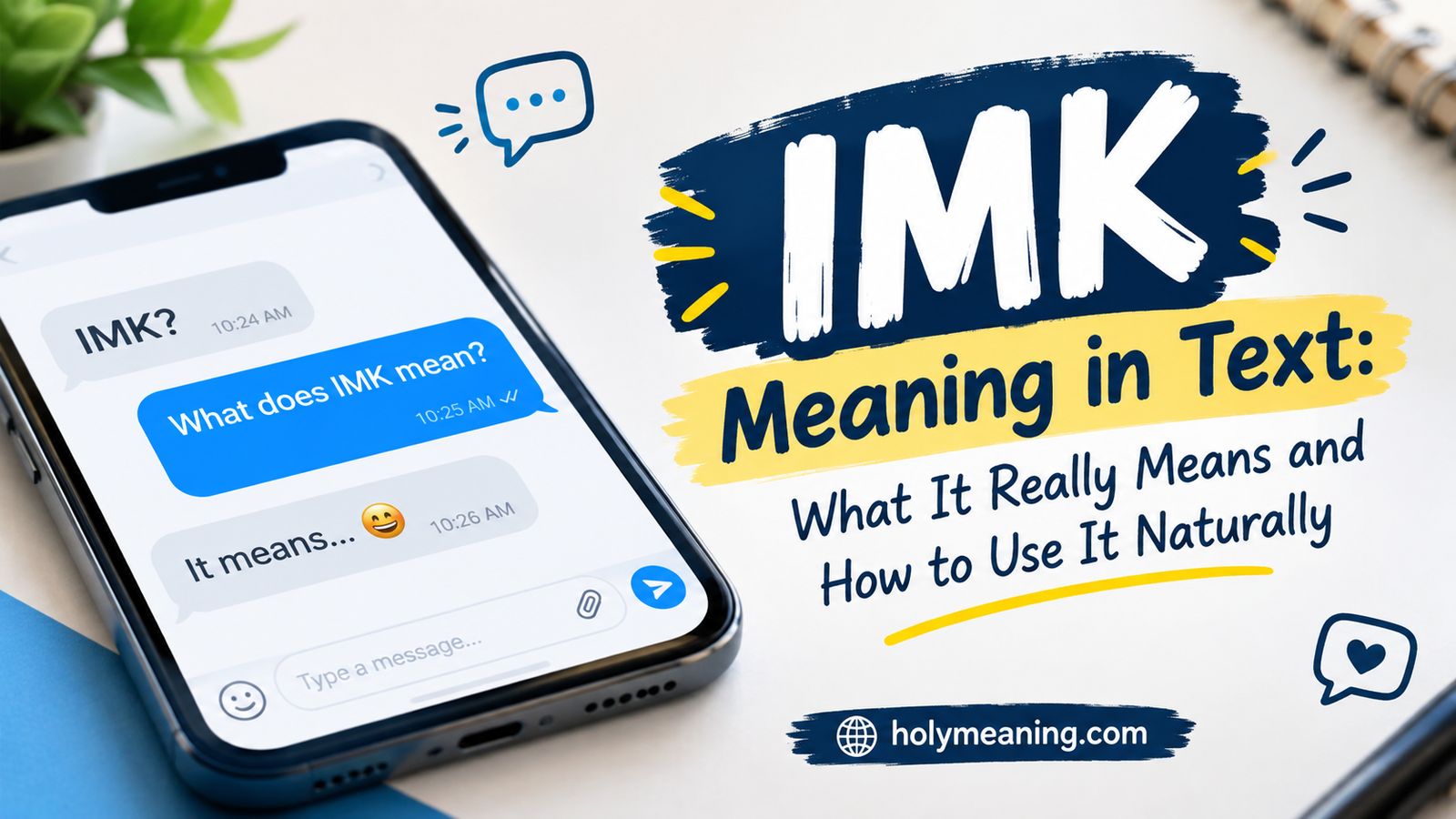
The IMK meaning in text is “in my knowledge.” People type it to share information they believe is true, much like saying “as far as I know.”
Three letters. One tiny hedge. Yet swap a single character and the whole message flips, turning a helpful update into a sudden request for news. Sneaky stuff.
Still, IMK remains a quiet favorite in casual texts, group chats, and social media replies across Snapchat, WhatsApp, and Instagram. It softens a claim without sounding unsure or stiff. A few rare readings exist, such as “I must know.” Context clues matter.
What Does IMK Mean in Text?
IMK stands for “in my knowledge.” People type this IMK abbreviation to share known information from their own personal knowledge. It carries the same spirit as as far as I know or to my knowledge. The speaker offers what they’ve got. They don’t promise it’s the final word.
Most sources agree on this IMK definition. In casual online conversations, IMK usually means “in my knowledge,” which is similar to saying “as far as I know” or “to the best of my knowledge.” Urban Dictionary backs this up. Its second definition reads “in my knowledge,” along the lines of “just so you know” or “from my understanding.”
Think of a weather forecaster. She doesn’t announce that it will rain. She says the chance is high. IMK plays that same role in a chat. It tells the reader, “Here’s what I’ve got, but the situation could change.”
That small signal does real work. It keeps a knowledge-based statement honest. It also protects the sender. If the party moves to ten, nobody can accuse your friend of lying. They only said what they knew.
IMK Full Form and IMK Definition at a Glance
The IMK full form has just three words. Here’s a quick reference before the details.
| Detail | Answer |
|---|---|
| IMK full form | In my knowledge |
| IMK acronym type | Initialism (people say each letter) |
| Plain-English equivalents | As far as I know, to my knowledge, to the best of my knowledge |
| Register | Casual |
| Typical job | Flags a statement as based on what the speaker knows |
| Where it appears | Snapchat, WhatsApp, TikTok, Instagram, Facebook, Twitter |
| Close relatives | AFAIK, AFAIAA |
| Official dictionary status | None |
A quick note on terms. Many people call IMK an acronym. Strictly speaking it’s an initialism, since you say “I-M-K” letter by letter. Either label works in everyday talk. The full form of IMK stays the same regardless.
The platform list comes from AmazingTalker. It notes that people mostly use the term on Snapchat, TikTok, WhatsApp, Facebook, Twitter, and Instagram. The related abbreviation AFAIAA (as far as I am aware) appears on The Word Counter, which compares IMK with both AFAIK and AFAIAA.
How IMK Works in a Sentence
The pattern is easy. Put IMK first. Follow it with the claim.
IMK the store closes at 9.
Read it as: “As far as I know, the store closes at 9.”
Here’s how the pieces break down:
- IMK flags the next statement as personal knowledge.
- The claim delivers the actual information.
- The reader decides whether to trust it or double-check.
Sources also point to a placement habit. Writers usually put IMK at the start of a sentence, which prepares the reader for information that comes with a small caveat. You’ll occasionally see it tacked on at the end. That version reads like an afterthought, but it means the same thing.
A simple example from AmazingTalker shows the tone. Someone writes a line like “IMK it is going to rain today,” which means it will rain as far as they know, and they may turn out to be wrong.
Does IMK Signal Doubt?
Here’s a fair debate. Some guides treat IMK as an admission of uncertainty. Others push back. One guide argues that IMK doesn’t necessarily mean the speaker is unsure, since the person may be fairly confident and simply reporting the information available to them.
The practical takeaway sits in the middle. IMK signals limited information. It doesn’t confess ignorance. A reader hears a mild caution, not a shrug. That’s why the phrase works so well for quick updates among friends.
Other Meanings of IMK: Alternate Meanings and Rare Meanings
Now the messy part. IMK interpretations vary more than most abbreviation meanings. Internet slang grows without a rulebook. There’s no official dictionary-approved meaning for IMK because internet slang develops informally.
Still, not every claim deserves equal trust. Some alternate meanings show up in several places. Others rest on a single page. This table sorts them by strength of evidence.
| Interpretation | Where it appears | Evidence | Typical clue |
|---|---|---|---|
| In my knowledge | Nearly every guide plus Urban Dictionary | Strong | Answers a question or states a fact |
| I must know | Urban Dictionary (listed as least used), Capitalize My Title | Moderate | Appears in a question or a demand for gossip |
| Let me know (typo for LMK) | Urban Dictionary’s first entry | Moderate | Followed by “how it goes” or “more” |
| I’m just kidding | Capitalize My Title | Weak | Stands alone after a joke lands badly |
| Inform me, kid | Capitalize My Title | Weak and playful | Teasing tone only |
| In My Kitchen | One SEO article about food bloggers | Weak and unverified | Food blog context |
I Must Know: The Rare Curious Variant
This reading shows up when someone craves details. Urban Dictionary lists “I must know” as its third definition and notes it’s the least used. Capitalize My Title gives the example of someone asking whether a person named Shelly showed up and mentioned them, then adding IMK for “I must know.”
The clue is the sentence around it. A question plus IMK usually signals hunger for gossip. A flat statement plus IMK signals knowledge.
I’m Just Kidding: The Rarest Real Reading
This one is thin but documented. One guide says IMK can mean “I’m just kidding” or “ignore my kidding,” and people mostly use it alone when someone takes a joke too seriously.
Picture a friend who tells you class is canceled. You panic. They send one word: “IMK.” Context rescues the meaning. Still, treat this as a rare meaning. Few people use it, and a single source describes it.
Typo Confusion: When IMK Is Really LMK
Here’s the most useful alternate meaning of all. Look at Urban Dictionary’s first entry. It defines IMK as “let me know” and pairs it with a sample like “Imk how it goes.”
Why would that happen? The likely culprit is a font problem. In many sans-serif fonts, a lowercase “l” and a capital “I” look nearly identical. Autocorrect can even capitalize the first letter of a message and change how it looks. So “lmk how it goes” can appear as “Imk how it goes.” That explanation is an educated reading of the entry rather than a documented fact. It fits the evidence well though.
This typo confusion explains a lot of puzzling messages. If IMK sits in front of “how it goes,” “when you can,” or “more,” the sender almost certainly meant let me know.
Claims Worth Treating With Caution
A few sites list other readings. Two are worth naming so you can ignore them with confidence.
- “I’ll let you know.” One page frames this as an IMK meaning and calls it the opposite of LMK. That guide contrasts IMK (“I’ll let you know”) with LMK (“let me know”) as opposite directions. No dictionary-style source backs it up. Urban Dictionary actually points the other way, treating IMK as a mistyped “let me know.”
- “I might know.” One site says IMK can mean “I might know,” which would show doubt. Again, no second reliable source supports it.
Both claims trace to single pages. Treat them as guesses.
How to Tell Which IMK Meaning Someone Intends
Context clues beat memorization every time. One guide stresses that context matters more than the letters alone, since internet abbreviations can carry several meanings or even be typing mistakes.
Use this quick decoder:
- A statement of fact follows. It means “in my knowledge.”
- “How it goes,” “more,” or “when you can” follows. It’s probably a mistyped LMK.
- It appears in a question about gossip. It could mean “I must know.”
- It appears alone after a joke. It might mean “I’m just kidding.”
- Nothing fits. Ask. A quick “wait, do you mean in my knowledge?” costs five seconds.
IMK vs. Similar Abbreviations: Common Abbreviations Compared
IMK lives in a crowded neighborhood. Several common abbreviations sound alike or work alike. Mixing them up causes real misunderstandings. This table lays the family out.
| Abbreviation | Full form | What it signals | Best use |
|---|---|---|---|
| IMK | In my knowledge | Knowledge-based statement with a small caveat | Casual info sharing |
| AFAIK | As far as I know | Same idea as IMK | Broader audiences |
| AFAIAA | As far as I am aware | Same idea, slightly formal tone | Rare, mixed settings |
| IMO | In my opinion | Personal opinion | Sharing views |
| IMHO | In my humble opinion | Softened opinion | Polite disagreement |
| LMK | Let me know | Request for an update | Asking for news |
| IDK | I don’t know | No knowledge | Admitting a gap |
These chat abbreviations each do a different job. Three matter most for IMK readers.
IMK vs IMO: Knowledge vs. Opinion
The IMO meaning is in my opinion. It covers taste, judgment, and preference. IMK covers information. One guide puts it plainly: IMK focuses on information while IMO expresses personal views.
Compare these two lines:
IMK the movie starts at 7.
IMO the movie is overrated.
The first is a factual information claim. Someone could check it against a schedule. The second is a personal opinion. Nobody can prove it wrong.
Here’s a handy test. Ask whether a calendar, a clock, or a receipt could settle the claim. If yes, IMK fits. If only taste settles it, reach for IMO. This opinion abbreviation never carries a factual caveat.
Mixing them up creates awkward moments. Say “IMO the meeting is at 10” and your friend will wonder if you’re guessing or arguing. Say “IMK it’s a great restaurant” and the message feels oddly stiff.
IMK vs LMK: One Letter, Opposite Directions
The LMK meaning is let me know. It asks someone to send you information. IMK usually offers information. The two share nearly identical letters, which fuels the confusion.
| IMK | LMK | |
|---|---|---|
| Full form | In my knowledge | Let me know |
| Direction | Sender gives information | Sender requests information |
| Example | “IMK she’s on her way” | “LMK if she’s on her way” |
| Common slip | Looks like “Imk” in some fonts | Looks like “Imk” in some fonts |
That last row explains the typo confusion covered earlier. When a lowercase “l” masquerades as a capital “I,” LMK becomes IMK. So read the surrounding words. A sentence that asks for news is LMK. A sentence that delivers news is IMK.
IMK vs AFAIK: Same Idea, Different Reach
The AFAIK meaning is as far as I know. It does the same job as IMK. Both serve as knowledge abbreviation shortcuts. The big difference is recognition.
IMK isn’t among the most familiar shortcuts. One guide states that IMK is still used online but ranks below the most common internet abbreviations. AFAIK has a longer track record in forums and chat rooms. So more people read it without a second thought.
A simple rule follows. Use IMK with friends who already type it. Use AFAIK when your audience might not know either. Spell the phrase out when the message matters.
Full Phrase Options That Always Work
Sometimes the best abbreviation is no abbreviation. These phrases carry the same meaning with zero decoding required:
- As far as I know
- To my knowledge
- To the best of my knowledge
- From what I understand
One guide notes that these phrases sound natural in both casual and moderately professional English. They also save you from a confused reply.
IMK in Conversations: Where You’ll See It
IMK in conversations turns up wherever people type fast and hedge lightly. The term suits casual texting. It shows up in messaging apps, comment sections, and online conversations across many platforms.
Usage isn’t universal though. IMK stays a niche term. One guide describes its usage as relatively niche and stable rather than growing or declining. You won’t see it as often as LOL or IDK. Still, you’ll spot it in the right circles.
Age plays a role too. Younger users tend to use IMK as a quick way to qualify an answer, while older users may recognize it but prefer writing “as far as I know.” The difference is style rather than meaning.
IMK in Text Messages
IMK in text messages works as a quick qualifier. Friends use it to answer questions in one line. Family members use it to pass along updates.
A typical exchange looks like this:
You: Is Mom home yet?
Sister: IMK she got back around five.
Notice the tone. Your sister doesn’t claim certainty. She reports what she knows. You can act on it or double-check.
IMK in Group Chats
Group chats raise the stakes. Many people read every message. A wrong fact travels fast. So IMK acts as a small shield.
Alex: Anyone know if practice is canceled?
Jordan: IMK it’s still on, but Coach hasn’t confirmed.
Jordan shares known information and admits the gap. The whole group benefits from the honesty.
IMK in Social Media Replies
Social media replies move quickly. Comment threads reward short answers. IMK fits that rhythm. Readers see IMK in comments and replies on platforms like TikTok and Instagram.
A reply to a question about a store’s return policy might read: “IMK they take returns within 30 days.” Short. Helpful. Honest about its limits.
IMK in Online Conversations and Instant Messaging
Instant messaging and forums encourage the same habits. People trade quick answers. They flag uncertainty without writing paragraphs. IMK compresses a whole hedge into three letters.
This pattern is the heart of digital communication today. Speed matters. Clarity matters too. Abbreviations like IMK try to serve both.
IMK Usage Examples: Real Text Examples and Sample Conversations
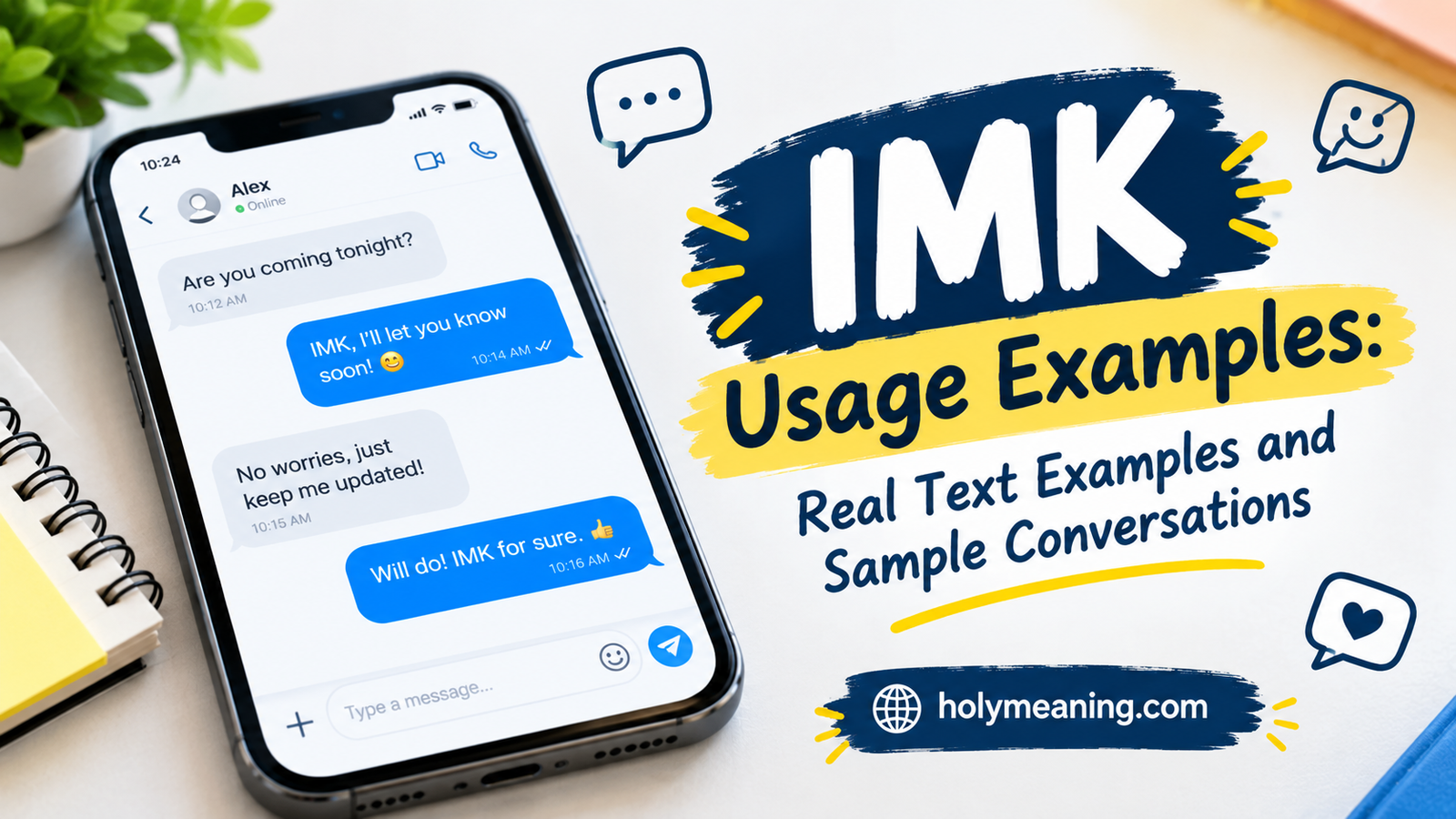
Nothing teaches slang like real text examples. These sample conversations show how IMK behaves in different usage scenarios. Each one includes a note on what the message signals.
Answering a Factual Question
Friend: Is the pharmacy open on Sundays?
You: IMK it closes at 6 on Sundays.
What it signals: You know the schedule but haven’t checked it lately. Your friend should verify if timing is tight.
Making Plans in a Group Chat
Maya: What time are we meeting?
Chris: IMK 7:30, but Dana might change it.
What it signals: Chris shares the current plan and warns of a possible shift. Everyone stays informed without a firm promise.
A Semi-Casual Work Message
Teammate on Slack: Did the client sign off on the draft?
You: IMK yes, though I’ll confirm with Priya.
What it signals: You lean toward yes and you promise a follow-up. Note the setting. This works on an informal team channel. Skip it in a client email.
A Social Media Comment
Original post: Does this app work offline?
Comment: IMK the premium version does.
What it signals: The commenter shares a partial fact from personal experience. Other readers can correct them.
When IMK Means “I Must Know”
Friend: Guess who showed up at the party last night.
You: Who?? IMK.
What it signals: Pure curiosity. The question mark gives it away.
When IMK Is Really LMK
Friend: I’m trying that new ramen place tonight.
You: Imk how it goes.
What it signals: A typo. The sender meant “lmk how it goes.” The sentence asks for news rather than delivering it.
What These Texting Examples Have in Common
These texting examples share three traits:
- A clear claim follows IMK. The reader always knows what’s being asserted.
- The setting is casual. Even the work example lives on a friendly channel.
- Context resolves any confusion. Question marks, follow-up words, and the conversation flow all point to the right reading.
Case Study: The Rumor in the Group Chat
This is an illustrative scenario, not a published study.
Imagine a friend group chat. Someone posts that a mutual friend, Sam, is moving to another city. Nobody knows if it’s true. Two members respond differently.
Response A: “Yeah, Sam is definitely moving next month.”
Response B: “IMK he’s looking at apartments there, but I haven’t heard a date.”
Response A sounds like a fact. If Sam isn’t moving, the sender now looks careless. Response B reports exactly what’s known. It also leaves room for correction. When Sam finally weighs in, Response B’s sender loses no credibility.
The lesson is simple. IMK turns a risky claim into an honest one. It works best when the information is secondhand or partial.
The Tone of IMK: Casual Tone, Cautious Language, Neutral Tone
The tone of IMK is soft. It reads as casual tone with a dash of cautious language. It rarely offends anyone. It also rarely commands anyone.
Several sources agree on the mild flavor. One guide calls IMK generally polite and neutral, noting that it simply signals the speaker is sharing what they know. Another likens the phrase to a cushion that absorbs potential friction. That’s hedging language at its gentlest.
The conversational style matters here. IMK sounds like something a friend says across a table. It doesn’t sound like a memo. That makes it approachable. It also limits where it belongs.
What You’re Really Saying When You Use IMK
Behind those three letters sits a small speech act. Here’s what the sender communicates:
- “This is my honest information.”
- “I’m not claiming to be an authority.”
- “Feel free to correct me.”
- “Don’t blame me if the facts change.”
One guide describes it as a polite heads-up that says “I’m pretty sure about this but don’t come for me if I’m wrong.” That captures the spirit well.
How the Tone Lands in Different Situations
| Situation | How IMK lands |
|---|---|
| Friend asks a quick question | Friendly and honest |
| Group chat with mixed information | Helpful and careful |
| Urgent decision needed | Frustrating, since the reader wants certainty |
| Work chat with teammates | Fine if the team is casual |
| Formal email to a client | Out of place |
| Repeated in every message | The sender sounds unsure |
The bottom rows deserve attention. One guide warns that someone who uses IMK constantly may come across as unsure, even when they aren’t. A hedge works once. A hedge on every line becomes a personality trait.
How IMK Can Backfire
Three situations expose the weakness of this neutral tone:
- The reader needs a firm answer. A vague “IMK 3 pm” when someone must catch a train feels unhelpful.
- The sender knows the answer. Adding IMK to a fact you’ve verified undersells your own reliability.
- The audience doesn’t know IMK. Confusion replaces clarity.
Case Study: One Answer, Three Tones
This is an illustrative scenario, not a published study.
A coworker asks, “Is the meeting still at 2?” Compare three replies.
| Reply | Tone | Likely reaction |
|---|---|---|
| “Yes.” | Confident and blunt | Coworker relaxes, unless you’re wrong |
| “IMK yes, but I’ll double-check.” | Honest and careful | Coworker trusts you and waits for the follow-up |
| “IMK, maybe, I think, probably.” | Stacked hedges | Coworker wonders if you know anything |
The middle reply wins. It combines a clear claim with a small caveat and a next step. The third reply shows what happens when hedging piles up.
When to Use IMK (and When to Skip It)
Good slang use comes down to reading the room. IMK suits some rooms and clashes with others.
Use IMK When
- You share partial information. You know most of the story but not all of it.
- The chat is casual. Friends, family, and relaxed team channels welcome it.
- You want to sound honest without writing a paragraph. Three letters beat a long disclaimer.
- You’re passing along secondhand news. A cautious flag protects everyone.
- Your audience already uses similar shorthand. They’ll decode it instantly.
Avoid IMK When
- The setting is formal. One source insists IMK is a very casual term that belongs in texts and social posts rather than business emails or formal communication.
- You can verify the fact in seconds. Just check. A firm answer beats a hedged one.
- Accuracy carries real consequences. Money, health, safety, and legal matters call for clear language. (That’s editorial advice rather than a rule from any source.)
- The reader may not know the term. Spell it out instead.
- You already know the answer. Hedging a verified fact weakens it.
Another guide agrees that IMK is too casual for most professional communication. The consensus is clear.
Quick Checklist Before You Type IMK
Ask yourself three questions:
- Is the chat casual? If no, use “as far as I know” or “to my knowledge.”
- Is my information partial or secondhand? If no, drop the hedge.
- Will the reader understand IMK? If unsure, write the full phrase.
Three yeses mean IMK fits.
Better Alternatives for Formal Settings
| Situation | Try this instead |
|---|---|
| Email to a manager | “To the best of my knowledge” |
| Message to a client | “As far as I’m aware” |
| Mixed audience chat | “AFAIK” or “as far as I know” |
| Team update | “From what I understand” |
Common Mistakes With IMK
Even simple slang produces slip-ups. These are the ones to watch.
Reading IMK as a Misspelled “I’m”
It’s an easy guess. Both start with “I” and “m.” One guide addresses this directly, calling the guess logical but incorrect. IMK isn’t a typo for “I’m.” It’s its own abbreviation.
Confusing IMK With IMO
Remember the calendar test. Facts you could verify belong to IMK. Views and tastes belong to IMO. Mixing them muddles your message.
Missing the LMK Typo
If the sentence asks for news, suspect typo confusion. Read the words around IMK before you decode it.
Using IMK for Facts You Should Confirm
Some facts deserve a quick check. A flight time. A pharmacy hour. A deadline. Hedging with IMK when a ten-second search would solve the problem wastes everyone’s time.
Stacking Hedges
“IMK maybe I think” says the same thing three times. Pick one signal and trust it.
Using IMK in Formal Writing
A cover letter, a client proposal, or a school essay is the wrong home. Write out the full phrase.
Good vs. Bad Usage
| Version | Message | Verdict |
|---|---|---|
| Good | “IMK the deadline is Friday, but I’ll confirm.” | Clear claim plus follow-up |
| Bad | “IMK maybe probably Friday I guess.” | Stacked hedges |
| Good | “IMK she’s coming.” (to a friend) | Casual and natural |
| Bad | “IMK the contract terms are acceptable.” (to a client) | Too casual and too risky |
How to Reply When Someone Texts You IMK
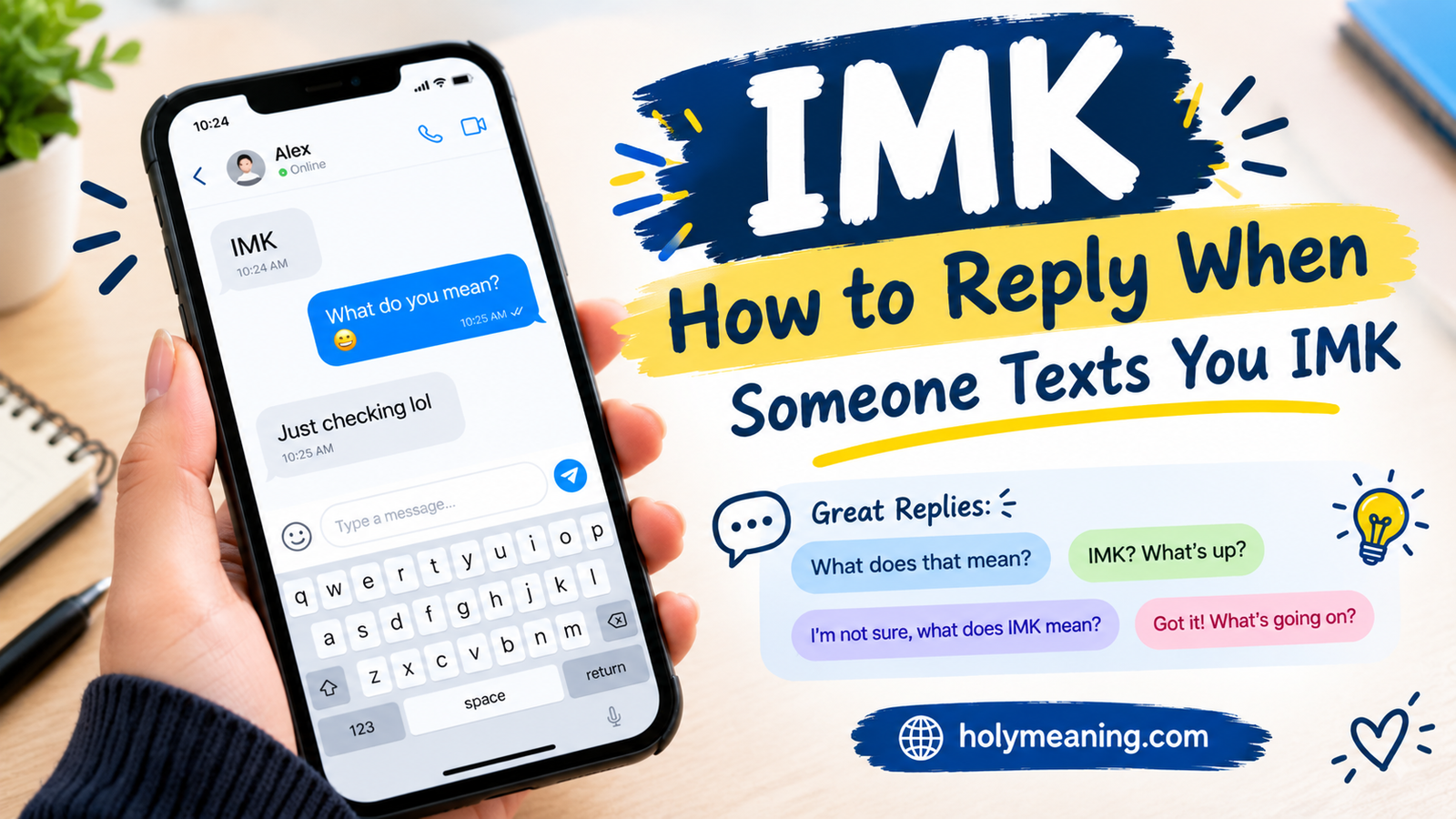
Receiving IMK raises a fair question. What now? Your response depends on how much the information matters.
When the information is low-stakes, accept it and move on:
“Thanks! Good to know.”
When you need certainty, ask for confirmation:
“Can you double-check that? I’m planning around it.”
When you can verify it yourself, do that and share the result:
“Just checked. It closes at 6, like you said.”
When the message looks like a typo, ask a quick clarifying question:
“Did you mean ‘let me know’?”
Never treat IMK as rude. Guides describe it as generally polite and neutral. The sender simply offers what they have.
Where Did IMK Come From? Origin and Rise
Here’s what the evidence shows. IMK has no clearly documented origin. One guide says like many internet abbreviations it lacks a documented origin, and it likely emerged from online forums and chat rooms.
The likely path follows the older shortcuts. One guide says IMK didn’t come from a formal dictionary or a single viral moment, and it grew from the same culture that produced IMO and IMHO. That’s a reasonable inference. It’s still an inference.
You may find sites offering tidy timelines with specific decades and milestones. One such page lists dated stages from early message boards through the 2010s and beyond. None of those claims points to a checkable source. Treat them with caution.
What can be dated? Indexed copies of the Urban Dictionary entry for IMK and The Word Counter’s explainer carry dates of January 2020 and May 2021. So the term was circulating by then. To dig deeper, check the entry dates on Urban Dictionary directly and browse older captures through the Wayback Machine.
The current picture is steady. IMK isn’t racing up the charts. It also isn’t fading. It sits in a stable niche, used by people who like short hedges.
FAQs
What does IMK mean in text?
IMK stands for “in my knowledge.” It works like “as far as I know” and signals that you’re sharing information you believe is true without guaranteeing it.
Is IMK the same as LMK?
No. IMK usually gives information, while LMK means “let me know” and asks for it. In some fonts a lowercase “l” looks like a capital “I,” which causes the mix-up.
Is IMK still used in 2026?
Yes, but it’s a niche term. Usage looks steady rather than growing or fading, and you’ll mostly spot it on Snapchat, WhatsApp, TikTok, and Instagram.
Is IMK okay to use at work?
Only in casual team chats. For emails or client messages, write “to my knowledge” or “as far as I know” instead.
Are there other meanings of IMK?
Yes, though they’re rare. “I must know” and “I’m just kidding” show up in a few sources. Neither is common, so “in my knowledge” is the safe default.
conclusion
The IMK meaning is simple. It stands for “in my knowledge.” You use it to share what you know without making a big promise. It works like “as far as I know.” It’s a tiny hedge with a clear job. Friends, group chats, and social media replies all welcome it.
Keep the IMK meaning in mind next time it pops up. Check the words around it. If it asks for news, the sender probably meant LMK. Use IMK in casual chats. Skip it at work. Now you can text with confidence.