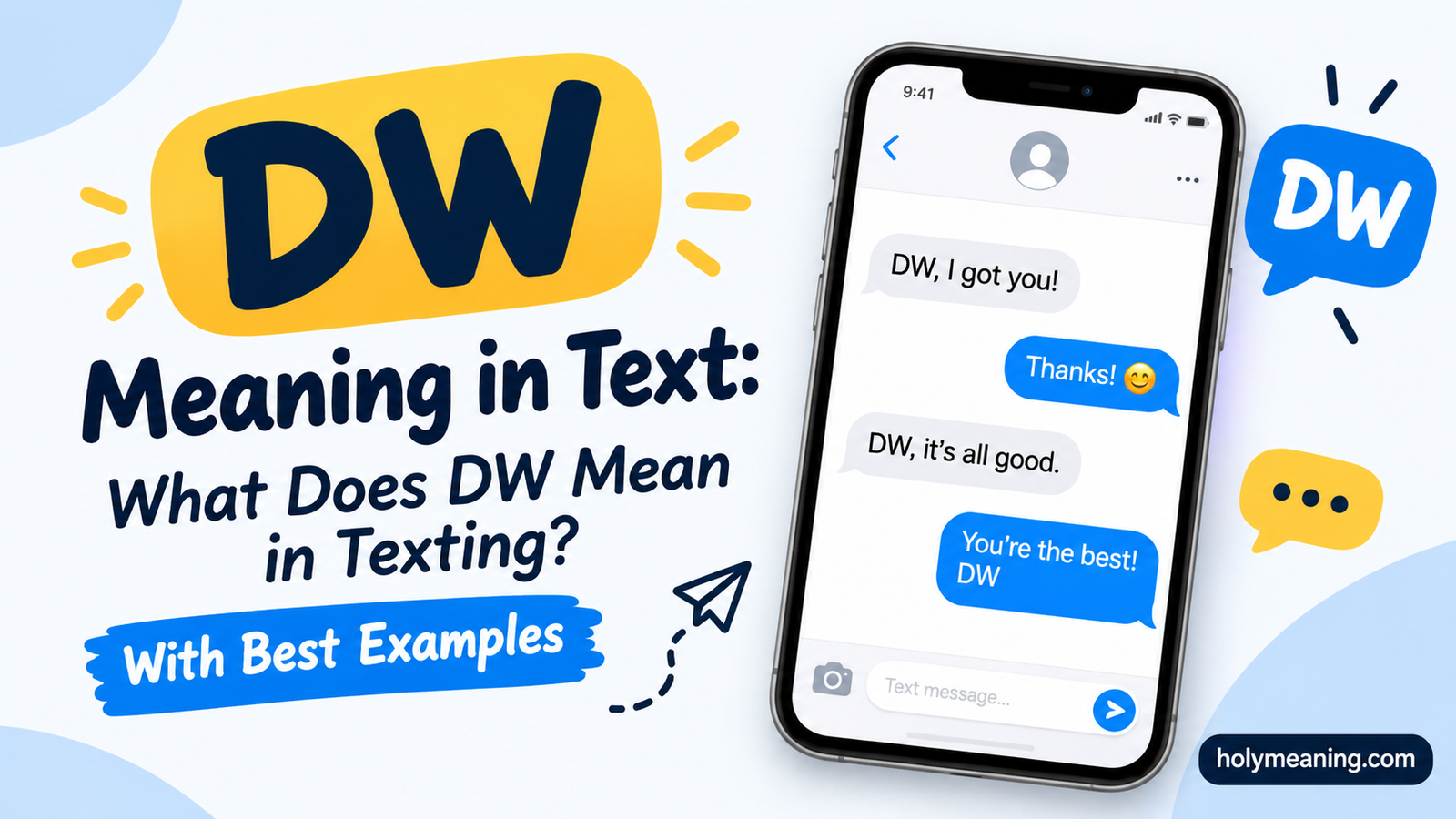
The DW meaning in text is simple: it stands for “don’t worry.” People type it to soothe a friend, accept an apology, or wave off a small hiccup in casual chats.
Two lowercase letters can land like a warm hug or a slammed door. Few of us ever pause to notice how much one tiny message can change a mood.
Beyond comfort, DW has a few surprising cousins. Depending on the chat, it can also mean Dear Wife, Dishwasher, or Doctor Who. Tone, punctuation, and context decide which one you’re reading. A quick look at the surrounding words usually settles it.
What Does DW Mean in Texting?
DW means “don’t worry.” People type it to reassure someone, to accept an apology, or to say a small problem doesn’t matter. It’s casual chat shorthand that saves a few keystrokes and sounds relaxed.
You’ll see it in several forms:
- dw (the most common version, all lowercase)
- DW (capitalized, often a bit more emphatic)
- dw about it (a gentle push to drop the subject)
- dw I got it (the speaker is handling the task)
- dw, it happens (a kind way to forgive a slip)
Here’s a typical exchange:
Maya: Sorry, I’m running ten minutes late!
Jordan: dw, I just got a table.
That’s all there is to it. Jordan isn’t annoyed. Jordan is saving Maya some stress.
Quick Definition Box
| Detail | Answer |
|---|---|
| DW abbreviation | DW |
| DW definition | Don’t worry |
| Type | Initialism (you say each letter) |
| Tone | Casual, friendly, sometimes brief |
| Best used | Friends, family, peers |
| Common synonyms | No worries, no problem, don’t stress, it’s okay |
Is DW Slang or an Abbreviation?
It’s both, depending on how you look at it. Technically, DW is an initialism. Each letter stands for a word, and you pronounce each letter on its own: “D-W.” That’s different from an acronym like “NASA,” which people say as a single word.
In everyday talk, though, most people call it texting slang. That label fits because DW lives almost entirely in informal spaces such as text threads, DMs, comment sections, and group chats. You won’t find it in a legal contract or a news article.
Dictionaries like Merriam-Webster track many informal terms. Slang often spreads long before editors record it. That’s how most texting abbreviations grow up.
Where Did DW Come From?
Nobody can point to a single origin. Shortened phrases like this began to spread with early SMS, when messages had tight character limits and typing on number pads took forever. People trimmed everything. “Don’t worry” became “dw” the same way “talk to you later” became “ttyl.”
Anyone who tells you DW was invented on a specific date by a specific person is guessing. The honest answer is that it grew naturally out of online language.
How People Use DW in Messages
DW in messages shows up in a handful of predictable situations. Learn these four patterns and you’ll decode almost any DW usage you run into.
Answering an Apology
This is the most common use. Someone says sorry for something small. You respond with DW to say, “No harm done.”
Sam: Sorry, I forgot to text you back yesterday.
Riley: dw, I figured you were busy.
Notice how the reply carries reassurance without making a speech out of it.
Calming Someone Who’s Worried
Here DW works as comfort. A friend feels nervous. You step in with a short, supportive line.
Chris: I think I bombed that interview.
Alex: dw, you prepped for weeks. You’ll hear back soon.
In this case, DW often sits next to a few extra words. That added detail makes the message feel sincere.
Waving Off a Small Inconvenience
Sometimes nobody’s upset. Someone just needs to know a minor hiccup isn’t a big deal.
Pat: I forgot to grab your charger.
Dana: dw, I’ve got a spare.
This version works like no worries or no problem. It keeps the mood light.
Closing a Topic
The phrase “dw about it” can signal that the speaker wants to move on. It might mean “I’ve got this” or “Let’s drop it.”
Lee: Should I help you with the budget?
Taylor: dw about it. Already done.
Tone matters here. A friendly “dw about it!” sounds helpful. A flat “dw about it.” after a tense argument can feel like a door closing.
DW Meaning in Chat vs. Social Media
The DW meaning in chat stays the same across platforms. Whether you’re on iMessage, WhatsApp, Snapchat, Instagram, TikTok, Discord, or Slack, DW still means don’t worry.
What changes is the style around it. Here’s a quick comparison:
| Platform | Typical style | Example |
|---|---|---|
| iMessage / SMS | Lowercase, short | “dw, see you at 7” |
| Lowercase plus emoji | “dw 😊 no rush” | |
| Snapchat | Very brief, quick replies | “dw lol” |
| Instagram DMs | Friendly, emoji-heavy | “dw!! it’s all good 💛” |
| TikTok comments | Often answers a creator or fan | “dw, part two is coming” |
| Discord | Gaming context, playful | “dw, I’ll carry the team” |
| Slack | Short, workplace tone | “dw, I’ll update the doc” |
Context drives everything. A comment on a gaming video might use DW to mean Dynasty Warriors. A reply in a family forum might mean dear wife. More on that in a moment.
Other Meanings of DW
Here’s where it gets interesting. DW isn’t a one-trick abbreviation. Several alternate meanings exist. The surrounding words almost always reveal which one someone intends.
| Meaning | Where you’ll see it |
|---|---|
| Don’t worry | Texts, DMs, comments (by far the most common) |
| Dear Wife | Parenting and family forums such as Mumsnet |
| Dishwasher | Home listings, recipes, appliance manuals |
| Doctor Who | Fan communities for the long-running BBC series |
| Deutsche Welle | The German international broadcaster at dw.com |
| Dynasty Warriors | Gaming chats and forums |
| Dragon Warrior | Retro gaming (the early North American name for Dragon Quest) |
| DeWalt model prefix | Tool listings, such as DW745 or DW735 |
Let’s unpack the big ones.
Dear Wife
On British-style family forums, users often write in shorthand. DW means Dear Wife. It usually appears alongside DH (dear husband), DS (dear son), and DD (dear daughter). Mumsnet, founded in 2000, helped popularize this style.
A sample line: “DW and I are taking the kids to the coast this weekend.” If you see that in a parenting thread, nobody’s telling you not to worry.
Dishwasher
Real estate listings squeeze lots of details into small spaces. A line like “Updated kitchen, DW, granite counters” means the kitchen has a dishwasher. Appliance manuals and recipe notes (such as “DW safe”) use it too.
Doctor Who
The BBC series first aired on November 23, 1963. Fans have been shortening the title for decades. In fan spaces, “DW” can mean the show itself. Someone might post, “Anyone watching the new DW episode?”
Deutsche Welle
Founded in 1953, Deutsche Welle is Germany’s international broadcaster. It publishes content in more than 30 languages at dw.com. People in news-related conversations sometimes refer to it as simply “DW.”
Dynasty Warriors
This is a long-running action game series from Koei Tecmo’s Omega Force studio. The first title arrived in 1997 as a one-on-one fighter. The series later became famous for its large-scale battles. Gamers shorten the name to DW in chats and forums.
Dragon Warrior and Tool Brands
Older gamers may remember that the first Dragon Quest game reached North America under the name Dragon Warrior. Meanwhile, DeWalt model numbers often begin with “DW,” so you’ll see those in tool listings and reviews.
How to Tell Which DW Meaning Someone Intends
Here’s a simple rule: check what came right before the “dw.” Context does most of the work. Think of it like a crossword clue. The words around it point to the answer.
After an Apology or Mistake
If someone just said sorry, it’s almost certainly don’t worry.
When Someone Sounds Stressed
If a person expresses nerves or concern, DW is a comfort phrase. It’s the same meaning.
In Family-Forum Posts
If the post mentions kids, a spouse, or other abbreviations like DH or DS, think Dear Wife.
In Gaming, TV, or Home Topics
Match it to the topic:
- Game talk usually points to Dynasty Warriors or Dragon Warrior.
- TV talk points to Doctor Who.
- Home or kitchen talk points to dishwasher.
- News or media talk can point to Deutsche Welle.
Quick Decoder
| Clue in the message | Likely meaning |
|---|---|
| “Sorry,” “my bad,” “oops” | Don’t worry |
| “Nervous,” “scared,” “stressed” | Don’t worry |
| “DH,” “DS,” “DD,” kids, marriage | Dear Wife |
| “Kitchen,” “listing,” “safe” | Dishwasher |
| “Episode,” “Tardis,” “Doctor” | Doctor Who |
| “Warriors,” “Musou,” “Koei” | Dynasty Warriors |
| “Broadcast,” “German news” | Deutsche Welle |
Does DW Always Mean Don’t Worry?
No. But it does most of the time. In personal texting, plan on don’t worry about 95 percent of the time. That’s a practical estimate based on how people use the term in everyday chats; no official survey exists.
The other meanings tend to live in narrow communities. If you’re texting with a friend, a coworker, or a date, you can safely assume the usual definition.
If you’re ever unsure, you’ve got two easy options:
- Read the sentence again with “don’t worry” swapped in. Does it make sense?
- Ask. A quick “Wait, what does DW mean here?” costs nothing.
What Tone Does DW Carry?
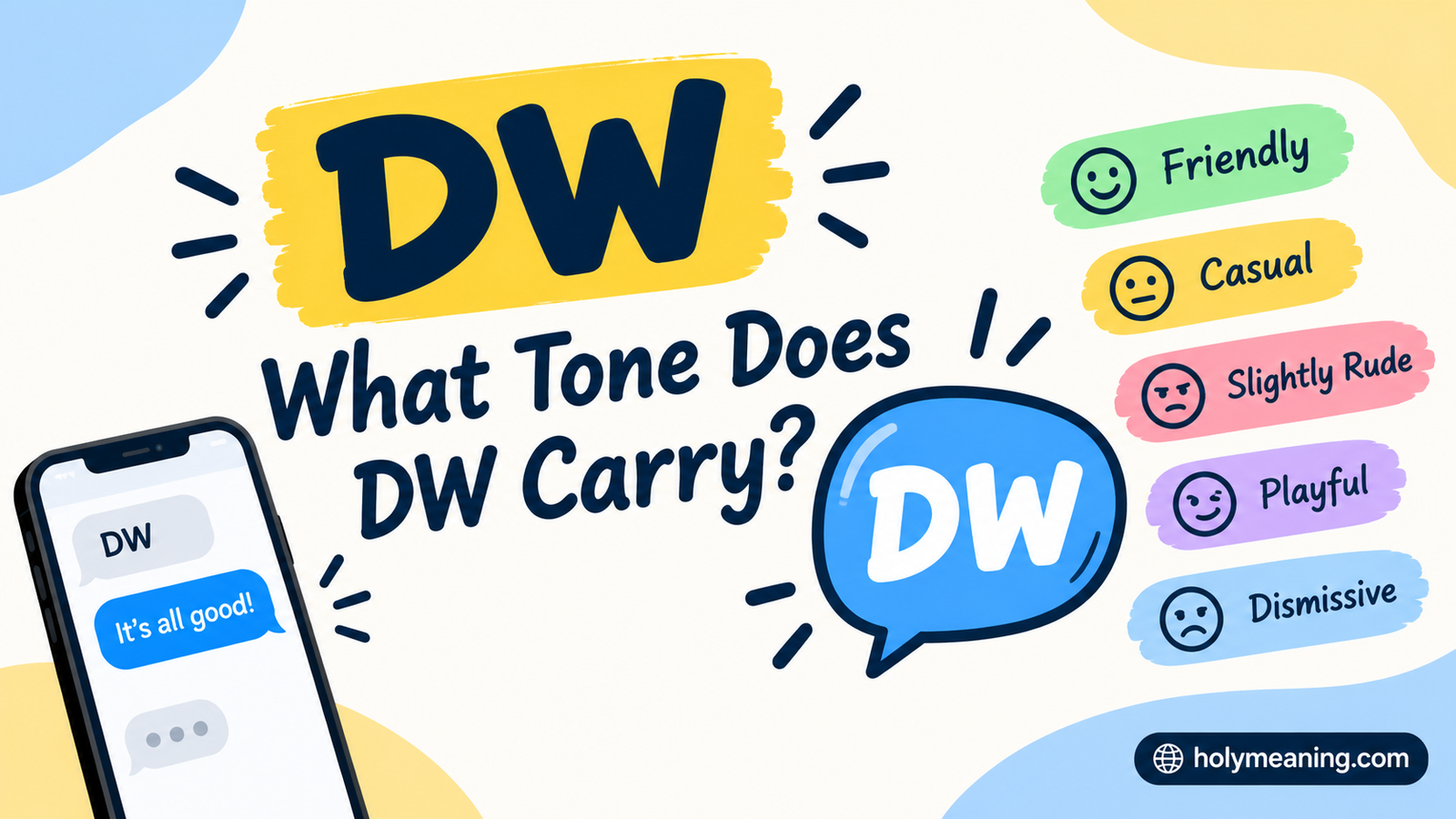
Text strips away your voice, your face, and your body language. That leaves texting tone to hide in tiny details. A single DW can sound friendly, flat, or even cold.
Let’s compare three versions:
| Message | How it reads |
|---|---|
| “dw!” | Warm and upbeat |
| “dw 🙂” | Friendly and relaxed |
| “dw.” | Neutral or slightly clipped |
What Shifts the Tone
Several small signals change the message tone:
- Punctuation. Exclamation points add warmth. A period can add distance.
- Emoji. A smiley or heart softens the line.
- Length. Extra words feel kind. A lone “dw” can feel brief.
- Reply speed. A fast answer feels relaxed. A slow one can feel loaded.
- History. Past conversations shape how you read the word.
Sincere vs. Clipped
Here’s a side-by-side look.
Sincere:
Jess: I’m so sorry I missed your call!
Ben: dw!! Call me when you’re free 😊
Clipped:
Jess: I’m really sorry. I feel awful about missing your birthday dinner.
Ben: dw.
The second reply is the same word. But after a long, heartfelt apology, a bare “dw.” may read as dismissive. It might mean “I’m fine.” It might mean “I’m hurt and don’t want to talk.” You’d have to judge based on your history together.
DW Meaning from a Girl or a Guy
People often search for the DW meaning from a girl or the DW meaning from a guy. Here’s the plain truth: gender doesn’t change the definition. Girl texting DW means don’t worry. Guy texting DW means the same.
What changes is texting context. Look at the relationship, the topic, and the mood.
DW from Her
If a girl texts you “dw” after you apologize, she’s most likely saying it’s fine. If she adds an emoji or a kind follow-up, the message reads as warm. If it’s a lone “dw.” after a real conflict, check in. A quick “Are we okay?” can clear the air.
DW from Him
If a guy texts “dw” after you cancel plans, he’s likely easygoing about it. Many people text in short bursts, so brevity isn’t always a signal. Look at his usual style. If he normally sends one-word replies, then “dw” is just his normal voice.
Flirting and Dating Context
Early dating adds extra pressure to every message. A relaxed “dw, we can reschedule” signals interest in a new plan. A flat “dw” with no follow-up might mean low energy. Don’t over-read one word. Look at the whole pattern.
| Situation | Likely meaning of “dw” |
|---|---|
| You apologize for cancelling | Reassurance, it’s fine |
| You say you’re nervous before a date | Comfort, don’t stress |
| Conversation has gone quiet | Possibly low interest; check other signals |
| You ask a favor and they reply “dw” | They’ve got it covered |
Using DW with Friends, Family, and Coworkers
DW fits some settings better than others. Think of it like wearing sneakers. They’re great for a walk in the park. They’re less ideal at a black-tie dinner.
Friends and Family
It’s fine in almost every case. When the moment matters, add warmth. For example: “dw, honestly, it’s no big deal.” That extra phrase turns a quick shorthand into a real reassurance.
Workplace Texting and Professional Messages
In professional messages, the answer depends on your audience.
It’s usually okay when:
- You’re chatting with a peer on Slack messages or Teams
- The workplace culture is relaxed
- The message is short and low-stakes
Skip it when:
- You’re writing to a client
- You’re messaging an executive
- It’s your first message to someone new
- The topic is serious or sensitive
Better swaps for formal communication:
| Instead of | Try |
|---|---|
| “dw” | “No problem at all.” |
| “dw about it” | “Please don’t worry about it.” |
| “dw, I got it” | “I’ll take care of it.” |
| “dw” | “That’s perfectly fine.” |
Business messaging leans on clarity. Spell it out, and nobody has to guess.
Case Study: The Slack Reschedule
This is an illustrative scenario based on common workplace habits.
Priya manages a marketing team. A junior designer, Marcus, messages her: “Sorry, my file is going to be an hour late.” Priya replies, “dw, send it by 3.”
Marcus relaxes. The tone fits because Priya and Marcus chat casually every day. Now imagine Marcus had written to the company’s CEO. A “dw” back from the CEO would still be fine. But if Marcus replied to the CEO with “dw,” it could feel too casual. Rank and relationship shape the work communication rules.
How to Reply to DW
Most of the time, you don’t need a long response. A short thank-you does the job. Here are some ready-made options.
| They send | Casual reply | Warmer reply |
|---|---|---|
| “dw, it happens” | “Thanks 🙏” | “Thanks, I appreciate you being cool about it.” |
| “dw about it” | “ok will do” | “Okay, I’ll let it go. Thanks for saying that.” |
| “dw, I got it” | “You’re the best” | “Thank you! Let me know if that changes.” |
| “dw!” | “Haha thanks” | “That means a lot, thank you.” |
| “dw, no rush” | “Cool, thanks” | “Thanks for the extra time. I’ll finish soon.” |
When You Don’t Need to Reply
Sometimes the conversation has already reached a natural end. A thumbs-up reaction or no reply is perfectly fine. Don’t force more words into a closed loop.
When to Follow Up
If the DW felt flat or cold, you can check in. Try one of these:
- “Just checking. Are we good?”
- “I really am sorry. Want to talk it through?”
- “Thanks for understanding. I’ll make it up to you.”
These are gentle, direct, and low-pressure.
DW vs. Similar Texting Expressions
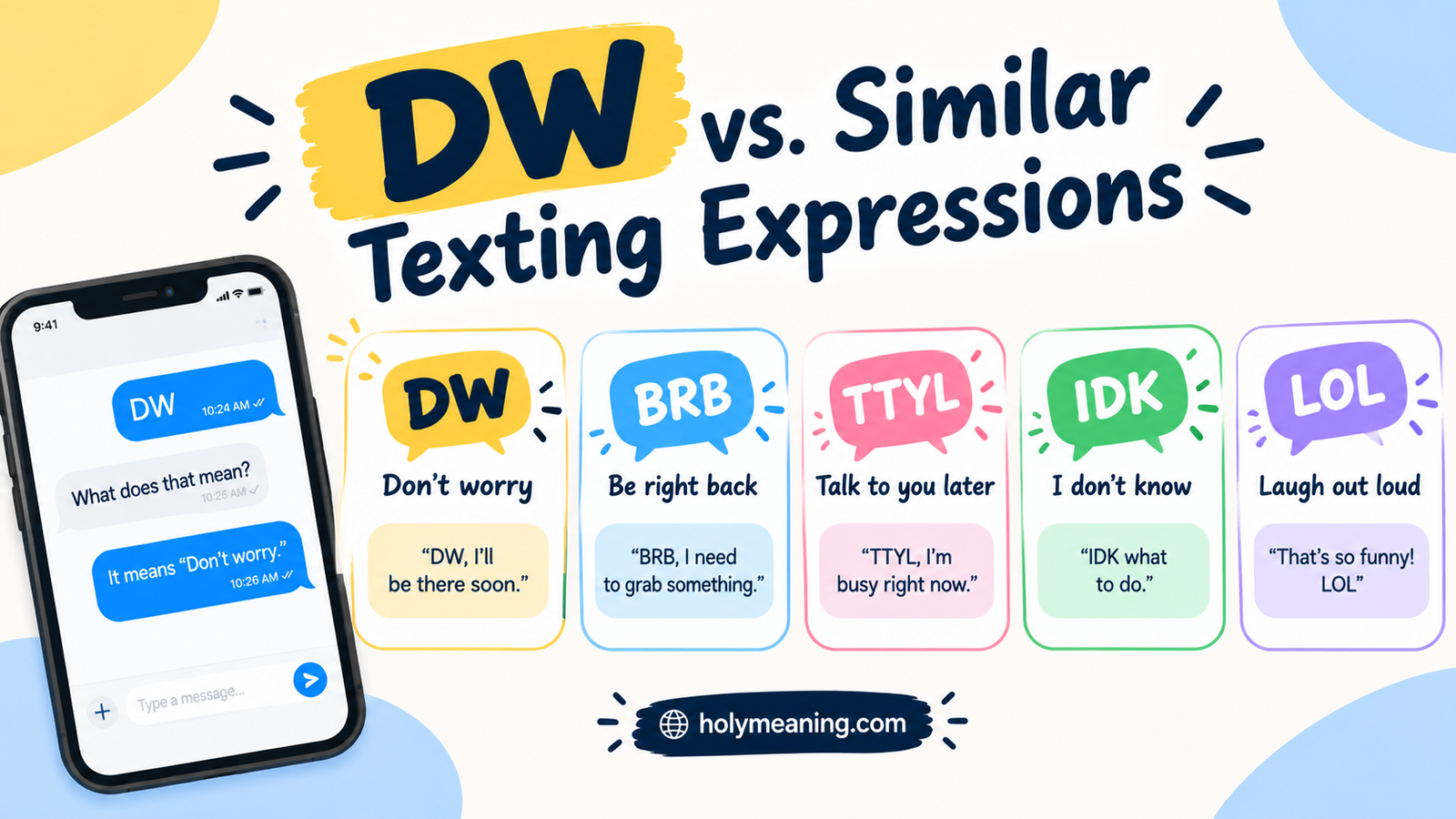
DW has plenty of cousins. These similar texting expressions overlap a bit but they aren’t identical. Knowing the difference helps you pick the right one.
| Term | Meaning | Key difference from DW |
|---|---|---|
| NW | No worries | Nearly identical; slightly more relaxed |
| NP | No problem | Replies to thanks, not apologies |
| NVM | Never mind | Withdraws a question or request |
| YW | You’re welcome | Answers thanks only |
| IDC | I don’t care | Dismissive, not reassuring |
DW vs. NW
These two are close twins. NW (no worries) leans a little more laid-back. DW (don’t worry) leans slightly more toward comfort. In practice, people swap them freely.
DW vs. NP
NP (no problem) usually answers a “thank you.” DW usually answers a “sorry.” That’s the cleanest way to separate them.
DW vs. NVM
NVM (never mind) cancels what you said earlier. If you ask a question and then say “nvm,” you want the other person to ignore it. DW doesn’t cancel anything. It soothes.
DW vs. IDC
Be careful here. IDC (I don’t care) can sound harsh. DW is kind by comparison. Don’t mix them up when you’re in a delicate moment.
Real DW Examples by Situation
Nothing teaches like practice. Below are real DW examples you can adapt. These sample exchanges come from common everyday scenarios.
Running Late
Nina: Stuck in traffic. So sorry!
Omar: dw, I’ll order you a coffee.
Canceled Plans
Leo: I have to cancel tonight. Family thing came up.
Grace: dw, we’ll do it next week!
A Forgotten Item
Kai: I left your book at home. Ugh.
Zoe: dw, give it to me Monday.
Nerves Before a Test
Tess: My exam is in an hour. I’m freaking out.
Ravi: dw, you know this stuff. Go crush it.
A Work Reschedule
Hannah: Can we push our meeting to Thursday?
Mike: dw, Thursday works.
A Small Mistake in a Group Chat
Dev: Oops, wrong chat. Sorry everyone!
Lena: dw lol happens to all of us.
A Late Reply
Cole: Sorry for the slow response. Crazy week.
Ava: dw, no pressure at all.
A Friend Feeling Guilty
Ellis: I feel terrible for missing your show.
Rae: dw, I’m not mad. Come to the next one.
Taking Charge of a Task
Sky: Do you need help with the slides?
Ben: dw, I’ve got it covered.
Gentle Closing of a Topic
Mel: I keep thinking about what I said yesterday.
Drew: dw about it. Seriously. All good.
DW Case Studies: Mixed Signals and Misreads
Short messages cause long misunderstandings. These two DW scenarios show how.
Case Study: The Birthday Apology
This is an illustrative scenario.
Tom forgot his friend Alicia’s birthday dinner. He sent a long, heartfelt apology. Alicia replied with a single word: “dw.”
Tom spiraled. Was she angry? He called her. She laughed. She’d been driving, and she typed fast. The real message was “I’m fine.” The lesson is simple: brief doesn’t always mean cold. Check the context before assuming the worst.
Case Study: The Quiet Hurt
This is another illustrative scenario.
Sara canceled on her sister for the third time that month. Her sister answered “dw.” No emoji. No follow-up. No “see you soon.”
This time, the pattern signaled hurt. Sara called, apologized, and rescheduled. They had a real conversation. Sometimes DW hides disappointment. When your gut says something’s off, trust it and check in.
The Takeaway
| Signal | Probably fine | Possibly hurt |
|---|---|---|
| Emoji or exclamation | ✔ | |
| Follow-up plan | ✔ | |
| Fast, upbeat reply | ✔ | |
| Flat, one-word reply after repeated cancellations | ✔ | |
| No further messages | ✔ |
Is DW Formal or Informal?
Informal. Always. DW belongs to casual texting, casual communication, and casual expressions. It’s chat shorthand for people who already feel comfortable with each other.
Should you capitalize it? Either way works. Lowercase “dw” feels relaxed. Uppercase “DW” feels a bit more emphatic. Neither one is wrong.
In formal communication, spell it out. Write “Please don’t worry” or “There’s no need to be concerned.” It reads as polite and professional.
Mistakes to Avoid When Using DW
A few small slip-ups can create confusion. Steer clear of these.
- Reading “dw” as cold when it’s just brief. Check the sender’s usual style first.
- Using it to brush off something that truly bothers the other person. If someone’s upset, a quick “dw” can feel dismissive.
- Sending it to a boss or client. Choose a fuller phrase.
- Assuming “Dear Wife” outside forum culture. Outside parenting boards, this meaning is rare.
- Over-using it. A conversation packed with abbreviations can feel robotic.
- Ignoring context. The same word means different things in different spaces.
Tips for Using DW Naturally
Want your DW usage to sound human? Try these habits.
- Pair it with a detail. “dw, I’ll handle the tickets” feels richer than “dw.”
- Match the other person’s energy. If they’re stressed, add warmth.
- Use emoji sparingly. One friendly symbol goes a long way.
- Vary your phrasing. Mix in no worries, no problem, don’t stress, and it’s okay so you don’t repeat yourself.
- Think about timing. Respond quickly when someone feels anxious.
Alternatives Worth Knowing
| Phrase | Vibe |
|---|---|
| “No worries” | Relaxed and friendly |
| “No problem” | Easygoing |
| “Don’t stress” | Casual and supportive |
| “It’s okay” | Gentle and kind |
| “All good” | Breezy |
| “You’re fine” | Soft and reassuring |
Why Texting Shorthand Keeps Growing
Texting abbreviations haven’t faded. They’ve evolved. Early phones capped messages at 160 characters, which pushed people toward shortcuts. That limit shaped a whole messaging shorthand culture.
Today, character limits matter less. Speed still matters. People type on small screens while walking, commuting, or juggling other tasks. Shorthand like DW, NW, NP, NVM, and YW helps keep conversations quick.
Shorthand also signals closeness. When you drop into abbreviations with someone, it suggests ease. That’s why DW feels natural among friends yet awkward in formal settings.
If you’re curious about how new terms spread, browse Urban Dictionary. It’s user-submitted, so treat it as a window into usage rather than a final authority.
FAQs
What does DW mean in text?
DW stands for “don’t worry.” People use it to reassure a friend or accept an apology in casual chats.
Does DW have other meanings?
Yes. Depending on the space, it can mean Dear Wife, Dishwasher, or Doctor Who. The surrounding words usually reveal which one you’re reading.
What is the DW meaning from a girl or a guy?
It means the same thing no matter who sends it. Tone, emoji, and your history with the person tell you how warm it is.
Is DW rude?
Not by default. A lone “dw.” after a heartfelt apology can feel curt, so check the punctuation and context.
Can you use DW in professional messages?
It’s fine with close peers on Slack. With clients or executives, write “no problem at all” instead.
conclusion
The DW meaning in text is easy to remember. It stands for “don’t worry.” People use it to comfort friends, accept apologies, and keep chats light. Other meanings exist, like Dear Wife or Dishwasher. Context tells you which one fits.
Now you know how to read the DW meaning in text with confidence. Check the tone, the punctuation, and the person behind the message. Use it freely with friends. Skip it with clients. When a “dw” pops up, you’ll know exactly what it means.








2 thoughts on “DW Meaning in Text: What Does DW Mean in Texting? With Best Examples”