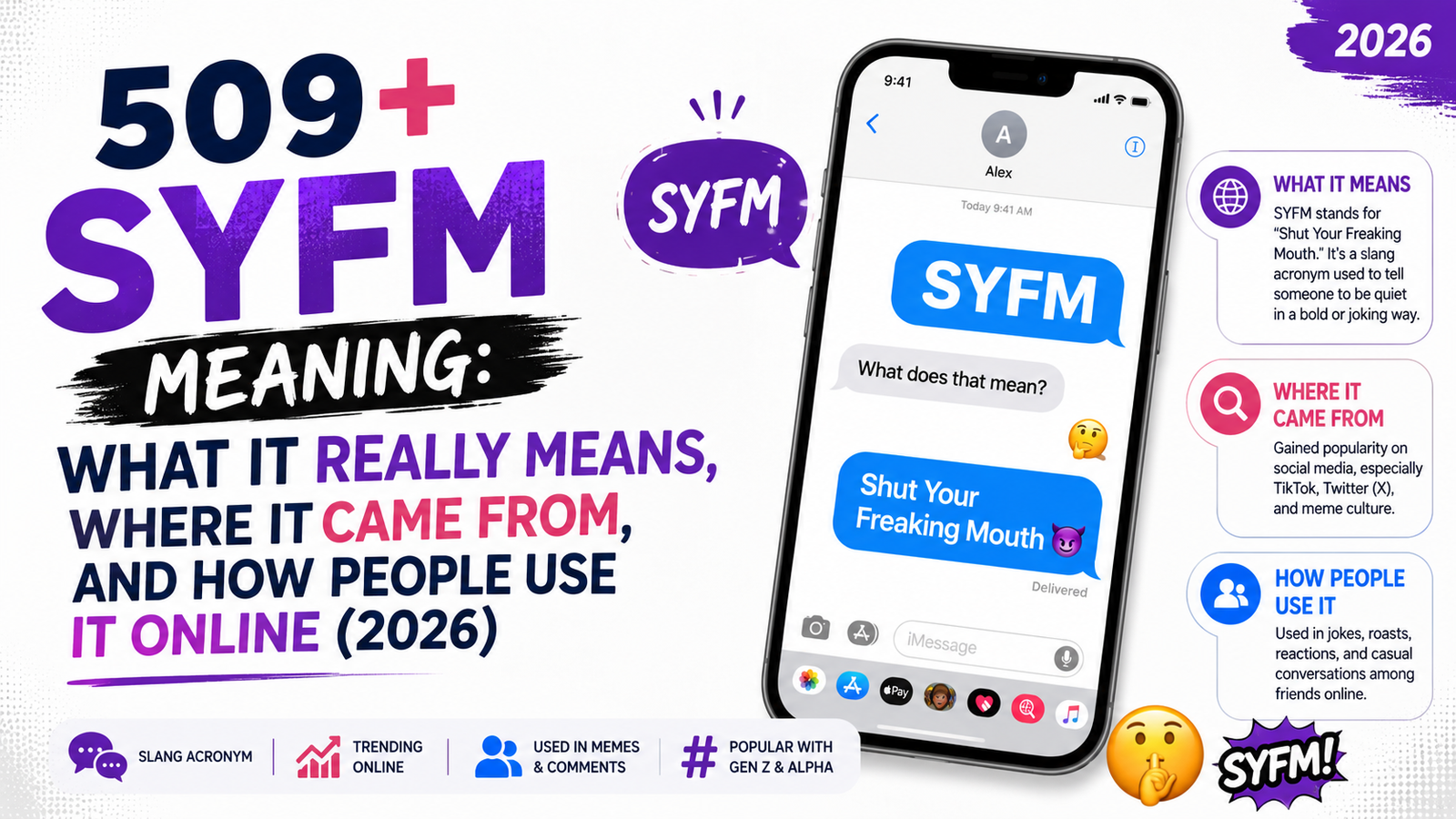
syfm meaning stands for “Shut Your F**king Mouth,” a blunt, profanity-driven piece of internet slang used to tell someone to stop talking. It shows up across texting, gaming chat, and social media, carrying a tone that ranges from playful to genuinely hostile depending on context.
Picture this: a friend roasts you in the group chat, you fire back “SYFM 😭,” and suddenly four random letters carry more attitude than a full sentence ever could. That’s the power this tiny acronym holds online.
Behind that punchy exterior sits a real story worth knowing — one tied to internet slang history, gaming culture, and the way TikTok turns old phrases into fresh viral moments. Here’s what SYFM actually reveals about how we talk online.
What Does SYFM Mean? The Core Definition
Let’s get straight to it. SYFM stands for “Shut Your F**king Mouth.” That’s the primary and most widely recognized SYFM acronym breakdown across slang dictionaries, texting glossaries, and internet culture trackers.
In plain terms, it’s a blunt, profanity-based way of telling someone to stop talking. It’s aggressive by design. The whole point of the phrase is to shut a conversation down fast, whether that’s because someone’s annoying, oversharing an opinion nobody asked for, or pushing a person’s buttons in an argument.
Here’s the thing people searching “what does SYFM mean” often miss: the words themselves are simple, but the tone behind them does all the heavy lifting. The same four letters can read as a light jab between friends or a genuinely hostile insult, depending entirely on context. That distinction matters more than the definition itself, and we’ll unpack it throughout this guide.
Quick facts about SYFM:
| Attribute | Detail |
|---|---|
| Full meaning | Shut Your F**king Mouth |
| Category | Vulgar internet/texting slang |
| Tone | Aggressive, blunt, dismissive |
| Common platforms | TikTok, texting, Reddit, gaming chat, X (Twitter) |
| Typical use case | Silencing someone in an argument, annoyance, or joking insult among friends |
| Formality level | Strictly informal — never appropriate in professional settings |
| Related terms | STFU, SYBAU, SYM |
Secondary Meanings Worth Knowing
While “Shut Your F**king Mouth” is the dominant and most consistently cited SYFM definition, a handful of slang trackers list rare, largely unrelated backronyms tied to the same four letters — things like casual shorthand for agreement in unrelated niche communities. These alternate meanings show up so infrequently that they’re not worth treating as real competing definitions. If you see SYFM in a text, a comment section, or a gaming lobby in 2026, it means “Shut Your F**king Mouth” roughly 99% of the time. Context will confirm it fast — usually within the same sentence.
Where Did SYFM Come From? SYFM Origin and History
Understanding SYFM origin means understanding a much bigger pattern in internet culture: the constant recycling of “shut up” into new acronym forms.
The Early Internet’s Acronym Habit
Long before SYFM existed, internet forums, IRC chats, and early texting culture were already shortening blunt phrases into letters. STFU (“Shut The F**k Up”) is the clearest ancestor here — a term that’s been part of internet acronyms culture since the late 1990s and early 2000s, born out of forums, gaming lobbies, and instant messaging platforms where typing speed mattered and bluntness was the norm.
SYFM follows that exact same formula, just with different wording (“mouth” instead of “up,” and a possessive “your” instead of “the”). It’s less a brand-new invention and more a remix of a phrase people have been shortening for two decades. That’s a pattern worth remembering any time a “new” piece of slang goes viral: it’s rarely actually new. It’s usually an old idea wearing a fresh acronym.
How SYFM Resurfaced and Spread
SYFM’s more recent spike in visibility traces back to short-form video culture. Meme-tracking communities like Know Your Meme have documented SYFM, alongside its cousin term SYBAU (“Shut Your Bitch Ass Up”), circulating heavily through TikTok comment sections and reaction videos. A wave of short clips using the phrase — often layered over reaction audio or paired with exaggerated facial expressions — helped push it from niche texting slang into something closer to mainstream meme culture.
From there, the usual spread pattern kicked in:
- TikTok comment sections picked it up first, using it as a punchy, half-joking clapback.
- Gaming chat absorbed it next, since gamers already had a long history of blunt, profanity-laced shorthand.
- Reddit and X (Twitter) followed, where it started appearing in replies during arguments or debates.
- Group texts picked it up last, once it had enough cultural recognition that friends could use it without needing to explain the joke.
This spread pattern isn’t unique to SYFM. It’s basically the standard online evolution path for most viral texting slang — video platforms surface it, gaming and forum culture normalize the bluntness, and texting between friends is where it finally softens into something closer to playful.
The Many Ways People Use SYFM Online
SYFM usage isn’t one-size-fits-all. The exact same four letters shift meaning depending on the relationship between the people using them and the platform they’re on. Here’s a breakdown of the real, common use cases you’ll actually run into.
Between Close Friends — The Playful Use
Among people who already have a close, joking relationship, SYFM often loses most of its bite. It becomes closer to “oh stop” or “shut up, that’s hilarious” than an actual insult.
Example text exchange:
Friend 1: “I told him you cried during that movie.” Friend 2: “SYFM 😭 you promised you wouldn’t say anything.”
Here, nobody’s actually offended. The phrase is doing the same job as an eye-roll emoji — mild, exaggerated annoyance, not real hostility.
As a Genuine Insult
On the flip side, SYFM shows up constantly as an actual insult, especially in arguments where someone wants to shut the other person down without engaging further.
Example:
Person A: “You clearly don’t know what you’re talking about.” Person B: “SYFM. You weren’t even there.”
This version carries real hostility. It’s dismissive on purpose — a way of ending a conversation by insulting the other person’s right to speak at all.
In Gaming Chat — Trash Talk Culture
SYFM in gaming chat fits neatly into a much older tradition: trash talk. Multiplayer games, especially competitive ones, have long had their own dialect of blunt, aggressive shorthand, and SYFM slots right in alongside older staples like STFU.
In this context, it’s less about genuine anger and more about competitive banter — the gaming equivalent of trash-talking someone after a bad play. That said, tone still varies. A friendly squad using it after a funny in-game mistake is very different from a toxic lobby using it to actually harass someone. Gamer communication has always walked that line, and SYFM is no exception.
In Reaction Memes and TikTok Comments
On TikTok specifically, SYFM frequently shows up as a comment-section reaction — a quick, punchy response to a video that’s either mildly annoying, unintentionally funny, or delivering a hot take nobody asked for. It works almost like a digital eye-roll stamped under a video, often paired with laughing emojis to soften it into a joke rather than a genuine callout.
Real-World Usage Examples by Platform
| Platform | Typical Tone | Example |
|---|---|---|
| Texting (close friends) | Playful, joking | “SYFM 😂 you’re never gonna let that go” |
| TikTok comments | Reactive, half-serious | “SYFM this take is wild” |
| Gaming chat | Competitive trash talk | “SYFM you missed that shot on purpose” |
| Reddit threads | Dismissive, argumentative | “SYFM, this has been debunked already” |
| X (Twitter) replies | Confrontational | “SYFM nobody asked for your opinion” |
SYFM in Texting vs. Social Media vs. Dating Apps
Context changes everything with this phrase, and nowhere is that clearer than comparing SYFM in texting against SYFM on social media and, separately, dating apps.
Texting: Intimacy Shapes Everything
In one-on-one texting between people who already know each other well, SYFM tends to land softer. Established relationships come with shared context — inside jokes, a known sense of humor, a track record of teasing each other. That history is what turns a harsh-sounding phrase into a harmless one.
The risk zone is texting someone you don’t know that well. Without an established rapport, the same phrase can land as genuinely rude, since the receiver has no context to soften it with.
Twitter/X and Reddit: Expect Heat
SYFM on social media, particularly on X and Reddit, skews more hostile by default. Public platforms strip away the personal relationship that softens the phrase in texting. When a stranger types SYFM at you in a comment thread, there’s no shared history to fall back on — it almost always reads as a genuine attempt to shut down your point rather than a joke.
Reddit threads in particular tend to use it as a conversation-ender during debates, especially in comment sections already running hot with disagreement.
Dating Apps: Major Red Flag
This one deserves its own callout. If someone sends SYFM to you on a dating app — especially early in a conversation, before any real rapport exists — treat it as a warning sign. There’s no established relationship to justify the bluntness, and using aggressive, profanity-laced language that early is a pretty reliable signal of how someone communicates under mild friction. It’s not really about the acronym itself; it’s about what using it that early says about someone’s baseline communication style.
How to Respond When Someone Sends You SYFM
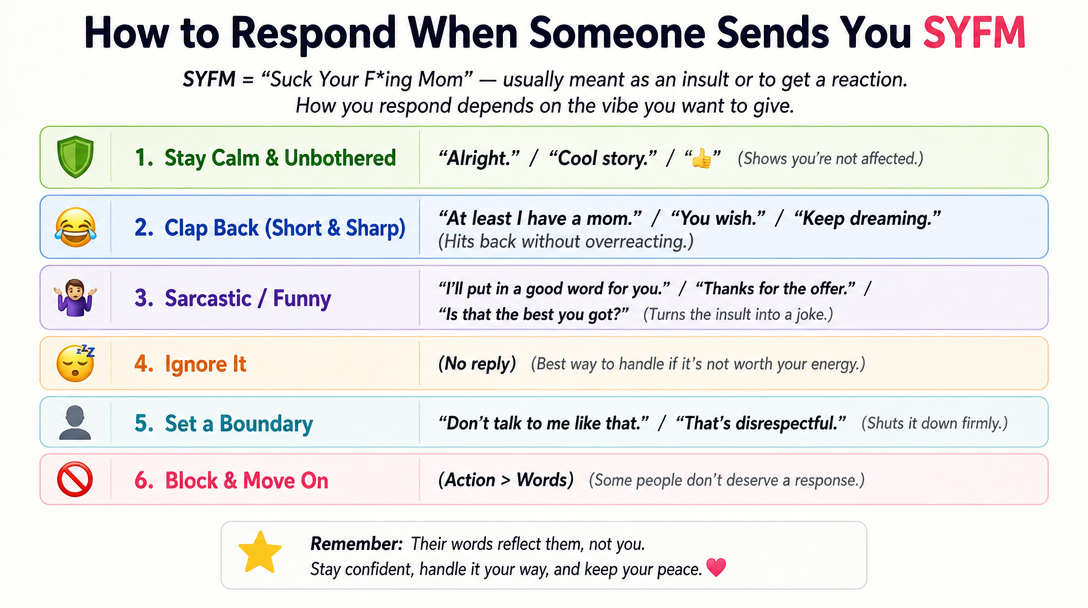
Knowing how to respond to SYFM comes down to reading tone accurately before reacting. Here’s a practical breakdown.
If It’s Clearly a Joke from a Friend
If the context is playful — an inside joke, a laughing emoji, an ongoing bit — the easiest move is to just play along. Responding with a similar level of exaggerated mock offense usually keeps the tone light: “wow, rude” or a laughing reaction does the job fine. Overreacting to an obvious joke tends to create more friction than the original message ever did.
If It Feels Aggressive
If someone sends it with real hostility, especially mid-argument, it’s worth pausing before reacting. Firing back with equal aggression usually escalates things fast. A more effective conflict resolution approach is to name what happened directly: “That came across pretty harsh — what’s actually going on?” This shifts the conversation away from the insult and back toward whatever the real issue is.
If You’re Unsure of the Tone
Text lacks tone of voice, so ambiguity is common. When you genuinely can’t tell whether someone’s joking or serious, asking directly beats guessing: “wait, are you actually annoyed or just messing around?” It’s a small, low-stakes question that avoids both an overreaction to a joke and an underreaction to a real problem.
Quick response guide:
| Situation | Suggested Response Style |
|---|---|
| Obvious joke from a close friend | Play along, keep it light |
| Genuine hostility in an argument | Stay calm, name the tone, ask what’s going on |
| Unclear tone | Ask directly instead of assuming |
| Stranger on social media | Disengage — rarely worth a serious reply |
| Dating app, early conversation | Treat as a communication red flag |
SYFM vs. Similar Slang Terms — Full Comparison
SYFM doesn’t exist in isolation. It’s part of a small family of blunt “stop talking” acronyms that overlap heavily in meaning but differ slightly in tone and intensity.
| Term | Full Meaning | Intensity | Typical Context |
|---|---|---|---|
| SYFM | Shut Your F**king Mouth | High | Texting, TikTok, gaming, arguments |
| STFU | Shut The F**k Up | High | General internet slang, forums, gaming |
| SYBAU | Shut Your Bitch Ass Up | Very high | TikTok comments, confrontational replies |
| SYM | Shut Your Mouth (no profanity) | Moderate | Softer version, more casual disagreements |
A few things stand out in this slang comparison. First, all four terms share the same basic function — telling someone to stop talking — but they scale in aggression depending on the specific wording. SYM, without profanity, is genuinely milder and shows up in situations where someone wants to sound annoyed without being outright vulgar. SYBAU sits at the top of the intensity scale thanks to its added insult layered on top of the “shut up” instruction.
Second, these terms tend to travel together. If you see one in a comment section, there’s a good chance you’ll spot the others nearby, since they’ve spread through the same TikTok and gaming-adjacent communities around the same period.
Is SYFM Offensive? Hidden and Contextual Meanings
Asking “is SYFM offensive” doesn’t have a single yes-or-no answer, because the phrase’s offensiveness depends almost entirely on three variables: relationship, platform, and delivery.
When It Crosses the Line
SYFM becomes genuinely offensive when it’s:
- Used by a stranger with no established relationship
- Sent during a real, heated disagreement rather than banter
- Paired with other insults or dismissive language
- Used repeatedly to shut someone down or silence their input
- Sent in a professional or semi-formal setting, where profanity is inappropriate regardless of tone
In these situations, it’s not really a gray area. The profanity and dismissiveness built into the phrase are doing exactly what they’re designed to do — shutting someone down and disrespecting them in the process.
When It Doesn’t Land as Offensive
On the other end, SYFM regularly gets used without any real intent to offend, particularly:
- Between friends with an established pattern of teasing
- Paired with laughing emojis or reaction memes signaling it’s a joke
- In gaming chat among people who already trash-talk regularly
- As a lighthearted response to something mildly embarrassing, not something serious
The honest takeaway here: SYFM is a phrase that carries contextual meaning more than fixed meaning. The words don’t change, but what they communicate absolutely does, based on who’s saying them and why.
Do Regional or Generational Differences Really Matter?
Unlike some slang that’s genuinely regionally coded, SYFM doesn’t show meaningfully different meanings across countries. It’s internet-native slang, born on video and texting platforms that don’t respect borders, so a teenager in Ontario and a teenager in Manchester are pulling the phrase from the same TikTok and gaming ecosystem.
Where a real difference does show up is generational. SYFM is overwhelmingly a Gen Z slang term — most commonly used by teens and young adults active on TikTok, in gaming chat, and in fast-moving group texts. Older internet users are far more likely to recognize its ancestor, STFU, without necessarily knowing SYFM at all. If you’re seeing it and don’t recognize it, that gap is generational far more than it is regional.
Common Misconceptions About SYFM
A few myths keep circulating around this term, so it’s worth clearing them up directly:
- “SYFM is brand new.” It’s not. It’s a variation on a decades-old pattern of shortening “shut up” phrases into acronyms — STFU came first, SYFM is a newer remix of the same idea.
- “SYFM always means someone’s genuinely angry.” Not true. Plenty of everyday conversations use it jokingly, especially between friends who already trash-talk each other regularly.
- “It only exists in gaming.” It didn’t start there and doesn’t live there exclusively — texting and TikTok comment sections use it just as often, if not more.
- “There are hundreds of distinct meanings.” There aren’t. The core SYFM definition stays consistent; what changes is tone and context, not the actual meaning of the words.
Should You Use SYFM? A Practical Guide
Whether SYFM is a safe phrase to use comes down almost entirely to who you’re talking to and where.
Quick Reference Table
| Situation | Should You Use SYFM? |
|---|---|
| Texting a close friend who jokes this way already | Yes, generally safe |
| Texting someone you don’t know well | No — risk of misreading the relationship |
| Gaming chat with regular squadmates | Usually fine, read the room first |
| Public comment section (TikTok, Reddit, X) | Use with caution — strangers won’t have context |
| Dating app conversation | No — too aggressive for an unestablished connection |
| Any professional or formal setting | Never |
| Talking to someone significantly younger or a minor | Avoid — inappropriate given the profanity |
The general rule: the less established the relationship and the more public the platform, the riskier this phrase becomes. It’s built for close, informal, already-joking dynamics — not for strangers, coworkers, or anyone who hasn’t already signaled they’re fine with blunt, profanity-laced humor.
SYFM in Professional and Formal Communication
There isn’t much nuance here. SYFM has no place in professional or formal digital communication, full stop. It’s built entirely around profanity and confrontation, both of which are inappropriate in workplace messaging, client communication, customer service exchanges, or any formal correspondence.
If you’re tempted to use a version of this sentiment at work — say, to shut down a coworker’s unsolicited opinion — a professional alternative gets the point across without the risk: “Let’s stay focused on the task at hand” or “I’d rather not get into that right now.” Same intent, none of the fallout.
Parent and Educator Guide: What to Know About SYFM
Parents and educators searching for this term have often spotted it in a kid’s texts or comment history and understandably want context.
It’s Not Always What It Looks Like
Seeing SYFM once, especially in a joking exchange between established friends, isn’t automatically a red flag. As covered throughout this guide, it’s frequently used playfully, and plenty of teens use it the same way earlier generations used milder insults — as low-stakes teasing, not genuine aggression.
When to Be Concerned
That said, a few patterns are worth paying attention to:
- Repeated, one-sided use where the same person is consistently on the receiving end
- Escalating hostility paired with other insults, not just this single phrase
- A shift in tone where a previously playful relationship starts looking genuinely hostile
- Use in contexts with strangers, particularly on gaming platforms or public comment sections, which can signal exposure to more toxic online spaces
Starting the Conversation
If a parent or educator wants to bring this up, leading with curiosity works better than leading with alarm. Something like “I saw this phrase come up — what does it usually mean when you or your friends use it?” opens a conversation instead of shutting one down (ironic, given the phrase itself). Most of the time, the answer will be exactly what this guide has described: a blunt, informal way of saying “quit talking,” used mostly in fun.
FAQs
1. What does SYFM mean?
SYFM stands for “Shut Your F**king Mouth,” a blunt slang term used to tell someone to stop talking.
2. Is SYFM offensive?
It can be. Among close friends it’s often a joke, but from strangers or in arguments it reads as genuinely rude.
3. Where did SYFM come from?
It’s a modern variation on older “shut up” acronyms like STFU, popularized recently through TikTok comments and gaming chat.
4. What’s the difference between SYFM and SYBAU?
Both mean “shut up,” but SYBAU (“Shut Your Bitch Ass Up”) carries a sharper insult and generally reads as more aggressive.
5. Should I use SYFM on a dating app?
No — without an established relationship, it usually comes across as a red flag rather than a joke.
conclusion
At the end of the day, SYFM meaning comes down to one simple phrase: “Shut Your F**king Mouth.” It’s blunt. It’s informal. And it shows up everywhere, from texts to TikTok comments to gaming chats. The words never change. But the tone behind them always does.
Understanding SYFM meaning isn’t really about memorizing an acronym. It’s about reading the room. A joke between friends looks nothing like a real insult from a stranger. Once you get that difference, you’ll never misread this slang again.