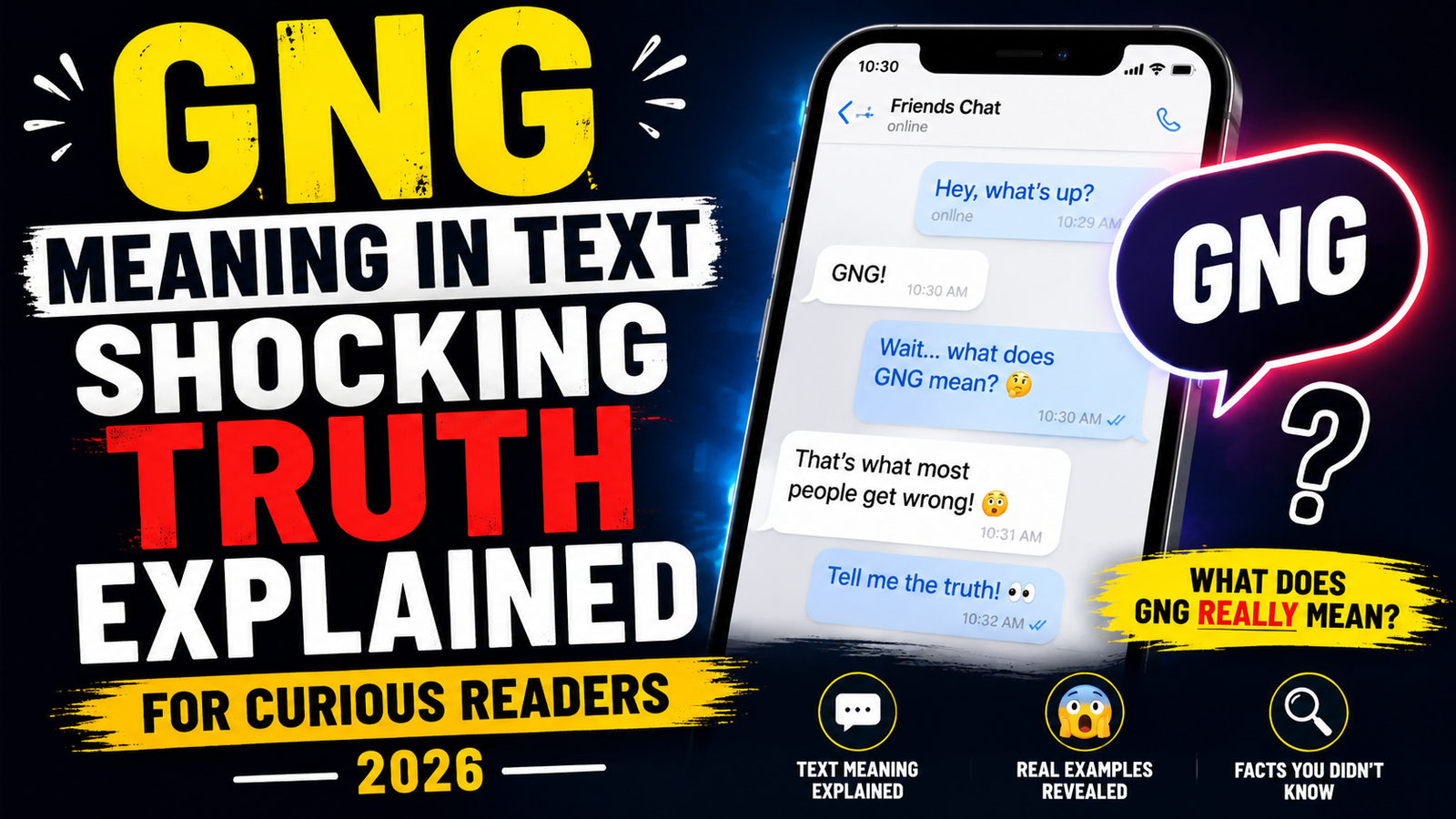
GNG meaning in text shifts depending on where you spot it. Most of the time, it stands for “gang,” a casual nod to your closest friends or crew. In other conversations, it simply means “going,” a quick stand-in for someone heading out or moving on to something else.
Three letters, four completely different meanings, and one very confused reader caught in the middle. That’s the reality of modern texting slang, and GNG might be the trickiest example out there.
Depending on the platform, GNG can also mean “Good Night Gang” or, in professional settings, “Go/No-Go.” Knowing which one applies turns confusing texts into conversations that finally make sense.
What Does GNG Mean in Text?
Here’s the short version, since you probably want it fast: GNG doesn’t have one fixed meaning. It’s a flexible abbreviation, and its definition depends entirely on context.
That said, four interpretations cover almost every real-world use:
| Meaning | Where You’ll See It | How Common |
|---|---|---|
| Gang (friend group, crew) | Texting, social media, gaming | Most common overall |
| Going | SMS, Snapchat, casual chats | Very common |
| Good Night Gang | TikTok and Instagram comments/DMs | Common as a sign-off |
| Go/No-Go | Workplace, project management | Common only in professional settings |
Notice something important here: three of these meanings live in casual, social contexts, while the fourth lives almost entirely in offices and project meetings. That split matters. If a coworker texts you “GNG” during a product launch, they’re probably not calling you their crew. They want to know if the launch is happening or not.
Context is everything with this one. Let’s go through each meaning properly.
The Real Meanings of GNG, Ranked by How Often You’ll See Them
GNG = Gang (Most Common by Far)
In casual GNG slang, “gang” wins the popularity contest by a wide margin. When someone types GNG in a group chat or comment section, they usually mean their circle of close friends. Think of it as digital shorthand for “my crew,” “my people,” or “my squad.”
Linguistically, this use comes from a process called vowel deletion, where digital slang strips out vowels to shrink a word down. “Gang” loses its A and becomes GNG. You’ll see the same pattern in words like “msg” for message or “plz” for please. It’s not laziness so much as efficiency: typing fast matters more than typing fully.
Here’s what makes this meaning distinct: it usually carries warmth. When someone says “love y’all, GNG” or “we got this, GNG,” they’re expressing loyalty and belonging, not describing an actual criminal organization. The friend group sense of GNG has almost nothing to do with organized crime in the vast majority of everyday conversations. Confusing the two is one of the biggest misreads people make with this term.
Example conversation:
Jordan: just landed the internship!! Maya: LETS GOOO gng!! so proud of you Jordan: couldn’t have done it without this gng fr
Here, “gng” functions almost like a term of endearment aimed at the whole group. It’s a gang greeting as much as a label.
GNG = Going
The second major meaning is much simpler: going. Here, GNG is just a clipped version of the word itself, used to save a few keystrokes when someone is leaving, heading somewhere, or about to do something.
This use shows up constantly on Snapchat and in regular SMS threads. It slots into a sentence the exact same way the full word would.
Common phrasing patterns:
- “I’m gng to bed”
- “gng to the store, need anything?”
- “she’s gng through a lot rn”
- “we’re gng live in 10”
This is a straightforward going abbreviation, part of a much bigger family of texting shorthand that includes things like “wknd” for weekend or “tmrw” for tomorrow. There’s no hidden layer here. If the sentence still makes grammatical sense when you swap “gng” back in for “going,” that’s almost always your answer.
GNG = Good Night Gang
The third meaning combines the first two in a way: it’s a sign-off phrase, Good Night Gang, typically used late at night on social platforms. You’ll spot it most on TikTok and Instagram, usually in comment sections or story replies, right before someone logs off for the night.
It functions as a night sign-off aimed at an entire audience or friend group at once, rather than a single recipient. Think of it as the digital equivalent of waving goodbye to a room full of people before you head out.
Example:
Caption on a late-night TikTok: stream’s wrapped for tonight, love you all 🌙 gng Top comment: gng!! sleep well everyone
Some corners of the internet also use a playful variant, “Good Night, Gorgeous,” aimed at a romantic interest rather than a group. It’s far less common than the group sign-off version, but it does turn up occasionally in flirtier one-on-one chats. Don’t assume this meaning by default. It’s the exception, not the rule.
GNG = Go/No-Go
This is where things shift entirely. In professional settings, GNG almost always means Go/No-Go, a decision-point term used to determine whether a project, launch, or task should proceed.
The project management use of GNG has a completely different history from the slang versions above. It traces back to formal mission terminology used in aerospace and engineering environments, where a “go” or “no-go” call determines whether a mission phase proceeds. NASA-style checklists popularized the go/no-go framework decades before texting slang existed, and it eventually filtered into everyday project management vocabulary across industries.
In a workplace Slack channel or email, “GNG” functions as shorthand for approval status:
- “Are we GNG for the 3pm launch?”
- “Client just confirmed, we’re GNG on the campaign”
- “Engineering flagged an issue, might not be GNG this week”
This is a genuinely different workplace abbreviation from the casual “gang” or “going” meanings, and it’s worth treating as its own category entirely. If you see GNG in a professional context, “gang” is almost never the intended meaning.
GNG in Brand, Music, and Gaming Culture
Beyond these four core meanings, GNG also shows up as shorthand inside specific communities:
- Gaming and Discord servers often use GNG to refer to a squad, clan, or regular group of teammates, an extension of the “gang” meaning applied specifically to gaming identity.
- Music and hip-hop-adjacent online spaces sometimes use GNG stylistically, tied to the same crew-and-loyalty meaning found in general gang slang.
- Some usernames, brand handles, or small group names use “GNG” as a standalone identifier, unrelated to any of the definitions above. These are proper nouns, not slang, so context clues (a consistent capitalized handle, a logo, a bio) usually make that obvious fast.
How to Tell Which One Someone Means
Given how many directions GNG can go, decoding it comes down to reading a handful of signals rather than guessing.
| Signal | Points Toward | Why |
|---|---|---|
| Message ends with “GNG” after a farewell-style sentence | Good Night Gang | Sign-offs cluster at the end of a message |
| “GNG” replaces a verb mid-sentence | Going | It’s standing in for the actual word |
| “GNG” stands alone as a reply or tag | Gang | Used as an identity label, not a verb |
| Message comes from a coworker, manager, or client | Go/No-Go | Professional context overrides slang default |
| Message includes emojis, moon/sleep icons, or “love you all” | Good Night Gang | Emotional, group-directed sign-off tone |
| Message appears in a project thread, timeline, or checklist | Go/No-Go | Decision-point language |
A simple test works well here: try substituting each possible meaning back into the sentence. Whichever version still makes grammatical and contextual sense is almost always the right one.
Side-by-side examples:
- “I’m gng home” → substitute “going” → works. Substitute “gang” → doesn’t work. Answer: going.
- “miss you gng” → substitute “gang” (as in, my crew) → works. Substitute “going” → doesn’t work. Answer: gang.
- “sleep well gng 💤” → substitute “good night gang” → works cleanly. Answer: good night gang.
- “are we still gng for launch?” → in a work thread, substitute “go/no-go” → works. Answer: go/no-go.
Platform, tone, punctuation, and relationship to the sender all stack together to point toward one answer far more often than you’d expect.
GNG by Platform
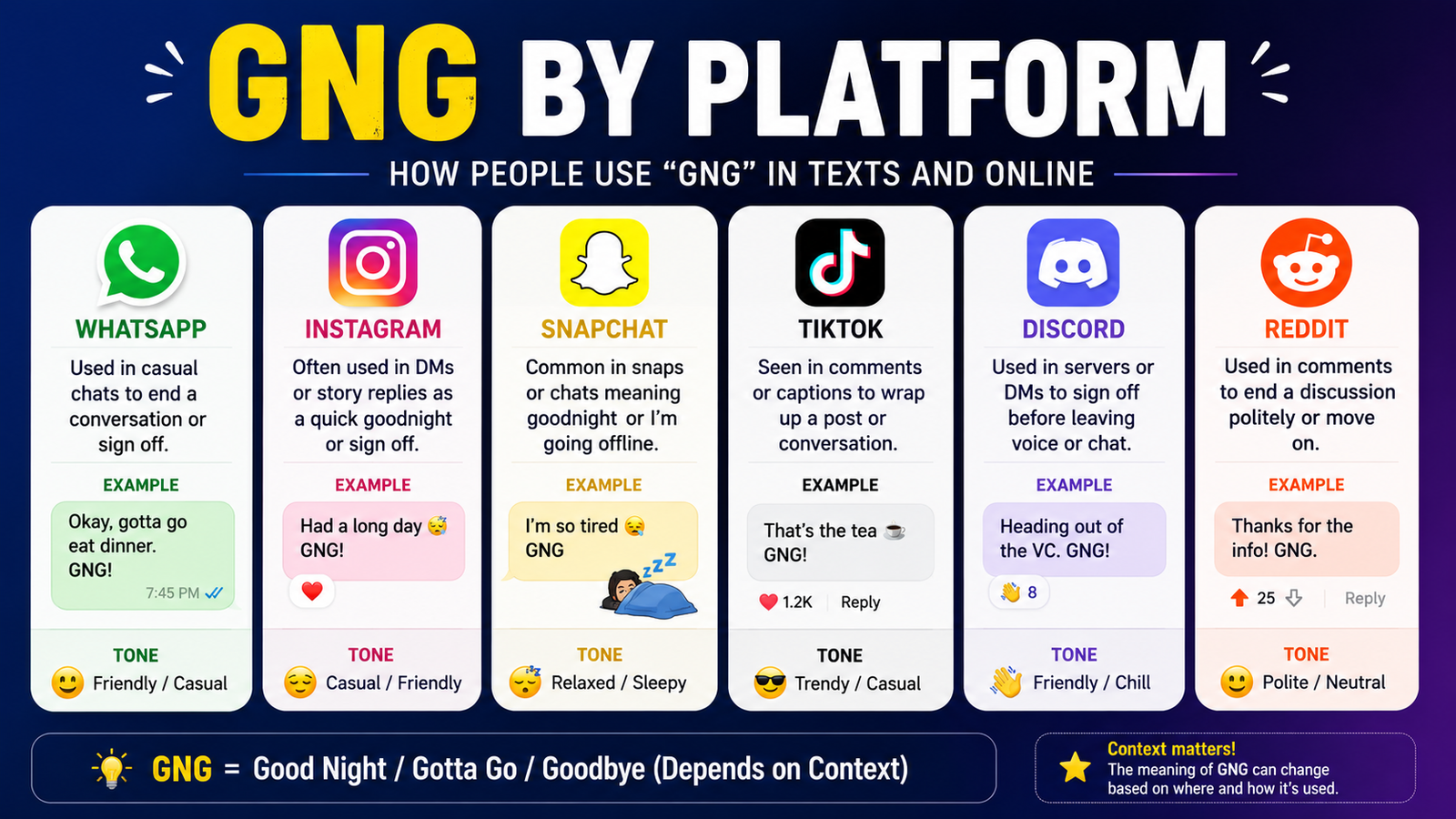
GNG by platform genuinely shifts the odds of which meaning applies, since different apps attract different age groups, use cases, and cultures of communication.
Texting and Snapchat
On regular SMS and Snapchat slang, “going” tends to dominate. Both platforms lean toward quick, personal, real-time updates, so GNG usually replaces the verb in a sentence about movement or plans.
TikTok and Instagram
TikTok slang and Instagram comments skew toward the “gang” and “good night gang” meanings. Comment sections are public-facing and group-oriented by nature, which fits both the crew-identity meaning and the late-night sign-off use far better than the verb “going” would.
Discord and Gaming
In Discord slang and gaming chat, GNG almost always circles back to “gang,” referring to a squad, clan, or consistent group of teammates. It’s an identity marker inside a community built around team-based play.
Workplace Slack and Email
In workplace Slack threads and professional email, Go/No-Go takes over almost entirely. Slang meanings essentially disappear in this setting, since the audience and purpose are formal, task-oriented, and decision-driven.
Quick reference table:
| Platform | Most Likely Meaning | Typical Age Group |
|---|---|---|
| SMS/Texting | Going | All ages |
| Snapchat | Going | Teens, young adults |
| TikTok | Gang / Good Night Gang | Teens, young adults |
| Gang / Good Night Gang | Teens to adults | |
| Discord | Gang (squad/crew) | Teens, young adults, gamers |
| Slack/Email | Go/No-Go | Working professionals |
How to Reply to GNG
Once you’ve figured out which meaning applies, replying is easy. Here’s how to handle each version.
If they mean “gang”: Match the warmth. A simple “love you too, gng” or “always, gng 🙌” fits the tone perfectly. This isn’t a question, so it usually doesn’t need a factual answer, just an acknowledgment of the group bond.
If they mean “going”: Treat it like a normal statement about plans. Reply with a question or confirmation: “okay, text me when you land” or “have fun, be safe.”
If they mean “Good Night Gang”: A short, matching sign-off works best: “night gng 🌙” or “sleep well everyone.” No need to overthink this one; it’s a farewell, not a prompt for a long response.
If they mean “Go/No-Go”: This one actually needs a real answer. Reply with the status clearly: “Confirmed, we’re GNG for 3pm” or “Hold off, waiting on final approval before we’re GNG.” Ambiguity here can cause real workplace confusion, so clarity matters more than tone.
Quick-reply cheat sheet:
| Their Meaning | Good Reply Example |
|---|---|
| Gang | “always, gng ❤️” |
| Going | “safe travels, text me later” |
| Good Night Gang | “night! sleep well 🌙” |
| Go/No-Go | “confirmed, we’re GNG” or “not yet, still pending” |
GNG vs. Similar Slang
GNG vs. similar slang terms is a fair comparison to make, since several other texting abbreviations get confused with each other in the same way.
| Term | Meaning | Typical Use |
|---|---|---|
| GNG | Gang / Going / Good Night Gang / Go-No-Go | Multi-purpose, context-dependent |
| GTG | Got to go | Ending a conversation abruptly |
| BRB | Be right back | Temporary pause, not leaving fully |
| FR | For real | Emphasizing sincerity or agreement |
| ONG | On God | Strong emphasis, similar to “I swear” |
The key difference between GTG and the “going” meaning of GNG is timing and finality. GTG signals the conversation is ending now. The “going” meaning of GNG usually describes a future or in-progress action, not necessarily the end of the chat.
FR and ONG are both emphasis markers, used to underline sincerity, rather than identity labels or status updates. They don’t overlap much with GNG’s core meanings, but they often appear in the same sentence as GNG, since all four belong to the same family of fast, casual online slang.
When Not to Use GNG
Even though GNG feels natural in casual social media language, a few settings call for spelling things out instead.
- Formal writing. Essays, cover letters, and official documents should never include GNG in any of its casual forms.
- Professional messages with unclear audiences. If you’re unsure whether a workplace contact will read GNG as “gang” or “go/no-go,” spell it out to avoid confusion entirely.
- Conversations with people unfamiliar with slang. Older relatives, new coworkers, or people outside your usual social circles may not recognize the term at all.
- Cross-generational chats. Age gaps change how slang lands. What reads as friendly to one generation can read as confusing, or even mildly concerning, to another, particularly around the “gang” meaning.
- First-time conversations with strangers. Using GNG with someone you just met can come across as overly casual before rapport has been established.
When in doubt, use the full word. “Going,” “good night, everyone,” or “confirmed, we’re good to proceed” all communicate the same thing without any risk of misreading.
GNG in 2026: Is It Still Relevant?
Short answer: yes, and it’s not going anywhere soon.
GNG in 2026 remains one of the more actively used pieces of modern slang across texting and social platforms, largely because it does something useful: it compresses several common ideas (identity, plans, farewells, decisions) into three letters that adapt to context. Abbreviations that serve multiple real needs tend to stick around far longer than ones built purely around a single joke or trend cycle.
Current texting trends show a broader pattern here too. Gen Z language increasingly favors flexible, multi-meaning shorthand over rigid, single-definition acronyms, since flexible terms move faster across different community norms without needing constant reinvention. GNG fits that pattern well: it’s not locked to one platform, one age group, or one specific use case.
The professional Go/No-Go meaning, meanwhile, isn’t tied to internet trend cycles at all. It’s institutional terminology with decades of use in engineering and project management, so its relevance doesn’t depend on what’s popular on social media this year.
Put both threads together, and GNG looks less like a passing trend and more like a durable piece of online communication shorthand, one that’s likely to stay in active rotation across texting, social media, gaming, and workplace contexts well beyond 2026.
FAQs
Is GNG still used in 2026?
Yes, it remains one of the more common pieces of texting slang across platforms, especially in group chats and social media comments.
What does GNG mean on Snapchat?
On Snapchat, GNG almost always means “going,” used to say someone’s about to leave or head somewhere.
Can GNG mean something bad or offensive?
Rarely. The “gang” meaning refers to a friend group, not criminal activity, so it’s generally harmless in everyday chats.
What does GNG mean in a work email?
In professional settings, GNG usually stands for “Go/No-Go,” a decision-point term asking whether a project or task should proceed.
Does GNG mean the same thing on TikTok and Instagram?
Mostly yes. Both platforms lean toward “gang” or “Good Night Gang,” especially in comments and late-night captions.
Conclusion
GNG meaning in text really comes down to context. It might mean “gang,” “going,” “good night gang,” or “go/no-go” at work. Check the platform, the sender, and the sentence around it. That’s usually all you need.
Slang like this moves fast, but GNG isn’t going away soon. Once you understand the GNG meaning in text, you’ll never feel lost when it pops up again. Read the room, pick the right meaning, and reply with confidence.