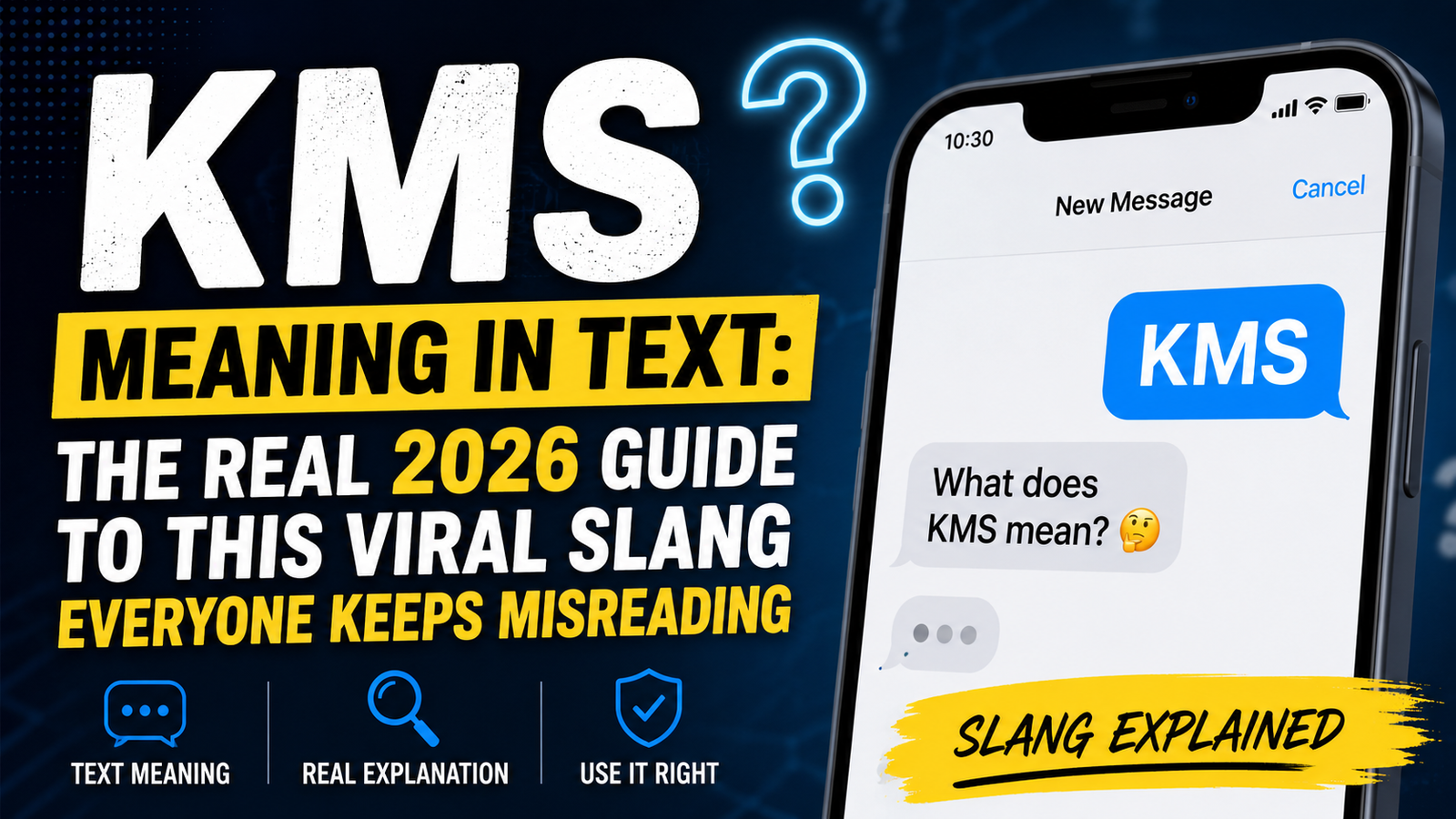
KMS meaning in text breaks down to “kill myself,” a slang abbreviation that exploded across group chats, comments, and gaming lobbies well before most people stopped to ask what it stood for. Nine times out of ten, it’s pure hyperbole — closer to “I can’t even” than an actual statement.
Here’s the twist nobody warns you about: the exact same three letters can mean a bad grade or a genuine cry for help, and telling the two apart isn’t guesswork — it’s a skill.
This guide unpacks every real meaning behind KMS, how it shifts across Snapchat, Discord, and texting, and exactly how to respond when it lands in your inbox.
What Does KMS Actually Mean in Text?
KMS stands for “kill myself.” That’s the literal expansion, and no article about this slang term should dance around it.
But here’s the part that trips people up: in the overwhelming majority of cases, nobody typing KMS means it literally. It functions the same way “I’m dying” works when you laugh too hard at a video, or “this is killing me” works when your boss piles on another deadline. It’s exaggeration. It’s a self directed phrase used to express frustration, embarrassment, exhaustion, or comedic despair — not an actual statement of intent.
That said, context always matters, and pretending the phrase never carries real weight would be irresponsible. Later sections of this guide dig into how to spot the difference, because that distinction is the entire point of understanding this kms slang meaning properly instead of guessing.
Quick Facts About KMS
| Detail | Information |
|---|---|
| Full form | Kill myself |
| Type of slang | Abbreviation / internet acronym |
| Primary users | Gen Z and Gen Alpha, though usage spans into millennial texting habits too |
| Typical tone | Hyperbolic, sarcastic, comedic — rarely literal |
| Common platforms | Texting apps, Snapchat, Discord, Instagram, Reddit, X (Twitter) |
| Closely related terms | KYS, KMSL, “I can’t even,” “send help” |
| First widespread use | Traces back to early-2010s internet forum and meme culture, gained mainstream traction through Vine, Tumblr, and early Twitter hyperbole culture |
| Risk level | Low in casual use; requires attention when paired with isolation, repetition, or flat tone |
Think of KMS as digital shorthand for “I am so done with this” — a text message language shortcut that’s less about literal meaning and more about emotional punctuation, similar to how “lol” rarely means someone is actually laughing out loud.
Every Real Meaning of KMS — And Why Ranking Them Misses the Point
A lot of guides try to rank KMS meanings from “most common” to “least common.” Honestly? That’s a little misleading, because there’s no reliable data showing exactly how often each meaning shows up. What actually determines the meaning of KMS isn’t frequency — it’s context. So instead of a countdown, think of it as a spectrum, running from harmless hyperbole all the way to genuine distress.
Hyperbolic Frustration (“I Simply Cannot”)
This is the baseline, everyday use. Someone’s stuck in traffic, their WiFi died mid-download, or their group project partner ghosted them again. KMS here means roughly the same thing as “I can’t deal” or “this is so annoying.” It’s not about death at all — it’s about mild suffering, exaggerated for effect.
Example text: “my professor just added ANOTHER reading kms 😭”
Nobody reading that thinks the student is in crisis. It’s a casual expression, plain and simple.
Comedic Exaggeration and Irony
Sometimes KMS shows up purely for laughs — reacting to secondhand embarrassment, a cringeworthy video, or an awkward interaction. It’s the digital equivalent of covering your face and groaning.
Example text: “he waved back at someone who wasn’t waving at him kms 💀”
This use leans heavily into meme culture, where exaggerated language is the whole joke. The skull emoji (💀) often travels alongside it, since both signal “this is painfully funny” rather than anything somber.
Genuine Emotional Overwhelm
Here’s where things shift. Sometimes KMS shows up during a moment of real stress — finals week, a breakup, a family conflict — and while it’s still not usually literal, it signals actual emotional overload rather than a joke. The tone tends to change here: fewer emojis, shorter messages, more repetition.
Example text: “i can’t do this anymore kms fr”
That “fr” (for real) matters. It softens the hyperbole slightly, but it also signals the person is genuinely overwhelmed, even if they’re not planning anything. This is the gray zone worth paying attention to, and it’s covered in more depth later in this guide.
Gaming Rage Culture
Anyone who’s spent time in Discord and gaming chats knows this one well. Losing a ranked match, dying to the same boss for the twentieth time, or getting outplayed in the final round of a match — KMS here is rage-quit energy, nothing more.
Example text: “lost my win streak to a guy camping spawn kms”
This is one of the most consistently non-literal uses of the phrase across the entire internet. Gaming culture treats “dying” (literally and figuratively) as part of the entertainment, so the language mirrors that.
Platform-Specific Slang Mutations
KMS doesn’t stay static — it morphs depending on where it’s used. On some platforms it’s practically a punctuation mark. On others, it carries more weight because of the audience or format. Part of this comes down to user intent shifting with the crowd watching. A private text between two best friends invites a very different tone than a public comment where strangers might read it out of context. The next section breaks that down platform by platform.
It’s also worth noting how quickly this kind of digital shorthand evolves. Slang tied to death, mortality, or extreme emotion has existed in casual speech long before smartphones — “that killed me,” “I’m dead,” “you’re going to be the death of me” all predate the internet by decades. KMS is simply the text-speed, abbreviated descendant of that same instinct: compress a big emotional reaction into the smallest possible unit of language. Understanding that lineage helps explain why so many different online abbreviations follow the same pattern, from “dead 💀” to “I can’t” to “not me doing X.”
KMS vs. KYS vs. KMSL — Know the Difference
This is one of the most important distinctions in this entire guide, and it’s where a lot of people — especially anyone slightly older or newer to internet slang — get confused.
| Term | Full Meaning | Directed At | Typical Tone | Risk Level |
|---|---|---|---|---|
| KMS | Kill myself | Self | Usually hyperbolic, occasionally genuine | Low to moderate, context-dependent |
| KYS | Kill yourself | Another person | Often hostile, sometimes “joking” among close friends | High — frequently classified as online harassment |
| KMSL | Kill myself laughing | Self, reactive | Almost always comedic | Very low |
The critical difference: KMS vs KYS isn’t just about one letter. KMS is self-directed, which keeps it (mostly) in the territory of exaggerated self-deprecation. KYS, on the other hand, is aimed at someone else, and that changes everything. Telling someone else to “kill themselves,” even as a supposed joke between friends, edges into harmful language and is treated as a form of digital abuse on most platforms, including formal moderation policies on Discord, Instagram, and X.
“Words carry the weight we give them, but some words carry weight regardless of intent — telling someone to end their life is one of them, even dressed up as a joke.”
KMSL is the safest of the three. Adding that final “L” (laughing) almost always confirms the phrase is comedic, similar to “LMAO” or “dead 💀.”
Knowing these slang differences matters because mixing them up — assuming KMS is as aggressive as KYS, or assuming KYS is as harmless as KMS — leads to either overreacting to a joke or underreacting to actual harassment.
There’s also a generational layer worth mentioning. Plenty of parents, teachers, and managers first encounter KMS through a screenshot shared out of context — a worried relative forwards a message, or a school administrator flags a chat log — and without knowing the slang interpretation norms of the group involved, the reaction can swing straight to alarm. That’s not an unreasonable response on its own; erring toward caution around this kind of language makes sense. But it does mean a huge share of real-world confusion around KMS comes from adults applying literal, dictionary-style reading to a phrase that functions almost entirely as casual expressions within peer groups. Recognizing that gap is part of getting the kms definition right in practice, not just on paper.
KMS Across Every Platform — What It Really Looks Like
KMS on social media doesn’t behave the same way everywhere. The platform shapes the tone, the audience, and how seriously it should be taken.
Texting Between Friends
In one-on-one or group texts with people who know each other well, KMS in texting is usually the most casual version of the phrase. It’s shorthand between people who already understand each other’s humor, similar to inside jokes that would sound strange to outsiders.
Snapchat and BeReal
These platforms are reactive by nature — built around a single photo or moment. KMS here usually reacts to something visual: a bad selfie, an awkward candid BeReal, a messy room caught on camera. It’s tied to embarrassment more than distress.
Instagram Comments
Comments are public, so the tone shifts slightly toward performance. People use KMS partly to express a reaction and partly because it reads as relatable to whoever else scrolls past. It’s less private, more crowd-aware.
Dating Apps
On dating apps, KMS often shows up in a flirty, self-deprecating way — reacting to sending an overly long message, an awkward opener, or a nervous overshare. “kms i just sent you three paragraphs about my dog” is a completely different animal than the same phrase sent during a moment of real sadness.
Discord and Gaming Chats
As covered earlier, this is rage-quit territory. Internet slang terms like KMS blend into a broader vocabulary of exaggerated gaming frustration (“I’m throwing,” “this game is rigged,” “uninstalling”).
Reddit and Twitter/X
On these platforms, KMS often appears in a more ironic, meme-adjacent way, sometimes inside darker humor threads where the entire community understands the exaggeration as a shared bit. Context from the surrounding thread usually clarifies intent quickly.
The Workplace — Yes, It Happens
This one surprises people, but casual slang bleeds into professional messaging more than you’d think, especially among younger employees texting coworkers or messaging in casual Slack channels. Workplace communication has different norms, though — what reads as harmless among friends can come across as unprofessional, alarming, or simply confusing to a manager or older colleague unfamiliar with the term. This is one of the clearest cases where online etiquette and social boundaries genuinely matter.
A useful rule of thumb: if you wouldn’t say the literal, unabbreviated phrase out loud in that setting, the abbreviation probably doesn’t belong there either. Nobody would announce “I want to kill myself” in a client meeting as a joke about a tight deadline, so typing KMS in that same context carries some of that same mismatch, even if it reads as harmless shorthand among friends. HR teams at a handful of companies have started including brief guidance on casual slang in onboarding materials for exactly this reason — not to police humor, but to prevent innocent comments from being misread as genuine distress calls, which can trigger unnecessary (and sometimes uncomfortable) formal check-ins.
Is KMS Offensive, Flirty, or a Red Flag?
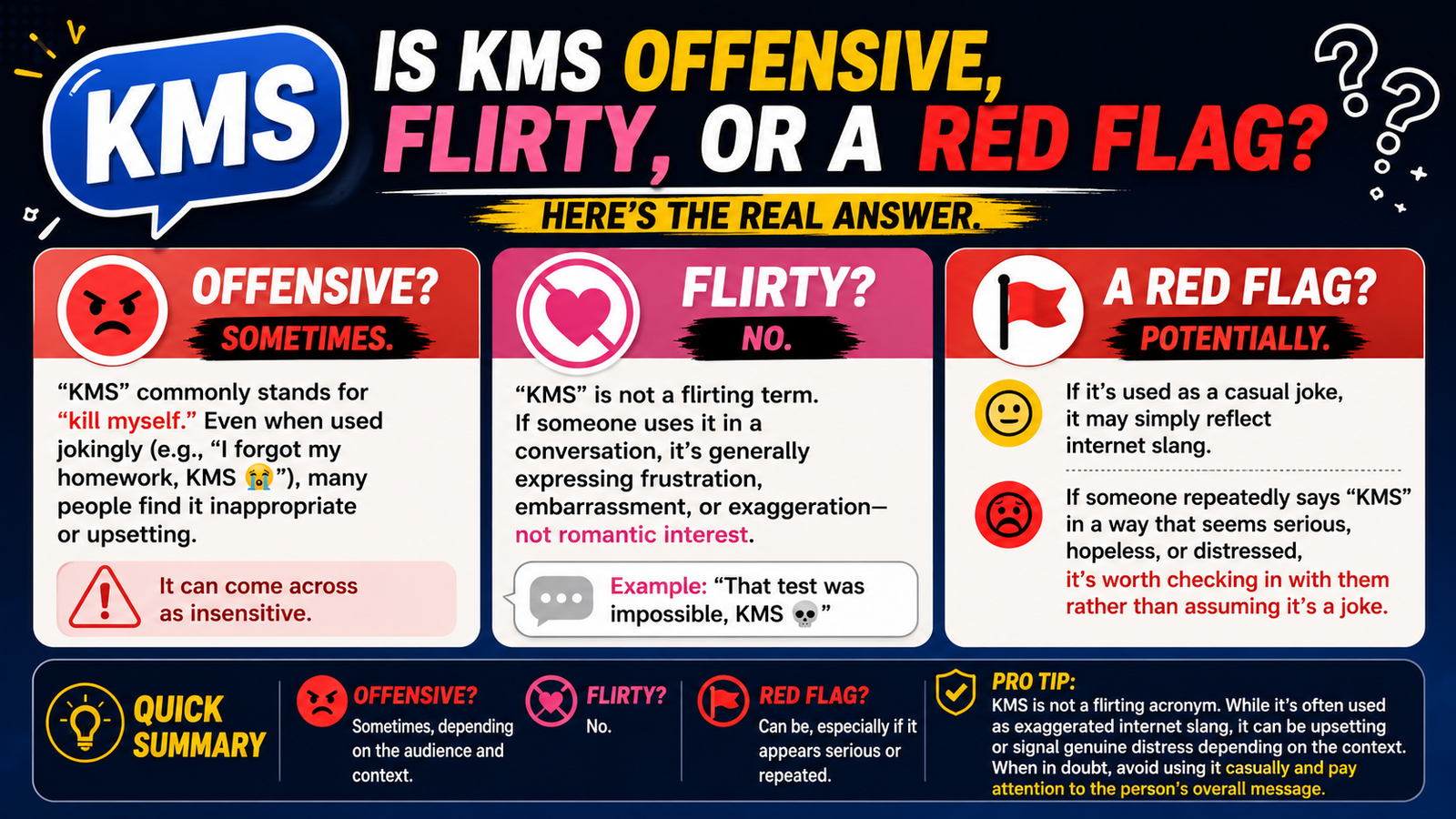
There’s no single answer here, and any guide claiming otherwise is oversimplifying. KMS usage context determines everything.
It’s usually harmless when:
- It’s sent between close friends with an established pattern of dark or exaggerated humor
- It’s reacting to something specific and minor (a bad grade, an embarrassing moment, a lost game)
- It includes emojis, laughing reactions, or lighthearted follow-up messages
It can be insensitive or a red flag when:
- It’s sent by someone you know has struggled with emotional distress or self-harm in the past
- It’s used repeatedly, with no clear joking context
- It comes from a stranger or acquaintance rather than a close friend
- It shows up in a formal or professional setting, where the norms of casual slang don’t apply
It rarely qualifies as flirty on its own, though it can appear in flirty exchanges as a form of playful self-deprecation (see the dating app example above). The phrase itself isn’t romantic — it’s the surrounding conversation that gives it that tone.
There’s a useful mental shortcut for sorting through this in real time: picture how the message would sound if it were said out loud with a laugh versus said out loud with a sigh. A laugh-delivery version — quick, offhand, tossed into a sentence about something trivial — almost always maps onto harmless casual texting. A sigh-delivery version — slower, heavier, without any follow-up joke — deserves a closer look. This isn’t a perfect system, but it’s a far better filter than reacting to the letters alone, since the same four characters can carry completely different emotional weight depending on delivery.
How to Respond When Someone Texts You KMS
How to respond to KMS depends entirely on your relationship with the person and the context of the conversation. Here’s a practical breakdown.
Casual and Funny Replies (For Close Friends)
If the context is clearly a joke — a bad test grade, an awkward moment, a lost gaming match — matching the energy works fine. Examples:
- “same tbh”
- “rip 💀”
- “we’re all going down together”
These supportive replies aren’t about therapy — they’re about keeping the conversation natural and not overreacting to something that was never meant seriously.
Checking In Without Awkwardness
If you’re not totally sure whether someone’s joking, you don’t need to launch into a heavy conversation. A light, low-pressure check-in works well:
- “lol you good?”
- “that bad huh, what happened”
- “kms mood, wanna vent about it?”
This keeps the door open without making the person feel interrogated over a phrase they probably didn’t think twice about.
When You’re Genuinely Concerned
If the tone feels off — flat, repetitive, isolated, without the usual jokes or emojis — it’s worth taking a more direct approach. Caring communication here means asking clearly, without judgment:
- “hey, that came across kind of heavy — are you actually okay?”
- “I know that’s probably just a phrase, but I wanted to check in for real”
If something genuinely feels wrong, don’t rely on guesswork. Reach out directly, and if needed, point them toward real support (more on this in the mental health section below).
Professional Replies
In a workplace setting, the safest move is a light redirect rather than ignoring it entirely, since silence can feel dismissive:
- “Rough day? Let’s regroup after lunch.”
- “Sounds like today’s a lot — anything I can take off your plate?”
This keeps things professional while still acknowledging the person said something, without treating a casual phrase like a crisis or a joke like it wasn’t said at all.
Why People Keep Misreading KMS — The Five Big Mistakes
Misunderstanding this phrase usually comes down to one of five recurring errors.
Taking It Literally Every Time
Panicking every single time someone types KMS — even in an obviously joking context — can come across as dismissive of the actual humor and, over time, makes people less likely to be honest with you when something’s genuinely wrong. Crying wolf on concern has a real cost.
Dismissing It Every Single Time
The opposite mistake is just as risky. Assuming it’s always a joke means genuine warning signs slip past unnoticed, especially from people who tend to mask real mental health signals behind humor — which, unfortunately, is extremely common.
Confusing KMS With KYS
As covered earlier, these are not interchangeable. One is self-directed hyperbole; the other is frequently classified as online harassment, even when framed as a joke.
Ignoring Generational and Cultural Context
Gen Z slang and Gen Alpha language treat dark humor differently than older generations typically do. This isn’t about generations being “too sensitive” or “too callous” — it’s a genuine shift in communication patterns, shaped by growing up immersed in meme culture, irony, and constant online interaction from a young age.
Platform Blindness
Reading a Discord message with the same weight as a Slack message, or treating an Instagram comment like a private, one-on-one text, ignores how much conversation context shifts meaning. The same five letters carry different weight depending on where they show up.
KMS and Mental Health: What to Actually Pay Attention To
This is the part of the guide worth reading slowly, because it’s the one place where getting it wrong actually matters.
Most uses of KMS are not a suicide awareness issue. They’re slang, plain and simple, part of a much larger vocabulary of exaggerated digital shorthand that includes phrases like “I’m actually going to die,” “this is the end of me,” or “I can’t survive this.” Nobody treats those literally, and KMS mental health concerns shouldn’t be assumed by default either.
That said, certain patterns deserve real attention. Here’s a comparison to help separate casual use from something worth checking on:
| Signal | Casual Use | Worth Checking On |
|---|---|---|
| Frequency | Occasional, tied to specific events | Repeated, showing up regularly without clear triggers |
| Tone | Includes emojis, humor, exaggeration | Flat, minimal punctuation, no humor |
| Context | Reacting to something minor (a grade, a game, embarrassment) | No clear trigger, or tied to isolation, loss, or ongoing struggle |
| Response to follow-up | Laughs it off, explains the joke | Deflects, goes quiet, or downplays repeatedly |
| Pattern over time | One-off mentions | Recurring theme across multiple conversations |
| Accompanying behavior | Normal social engagement continues | Withdrawal, isolation, changes in sleep or mood |
What NOT to do:
- Don’t diagnose someone based on a text message — that’s not your role, and it’s not accurate
- Don’t panic-text or overwhelm them with alarm, which can shut the conversation down
- Don’t ignore a pattern just because it’s uncomfortable to bring up
What TO do:
- Ask directly and calmly: “Hey, I’ve noticed you’ve said that a few times — is everything okay?”
- Listen without judgment, and let them lead the conversation
- If they express genuine distress, encourage them to reach out to a real support resource
If you or someone you know is genuinely struggling, the 988 Suicide & Crisis Lifeline (call or text 988 in the U.S.) is available 24/7, free, and confidential. Crisis Text Line is also reachable by texting HOME to 741741. These resources exist specifically for moments when a conversation moves past slang and into something real, and reaching out isn’t an overreaction — it’s exactly what they’re there for.
When You Should Never Use KMS
Even though KMS is overwhelmingly casual, there are situations where it’s worth avoiding entirely, regardless of intent:
- With someone in visible distress — even as an attempt at relatable humor, it can land badly during someone else’s genuinely hard moment
- In professional or public settings — casual slang doesn’t always translate well outside of peer groups, and it can come across as unprofessional or confusing
- Around people you know have struggled with self-harm — even unintentionally, it can feel dismissive of something they’ve actually experienced
- Directed at someone else as a joke — this crosses into KYS territory, and that distinction matters, even among close friends
FAQs
Is KMS still commonly used in 2026, or has it faded out?
It’s still widely used, especially in gaming chats, Discord, and Gen Alpha texting circles, though platforms like TikTok and Instagram have leaned more toward emoji-based shorthand (💀, 😭) alongside it.
Do social media platforms flag or moderate KMS automatically?
Some platforms, including Instagram and TikTok, use automated systems that can flag messages containing KMS for review, particularly when paired with other distress signals, though casual use rarely results in account action.
Is KMS more common among certain age groups right now?
Yes — it remains most prevalent among teens and young adults (roughly ages 13–25), with usage highest in gaming and messaging apps rather than more public-facing platforms like LinkedIn or Facebook.
Has KMS usage changed because of growing mental health awareness online?
Somewhat — younger users increasingly pair it with follow-up context or humor cues (like “kms fr” vs. just “kms”) to clarify tone, partly due to broader conversations around mental health sensitivity.
Are there official guidelines from platforms on how to respond if someone sends KMS?
Most major platforms (Instagram, Discord, TikTok) now surface automatic mental health resource prompts or crisis line pop-ups when certain phrases, including KMS, appear in flagged patterns — though this varies by platform and context.
conclusion
KMS meaning in text really comes down to context, not the letters themselves. Most of the time, it’s just a joke or a quick way to vent. It’s rarely literal. But tone, timing, and platform all matter. Learning to read those signs makes you a better friend online.
At the end of the day, understanding KMS meaning in text helps you respond the right way. Laugh along when it’s a joke. Check in when something feels off. That small pause can make a real difference. Slang changes fast, but paying attention never goes out of style.