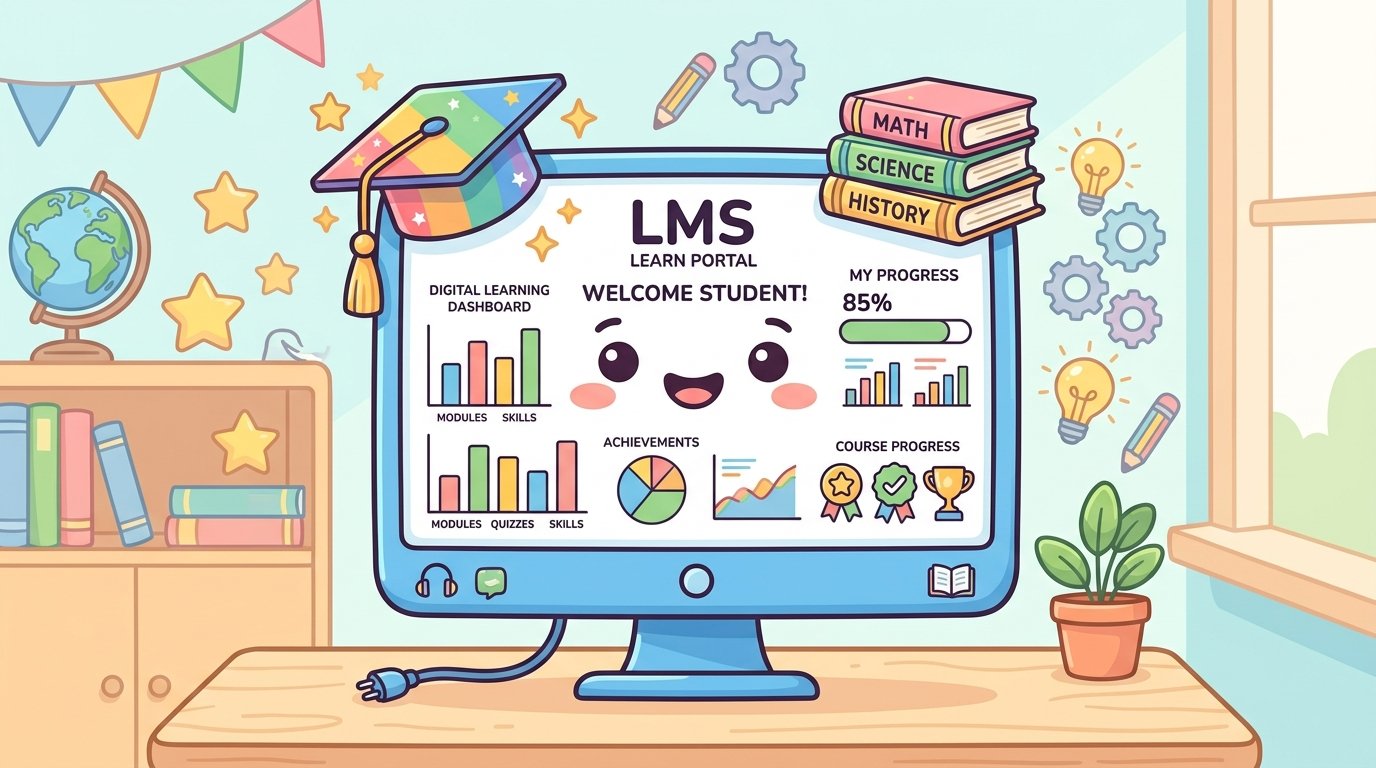
LMS meaning changes depending on where you spot it. As an acronym, LMS most commonly stands for Learning Management System, the software schools and companies use to deliver courses, track grades, and manage training online.
But that’s only half the story. Type “LMS” into a search bar and you’ll find it moonlighting as flirty texting slang and a nail-biting gaming term, all under the exact same three letters.
That’s the real charm of LMS meaning: one abbreviation, three completely different worlds. Whether you’re a student, a texter, or a Roblox Forsaken player, this guide untangles every definition so you never second-guess an “LMS” again.
LMS Has Three Unrelated Meanings — Here’s the Quick Answer
Let’s cut to the chase before we go deep on each one. Depending on the context, LMS stands for:
| LMS Meaning | Full Form | Where You’ll See It |
|---|---|---|
| Learning Management System | Software for delivering courses, tracking grades, and managing training | School, university, workplace |
| Like My Status | A request for likes or engagement | Texting, Snapchat, Instagram, TikTok |
| Last Man Standing | A survival-style game mode | Gaming, especially Roblox Forsaken |
None of these three definitions grew out of each other. They just happen to be a three-letter coincidence, kind of like how “ATM” can mean “automated teller machine” or “at the moment,” depending on whether you’re at a bank or texting a friend.
So here’s a quick example of each in action:
- “Log into the LMS before Friday and submit your essay.” → Learning Management System
- “New profile pic just went up, LMS if you see this 👀” → Like My Status
- “Only two of us left, this is LMS now.” → Last Man Standing
Once you know the context, the confusion disappears almost instantly. Let’s go deeper on each one, starting with the version you’ll run into most in professional and academic settings.
LMS Meaning #1 — Learning Management System
In education and business, LMS almost always stands for Learning Management System. This is software built to host, deliver, and track learning content, whether that’s a semester-long university course or a 15-minute compliance training video for new hires.
Think of an LMS as the digital classroom (or training room) that lives online. Instead of handing out paper syllabuses and grading assignments by hand, teachers and trainers upload everything into one platform. Students and employees log in, complete their work, and get graded automatically or manually — all inside the same system.
A modern Learning Management System typically handles:
- Course content delivery — videos, readings, slideshows, and interactive modules
- Assignments and quizzes — creation, submission, and automatic grading
- Progress tracking — dashboards showing who’s finished what and who’s falling behind
- Communication tools — announcements, discussion boards, and direct messaging
- Certification and compliance records — proof that someone completed required training
LMS Definition in Plain English
If you strip away the jargon, an LMS definition boils down to this: it’s a course management system that replaces the filing cabinet, the classroom bulletin board, and the physical gradebook with one online hub. It’s the backbone of most e-learning systems used today, whether you’re a college student or a new hire at a Fortune 500 company.
Popular LMS Platforms You’ve Probably Used
| Platform | Common Use Case |
|---|---|
| Canvas | Higher education, K-12 |
| Moodle | Universities, open-source e-learning |
| Blackboard | Colleges and universities |
| Google Classroom | K-12, informal learning |
| TalentLMS | Corporate training platform |
| Cornerstone OnDemand | Enterprise HR and compliance training |
Each one functions a little differently, but the core idea stays the same: they’re all built as an online learning platform where content, grades, and communication live in one place.
LMS in School
Ask any high schooler or college student what LMS means, and you’ll get one answer, fast: it’s the student portal where all their coursework lives. This is by far the most common use of the term in an academic setting, and it’s why “LMS meaning in school” gets searched so often around the start of every semester.
Here’s why teachers lean on the abbreviation instead of saying “learning platform” or “online classroom” every time: it’s just faster, and everyone in the building already knows what it means. Once a school picks a platform — say, Canvas or Google Classroom — “the LMS” becomes shorthand for the whole system, the same way “the copier” refers to whichever brand happens to sit in the teacher’s lounge.
Inside a school’s LMS, students typically manage:
- Assignments — due dates, submission uploads, rubrics
- Grades — real-time gradebooks instead of waiting for report cards
- Announcements — class-wide updates from teachers
- Attendance — some platforms track this automatically
- Discussion boards — for class participation grades
For teachers, the LMS cuts down on paperwork dramatically. Instead of collecting 30 physical essays, they get 30 digital submissions with built-in plagiarism checks and grading tools baked right in. That’s a big part of why school software adoption exploded over the last decade and hasn’t slowed down since.
Quick fact: According to multiple education technology surveys, over 90% of U.S. colleges and universities now use some form of LMS for at least part of their coursework, and K-12 adoption has followed a similar trajectory since remote learning pushed schools to digitize almost overnight.
LMS in AI
Here’s where things get interesting for 2026. The core LMS meaning in AI conversations isn’t a new definition of the acronym — it’s still Learning Management System. What’s changed is what’s happening inside that system.
AI has quietly become a standard feature in most modern LMS platforms, not a separate product bolted on the side. Here’s what that actually looks like in practice:
- Automated quizzes — AI generates quiz questions directly from uploaded course material, saving instructors hours of manual work
- Personalized learning paths — the system adjusts content difficulty and pacing based on how a student is performing
- AI tutoring — chatbot-style assistants answer student questions 24/7, walking learners through concepts they’re stuck on
- Predictive analytics — flags students at risk of falling behind before it becomes a bigger problem
- Auto-grading for open-ended answers — AI now handles some essay and short-answer grading, not just multiple choice
This shift toward intelligent education tools means the modern training platform does a lot more than host videos and PDFs. It actively adapts to each learner. A student who’s breezing through algebra might get pushed toward harder problems automatically, while one who’s struggling gets extra practice and simplified explanations, all without a teacher manually adjusting anything.
Corporate training platforms have embraced this even faster than schools, mostly because businesses can measure the ROI directly. If AI learning tools cut onboarding time from four weeks to two, that’s an easy number to point to in a budget meeting.
So when someone asks about “LMS meaning in AI,” the honest answer is: it’s still a Learning Management System. It’s just a much smarter one than the LMS your older sibling used in college a decade ago.
LMS Meaning Examples
Sometimes the clearest way to understand a term is to just see it used. Here’s a rundown of practical, real-world LMS meaning examples across every context we’ve covered so far.
Learning Management System examples:
- “Check the LMS for your midterm grade, it posted this morning.”
- “IT is migrating us to a new LMS this summer, so expect some downtime.”
- “Our company’s LMS tracks every certification employees complete.”
Texting slang examples:
- “New pic just dropped, LMS if you’re seeing this.”
- “LMS and I’ll hit you back with a compliment 😊”
- “Bro really said LMS on a three-day-old post lol”
Gaming examples:
- “It’s LMS now, just me and one other survivor left.”
- “That LMS round in Forsaken had me sweating.”
- “First one to win LMS three times in a row gets bragging rights.”
These example sentences show exactly why context does all the heavy lifting here. Nobody actually gets confused mid-conversation, because the surrounding words make the meaning obvious almost immediately. The confusion mostly happens when someone sees “LMS” cold, out of context, usually in a search bar.
LMS Meaning Game
Outside of school and texting, LMS meaning game searches point to one specific thing: Last Man Standing, a game mode built around survival and elimination. It’s not tied to one specific title — you’ll find LMS-style modes across multiple multiplayer gaming experiences, though it’s become especially associated with certain Roblox titles.
The basic structure of an LMS mode almost always follows the same formula:
- Multiple players start the round together
- Players get eliminated one by one through combat, environmental hazards, or a chasing enemy
- The round intensifies as fewer players remain
- The last person alive wins, or survives until a timer runs out
This setup borrows heavily from the broader survival game genre and battle-royale mechanics that blew up over the last several years. The appeal is simple: every match gets more intense as the player pool shrinks, and there’s real tension in being the final person left.
LMS Meaning Forsaken
This is one of the most-searched LMS meaning examples in gaming right now, and for good reason. In Roblox Forsaken, a popular horror-survival game, LMS mode specifically kicks in during the endgame.
Here’s how it works: once a killer character has eliminated every survivor except one, the game shifts into Last Man Standing mode. The round timer resets to just over a minute, and the sole remaining survivor has to outlast the killer until time expires. If they survive, they win the round. If they get caught, the killer wins.
Players in the Forsaken game community talk about LMS rounds constantly, because they’re widely considered the most nerve-wracking part of any match. Here’s a quick breakdown:
| Forsaken LMS Stage | What Happens |
|---|---|
| Trigger condition | Only one survivor remains |
| Timer | Resets to roughly 60-90 seconds |
| Objective | Survivor must avoid the killer until time runs out |
| Outcome | Survivor wins if time expires, killer wins if survivor gets caught |
As one Forsaken community member put it on the game’s fan wiki when explaining the mechanic to a newer player: “Basically when the killer kills everyone but one person, last man standing activates and the timer gets wiped to a bit over a minute.”
This LMS mechanic isn’t unique to Forsaken specifically, either. Similar Roblox gaming titles borrow the same last-survivor structure, since it’s a proven way to keep the ending of a match tense instead of anticlimactic. If you’ve played other Roblox horror or battle-royale-adjacent games, you’ve likely run into a version of this same game mode under a different name.
Usage in Different Contexts
By now, the pattern should be pretty clear, but let’s lay it out one more time so it’s impossible to miss. LMS usage shifts entirely based on where the conversation is happening.
| Setting | Likely LMS Meaning | Typical Phrase |
|---|---|---|
| University email | Learning Management System | “Submit through the LMS by 5 PM” |
| Corporate Slack | Learning Management System | “New compliance module is live on the LMS” |
| Instagram comment | Like My Status | “LMS if you saw this 👀” |
| Snapchat chat | Like My Status | “LMS bestie” |
| Roblox voice chat | Last Man Standing | “It’s LMS, just us two left” |
| Gaming Discord | Last Man Standing | “That LMS round was insane” |
Notice that the setting almost always tells you everything you need to know before you even read the full sentence. An email from your registrar isn’t asking you to like a status update, and a Roblox teammate isn’t referring to your school’s grading portal.
Meanings Across Platforms
Let’s zoom in specifically on the social slang version, since that’s where most of the confusion actually happens for casual users scrolling their feeds.
LMS Meaning Social Media (General Overview)
At its core, LMS meaning social media boils down to Like My Status. It’s a social media abbreviation that started on Facebook, back when “status updates” were the main way people shared what they were up to. Someone would post an update and add “LMS” to nudge friends toward engaging with it.
The phrase carried over as social platforms evolved. Facebook’s dominance faded, but the underlying behavior — asking for likes in shorthand — stuck around and adapted to newer apps. It’s a textbook example of status engagement language: short, casual, and built entirely around getting a reaction.
LMS on Snapchat
LMS on Snapchat tends to feel more personal than it does elsewhere, and there’s a clear reason why. Snapchat is built around close friend groups and private stories rather than large public followings. So when someone sends Snapchat messages with “LMS” attached, it usually isn’t a broadcast to strangers — it’s a small nudge to people who already know them.
You’ll typically see it in two forms:
- In a private story caption — “LMS if you’re watching 👀”
- In a direct chat — “LMS bestie” sent alongside a photo or update
Because Snapchat streaks and private stories already carry a personal, ongoing-conversation vibe, LMS rarely feels awkward or overly needy on this particular app. It reads more like a quick check-in than a public plea for attention.
LMS on Instagram
LMS on Instagram shows up constantly in Instagram comments and captions, often paired with other requests. You’ll frequently see combinations like:
- “LMS and I’ll DM you 💌”
- “LMS if this is relatable”
- “LMS for a rate”
Instagram’s public-facing nature changes the tone slightly compared to Snapchat. Since Instagram messages and comments are often visible to a wider audience, LMS here leans more toward boosting visibility and social media engagement metrics — more likes, more comments, more reach in the algorithm — rather than a private, one-on-one nudge between close friends.
LMS Meaning Instagram vs. Snapchat: Quick Comparison
| Factor | Snapchat | |
|---|---|---|
| Audience | Often public or semi-public | Usually close friends |
| Purpose | Boost visibility, engagement | Personal check-in |
| Common pairing | “LMS and I’ll DM you” | “LMS bestie” |
| Tone | Slightly performative | Casual, low-pressure |
LMS Meaning in Text
Zooming out from specific platforms, LMS meaning in text messages generally follows the same Like My Status definition, just applied to regular texting apps and group chats rather than a specific social network.
When someone sends this as a text abbreviation, they’re almost always asking for one simple thing: engagement. That could mean a like on a shared link, a reaction to a photo, or just some kind of response acknowledging they saw the message.
A few things worth knowing about LMS meaning in texting:
- It’s almost exclusively used in casual texting, never in formal or professional messages
- It works best between friends who already have a relaxed rapport
- It’s often paired with emojis to soften the tone and signal it’s lighthearted
- Repeated or excessive use can come across as attention-seeking rather than playful
Sample Messages Using LMS
Here are a few sample messages showing how this plays out in real conversations:
- “Just posted a new pic, LMS 😘”
- “LMS if you’re free later”
- “lms this is kinda funny ngl”
Notice the tone stays light and informal across every example. That’s intentional — this is chat slang, built for quick, low-stakes exchanges, not anything that needs a serious or measured response.
Other Fields
Beyond school, social media, and gaming, LMS pops up in a couple of niche technical and historical contexts. These won’t come up in everyday conversation, but they’re worth knowing if you stumble across the term in an unfamiliar setting.
- Least Mean Squares (LMS) — an algorithm used in statistics and signal processing to minimize error in adaptive filtering. You’ll find this in engineering textbooks and technical papers, far removed from anything social or educational.
- London, Midland and Scottish Railway (LMS) — a historical British railway company that operated from 1923 to 1948, before Britain’s railways were nationalized. Train enthusiasts and UK history buffs still reference it today.
Neither of these shows up in casual conversation, but if you’re reading something technical or historical and see “LMS” without any surrounding context about school, texting, or gaming, one of these two is likely the intended meaning.
Common Misconceptions & Mistakes
Even with three fairly distinct meanings, people still manage to mix them up in a few predictable ways. Here are the most common mistakes worth avoiding.
- Assuming LMS always means the software. If a friend texts “LMS” under your selfie, they’re not asking you to log into a course platform.
- Assuming LMS always means the slang version. Showing up to a university orientation and hearing “check the LMS” has nothing to do with liking a status update.
- Using texting slang in professional messages. Sending “LMS” in a work email will almost certainly confuse your coworkers, and not in a fun way.
- Confusing LMS with similar-looking acronyms. Texting abbreviations move fast, and it’s easy to mix LMS up with something like “LMK” (let me know) if you’re skimming quickly.
- Assuming “LMS” and “LMS system” mean different things. Since the “S” in LMS already stands for “System,” saying “LMS system” is technically redundant, even though plenty of people say it anyway without thinking twice.
Similar Terms & Alternatives
If you’re navigating the online slang side of things specifically, a few related terms tend to travel in the same circles as LMS:
| Term | Meaning |
|---|---|
| LMK | Let Me Know |
| RT | Retweet (or “rate this” in some slang contexts) |
| F4F | Follow for Follow |
| L4L | Like for Like |
On the education side, terms that overlap closely with Learning Management System include:
- LXP (Learning Experience Platform) — a more modern, employee-focused spin on traditional LMS platforms
- CMS (Course Management System) — sometimes used interchangeably with LMS, though CMS can also mean Content Management System in web development, adding yet another layer of acronym overlap
- VLE (Virtual Learning Environment) — more common in UK education settings than in the US
How to Respond to It
If someone sends you the slang version of LMS, there’s honestly no wrong way to handle it. A quick like takes two seconds and costs nothing. If you don’t feel like engaging, ignoring it is completely fine too — it’s a low-pressure ask, not an obligation.
That said, if someone sends LMS constantly, multiple times a day, or gets visibly upset when it’s ignored, that pattern says more about their need for validation than anything you’re required to do about it. A single LMS between friends is casual and normal. A flood of them starts to look less like playful engagement bait and more like something worth a gentle conversation.
If you’re on the receiving end in a school or work context and someone mentions “the LMS,” the appropriate response is obviously different: log in, check your assignments or training modules, and follow up with whatever’s due.
Differences From Similar Words
It’s worth pausing here to clarify how LMS differs from a handful of terms people sometimes lump together with it.
- LMS vs. CMS: An LMS is specifically for structured learning with grading and progress tracking. A CMS (Content Management System) is broader and often used for websites, not necessarily tied to education at all.
- LMS vs. LMK: These look similar in a quick glance at a text thread, but they mean completely different things. LMK means “let me know,” while LMS in texting means “like my status.”
- LMS vs. “Last Man Standing” the TV show or general phrase: The gaming acronym borrows the phrase “last man standing,” which also exists as a general idiom and even a TV show title. Context makes clear whether someone’s talking about a Roblox match or something unrelated.
Relevance in Online Conversations & Dating Apps
The slang version of LMS occasionally shows up in dating app conversations and flirtier online exchanges, usually as a lighthearted way to prompt engagement without being too direct. Someone might send “LMS 😏” as a playful nudge rather than saying something more forward outright.
In these contexts, LMS functions less like a genuine engagement request and more like a social signal — a way of testing interest or keeping a conversation going without much effort. It fits into the same broader category as other low-commitment online communication habits, like sending a meme instead of starting a real conversation. It’s not a serious or deep interaction, but it does keep the door open for one.
Popularity & Trends Over Time
LMS as online slang isn’t new. It traces back to the early-to-mid 2010s, when Facebook status updates were still the dominant form of social sharing. Here’s a rough timeline of how the term evolved:
| Era | What Happened |
|---|---|
| 2010–2015 | Facebook status culture normalizes shorthand requests for engagement; LMS emerges as a natural abbreviation |
| 2015–2020 | Term spreads to Snapchat, Instagram, and general texting culture as those platforms grow |
| 2021–2025 | Usage shifts somewhat, sometimes signaling mood or light flirtation rather than pure engagement-seeking |
| 2026 | Still widely recognized, though younger users increasingly favor newer slang like “fr” or “no cap” for everyday emphasis |
Is LMS still relevant in 2026? Yes, but it’s not exactly trending the way it once did. Gen Z recognizes it instantly, even if it’s used a little less often than it was five or six years ago. It hasn’t disappeared, it’s just settled into being a familiar, slightly nostalgic piece of internet vocabulary rather than the cutting edge of slang.
Meanwhile, the Learning Management System definition has only grown in relevance, not faded. With AI features baked into nearly every major platform and remote or hybrid learning still common in both schools and workplaces, the software meaning of LMS is arguably more central to daily life now than it’s ever been.
And on the gaming side, LMS mode keeps showing up across new titles as the survival and battle-royale genres continue attracting massive player bases, particularly within Roblox gaming communities where new horror and survival titles launch constantly.
FAQs
What does LMS stand for in 2026?
LMS most often means Learning Management System, but it also stands for “Like My Status” in texting and “Last Man Standing” in gaming, especially Roblox Forsaken.
What is the most common LMS meaning right now?
In everyday searches, Learning Management System is still the top meaning, thanks to AI-powered school and workplace training platforms.
Is “LMS” as texting slang still popular in 2026?
It’s still recognized and used, especially on Instagram and Snapchat, though Gen Z now favors it less than newer slang like “fr” or “no cap.”
What does LMS mean in Roblox Forsaken today?
It still means Last Man Standing, the endgame mode where the last surviving player must outlast the killer until the timer runs out.
Do AI features change what LMS stands for?
No, the acronym stays the same. AI just adds tools like automated quizzes and personalized learning paths inside existing Learning Management Systems.
conclusion
So there you have it. LMS meaning really comes down to context. It’s a Learning Management System at school or work. It’s “Like My Status” in a text or DM. And it’s “Last Man Standing” mid-game in Forsaken.
Next time you spot “LMS” somewhere, don’t panic. Just check where you saw it. That one clue usually gives away the right LMS meaning instantly. Three letters, three worlds, one simple trick to tell them apart. Easy, right?