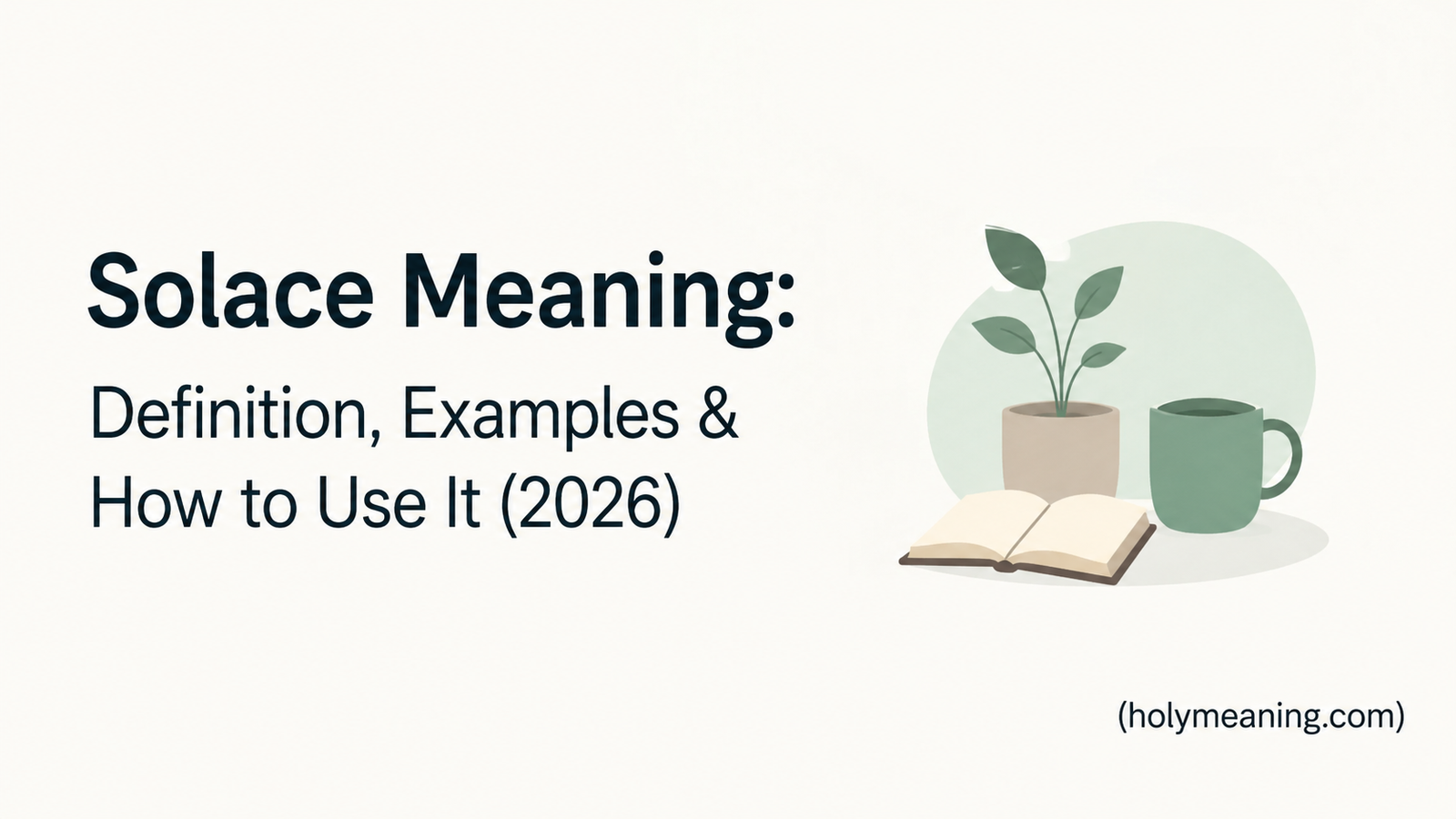
solace meaning means comfort or consolation you feel during grief, loss, or hardship—it’s not happiness, and it doesn’t erase pain. It’s the quiet relief that shows up right when something hurts, easing the weight without pretending the weight isn’t there.
Think about the last time a song, a memory, or a single kind sentence pulled you back from the edge of a terrible day. That’s solace at work, and it’s been doing this exact job for humans since the word first took shape in Latin centuries ago.
This guide breaks down its true meaning, correct spelling, real-life examples, and even its Farsi translation, so you’ll never misuse—or misspell—this beautifully human word again.
What Does Solace Mean? (Quick Definition)
Let’s start simple. The solace meaning boils down to this:
Solace (noun): comfort or consolation received during a time of great distress, sadness, or loss.
If someone says, “Reading gave her solace after the divorce,” they mean reading eased her pain — it didn’t fix the divorce, but it made the grief a little more bearable.
Here’s the breakdown you need at a glance:
| Detail | Information |
|---|---|
| Word | Solace |
| Pronunciation | SOL-iss (/ˈsɒl.ɪs/) |
| Part of speech | Noun (most common), also used as a verb |
| Simple definition | Comfort during sorrow, grief, or hardship |
| Word origin | Latin, via Old French |
| Tone | Gentle, literary, emotionally warm |
| Common in | Poetry, therapy language, eulogies, personal reflection, song lyrics |
So when you ask what does solace mean, the honest answer is: it’s comfort with weight behind it. You don’t take solace in a good parking spot. You take solace in something after you’ve lost something else.
Solace isn’t quite the same as happiness, either. It doesn’t erase pain — it just makes room to breathe inside it. That’s the emotional nuance a lot of dictionaries miss, and it’s the reason writers reach for “solace” instead of the flatter word “comfort” when they want a sentence to actually feel like something.
Where Does the Word Solace Come From? (Origin & Etymology)
Words carry history, and solace has a pretty clean one. Understanding the word origin actually helps explain why it feels so emotionally loaded even today.
Solace traces back to:
- Latin — solacium, meaning “comfort” or “consolation,” itself rooted in solari, “to console.”
- Old French — solas, which kept the same core meaning as it moved through medieval Europe.
- Middle English (around the 13th century) — solas, adopted into English and eventually settling into the spelling we use now.
What’s interesting is how stable the meaning has stayed. Unlike a lot of words that drift wildly over centuries (looking at you, “awful,” which used to mean “awe-inspiring”), solace has meant roughly the same thing for 700-plus years: relief from grief.
That kind of consistency is rare. It’s part of why the word still shows up in formal writing, religious texts, and literature without sounding dated or out of place. A word that’s held its meaning this long tends to earn a permanent home in a language — and solace has clearly earned its spot.
It’s worth comparing solace to a word like “nice,” which meant “foolish” or “ignorant” in Middle English before drifting all the way to its current, friendly meaning. Solace never took that kind of detour. Every step of its journey — Latin solacium, Old French solas, Middle English solas — kept pointing at the same core idea: something that eases pain. Linguists sometimes call this kind of stability “semantic conservation,” and it tends to happen with words tied to universal human experiences like grief, hunger, or fear. Comfort after loss is one of those experiences every culture and era has needed a word for, so the word itself had less reason to wander.
You’ll also notice solace shares a root with a handful of related English words, including “console” and “consolation” — both descended from the same Latin family tree (consolari). That shared ancestry is exactly why solace and consolation feel like cousins rather than strangers, a relationship we’ll unpack more in the comparison section below.
Solace or Solice: Which Spelling Is Correct?
Let’s clear up a mistake that trips up a surprising number of people searching solice or solace meaning.
The correct spelling is “solace.” “Solice” is a common misspelling and isn’t a recognized English word.
Why does this mix-up happen so often? A few reasons:
- The “-ice” ending shows up in tons of English words (notice, service, office), so your brain defaults to the familiar pattern.
- Solace is pronounced with a soft “s” sound at the end, and “-ice” looks like it would produce that sound, even though it’s actually spelled “-ace.”
- Autocorrect doesn’t always catch it, since “solice” reads as a plausible word rather than obvious gibberish.
Here’s a quick memory trick to lock in the correct solace spelling for good: think of the phrase “a taste of solace” — the word “taste” and “solace” both end in “-ace” sounds tied to that soft, quiet vibe. Or just remember: sol-ACE, like the ace up your sleeve when things get hard.
If you’ve ever typed “solice” into a search bar wondering if it was a real word, you’re not alone — it’s one of the most common spelling mistakes tied to this term, and dictionaries will flag it every time.
How to Use “Solace” in a Sentence
Knowing a definition is one thing. Actually using the word naturally is another. Here’s how solace in a sentence typically works, broken down by grammatical role.
Solace as a Noun (Most Common Usage)
This is the noun usage you’ll see 90% of the time. It usually pairs with verbs like “find,” “take,” “give,” “offer,” or “seek.”
Example sentences:
- She found solace in her morning walks after her father passed.
- He took solace in knowing he’d done everything he could.
- Music offered her a quiet solace during finals week.
- The old church became a place of solace for grieving families.
- There’s a strange solace in rainy days when you’d rather stay in anyway.
- Even a small solace was welcome after the year she’d had.
Notice the pattern: solace almost always shows up after something painful. It needs that contrast to make sense. You wouldn’t say “the party gave me solace” unless something bad had just happened that the party helped soften.
Solace as a Verb (Less Common but Correct)
The verb usage of solace means “to comfort” or “to console” someone directly. It’s less common in casual speech but still grammatically correct and shows up in formal or literary writing.
Example sentences:
- She tried to solace her friend after the funeral.
- His letters solaced her during the long months apart.
- Nothing could solace him after the loss of his dog.
If “solace her” sounds a little formal or old-fashioned to your ear, that’s accurate — the verb form leans literary. In everyday conversation, most people default to the noun form (“find solace”) rather than the verb (“solace someone”).
A Quick Note on Grammatical Usage
One mistake worth flagging: solace doesn’t pluralize the way you might expect. You won’t typically see “solaces” in modern writing — it functions almost exclusively as an uncountable noun, similar to words like “comfort” or “peace.” So “she found many solaces” would sound unnatural to most native speakers; “she found solace in many places” is the correct, idiomatic phrasing.
It also doesn’t take an indefinite article very often. You’re more likely to hear “she found solace” than “she found a solace,” though the latter isn’t grammatically wrong — it’s just less common in contemporary usage. This kind of small grammatical usage detail is exactly the sort of thing that separates fluent-sounding English from technically-correct-but-stiff English.
How to Respond When Someone Offers You Solace
There’s also a practical, everyday angle worth covering: what do you actually say when someone offers you comfort using this kind of language? If a friend says something like “I hope you find some solace in knowing how loved they were,” a simple, genuine acknowledgment is usually all that’s needed — something like “thank you, that actually does help” or “I’m holding onto that.” You’re not expected to match their eloquence. The word itself does the emotional heavy lifting; your response just needs to be honest.
Common Phrases That Use “Solace”
Certain solace common phrases show up again and again, almost like fixed expressions. Knowing these will make your writing sound natural instead of textbook-stiff.
| Phrase | Meaning | Example |
|---|---|---|
| Find solace in | To discover comfort through something | “She found solace in painting.” |
| Take solace in | To draw comfort from something, often a thought or fact | “We took solace in the fact that he didn’t suffer.” |
| Give/offer solace | To provide comfort to someone else | “Her presence alone gave him solace.” |
| Small solace | A minor, limited comfort — often bittersweet | “It’s small solace, but at least the pain is gone now.” |
| Cold comfort | A close cousin phrase — comfort that doesn’t help much | “Knowing it could’ve been worse was cold comfort.” |
| A source of solace | Something reliable that consistently brings comfort | “Her grandmother’s letters remained a source of solace for years.” |
Here’s a subtle point worth knowing: “small solace” and “cold comfort” both carry a slightly bitter edge. They’re used when the comfort offered barely makes a dent in the pain — a linguistic shrug that says, “it helps, but not much.” That’s different from finding comfort in a more wholehearted, unqualified sense.
Synonyms and Antonyms for Solace
If you’re a writer, you already know that repeating the same word gets boring fast. Here are your best synonyms for solace, along with the subtle differences between them — because no two comfort-words mean exactly the same thing.
Synonyms for Solace
| Word | Nuance | Example Sentence |
|---|---|---|
| Comfort | Broader, everyday word; works for physical or emotional ease | “A hot bath is pure comfort after a long day.” |
| Consolation | More formal, often tied to loss or failure | “His consolation prize didn’t ease the disappointment.” |
| Relief | Focuses on the removal of stress or pain rather than warmth | “Finishing the exam brought instant relief.” |
| Succor | Old-fashioned, literary; implies help given in a moment of real need | “The village offered succor to the storm’s survivors.” |
| Reassurance | Comfort specifically tied to easing worry or fear | “Her calm voice was all the reassurance he needed.” |
| Balm | Poetic; something soothing, often used metaphorically | “Her letters were a balm to his loneliness.” |
Solace sits in a specific lane among these: it’s warmer than “relief,” more emotional than “comfort,” and less formal than “consolation.” It’s the word you reach for when something genuinely soothes an aching part of a person, not just a passing inconvenience.
Antonyms for Solace
- Distress
- Anguish
- Torment
- Despair
- Misery
Solace vs. Comfort vs. Consolation: What’s the Difference?
This trips people up constantly, so let’s settle the solace vs comfort debate directly, plus throw consolation into the mix since it’s the third word people confuse.
| Word | Best Used When… | Example |
|---|---|---|
| Comfort | The situation is everyday, physical, or emotional — no grief required | “This blanket is so comforting.” |
| Consolation | Someone has lost or failed at something specific, and you’re softening the blow | “At least you tried — that’s some consolation.” |
| Solace | Deep emotional pain or grief is present, and something meaningful eases it | “Her faith gave her solace after the diagnosis.” |
Think of it as a scale of emotional weight:
Comfort → Consolation → Solace
Comfort is the lightest of the three — you can find comfort in a cup of tea. Consolation carries a bit more emotional context; it usually follows disappointment or loss. Solace is the heaviest and most literary — it implies real grief, and real relief from it.
A quick gut-check: if you could swap the word for “cozy,” you probably mean comfort. If you’re softening a loss, you mean consolation. If someone’s world just changed and something is helping them survive it, that’s solace.
“Solace” in Everyday and Emotional Contexts
Words don’t live in dictionaries — they live in real conversations, therapy sessions, and grief support groups. Here’s where emotional comfort language around solace shows up most.
Grief and Loss
This is solace’s home turf. After a death, people frequently describe finding comfort through rituals, memories, or community.
“Grief is the price we pay for love, but solace is what lets us keep paying it.” — a sentiment echoed often in grief counseling circles, even if not tied to one single quote.
Common grief-related uses include:
- Finding solace in shared memories with other mourners
- Taking solace in a person’s legacy or impact
- Religious or spiritual solace through prayer, scripture, or ritual
Mental Health and Therapy Language
In therapy-speak, solace often overlaps with emotional support and self-soothing strategies. A therapist might ask, “Where do you find solace when anxiety hits?” — inviting a client to name a grounding activity, place, or person.
This usage has grown alongside the broader cultural shift toward openly discussing mental health. Journaling apps, therapy TikTok, and wellness content creators use “solace” regularly because it captures something gentler than clinical terms like “coping mechanism,” while still meaning something real.
Religious and Spiritual Use
Solace has deep roots in religious language, particularly in Christian, Jewish, and Islamic traditions, where prayer, scripture, and community are framed as sources of comfort during hardship. You’ll find the word throughout hymns, sermons, and religious texts translated into English — it’s one of the most natural English words for describing spiritual comfort during suffering.
Solace in Personal and Relationship Contexts
People sometimes search for solace meaning in love or wonder how the word applies to relationships. Here’s the honest answer: solace isn’t a romance-specific word, but it absolutely applies to relationships when relationship solace is what someone needs during a hard season — a breakup, a fight, distance, or loss.
Example sentences:
- After the breakup, she found solace in her sister’s company, not a new relationship.
- He was her solace during the years his career kept them apart.
- Their marriage wasn’t perfect, but it was a solace neither of them wanted to lose.
You’ll also see “my solace” used as a caption or personal phrase — “he’s my solace,” “this song is my solace” — meaning that person or thing is your primary source of comfort. It’s become a popular way to describe a partner, friend, pet, or ritual that reliably grounds someone through hard times. This is a genuine, common usage, not internet slang with a shifting definition — it’s just the standard meaning of solace, applied personally.
Solace in Online Conversations and Dating Contexts
The word also shows up in dating app bios and profile prompts, usually in phrases like “looking for my solace” or “someone who feels like solace.” In that context, it’s shorthand for wanting a partner who feels safe and grounding rather than chaotic or draining — a reasonable thing to want, and a fairly economical way to say it in a 150-character bio. It’s not a coded term with a hidden meaning; it’s simply the standard definition of solace, condensed into dating-app language where people are trying to signal emotional maturity or what kind of relationship they’re after.
Used this way, “solace” tends to read as more sincere than flashier dating-app phrases, partly because it’s an uncommon word choice in that setting. Most bios lean on words like “fun,” “adventure,” or “vibes” — someone reaching for “solace” instead is usually signaling they’ve been through something and are looking for stability, not another rollercoaster.
“Quantum of Solace” — Where the Phrase Comes From
If you searched for Quantum of Solace meaning, you’re likely thinking of the 2008 James Bond film starring Daniel Craig — the 22nd entry in the franchise and a direct sequel to Casino Royale.
But the phrase itself predates the movie by decades. It originally comes from a 1960 Ian Fleming short story of the same name, part of the collection For Your Eyes Only. In Fleming’s story, “quantum of solace” is used to describe the smallest measurable amount of comfort two people need to maintain a relationship — once that quantum runs out, according to the story’s logic, the relationship is effectively over.
Here’s the breakdown:
| Term | Meaning |
|---|---|
| Quantum | A specific, measurable quantity or amount |
| Solace | Comfort during hardship |
| Quantum of Solace (combined) | The minimum amount of comfort or empathy required to sustain a relationship or endure hardship |
So the film title doesn’t literally connect to the plot of espionage and revenge — it’s a thematic nod. Bond, grieving the death of Vesper Lynd from the previous film, is operating on almost no emotional “quantum of solace” himself, driven by loss rather than comfort.
The phrase has since become a small comfort phrase used outside the Bond universe entirely — people use “quantum of solace” to describe any minimal, bare-minimum amount of comfort in a tough situation, independent of the movie or short story.
Solace in Other Languages
English isn’t the only language with a word for this feeling — comfort during grief is a universal human experience. Here’s how solace translates in a few languages people frequently search for, verified against standard dictionary sources rather than guesswork.
Solace Meaning in Farsi (Persian)
For solace meaning in Farsi, the most common Persian translation is:
- تسلی (tasalli) — meaning consolation or comfort, especially after loss or sadness
- آرامش (aramesh) — used more broadly for peace or calm, sometimes overlapping with solace in emotional contexts
Tasalli is the closer match to the English “solace” specifically because it carries that same grief-adjacent, consoling weight. Aramesh leans more toward general peace or tranquility and doesn’t necessarily require prior hardship the way solace does.
If you’re translating a sentence like “she found solace in her family,” tasalli would be the more accurate comfort in Farsi choice over aramesh.
Solace Meaning in English (For Non-Native Speakers)
If you arrived here specifically wondering about solace meaning in English as a second-language learner, here’s the simplest possible English definition:
Solace = comfort you feel after something sad or difficult happens.
A few tips for using it naturally in English:
- It’s a slightly formal, literary word — you won’t hear it in super casual small talk.
- It almost always needs a reason behind it (grief, loss, hardship) to make sense.
- Pair it with “find,” “take,” or “give” for the most natural-sounding sentences.
Solace Meaning Example (Real-World Case Study)
Let’s look at a real-world example of how this word functions outside a dictionary page.
Case Study: Grief Memoirs and the Language of Solace
Joan Didion’s memoir The Year of Magical Thinking, written after the sudden death of her husband, doesn’t use the word “solace” casually — it appears in the broader landscape of grief literature specifically because writers reach for it when ordinary words like “comfort” feel too small for the moment. Grief memoirs across the genre consistently use “solace” to describe partial, imperfect relief: the specific comfort of routine, of memory, of continuing to set two coffee cups out of habit before catching yourself.
This pattern shows up across grief writing generally — solace tends to appear at the exact moment a writer wants to signal “this didn’t fix anything, but it helped.” That’s the usage example worth remembering: solace is the word for partial repair, not full healing.
Case Study: How Grief Counselors Use the Word
Grief counselors and hospice workers often introduce the concept of solace deliberately, precisely because it doesn’t demand that a grieving person feel “better.” A counselor might ask a client, “What’s giving you even a little solace this week?” instead of “What’s making you happy?” — the second question can feel almost insulting to someone in acute grief, while the first one leaves room for partial, complicated relief. This distinction is small, but it’s exactly why the vocabulary of solace has stuck around in therapeutic settings: it respects that healing isn’t linear and comfort doesn’t require the absence of pain.
Case Study: Solace in Song Lyrics
Songwriters reach for “solace” constantly, especially in folk, indie, and singer-songwriter genres, because it fits a specific emotional register other words don’t — sad, but not hopeless. Across decades of popular music, the word tends to appear in bridges and final choruses, often right after a verse describing loss, distance, or heartbreak, functioning almost like a turning point in the song’s emotional arc. That placement isn’t a coincidence; it mirrors exactly how the word functions in real speech — it shows up after the hard part, not during it.
FAQs
Is “solace” trending in searches right now?
Yes—interest in the word spikes seasonally around grief-awareness months and whenever a Bond-related search trend resurfaces online.
What’s the correct spelling: solace or solice?
“Solace” is correct; “solice” is a common misspelling with no dictionary entry in any current English dictionary.
Is solace used often in 2026 pop culture and social media?
Yes—it’s a frequent word in captions, therapy-focused content, and dating app bios describing a calming, grounding presence.
Does “Quantum of Solace” still refer only to the James Bond film?
No—the phrase now also gets used generally online to mean the smallest amount of comfort needed to get through something hard.
What’s the most accurate Farsi translation for solace today?
“تسلی” (tasalli) remains the standard, widely accepted Persian translation used in modern dictionaries and translation tools.
conclusion
Understanding the solace meaning helps you use it exactly where it belongs: in moments of real hurt, not everyday small talk. It’s a word for grief, loss, and quiet healing. Now you know its roots, its spelling, and how to use it correctly in a sentence.
Next time you write, speak, or search for the solace meaning, you’ll reach for it with confidence. Whether it’s comfort in love, a line from a Bond film, or a Farsi translation, this word carries real emotional weight. Use it wisely, and it’ll never lose its meaning.
Read more
- https://holymeaning.com/lms-meaning/
- https://holymeaning.com/animal-puns/
- https://holymeaning.com/renaissance-puns-jokes/