Renaissance puns and jokes are wordplay built around the artists, artworks, and vocabulary of the 14th-to-17th-century artistic movement — think Leonardo da Vinci puns, Mona Lisa jokes, and clever twists on terms like fresco and perspective. They turn five-century-old history into fresh, laugh-out-loud humor.
Picture Mona Lisa’s smile finally cracking, Michelangelo trading his chisel for a microphone, and da Vinci’s notebooks doubling as a joke book. That’s the energy waiting inside this list.
This collection blends Renaissance humor with real art history, covering Michelangelo puns, Renaissance Instagram captions, and clean Renaissance puns for students. It’s witty, share-worthy, and packed with clever lines for classrooms, road trips, and museum visits alike.
Leonardo da Vinci Puns
No figure looms larger over this era than Leonardo da Vinci. Painter, inventor, anatomist, engineer — the man treated “specializing” like it was optional. Born in 1452 in the Tuscan town of Vinci (hence the name), he produced fewer than 20 surviving paintings in his lifetime, yet he’s arguably the most famous artist who ever lived. That contradiction alone makes him pun gold: a guy with a tiny portfolio and a massive legacy.
His notebooks, written in mirror script, contain sketches for helicopters, tanks, and diving suits centuries before anyone built them. So Leonardo da Vinci puns don’t just play on his name — they play on invention, flight, anatomy, and that maddening habit of leaving projects unfinished.
- I tried to paint like da Vinci, but I just don’t have the Vinci-bility.
- Da Vinci’s diary was full of Leo-nerd-o thoughts.
- He didn’t finish half his paintings. Talk about Vinci and dine.
- Da Vinci’s favorite exercise? The Vitru-plank.
- I asked Leonardo for advice. He gave me a sketchy answer.
- Da Vinci invented a flying machine, but his career really took off with painting.
- He’s the reason “Renaissance man” isn’t just a fancy job title.
- Leonardo’s helicopter design never flew, but his reputation sure did.
- Da Vinci was never one to half-Ass-isi a project. Wait, wrong city.
- I’ve got a Da Vinci Code joke, but it’ll take you 400 years to decrypt it.
- Leonardo’s to-do list was longer than his finished-paintings list.
- He drew the human body from every Vinci-point.
- Da Vinci’s notebooks: proof that mirror writing is the original plot twist.
- I’m not left-handed, but I’ll still try writing backwards like da Vinci. It’s a mirror-cle if it works.
- Leonardo studied birds so closely, his research really took flight.
- Da Vinci once said, “Simplicity is the ultimate sophistication.” I say, “Simplicity is the ultimate Da Vinci flex.”
- He painted, sculpted, engineered, and dissected. Some call it genius. I call it Vinci-credible.
- Leonardo’s résumé had more sections than his sfumato had gradients.
- The Last Supper took three years to finish. That’s what I call a slow Vinci roast.
- Da Vinci sketched flying machines centuries early — the original overachiever.
Vitruvian Man Jokes
The Vitruvian Man — that famous sketch of a guy stretched into a circle and a square — deserves its own little corner. It’s less a painting and more a geometry flex, and it’s been parodied, printed on mugs, and stretched (pun intended) into a symbol of human proportion itself.
- The Vitruvian Man really knows how to stretch himself thin.
- He’s got the perfect figure — literally, it’s a geometric formula.
- Vitruvian Man’s workout routine: arms out, legs apart, hold for 500 years.
- That sketch has more range than most gym memberships.
- Vitruvian Man taught us that everybody’s got an inner circle (and square).
Mona Lisa Puns and One-Liners
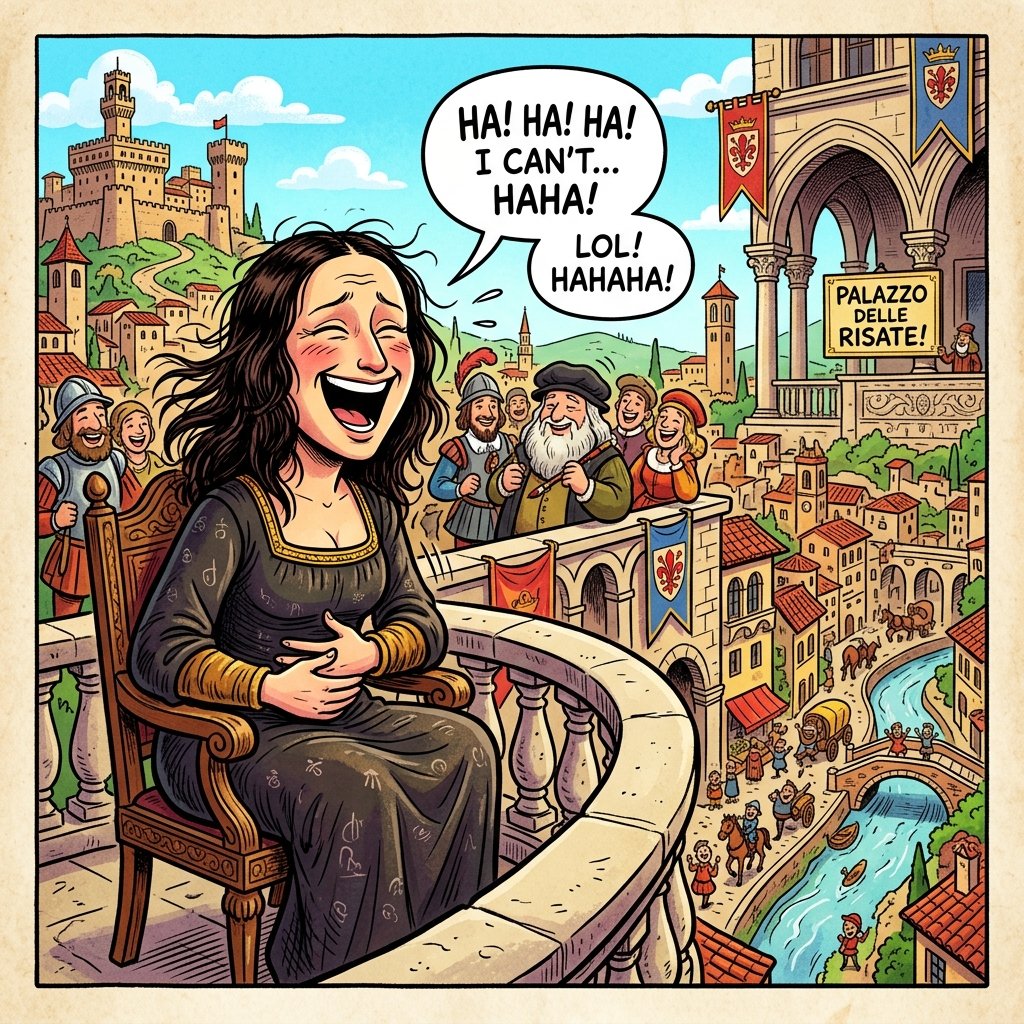
If one painting defines the Renaissance in the public imagination, it’s the Mona Lisa. Painted by da Vinci sometime between 1503 and 1519, it hangs behind bulletproof glass in the Louvre, where roughly 20,000 people file past it every single day. It’s small — just 30 by 21 inches — which surprises almost everyone who sees it in person.
That smile is the whole show. Art historians have spent centuries arguing over what it means, and da Vinci used a technique called sfumato — soft, smoky transitions between light and shadow — to make her expression shift depending on the angle you view it from. That ambiguity is basically an open invitation for Mona Lisa puns.
- She’s got the most iconic Mona-lith smile in art history.
- I asked her what she was smiling about. She Lisa-tened and said nothing.
- That painting has serious frame-of-mind.
- Mona Lisa never frowns — she’s got a strict no-drama policy.
- People travel across the globe just to Mona-ment her smile.
- She’s small in size but Mona-mental in fame.
- I tried to copy her smile. It was a total Mona-strosity.
- Da Vinci really nailed the “resting smug face.”
- She’s been smiling that same smile since 1503. Talk about commitment.
- Mona Lisa’s secret? She never overshares — she just smiles and Lisa-tens.
- That’s not just paint, that’s a Mona-mental achievement.
- She’s the original influencer — millions of visits, zero social media.
- I heard she used to date a guy named Leo. It didn’t work out; he kept leaving her unfinished business.
- Mona Lisa’s smile: proof that mystery never goes out of style.
- She’s got more security guards than most celebrities.
- If Mona Lisa could talk, she’d probably just smile and say nothing — she’s been Lisa-tening for centuries.
- That smile could launch a thousand memes.
- She’s the reason “iconic” was invented, probably.
- Mona Lisa doesn’t do bad angles. Every angle’s a good one — that’s the sfumato talking.
- Behind that smile is either deep wisdom or she just remembered she left the stove on in 1506.
Michelangelo and Sistine Chapel Puns
Michelangelo Buonarroti considered himself a sculptor first, a painter second, and he never let anyone forget it. When Pope Julius II commissioned him to paint the ceiling of the Sistine Chapel in 1508, Michelangelo reportedly grumbled about it the entire time. He spent four years on his back (not flat on the floor, as legend often claims, but on a custom scaffold he designed himself), painting over 5,000 square feet of biblical scenes, including the now-iconic “Creation of Adam.”
His sculpture David — a 17-foot marble figure carved from a single block that other artists had already rejected as ruined — remains one of the most studied works in art history. Between the ceiling and the statue, Michelangelo left behind enough material for a whole subcategory of Michelangelo puns.
- Michelangelo really knows how to work under pressure — and a ceiling.
- His neck never fully recovered from painting the Sistine Chapel. Talk about a stiff-necked commitment.
- David’s got the body of a god and the composure of a guy who’s just chill about it.
- Michelangelo didn’t paint a masterpiece — he Michel-angled the whole ceiling.
- I asked him about his back pain. He said it was a small price to Pope.
- The Sistine Chapel ceiling: proof that overtime pay should’ve existed in 1512.
- Michelangelo’s chisel skills? Absolutely cutting-edge.
- David’s abs took four years and one giant slab of marble. Meanwhile my abs are still “in progress.”
- Michelangelo once said the sculpture already existed inside the marble. Talk about a chip on his shoulder — several thousand chips, actually.
- He painted over 300 figures on that ceiling. Overachiever much?
- Michelangelo’s ceiling work really put him on top.
- The Sistine Chapel is proof that ceilings can steal the spotlight.
- David stands 17 feet tall, which is a lot of pressure to live up to.
- Michelangelo’s motto: go big or go marble.
- He rejected a “ruined” block of marble that everyone else gave up on. Now that’s a glow-up.
- The Creation of Adam has the most famous almost-touch in history — talk about commitment issues.
- Michelangelo’s back problems from the ceiling? A literal Renaissance pain.
- He didn’t just sculpt David, he chiseled his way into history.
- The Sistine ceiling took four years. My last home project took four weekends and I still complain about it.
- Michelangelo proved that lying down on the job can still make you legendary.
Raphael, Donatello, and Other Master Painter Puns
The Renaissance wasn’t a one-man show. Raphael, Botticelli, and Titian each carved out reputations that rival da Vinci’s and Michelangelo’s, even if pop culture gives them less airtime.
Raphael Sanzio died at just 37, yet he produced an astonishing body of work, including The School of Athens, a fresco packed with over 50 figures representing history’s great philosophers. Botticelli gave the world The Birth of Venus, that dreamy image of a goddess emerging from a seashell. Titian, working out of Venice, became famous for his mastery of color and for living to nearly 90 — practically ancient by 16th-century standards.
| Artist | Known For | Active Years | Signature Style |
|---|---|---|---|
| Raphael | The School of Athens | 1483–1520 | Balanced composition, clarity |
| Botticelli | The Birth of Venus | 1445–1510 | Flowing lines, mythological themes |
| Titian | Assumption of the Virgin | 1488–1576 | Rich color, loose brushwork |
| Donatello | David (bronze) | 1386–1466 | Naturalism, early Renaissance sculpture |
- Raphael’s School of Athens has more philosophers than my group chat has opinions.
- Botticelli’s Venus rides in on a shell — talk about a grand entrance.
- Titian lived to almost 90. His secret? Probably all that Venetian color therapy.
- Donatello beat Michelangelo to David by decades. Bronze medal, historically speaking — pun very much intended.
- Raphael died at 37 and still out-produced most of us in a lifetime.
- Botticelli’s Venus has better hair than most shampoo commercials.
- Titian’s brushwork was so loose, critics called it unfinished. Now we call it visionary.
- Raphael’s fresco game was so strong, it basically invented “squad goals.”
- Donatello: not just a ninja turtle, an actual Renaissance sculptor first.
- Botticelli painted goddesses; the rest of us can barely paint a fence.
Renaissance Art Term Puns (Fresco, Sfumato, Perspective)
Renaissance art terms aren’t just vocabulary for art history students — they’re also underused pun material. Here’s what the words actually mean before the jokes:
| Term | Definition |
|---|---|
| Fresco | Painting done on wet plaster, so pigment fuses directly into the wall as it dries |
| Sfumato | Da Vinci’s technique of blending tones so softly there’s no visible line, creating a hazy, smoke-like effect |
| Perspective | The mathematical system for making a flat surface look three-dimensional, pioneered by Brunelleschi |
| Humanism | The intellectual movement that shifted focus from purely religious themes to human experience, emotion, and individual achievement |
| Chiaroscuro | The dramatic use of light and shadow to create volume |
- Fresco painters had to work fast — wet plaster doesn’t wait for anyone.
- My jokes are like sfumato: the punchline blends in so smoothly you almost miss it.
- Perspective changed art forever. It also changes how bad my drawings look from far away.
- Humanism put people at the center of art. My selfies do the same thing.
- Chiaroscuro: because sometimes the best way to shine is to stand next to some shadow.
- A fresco artist’s biggest fear? Running out of time before the plaster dries. Relatable.
- Sfumato is basically the Renaissance version of a soft-focus filter.
- Brunelleschi invented linear perspective and single-handedly ruined everyone’s ability to draw a straight hallway.
- Humanism: proof that “main character energy” started 500 years early.
- Fresco painting is high-stakes. One wrong move and you’re stuck with it — literally, in the wall.
Florence and Italy Travel Puns
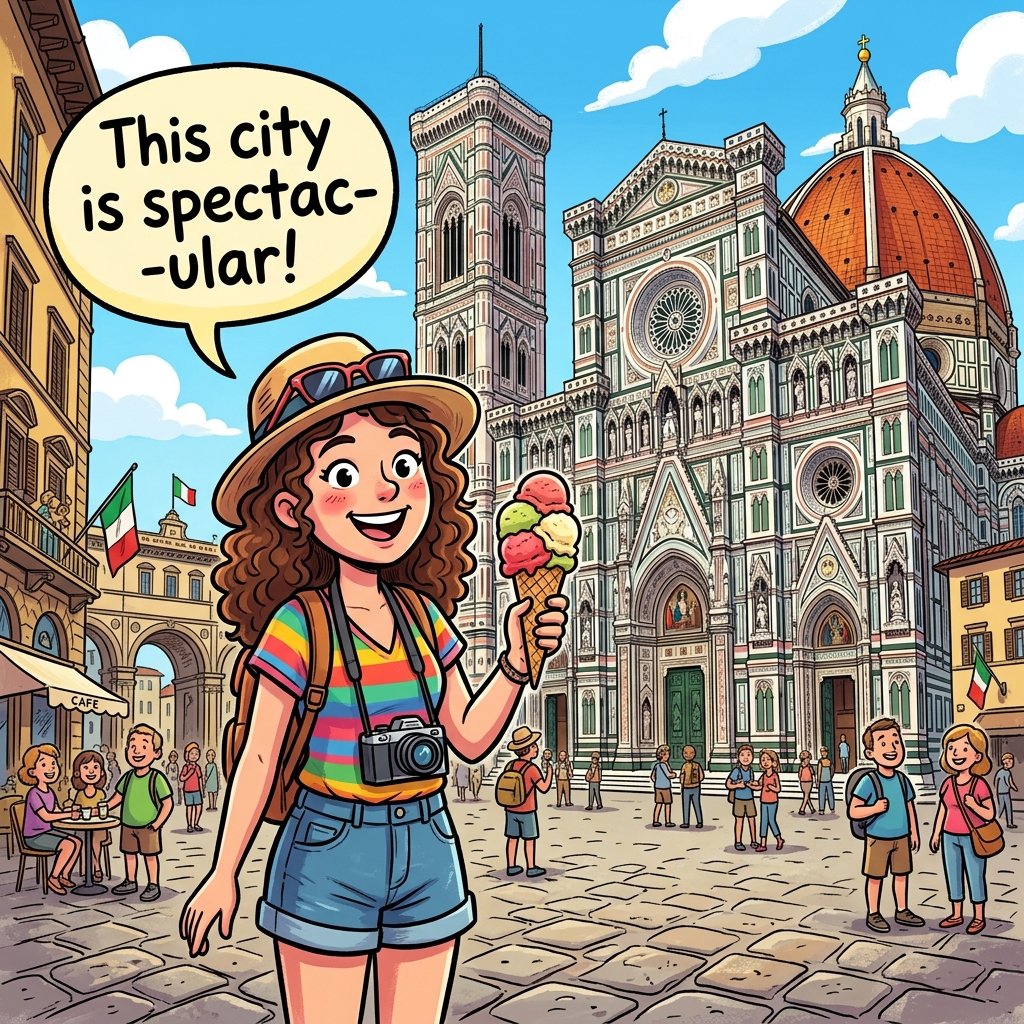
Renaissance art didn’t happen in a vacuum — it happened almost entirely in a handful of Italian cities, and Florence sits at the center of it all. Between 1400 and 1600, Florence produced more masterpieces per square mile than arguably any city in history, largely thanks to wealthy patrons willing to fund artists.
If you’re planning a trip, or just love a good travel caption, this section’s for you.
- Florence: where every alley leads to another masterpiece.
- I went to the Uffizi Gallery and left feeling artsy-fartsy.
- Tuscany’s got rolling hills and rolling puns.
- Florence’s Duomo dome took 16 years to build. My travel itinerary took 16 minutes.
- I came to Italy for the art and stayed for the gelato. Priorities.
- Walking through Florence feels like stepping into a fresco.
- The Ponte Vecchio: a bridge so charming, it’s basically flirting with the river.
- Venice has canals, Florence has domes, and I have zero self-control around pasta.
- Italy’s art scene really Renaissance-anced my whole trip.
- Florence in one word: masterpiece-adjacent.
- I tried to act cultured in the Uffizi. Then I got hungry and thought about lunch instead.
- The Sistine Chapel line was so long, I nearly became a Renaissance relic myself.
- Italy taught me that even the bathrooms have better architecture than my apartment.
- Florence gave the world humanism, and also unbelievable espresso.
- I didn’t just see the David, I stood there Awe-struck-arroti.
Medici Family and Patron Puns
None of this happens without money, and the Medici family had plenty of it. Starting as bankers in the late 1300s, the Medici became the single most powerful patrons of the Renaissance, funding Michelangelo, Botticelli, and dozens of others. Their wealth and political influence in Florence essentially bankrolled an entire artistic era — historians often argue there’s no Renaissance, at least not the one we know, without them.
- The Medici family didn’t just fund art, they Medici-um-handedly built the Renaissance.
- Lorenzo de’ Medici had impeccable taste and an even better checkbook.
- Being a Medici patron meant your art career got Medici-cated support.
- The Medici bank funded painters the way tech investors fund startups today — high risk, legendary reward.
- No Medici, no Michelangelo funding, no Sistine Chapel. Basic Renaissance math.
- The Medici crest had balls on it. Historians still debate why, but I’d call that a bold financial move.
- Lorenzo “the Magnificent” really lived up to the nickname — and the budget.
- The Medici family proved that behind every great artist is an even greater accountant.
- Their patronage turned Florence into an art capital. Ours turns group chats into meme capitals.
- The Medici didn’t do things halfway — they went full Medici-um rare on funding genius.
Short One-Liner Renaissance Puns
Sometimes you just need something quick and scrollable. Here’s a tight batch of short Renaissance puns, no set-up required.
- Renaissance artists really knew how to fresco it up.
- I’ve got a chisel personality — sharp and a little rough around the edges.
- Art history class: where every lecture is a Renaissance-ance.
- I’m not artistic, but I’ve got Michelangelo intentions.
- Renaissance puns are an acquired taste, like Titian’s color palette.
- Some paintings age like wine. Others age like a fresco — permanently.
- Perspective changed everything. Even my bad attitude, occasionally.
- I tried sculpting once. It was rock bottom.
- Sfumato: when your point kind of blends into nothing.
- Renaissance humor: 500 years old and still landing better than most sitcoms.
- Old masters, new jokes.
- I’ve got a Renaissance mind and a modern Wi-Fi connection.
- Every fresco has a story. Every pun has a groan.
- History class got a lot more fun once we hit the Renaissance unit.
- Botticelli’s Venus arrived on a shell. I arrive fashionably late, no shell required.
Clever Renaissance Puns for Instagram Captions
Museum trip? Art class post? Vacation photo in front of a fresco? These Renaissance Instagram captions are built for exactly that moment.
- “Sfumato mood: soft edges, big vibes.”
- “Living my best Mona Lisa life — mysterious and a little smug.”
- “Renaissance era, main character energy.”
- “Just here for the frescoes and the pasta.”
- “Vitruvian vibes: arms out, no regrets.”
- “Chiaroscuro? More like chiar-ooh-scuro.”
- “Basically a walking Botticelli.”
- “Left my heart in the Uffizi.”
- “David called, he wants his confidence back.”
- “Humanism era: putting myself at the center of the composition.”
- “Da Vinci sketched flying machines. I sketch out my weekend plans. Same energy.”
- “Not to brag, but I basically radiate perspective.”
- “This trip? Absolute Renaissance-ance.”
- “Frescoed, blessed, and slightly obsessed.”
- “Mona Lisa smile, budget museum-line patience.”
Renaissance Puns for Teachers and Students
Art history and world history teachers know this era is a goldmine for classroom engagement — it’s got drama, money, betrayal, and genius, all wrapped into one syllabus unit. These Renaissance puns for students work well as bulletin board headers, worksheet titles, or a five-second icebreaker before a lecture on Florence.
- “Renaissance unit: prepare to be en-lightened.” (Get it — humanism, enlightenment ideas taking root.)
- Pop quiz: what do you call a bored art student? Mannerist.
- “Class, today we’re covering Michelangelo. Try to stay chiseled in.”
- Homework tip: if you’re stuck, channel your inner da Vinci and just sketch it out.
- “Renaissance vocabulary quiz: don’t get lost in perspective.”
- Teacher: “Who painted the Sistine Chapel ceiling?” Student: “Ceiling fans, probably.”
- “Extra credit for anyone who can pronounce ‘chiaroscuro’ correctly on the first try.”
- Group project tip: two heads are better than one, unless you’re grading a Botticelli — then it’s however many cherubs fit in frame.
- “Bell rings, class starts — Renaissance-ance, everyone, take your seats.”
- Study group snack idea: fresco-flavored chips. (They don’t exist. Someone should fix that.)
Clean, Family-Friendly Renaissance Jokes
Perfect for greeting cards, classrooms, or anyone who wants clean jokes with zero innuendo attached.
- Why did the fresco painter never get in trouble? He always stayed within the lines — mostly because the plaster dried too fast to mess up twice.
- What did Michelangelo say to his ceiling? “We’re really going to make this work.”
- Why was the Mona Lisa never lonely? She always had company — thousands of visitors a day.
- What’s a painter’s favorite kind of math? Perspective — it’s the only kind that makes flat things look real.
- Why did Leonardo never finish some of his paintings? He was too busy sketching helicopters.
- What do you call a Renaissance artist who tells jokes? A pun-tist.
- Why did the marble block get nervous around Michelangelo? It knew it was about to get chiseled into shape.
- What’s Botticelli’s favorite season? Venus was born in the spring one, technically.
- Why did the Renaissance painter bring a ladder to work? The Sistine Chapel ceiling wasn’t going to paint itself.
- What did the fresco say to the wall? “We’re stuck together for centuries.”
Cheeky (But Not Explicit) Renaissance Puns for Adults
A little wink, nothing explicit. These lean into innuendo without crossing into anything you couldn’t say at a dinner party.
- Michelangelo’s David has been turning heads (and everything else) for 500 years.
- The Renaissance loved a good nude — art historians call it “the human form,” everyone else just calls it bold.
- Botticelli’s Venus arrived with zero clothes and maximum confidence.
- Da Vinci studied anatomy so closely, some of his sketches still make people blush.
- Renaissance patrons paid good money for “artistic nudity.” Some things never change.
- The Sistine Chapel ceiling has more bare skin than most beach vacations.
- David’s confidence really is unclothed and unbothered.
- Venus rode in on a shell wearing absolutely nothing but attitude.
- Renaissance art proved that “tasteful” and “totally exposed” can coexist.
- Marble abs, zero shame — Michelangelo really set a standard.
Famous Quotes with a Renaissance Pun Twist
Real Renaissance quotes, reworked with a wink. The originals stay historically accurate; the twist is the punchline.
“Simplicity is the ultimate sophistication.” — Leonardo da Vinci
Twist: Simplicity is the ultimate sophistication — unless you’re painting a 5,000-square-foot ceiling, apparently.
“I saw the angel in the marble and carved until I set him free.” — Michelangelo
Twist: I saw the angel in the marble, and also four years of neck pain.
“Learning never exhausts the mind.” — Leonardo da Vinci
Twist: Learning never exhausts the mind. Sixteen years painting one smile, though? That’ll exhaust anybody.
“The true work of art is but a shadow of the divine perfection.” — Michelangelo
Twist: The true work of art is a shadow — chiaroscuro really said it best.
- Da Vinci once said art is never finished, only abandoned. Honestly, relatable — that’s my entire to-do list.
- Michelangelo believed every block of marble had a statue inside. I believe every fridge has a snack inside. Same devotion, different medium.
- Leonardo’s notebooks proved that genius looks a lot like getting distracted by 40 projects at once.
- The Medici believed in investing in genius. I believe in investing in coffee. Both, arguably, fuel masterpieces.
Renaissance Puns for Tourists and Travelers
Standing in front of centuries-old Renaissance masterpieces hits differently in person. These puns are built for the actual travel moment — the ticket line, the gift shop, the “just one more photo” request.
- Waited two hours to see the Mona Lisa. Worth every Lisa-tening minute.
- The Uffizi gift shop got me — I bought a fridge magnet shaped like David. No regrets.
- My feet hurt from all the walking, but my soul got a serious perspective shift.
- Florence: the only place where getting lost feels like a fresco tour.
- I asked for directions in Italian and got a Renaissance history lesson instead. Worth it.
- The Vatican Museums are basically a marathon with better wallpaper.
- Bought a beret in Florence. Now I identify as an artist. Kidding — mostly.
- The gelato line was almost as long as the one for the Sistine Chapel. Almost.
- Every church in Florence has a ceiling that’ll give you neck cramps just from looking up.
- Tourist tip: bring comfortable shoes and an appreciation for standing still in awe.
Share-Worthy Renaissance Puns for Every Mood
A final grab-bag for whenever you need one more line — for a caption, a card, or just to make an art teacher groan appreciatively.
- Renaissance humor never goes out of style, unlike most 500-year-old fashion trends.
- History’s funniest era? Debatable. History’s most quotable era? Absolutely.
- Old art, fresh jokes — that’s the whole appeal here.
- If laughter is timeless, so is a good Michelangelo pun.
- Some things age like fine wine. This list ages like fine fresco.
- A pun a day keeps history from getting boring.
- Renaissance wordplay: proof that even the classics can be a little silly.
- Da Vinci sketched the future. We’re just here sketching out puns about it.
- Great art inspires. Great puns about that art? Also inspires, just differently.
- Five hundred years later, and the Renaissance still gets the last laugh.
FAQs
What are Renaissance puns and jokes based on?
They’re built around real Renaissance figures, artworks, and terms — like Leonardo da Vinci, the Mona Lisa, and words such as fresco and sfumato.
Who is the most popular subject for Renaissance puns?
Leonardo da Vinci tops the list, followed closely by Michelangelo and the Mona Lisa, thanks to their name recognition worldwide.
Are Renaissance puns suitable for classrooms?
Yes, most puns tied to artists, art terms, and famous works are clean and work well for art history jokes and classroom use.
Where can I use Renaissance puns besides classrooms?
They’re popular as Renaissance Instagram captions, museum-trip captions, greeting cards, and travel posts from cities like Florence and Rome.
Is the Mona Lisa still the most visited Renaissance artwork today?
Yes, it remains the Louvre’s top draw, seen by roughly 20,000–30,000 visitors daily, making it the era’s most referenced painting for jokes.
conclusion
Renaissance puns and jokes turn centuries-old art into something fun and easy to enjoy. From da Vinci’s sketches to Mona Lisa’s smile, every line here celebrates real history with a laugh. Whether you’re a student, teacher, or art lover, this list gives you plenty to share.
So next time you see a fresco or a famous portrait, remember these Renaissance puns and jokes. They’re clever, clean, and perfect for captions, classrooms, or casual chats. Art doesn’t have to feel serious all the time. Sometimes, the best way to appreciate a masterpiece is with a good, groan-worthy joke.