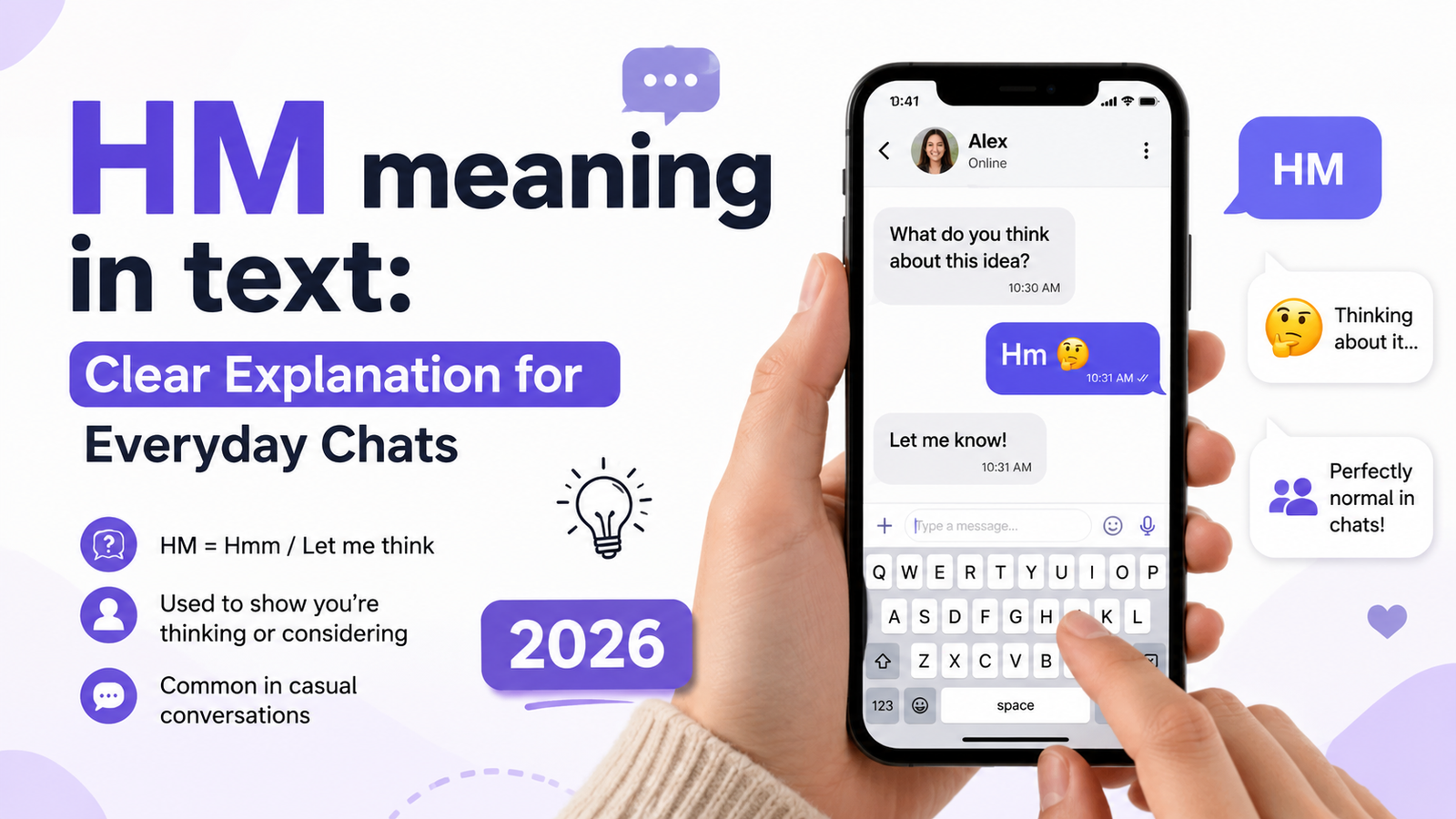
Hm meaning in text refers to a written hesitation sound people use when they’re thinking, doubting, or holding back a reaction. It’s not a real word — it’s a texting stand-in for that involuntary “hm” you make out loud before finding the right response.
Two letters, five possible meanings, and zero context clues unless you know what to look for. That tiny reply has ended dates, sparked arguments, and left plenty of people staring at their screens wondering what just happened.
This guide breaks down every real interpretation behind “hm,” from innocent thinking pauses to sneaky soft nos. You’ll walk away finally able to read between the letters.
What Does “Hm” Mean in Text?
At its core, HM meaning in text boils down to one thing: a written stand-in for the sound humans make when they’re processing something and haven’t landed on a reaction yet. It’s not a word in the traditional sense. It’s closer to punctuation for your brain — a little audible shrug that made its way onto the screen.
Linguists classify sounds like “hm,” “uh,” and “um” as filler sounds or hesitation markers. They don’t carry a fixed dictionary meaning the way “yes” or “no” does. Instead, they signal a mental state: I’m still working on my answer.
When you type it, though, something interesting happens. You strip away the tone of voice, the facial expression, and the pause length that would normally tell a listener exactly what that “hm” meant. What’s left is just two letters, and the reader has to fill in the emotional blanks themselves.
That’s why HM in text causes so much confusion. In speech, “hm” is loaded with context — pitch, timing, breath. In a text message, all of that gets flattened into plain text, so the same two letters can mean five completely different things depending on who sent them and why.
Here’s the short version before we go deeper:
| Signal Type | What It Usually Means | Common Trigger |
|---|---|---|
| Thinking | Processing your message | A question or new idea |
| Doubt | Not fully convinced | A claim or excuse |
| Passive interest | Mild engagement, low energy | Small talk, updates |
| Soft no | Indirect refusal | A request or invitation |
| Frustration | Quiet annoyance | Repeated topic, bad news |
Why Do We Even Type “Hm”? The Linguistic Root of a Hesitation Sound
Before texting slang existed, “hm” already had a job to do. It’s what linguists call a hesitation sound — a short, nasal utterance that fills the gap between hearing something and responding to it. You’ve made this sound a thousand times without thinking about it. Someone asks what you want for dinner, and before your mouth forms actual words, out comes an involuntary “hmm.”
This isn’t unique to English, either. Similar hesitation sounds show up across languages with slightly different spellings but the same basic function: buying time, signaling active thought, or softening a reaction before delivering it.
What makes this relevant to texting slang is that written language usually avoids capturing these in-between sounds. We don’t write “the meeting starts at, uh, three o’clock” in a work email. But casual texting broke that rule. It welcomed spoken speech patterns, including filler sounds, straight into written online communication.
So when you see “hm” in a chat, you’re looking at something a little unusual linguistically: a vocal habit that jumped from spoken language into text with almost none of the tone cues that made it understandable in the first place. That gap between what “hm” sounds like and what it reads like is exactly why so many people misread it.
Quick fact: Hesitation sounds like “hm” and “um” aren’t considered lazy or meaningless by linguists. They actually help conversations flow more smoothly by signaling to the listener that a response is coming — just not yet.
The 5 Real Meanings of “Hm” (Based on Context)
This is where HM meaning by context really matters. The same two letters can carry wildly different weight depending on the situation. Below are the five most common interpretations, based on how people actually use this text abbreviation in real conversations.
HM as a Thinking Signal
This is the most neutral and probably the most common use. Someone asks you a question, you’re not sure yet, and “hm” buys you a second to think.
Example:
You: “Should we go with the blue one or the red one?” Them: “Hm, let me look at both again.”
This version of “hm” isn’t loaded with any negative emotion. It’s a genuine reflective pause — the texting equivalent of tapping your chin. If it’s followed by a real answer within a few messages, you can safely read it as pure HM as a thinking signal with nothing else attached.
How to spot it: It usually comes right before a question gets an actual answer, and it’s often paired with something like “let me think” or “give me a sec.”
HM as Doubt or Disagreement
Here’s where things get a little sharper. When “hm” follows a claim, an excuse, or a statement the reader isn’t fully buying, it turns into a subtle expression of doubt or disagreement.
Example:
You: “I swear I texted you back yesterday.” Them: “Hm.”
That single word is doing a lot of work here. It’s HM as doubt or disagreement in its purest form — a subtle disagreement without an argument. The sender isn’t calling you a liar outright, but they’re also not accepting your explanation at face value. Think of it as skepticism wrapped in a syllable.
This version often shows up in disagreements where someone doesn’t want to escalate but also doesn’t want to just roll over and agree.
HM as Passive Interest
Sometimes “hm” isn’t about doubt at all — it’s about energy, or the lack of it. When someone’s mildly engaged but not particularly invested, “hm” becomes a minimal reply that keeps the conversation alive without adding much fuel.
Example:
You: “I finally organized my whole closet today.” Them: “Hm, nice.”
Nobody’s upset here. Nobody’s confused. It’s just a neutral reaction, a polite acknowledgment that doesn’t require follow-up. This is HM as passive interest, and it shows up constantly in casual, low-stakes chatting — especially with people who text while doing five other things at once.
HM as a Soft No (Most People Miss This One)
This is the one that trips people up the most, and it’s worth slowing down for. When “hm” responds to a request, a plan, or an invitation, it can function as an indirect refusal — a way of saying no without actually saying the word.
Example:
You: “Want to grab dinner tonight?” Them: “Hm, I don’t know.”
Technically, no rejection happened. But practically? That “hm” is doing the heavy lifting of a polite rejection. It’s a hesitant no, the kind of answer that leaves the door cracked open just enough to avoid outright conflict while still signaling reluctance.
Why this matters: A lot of people wait for a hard “no” that never comes, holding out hope based on a soft “hm” that was actually a decline in disguise. Recognizing this pattern saves you from misreading interest that isn’t really there.
HM as Disapproval or Frustration
The final major reading is the most emotionally loaded one. When “hm” comes after bad news, a repeated argument, or something the sender clearly isn’t happy about, it can carry real negative response energy.
Example:
You: “I might be late again tonight.” Them: “Hm.”
There’s no explosion here, no all-caps anger. But the flatness of that single word, especially without a follow-up question or reassurance, often signals quiet frustration. This version of “hm” tends to show up in situations where someone’s annoyed but choosing restraint over confrontation.
Quick summary table — the 5 meanings side by side:
| Type | Emotional Tone | Typical Follow-Up |
|---|---|---|
| Thinking Signal | Neutral | An actual answer soon after |
| Doubt/Disagreement | Skeptical | Silence or a challenging question |
| Passive Interest | Mild, low-energy | Short reply, topic often changes |
| Soft No | Reluctant | Vague excuses, no confirmation |
| Disapproval | Tense, restrained | Short replies, possible cooldown |
“Hm” vs “Hmm” vs “Hmmm” — Does Letter Count Actually Change the Meaning?
Short answer: yes, and it matters more than people think. This is the HM vs HMM question, and once you notice the pattern, you’ll see it everywhere.
Adding letters to a hesitation sound generally stretches out the implied pause — and a longer pause usually signals a stronger reaction, whether that’s deeper thought, deeper doubt, or deeper annoyance.
| Version | Implied Pause | Common Reading |
|---|---|---|
| “Hm” | Short, quick | Light thought, mild reaction |
| “Hmm” | Medium | Genuine consideration or noticeable doubt |
| “Hmmm” | Long, drawn-out | Strong skepticism, real hesitation, or building tension |
| “Hmmmmm” | Exaggerated | Often playful, teasing, or dramatic — sometimes sarcastic |
This is one of the more reliable context clues in texting. A one-letter difference between “hm” and “hmmm” isn’t random — it’s an intensity dial. Someone typing “hmmmmm” after you mention something suspicious is almost certainly teasing you or building suspense, not genuinely confused.
Case in point: Picture two responses to the same message, “I might have accidentally told your secret.”
- “Hm, okay.” → Mild, controlled, maybe even accepting.
- “Hmmmmm… we need to talk.” → Playful but pointed, clearly building toward something bigger.
Same trigger, wildly different emotional weight, and the only thing that changed was letter count.
Is “Hm” Rude? Reading Tone Without Hearing a Voice
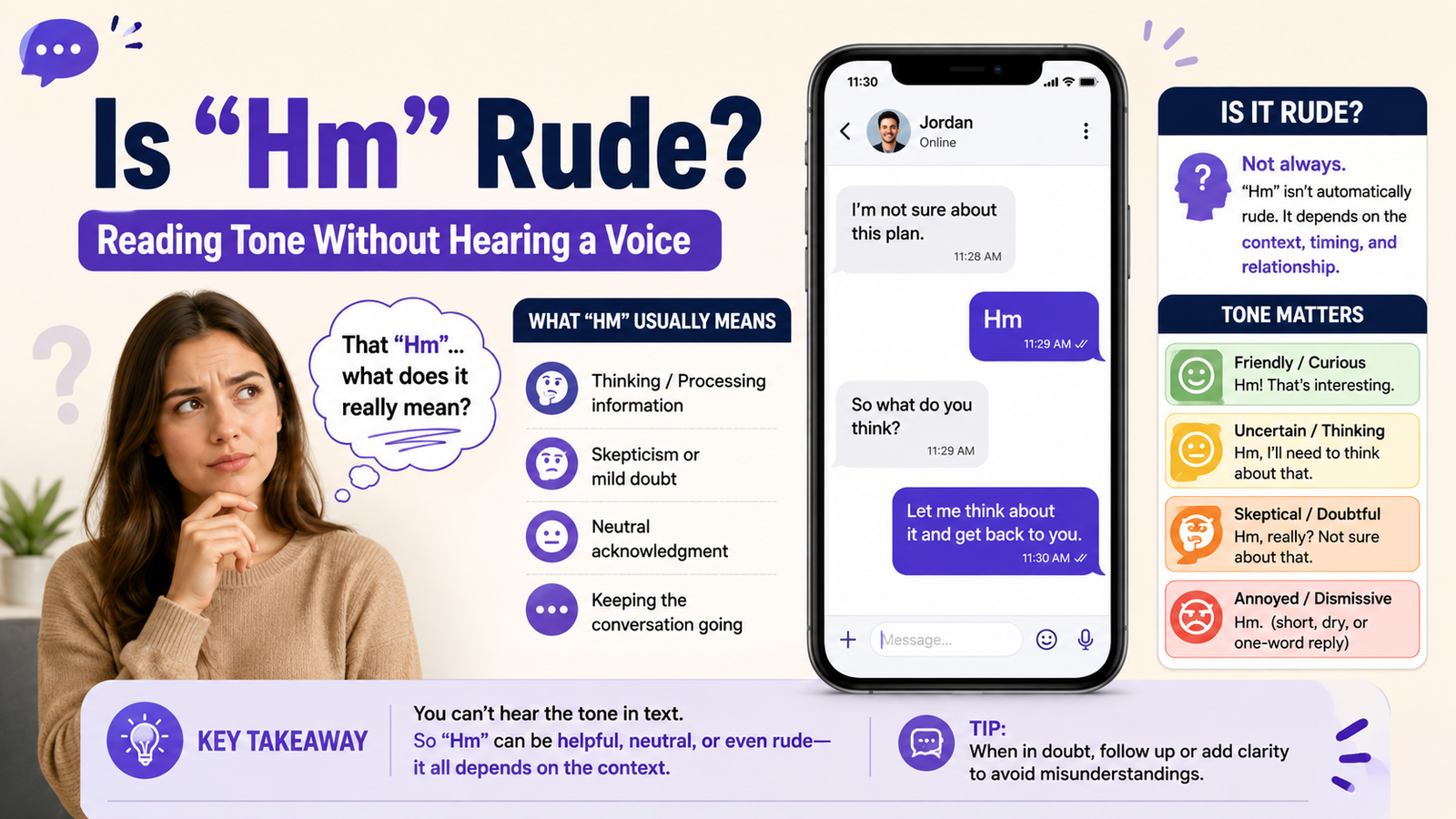
Whether “hm” comes across as rude depends heavily on texting tone, and that tone lives almost entirely in the punctuation and timing around it, since the word itself carries no built-in politeness or hostility.
Here’s how punctuation shifts the reading:
- “Hm.” — The period adds finality. This often reads as flat, closed-off, or mildly annoyed.
- “Hm?” — The question mark softens it into genuine confusion or curiosity. Much less likely to be rude.
- “Hm…” — The ellipsis suggests an unfinished thought, often read as thoughtful or slightly uncertain rather than dismissive.
- “hm” (lowercase, no punctuation) — Usually the most casual and neutral version, especially between close friends.
Timing plays a role too. An instant “hm” right after your message often reads as reflexive — barely processed. A “hm” that comes ten minutes later, after you can see they’ve clearly read the rest of the conversation, tends to feel more deliberate, and deliberate answers usually carry more weight than reflexive ones.
Bottom line: “Hm” isn’t inherently rude. But stripped of a smiley face, a follow-up sentence, or any softening language, it can land as rude even when the sender didn’t mean it that way. If you’re not sure how it was meant, the punctuation and response time are your best clues.
“Hm” Meaning by Relationship Type
Context doesn’t just come from the message itself — it comes from who’s sending it. The same “hm” lands completely differently depending on whether it’s from a close friend, a partner, or a coworker.
Between Friends
Among friends, “hm” is usually low-stakes. Friendships tend to run on shorthand, and a huge chunk of that shorthand is built on minimal reply culture — short texts that keep the rhythm of a conversation going without much effort.
A friend typing “hm” after you share weekend plans probably isn’t judging you. They’re skimming, multitasking, or just not that invested in the details of your Saturday, and that’s completely normal. The exception is if “hm” shows up after something more serious, like advice you gave or a disagreement between you two. In that case, it can carry real subtle disagreement the same way it would in any other relationship.
In Romantic Texting
HM meaning in romantic conversations carries more emotional weight than almost any other category, simply because romantic texting comes loaded with higher expectations. A “hm” from a partner can feel like a much bigger deal than it would from a coworker, even when the sender meant almost nothing by it.
In relationship messages, “hm” often shows up in a few recognizable patterns:
- After a flirty message — often playful, a way of teasing or building anticipation rather than shutting things down.
- After a serious question (“Where do you see this going?”) — genuinely reflective, and rushing someone past a real “hm” here usually backfires.
- After a request or invitation — can be the soft no pattern discussed earlier, especially if it’s followed by vague excuses.
- After bad news or a mistake — often signals real hurt or disappointment being held back.
The emotional tone in romantic texting is almost always amplified compared to platonic chats. A “hm” that would mean nothing from a friend can feel like a red flag from a partner, mostly because we read romantic messages through a more anxious, higher-stakes lens. That doesn’t mean every romantic “hm” is a crisis — it just means context and follow-up matter even more here than elsewhere.
In Professional or Work Chats
Work chats operate under different rules entirely. Messaging etiquette in professional settings tends to strip out a lot of the emotional guessing game, and “hm” in this context usually falls into one of two buckets: genuine thinking, or diplomatic hesitation.
Example:
Manager: “Can we push the deadline up by two days?” You: “Hm, let me check with the team first.”
This reads as professional and measured, not passive-aggressive. In work settings, “hm” often functions as a placeholder before someone commits to something they need to think through first, especially around commitments, deadlines, or requests that affect other people.
Where it gets trickier is in feedback conversations. A “hm” in response to a proposal or idea can carry real mild objection energy, functioning almost like a diplomatic version of “I’m not sure this works,” delivered without the confrontation of saying so directly.
How to Respond When Someone Texts You “Hm”
Responding to HM doesn’t have to be a guessing game once you know which of the five categories you’re likely dealing with. Here’s a practical, context-matched approach.
If it seems like a thinking signal: Give them space. Don’t pile on more questions immediately. A simple “take your time” or just waiting it out usually works better than following up with three more messages.
If it seems like doubt or disagreement: Address it directly instead of ignoring it. Something like “You sound unsure — what’s up?” invites them to actually say what’s on their mind instead of leaving it in vague hesitation territory.
If it seems like passive interest: No real action needed here. This is a low-stakes moment, and trying to force more enthusiasm out of someone who’s just not that invested right now usually doesn’t land well.
If it seems like a soft no: This is the one worth handling carefully. Rather than pushing the original plan again, try asking directly: “Sounds like maybe not — no worries either way.” This gives them an easy exit and shows you picked up on the hesitation without making it awkward.
If it seems like disapproval or frustration: Don’t ignore it and don’t over-apologize either. A grounded response like “You seem a little off — did I do something?” opens the door without assuming the worst.
Quick reference table:
| Their “Hm” Type | Your Best Move |
|---|---|
| Thinking | Wait, don’t rush them |
| Doubt | Ask what’s making them unsure |
| Passive interest | Move on naturally, no pressure |
| Soft no | Offer an easy out, don’t push |
| Frustration | Check in directly, stay calm |
Common Misreadings of “Hm” (And What They’re Actually Saying)
Misunderstanding this tiny word is incredibly common, mostly because people default to the worst-case text interpretation when they’re anxious about a conversation. Here are the most frequent mix-ups.
Mistake #1: Assuming anger when it’s actually distraction. Someone typing “hm” while genuinely busy — driving, working, mid-task — often isn’t reacting emotionally at all. It’s just a low-effort placeholder response, not a negative response in disguise.
Mistake #2: Assuming interest when it’s actually a soft no. As covered earlier, a hopeful reading of “hm, maybe” can lead people to wait around for a “yes” that was never coming. If “hm” gets paired with vague language and no concrete follow-up, that’s usually your answer.
Mistake #3: Reading every “hmmm” as suspicious or accusatory. Sometimes a stretched-out “hmmm” is just playful teasing, not a sign that someone caught you in something. Context around the message matters more than the letter count alone.
Mistake #4: Treating “hm” as a complete non-answer. It’s rarely truly meaningless. Even the most neutral versions carry some signal — they’re just quieter ones. Dismissing every “hm” as noise means missing real, if subtle, conversational meaning.
Mistake #5: Expecting the same “hm” to mean the same thing from everyone. Texting habits are personal. Some people type “hm” constantly as a verbal tic with almost no weight behind it, while for others, it’s a rare and meaningful reaction. Pattern-matching against how a specific person normally texts beats applying a universal rule.
Case Studies: “Hm” in Real Conversations
Theory only goes so far. Seeing how these patterns play out in actual message threads makes the HM interpretation framework a lot easier to apply to your own chats.
Case Study 1: The Group Project Text
Maya messaged her coworker about swapping a deadline. The reply came back fast: “Hm, that might be tight.” Maya almost panicked, reading it as a flat rejection. But nothing about the punctuation or timing pointed to frustration — it was a quick, instant reply with no period, no cold tone. Twenty minutes later, her coworker followed up with a full plan for making the new deadline work. In hindsight, that “hm” was a textbook thinking response, not pushback. The lesson: an instant, casual “hm” followed by real engagement almost never means “no.”
Case Study 2: The Dinner Invitation
Jordan asked a date, “Want to grab dinner Friday?” The reply: “Hm, I don’t know, maybe.” No follow-up question, no alternative day suggested, no real enthusiasm in the messages that came after. Jordan waited two days for a firmer answer that never arrived. This is close to a perfect example of HM as a soft no — vague language, zero commitment, and a conversation that quietly drifted rather than getting a direct decline. Recognizing this pattern earlier would have saved Jordan the wait.
Case Study 3: The Family Group Chat
A sibling posted exciting news in a family group chat. One relative replied with just “Hm, interesting.” Compared to everyone else’s exclamation points and follow-up questions, that single flat reply stuck out. Was it disapproval? In this case, a private message later revealed the relative was simply distracted at work and hadn’t fully processed the news yet — a case of passive interest driven by circumstance, not judgment. This case is a good reminder that HM meaning by context isn’t just about the message itself; it’s about comparing it to the sender’s normal texting energy and the situation they’re in.
What these cases have in common: none of them could be accurately read from the word “hm” alone. Timing, punctuation, follow-up behavior, and the sender’s usual habits all played a bigger role than the two letters themselves. That’s the real skill behind decoding this texting slang — treating “hm” as a clue to investigate, not a verdict to accept at face value.
Is “Hm” Understood the Same Way Everywhere? A Cultural Note
HM meaning isn’t perfectly universal, and it’s worth knowing that before assuming your read on it applies globally. Hesitation sounds exist across most spoken languages, but their written texting equivalents don’t always carry identical weight.
In some cultures and language communities, indirect communication is the norm, not the exception, and soft, ambiguous responses like “hm” are a completely standard way to express disagreement or hesitation without confrontation. In more direct communication cultures, the same response might stand out as unusually vague or even slightly evasive.
Age also shapes interpretation. Younger texters, who grew up treating texting almost like spoken conversation, tend to load “hm” with more emotional nuance — tone, punctuation, letter count — while older or less frequent texters may use it more literally, closer to its original function as a simple thinking sound.
The takeaway: don’t assume your personal read on “hm” is the universal one, especially in cross-cultural or cross-generational conversations. When in doubt, context from the specific person and relationship beats any general rule.
“Hm” vs Similar Texting Expressions
To really nail down HM meaning, it helps to see how it compares to other short chat expressions that occupy similar territory.
| Expression | Core Meaning | Emotional Weight |
|---|---|---|
| Hm | Thinking, doubt, or hesitation | Low to medium, varies by context |
| Oh | Surprise, realization, or mild disappointment | Low to medium |
| K | Acknowledgment, often curt | Can read as cold or annoyed |
| … (ellipsis alone) | Unfinished thought, hesitation, or tension | Medium to high |
| Idk | Genuine uncertainty or deflection | Low to medium |
| Sure | Agreement, sometimes reluctant | Depends heavily on punctuation |
What sets “hm” apart from most of these is its flexibility. “K” almost always reads as short and closed-off. “Idk” almost always signals real or performed uncertainty. But “hm” swings across five genuinely different meanings depending purely on context, making it one of the more nuanced entries in the world of minimal text responses.
FAQs
1. What does “hm” mean in a text message?
It’s a written hesitation sound showing the sender is thinking, doubting, or holding back a reaction. The exact meaning depends on context, punctuation, and who’s sending it.
2. Is “hm” a rude response?
Not inherently — “hm?” reads as curious, “hm…” as thoughtful, but “hm.” with a period can come across as flat or annoyed. Tone lives in the punctuation, not the word itself.
3. Does “hmm” mean something different from “hm”?
Yes — more letters generally signal a longer implied pause, so “hmm” suggests deeper thought or doubt, while “hmmmmm” often reads as playful or teasing.
4. Can “hm” be a soft no?
Yes, when it follows a request or invitation with no firm follow-up, it often functions as an indirect decline rather than genuine indecision.
5. Does “hm” mean the same thing to everyone?
No — it varies by relationship, culture, and individual texting habits, so comparing it to how that specific person normally texts is more reliable than a universal rule.
Conclusion
“Hm” looks tiny, but it carries real meaning. The hm meaning in text changes with context, punctuation, and timing. It can show thinking, doubt, mild interest, a soft no, or quiet frustration. Reading it right takes more than the two letters alone.
The best way to understand hm meaning in text is to look at the full picture. Check the punctuation. Notice how fast they replied. Think about your relationship with them. Once you do this, “hm” stops feeling confusing. It becomes an easy clue, not a mystery.