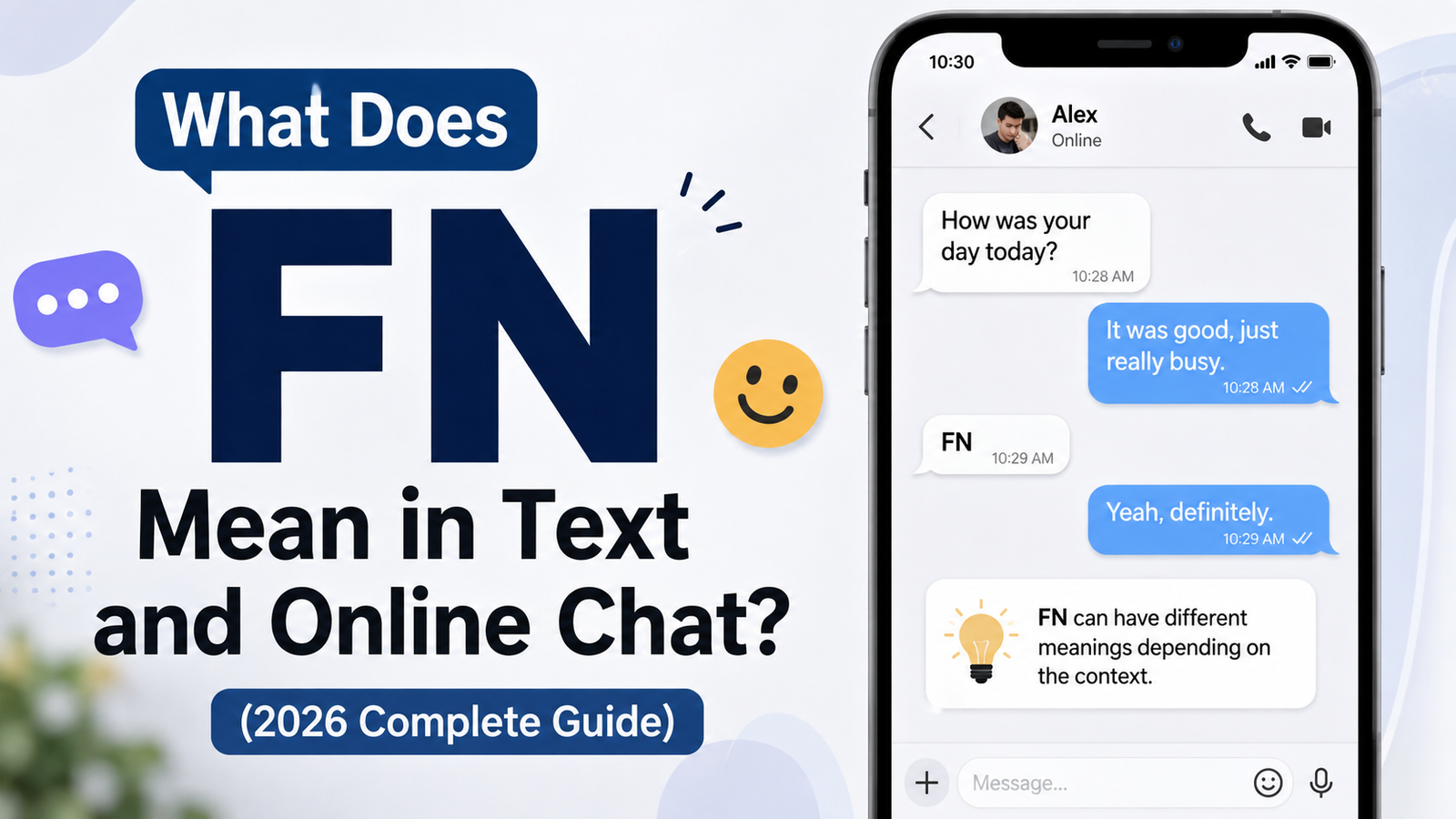
FN in text is a flexible abbreviation that most often stands for “f***ing,” used as an intensifier to add emphasis to a message. Depending on the situation, it can also mean “for now,” “fine,” or reference Fortnite in gaming chats.
Two letters, five completely different meanings, and one confusing text away from a total misunderstanding. That’s the chaos of modern texting shorthand in a nutshell.
From Snapchat captions to Discord gaming servers, FN shifts its identity based on platform, tone, and the words sitting right beside it. Once you know the patterns, decoding it becomes second nature, and you’ll never second-guess a text again.
FN’s Most Common Meanings at a Glance
Before we get into the weeds, here’s the cheat sheet. This covers FN most common meanings across texting, gaming, and everyday tech use.
| Meaning | Where You’ll See It | Example |
|---|---|---|
| F***ing (intensifier) | Texts, Snapchat, TikTok captions | “That’s FN awesome” |
| For now | Casual planning texts | “I’m staying in FN” |
| Fine | Reply to “you good?” | “Yeah, I’m FN” |
| Fortnite | Gaming chats, Discord servers | “FN squad tonight?” |
| Function key | Tech talk, keyboard shortcuts | “Press Fn + F5” |
| First name | Forms, professional shorthand | “Enter FN and LN below” |
Keep that table in mind as you read on. Every meaning below ties back to one of these six, and knowing which bucket you’re dealing with makes the rest of this guide click into place fast.
FN as an Intensifier: The “F***ing” Stand-In
Let’s start with the meaning you’ve probably seen the most. FN as an intensifier is, hands down, the dominant use of this abbreviation in casual text slang today.
Here’s how it works: instead of typing out a full curse word, people shrink it down to two letters. It softens the language just enough to slide past a content filter, avoid an awkward autocorrect moment, or simply look less aggressive on screen. The meaning stays intact — it’s still doing the job of an intensifier — but it reads a little cleaner.
You’ll see it show up right before an adjective, working exactly the way the full word would:
- “That movie was FN hilarious.”
- “I am FN exhausted.”
- “This traffic is FN ridiculous.”
In every one of these, FN is pumping up the emotion of the sentence. Swap it for “extremely” or “so” and the sentence still makes sense — that’s your tell you’re looking at the slang intensifier version of FN, not one of its other meanings.
This usage really took off with the rise of SMS texting and early messaging apps, when character limits and typing speed pushed people toward shorter everything. Once smartphones and social platforms entered the picture, the habit stuck around and spread. Snapchat captions, TikTok comments, Twitter (now X) replies — this profanity abbreviation shows up everywhere casual, unfiltered conversation happens.
One thing worth noting: this meaning depends heavily on tone. A text that reads “I’m FN done with this job” carries real frustration. A text that reads “this cake is FN incredible” carries excitement. Same abbreviation, opposite emotional temperature. Reading the sentence around FN — not just the letters themselves — tells you which one you’re getting.
FN as “For Now” or “Fine”
Not every use of FN is loaded with attitude. A big chunk of the time, FN for now is exactly what it sounds like: a low-key, practical shorthand for a temporary situation.
Picture this text exchange:
Friend: You still coming tonight? You: Staying home FN, might swing by later.
Here, FN isn’t intensifying anything. It’s compressing “for now” into two characters, the texting equivalent of shaving off three words you don’t have time to type. This version shows up constantly in planning texts, status updates, and quick check-ins where someone’s describing their current situation rather than expressing emotion.
Closely related — and sometimes genuinely hard to tell apart from “for now” — is FN as a stand-in for “fine.”
Friend: You okay? You: Yeah, I’m FN. Just tired.
This one leans conversational and a little breezy. It’s the texting cousin of a shrug — not upset, not thrilled, just okay. Context does most of the heavy lifting here: a direct answer to “are you okay?” almost always points to “fine,” while a comment about plans or duration usually points to “for now.”
Both of these meanings share a common thread — they’re built around short-term situations. Nobody’s using FN-as-fine or FN-as-for-now to describe something permanent. That built-in temporariness is actually a handy identifier when you’re trying to sort out which FN you’re looking at.
FN in Gaming — Does It Always Mean Fortnite?
Step into a gaming server, and the rules change completely. FN in gaming almost always points to one thing: Fortnite, the battle royale game that’s been a cultural fixture since 2017.
FN in Fortnite chat shows up constantly — in Discord servers, gaming subreddits, esports commentary, and anywhere players gather to talk strategy, loot, or squad plans:
- “Anyone want to run FN tonight?”
- “New FN update just dropped.”
- “My FN stats are actually improving.”
This Fortnite abbreviation works because gamers love efficiency. Typing “FN” instead of “Fortnite” saves time mid-match, in a fast-scrolling Discord channel, or in a Reddit thread where everyone already knows what game is being discussed. It’s not really slang in the profanity sense at all — it’s more like an industry nickname, the same way people say “WoW” instead of World of Warcraft or “CoD” instead of Call of Duty.
Here’s the key distinction, though: context still rules. The exact same message — “FN squad tonight?” — makes zero sense outside a gaming conversation. But drop it into a Discord slang-heavy gaming server, and everyone instantly knows you’re asking about a Fortnite session. That’s the nature of gamer shorthand: it’s dense with meaning inside its native environment and nearly meaningless outside it.
A quick gut check for spotting gaming context: if the conversation already involves game titles, squads, matches, loadouts, or Discord voice channels, FN is Fortnite. If the conversation is about plans, feelings, or general chit-chat, it almost certainly isn’t.
FN as a Keyboard Function Key
Now for the least dramatic — but genuinely useful — meaning on this list. The FN keyboard function key is a physical button found on most laptop keyboards, right near the bottom-left corner.
Here’s what it actually does: laptops pack more functions into fewer keys than a full desktop keyboard can offer, so manufacturers double up. The Fn key acts like a shift key for your function row, letting you access a second layer of shortcuts — brightness controls, volume, screen mirroring, airplane mode, and more — all mapped onto keys that already have another primary job.
Common combinations you’ll run into on most laptop keyboards:
| Shortcut | What It Usually Does |
|---|---|
| Fn + F2 | Adjust volume |
| Fn + F5 | Refresh or adjust brightness |
| Fn + F11/F12 | Toggle airplane mode or media controls |
| Fn + Esc | Lock the Fn key itself (varies by manufacturer) |
There’s a small but genuinely useful detail here: in technical writing, this meaning is almost always styled as “Fn” with a lowercase n, not the all-caps “FN” you’ll see in slang contexts. It’s not a hard rule — plenty of casual typing ignores capitalization altogether — but it’s a helpful visual cue when you’re skimming a message and trying to figure out which meaning applies.
This meaning shows up in tech support threads, laptop manuals, IT forums, and the occasional frustrated tweet about accidentally hitting the wrong computer keys. You’re very unlikely to see it in a casual text between friends, which actually makes it one of the easier meanings to rule in or out.
Other Legitimate Meanings of FN You Should Know
Beyond the big four, FN carries a handful of narrower, more formal meanings. They won’t show up in your group chat, but they’re worth knowing so you’re not caught off guard.
First Name. In forms, databases, and professional paperwork, FN is common shorthand for “first name,” usually paired with LN for “last name.” You’ll spot this on intake forms, spreadsheets, and customer databases far more than in conversation.
Footnote. Academic writing and legal documents use FN to mark a reference at the bottom of a page. If you’re reading a research paper or a court filing and see “FN 12,” that’s pointing you to footnote twelve, not asking you to feel some kind of way about it.
Fabrique Nationale. This one’s a genuine curveball: FN is also the abbreviation for Fabrique Nationale, a Belgian firearms manufacturer that’s been operating since the late 1800s. If you ever see “FN” in a firearms or military context, this is almost certainly what’s meant — it has nothing to do with texting slang at all.
Fireman. In the U.S. Navy and Coast Guard, FN is an official enlisted rate abbreviation. Again, a context you’d only encounter in a very specific professional setting, not in everyday online communication.
None of these four are likely to trip you up in a text from a friend, but they’re a good reminder that FN’s flexibility goes well beyond internet culture. This is a genuinely overloaded abbreviation — one set of letters, carrying an unusually wide spread of popular meanings depending entirely on where it lands.
How FN Meaning Changes by Platform
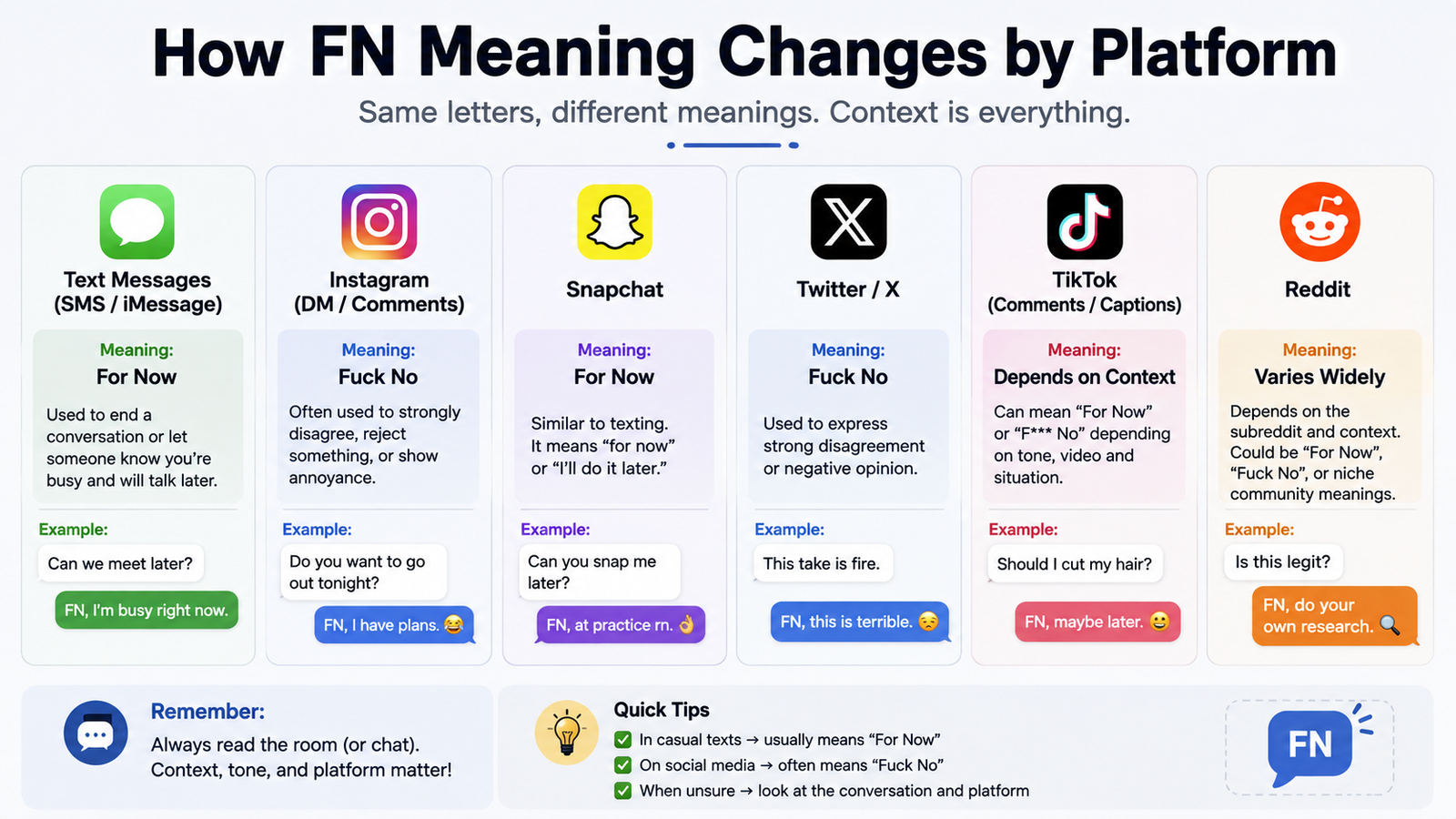
FN meaning changes dramatically depending on where you’re reading it, and platform differences are honestly one of the fastest ways to narrow things down. Here’s a breakdown of what to expect where.
Snapchat and Instagram. These platforms lean heavily toward the intensifier meaning. Captions, story replies, and comment sections are full of “FN” doing the work of an unfiltered curse word, dialed down just enough to feel casual rather than crude.
TikTok. Similar story, with an extra layer of meme culture mixed in. You’ll see FN used for emphasis in comments and captions, sometimes paired with exaggerated reactions or trending sounds that amplify the emotional punch of the phrase.
Discord and gaming forums. Here, gaming context takes over almost entirely. Unless the conversation clearly shifts toward feelings or plans, FN on a gaming server points straight to Fortnite.
Dating apps. This one’s more mixed — usually leaning toward “for now,” but occasionally carrying a flirtier edge depending on the conversation (more on that below).
Professional and email contexts. Slang meanings basically disappear here. In a work email or a form, FN almost always means “first name” or, in academic and legal writing, “footnote.”
The pattern across all of these social media slang environments is pretty consistent: casual, high-emotion platforms skew toward the intensifier meaning, planning-focused conversations skew toward “for now,” and gaming spaces skew toward Fortnite. Once you clock which bucket a platform falls into, you’ve already solved most of the puzzle.
How to Figure Out Which FN Someone Means
By now you’ve probably noticed a pattern: figuring out FN’s meaning isn’t about memorizing a definition — it’s about reading the room. Here’s a simple three-step process for picking up on the right context clues every time.
Step one: check the platform. Gaming server? Probably Fortnite. Snapchat or TikTok? Probably the intensifier. A work form or email? Probably “first name.”
Step two: read the tone. An emotional, exaggerated message points toward the intensifier meaning. A practical, logistical message points toward “for now.” A calm, direct answer to “are you okay?” points toward “fine.”
Step three: look at the surrounding words. This is often the fastest tell of all.
- “FN awesome” only makes grammatical sense as profanity — you can’t logically say “for now awesome.”
- “I’ll do it FN, but I might change plans” only makes sense as “for now.”
- “FN tournament starts at 8” only makes sense as Fortnite.
Here’s that logic applied to a couple of real exchanges:
Text 1 Friend 1: “That show was FN incredible.” Friend 2: “Right?? I couldn’t stop watching.” (FN = intensifier — the sentence structure and enthusiasm both point that way.)
Text 2 “I’ll be online FN, but I might log off if I get busy.” (FN = for now — the sentence is describing a temporary state, not adding emphasis.)
Nine times out of ten, one of these three checks resolves the ambiguity instantly. On the rare occasion it doesn’t, there’s a much simpler option — just ask.
Is FN Offensive or Inappropriate?
This is genuinely worth addressing directly, because the honest answer isn’t a flat yes or no. It depends on which meaning you’re dealing with and where it’s being used.
In its most common casual form — the intensifier — FN is standing in for profanity. That doesn’t make it aggressive or harmful in most everyday contexts; it’s mild, common, and generally read as casual inappropriate language rather than anything genuinely offensive. Millions of people use it daily in texts to friends, captions, and comments without anyone batting an eye.
That said, a couple of things are worth knowing:
- It’s still censored profanity at its core, which means it’s not automatically appropriate for professional messages, formal writing, or conversations with people you don’t know well. Sending “FN” as an intensifier in a work Slack channel is going to land very differently than in a group chat with close friends.
- Some corners of the internet use FN as shorthand for far more aggressive or offensive phrases, including slur-adjacent language that shows up on certain slang-definition sites. This usage is a lot rarer and far more context-dependent than the common meanings covered above, but it’s worth knowing it exists so you’re not caught completely off guard if you stumble across it.
The meanings that carry zero baggage — “for now,” “fine,” Fortnite, the function key, first name — are entirely harmless and appear constantly in totally normal, everyday conversation. It’s really only the intensifier meaning (and its much rarer, harsher cousin) that calls for a little judgment about audience and setting.
Bottom line: FN isn’t inherently a bad word. It’s a flexible abbreviation that happens to include one meaning rooted in mild profanity, plus several completely neutral, practical ones. Reading the room — who you’re talking to, and where — tells you everything you need to know about whether it’s acceptable usage in that moment.
How to Respond to FN in a Text
Once you’ve figured out which FN you’re dealing with, replying is pretty straightforward. Here’s a quick reference for each meaning.
If FN means the intensifier: Just respond naturally, matching the energy. “That’s FN awesome” doesn’t need a formal reply — “Right?? So good” works fine.
If FN means “for now”: Acknowledge the temporary plan and move on. “I’m staying in FN” pairs naturally with something like “Cool, lmk if that changes.”
If FN means “fine”: Take it at face value unless other context suggests otherwise, then follow up warmly if you sense there’s more going on. “Yeah I’m FN” can be met with a simple “Okay, glad to hear it” or a gentler “You sure? I’m here if not.”
If FN means Fortnite: Respond in kind — confirm, decline, or ask for details. “FN squad tonight?” invites a quick “I’m in” or “Can’t tonight, maybe tomorrow.”
If you genuinely can’t tell: There’s no shame in asking. A quick “wait, what do you mean by FN?” resolves the ambiguity in seconds and shows you’re actually paying attention to the conversation, not just skimming past confusing shorthand.
FN in Dating Apps and Online Conversations
FN in dating apps tends to skew toward the lower-stakes end of the spectrum — usually “for now” — but the flirty edge of texting culture means it can pick up extra shading depending on who’s typing it.
A message like “just chilling FN, you?” is standard small talk, no different from how it’d read in any other casual texting context. But drop FN into a more charged exchange, and it can pick up a flirtier tone, working almost like a wink — a way of adding emphasis or playfulness without spelling everything out.
Match: “This app is exhausting honestly” You: “Facts, but you’re FN worth it”
Here, FN is doing intensifier duty, adding a little charm to the compliment. It’s a good example of how dating slang borrows from general texting slang rather than inventing something entirely new — the same core meanings apply, just filtered through a flirtier lens.
One practical note: message context matters even more on dating apps, since you’re often talking to someone whose texting style you don’t know yet. If a meaning feels ambiguous early in a conversation, it’s worth reading a few more messages before assuming the flirtier interpretation — better to get the tone right than to misread a casual comment as something it wasn’t.
Why Do People Use FN in Texting?
Step back, and the appeal of FN comes down to one core thing: efficiency. Texting shorthand exists because typing on a phone is slower than speaking, and people naturally compress language to keep conversations moving at a more natural pace.
A few specific reasons FN caught on and stuck around:
- Speed. Two letters beat out full words every time, especially mid-conversation when you’re firing off quick replies.
- Softening profanity. Typing “FN” instead of spelling out a curse word feels a little less aggressive, especially in mixed company or on platforms with content moderation.
- Filter-dodging. Some apps and platforms flag or restrict explicit language; abbreviations like FN slide past those filters while still getting the point across.
- In-group identity. In gaming spaces especially, using shorthand like FN signals you’re part of the community — you know the lingo, so you belong.
None of this is unique to FN, by the way. It’s the same logic behind LOL, BRB, IDK, and dozens of other texting abbreviation staples. FN just happens to be unusually flexible, carrying more distinct meanings than most of its peers.
Tips for Using FN Correctly in Conversation
If you’re planning to actually use FN yourself rather than just decode it, a few quick guidelines will keep you out of trouble.
- Match your audience. Save the intensifier meaning for casual conversations with people who won’t misread the tone. Skip it entirely in professional or formal messages.
- Lean on surrounding context. If there’s any chance your message could be misread, add a word or two of clarity — “for now” instead of just “FN,” for instance, costs you almost nothing and removes all ambiguity.
- Watch your capitalization in tech contexts. If you’re referring to the keyboard key, lowercase “Fn” is the more standard, recognizable form.
- Read the platform first. A gaming Discord and a work Slack channel call for very different assumptions about what FN means and whether it’s appropriate to use at all.
- When in doubt, spell it out. There’s no rule that says you have to abbreviate. If a meaning genuinely feels unclear, using the full phrase avoids any confusion entirely.
A Brief History — Where Did FN Come From?
Unlike some internet abbreviations with a clear origin story, FN doesn’t trace back to one single moment or platform. Its roots sit firmly in the broader wave of SMS abbreviation culture that took off in the early days of text messaging, when character limits and clunky T9 keyboards pushed people toward shorter everything.
As texting evolved into full-blown social media culture, FN’s meaning didn’t stay fixed — it multiplied. The intensifier use spread through platforms like Twitter and, later, Snapchat and TikTok, where fast, casual, emotionally expressive language thrives. Meanwhile, gaming communities adopted FN independently as shorthand for Fortnite once the game exploded in popularity around 2017 and 2018, giving the abbreviation a second, entirely separate life inside online gaming spaces.
That’s really the throughline of FN’s history: it didn’t evolve in one place and spread outward. It evolved in several places at once, shaped by whatever community was using it, which is exactly why it carries so many unrelated meanings today. It’s less a single piece of online slang with one clean definition and more a shared set of letters that different corners of the internet happened to repurpose for their own needs.
FAQs
What does FN mean on Snapchat or TikTok?
It’s almost always the intensifier meaning, standing in for profanity to add emphasis, as in “that’s FN funny.”
What does FN mean in Fortnite or Discord chats?
It’s shorthand for the game Fortnite itself, commonly used when discussing matches, updates, or squad plans.
Is FN considered offensive to use in texting?
Not typically. It’s a softened, censored version of profanity, so it reads as casual rather than harsh in most everyday conversations.
What does FN mean from a crush on a dating app?
Usually “for now,” though it can carry a flirty, complimentary tone depending on the context of the exchange.
What’s the difference between Fn and FN?
Lowercase “Fn” usually refers to the keyboard function key, while all-caps “FN” typically signals one of the slang meanings used in texting.
conclusion
So, what does FN mean in text? It really comes down to context. Check the platform, read the tone, and look at the words around it. That’s usually all it takes to crack the code.
Once you know the patterns, FN mean in text stops being confusing. It becomes just another piece of everyday texting shorthand. Next time it pops up in your messages, you’ll know exactly what’s being said, and you won’t have to guess or ask twice.