dpmo meaning in text in text usually stands for “Don’t Piss Me Off,” a slang warning that’s become common in group chats, TikTok comments, and casual online chats. It’s a direct extension of the shorter acronym PMO, built to make frustration unmistakable instead of ambiguous.
Picture this: one message, four letters, and suddenly you’re wondering if your friend’s actually mad or just messing around. That split-second confusion is exactly why this tiny acronym carries so much weight.
Beyond the slang, DPMO doubles as a real Six Sigma metric — Defects Per Million Opportunities — used across quality control and manufacturing. Same letters, two completely different worlds worth understanding.
The Short Answer
If you only have thirty seconds, here’s the DPMO meaning in plain terms:
- In texts, TikTok comments, and casual chats, DPMO almost always stands for “Don’t Piss Me Off.” It’s a slang abbreviation, usually half-joking, sometimes not.
- In business, manufacturing, and quality management, DPMO stands for “Defects Per Million Opportunities.” It’s a real, widely used Six Sigma metric that measures how often something goes wrong in a production or service process.
Same acronym, two entirely different worlds. One belongs in a group chat. The other belongs in a factory audit report. Below, we’ll walk through both in depth, because context is genuinely the only thing that separates them, and context is exactly what most quick-answer sites skip over.
DPMO as Slang: “Don’t Piss Me Off”
Let’s start with the version you’re more likely to run into on your phone. DPMO as slang is a direct extension of a much older and more common acronym: PMO, which stands for “Piss Me Off” (or, depending on the sentence, “Put Me On” — more on that overlap in a second). DPMO simply tacks a “Don’t” onto the front, turning a statement of frustration into a warning.
Think of the relationship this way: PMO describes a feeling that already happened (“that pmo” = “that pissed me off”). DPMO is preemptive. It’s the text-message equivalent of holding up a hand before someone even finishes their sentence.
How DPMO Relates to PMO
PMO picked up serious momentum on TikTok in the early 2020s, and it developed something of a split personality along the way. Depending on the sentence around it, PMO can mean:
| Reading | Meaning | Example |
|---|---|---|
| Piss Me Off | Expressing irritation | “when people chew loudly pmo” |
| Put Me On | Asking for a recommendation | “pmo with a new show to watch” |
That ambiguity is exactly why DPMO as slang exists as a separate, more specific term. Adding the “Don’t” strips away the “Put Me On” reading entirely — nobody says “don’t put me on” as a request for recommendations, so DPMO locks the sentence into the frustration lane. If PMO is the ambiguous cousin, DPMO is the one who says exactly what they mean.
Real Examples of DPMO in Text Messages and Chats
Seeing an abbreviation defined in isolation rarely helps as much as seeing it used. Here’s how DPMO in text messages actually shows up in the wild:
- “i already told you twice, dpmo about it again”
- “running late but dpmo, traffic isn’t my fault”
- “if you bring that up one more time dpmo fr”
- “dpmo but can you not eat my leftovers”
Notice the pattern: DPMO almost always precedes or follows the actual complaint. It rarely stands alone the way a simple “lol” might. It’s doing a specific job — flagging that a line is close to being crossed, or has already been crossed once, and shouldn’t be crossed again.
Is DPMO a Joke or a Genuine Warning?
This is where tone becomes everything, and honestly, where most other explainer articles stop short. The truth is that DPMO’s emotional temperature depends entirely on delivery:
- Playful DPMO shows up with lowercase letters, casual punctuation, or a laughing emoji nearby. It reads like teasing between people who are comfortable with each other.
- Serious DPMO tends to arrive in all caps, with exclamation points, or completely alone with no softening language around it. That version usually means the sender has actually reached a limit.
A good rule of thumb: if the rest of the message sounds relaxed, DPMO is relaxed too. If the surrounding message is short, clipped, or unusually formal for that person, treat the warning as real.
DPMO as a Business Term: Defects Per Million Opportunities
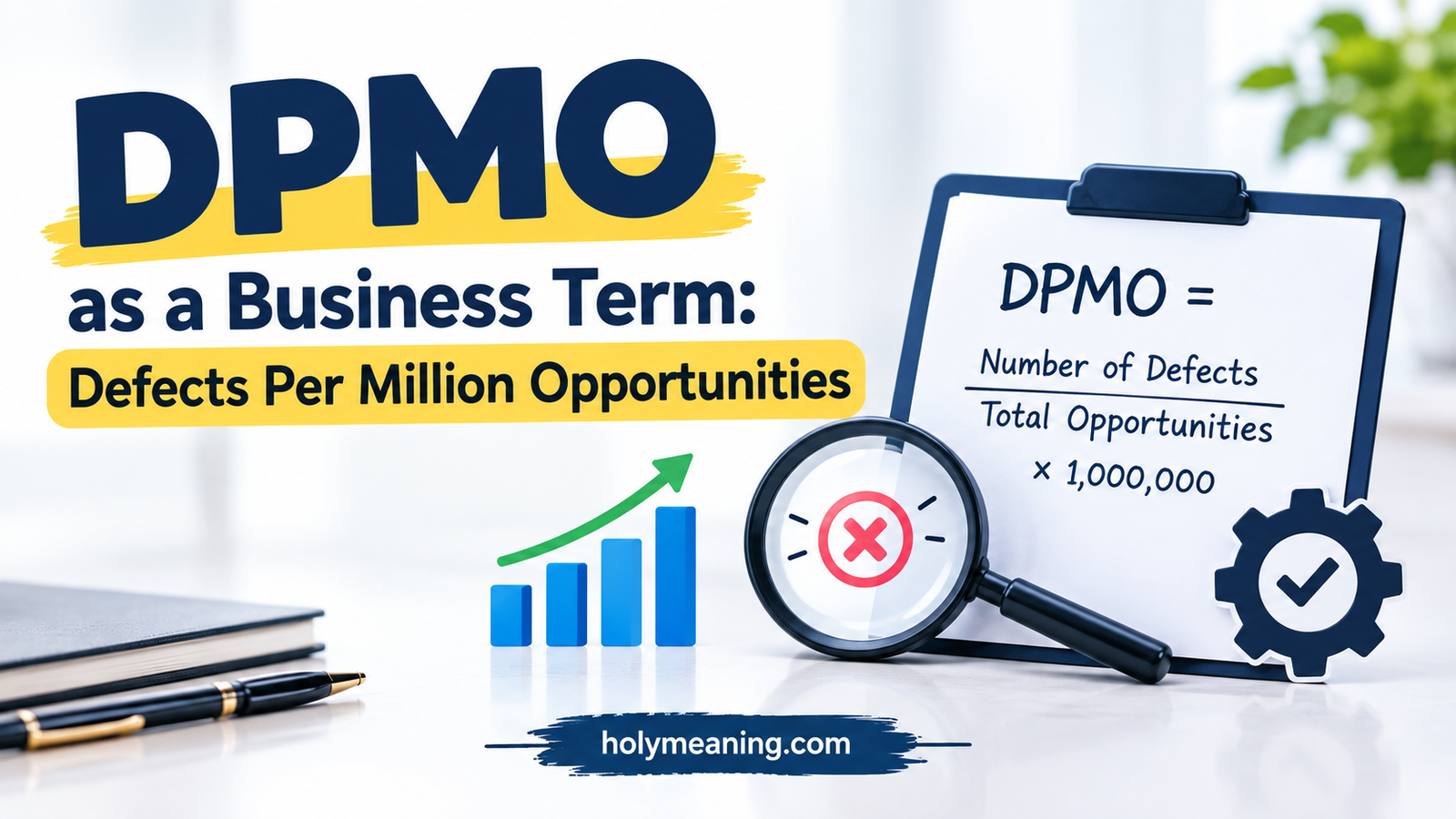
Now for the completely different half of this acronym’s identity. In the world of manufacturing, logistics, and process improvement, DPMO has meant one specific thing for decades: Defects Per Million Opportunities. This is a quality metric, and a fairly precise one, used to measure how reliably a process performs.
In plain terms: DPMO answers the question “out of every one million chances for something to go wrong, how many actually did?”
That single sentence is the entire concept. Everything else is just the math and the context around applying it.
What DPMO Means in Six Sigma and Quality Control
DPMO in Six Sigma is one of the foundational quality metrics used to evaluate process capability. Six Sigma itself is a quality management methodology, originally developed at Motorola in the 1980s, built around reducing variation and defects in manufacturing and business processes. DPMO is the number that tells practitioners exactly how far a process is from “perfect.”
Here’s why it matters more than a simple defect count: a company that ships 50 defective parts sounds bad until you learn they shipped 50 million parts total. DPMO normalizes that comparison, which makes it possible to compare defect rate across processes of wildly different sizes — a small workshop and a massive assembly line can be measured on the same scale.
DPMO feeds directly into process improvement work because it gives teams a single, comparable number to track over time. Improvement isn’t a vague feeling that “things are better.” It’s a measurable drop in that number, quarter over quarter.
The DPMO Formula and How to Calculate It
The math behind DPMO is more approachable than it looks on paper. The formula is:
DPMO = (Number of Defects ÷ (Number of Units × Opportunities per Unit)) × 1,000,000
Let’s walk through a worked example, because formulas mean nothing without numbers attached to them.
Scenario: A factory produces 2,000 circuit boards in a day. Each board has 15 points where a defect could occur (a solder joint, a component placement, and so on). Quality inspection finds 45 defects across the whole batch.
Step 1: Multiply units by opportunities per unit.
2,000 × 15 = 30,000 total opportunities
Step 2: Divide defects by total opportunities.
45 ÷ 30,000 = 0.0015
Step 3: Multiply by one million.
0.0015 × 1,000,000 = 1,500 DPMO
That result — 1,500 defects per million opportunities — is what quality teams report up the chain, compare against past batches, and use to decide whether a process needs intervention.
DPMO and Sigma Levels: The Full Reference Table
One of the most useful things about DPMO is that it maps directly onto Sigma levels, giving quality teams an instant sense of how good “good” actually is. This table is a standard reference across Six Sigma methodology:
| Sigma Level | DPMO | Approximate Yield |
|---|---|---|
| 1 Sigma | 690,000 | 31% |
| 2 Sigma | 308,000 | 69.2% |
| 3 Sigma | 66,807 | 93.3% |
| 4 Sigma | 6,210 | 99.38% |
| 5 Sigma | 233 | 99.977% |
| 6 Sigma | 3.4 | 99.99966% |
That jump from 3 Sigma to 6 Sigma looks small on paper, but it represents the difference between a process that fails roughly 1 in 15 times and one that fails roughly 3.4 times out of every million. That gap is exactly why Six Sigma became a household name in manufacturing quality circles — it’s an enormous leap in defect reduction, and companies that achieve it save serious money on rework, returns, and recalls.
Why the Business Meaning Sometimes Leaks Into Casual Chat
Here’s a detail most slang-focused articles miss entirely: DPMO as a business term doesn’t stay locked inside factories and spreadsheets. Anyone who works in quality control, manufacturing, supply chain, or process engineering picks up the term as everyday vocabulary, and vocabulary has a habit of following people home.
So you’ll occasionally see DPMO business term usage pop up in group chats among coworkers, usually as a joke:
- “my cooking last night had a dpmo of like 400,000”
- “this dating app has a way higher dpmo than my last job”
- “our fantasy football league needs a dpmo tracker at this point”
In these cases, the sender knows the real, technical meaning and is deliberately borrowing it for comic effect — applying a rigid quality measurement concept to something completely informal, like a bad batch of pancakes or a string of bad decisions. It’s a niche joke, mostly limited to people with manufacturing, engineering, or operations backgrounds, but it’s a real and traceable pattern, not something invented for this article.
How to Tell Which Meaning Someone Means
Given that the exact same four letters point to two unrelated concepts, how do you actually know which one you’re looking at? A few context clues make this almost foolproof:
- Check the platform. A text from a friend or a TikTok comment almost always means the slang version. A message in a work Slack channel or an email from your quality assurance team almost certainly means the business version.
- Check the sender. If the person works in manufacturing, engineering, supply chain, or operations, and the conversation is even loosely work-adjacent, lean toward the business meaning.
- Check the surrounding words. Slang DPMO shows up next to complaints, warnings, or teasing. Business DPMO shows up next to numbers, percentages, “sigma,” “defects,” or “process.”
- Check for numbers attached. If someone writes “DPMO of 12,000” or “our DPMO dropped this quarter,” that’s a dead giveaway for the quality metric. Slang DPMO is never followed by a specific figure.
Ninety-five percent of the time, the platform and the sender alone will answer the question before you even finish reading the message.
Platform Notes: Where DPMO Actually Shows Up
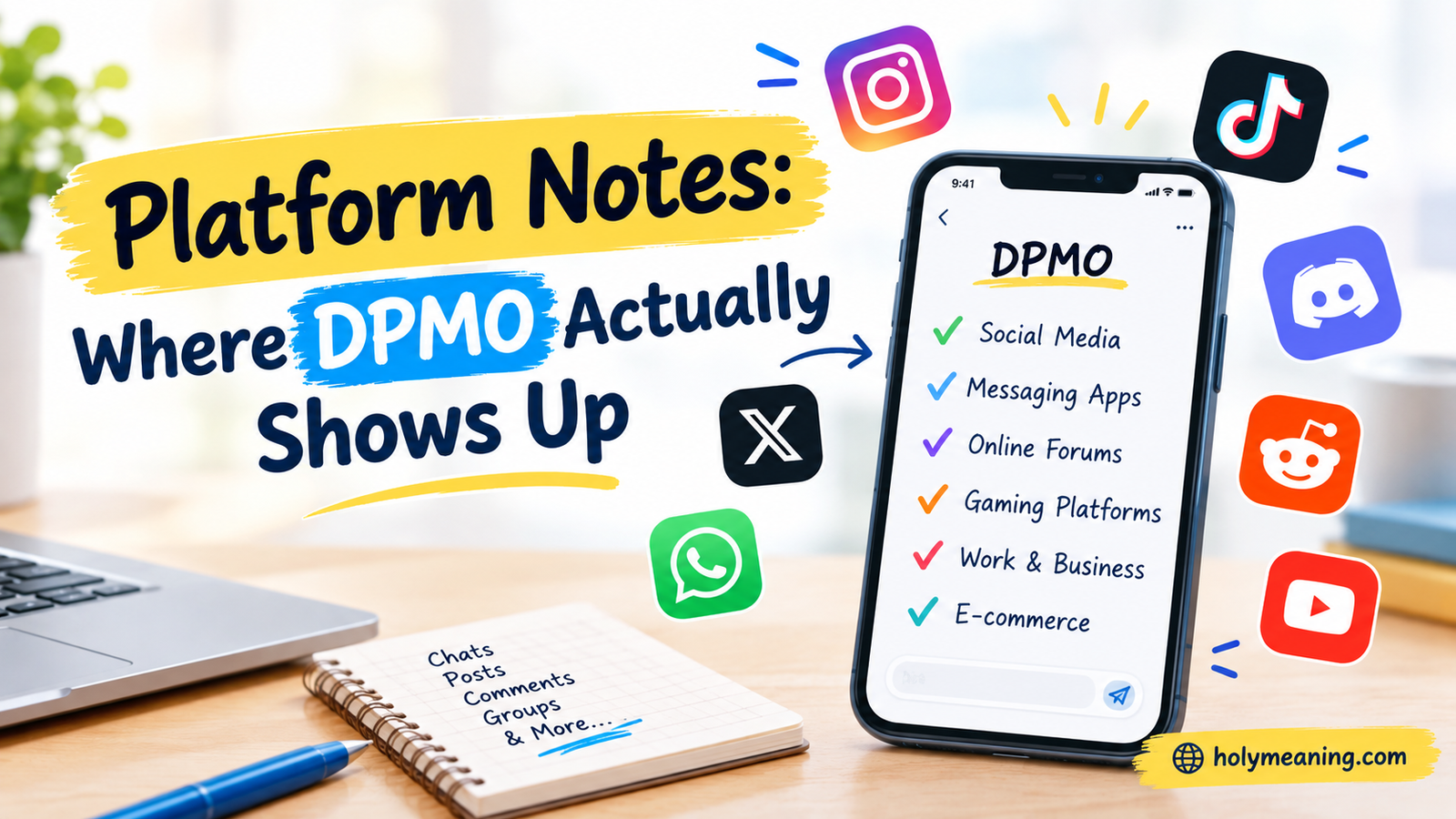
It’s worth being straightforward here rather than padding this section out with invented distinctions: DPMO doesn’t have wildly different meanings depending on which app you’re using. The slang version is the slang version everywhere. That said, usage frequency and tone do shift a little by platform.
DPMO Meaning on TikTok
DPMO meaning on TikTok leans heavily toward the comment section rather than captions themselves. You’ll see it dropped into replies under videos about petty annoyances, relatable frustrations, or “things that instantly pmo” style content — a genre that’s practically its own subcategory of TikTok slang. Because TikTok comments are short and rapid-fire, DPMO tends to appear alone or attached to a very brief phrase rather than a full sentence.
DPMO Meaning on Snapchat
DPMO meaning on Snapchat functions almost identically to its meaning in a regular text thread, since Snapchat conversations tend to mimic direct texting more than public commentary. The difference is tone: Snapchat exchanges are usually between people who already know each other well, so DPMO on Snapchat skews more playful and less likely to be a genuine warning compared to, say, a reply-guy comment on a public post from a stranger.
DPMO on Twitter/X, Discord, and Group Chats
Across Twitter/X, Discord servers, and general group chats, DPMO behaves consistently with everything already described — it’s a chat abbreviation for “Don’t Piss Me Off,” used the same way regardless of app. Discord gaming servers are worth a specific mention, since online communication there tends to be blunt and fast, and DPMO shows up frequently during competitive matches when someone’s patience is wearing thin over a teammate’s mistakes.
The honest takeaway: don’t overthink platform differences. DPMO meaning in messages stays stable across apps. What changes is who you’re talking to and how well you know them, and that context matters far more than which app happens to be open.
How to Respond If Someone Sends You DPMO
Getting a DPMO text can feel like a small gut-punch, especially if you’re not sure how serious it is. Here’s how to handle each version.
If It’s Clearly a Joke
When the message is lowercase, casual, and paired with something silly, match that energy. A simple “lol my bad” or a laughing reaction usually closes the loop just fine. Overreacting to a playful DPMO — apologizing profusely or getting defensive — tends to make things awkward for no reason.
If They Seem Genuinely Irritated
If the tone reads serious, the best move is a short, direct acknowledgment rather than a joke back. Something like “got it, sorry” or “noted, won’t bring it up again” shows you actually heard them. This is not the moment for a wall of text explaining your side — that usually escalates rather than resolves.
If It Came Out of Nowhere
Sometimes DPMO lands with zero context, and you genuinely don’t know what triggered it. In that case, a simple, non-defensive check-in works best: “did I do something?” Asking directly beats guessing, and it beats the anxious spiral of trying to reverse-engineer what you might have said three conversations ago.
What NOT to Say Back
A few responses tend to make things worse regardless of the situation:
- Mirroring it back sarcastically (“well dpmo too”) when the original message was genuinely serious
- Ignoring it entirely, which often reads as dismissive even if that’s not the intent
- Over-apologizing for something that was clearly a lighthearted joke, which can feel performative
- Demanding they explain themselves immediately, which can come across as combative rather than curious
Common Misconceptions About DPMO
A few myths circulate around this term that are worth clearing up directly:
- “DPMO always means someone’s mad at you.” Not true — the playful version is far more common in day-to-day chats than the genuine-warning version.
- “DPMO is brand new slang.” The business meaning predates the slang meaning by decades; Six Sigma methodology has used DPMO since the late 1980s.
- “DPMO has hundreds of different meanings depending on the app.” It doesn’t. The core DPMO meaning stays consistent; only tone and frequency shift by platform.
- “DPMO is always rude.” Context determines this entirely. Between close friends, it’s often affectionate ribbing rather than an actual insult.
Is DPMO Appropriate for Professional Communication?
Short answer: it depends entirely on which meaning you’re using. The business abbreviation — Defects Per Million Opportunities — is completely standard business terminology in manufacturing, supply chain, and quality reports. You’ll see it in official documentation, dashboards, and performance measurement reviews without a second thought.
The slang meaning is a different story. Even in a casual internal Slack channel among coworkers who get along well, “Don’t Piss Me Off” phrasing carries an edge that doesn’t translate cleanly to professional settings, especially with clients, supervisors, or anyone outside your immediate social circle at work. If in doubt, keep the slang version confined to personal messaging and save DPMO-as-metric for anything work-related.
Quick Reference Table
Here’s the entire concept condensed into one table you can screenshot and keep for later:
| Context | Full Meaning | Typical Tone | Where You’ll See It |
|---|---|---|---|
| Texting / social media | Don’t Piss Me Off | Playful or genuinely annoyed | Texts, TikTok comments, Discord, group chats |
| Business / manufacturing | Defects Per Million Opportunities | Neutral, technical | Quality reports, Six Sigma audits, process reviews |
FAQs
Is DPMO the same as PMO?
No — PMO can mean “Piss Me Off” or “Put Me On,” while DPMO locks in only the “Don’t Piss Me Off” warning.
Is DPMO rude to send someone?
Not usually — between friends it’s often playful, though tone and caps can make it read as a genuine warning.
What does DPMO mean in business or Six Sigma?
It stands for Defects Per Million Opportunities, a standard quality metric measuring defect rates in a process.
Does DPMO mean the same thing on TikTok, Snapchat, and Discord?
Yes — the core meaning stays consistent across platforms; only the tone and frequency of use shift slightly.
Can DPMO show up in professional settings?
Yes, but only the business meaning (Defects Per Million Opportunities) — the slang version doesn’t fit formal or client-facing communication.
conclusion
DPMO meaning in text really comes down to context. Among friends, it’s a playful warning: “Don’t Piss Me Off.” In business, it’s a serious quality metric tracking defects. Same four letters, two different worlds.
Next time DPMO pops up in your messages, you won’t have to guess. Check the sender, check the tone, and the DPMO meaning in text becomes obvious fast. Whether it’s a joke from a friend or a number in a quality report, you’ll know exactly what it means and how to respond.