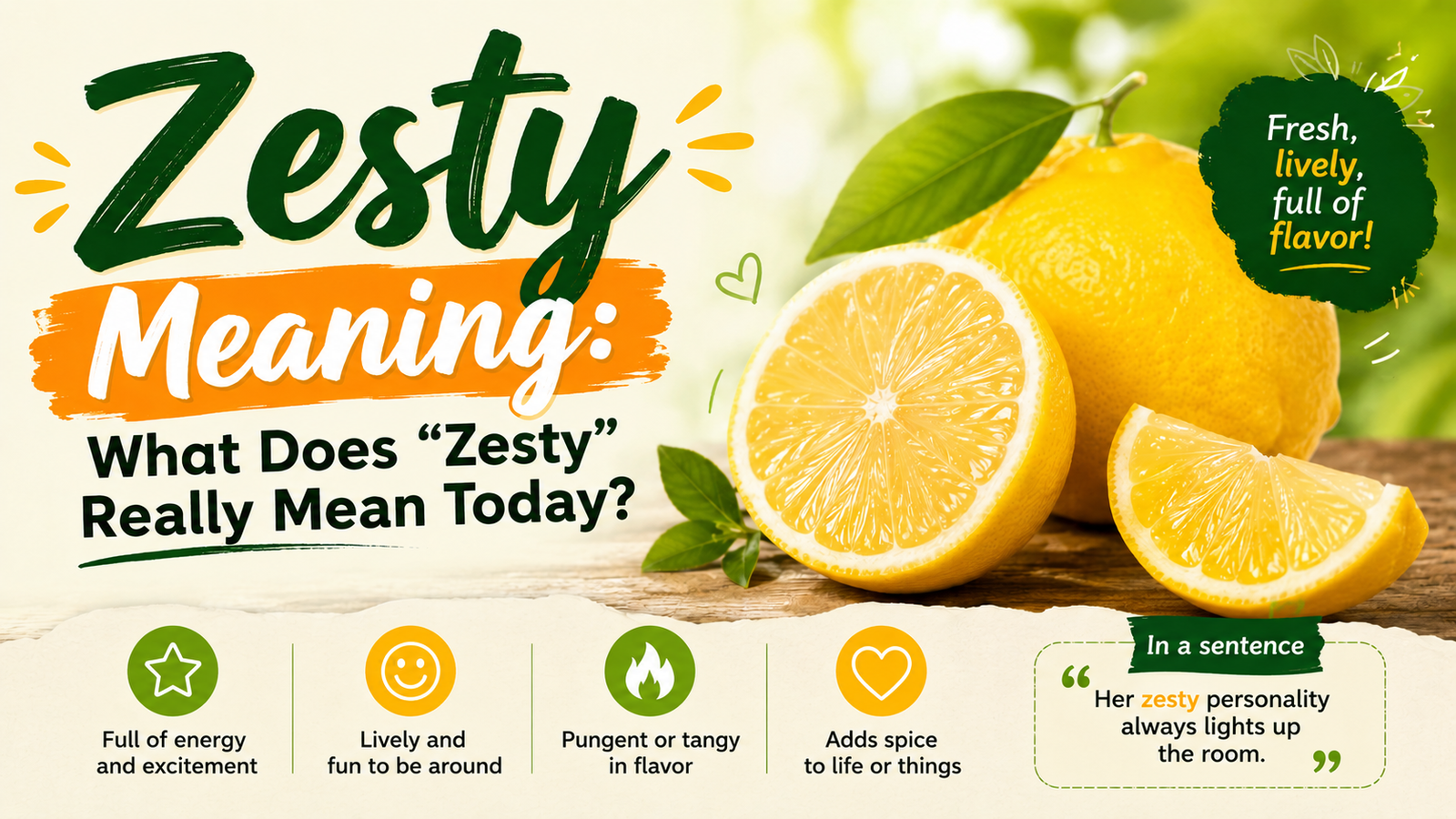
Zesty meaning, in its simplest form, describes something bold, energetic, and full of personality — a word that started in the kitchen to describe tangy, citrus-bright flavors and has since jumped straight into everyday slang.
Picture the friend who walks into a room and instantly changes its energy, all confidence, humor, and flair nobody can ignore. That’s zesty in a nutshell, and it’s taken over TikTok captions, Discord chats, and group texts everywhere.
This guide breaks down where the word came from, how meme culture reshaped it, and exactly how to use it (or avoid it) so you never second-guess a caption again.
Quick Answer
Here’s the direct answer, no fluff: in modern slang, zesty describes someone or something bold, expressive, and full of personality — think confident energy, a flamboyant flair, or a style that refuses to blend into the background. It grew out of the culinary word for “tangy” or “citrusy,” and Gen Z slang repurposed it to describe people the same way you’d describe a dish: full of flavor, a little extra, impossible to ignore.
That’s the concise definition in one breath. Tone decides whether it lands as a compliment or a tease, and we’ll get into that shortly. But if you needed a quick definition for a featured snippet-style answer, that’s it.
Where “Zesty” Started
Before it was a personality label, “zesty” was just a kitchen word. Understanding where it comes from actually makes the modern slang usage click faster, so let’s rewind.
The Word’s Roots
“Zest” traces back to the French word zeste, which originally referred to the peel of a citrus fruit — the part you scrape off to add a sharp, aromatic punch to a dish. English absorbed the word in the 17th century, and “zesty” followed as the adjective form, describing anything with that same tangy, invigorating quality. Lemon zest, lime zest, a zesty vinaigrette — the throughline is always brightness and intensity.
That “sharp and invigorating” quality is the seed of everything that came after. Even centuries later, when the word jumped from food to people, it kept that same core idea: something (or someone) that adds a punch you notice.
How Cooks Still Use It Today
In the kitchen, zesty hasn’t changed much at all. Recipe writers, food bloggers, and restaurant menus still use it constantly to describe:
- Citrus-forward dressings and marinades
- Spicy or tangy sauces (think zesty buffalo wing sauce)
- Bright, acidic dishes that wake up your palate
- Seasoning blends built around lime, lemon, chili, or vinegar
If you search a recipe site right now, you’ll find hundreds of dishes labeled “zesty” specifically because the word signals flavor with an edge — not bland, not one-note, but sharp and alive. That’s a useful mental anchor. Every modern slang use of the word borrows this exact feeling and just points it at a person instead of a plate.
The Older “Lively Personality” Sense
Here’s something most articles about zesty slang completely skip: the “lively personality” meaning isn’t new. Dictionaries have listed zesty as a way to describe an energetic, spirited person since at least the mid-20th century — decades before TikTok existed. A grandmother calling her granddaughter “such a zesty little thing” wasn’t using internet slang. She was using a completely standard, dictionary-recognized sense of the word.
This matters because it kills a myth. The internet didn’t invent the “zesty = lively personality” connection out of nowhere — it took an existing, slightly old-fashioned personality descriptor and gave it a modern glow-up, sharpened its edges, and gave it a specific cultural flavor tied to boldness, flamboyance, and confidence.
How It Turned Into Slang
So how did a word your grandma might use turn into something you’d see captioning a viral TikTok? The path runs through classic internet meme culture.
The 2010s Meme Shift
Through the mid-2010s, internet memes and reaction-image culture on platforms like Twitter and Tumblr started applying “zesty” to over-the-top personalities and flamboyant behavior, often paired with GIFs of dramatic reactions or theatrical moments. It wasn’t mainstream yet, but it was building. The word started attaching itself specifically to expressive, larger-than-life energy — not just “lively” in a generic sense, but something closer to theatrical, campy, or delightfully extra.
This slow-burn phase is exactly how a lot of viral slang gets built. A word sits in niche online humor for a few years, gets refined and narrowed by repeated use, and waits for the right platform to blow it up.
The TikTok Explosion
That platform turned out to be TikTok. Between roughly 2022 and 2024, zesty exploded across TikTok captions, comment sections, Discord servers, and gaming chats. The TikTok trend cycle works fast: a word gets used in one viral video, gets repeated in duets and comment sections, and within weeks it’s everywhere.
By 2023, zesty had fully crossed over from niche slang into mainstream Gen Z vocabulary. You’d see it describing:
- A bold outfit choice
- A dramatic dance move
- A streamer’s over-the-top reaction to a game
- A friend’s unexpectedly sharp, witty comeback in a group chat
The social media trends around the word kept it alive through emoji pairings (🔥, 💅, ✨), reaction-video formats, and trending audio clips that riffed on the word directly. It became shorthand — quick, punchy, and instantly understood by anyone plugged into digital culture.
Here’s a simplified timeline of how the meaning shifted:
| Era | Primary Meaning |
|---|---|
| 1600s–1900s | Citrus peel, then “tangy/bright” flavor in food |
| Mid-1900s | Occasional use for a lively, spirited personality |
| 2010–2018 | Niche internet humor, tied to flamboyant or theatrical behavior |
| 2019–2022 | Growing use in memes, GIFs, and reaction posts |
| 2023–2026 | Mainstream Gen Z slang on TikTok, Discord, and gaming chats |
A Mini Case Study: One Sound, One Surge
Slang doesn’t spread evenly. It tends to jump in sudden bursts tied to a single viral post, and zesty followed that same pattern. A handful of early-2023 TikToks paired dramatic, theatrical reactions with a specific trending audio clip, and the word “zesty” got dropped into the caption almost as a punchline. Viewers duetted the videos, repeated the phrase in their own captions, and within a couple of weeks the word had detached completely from that original sound and started standing on its own.
This is a pretty textbook example of how meme culture manufactures a viral TikTok trend. A word doesn’t need months of slow buildup anymore — it needs one well-timed video, a catchy audio pairing, and an audience primed to repeat what they see. That’s also why slang cycles feel so much faster now than they did even ten years ago. The infrastructure of duets, stitches, and comment-section repetition turns a single joke into shared vocabulary almost overnight.
What Zesty Means in Slang Right Now
Let’s nail down exactly what you’ll hear if someone calls you (or something) zesty today.
The Core Definition
In current slang, zesty means bold, dramatic, expressive, or a little extra — usually said with warmth rather than judgment. It’s a compliment dressed up in humor. Picture a mix of confidence, flair, and unapologetic personality, and you’ve basically got it. Someone described as zesty stands out in a room, whether through their outfit, their humor, their dance moves, or the sheer energy they bring to a conversation.
It’s worth noting that zesty often (though not always) carries a flamboyant or theatrical undertone — a stereotypically animated, expressive style of speaking or moving. That’s part of why it gets applied so often to dramatic reactions, bold fashion choices, and exaggerated performances.
How Tone Flips the Meaning
Here’s the part that trips people up: zesty is almost entirely tone-dependent. The exact same sentence can be a genuine compliment or a subtle jab, and the difference usually comes down to:
- Relationship — a close friend saying it usually reads as affectionate
- Delivery — said with a laugh versus said flatly changes everything
- Context — praising a bold outfit choice versus mocking someone’s mannerisms
- Platform norms — a TikTok comment section treats it more playfully than, say, a formal review
Because of this, you really can’t judge the word in isolation. You have to read the whole exchange, not just the word itself.
One TikTok commenter put it well when describing why the word feels so slippery: “It’s a compliment until it isn’t, and you usually only find out which one it was by watching everyone’s face.” That captures the whole dynamic — the meaning lives more in the room than in the dictionary.
Real Example Sentences
Seeing it in context helps more than any dictionary definition. Here are some real-style usage examples pulled from how people actually talk online:
- “Her outfit today was so zesty, it lit up the whole group chat.”
- “Bro really said that with zesty confidence, I’m dead 💀”
- “That dance move was a whole zesty moment, run it back.”
- “He’s giving very zesty energy in this stream today.”
- “Ok that reaction was kind of zesty, I respect it.”
Notice the pattern: it’s almost always paired with praise or amusement, rarely with straightforward criticism. That’s your biggest clue about how the word functions in real conversations.
Does Zesty Mean Gay?
This is one of the most-searched questions tied to the word, and it deserves a straight answer instead of a dodge.
Why People Ask This
Because zesty so often describes flamboyant, animated, theatrical behavior, and because that style has long been stereotypically associated with gay men in pop culture, some people assume the word is a coded way of describing sexual orientation. It’s an understandable question given how the slang gets used, but the assumption doesn’t hold up.
The Actual Answer
No, zesty does not mean gay. It describes a style of energy — bold, expressive, theatrical — not a stated sexual orientation. Plenty of people use “zesty” to describe straight friends, celebrities, athletes, and even inanimate things like outfits or dance routines. The word tracks how someone expresses themselves, not who they’re attracted to. Conflating an expressive personality trait with a person’s orientation is exactly the kind of stereotype-driven leap that causes confusion in the first place, and it’s worth pushing back on rather than repeating.
Why the Stereotype Still Persists
The association sticks around mostly because flamboyant mannerisms have been stereotyped in media for decades, and slang words tend to inherit whatever cultural baggage surrounds the traits they describe. It’s less about the word itself and more about a long-running (and outdated) pop-culture shorthand that treats expressiveness as evidence of orientation. Recognizing that gap is genuinely useful — it helps you use the word accurately instead of accidentally implying something you didn’t mean.
Is Zesty Offensive?
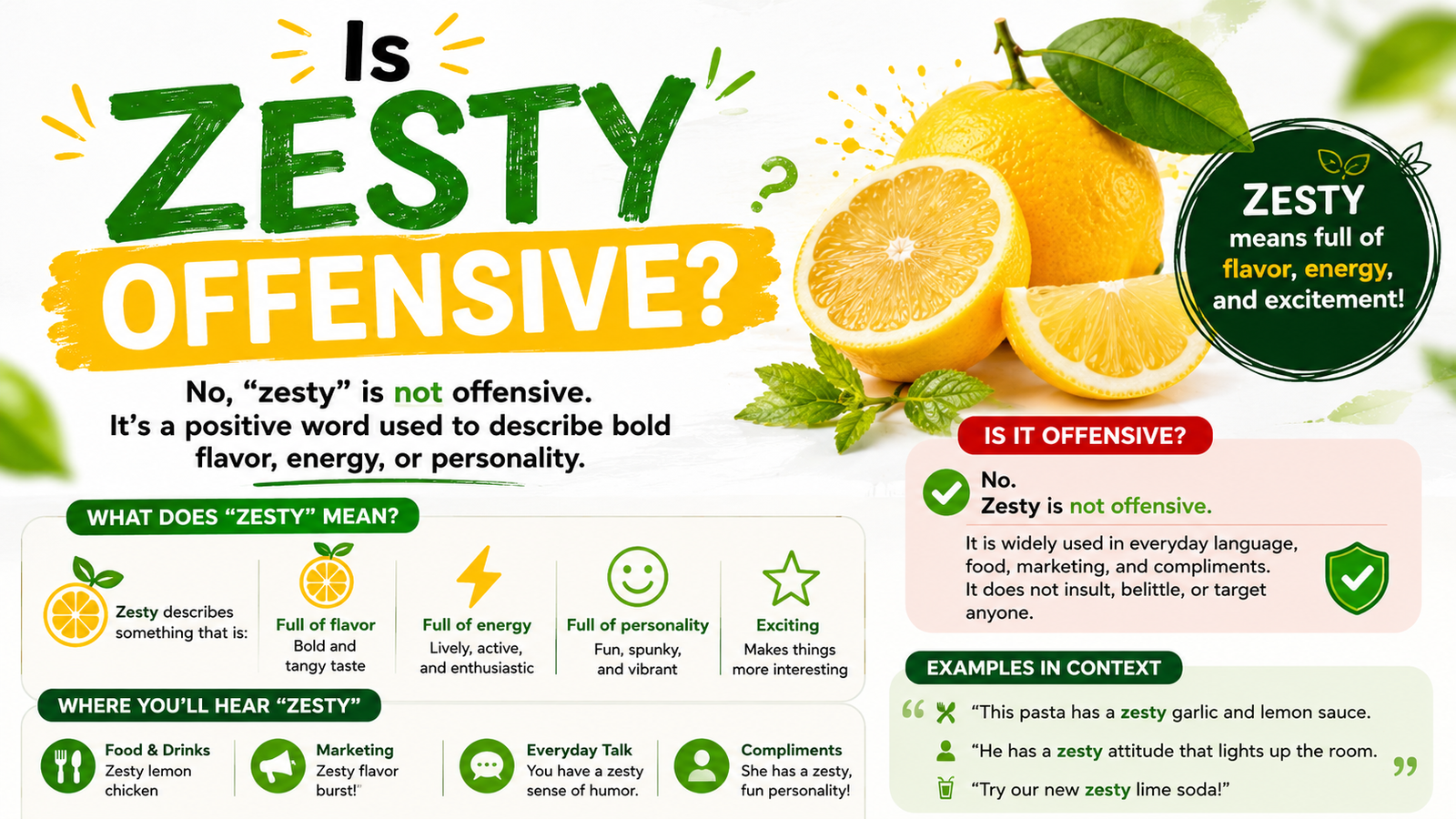
Short answer: usually not, but it can land badly depending on how it’s used.
What Changes the Read
A few factors decide whether “zesty” lands as a warm compliment or a subtle insult:
- Who’s saying it — a close friend has more leeway than a stranger or coworker
- What prompted it — reacting to a bold choice someone made on purpose reads differently than commenting on something they can’t control, like natural mannerisms
- The setting — a casual TikTok comment section is far more forgiving than a formal or professional space
- Repetition — using it once as a lighthearted reaction is different from repeatedly singling someone out
When It Lands as a Compliment
Most of the time, calling someone or something “zesty” is genuinely a compliment. It praises confidence, humor, style, and personality — the kind of energy people want credit for, not criticism.
When It Can Come Across as Mocking
It can tip into mockery when it’s used to poke fun at someone’s natural mannerisms rather than a deliberate choice, especially if it’s tied (even indirectly) to stereotypes about someone’s identity. Context is everything here — the same word that celebrates a friend’s bold dance move can sting if aimed at how someone naturally talks or moves.
A Simple Gut-Check
Before you use it, ask yourself:
- Am I reacting to something they chose to do, or something they simply are?
- Would I be comfortable saying this to their face, in this exact tone?
- Is there any chance this reads as mocking an identity rather than praising energy?
If you hesitate on any of those, it’s worth choosing a different word.
How to Use It Correctly
Once you understand the tone rules, using zesty naturally becomes pretty easy. Here’s how it plays out across common situations.
Describing a Person’s Energy or Style
This is the most common use case — praising someone’s confidence, humor, or bold fashion sense. “She walked in with such zesty confidence, the whole room noticed.” It works best when it’s clearly celebratory, tied to something the person actively brought to the moment. You’ll also see it used to describe someone’s speaking style — a friend who talks with big gestures, exaggerated expressions, and theatrical pauses is a prime candidate for the label, and it’s almost always meant as a nod to their charisma rather than a knock against them.
Think about the difference between describing someone as simply “confident” versus “zesty.” Confident is flat and factual. Zesty adds texture — it implies the confidence comes with flair, humor, and a bit of showmanship. That extra layer of personality is exactly why the word caught on instead of people just sticking with older, blander personality trait descriptors.
Describing Content — Outfits, Dances, Streams
Zesty shows up constantly under videos, photos, and livestreams. A caption like “this fit is zesty 🔥” praises a bold outfit choice, usually something with strong colors, unexpected pairings, or a dramatic silhouette. A comment like “that stream got zesty real quick” reacts to an unexpectedly dramatic or funny moment in the content itself, often after a streamer overreacts to something in a game or gets unexpectedly theatrical during a normally low-key segment.
Dance content is another huge home for the word. A choreography clip with sharp, exaggerated movements and confident facial expressions gets tagged zesty constantly in the comments, since the whole appeal of that kind of dance style is the same “bold and impossible to ignore” quality the word has carried since its earliest slang days.
In Texts and DMs
Between friends, it functions almost like a playful nickname for “extra” or “iconic.” A quick text — “you were being SO zesty at dinner lol” — reads as an affectionate callback to a moment, not a criticism. It’s the kind of thing you send right after something happens, almost like a running joke you’re both already in on.
Group chats lean on it heavily too, often as a quick reaction to a screenshot or voice memo someone shares. Because it’s short, easy to type, and instantly understood by anyone who’s spent time online recently, it’s become a default reaction word in the same family as “iconic,” “unhinged,” or “sending me.”
Real Example Captions, Explained
- “POV: you walked in zesty and left legendary” — celebrates confident entrance energy, common in TikTok caption format.
- “That was a zesty reaction and I’m here for it” — praises an over-the-top, funny response.
- “New zesty era unlocked ✨” — frames a bold style change as a personal glow-up.
Each of these leans positive, playful, and celebratory — the dominant tone you’ll find across actual usage.
Zesty vs. Other Slang
Zesty overlaps with several other slang terms, but each one has its own specific flavor. Here’s a quick side-by-side:
| Term | Core Meaning | How It Differs From Zesty |
|---|---|---|
| Slay | Doing something impressively well | Praises performance/achievement, not personality style |
| Sus | Suspicious or questionable | Negative/skeptical in tone, opposite energy from zesty’s warmth |
| Extra | Over-the-top or dramatic | Closely related, but “extra” can skew more critical/eye-roll; zesty leans more affectionate |
| Flamboyant | Showy, bold in style or manner | Older, more formal word; zesty is its playful, internet-native cousin |
Think of zesty as sitting right between “extra” and “flamboyant” — bold and theatrical like the latter, but delivered with the casual warmth of modern TikTok slang.
Safer Alternatives to “Zesty”
Sometimes you want the same idea without the slang baggage or tone risk. Here are solid swaps.
For Work or Formal Writing
- Vibrant
- Charismatic
- Dynamic
- Spirited
- Expressive
These carry the same “bold, lively personality” idea without any of the internet-slang ambiguity, and they read as fully appropriate in a professional bio, performance review, or formal write-up.
For Casual Conversation
- Extra (when you want the dramatic flair angle)
- Iconic (for a standout moment)
- Unmatched energy (for pure enthusiasm)
- Main character energy (for confident, scene-stealing moments)
When a Synonym Is the Smarter Choice
If you’re texting someone you don’t know well, writing professionally, or just unsure how the word will land, swap it out. There’s no real downside to using vibrant or charismatic instead — you keep the compliment and lose the risk entirely.
A good rule of thumb: reach for the slang version when you’re already speaking casually and the relationship can absorb a joke, and reach for the formal synonym any time you’re writing something that might get read out of context later — a bio, a recommendation, a caption for a professional account, or anything that could be screenshotted and shared beyond the original conversation. Slang ages fast and reads differently across generations, so a formal synonym tends to hold up better over time anyway.
Who’s Actually Using This Word
Zesty isn’t used identically everywhere. Here’s the breakdown by group and platform.
Gen Z vs. Gen Alpha — Any Real Difference?
Gen Z largely popularized the modern slang usage and still drives most of its everyday application — outfits, personalities, funny reactions. Gen Alpha (the generation coming up behind them) has picked it up too, often through older siblings, YouTube, and TikTok, but tends to apply it even more loosely and playfully, sometimes stretching it to describe almost anything mildly exciting or funny, not just personality traits.
TikTok, Discord, and Gaming Chat
- TikTok — the word’s main home, used in captions, comments, and duets
- Discord — common in gaming servers and friend-group chats, often reacting to funny in-game moments
- Gaming chat generally — used to praise a flashy, confident, or skillful play style, almost like calling someone’s move “stylish”
Can Older Adults or Brands Use It Without Sounding Forced?
Carefully, yes. Adults who already text casually and stay plugged into online slang can use it naturally in the right context. Brands have a harder time — using slang terms in marketing copy often reads as try-hard unless the brand’s whole voice is already built around Gen Z humor. If a brand isn’t naturally fluent in internet terms, forcing “zesty” into a caption usually backfires and reads as a company trying too hard to seem relatable.
There’s a useful test for this: if a brand’s social team has to explain the joke internally before posting it, that’s usually a sign the term won’t land the way they hope. Successful brand use tends to come from teams that already talk like their audience day to day, not ones bolting a trending word onto an otherwise formal voice. A food brand joking that its new sauce is “extra zesty (in both senses)” works, because it plays directly off the word’s culinary roots. A bank tweeting that its new savings account is “zesty” mostly just confuses people.
It’s also worth separating platforms by how forgiving they are. TikTok and Discord tolerate — and even reward — playful experimentation with slang, since the whole culture there runs on quick, shared references. Instagram sits somewhere in the middle, depending on the account’s usual tone. LinkedIn and formal email are the least forgiving spaces of all; dropping “zesty” into a professional message will almost always read as out of place, no matter how well-intentioned it is.
Is It Still Trending in 2026?
Yes — zesty remains solidly active heading through 2026, still showing up regularly across TikTok, Discord, and gaming communities. It hasn’t shown real signs of fading the way some slang burns out fast; instead it’s settled into a steady, recurring presence, more like an established piece of modern vocabulary than a fleeting micro-trend. That said, heavy slang like this naturally ebbs and flows with whatever meme or audio clip is currently trending, so expect its visibility to rise and fall in waves rather than staying at a constant peak.
Common Mistakes People Make With “Zesty”
Even with a clear definition in hand, people trip up on the word in a few predictable ways:
- Using it to describe something purely negative. The word almost always carries a positive or playful undertone — using it as a straightforward insult misses how it actually functions in real conversations.
- Assuming it’s a coded reference to sexual orientation. As covered above, it describes energy and expression, not orientation — treating it otherwise spreads a stereotype rather than an accurate definition.
- Forcing it into formal or professional writing. It’s casual slang through and through; dropping it into a resume, a work email, or a formal article makes the writing feel oddly out of place.
- Using it about someone’s natural mannerisms without context. This is where it risks reading as mocking rather than complimentary — aim it at deliberate choices (an outfit, a joke, a dance) rather than involuntary traits.
- Overusing it until it loses meaning. Like most viral slang, repeating it constantly dilutes its punch; it works best as an occasional, well-placed reaction rather than a catch-all descriptor.
- Treating it as brand-new internet vocabulary. Missing the word’s older, pre-internet personality sense makes it easy to over-explain or misjudge how established the term actually is — it’s more of a revival with a modern spin than a word invented from scratch.
FAQs
What does zesty mean in slang?
It describes someone or something bold, expressive, and full of confident personality — almost always used as a playful compliment.
Does zesty mean gay?
No. It describes an expressive, flamboyant style of energy, not a person’s sexual orientation.
Is zesty still popular in 2026?
Yes, it remains active and widely used across TikTok, Discord, and gaming chats, holding steady rather than fading out.
Is calling someone zesty rude or offensive?
Usually not — it’s typically a compliment, though tone, context, and relationship can occasionally push it toward mockery.
What’s a formal alternative to zesty?
Words like vibrant, charismatic, or spirited carry the same energy without the slang risk.
conclusion
Zesty meaning has come a long way from describing tangy lemon peel. Today, it captures bold energy, big personality, and confident style. It’s a compliment, mostly playful, always tied to tone. Knowing the real zesty meaning helps you use it right and avoid awkward mix-ups.
Slang moves fast, but this one has real staying power. Understanding zesty meaning keeps you fluent in how people actually talk online. Use it with the right person, at the right moment, and it lands perfectly. Master the zesty meaning, and you’ll never feel lost in a caption again.