Foxtrot Delta Tango is the NATO phonetic spelling of three letters — F, D, and T — pulled straight from the same radio alphabet pilots and soldiers use every day. On paper, it’s pure military jargon.
But online, those three harmless-sounding words are doing something sneakier. They’ve become one of the internet’s cleverest disguises, letting people say something blunt and political while sliding right past content filters, nosy parents, and workplace Slack bots.
Behind the phonetic spelling sits a real story — a 2016 election-era acronym, a viral song, and a slang habit that’s stuck around far longer than most internet trends ever do.
What Does Foxtrot Delta Tango Mean?
At its core, Foxtrot Delta Tango meaning works on two levels, and mixing them up is where most of the confusion starts.
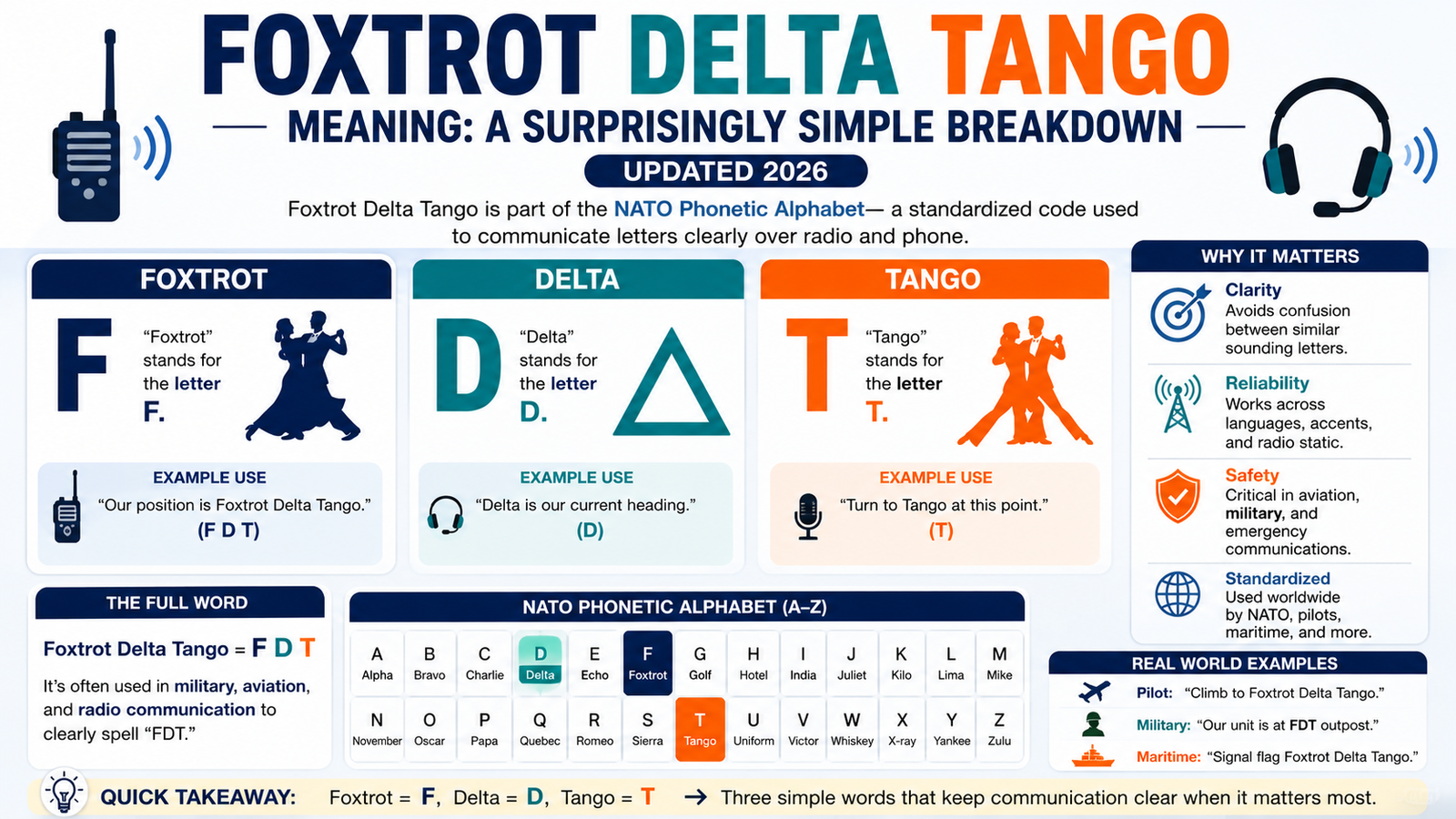
Literal meaning: Foxtrot, Delta, and Tango are three words from the official NATO phonetic alphabet, used to represent the letters F, D, and T without any risk of them getting confused over a bad radio connection.
Slang meaning: Online, FDT is shorthand for a blunt political rejection — “F*** Donald Trump.” It’s not subtle once you know it, but spelled out phonetically, it reads as harmless jargon to anyone who isn’t in on the code.
That gap between the literal and the coded meaning is the whole reason this phrase keeps showing up in search results. Someone hears it, has no context, and needs the factual explanation rather than a guess. So here it is, plainly: unless you’re reading a flight log or a military transcript, “Foxtrot Delta Tango” almost always means the political version. Context is what tells you which one you’re looking at, and we’ll get into exactly how to read that context as we go.
It helps to think of it less like a secret cipher and more like a wink. The phrase doesn’t hide its meaning so much as dress it up — the kind of trick that works because everyone involved already knows the punchline.
The NATO Phonetic Alphabet, Explained
Before FDT became internet shorthand, “Foxtrot,” “Delta,” and “Tango” already had a long, unglamorous job: making sure people don’t mishear each other over static-filled radio channels.The NATO phonetic alphabet — officially called the International Radiotelephony Spelling Alphabet — assigns one distinct, easy-to-pronounce word to every letter of the English alphabet. It was finalized by the International Civil Aviation Organization and adopted by NATO in 1956, after years of testing different word sets for clarity across languages, accents, and lousy audio quality.
The goal was simple: B and D sound almost identical over a crackly radio line. So do M and N, or F and S. Swap those letters for words like Bravo, Delta, Mike, November, Foxtrot, and Sierra, and the confusion mostly disappears — even when the connection is bad or the listener’s first language isn’t English.
This is the exact reason the military alphabet — often used interchangeably with radio alphabet — still gets taught to pilots, air traffic controllers, ship crews, police dispatchers, and emergency responders today. It’s not decorative. It’s a practical fix for a real communication problem.
Why the NATO Code Exists
The clearest way to understand the reasoning is to picture a pilot reading back a clearance over a noisy radio: “Cleared to land, runway three-one, taxi via Alpha, Bravo, Foxtrot.” Strip away the phonetic words and just say the letters — “A, B, F” — and a controller straining to hear through static could easily mishear one for another. Get it wrong at 30,000 feet, and the mistake isn’t just embarrassing.
That’s the entire logic behind aviation communication standards: remove ambiguity wherever human error and bad audio quality intersect. The same principle carries over into military communication, maritime radio procedure, and even customer service reps reading back a confirmation number over the phone — “that’s B as in Bravo, 4, D as in Delta.”
NATO Phonetic Alphabet Table
Here’s the complete list, since Foxtrot, Delta, and Tango are just three entries in a much bigger, standardized system.
| Letter | NATO Word | Letter | NATO Word |
|---|---|---|---|
| A | Alpha | N | November |
| B | Bravo | O | Oscar |
| C | Charlie | P | Papa |
| D | Delta | Q | Quebec |
| E | Echo | R | Romeo |
| F | Foxtrot | S | Sierra |
| G | Golf | T | Tango |
| H | Hotel | U | Uniform |
| I | India | V | Victor |
| J | Juliett | W | Whiskey |
| K | Kilo | X | X-ray |
| L | Lima | Y | Yankee |
| M | Mike | Z | Zulu |
Notice the three letters relevant here — Foxtrot, Delta, Tango — spell out F-D-T when you take the first letter of each word. That’s the entire mechanism behind the phrase. No cipher, no hidden math. Just three ordinary radio-alphabet words, read in a row.
Where Foxtrot Delta Tango Actually Comes From
Here’s something a lot of explainer posts get backwards: the acronym FDT didn’t start as a phonetic trick. The phonetic spelling came later, layered on top of an acronym that was already circulating.
The clearest, most checkable point in this phrase’s history is the 2016 release of a song titled “FDT” by rapper YG, which came out during the U.S. presidential election cycle that year. The track put the acronym in front of a mainstream audience and tied it firmly to its political meaning. Around the same period, protest signage and social media captions started using the shorthand version — three letters, no spelling-out required — as a way to express opposition quickly and visibly.
The phonetic version — actually saying or typing “Foxtrot Delta Tango” instead of the letters — is a newer layer, and it’s a distinctly internet-era habit. As platforms got stricter about political language and profanity, users needed a way to say the same thing without tripping filters, and the NATO phonetic alphabet was sitting right there, already familiar from movies, video games, and military dramas. Repurposing it for a political acronym was a small, clever step, not a whole new invention.
Why People Spell It Out Phonetically Instead of Just Typing FDT
If FDT already existed as a shorthand, why go through the extra step of spelling it out as three whole words? A few practical reasons explain it.
- Filter avoidance. Automated moderation systems on major platforms scan for specific flagged terms and combinations. Spelling the acronym out as “Foxtrot Delta Tango” sidesteps a lot of those keyword filters, since the individual words are completely ordinary military vocabulary.
- Plausible deniability. In a mixed setting — a family group chat, a work Slack channel, a school assignment — “Foxtrot Delta Tango” reads as jargon or trivia to anyone not in on the joke. It’s a coded phrase in the truest sense: hidden in plain sight.
- Social currency. Recognizing and using the phonetic version signals that you’re plugged into a certain layer of internet culture. It’s a small in-group marker, the same way any slang acronym works — the effort of decoding it is part of the appeal.
None of these reasons are mysterious once you lay them out. They’re the same motivations behind basically every piece of filter avoidance language the internet has ever produced, from asterisks in swear words to leetspeak.
Foxtrot Delta Tango on Reddit and Social Media
Reddit and social media are where this phrase does most of its actual living. It’s less common in everyday speech and far more common as written text, which makes sense — a phonetic trick built around content moderation only works where there’s a moderation system to dodge in the first place.
Political Threads
In political threads, particularly on subreddits with heavy discussion around U.S. politics, “Foxtrot Delta Tango” shows up as a stand-in for the blunt version of the phrase. It’s common in comment sections responding to news posts, often paired with reaction emojis or upvote trains. The phrase functions here as shorthand for a strong, generally dismissive political opinion — a quick way to register a reaction without writing out a full sentence.
Moderation Filters
This is the practical engine behind the whole trend. Many platforms run automated moderation systems that flag or remove posts containing certain profanity-and-name combinations, particularly ones involving public figures. Because “Foxtrot,” “Delta,” and “Tango” are individually harmless words with an established, legitimate use in aviation and the military, they don’t trip those keyword filters the way the direct phrase would. This is the actual mechanical reason the phonetic version has outlasted the plain acronym on heavily moderated platforms — it’s not cleverness for its own sake, it’s a workaround for platform rules.
Joke and Meme Threads
Not every use is political anymore. In plenty of meme culture corners, the phrase has been recycled purely as a punchline — something people say because it’s recognizable, not because they’re making a political statement at all. It works the way a lot of viral phrases eventually do: the reference becomes bigger than the original context, and people reuse it as a wink rather than a genuine statement.
FDT 8647: What the Number Combo Means
If you’ve seen “FDT 8647” and wondered whether the numbers add something new, they do — but only once you split them apart.
86 is a long-standing piece of American slang meaning “to get rid of” or “to reject.” It has roots in restaurant and bar culture, where “86 the special” means to take an item off the menu because it’s out of stock or no longer available. Over decades, it broadened into general slang for rejecting or dismissing something entirely.
47 is a reference to the numbering of the current U.S. presidency. Combined with the “86,” the number pairing reads as a compressed version of the same underlying sentiment as FDT — expressed through slang math instead of spelled-out letters.
Here’s a quick breakdown:
| Element | Meaning | Origin |
|---|---|---|
| 86 | Slang for “remove” or “get rid of” | Restaurant and bar slang, mid-20th century |
| 47 | Refers to the 47th U.S. presidency | Ordinal reference to the current office holder |
| Combined (8647) | A numeric version of the same rejection sentiment as FDT | Internet-era combination, popularized alongside the phonetic FDT trend |
It’s worth being direct about what this number combo actually is: a piece of political speech expressing opposition, not a coded threat or anything resembling one. Treating it as more sinister than that misreads a fairly ordinary (if blunt) slang pattern — numbers standing in for words the same way letters do.
Non-Political, Everyday Uses of the Phrase
Not every appearance of FDT carries political weight. Slang acronyms have a habit of getting adopted by completely unrelated communities once they’re recognizable enough, and FDT is no exception.
In gaming and Discord spaces, three-letter combinations like FDT sometimes get repurposed as clan tags, server role names, or inside jokes that have nothing to do with the original political meaning. This is a familiar pattern across internet abbreviations generally — once an acronym is widely recognized, its “brand recognition” outlives its original context, and communities borrow the letters without borrowing the backstory.
Case Study: How Gaming Culture Helped the Phrase Spread
It’s worth being honest about the limits of this section rather than manufacturing a tidy anecdote. What’s verifiable is the broader pattern: gaming communities have a long track record of adopting politically or culturally loaded acronyms as neutral labels — clan tags, Discord role names, chat shorthand — simply because the letters are catchy and already recognizable. FDT fits that pattern well, showing up periodically in gaming forums and Discord servers as a tag or joke disconnected from its political roots. Rather than pointing to one specific, cherry-picked example and presenting it as definitive, the honest takeaway is this: FDT’s spread through gaming culture looks like the same recycling process that’s happened to dozens of other slang acronyms before it, not a single traceable event.
Foxtrot Delta Tango in Military and Aviation Contexts
Strip away the internet layer entirely, and “Foxtrot Delta Tango” goes back to being exactly what it started as: three ordinary words from a standardized spelling system, with zero political charge.
In military and aviation contexts, FDT might show up as part of a callsign, a grid reference, or a longer alphanumeric string — a waypoint labeled “checkpoint FDT,” for instance, or a portion of a tail number read back during radio communication. In that setting, nobody blinks at it. It’s as mundane as reading out a license plate letter by letter.
This is the cleanest way to resolve any confusion about Foxtrot Delta Tango meaning: the words themselves are neutral. The political meaning is entirely a layer that internet culture added on top, and it only applies in contexts where that culture is in play — comment sections, memes, captions. A pilot reading back a clearance and an internet commenter making a political jab are using the exact same three words for entirely different reasons, and the setting is the only thing that tells you which is which.
Common Misconceptions About Foxtrot Delta Tango
A few myths keep circulating around this phrase, and they’re worth clearing up directly.
It’s Not Secret Spy Language
The NATO phonetic alphabet is about as far from classified as language gets. It’s taught in flight schools, published on NATO‘s own website, and used daily by anyone working in aviation, maritime transport, or emergency dispatch. There’s no hidden cipher here — the “code” part of this whole phrase refers to the slang layer people added on top, not to the alphabet itself.
It Doesn’t Always Mean Politics
Context decides everything. The exact same three words mean something entirely different in a cockpit than they do in a Reddit comment thread. Assuming every instance of “Foxtrot Delta Tango” is a political statement is a false assumption — plenty of uses are jokes, gaming references, or genuinely unrelated jargon.
It’s Usually Not Aggressive
Most usage online falls into dismissive or sarcastic territory rather than a genuine threat. That said, it’s worth distinguishing “expressing political frustration” from “confrontational language” honestly rather than smoothing it over — the phrase is blunt by design, even in its softened, spelled-out form. It communicates rejection clearly; it’s just doing so in a roundabout way.
Similar Coded Slang Terms
FDT isn’t the only coded acronym riding on the back of a legitimate alphabet or numbering system. A few patterns show up again and again across online jargon:
- Number-substitution slang — using numbers that carry an established meaning (like 86) stacked next to a reference number, the same structural trick behind FDT 8647
- Phonetic-alphabet borrowing — repurposing NATO or similar spelling systems to spell out unrelated acronyms, which works precisely because those systems are public and easy to recognize
- Letter-initial euphemisms — saying “the F word” or spelling out initials generally, a much older pattern that phonetic slang is really just a dressed-up version of
The common thread across all of these: they borrow legitimacy or neutrality from an existing, “boring” system, and use that borrowed credibility to slip a loaded phrase past a filter, a parent, or a moderator.
Is Foxtrot Delta Tango Still Popular in 2026?
Slang tied to a specific political figure tends to follow news cycles rather than holding a flat, steady level of interest. Search interest and social usage around FDT and its variants typically spike around elections, major political news, and controversy cycles, then cool off in quieter stretches — a pattern common to almost all political slang.
What sets FDT apart from a lot of internet phrases is durability. Most viral internet slang burns out within a single news cycle and never resurfaces. FDT has now stuck around across multiple election cycles and news spikes since 2016, which suggests it’s become something closer to an established piece of online terminology rather than a fleeting meme. As of 2026, it remains active enough across Reddit discussions, TikTok captions, and X threads that it continues generating consistent search volume — one of the clearer signs that a slang term has moved from “trend” to “fixture.”
Why Coded Slang Like This Keeps Catching On
Pulling together everything covered so far, three concrete mechanisms explain why phrases like this one keep spreading rather than fading out:
- Moderation evasion — spelling things out phonetically genuinely works against automated moderation systems built around flagged keyword lists, giving the phrase practical staying power beyond pure novelty.
- In-group signaling — recognizing and correctly using the code marks someone as plugged into a particular online space, the same social function slang has always served, just running through a phonetic filter now.
- Plausible deniability — the phrase reads as harmless jargon in professional or family settings, letting people express something pointed without the risk of it landing in the wrong context.
None of these are new forces. What’s new is the specific vehicle — a 1956 military spelling system doing double duty as a 2020s internet dodge.
Quick Facts Summary
| Question | Answer |
|---|---|
| What does Foxtrot Delta Tango spell? | F-D-T |
| Common slang meaning | A political rejection phrase (“F*** Donald Trump”) |
| Literal/military meaning | None — just three NATO alphabet words |
| Origin era | Mid-2010s, tied to the 2016 U.S. election cycle |
| Key cultural marker | YG’s 2016 song “FDT” |
| Most common platforms | Reddit, TikTok, X (Twitter) |
| Related term | FDT 8647 (86 = “remove,” 47 = current presidency) |
| Still active in 2026? | Yes — usage spikes around political news cycles |
| Is it secret military code? | No — the NATO alphabet is public and widely taught |
FAQs
1. Is Foxtrot Delta Tango still popular in 2026?
Yes — it remains active across Reddit, TikTok, and X, though usage clusters around election news and political controversies rather than staying constant.
2. What does Foxtrot Delta Tango mean on social media today?
It’s mainly a filter-friendly way to express political rejection, though it’s increasingly used as generic slang for frustration too.
3. Do platforms actually block the direct phrase but not the phonetic version?
Largely yes — spelling it out as three ordinary NATO words tends to slip past keyword-based moderation that catches the explicit version.
4. Has FDT’s meaning expanded beyond politics recently?
Yes — gaming and Discord communities now use it casually for everyday annoyances, like a bad update or an early wake-up call.
5. Is Foxtrot Delta Tango an official military phrase?
No — the individual words come from the real NATO phonetic alphabet, but “Foxtrot Delta Tango” as a meaningful phrase is purely internet slang.
conclusion
Foxtrot Delta Tango looks complicated. It really isn’t. It’s just three NATO words spelling out F-D-T. Online, those letters carry a blunt political message. That’s the whole trick.
Context tells you what Foxtrot Delta Tango really means. In a cockpit, it’s harmless. In a comment section, it’s a jab. Either way, there’s no secret code here. Just an old radio alphabet, doing a new job. Simple, clever, and here to stay in 2026.