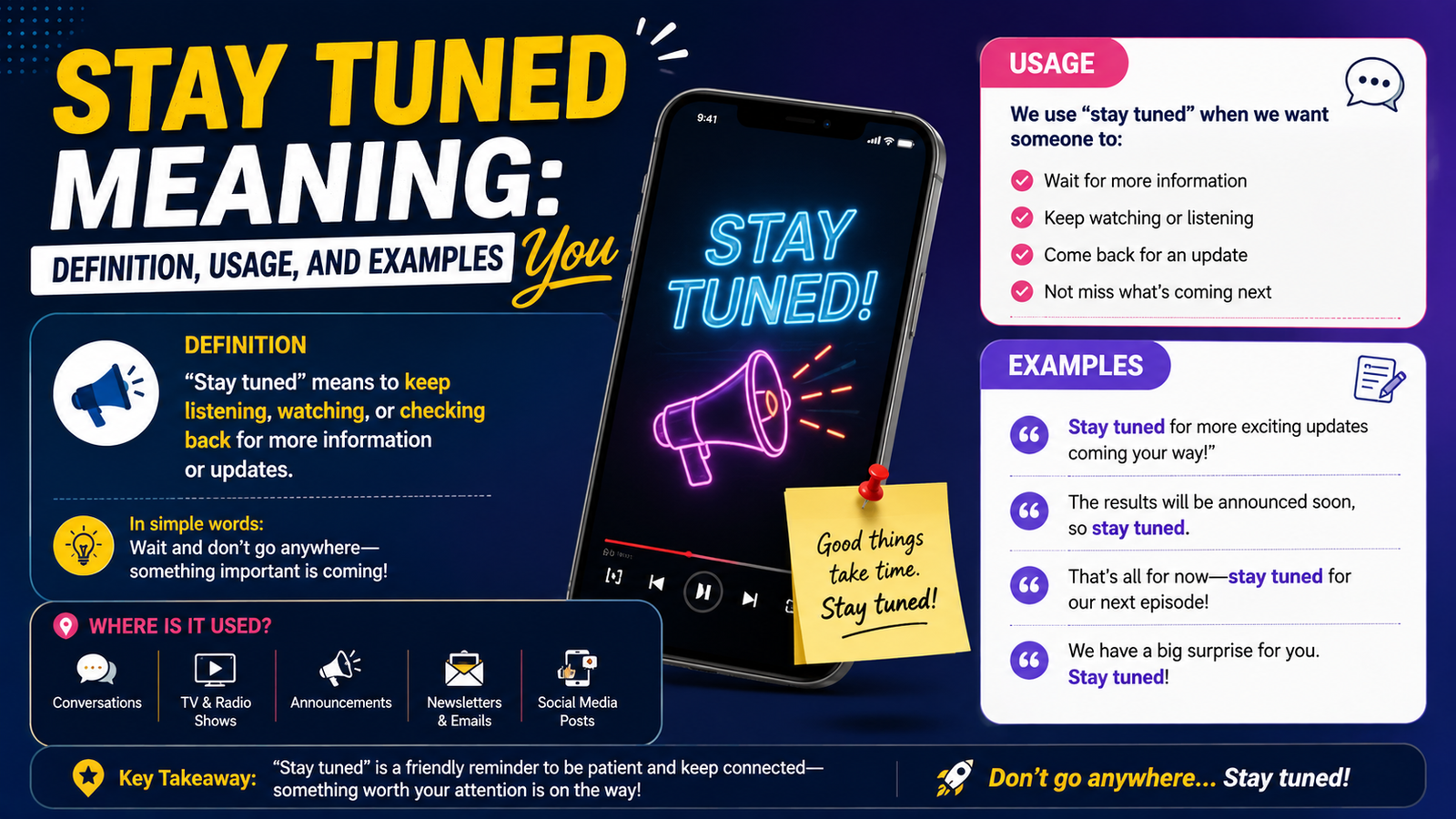
stay tuned meaning means waiting patiently for more information, an update, or content that’s coming soon. It started as a literal instruction on early radio, asking listeners to keep their dial locked on a station, and it now works as a general promise across broadcasting, marketing, and everyday conversation.
Two words, one job: keep you hooked. That’s the quiet power behind this phrase — it turns a simple pause into a moment of genuine anticipation, the kind that keeps you refreshing a feed or waiting through a commercial break without ever feeling like a chore.
From its radio-era roots to its home in modern social captions, “stay tuned” has proven remarkably durable. This guide unpacks its origin, its shifting tone across formal and casual settings, and the small usage mistakes worth avoiding entirely.
What Does “Stay Tuned” Mean?
At its core, “stay tuned” is a two-word instruction that carries one simple request: don’t go anywhere, because something else is coming. It’s part invitation, part promise. When someone says it, they’re telling you to hold your attention, keep watching, keep listening, or simply wait for updates on whatever they just mentioned.
The phrase works because it does two jobs at once. It signals that the current moment isn’t the end of the story, and it builds a small amount of anticipation for what’s next. That combination — closure plus a hook — is exactly why it has survived nearly a century of language change basically unchanged.
The Literal vs. Figurative Meaning
Understanding the stay tuned definition properly means separating its two layers of meaning.
Literal meaning: In its original broadcasting sense, “stay tuned” meant exactly what it said. Radios in the early 20th century required manual tuning to lock onto a station’s frequency. If a listener’s dial drifted, or if they switched to another station out of boredom, they’d lose the broadcast. Announcers said “stay tuned” to mean, quite literally, keep your radio tuned to this frequency.
Figurative meaning: Today, almost nobody uses the phrase literally. When a coworker says “stay tuned for the project update,” there’s no dial involved. This is the meaning of stay tuned that dominates modern use: an informal promise that more details, news, or content will follow, and the listener should keep paying attention or check back later.
Here’s a simple table showing how the same phrase shifted meaning over time:
| Era | Primary Meaning | Typical Use |
|---|---|---|
| 1920s–1950s | Literal — keep the radio dial on this station | Radio broadcasting |
| 1950s–1990s | Mixed literal/figurative | Television and radio |
| 2000s–present | Almost entirely figurative | Social media, marketing, texting, everyday speech |
The figurative sense is now so dominant that many younger speakers have never encountered the literal one at all. That’s a natural pattern in language: a phrase born from a specific technology often outlives the technology itself.
Where Does “Stay Tuned” Come From?
The broadcasting history behind this phrase is more interesting than most people expect, mainly because it tracks the entire evolution of American mass media across three distinct technologies.
Radio’s Role in Creating the Phrase
Radio broadcasting is the true birthplace of “stay tuned.” The phrase started showing up in American radio programming in the 1920s and 1930s, once radio communication became a household technology. Early radios used analog dials, and listeners had to physically adjust the frequency to lock onto a signal. Interference, static, and signal drift were constant problems.
Announcers began using “stay tuned” as a functional instruction between segments or before a commercial break, asking the audience not to touch the dial. This wasn’t marketing language yet. It was practical, almost technical, advice — the radio broadcast equivalent of “don’t touch that knob.”
As radio programming matured through the 1930s and 1940s — the so-called Golden Age of Radio — announcers refined the phrase into a smoother transitional device. It started appearing before serialized dramas, news bulletins, and variety shows, always with the same underlying message: don’t switch away, there’s more coming.
How Television Picked It Up
When television broadcasting exploded in popularity during the 1950s, it inherited a huge amount of its on-air vocabulary directly from radio, including “stay tuned.” Early TV was staffed and run by people who’d built their careers in radio, so the crossover of phrases like this one was almost inevitable.
Television gave the phrase a new practical function, too. TV sets of the era also required physical tuning — turning a dial to lock a channel’s signal — so the instruction stayed literally accurate even as it moved to a new medium. News anchors and program hosts used it to bridge sponsor breaks, teasing an upcoming segment as reason to stay put.
Television also introduced something radio never had: a visual layer to go with the verbal cue. Networks started pairing “stay tuned” announcements with on-screen graphics, countdown clocks, and quick previews of upcoming segments, stacking a visual promise on top of the spoken one. That combination — spoken instruction plus visual teaser — became the template that modern trailers, movie previews, and “coming up next” bumpers still follow today.
By the 1960s and 1970s, television programming had cemented “stay tuned” as a standard piece of broadcast media vocabulary, appearing in everything from local news to national sitcoms. A short table helps show the parallel evolution:
| Medium | Peak Adoption | Function |
|---|---|---|
| Radio | 1930s–1940s | Prevent dial-switching during breaks |
| Television | 1950s–1970s | Bridge commercial breaks, tease next segment |
| Cable news | 1980s–2000s | Hold viewers across ad blocks and headline teasers |
The Jump Into Everyday Language
Somewhere around the late 20th century, “stay tuned” stopped being exclusively broadcast communication and started showing up in common language — everyday conversations that had nothing to do with radios or TVs at all. This kind of shift, where a technical or industry-specific phrase becomes part of general vocabulary, happens more often than people realize. Think of phrases like “on the same page” (publishing) or “reboot” (computing) — both moved the same way.
By the 1980s and 1990s, “stay tuned” had become fully detached from its broadcasting roots for most speakers. People started using it in workplace memos, personal letters, and eventually texts and emails, always keeping the same core idea: wait, because more is coming. The broadcast phrase had officially become part of daily conversation.
Is “Stay Tuned” Formal or Informal?
This is one of the most practical questions people search for, and it deserves a direct answer: “stay tuned” sits in a gray zone, leaning informal but flexible enough to work in a surprising range of settings.
It’s not slang, and it’s not incorrect in professional writing, but it does carry a casual, friendly tone that doesn’t always match highly formal contexts like legal documents, academic papers, or first-contact business correspondence.
Where it works well:
- Marketing emails and newsletters
- Internal team updates
- Social media captions
- Product launch teasers
- Friendly, ongoing professional relationships
Where it can feel too casual:
- Cover letters and job applications
- Formal reports or academic writing
- First emails to a new client or executive
- Legal or contractual communication
A useful rule of thumb: if you’d feel comfortable saying “hang tight, more coming soon” in that same email, “stay tuned” will land fine too. If the tone calls for something closer to formal communication, you’re better off with a phrase like “further details will follow” or “additional information will be provided shortly.”
How to Use “Stay Tuned” Correctly
Beyond knowing what it means, using “stay tuned” well comes down to a few small grammar and structure choices that a lot of writers get slightly wrong.
Grammar Basics
“Stay tuned” functions as an imperative phrase — it’s giving a command or request, similar to “hang on” or “wait here.” It doesn’t require a subject because the subject (you, the listener) is implied.
It commonly pairs with two prepositions, and the choice changes the meaning slightly:
- “Stay tuned to” — used when referencing a specific channel, station, account, or source. Example: “Stay tuned to our Instagram for the announcement.”
- “Stay tuned for” — used when referencing the content or event itself. Example: “Stay tuned for a big announcement next week.”
Mixing these up isn’t a serious error, but native speakers notice it. “Stay tuned to a big announcement” sounds slightly off, while “stay tuned for our Instagram” also reads a bit unnatural. Matching the right preposition to the right object makes your writing sound more polished.
Punctuation and Placement
“Stay tuned” almost always works best as its own short sentence or as a closing clause. It’s rarely embedded in the middle of a longer sentence, mainly because its whole function is to create a pause — a beat of anticipation — right before the reader moves on.
Strong placement examples:
- At the end of an announcement: “We’re rolling out three new features this quarter. Stay tuned for details.”
- As a standalone closer: “More to come. Stay tuned.”
- As a caption opener: “Stay tuned — this is just the beginning.”
Avoid burying it mid-paragraph where it loses its punch. Since the phrase is doing rhetorical work (building anticipation), it needs breathing room to land properly.
It’s also worth noting how punctuation shifts tone. An exclamation point (“Stay tuned!”) reads as upbeat and energetic, common in social media posts and marketing copy. A plain period (“Stay tuned.”) reads more neutral and controlled, which tends to fit better in workplace writing or news broadcasting. An ellipsis (“Stay tuned…”) adds a sense of suspense or mystery, often used when the writer wants to hint at something dramatic without revealing any details at all. None of these choices are wrong — they simply shift the emotional register of an otherwise simple phrase.
Where You’ll See “Stay Tuned” Today
The phrase now shows up across nearly every communication channel, though the tone shifts depending on the context.
Broadcasting
This is still home turf. News anchors, sports commentators, and radio hosts use “stay tuned” constantly to hold audiences across commercial breaks or before revealing scores, weather, or breaking updates. It remains one of the most reliable tools in broadcast media for managing audience retention.
Social Media Captions and Teasers
On social platforms, “stay tuned” has become a staple of social media posts, especially for brands and creators building anticipation for a launch, collaboration, or content drop. It’s short, punchy, and works well in captions with limited character space.
Typical social media examples:
- “New merch drop this Friday. Stay tuned 👀”
- “We’ve been working on something big. Stay tuned.”
- “Part 2 coming tomorrow — stay tuned!”
This kind of online communication relies on the phrase’s built-in curiosity gap. It tells followers just enough to keep them checking back without giving away the actual news.
Marketing and Product Announcements
In digital marketing, “stay tuned” shows up constantly in product announcements, email campaigns, and brand messaging. It’s a low-effort, high-return phrase for signaling that a product update or feature release is on the way, without committing to specific details or a hard deadline.
Marketing teams like it because it manages expectations while keeping the audience engaged. A vague but confident promise (“stay tuned”) often performs better in open rates and engagement than a specific date that risks getting pushed back.
Case in point: Many SaaS companies use “stay tuned” language in their release notes and changelogs specifically because it lets them hint at upcoming features without locking themselves into a public deadline. If the feature slips, there’s no broken promise on record — just an open-ended tease.
Texting and Casual Conversation
In casual conversation and texting, “stay tuned” has become shorthand for “I’ll let you know” or “more info soon.” It fits naturally into informal speech between friends, family, or coworkers who have an established relaxed tone.
Everyday texting examples:
- “Still figuring out the plan for Saturday, stay tuned.”
- “Waiting to hear back from the doctor, stay tuned.”
- “Big news might be coming… stay tuned 👀”
“Stay Tuned” in a Sentence — Real Examples
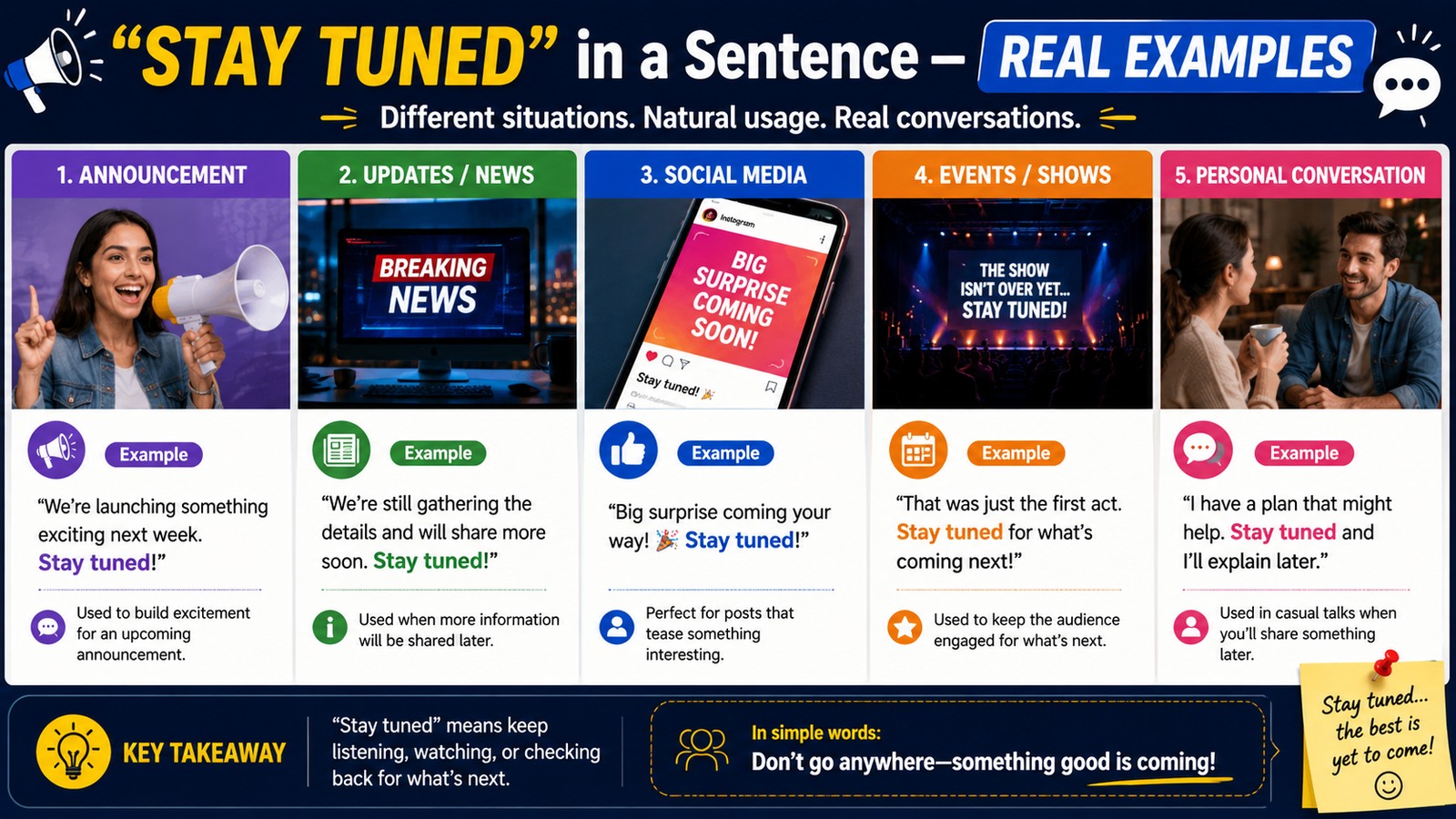
Seeing the phrase across different registers makes the pattern easier to internalize. Here’s a spread of real-world style examples across contexts:
Broadcasting:
- “We’ll have full coverage of the storm right after this. Stay tuned.”
- “The results of tonight’s game, coming up after the break — stay tuned.”
Marketing:
- “Our biggest sale of the year is almost here. Stay tuned for the details.”
- “New collection dropping soon. Stay tuned to our newsletter.”
Workplace/Professional:
- “We’re finalizing the budget proposal this week — stay tuned for the updated numbers.”
- “Leadership will share more on the reorg next Monday. Stay tuned.”
Casual/Texting:
- “Not sure if I can make it yet, stay tuned.”
- “Might have exciting news soon — stay tuned!”
Notice how the tone shifts (formal to playful) while the underlying phrase meaning stays exactly the same: wait, more is coming.
Synonyms and Alternatives to “Stay Tuned”
There’s no shortage of related expressions that carry a similar function, though picking the right one depends heavily on tone and setting. Below is a breakdown by language register.
| Register | Alternative Phrases |
|---|---|
| Casual | “hang tight,” “hold on,” “more to come,” “sit tight” |
| Professional | “further updates to follow,” “additional details will be shared soon,” “more information forthcoming” |
| Playful/Marketing | “watch this space,” “keep your eyes peeled,” “big things coming,” “the wait is almost over” |
Some of these synonymous expressions carry slightly different nuance worth knowing:
- “Watch this space” leans more visual and works especially well for content or design reveals.
- “Keep an eye out” implies the update might appear unexpectedly, rather than at a scheduled time.
- “Hold that thought” is closer to a conversational pause than a promise of future content, so it’s less interchangeable than it sounds.
- “To be continued” is almost exclusively used for narrative content — stories, shows, series — rather than announcements or updates.
Choosing the right comparable expression matters more than people think. Using “watch this space” in a formal client email can feel oddly casual, while “further updates to follow” in a fun Instagram caption can feel stiff and corporate.
How to Respond to “Stay Tuned”
Responding to “stay tuned” is usually simple, but the right response still depends slightly on context and tone.
Casual responses:
- “Will do!”
- “Can’t wait!”
- “Ooh, now I’m curious.”
Professional responses:
- “Sounds good, looking forward to it.”
- “Understood, thanks for the heads-up.”
- “Appreciate the update — I’ll keep an eye out.”
Playful/enthusiastic responses:
- “You’re killing me with the suspense 😂”
- “Okay now you HAVE to tell me more.”
There’s no strict rule here, but matching the energy of the original message keeps the exchange feeling natural rather than mismatched.
Common Mistakes With “Stay Tuned”
Even a simple, familiar phrase like this one comes with a handful of common mistakes and usage errors worth avoiding, particularly in business writing where tone control matters more.
Overusing It Until It Loses Weight
The biggest frequent mistake brands make is leaning on “stay tuned” so often that it stops meaning anything. If every single post or email ends with “stay tuned,” audiences start tuning it out entirely — an ironic outcome for a phrase built to hold attention. Save it for moments that actually warrant anticipation.
Promising Updates You Never Deliver
This is arguably the most damaging incorrect usage pattern. Saying “stay tuned” sets an expectation. If the promised update, announcement, or content never actually arrives, it erodes trust fast — especially in marketing communication, where audiences remember unfulfilled teasers more than they remember delivered ones.
Wrong Tone for the Setting
Dropping “stay tuned” into a highly formal document, a legal notice, or a serious professional update can undercut the tone you’re going for. It’s a small writing mistake, but it’s noticeable — mixing a breezy phrase into an otherwise serious message can read as tonally inconsistent.
Vague Teasers With No Timeline or Context
“Stay tuned” works best paired with at least a hint of what’s coming or when. A completely open-ended “stay tuned” with zero context can feel more like filler than an actual promise. Compare:
- Weak: “Something’s coming. Stay tuned.”
- Stronger: “We’re announcing our new product line next Tuesday. Stay tuned.”
The second version keeps the anticipation while giving the audience an actual reason to stay engaged.
Here’s a quick side-by-side showing weak versus strong phrasing across a few common scenarios:
| Situation | Weak Version | Stronger Version |
|---|---|---|
| Product launch | “Stay tuned, something’s coming.” | “Stay tuned — we’re revealing the new lineup on March 3rd.” |
| Team update | “Stay tuned for changes.” | “Stay tuned for the updated schedule, coming Friday.” |
| Social post | “Big news soon. Stay tuned.” | “Stay tuned — the collab drops this weekend.” |
Notice the pattern: the stronger version never sacrifices the sense of anticipation, it just anchors that anticipation to something concrete. That small addition is often the difference between a teaser that builds trust and one that quietly damages it.
It’s also worth flagging a subtler usage error: pairing “stay tuned” with language that contradicts urgency. Saying “stay tuned, this is extremely time-sensitive” undercuts itself, since “stay tuned” inherently implies a wait. If something truly can’t wait, a direct call to action (“act now,” “respond today”) communicates that far more effectively than a phrase built around patience.
“Stay Tuned” vs. Similar Phrases
While many alternative phrases overlap in meaning, they’re not perfectly interchangeable. Here’s a direct comparison:
| Phrase | Best Used For | Key Difference |
|---|---|---|
| Stay tuned | General anticipation for an update or announcement | Broadest, most flexible option |
| Hang on / Hold on | Immediate, short-term waiting | Implies seconds or minutes, not days |
| Hold that thought | Pausing a conversation to return to it later | Conversational, not broadcast-style |
| To be continued | Narrative or serialized content | Story-specific, rarely used for real-world updates |
| Watch this space | Visual reveals, design, or product teasers | More visual/marketing-coded |
Understanding these small distinctions helps writers pick a phrase that actually fits the situation instead of defaulting to “stay tuned” out of habit.
Why “Stay Tuned” Has Lasted So Long
Plenty of broadcast-era phrases faded once their original technology disappeared. Nobody says “don’t touch that dial” anymore in any real sense, and “on the air” now feels more like a nostalgic nod than a functional phrase. So why did “stay tuned” survive when so many of its contemporaries didn’t?
Part of the answer is structural. “Stay tuned” doesn’t actually require the listener to know anything about radios or television to understand it intuitively. The word “tuned” carries an implied sense of attention even outside its technical origin — you can “tune in” to a conversation, “tune out” a distraction, or feel “in tune” with someone’s mood. Because the underlying metaphor (attention as a signal you can lock onto) already made sense on its own, the phrase had an easy path into general use once the literal broadcasting context faded into the background.
There’s also a psychological reason marketers and communicators keep reaching for it: stay tuned creates what behavioral researchers call an open loop. Human attention is drawn toward incomplete information — a sentence that isn’t finished, a story without an ending, a question left hanging. “Stay tuned” is essentially a verbal open loop generator. It tells the brain there’s more coming without resolving the tension, which keeps people checking back.
Case study: During major product launches, companies like Apple have historically used minimal, vague teaser language — sometimes nothing more than a date and a logo — instead of detailed previews. While Apple rarely uses the literal words “stay tuned,” the strategy behind its teaser campaigns runs on the exact same psychological principle: give just enough to spark curiosity, withhold the payoff, and let anticipation do the marketing work. Smaller brands borrow this same approach directly, often using “stay tuned” as the explicit, plain-language version of that strategy.
This is also why the phrase holds up so well in social media posts. Platforms reward content that keeps people coming back, and a two-word phrase that manufactures anticipation without requiring any extra production effort is about as efficient as marketing language gets.
“Stay Tuned” Across English-Speaking Regions
While “stay tuned” is broadly understood across English-speaking countries, its usage frequency and preferred alternatives shift slightly by region.
| Region | Common Usage Notes |
|---|---|
| United States | Extremely common across broadcasting, marketing, and casual speech |
| United Kingdom | Used similarly, though “watch this space” appears more frequently in British marketing |
| Australia | Common in broadcasting and casual conversation, closely mirroring US usage |
| Canada | Nearly identical usage patterns to the US, given shared media influence |
This regional consistency is part of why the phrase translates so well across global marketing campaigns — English speakers everywhere recognize it instantly, without needing localized alternatives.
FAQs
Is “stay tuned” one word or two?
It’s always two separate words — “stay” and “tuned” — never combined or hyphenated.
Can you use “stay tuned” in a professional email?
Yes, especially in marketing or team updates, though highly formal emails often read better with “further details to follow.”
Where did “stay tuned” come from?
It originated in 1920s–30s American radio broadcasting, when listeners had to keep their dial tuned to a station’s frequency.
What’s a more formal way to say “stay tuned”?
Try “additional information will be shared shortly” or “further updates to follow” for a more polished, professional tone.
Is “stay tuned” still commonly used today?
Yes — it’s widely used across social media, marketing, broadcasting, and everyday texting, and shows no signs of fading out.
conclusion
So that’s the full stay tuned meaning in a nutshell. It started as radio instruction. Now it’s everywhere. You’ll hear it on TV, see it in captions, and read it in texts. It simply means “wait, more is coming.” Easy to use. Easy to understand.
Knowing the stay tuned meaning helps you use it well. Save it for real updates. Match the tone to your setting. Skip it in formal writing. Use it in casual, friendly messages instead. Two small words, one clear job: keep people curious and ready for what’s next.