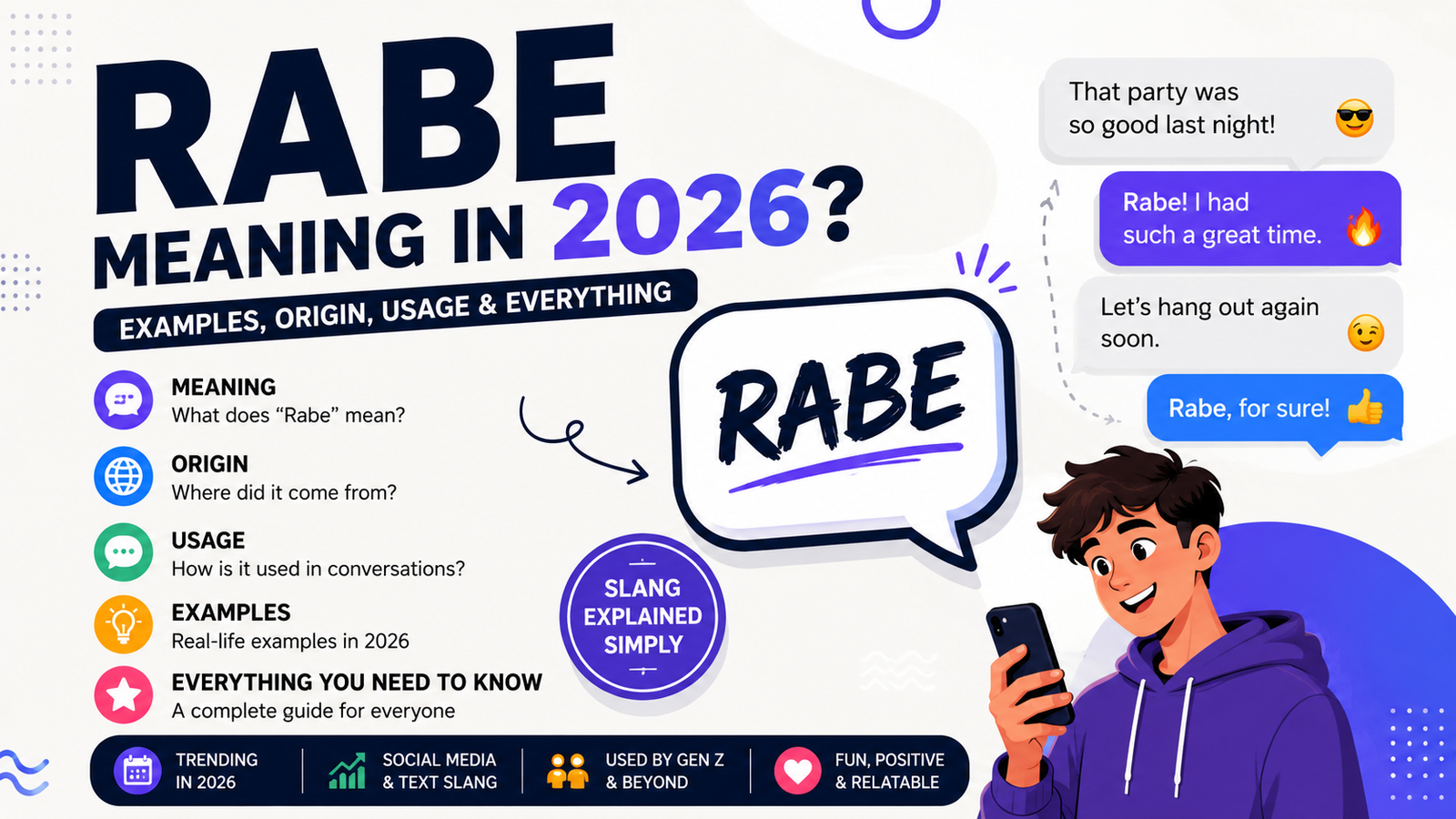
rabe meaning slang refers to the internet-era usage of “rabe,” a word with no fixed dictionary definition that mostly functions as a casual typo or stylized version of “babe” in texting and online chats.
Here’s the twist most articles won’t tell you: half the internet swears “rabe meaning slang is bold new slang, while the other half has never even heard of it — and both sides are only telling part of the story.
The real answer blends a documented German surname meaning “raven” with a modern texting habit, creating a word that’s equal parts history, autocorrect accident, and internet myth worth unpacking.
The Short Answer: What “Rabe” Means Right Now
Here’s the direct version, no hedging: “rabe” is not an established slang term with a fixed definition. It doesn’t appear in any major slang dictionary with a stable meaning, it isn’t tied to one traceable viral moment, and it doesn’t have the kind of broad, consistent usage that real slang eventually settles into.
What “rabe” actually is comes down to two separate things that get mixed together constantly:
- A real German surname meaning “raven” — documented, historical, and unrelated to texting culture entirely.
- A common typo of the word “babe,” produced by fast typing, swipe keyboards, and autocorrect quirks.
Everything else — the “TikTok slang,” the “compliment word,” the “aesthetic term” — is largely the product of content sites racing to rank for a search term that suddenly started getting traffic, without much concern for whether the definitions they’re publishing are true. That’s a real pattern in online content, and “rabe” happens to be a clean example of it.
So when someone texts you “rabe,” the most likely explanation is simple: they meant to type “babe” and didn’t notice, or they’re using it as a soft, stylized nickname. That’s it. There’s no hidden code to crack.
Where Did “Rabe” Actually Come From?
To understand the rabe meaning properly, you have to separate two completely different histories: the word’s real, documented origin, and the much murkier story of how it started showing up in text messages.
The Name Origin: Raven, Not Slang
Long before anyone typed “rabe” into a group chat, it existed as a German surname. In German, Rabe translates directly to “raven” — the same way “Fox,” “Wolf,” or “Bird” function as English surnames rooted in nature and animal symbolism.
Surnames like this typically trace back to one of a few sources:
- Occupational or symbolic naming, where families were associated with a trait or animal (ravens were often linked to intelligence, watchfulness, or omens in German and broader European folklore).
- Regional or descriptive naming conventions common across German-speaking Europe, where nature-based surnames were widespread by the medieval period.
- Literary and cultural reinforcement, since the raven shows up repeatedly in German folklore and fables — reinforcing Rabe as a recognizable, respected family name over centuries.
This is the part of the word’s history that’s actually documented and stable. If you search genealogical records or German-language surname databases, Rabe appears consistently as a nature-based German name, with no ambiguity and no competing theories. It’s a solid, historical surname origin — the opposite of the shifting, contradictory picture you get from slang sites.
The important thing to understand is this: the German surname and the internet slang usage are not the same lineage. Nobody took the German word for “raven” and turned it into a texting term. They’re two unrelated threads that happen to share four letters.
The Typo Theory
So where does the texting usage actually come from? The most credible explanation — and the one that holds up when you actually look at how the word appears in real conversations — is what’s often called the texting theory, or more plainly, the typo theory.
Here’s the logic. On a standard smartphone keyboard, especially with swipe-typing or predictive text enabled, small errors happen constantly. A keyboard error doesn’t need a dramatic explanation — sometimes a finger lands half a key off, or a swipe pattern gets misread, or autocorrect “helpfully” changes a word mid-sentence without the sender noticing before hitting send.
“Babe” is one of the most frequently typed pet names in casual texting. High-frequency words are exactly the ones most likely to develop common typing errors, simply because they’re typed so often that even a low error rate produces a lot of visible mistakes. Over enough messages, sent by enough people, “babe” becoming “rabe” is a natural and unremarkable autocorrect mistake — not a hidden new word being born.
You can actually see this pattern play out in real conversations. It typically follows one of these shapes:
- The sender catches it immediately and follows up with a correction: “rabe” → “*babe lol”
- The recipient notices and asks about it, and the sender explains it was a typo.
- Neither party comments on it at all, because the meaning is obvious from context and nobody cares about a single swapped letter.
This is a common text message typo pattern, and it’s far more consistent with how the word actually shows up online than any of the elaborate “hidden meaning” explanations floating around.
It’s worth adding one honest nuance here, since a lot of typo explanations get lazy: on a standard QWERTY layout, “B” and “R” aren’t actually next to each other, so a simple “wrong key pressed” explanation doesn’t fully hold up on its own. The more accurate mechanism is almost certainly swipe-typing, where a finger drags across the screen in a continuous path and the keyboard’s prediction engine occasionally misreads the intended word entirely, substituting a different but similarly-shaped path. Predictive text and autocorrect dictionaries can also “learn” unusual substitutions if a user has typed “rabe” by accident enough times, making the mistake more likely to repeat. That’s a small detail, but it’s the kind of detail that separates a real explanation from a guess — and it’s missing from almost every other article covering this topic.
How Typos Turn Into Real Words (And Why “Rabe” Might Not)
It helps to zoom out here, because “a mistake becoming an accepted word” isn’t a new phenomenon invented by texting culture — linguists have a name for related patterns, and language history is full of examples.
- “OK” is widely believed by many linguists to have started as a deliberate 1830s newspaper joke — an intentionally misspelled abbreviation (“oll korrect”) that stuck around long after the joke was forgotten.
- Eggcorns — a term linguists use for phrases like “old-timers’ disease” instead of “Alzheimer’s disease” — show how a mishearing or misreading can spread because it sounds plausible enough that people keep repeating it without noticing the error.
- Casual contractions like “prolly” (probably) or “ur” (your/you’re) started as shortcuts or typos in informal writing and eventually became recognizable, if still informal, spellings in their own right.
What all of these examples share is scale and time: they spread across large numbers of independent speakers over years, not weeks, and they got reinforced by repeated, genuine use rather than by search-optimized articles trying to define them. “Rabe” hasn’t shown that kind of organic, sustained spread yet. It’s entirely possible a common typo like this could eventually harden into an intentional, recognized spelling the way “prolly” or “ur” did — but right now, the evidence points to it being early-stage at best, confined mostly to individual pairs of texters rather than a broader speech community.
Why There’s No Clean Origin Story
This is the section most other articles skip past, and it’s arguably the most useful thing you can know about this word: there is no official slang origin for “rabe.”
Real slang terms, even fast-moving internet ones, usually have something traceable — a specific video, a specific creator, a specific community where the word first caught on. Words like “rizz” or “delulu” can be traced to identifiable online spaces and moments, even if the exact “first use” is fuzzy. That’s normal for slang etymology.
“Rabe” doesn’t have that. There’s no single post anyone points to. There’s no creator credited with coining it. There’s no documented slang entry with citations. What exists instead is a cluster of articles, most published within a similar window in 2026, each asserting a confident but different definition — with no primary source behind any of them.
That absence isn’t a gap in this guide’s research. It’s the actual finding. A word with a real language origin leaves a trail. “Rabe,” as slang, doesn’t.
Why So Many Sites Disagree on What “Rabe” Means
This is the part of the story that actually explains the confusion you’ve probably already run into, and it deserves more attention than most guides give it.
If you look across the current wave of content published about this word, you’ll find wildly conflicting meanings for something that supposedly has one clear definition. Here’s a side-by-side look at what’s actually being claimed:
| Claimed Meaning | Described Tone | Platform Cited | Source Given |
|---|---|---|---|
| Expression of admiration or approval | Positive | Group chats, DMs | None |
| Way to call out dramatic behavior | Playful/teasing | TikTok, group chats | None |
| Low-effort filler word | Neutral | Text messages | None |
| Stylistic/artistic mood word | Atmospheric | Music, captions | Unverified song reference |
| Simple typo or misspelling of “babe” | Affectionate | Texting, Snapchat | Pattern-based, most consistent |
Look at that table for a second. These aren’t small variations on one theme — they’re inconsistent usage claims that actively contradict each other. A word can’t simultaneously be “always positive” and “a way to call someone out for dramatic behavior” without at least some explanation for how those two uses coexist. None of the sources offering these varied definitions attempt that explanation. They just state a meaning as fact and move on.
This pattern has a name in the world of online content: it’s what happens when a search term suddenly shows rising interest — often because of a spike in typos, a coincidental trend, or a single ambiguous post — and multiple content sites rush to publish “definition” articles to capture that traffic before anyone else does. Speed matters more than accuracy in that race, and it shows.
A Quick Gut-Check You Can Use
Next time you’re trying to figure out if a slang definition you’re reading is real or manufactured, run it through this short checklist:
- Does the article cite a specific example (a real post, video, or account) rather than a vague “on TikTok, people often say…”?
- Do multiple independent sources agree on the core meaning, not just the existence of the word?
- Is there a plausible explanation for why the word emerged, or does the origin story feel invented after the fact?
- Does the site have any actual authority on language or internet culture, or is it one of many near-identical articles published in the same few weeks?
If a word fails most of these checks, treat any confident definition confusion you find with real skepticism. That’s exactly the case with “rabe.”
The Ways People Actually Seem to Use “Rabe”
Setting aside the manufactured slang claims, there are genuine, observable patterns in how “rabe” shows up in real messages. None of them require inventing a new word — they’re all consistent with either a typo or a small stylistic choice.
As a Stand-In for “Babe”
By far the most common real-world use. Someone means “babe” — as a pet name or term of endearment — and “rabe” comes out instead, either by accident or as a soft, intentional variation.
Example exchange:
“Morning rabe, did you sleep okay?” “Morning! Yeah, slept great 😊”
Nobody in that exchange treats “rabe” as anything other than “babe.” It reads naturally, gets no pushback, and carries the same affectionate tone as the correctly spelled version. This is the clearest, most repeatable pattern across real conversations, and it lines up directly with the texting theory covered earlier.
As a Low-Effort Filler Word
Less common, but it shows up: some people use “rabe” the way they’d use “lol” or “lowkey” — a short, casual add-on that doesn’t carry much specific meaning beyond softening a sentence’s tone.
Example exchange:
“That test was so hard rabe” “Fr, I barely finished”
Here, “rabe” isn’t standing in for “babe” in any literal sense — it’s closer to a verbal tic, the texting equivalent of “man” or “bro” used as filler rather than a direct address. This use is genuinely harder to pin down, and it’s the one most likely to have been inflated by content sites into something more meaningful than it is.
As a Username or Handle, Unrelated to Slang at All
A significant chunk of “rabe” sightings online have nothing to do with slang whatsoever — they’re simply an online username, gamer tag, or screen name. Because “rabe” is short, easy to type, and not overly common, it works well as an account name on gaming platforms, Discord servers, and social apps.
Example:
“Rabe is joining the match in five minutes.”
In context like this, treating “rabe” as slang would be a misread entirely — it’s just what someone decided to call their account, likely influenced by the German surname or simply because it sounded distinctive and was available.
Rare Stylized Spelling for a Softer Tone
Some texters deliberately swap letters in affectionate words to create a gentler, “softer” aesthetic — similar to writing “bbg” instead of “baby girl,” or doubling letters for emphasis (“babyy”). “Rabe” occasionally fits into this broader pattern of stylized spelling.
Example:
“night rabe 🥺✨”
This is a real, observable texting habit — it’s just not unique to “rabe” specifically, and it’s better understood as part of a wider texting style trend than as evidence of a standalone slang word with its own dictionary entry.
Real Examples of “Rabe” in Context
To make the patterns above concrete, here’s a broader set of real examples — realistic, representative message exchanges that mirror how the word actually appears, organized by which use case they demonstrate.
| Message | Most Likely Meaning | Signal |
|---|---|---|
| “Hey rabe what are you doing tonight?” | Typo/pet name for “babe” | Sent to a partner or close friend |
| “Lol I typed rabe again” | Confirmed typo | Sender explicitly flags the mistake |
| “That’s so rabe honestly 😭” | Filler/reaction word | No literal “babe” substitution fits |
| “Rabe just logged into the server” | Username | Third-person reference, gaming context |
| “From now on we’re calling you rabe” | Nickname born from a typo | Friends turning a mistake into a joke |
| “Text me later rabe” | Pet name | Casual, affectionate sign-off |
A few things stand out when you look at examples like these side by side. First, context does almost all of the interpretive work — the word itself carries very little fixed meaning on its own. Second, the “typo becoming an inside joke” pattern is genuinely common: a mistake gets repeated enough between two people that it turns into a private nickname, which is a completely normal thing that happens with texting typos in general, not something specific to this word.
Case Studies: “Rabe” in Three Different Situations
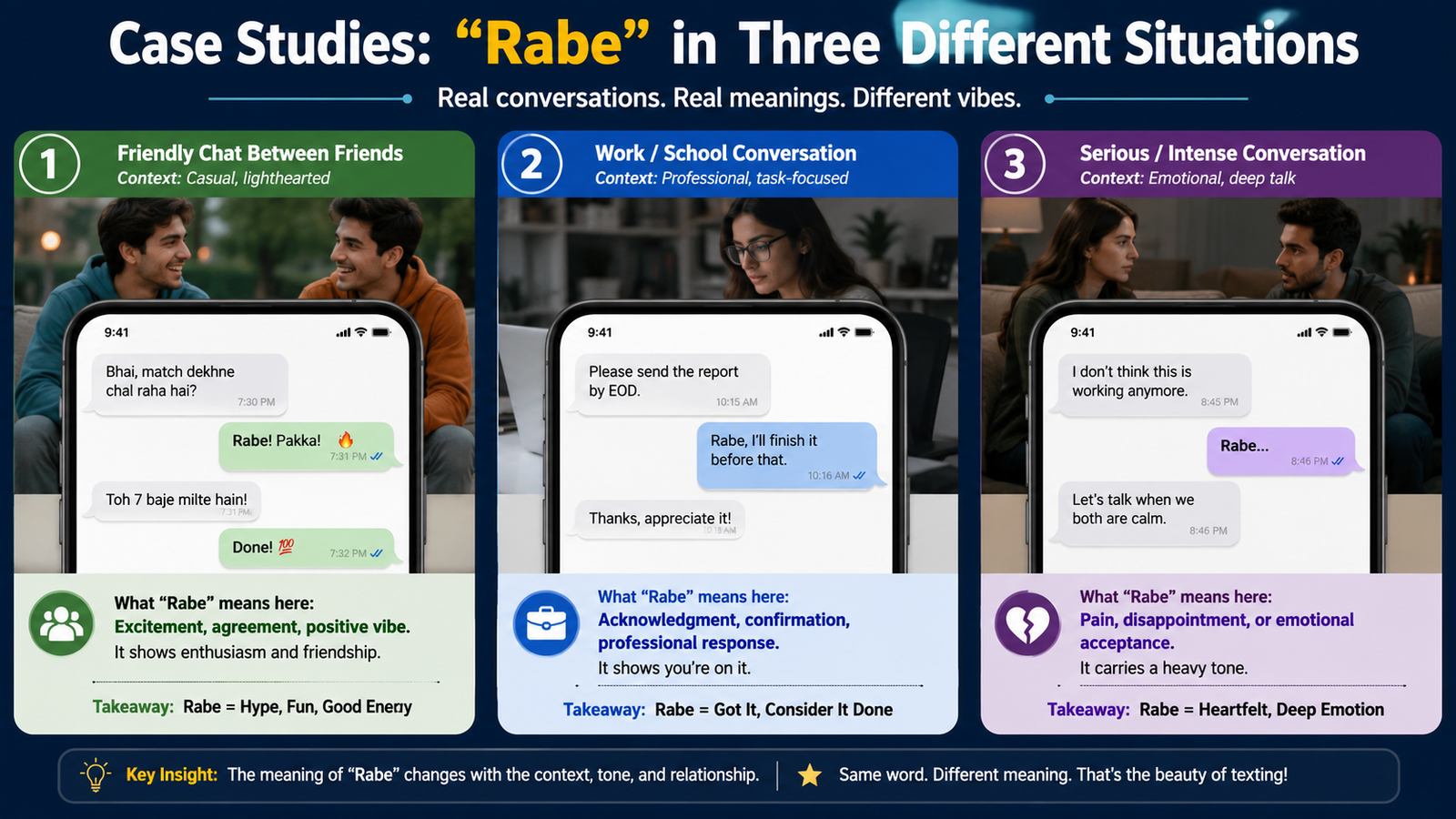
To pull everything together, here are three realistic, composite scenarios — built from the patterns covered above rather than any single traced post — showing how differently “rabe” can land depending entirely on context.
Case Study 1: The Accidental Nickname Two friends text daily. One of them fat-fingers “babe” as “rabe” while typing quickly on the way to work. The other doesn’t correct it, and it comes up again a few days later, half-jokingly. Within a couple of weeks, “rabe” has become their own private, affectionate in-joke — used the same way “babe” would be, just with a shared understanding of where it came from. Nobody outside that friendship would recognize it as anything meaningful, because it isn’t meaningful outside that specific relationship. This is the texting theory playing out exactly as expected: a typo, unchallenged and repeated, quietly becoming a nickname.
Case Study 2: The Gaming Handle A player joins a multiplayer server under the tag “Rabe” — chosen simply because it was short, easy to say over voice chat, and not already taken. Other players in the match refer to them by that name throughout, with zero connection to any slang meaning. Anyone stumbling across a chat log later and assuming “rabe” carries some hidden significance would be misreading a completely ordinary username or handle choice, likely influenced more by the word’s short length and clean sound than by the German surname or any slang trend.
Case Study 3: The Content Farm Effect A handful of low-authority websites, publishing within weeks of each other, notice rising search interest in “what does rabe mean” — interest almost certainly driven by the sheer volume of accidental typos happening across millions of daily messages. Rather than researching the term’s actual roots, several sites independently generate broad, vague “definitions,” each shaped to sound authoritative and each different from the last. Readers searching for a real answer instead find five contradictory ones. This case study is really the story of this entire guide’s investigation — and it’s the most common reason confident-sounding slang “definitions” for very new or very rare terms shouldn’t be taken at face value without a source behind them.
How to Tell If Someone’s Using It as Slang or Just Typo’d
Since context carries so much weight, it helps to have a practical way to read a given message rather than guessing. Here’s a simple framework:
- Look for a correction. If “rabe” is followed shortly by “*babe” or a similar fix, it’s a confirmed typo. This is the single strongest signal.
- Check the relationship. Pet names get typo’d between partners and close friends constantly. If the sender doesn’t normally use affectionate nicknames with you, “rabe” is more likely a username reference or unrelated filler.
- Notice sentence position. “Hey rabe” at the start of a message reads like a pet name. “That’s so rabe” mid-sentence reads more like filler or a reaction word.
- Consider the platform. In gaming chats and Discord servers, “rabe” is far more likely to be a username or handle than a term of endearment. In DMs and personal texts, the pet-name reading is far more likely.
- Watch for repetition without correction. If two people use “rabe” back and forth consistently over time with no correction ever appearing, it’s likely settled into a private nickname — which is a real, if small-scale, form of language use, even if it never becomes a broadly recognized slang term.
Is “Rabe” a Real, Recognized Slang Term?
Based on everything above, here’s the honest answer: not yet, and possibly not ever.
There’s an important distinction worth drawing out here between “a word people occasionally type” and “an established slang term with a dictionary entry and consistent meaning across a language community.” Plenty of typos and small in-group nicknames exist without ever crossing into the second category. That’s exactly where “rabe” currently sits.
For comparison, here’s what separates genuinely accepted slang from a word like “rabe”:
| Factor | Established Slang (e.g., “rizz,” “delulu”) | “Rabe” |
|---|---|---|
| Traceable origin or moment | Usually yes | No |
| Consistent meaning across sources | Mostly yes | No — contradictory |
| Dictionary or slang-database entry | Often yes, eventually | No |
| Broad, organic community adoption | Yes | Limited, mostly typo-driven |
| Independent verification across platforms | Yes | No |
None of this means the word is “fake” in some judgmental sense — typos becoming inside jokes is a completely normal part of how people communicate. It just means the confident claims of slang recognition you’ll find elsewhere online are overstating what’s actually going on.
Could It Still Catch On?
Language does occasionally work this way — an accidental typo becomes an intentional, widely adopted spelling over time. It’s happened before with other words that started as mistakes and eventually stuck in certain communities. But that kind of shift takes sustained, organic, cross-platform adoption over a real stretch of time, not a short burst of similar-sounding “definition” articles published within weeks of each other. As of now, “rabe” doesn’t show the broader signs of that kind of organic spread — its visibility looks driven mostly by search content rather than by widespread genuine use.
Common Mistakes People Make With “Rabe”
A few recurring errors show up whenever people try to make sense of this word:
- Assuming it always means the same thing. As shown above, context changes the read entirely — treating every instance as one fixed meaning leads to real misunderstandings.
- Overreading a simple typo. Not every “rabe” is meaningful. Most of the time, it’s exactly what it looks like: a small typing slip.
- Confusing the German surname with the slang usage. These are unrelated histories. Bringing up “raven symbolism” to explain a text from your partner is a mismatch of two separate stories.
- Trusting confident-sounding definitions without checking for a source. As this guide covered in detail, a lot of what’s published about this word isn’t backed by anything verifiable.
- Assuming it’s a major, established trend. The word shows up, but not with the scale or consistency that “trending slang” articles imply.
How to Reply If Someone Texts You “Rabe”
In practice, this is simpler than the rest of this guide might suggest. If someone sends you “rabe”:
- Default to reading it as “babe” unless the context clearly points somewhere else (a gaming chat, a third-person reference, etc.).
- Respond naturally, the same way you would if they’d spelled it correctly — there’s no need to call out the typo unless you want to.
- If you’re unsure, a quick, low-stakes “did you mean babe? 😄” clears it up without making it a big deal.
- If it becomes a recurring thing between you two, feel free to let it turn into your own private nickname — that’s a completely normal, low-key way language works between people who talk often.
FAQs
1. What does “rabe” mean in slang?
It’s most commonly a typo or stylized spelling of “babe,” used as a casual pet name in texting. It has no fixed, officially recognized slang definition.
2. Where does the word “rabe” come from?
It’s a real German surname meaning “raven.” The texting usage developed separately, unrelated to that origin.
3. Is “rabe” trending on TikTok in 2026?
Search interest has spiked, but there’s no verified viral post or creator behind it — the “trend” is mostly driven by contradictory definition articles, not organic usage.
4. Is “rabe” an officially recognized slang word?
No. It doesn’t appear in slang dictionaries or major online lexicons with a consistent, agreed-upon meaning.
5. Should I be worried if someone texts me “rabe”?
Not at all. It almost always just means “babe” — a simple typo or affectionate variation, not a hidden message.
conclusion
Rabe meaning slang boils down to something simple: it’s usually a typo, sometimes a sweet nickname, and rarely a “real” trend. It’s not deep internet code. It’s not a secret compliment. It’s “babe,” typed a little wrong, and repeated until it stuck.
Next time you see it, don’t overthink it. The truth about rabe meaning slang is refreshingly plain: a real German surname, a common typing slip, and a lot of noisy articles in between. Now you know the real story, not just another guess.