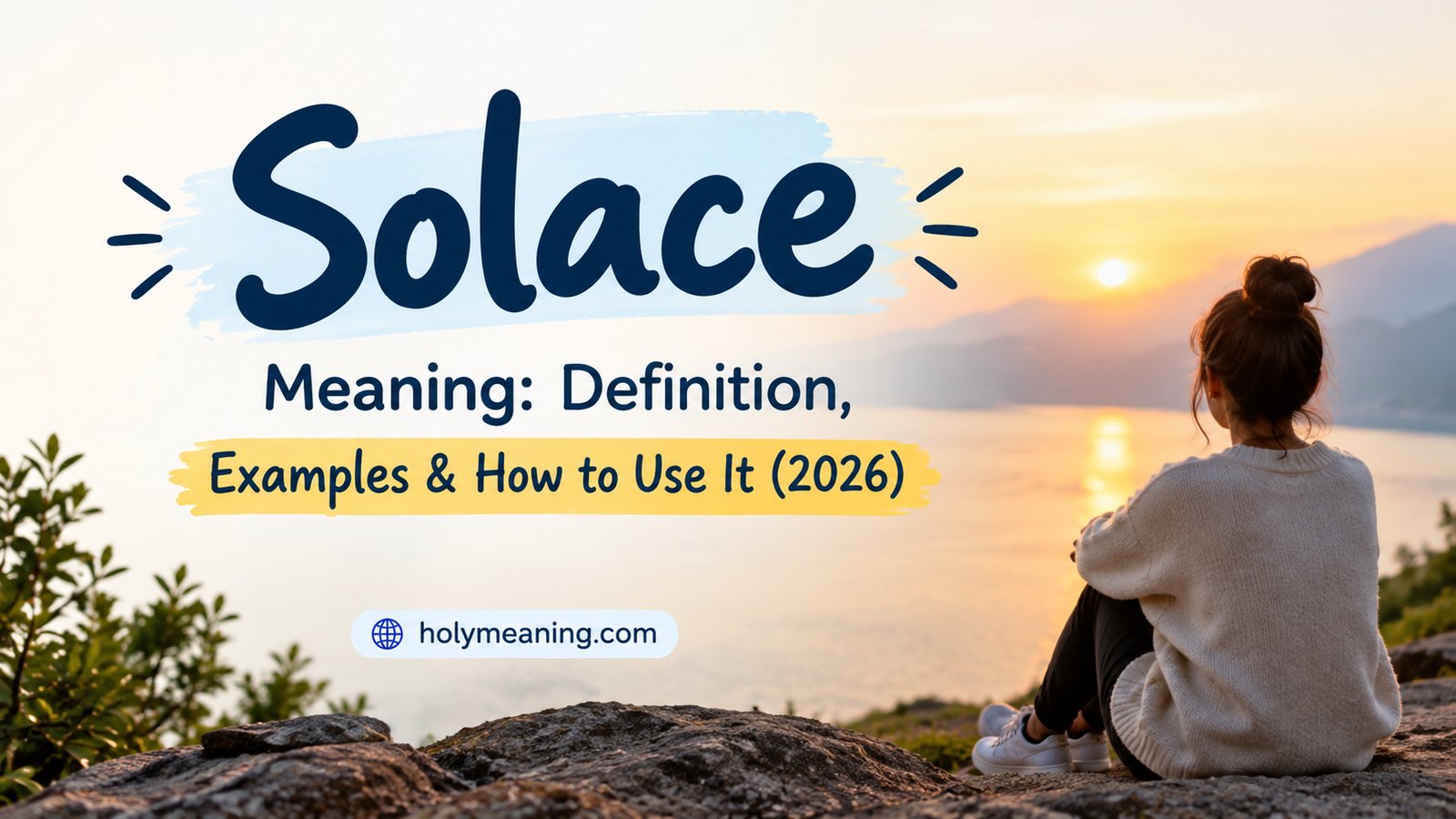
solace meaning the comfort or relief a person feels after grief, loss, or disappointment — not comfort in general, but the specific kind that arrives once something painful has already happened. It’s the quiet lift that follows a hard chapter.
Picture the exact moment pain softens just enough to breathe again. That fragile, hard-won relief has a name, and it’s older, richer, and far more precise than “comfort” ever could be.
From a 700-year-old Latin root to modern texts reading “you’re my solace,” this single word carries centuries of meaning packed into six letters. Understanding it changes how you read grief, love, and even a Bond movie title.
What Does “Solace” Mean?
At its core, the meaning of solace is this:
Solace (noun): comfort or consolation received during a time of grief, distress, disappointment, or hardship.
It’s pronounced SOL-iss (/ˈsɒl.ɪs/), with the stress on the first syllable — not “so-LACE,” which is a mistake a surprising number of people make out loud.
Grammatically, solace is almost always a noun. You don’t usually “solace” someone as a verb in modern English (older texts sometimes did this, but it reads as archaic today). Instead, you find solace, take solace, offer solace, or give someone solace. There’s also an adjective-adjacent phrase, “a solace to,” used to describe something or someone that provides this comfort — as in, “her garden was a solace to her.”
Here’s the part most quick definitions skip: solace always implies a “before.” There has to be something painful that came first. You can’t take solace in a nice cup of coffee on an ordinary Tuesday — that’s just enjoyment. But if you’re grieving and that same cup of coffee, made the way your mother used to make it, gives you a moment of peace? That’s solace. The word carries emotional weight that plain “comfort” doesn’t automatically have.
Quick Facts Table
| Detail | Information |
|---|---|
| Part of speech | Noun (occasionally used as a verb in older/literary English) |
| Pronunciation | /ˈsɒl.ɪs/ — “SOL-iss” |
| Word origin | Latin, via Old French |
| First known use | Around the 13th century in English |
| Common phrases | “find solace,” “take solace,” “give solace,” “a solace” |
| Tone | Reflective, often emotional or literary |
Where the Word Comes From
Understanding the history here isn’t just trivia — it actually explains why solace has such a specific meaning today.
Solace traces back to the Latin word solacium (or solatium), which meant comfort, consolation, or relief from distress. Latin solari — “to console” — sits underneath it. From there, the word moved into Old French as solas, and Middle English borrowed it directly, spelling and all, sometime around the 1200s–1300s.
What’s genuinely interesting is how little the core meaning has drifted in roughly 700 years. Words like “nice” (which once meant “foolish”) or “awful” (which once meant “awe-inspiring”) have wandered a long way from their roots. Solace hasn’t. From its earliest English use, it referred specifically to comfort given in response to sorrow — the same specific, contextual meaning it holds now. That kind of stability is rare, and it’s part of why the word still feels a little formal, even literary, compared to everyday alternatives.
How Solace Differs From Its Latin Root
One small but genuinely interesting wrinkle: in Latin, solacium had a slightly wider reach than modern English solace does. It could describe practical relief — soldiers receiving supplies, a debt being partially repaid — not just emotional comfort. Over centuries, as the word moved through Old French and into Middle English, its meaning narrowed and softened, settling almost entirely into the emotional register we recognize today. That narrowing is fairly typical of how words evolve: broad, practical Latin terms often become more specific and emotionally coded once they settle into English.
How to Use “Solace” in a Sentence
The best way to understand a word is to see it working. Here’s a solace meaning example set covering the most natural sentence patterns:
- She found solace in long walks after her father passed.
- Reading has always been a solace to me during hard weeks.
- He took solace from the fact that he’d done everything he could.
- Their letters were a small solace during the years they were apart.
- The community offered solace to the families affected by the flood.
- I couldn’t find much solace in his apology, honestly.
- Music has been my solace since I was a teenager.
- There’s little solace in knowing it “could have been worse.”
Notice the pattern: solace almost always follows a verb like find, take, offer, or give, or it functions as the subject/object of a sentence describing what comforts someone. It rarely stands completely alone the way “comfort” or “relief” can.
Mini Case Studies: Solace in Real Situations
To make this more concrete, here are a few short, realistic scenarios showing how solace actually functions in daily life — not just in a sentence, but in context.
Case 1: Grief after a job loss. Maria was laid off after eleven years at the same company. She described the hardest part as the identity loss, not the paycheck. What helped wasn’t advice — it was her weekly hiking group, which kept meeting the same as always. “It didn’t fix anything,” she said, “but it gave me somewhere to put the week.” That’s solace: not a solution, but a steady place to land.
Case 2: A difficult diagnosis. After a hard medical diagnosis, one man found that keeping his usual Sunday routine — coffee, the newspaper, a walk with his dog — mattered more than any single conversation. The normalcy itself became his solace, proof that ordinary life hadn’t disappeared even though everything felt different.
Case 3: Long-distance relationships. Couples separated by distance often describe voice memos or nightly calls as their solace — not because the calls close the physical gap, but because they make the waiting bearable. This is a good example of solace as partial comfort: it doesn’t remove the hardship (the distance), it just makes carrying it easier.
Each case follows the same underlying shape: something difficult happens, and then something — a habit, a person, a routine — makes it a little easier to bear. That “before, then after” structure is the throughline in almost every correct use of the word.
“Solace” vs. Similar Words
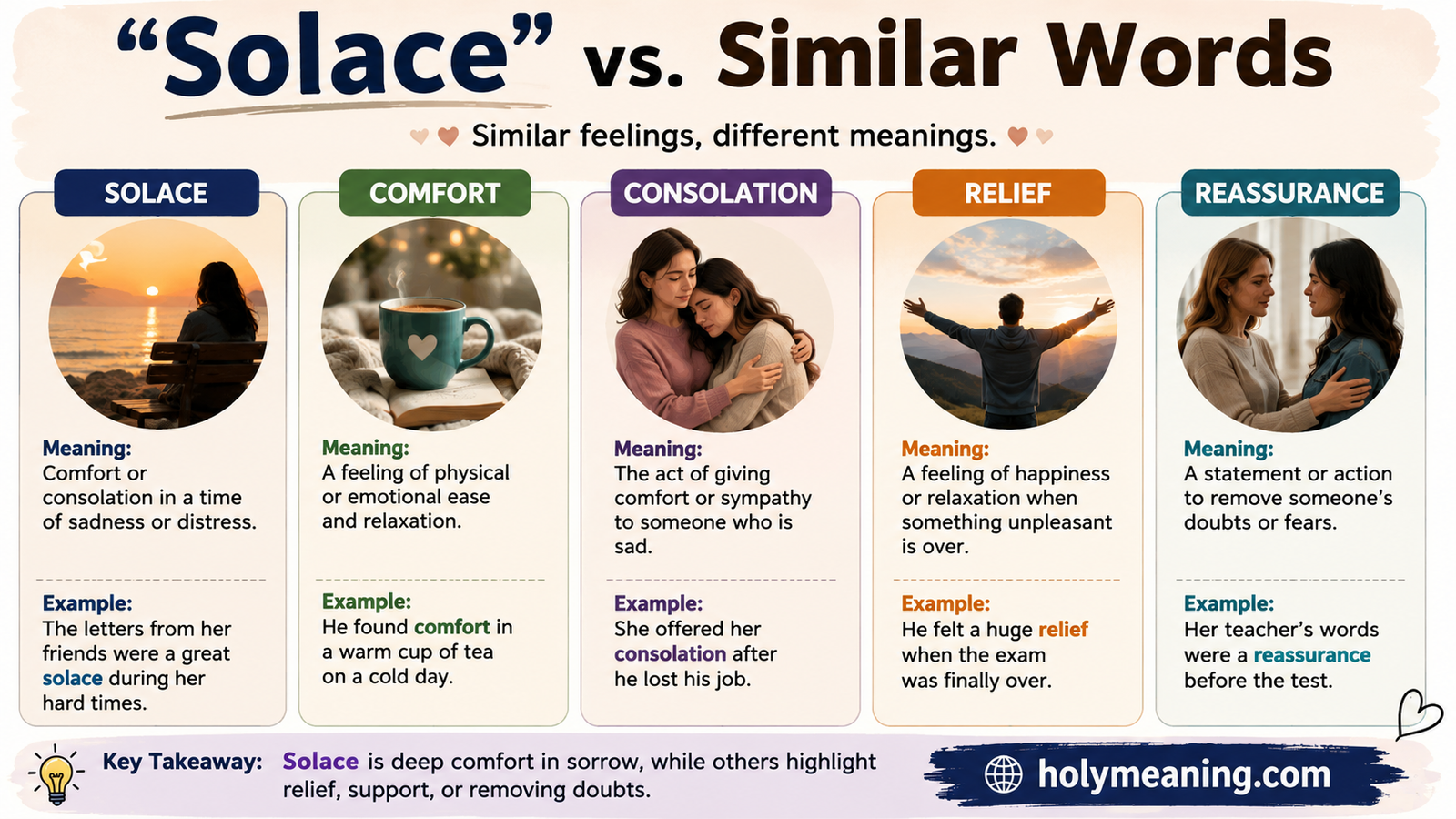
This is where a lot of people get tripped up, because English has several similar terms that all live in the same emotional neighborhood but aren’t quite interchangeable. If you’re trying to pick the right word instead of just a word, this section is the one to bookmark.
Comparison Table: Solace and Its Close Relatives
| Word | Meaning | Key Difference from Solace |
|---|---|---|
| Comfort | General ease or relief from discomfort, physical or emotional | Broader and can apply anytime — no painful “before” required |
| Consolation | Comfort given specifically for grief or disappointment | Very close to solace; consolation leans slightly more toward being comforted by someone else, while solace can be self-found |
| Relief | The lifting of stress, pain, or pressure | Often more physical or situational (“relief from pain”); less emotional weight than solace |
| Solstice | An astronomical event (the sun’s position) | Completely unrelated word — commonly confused due to similar sound |
| Peace | A state of calm or absence of conflict | Broader and more permanent-feeling; solace is often temporary comfort within ongoing hardship |
A simple way to remember the difference: comfort is the category, solace is the specific kind you feel after loss. Every solace is a form of comfort, but not every comfort counts as solace.
Related Words and Synonyms
If you’re looking for alternative terms to solace, here are the closest synonyms, roughly ranked from most to least similar in tone:
- Consolation
- Comfort
- Succor (more archaic/literary)
- Relief
- Reassurance
- Refuge (more metaphorical — “a refuge from grief”)
- Balm (“a balm for the soul”)
Each of these comparable words carries a slightly different flavor. “Succor” feels old-fashioned. “Balm” is more poetic and metaphorical. “Reassurance” leans more toward calming fear than easing grief. When you’re writing, picking between these word alternatives is really about matching the emotional register of your sentence.
A useful test: try swapping the word into one of your own sentences and see if the meaning still holds. “I found comfort in her voice” works fine generically. “I found succor in her voice” sounds like it’s from a 19th-century novel. “I found solace in her voice” hits the middle ground — emotionally specific, but still natural in a modern sentence. That balance is exactly why solace tends to outlast trendier, more casual alternatives in writing that’s meant to last.
“Solice” or “Solace” — Which Spelling Is Correct?
Here’s one of the most common misconceptions around this word: a lot of people spell it “solice.” It’s an easy usage error to make because “-ice” endings are common in English (notice, service, novice), so the brain defaults to a familiar pattern.
The correct spelling is always “solace,” with an “a.” “Solice” isn’t a recognized English word in any standard dictionary — it’s simply a misunderstanding based on how the word sounds, not how it’s actually spelled.
The second mix-up is with “solstice.” These two words don’t mean anything alike — solstice refers to the two points in the year when the sun reaches its highest or lowest point in the sky (summer and winter solstice) — but because they share a similar rhythm and a few overlapping letters, people occasionally type one when they mean the other. If you’re searching for the meaning of a word connected to grief, comfort, or emotional relief, you want solace. If you’re asking about the calendar or astronomy, you want solstice.
Common Ways People Use “Solace” Today
Dictionary definitions are useful, but they don’t tell you how a word actually behaves in real-world usage. Solace shows up in several different contexts, and the tone shifts a little depending on where you encounter it.
In Everyday Conversation and Writing
In regular speech and writing, solace tends to appear when someone is processing something difficult — a breakup, a loss, a disappointment, a hard season of life. It’s more common in written reflection (journaling, memoirs, obituaries, personal essays) than in casual spoken conversation, simply because it carries a slightly more formal, thoughtful tone than words like “comfort” or “relief.”
In Digital Communication and Texting
Solace has had a real resurgence in digital communication. It shows up in text conversations, direct messages, and social media chats more than you might expect for a word with 700-year-old Latin roots. A few common patterns in online messaging:
- “you’re my solace 🤍” — sent as a message of deep appreciation, often romantic
- “this song is my solace rn” — used to describe something providing comfort during a hard moment
- Captions on grief-related or reflective social media posts
Part of this comeback is aesthetic. Solace has become a popular word in the “soft,” reflective corner of the internet — journaling communities, poetry accounts, and quote-graphic culture — where slightly literary vocabulary gets shared and reused until it becomes part of everyday internet conversations.
In Dating Apps and Romantic Messaging
This is genuinely one of the more interesting usage contexts for the word right now. In dating app bios and early conversations, “solace” tends to signal something specific: the person values emotional depth and isn’t afraid to name it directly. Using the word “solace” in a bio or message is rarely accidental — it’s a deliberate, slightly vulnerable word choice, which is exactly why it stands out in a sea of “just here for good vibes” bios.
In Therapy and Grief Support
Mental health professionals, grief counselors, and support communities use solace regularly because it captures something more precise than “feeling better.” A therapist might ask, “Where do you find solace right now?” — a question that specifically points toward coping mechanisms and sources of comfort during hard periods, not just general happiness.
What Does “You Are My Solace” Mean?
When someone tells you, “you are my solace,” they’re saying something with real emotional weight — not a casual compliment. They’re telling you that you specifically are the thing that brings them comfort during hard times. It’s a step beyond “you make me happy,” because happiness doesn’t require prior pain — solace does. This phrase usually implies:
- You’ve been present during a difficult period in their life
- Being around you (or talking to you) genuinely eases something heavy they’re carrying
- They trust you enough to name that openly
It shows up in romantic contexts most often, but it’s also used between close friends, family members, or even about a pet, a place, or a routine.
Here’s a quick breakdown of how the phrase tends to shift depending on who’s saying it:
| Relationship | What “you’re my solace” usually signals |
|---|---|
| Romantic partner | Deep emotional reliance; often said during or after a hard period in the relationship or in life generally |
| Close friend | Gratitude for consistent, judgment-free support during a hard stretch |
| Family member | Recognition of steady presence, often during illness, loss, or family conflict |
| About a pet or place | A coping mechanism — something non-verbal that still reliably eases distress |
The common denominator across every row: it’s never used lightly. Even in its most casual form (about a pet, a hobby, a playlist), it still implies this specific thing gets me through something hard — which is exactly why it hits differently than a compliment like “you’re the best.”
How to Respond When Someone Calls You Their Solace
Because the phrase carries real sincerity, a flippant response can land oddly. A few natural ways to respond, depending on the relationship:
- Sincere/romantic: “That means more than you know — you’re mine too.”
- Warm but casual: “I’m really glad I can be that for you.”
- If you’re not sure how to reciprocate yet: “Thank you for telling me that. I’m here.”
- Between close friends: “Same goes for you, always.”
The main thing to avoid is brushing it off with a joke — the word wasn’t chosen casually, so a one-word “aw thanks lol” tends to undersell how much someone just shared.
“Solace” in Pop Culture: Quantum of Solace
If you’ve searched this word, there’s a decent chance the 2008 James Bond film Quantum of Solace is part of why. The title uses “quantum” in its older sense — meaning “a specific amount” or “quantity” — rather than the physics term. So Quantum of Solace literally translates to “a small amount of comfort.”
The phrase is thematically loaded: the film is about Bond seeking a small measure of comfort (solace) after grief and betrayal, while emotionally unable to move past his loss. It’s a fitting title precisely because solace implies comfort after something painful — the film’s title wouldn’t make the same sense with a word like “peace” or “happiness” swapped in.
This is one of the clearer examples of a word’s dictionary meaning shaping how it gets used artistically — the title only works because audiences intuitively understand solace as partial, hard-won comfort, not blanket contentment.
Beyond the Bond film, solace shows up regularly as a title or theme in music, poetry, and literary fiction — it’s a favorite word for artists precisely because it’s specific enough to be meaningful but open enough to fit almost any kind of loss: heartbreak, death, war, aging, or disillusionment. You’ll find it in song titles across genres, from indie folk to metal, almost always attached to something reflective or mournful rather than upbeat.
“Solace” in Other Languages
While this guide focuses on solace meaning in English, it’s worth noting the concept exists across cultures, even where the exact word doesn’t translate directly. In Persian (Farsi), for instance, words like ārāmesh (آرامش) or tasalli (تسلی) carry overlapping meaning — tasalli specifically leans toward consolation after hardship, closely mirroring English solace. Translation across languages rarely maps one-to-one, but the underlying human experience — needing comfort after loss — shows up in nearly every language for obvious reasons.
Is “Solace” a Popular Word? Usage & Trends
Solace isn’t a rare or obscure word, but it’s not a top-100 common noun either — it sits comfortably in the “recognizable but slightly elevated” category, alongside words like “solitude” or “resilience.”
A few notable patterns:
- Baby name culture has boosted visibility of the word, thanks to “Solace” gaining slow but steady traction as a given name, especially in the U.S. over the past decade.
- Journaling and quote-graphic culture online has kept the word in circulation, since it pairs well visually and emotionally with reflective, minimalist content.
- Tattoo culture — the word or phrases like “find solace” are a recurring choice for memorial tattoos, since the word so directly captures comfort found after loss.
- Usage in published books and articles has remained fairly steady rather than spiking or declining sharply, which tracks with its stable meaning over centuries.
None of this makes solace a trendy slang term — it’s more that a centuries-old word has found new, active life in modern online conversations, precisely because its meaning is specific enough to say something a vaguer word can’t.
Why the Word Persists
It’s worth asking why, out of dozens of near-synonyms, solace specifically keeps getting chosen. Part of the answer is rhythm — it’s a short, soft-sounding word that reads well in a caption or a lyric. But the bigger reason is precision. “Comfort” is comfortable, almost too neutral. “Consolation” can sound slightly formal or even pitying. Solace sits in a sweet spot: warm, specific, and a little literary without tipping into obscure. When someone wants to say this helped me get through something hard in as few words as possible, solace often does more emotional work than any of its alternatives.
FAQs
1. What does “solace” mean?
Solace means comfort or relief felt after grief, loss, or disappointment — comfort that follows pain, not comfort in general.
2. Is “solice” the correct spelling?
No. “Solice” is a common misspelling; the correct English spelling is always solace.
3. What does “Quantum of Solace” mean?
It refers to “a small amount of comfort” — “quantum” here means “a specific quantity,” not the physics term.
4. What’s the difference between solace and comfort?
Comfort is broad and can apply anytime; solace specifically requires a painful “before” — it’s comfort found after hardship.
5. What does it mean when someone says “you’re my solace”?
It’s a sincere statement that you specifically bring them comfort during a hard time — not a casual compliment.
conclusion
Now you know the full solace meaning — comfort that shows up after pain, not before it. It’s why the word feels heavier than “comfort,” and why people reach for it during grief, love, and hard goodbyes. Small in size, big in feeling.
Next time you hear it in a text, a song, or a movie title, you’ll catch the real weight behind it. That’s the beauty of solace meaning: simple to say, deep to feel, and worth using with care.