MYF meaning in text is simple: it stands for “miss your face.” People send this affectionate text to tell friends, family, and partners they miss them.
Three tiny letters can turn an ordinary Tuesday into a warm reminder that someone’s thinking of you. No long message needed. Just a quick spark of connection.
Still, context shapes the message. MYF also works as an airport code for San Diego’s Montgomery-Gibbs Executive Airport and as shorthand for Methodist Youth Fellowship. This guide explains each meaning, plus real examples and simple etiquette tips for everyday chats.
What Does MYF Mean in Text?
MYF stands for “miss your face.” People send it to friends, family members, and partners when they want to show affection. The tone stays light. The feeling stays real.
Here’s the short version:
Quick answer: In texts, DMs, and chats, MYF means “miss your face.” It’s an affectionate text shorthand for “I miss you.”
That’s the core MYF text meaning. Most readers can stop here if they just need a fast answer. Keep reading if you want to send it well.
MYF Definition at a Glance
This table sums up the MYF explained basics.
| Detail | Answer |
|---|---|
| Acronym | MYF |
| MYF stands for | Miss your face |
| Type | Informal acronym, chat abbreviation |
| Tone | Warm, playful, affectionate |
| Typical senders | Friends, family, partners |
| Typical channels | SMS, iMessage, WhatsApp, DMs, story replies |
| Closest plain-English phrase | “I miss you” |
| Best used | Casual, private messages |
Think of it as a message shorthand for a feeling most of us know well. You don’t have time for a long note. You still want the other person to feel remembered.
Why “Face” Instead of “You”
The word “face” does real work here. Saying “I miss you” covers a lot of ground. Saying “missing your face” points at something specific. You miss the smile, the laugh, and the way someone looks when they tell a story.
That small detail makes the phrase feel personal. It also keeps the tone playful. “I miss you” can land heavy. “Miss your face” often feels lighter and more teasing.
Consider a simple contrast:
- “I miss you.” It’s direct and sincere.
- “Miss your face.” It’s warm and a little cheeky.
Both work. They just set different moods.
How the MYF Abbreviation Looks in Real Messages
People write the MYF abbreviation in several ways. You’ll see all of these:
- MYF
- myf
- Myf!
- MYF 🥺
- MYF already
- myf so much
Capital letters don’t change the meaning. Lowercase feels softer. All caps feels more excited. Punctuation adds color too. An exclamation point signals joy. A period can feel quiet and sincere.
Emojis help a lot. A crying face, a heart, or a hug emoji makes the MYF message meaning obvious at a glance.
Other Meanings of MYF (and How Much Weight to Give Each)
Here’s a fair warning. Many websites list a long string of MYF alternative meanings. Most of those lists lack credible sources. Some pages contradict each other outright. One claims MYF means “miss you forever.” Another says “mind your business.” A third says “my fault.”
I couldn’t confirm any of those through a dictionary, a style guide, or a reliable reference. So this section sorts the other meanings of MYF by how well they hold up.
| Meaning | Where you’ll see it | Reliability |
|---|---|---|
| Miss your face | Texts, DMs, captions | Consistent across nearly every source |
| MYF airport code | Flight searches, airport listings | Verifiable through airport records |
| Methodist Youth Fellowship | Church youth groups | Verifiable through church organizations |
| “My fault,” “mind your business,” “miss you forever” | Low-quality SEO pages | Unverified |
You get a cleaner picture that way. Two real alternatives exist outside of texting. Everything else deserves a raised eyebrow.
MYF Airport Code
MYF is the IATA code for Montgomery-Gibbs Executive Airport in San Diego, California. The airport used to go by the name Montgomery Field. Its ICAO code is KMYF. You can read more on the airport’s Wikipedia page.
The MYF airport code shows up in flight tracking tools, pilot forums, and aviation news. General aviation traffic uses the airport heavily. Commercial airline service is limited.
Picture this. A pilot texts a colleague, “Landing at MYF around 3.” Nobody in that chat thinks about missing a face. The setting makes the meaning clear.
Methodist Youth Fellowship
MYF also stands for Methodist Youth Fellowship. Methodist congregations in several countries run youth programs under this name. A church newsletter might read, “MYF meets Friday at 6 p.m.”
That’s a perfectly valid use of the MYF acronym. It just belongs to a different world than texting between friends. Usage varies by country and denomination, so check the local church’s own materials if you need specifics.
Unverified Claims
Some pages say MYF can mean “my fault,” “mind your business,” or “miss you forever.” These claims show up mainly on thin, repetitive websites. I found no dictionary entry or authoritative source backing them up.
Does that mean nobody has ever used MYF that way? No. Slang is messy, and individuals invent shorthand all the time. A friend group might adopt its own private meaning. Still, these readings don’t qualify as established MYF acronym meanings.
Treat them as possible but unproven. If a message doesn’t fit “miss your face,” ask the sender.
How to Decode MYF Context
Use a simple three-step check whenever you see MYF.
- Check the sender. Friends, family, and partners almost always mean “miss your face.”
- Check the setting. A private chat points to affection. A church group points to Methodist Youth Fellowship. An aviation thread points to the airport.
- Check the words around it. Phrases like “it’s been too long” or “come back soon” make the MYF context obvious.
When all three checks fail, ask. A quick “wait, what does MYF mean here?” beats guessing wrong.
How to Use MYF in a Text
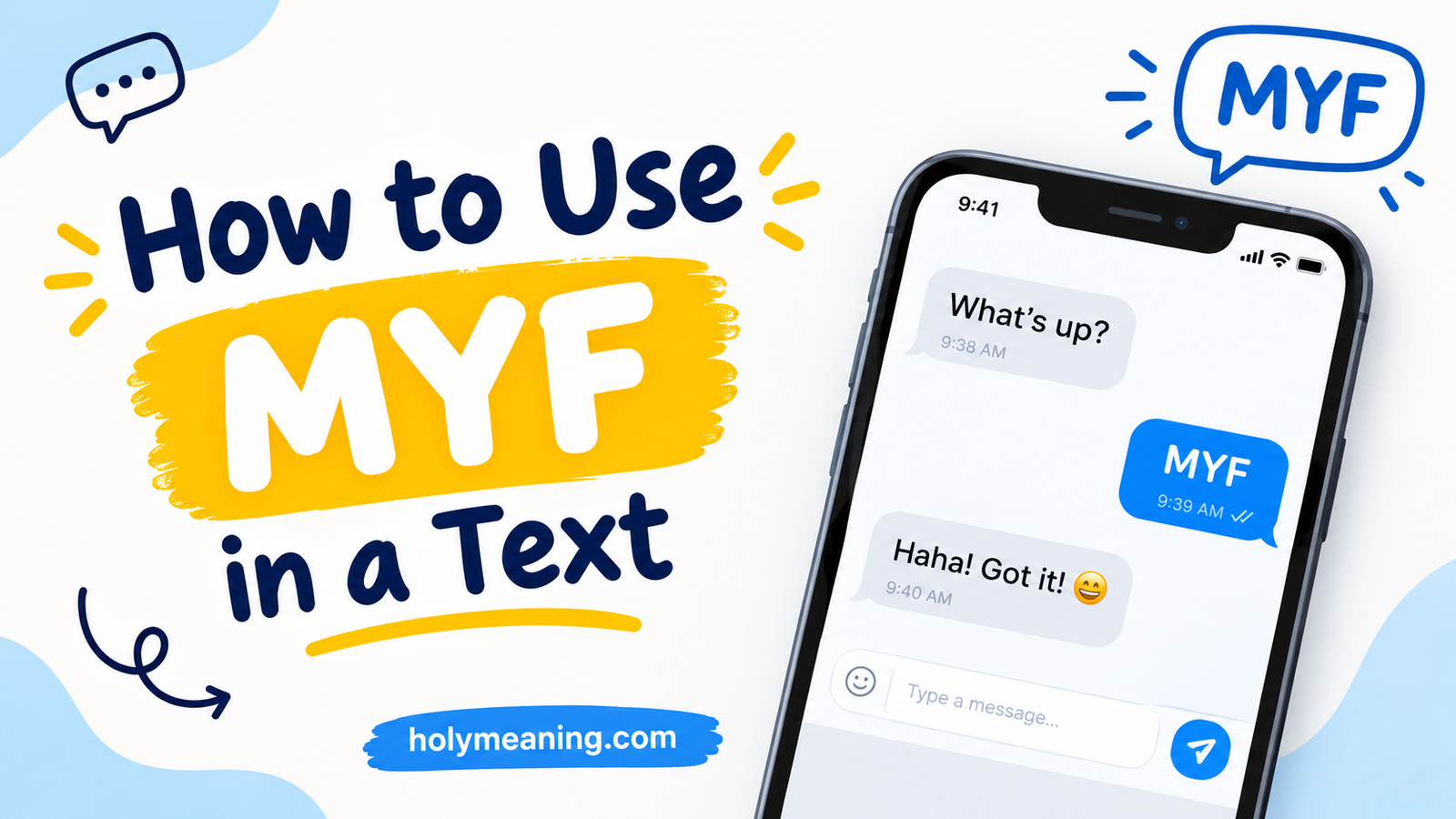
Learning the MYF usage rules takes about two minutes. The basic idea is simple. Send it to people you know well. Send it when the mood is casual.
When to Use MYF
These are the best moments for sending MYF:
- After time apart. A friend returns from a trip, or a cousin moves away.
- During a long-distance stretch. Partners and close friends often text it daily.
- As a reply to a photo. An old picture or a fresh selfie can spark it.
- At the end of a fun evening. “That was great, MYF already.”
- In a group chat after a reunion. Everyone feels the same thing at once.
Here’s a good test. Would you say “I miss you” out loud to this person? If yes, then using MYF in texts probably works.
With Close Friends
Friends use it most. The phrase feels natural between people who joke around. It can carry a little teasing too. “MYF, you weirdo” sounds perfectly friendly.
With Family
Siblings, cousins, and parents use it as well. A college student might text a sibling, “MYF, come visit.” Older relatives may not know the acronym, so spell it out if you’re unsure.
With a Partner
Couples use MYF in conversation often. It works well as a quick midday check-in. It also softens the distance during work trips.
When to Skip It
Some situations call for full words. A few hints help you decide when not to use it.
Professional Messages
Skip it with your boss, clients, or coworkers you barely know. Even warm workplace relationships benefit from clear language. Plus, a stray acronym can confuse people. Nobody wants a mix-up in a work thread.
Serious Emotional Moments
Imagine a friend is grieving. A breezy “MYF” might feel too casual. Write out a full message instead. “I’ve been thinking about you so much, and I miss you” carries more weight.
People Who May Not Know the Acronym
Not everyone keeps up with texting language. A grandparent or a new acquaintance may puzzle over it. Spell it out the first time. You can shorten it later.
How to Respond to MYF
Replying feels easy once you know the tone. Match the warmth. Here are some options:
- “MYF too!”
- “Miss you so much. Let’s fix that soon.”
- “Same here. When are you free?”
- “Aw, MYF back 🥰”
- “Dinner this weekend?”
The last reply works best when you want to turn the feeling into action. Affection is nice. A plan is better.
MYF vs IMY and Other Miss-You Abbreviations
People often ask how MYF vs IMY compares. The two phrases overlap, yet they don’t feel identical.
IMY is short for “I miss you.” That’s the IMY meaning in a nutshell. It’s more direct. It’s also a bit more serious.
| Feature | MYF | IMY |
|---|---|---|
| Stands for | Miss your face | I miss you |
| Tone | Playful, warm | Direct, sincere |
| Intimacy level | Friendly to close | Friendly to very close |
| Best for | Casual check-ins, photo replies | Heartfelt messages |
| Risk of confusion | Moderate (other meanings exist) | Low |
| Feels like | A smile | A hug |
This MYF comparison shows a pattern. MYF leans playful. IMY leans earnest. Neither is better. They just fit different moments.
Other Miss-You Shorthand
Plenty of miss you abbreviation options exist. A few examples include:
- Miss u: a very common, easy-to-read version
- Miss ya: casual and friendly
- IMY: direct and clear
- IMYSM: “I miss you so much,” stronger in tone
Pick the one that matches your voice. Consider your audience too. A teenager might prefer MYF. A coworker might prefer “miss you.”
Which One Should You Choose?
Use this quick guide:
- Choose MYF when you want to sound playful and close.
- Choose IMY when you want to sound clear and sincere.
- Choose “I miss you” in full when the moment matters.
Sometimes plain words win. A full sentence shows effort. That effort can mean a lot.
MYF Examples in Conversation
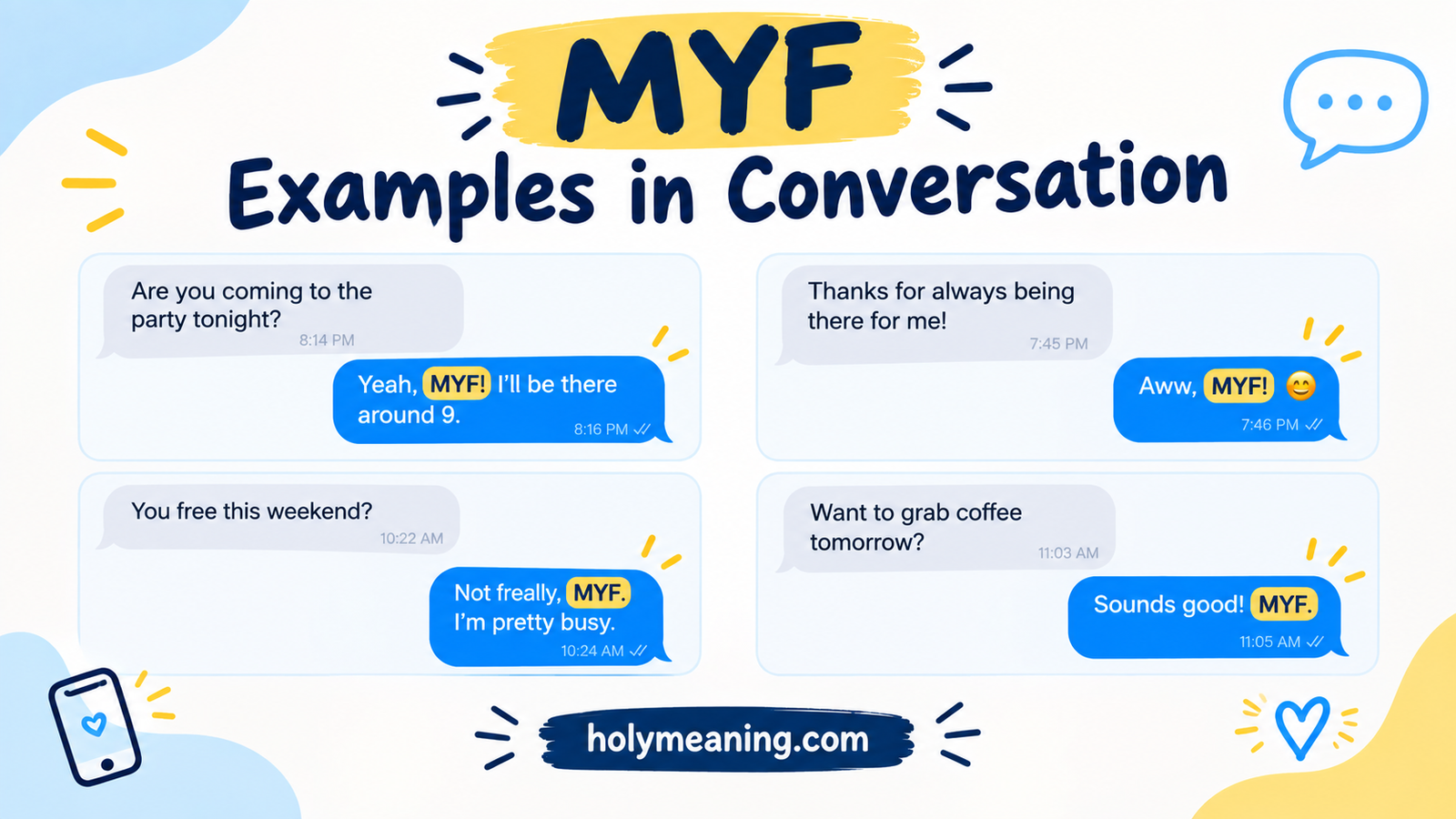
Nothing teaches like MYF examples. The sample messages below show real text examples of the abbreviation in action. These are illustrative scenarios, not transcripts from real people.
After a Trip
Two friends catch up after one returns from three weeks abroad.
Maya: Just landed! So tired lol
Jordan: Welcome home!! MYF so much
Maya: MYF too. Coffee Saturday?
Jordan: Yes please ☕
Why it works: Jordan uses MYF right when the reunion feels near. Maya mirrors the tone and adds a plan. The exchange feels natural and quick.
Replying to a Selfie
A cousin posts a photo from a family gathering last summer.
Sam: posts old photo throwback to the lake
Riley: MYF!! Everyone looks so happy
Why it works: The photo triggers the feeling. Riley uses the MYF abbreviation as a reaction. No extra explanation needed.
Long-Distance Couple
Two partners live in different cities for work.
Alex: Finally done with meetings
Chris: Good. MYF all day 😩
Alex: Two weeks until I’m there. Counting days.
Why it works: Couples need small daily touchpoints. MYF gives Chris a fast way to show care. It keeps the mood light even though the distance feels hard.
Group Chat After a Reunion
Five college friends share a group thread after a weekend meetup.
Dana: That was the best weekend
Priya: MYF already
Leo: MYF x1000
Tess: Same. Let’s book the next one now
Why it works: Group chats amplify feelings. One MYF sparks several more. MYF chats like this often end with a plan.
Case Study: A Quick Mix-Up
Here’s an illustrative scenario. A church volunteer texts a friend, “Are you going to MYF on Friday?” The friend, who mostly sees MYF as “miss your face,” replies, “Aww, I miss you too!” The volunteer laughs and clarifies, “I mean Methodist Youth Fellowship.”
Lesson learned: Context matters. A shared acronym can mean different things in different circles. When you text someone outside your usual group, spell it out.
Case Study: The Professional Slip
Another illustrative scenario. A new employee texts a teammate, “Thanks for covering my shift, MYF.” The teammate frowns. Miss your face? They barely know each other.
Lesson learned: Affectionate informal expression choices don’t fit every relationship. A simple “Thanks so much!” would have worked better.
Why Texting Abbreviations Like MYF Stick
People have shortened words for as long as they’ve written them. Texting simply sped things up. A few facts explain why texting abbreviations caught on.
A Short History of Text Shorthand
- December 3, 1992: Engineer Neil Papworth sent the first SMS. The message read “Merry Christmas.” You can read more about SMS history here.
- The 160-character limit: SMS messages capped at 160 characters. That cap pushed people to write tighter.
- September 19, 1982: Computer scientist Scott Fahlman proposed the first smiley emoticon, :-), on a university message board. See the emoticon entry for details.
- 2011: The Oxford English Dictionary added LOL and OMG to its entries, which signaled how far internet slang had traveled. Visit the OED for its current entries.
These milestones show a pattern. Short forms began as practical tools. They later became cultural habits.
What Language Experts Say
Linguist David Crystal explored this topic in his 2008 book Txtng: The Gr8 Db8. He argued that texting doesn’t wreck language. According to his research, most text messages use relatively few abbreviations. Texters also play with language in creative ways.
That view fits MYF slang well. People don’t use it because they can’t spell. They use it because it feels fun, fast, and friendly.
Why MYF Fits the Pattern
Several reasons explain why text acronyms like this one spread:
- Speed. Three letters beat four words.
- Emotion. It packs warmth into a tiny space.
- Identity. Sharing slang signals closeness.
- Flexibility. It works on any app.
Each trait matters. Together, they give the chat abbreviation real staying power.
Where MYF Lives Online
You’ll see it across platforms:
- Text messages and iMessage
- WhatsApp and Telegram
- Snapchat and Instagram DMs
- Comments and story replies
- Gaming chats and Discord servers
It fits best in private or semi-private spaces. That’s where social media slang feels most natural.
Common Mistakes When Reading or Sending MYF
A few slips show up again and again. Avoid these traps, and you’ll sound smooth.
Assuming It’s Always Romantic
MYF isn’t only for couples. Friends, siblings, and cousins use it constantly. Read the relationship before you read into it.
Ignoring Context
The same three letters can point to an airport or a youth group. Always check who sent it and where.
Using It in Formal Settings
Work emails, school notices, and client messages call for plain language. Save conversational slang for casual spaces.
Skipping the First-Time Explanation
If you’re sending MYF to someone new, add a quick gloss. Write “MYF (miss your face)” once. After that, the shorthand carries on its own.
Overusing It
Too much of any phrase loses charm. If every text ends with MYF, the feeling fades. Mix in other words. Add a photo. Suggest a call.
Trusting Random Online Lists
Many MYF acronym pages list meanings they can’t prove. Stick with what you can verify. When in doubt, ask the sender directly.
Texting Etiquette for MYF
Good texting etiquette isn’t complicated. It mostly means paying attention to the other person. These texting rules keep your MYF communication friendly and clear.
Know Your Audience
Match your language to the relationship. A close friend gets slang. A new contact gets clarity. That single habit prevents most misunderstandings.
Read the Mood First
Before you send MYF, scan the conversation. Is the tone light? Good. Is the topic heavy? Then pause. Appropriate texting means fitting your words to the moment.
Keep It Sincere
Only send MYF when you mean it. Empty affection feels hollow. Real affection feels good on both ends.
Follow Up With Action
Words are nice. Plans are better. Try pairing the message with an invitation.
- “MYF. Call tonight?”
- “MYF. Free Sunday?”
- “MYF. Let’s video chat.”
That small nudge turns missing your face into a real reunion.
Respect Different Comfort Levels
Some people dislike slang. Others love it. If someone replies in full sentences, consider matching their style. That shows respect.
Quick Do and Don’t List
| Do | Don’t |
|---|---|
| Use MYF with close friends and family | Send it to bosses or clients |
| Add an emoji for warmth | Overuse it in every message |
| Explain it the first time | Assume everyone knows it |
| Pair it with a plan | Use it during serious conversations |
| Ask when a message feels unclear | Guess at unverified meanings |
A Note on Message Etiquette Across Generations
Younger people tend to adopt texting language faster. Older relatives may take a bit longer. That’s normal. A patient, friendly explanation usually works. Nobody needs to feel silly for asking.
Message etiquette also means staying kind when someone misreads you. A quick “I meant miss your face!” clears things up fast.
FAQs
What does MYF mean in text?
MYF stands for “miss your face.” It’s an affectionate text shorthand that tells someone you miss them.
Is MYF only used between couples?
No. Friends, siblings, cousins, and partners all use this informal expression. The relationship and tone decide how it reads.
What is the difference between MYF and IMY?
IMY means “I miss you” and sounds more direct. MYF feels lighter and more playful.
Does MYF have other meanings?
Yes. It’s the airport code for Montgomery-Gibbs Executive Airport in San Diego. It also stands for Methodist Youth Fellowship in church settings.
When should I avoid using MYF?
Skip it in formal or professional messages and during serious conversations. Spell it out for people who may not know the texting slang.
I didn’t run a fresh search for these answers, so confirm the airport and Methodist Youth Fellowship details against official sources before you publish.
conclusion
The MYF meaning in text is easy to remember. It stands for “miss your face.” People use it to show love and warmth. Friends, family, and partners all send it. It feels light, sweet, and personal.
Always check the context before you reply. Knowing the MYF meaning in text helps you avoid mix-ups. Remember the other uses, like the airport code and Methodist Youth Fellowship. Keep it casual, match the mood, and send it when you mean it. A few letters can make someone’s day.