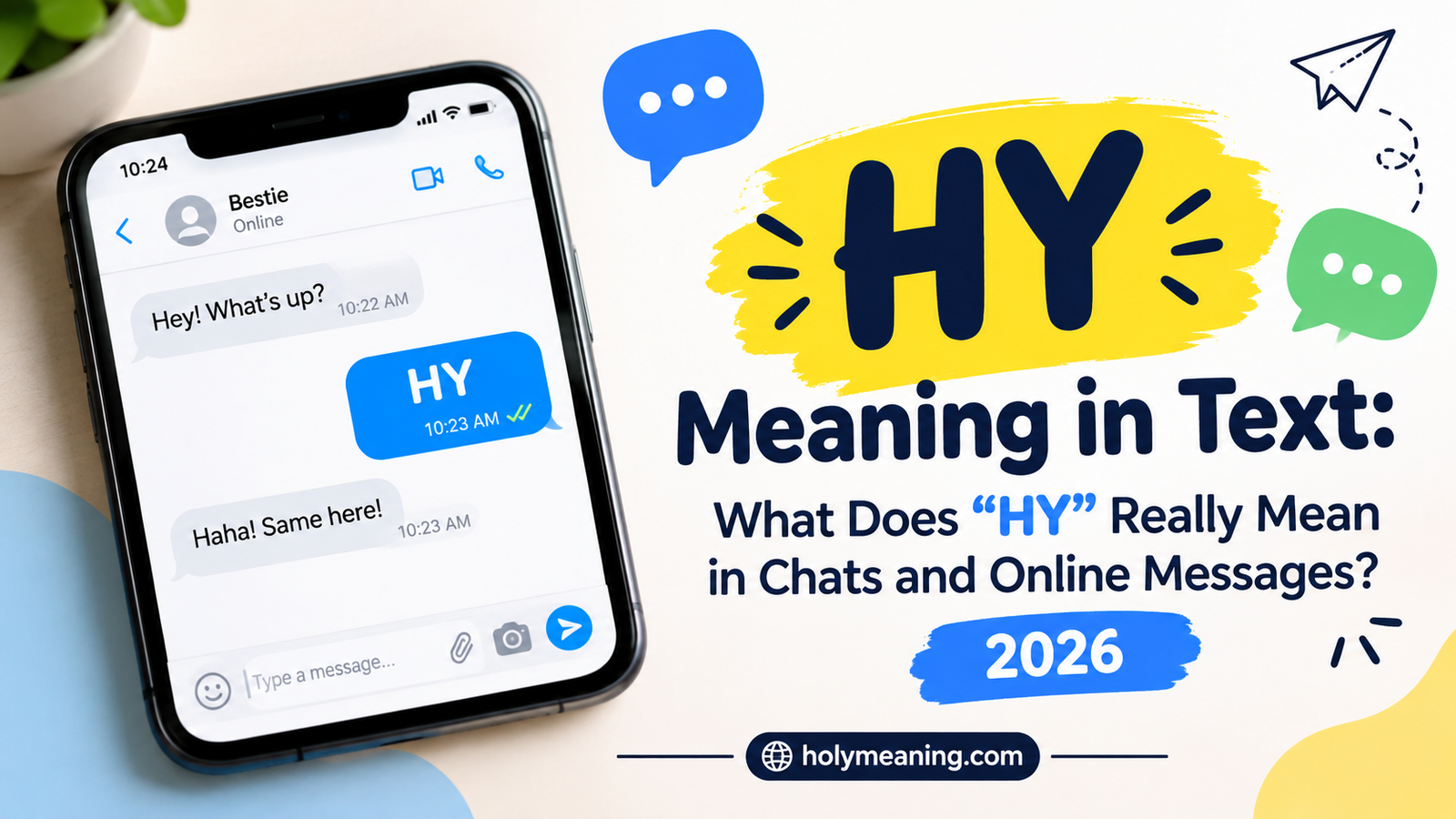
HY meaning in text comes down to two readings. It’s either a casual greeting, short for “hi” or “hey,” or an excited agreement, short for “hell yeah.” Context decides which one you’re holding.
Two letters. Two moods. One tiny message can leave you grinning or squinting at your screen. Guess wrong and the chat gets awkward fast.
Both meanings are older than most modern apps. Urban Dictionary logged them in 2005 and 2006. Today, HY still pops up on Snapchat, WhatsApp, and Instagram. Position and tone reveal the answer almost every time. Learn to read those clues and you’ll rarely misjudge a text again.
What Does HY Mean in Text Messages?
The meaning of HY splits into two main camps. One is a greeting. The other is enthusiastic agreement. A third, smaller reading (“hey you”) shows up in some guides.
Think of HY as a coin with two faces. Same metal. Different picture. You only see the face once it lands in a conversation.
HY as “Hi” or “Hey”
This is the greeting version of HY slang. The sender types HY instead of “hi” or “hey” to open a chat.
Linguists call this a phonetic respelling. The writer spells a word the way it sounds. “Hi” becomes “hy” in the same way “thanks” becomes “thx” or “you” becomes “u.” It isn’t an acronym at all.
The oldest evidence supports this reading. An Urban Dictionary entry from May 2006 describes HY as “the phonetic abbreviation of the commonly used greeting” “hi.” The same entry shows it in chatroom-style banter next to “lol.”
Modern guides agree that the greeting is common. Banteres says HY usually means “hi” or “hey” in fast messaging apps. Mean Vibe says the same and notes that the tone depends on context and emojis.
One detail deserves attention. “Hi” and “hy” both have two letters. The shortcut saves zero keystrokes. So the appeal is style. HY feels a bit looser and more playful than a plain “hi.”
HY as “Hell Yeah” or “Heck Yeah”
This is the enthusiasm version. It’s an acronym in the strict sense because each letter stands for a word: Hell Yeah.
The HY text meaning here is strong agreement. You’ll see it as a reply to plans, offers, and questions. Someone asks, “Want tacos tonight?” You answer, “HY.” That means you’re in.
This sense is old too. A February 2005 Urban Dictionary entry defines HY as “hell yea, hellz yea, heck yes” and calls it computer slang the author had seen a few times. The example is a short exchange about drawing a picture. One person answers “hy i did.”
Capitalize My Title leads with “hell yeah,” “hell yes,” or “heck yeah.” It calls the term an expression of enthusiasm, affirmation, and confirmation.
The Minor Reading: “Hey You” or “Hi You”
Some guides add a third reading. Thoughtgenic lists “Hi You” as a friendly greeting. Mean2You lists “Hey You.”
This version is really the greeting sense with an extra word. It feels more personal because it addresses the reader directly. In a flirty chat it can sound teasing. A message like “HY 😏” is a good example.
HY Meaning at a Glance
| Reading | Type | Where it appears | Typical feel |
|---|---|---|---|
| Hi / Hey | Phonetic respelling | First message in a chat | Casual, friendly |
| Hell yeah / Heck yeah | Acronym | Reply to a question or plan | Excited, agreeing |
| Hey you / Hi you | Greeting variant | Opener between people who know each other | Warm, sometimes playful |
How to Tell Which HY You Got
You can decode almost any HY with four quick checks. Run them in order.
- Look at position. Is it the first message of the day or thread? Lean toward “hi.”
- Look at what came before. Did you just ask a question or float an idea? Lean toward “hell yeah.”
- Read the punctuation. “HY!!” after your invitation screams agreement. “hyyy” on its own reads as a warm hello.
- Check the sender’s habits. Some people shorten everything. Others rarely do.
The message usage pattern is the strongest clue. A greeting starts a conversation. An agreement answers one.
| Clue | Points to “Hi/Hey” | Points to “Hell Yeah” |
|---|---|---|
| Position | Opens the thread | Follows your message |
| Your last message | None or old | A question, offer, or plan |
| Stretched letters (“hyyy”) | Common | Rare |
| ALL CAPS with “!!” | Sometimes | Common |
| Follow-up text | A question (“what are you up to?”) | Details (“what time?”) |
When the clues clash, don’t guess. Ask. A quick “Hey! Is that a yes for Saturday?” costs you five seconds. A wrong guess can cost you an awkward hour.
Where Did HY Come From? The Origin of This Slang Meaning
Every slang definition has a backstory. HY’s is hard to pin down. No linguist has traced it to one person, one forum, or one date. Anyone who tells you otherwise is guessing.
What exists is a paper trail. It’s short but useful.
What the Earliest Records Show
Urban Dictionary is a crowdsourced slang dictionary. Aaron Peckham founded it in 1999. By 2014 it held more than seven million definitions. That makes it a good record of how people actually write and talk online. It isn’t an official authority.
Its entries for HY show both senses in use early:
| Date | Entry | Meaning given |
|---|---|---|
| February 2005 | Computer slang shorthand | “Hell yeah” and variants |
| May 2006 | Chat-style greeting | Phonetic spelling of “hi” |
Two facts stand out. First, both meanings are more than two decades old. Second, neither one began with modern apps. Internet slang like this grew in chat rooms and forums long before TikTok existed.
The 2006 author also claimed the greeting sense was common in one particular online community. That’s a single contributor’s guess. It isn’t a proven origin.
Why the Confusion Never Went Away
Two meanings sharing one abbreviation is common in chat language. Nothing forced one meaning to win. A greeting and an agreement almost never appear in the same spot in a conversation. So both survive.
Think of it like the word “bark.” Nobody mixes up a dog’s bark with a tree’s bark. The sentence tells you. HY works the same way.
HY in Real Conversations: Texting Examples and Chat Examples
Rules are helpful. Real conversations are better. These chat examples show HY doing both jobs.
Texting Examples by Situation
| Message | Situation | Meaning | Good reply |
|---|---|---|---|
| “HY” | First text of the day | Hi / hey | “Hey! What’s up?” |
| “HY” | After “Pizza Friday?” | Hell yeah | “Great. 7 p.m.?” |
| “hyyy” | Friend checking in | Warm hello | “Hiii! How’s your week?” |
| “HY!!” | After your good news | Hell yeah (excited) | “Right? I’m still shocked!” |
| “HY 😏” | Flirty chat | Playful “hey you” | “Hey yourself.” |
| “HY, I’m Alex from the group project” | New contact introduces self | Hi | “Nice to meet you!” |
That last row comes from a pattern Mean Vibe describes. Group chats often use HY as a friendly opener with people you haven’t met.
Case Study: The Pool Party Mix-Up
This is an illustrative scenario based on a mix-up pattern that Legacy Stance describes. It isn’t a documented event.
Maya texts her group: “Pool party Saturday?” Jordan replies, “HY.” Jordan means “hell yeah.”
Maya reads it as a hello. She writes back, “Hey! Yes, pool party. Are you coming?” Jordan now feels confused. The conversation loops for three more messages before anyone clears it up.
The lesson: HY is fast but ambiguous. When the meaning matters, add a second word. “HY, count me in” ends the mystery.
Case Study: The Group Chat Opener
Another illustrative scenario.
Sam joins a new study group chat with eight strangers. Sam’s first message is “HY everyone.” Nobody wonders whether Sam is celebrating. The position (first message) and the audience (a whole group) both signal a greeting.
The lesson: When HY opens a chat aimed at several people, it’s almost surely a greeting.
Tone Variations: Same Letters, Different Energy
Small changes shift the mood:
- “hy” in lowercase feels relaxed.
- “HY” in caps feels louder and more urgent.
- “hyyy” feels warm and friendly.
- “HY!!!” feels thrilled.
- “hy.” with a period can feel flat or distant.
Tone is part of text communication. Letters alone carry only half the message.
Does HY Mean Something Different on Snapchat, TikTok, WhatsApp, or Instagram?
Plenty of guides promise a separate HY meaning for each social media platform. The evidence doesn’t back that up.
What the 2026 Guides Actually Say
Seven guides published in 2026 discuss HY. Their leading definitions don’t match:
| Guide | Published | Leads with |
|---|---|---|
| Thoughtgenic | Feb 2026 | Hell yes / hi you |
| Legacy Stance | Feb 2026 | Hey vs hell yeah (context decides) |
| Mean Vibe | Feb 2026 | Hey |
| Wordsmeans | Apr 2026 | Greeting or hell yes |
| Banteres | May 2026 | Hi / hey |
| Themeaninng | May 2026 | Hell yeah |
| Mean2You | Aug 2026 | Hell yeah / hey you |
Three lead with “hell yeah.” Two lead with a greeting. Two treat both as equals. The pattern points to one conclusion: no single sense dominates across the web.
Platform claims conflict as well. Themeaninng says HY on WhatsApp usually means “hell yeah.” Banteres says it means “hi” or “hey” across WhatsApp, Instagram, and Snapchat. Both can’t be the rule.
Case Study: Auditing the Urban Dictionary Claim
Mean2You says Urban Dictionary lists HY “mainly as Hell Yes.” Mean Vibe says Urban Dictionary defines it as a shortened “Hey.” Two guides, two opposite claims about the same source.
The source itself shows both. The 2005 entry gives “hell yea.” The 2006 entry gives “hi.” Neither guide is fully right.
The lesson: Check the original source before repeating a claim about it.
What This Means for Each App
| App | What you can say for certain |
|---|---|
| Snapchat | People use HY in quick chats. Meaning follows context. |
| TikTok | HY appears in comments and DMs. Same rule applies. |
| HY shows up in DMs and replies. Same rule applies. | |
| Used in personal and group chats. Same rule applies. | |
| SMS | Works the same as in the apps. |
The takeaway is simple. Treat HY the same way on every one of the social media apps. Read the position and the message before it.
Is HY Gen Z Slang or Something Older?
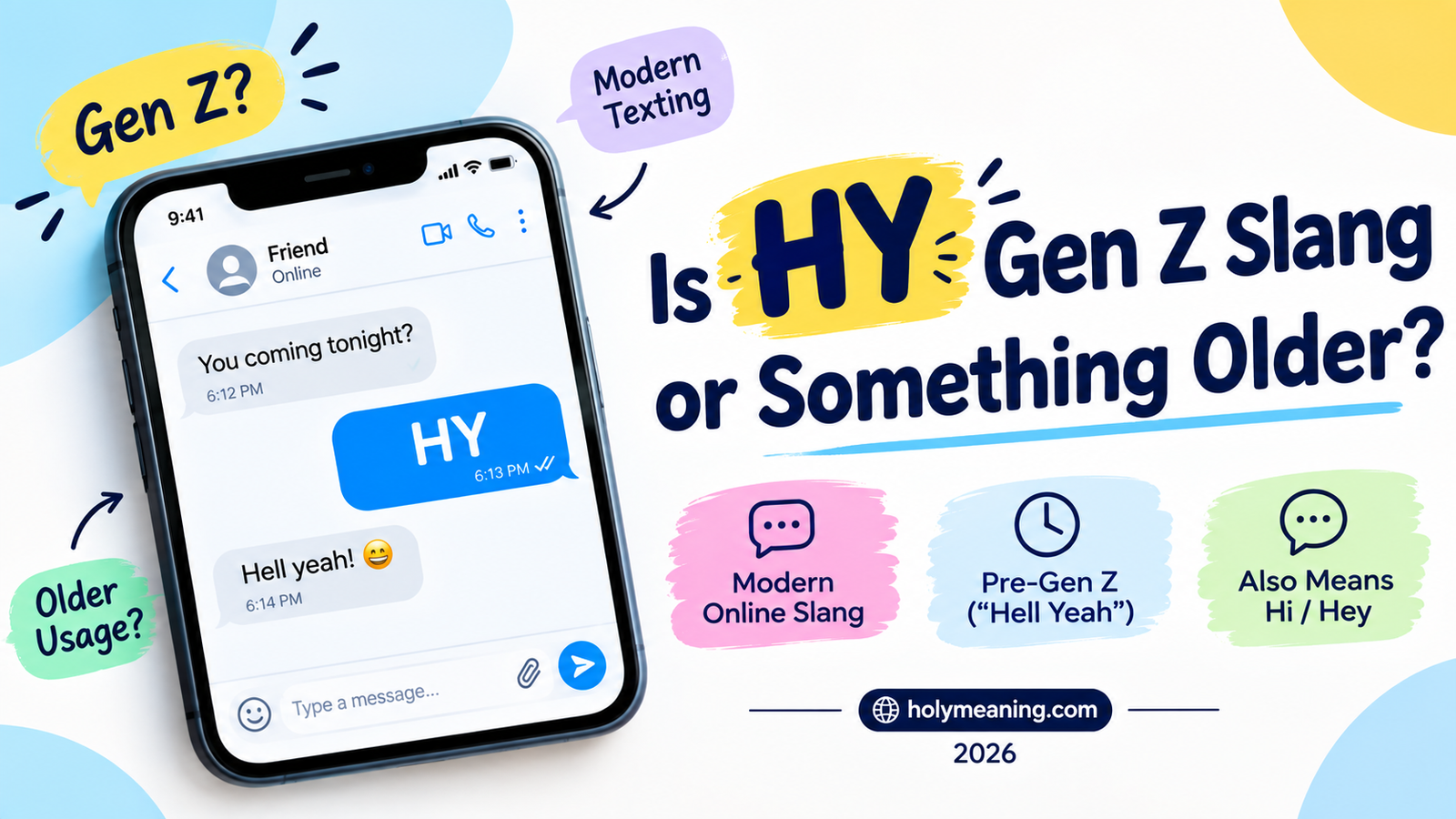
Many people file HY under Gen Z slang. The record says it’s older than that label suggests.
Pew Research Center defines Gen Z as people born from 1997 to 2012. The oldest Gen Z members were only eight years old when the first HY entry appeared in 2005. So HY didn’t start as Gen Z language. Earlier internet users created it.
Still, today’s youth slang keeps it alive. Younger users pick up modern slang from chats and apps and adapt it. That’s how digital slang works. Terms circulate across generations and get new life.
Why HY Fits Modern Messaging Culture
Three features make HY sticky:
- It’s short. Short slang fits fast chat.
- It’s flexible. One term covers two moods.
- It’s playful. HY sounds friendlier than a stiff “hello.”
Messaging culture rewards speed and tone. HY delivers both in two letters.
Is HY Still Used in 2026?
Yes. Seven separate guides published between February and August 2026 cover it. That’s a sign people still search for it and write about it. Search interest itself is best checked on Google Trends if you want live numbers.
HY as Two-Letter Slang: Why Tiny Abbreviations Work
Two-letter slang is a fascinating corner of internet shorthand. Think “ty” for thank you or “np” for no problem. HY belongs to that family.
How Two-Letter Abbreviations Get Made
Most two-letter abbreviations follow one of two paths:
| Path | How it works | Example |
|---|---|---|
| Initialism | First letters of words | HY = hell yeah |
| Respelling | Spelled by sound | HY = hi |
HY is unusual because it uses both paths at once. That’s why it feels tricky.
Why Short Forms Help Digital Language
Digital language evolved around small screens and fast thumbs. Short forms cut effort. They also signal friendship because they show you’re relaxed. Texting shortcuts like HY carry a social message too. They say, “We’re casual here.”
Text abbreviations also work as group signals. Knowing them shows you belong to a chat community. That’s part of chat culture.
How to Reply When Someone Sends You HY
A good reply matches the sender’s meaning and energy. Decode first. Then respond.
If HY Means “Hi” or “Hey”
Keep it warm and easy:
- “Hey! How’s your day going?”
- “Hi! What’s up?”
- “Heyyy, long time!”
If HY Means “Hell Yeah”
Lock in the plan with a detail:
- “Awesome. What time works?”
- “Same here! I’ll book it.”
- “Love it. Let’s do it.”
If You Can’t Tell
Ask one friendly question:
- “Hey! Is that a hello or a yes? 😄”
- “Wait, is that a yes for Saturday?”
Reply Cheat Sheet
| Sender’s likely meaning | Best reply style | Example |
|---|---|---|
| Greeting | Greet back and ask something | “Hey! How’ve you been?” |
| Agreement | Confirm and add a detail | “Great. 6 p.m. then.” |
| Flirty hello | Match the playful tone | “Hey yourself.” |
| Unclear | Ask a short question | “Is that a yes?” |
A short tip: match the length of their message. If they send two letters, don’t reply with three paragraphs.
Other Meanings of HY Outside Slang and Chat
Not every HY is texting slang. Outside chat, the letters point to very different things. This matters when you land on a page or document that isn’t about messaging.
Verified Non-Slang Uses
| Term | What it is | Source |
|---|---|---|
| HY Velorum | A binary star system | Wikipedia |
| HY-124798 | A chemical compound | Wikipedia |
| Hy-V | A flight experiment research project | Wikipedia |
| HY1935 bayonet | A Chinese infantry weapon | Wikipedia |
| hy- (prefix) | Connecting with the hyoid arch | Merriam-Webster |
None of these have anything to do with online interaction. If you see HY in a science paper or a product code, ignore the slang meanings entirely.
How to Know You’re Not Looking at Slang
Ask three questions:
- Is the text a casual chat?
- Is the message short and informal?
- Does it use lowercase or emoji?
Three “yes” answers mean slang. Otherwise, look for a technical meaning.
Lookalike Chat Abbreviations: HYD, HYS, and More
Several chat abbreviations share HY’s first letters. They’re easy to mix up.
| Abbreviation | Meaning | Note |
|---|---|---|
| HYD | How you doing | Common in casual chats (source) |
| HYS | How you sleep | Listed on Urban Dictionary |
| HYS | Have Your Say | A BBC-blog phrase, per Urban Dictionary |
| HRU | How are you | A standard check-in |
HYD deserves a special note. It’s a question. HY is usually a greeting or an answer. If someone sends “HYD,” respond with how you’re doing.
Message abbreviations like these keep evolving. New ones show up all the time. The best defense is a quick look at the surrounding chat.
Related Texting Slang You’ll See Beside HY
People often pair HY with other texting abbreviations:
- lol for laughing
- omg for surprise
- ty for thanks
- np for no problem
These often appear near HY in casual threads. Recognizing the neighbors helps you read the whole message.
Should You Use HY? Formal vs. Casual Message Usage
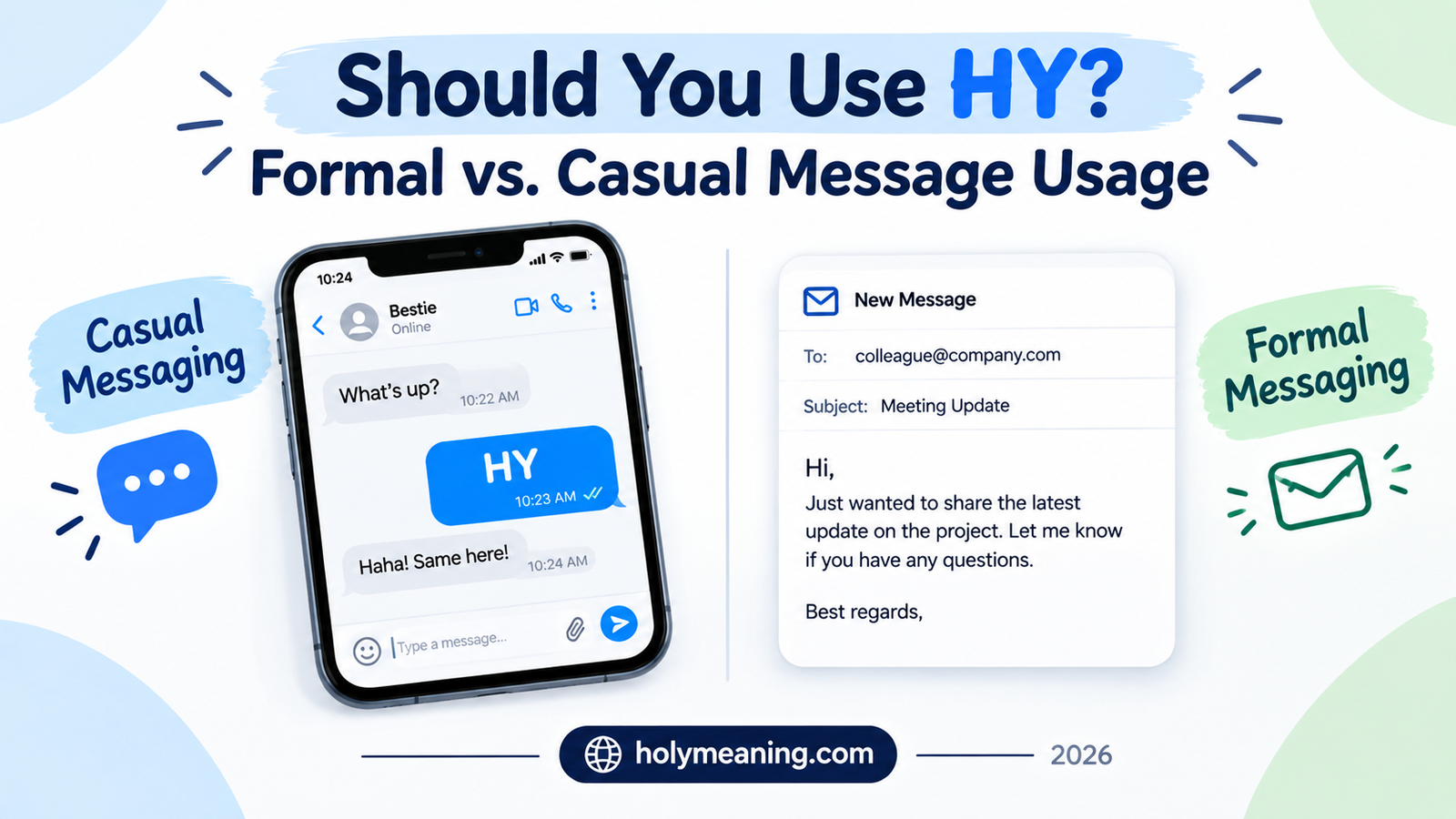
HY is informal language. It fits some places and not others.
Green Light Situations
Use HY when:
- You’re texting close friends.
- You’re chatting in a group with a relaxed tone.
- You’re replying to an invitation you love.
- You want a quick, friendly opener.
Red Light Situations
Skip HY when:
- You’re emailing a boss or client.
- You’re writing to a professor.
- You’re messaging someone you don’t know well.
- The topic is serious or formal.
Thoughtgenic says the same. It advises avoiding HY in formal emails and academic writing. Use “Hi” or “Hello” there.
A Simple Rule of Thumb
If you’d wear jeans to the conversation, HY is fine. If you’d wear a suit, type the full word. That rule covers most online texting decisions.
Tips for Decoding Internet Slang Like HY
Internet communication moves fast. New terms appear weekly. You don’t need to memorize them all. You need a method.
Five Habits That Work
- Read the message before it. Context solves most puzzles.
- Check the sender’s style. Someone who abbreviates everything uses shorthand often.
- Watch the emojis. A grin changes a message’s mood.
- Look up the term. A quick search of a slang meaning takes seconds.
- Ask when unsure. A friendly question beats a wrong guess.
Trust Primary Sources
Guides can be wrong. As the source audit above showed, two sites made opposite claims about Urban Dictionary. Whenever a guide cites a source, open the source. Compare the entries yourself.
Learn the Pattern, Not Just the Word
Most internet slang follows a few patterns:
| Pattern | Example | How it works |
|---|---|---|
| Initialism | HY (hell yeah) | First letters of words |
| Respelling | HY (hi) | Spelled by sound |
| Clipping | “def” (definitely) | Word shortened |
| Stretching | “hyyy” | Letters repeated for warmth |
Once you know these patterns, chat terminology gets much easier. You’ll decode new terms on sight.
FAQs
What does HY mean in text?
HY means “hi” or “hey” when it opens a chat. It means “hell yeah” when it answers a question or plan.
Is HY the same as “hi”?
Sometimes. HY can be a phonetic spelling of “hi,” but it can also stand for “hell yeah.” Check whether the message starts the conversation or replies to one.
Does HY mean something different on Snapchat, TikTok, or WhatsApp?
No platform has a separate documented meaning. The same two readings apply everywhere, and context tells you which one fits.
Is HY still used in 2026?
Yes. Several guides published between February and August 2026 still cover it, and Urban Dictionary entries for both meanings date back to 2005 and 2006.
Can I use HY in a work message?
Skip it. HY is informal slang, so use “Hi” or “Hello” with bosses, clients, and professors.
conclusion
Now you know the HY meaning in text. It has two main senses. One is a friendly “hi” or “hey.” The other is an excited “hell yeah.” Both have been around since 2005 and 2006.
Use context to decode it. Check where the message sits. Read the tone. Look at what came before. The HY meaning in text gets clear fast with these clues. Use it with friends. Skip it at work. When you’re unsure, just ask. A quick question beats a wrong guess every time.