FML stands for “F*** My Life,” a text slang acronym people use to express frustration, bad luck, or pure exasperation over something that’s gone sideways. It’s one of the most widely used abbreviations in casual texting today.
Picture this: your coffee spills seconds before an important call, autocorrect wrecks your text to your crush, or your Wi-Fi dies mid-episode. That familiar groan has a name now, and it’s three letters long.
This acronym actually traces back to a specific website that turned everyday disasters into internet gold, spreading FML from niche slang into a phrase practically everyone recognizes, texts casually, and somehow can’t stop using.
What Does FML Mean? (Quick Answer)
FML stands for “F* My Life.”** It’s a text slang acronym people use to express frustration, bad luck, or general exasperation about something that’s gone wrong.
Here’s the thing, though: despite the harsh-sounding FML definition, it’s rarely meant literally. Nobody typing FML after spilling coffee on their laptop is having an existential crisis. It’s closer to an exaggerated sigh in text form, a way of saying “ugh, why is this happening to me” without writing out a whole paragraph.
That’s the meaning of FML in a nutshell: a quick, punchy way to vent about bad luck, minor disasters, or life’s small (and occasionally big) annoyances. Think of it as digital shorthand for a groan.
Where FML Came From
Slang doesn’t appear out of nowhere. It usually has a starting point, a moment where it caught on, and a path that took it from niche to mainstream. FML’s story actually has all three.
The Phrase Before the Internet
The full phrase, “f*** my life,” existed in spoken English long before texting was even a thing. People muttered it under their breath after bad days for decades. It’s the kind of exasperated phrase you’d hear from a friend after they missed their bus or forgot an umbrella during a downpour.
What changed wasn’t the phrase itself. It was the format. Once texting and instant messaging took over daily communication, people needed shorter ways to say things they’d normally say out loud. The FML origin as an acronym is really just the natural next step for a phrase that already existed in everyday speech.
FMyLife.com and How It Popularized the Acronym
Here’s where things get interesting. While the phrase existed casually, the FML website origin traces back to a specific site: FMyLife.com, which launched in 2008 as a French site called “Vie de Merde” before an English version followed shortly after.
The concept was simple and, frankly, kind of brilliant. FMyLife.com let users submit short, real-life stories about embarrassing, frustrating, or downright unlucky moments. Each submission ended with the tagline “FML,” turning the acronym into a punchline as much as an expression of misery.
A typical post on FMyLife looked something like this:
“Today, I got fired from my job for stealing. I’ve worked there for three years and never stole a thing. I was fired because my manager saw a bag of chips in my hand and assumed I didn’t pay for it. I’ve been buying my lunch from the vending machine every day for three years. FML.”
These bite-sized user stories were relatable, funny in a painful sort of way, and easy to share. The site became a genuine online community built entirely around bad days and worse luck. At its peak, FMyLife.com pulled in millions of visitors a month, and the acronym spread far beyond the site itself.
This is the real answer to “where did FML come from,” and it’s a detail a lot of casual explanations skip entirely. The acronym didn’t just organically evolve online. It got a massive push from one specific platform built around life stories and shared misery.
How FML Jumped From a Website to Everyday Texting
Once FMyLife.com normalized the acronym, it didn’t take long for FML to escape the site and enter everyday texting abbreviation territory. Social media accelerated that spread even further. As Twitter (now X), Facebook, and later Instagram and TikTok grew, so did the appetite for quick, expressive slang that fit character limits and fast-paced conversation.
By the early 2010s, FML had fully detached from its website origins. People used it without ever knowing FMyLife.com existed. That’s usually the sign a piece of internet slang has truly made it: when the origin fades into the background and the phrase just becomes part of how people talk.
How to Use FML in a Sentence
Knowing the definition is one thing. Actually using FML naturally in casual texting is another. Here’s how it typically shows up in real messages.
| Situation | Sample FML Text |
|---|---|
| Missed the bus in the rain | “Ran two blocks and still missed it. FML.” |
| Sent an email to the wrong person | “Just replied-all to the whole company by accident. FML.” |
| Phone dies at 1% before an important call | “Of course my phone died right before he called. FML” |
| Forgot an assignment was due today | “It’s due in an hour and I haven’t started. FML” |
| Stepped in something gross | “Just stepped in dog poop in brand new shoes. FML lol” |
Notice the pattern? FML almost always comes at the end of the sentence, tacked on like a verbal shrug. It rarely opens a message and it’s almost never used mid-sentence. That placement is part of what makes it feel natural rather than forced.
It’s also worth noting the tone difference a simple “lol” or exclamation point makes. “FML” alone can read as flat frustration. “FML lol” softens it into something more self-deprecating and light. Context and punctuation do a lot of heavy lifting here.
Where You’ll See FML Used Today
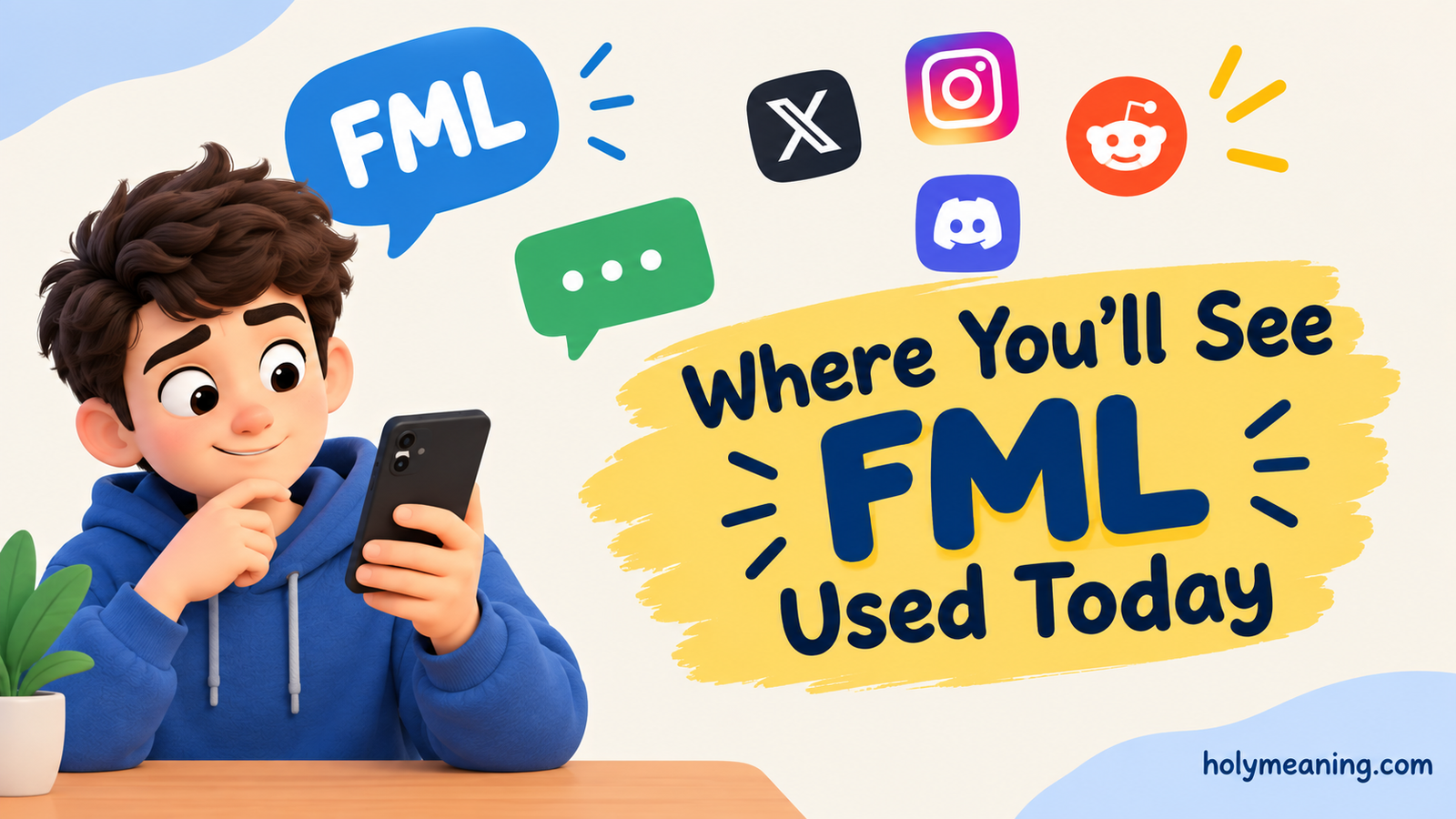
FML isn’t locked into one type of app or platform. It shows up across nearly every corner of FML social media and messaging, though the tone shifts slightly depending on where you’re reading it.
Texting and DMs
This is FML’s most natural home. Between friends, it’s used constantly and casually, almost like punctuation. A friend describing a rough commute, a bad grade, or an awkward run-in with an ex might end the story with a simple “FML” instead of writing out how they actually feel.
Twitter/X and Threads
On X, FML often gets paired with a longer rant or a screenshot of something absurd. Character limits used to make acronyms like this especially useful, and even though that constraint has loosened over the years, the habit stuck. You’ll also see it used ironically, tacked onto posts about objectively minor inconveniences for comedic effect.
TikTok and Instagram Comments
In comment sections, FML usually shows up as a quick reaction to relatable content. Someone posts a video about a disastrous first day at work, and the top comment might just be “FML I felt this in my soul.” It’s less about the commenter’s own life and more about secondhand embarrassment.
Reddit threads, especially ones built around storytelling (think r/tifu or similar communities), use FML constantly, both in post titles and comments. Given that FMyLife.com essentially pioneered this exact format of “share your worst moment,” it makes sense that Reddit’s storytelling culture leans on the same acronym so heavily.
Across all these social platforms, the core meaning stays consistent. What changes is the intensity. A text to a close friend might carry real frustration. A TikTok comment is almost always played for laughs.
FML vs. Similar Text Slang
FML doesn’t exist in a vacuum. It’s part of a whole family of texting slang that expresses frustration, disbelief, or exasperation. Here’s how it stacks up against some of the most common text slang people confuse it with.
| Acronym | Full Meaning | Tone | Example |
|---|---|---|---|
| FML | F*** My Life | Frustrated, self-deprecating, often exaggerated for effect | “Locked myself out again. FML.” |
| SMH | Shaking My Head | Disappointed, judgmental, sometimes about someone else’s actions | “He forgot her birthday again. SMH.” |
| FFS | For F***’s Sake | Sharp irritation, often more intense than FML | “FFS, not this again.” |
| WTF | What The F*** | Shock, confusion, disbelief | “WTF just happened in that meeting?” |
| YOLO | You Only Live Once | Reckless enthusiasm, justification for a spontaneous choice | “Booked the flight last minute, YOLO.” |
The clearest distinction worth remembering: FML is about your own bad luck, while SMH usually reacts to someone else’s behavior. FFS carries sharper anger, where FML leans more toward resigned frustration. WTF signals confusion or shock rather than frustration, and YOLO isn’t about frustration at all, it’s about justifying a bold or impulsive decision.
Mixing these up isn’t the end of the world, but using the right one makes your texting sound more natural and less like you’re guessing at slang you don’t fully understand.
Does FML Have Other Meanings?
Acronyms rarely belong to just one context, and FML is no exception. Outside of FML text slang, the letters pop up in a couple of other fields with completely unrelated meanings.
In medical and pharmaceutical shorthand, FML occasionally appears as an abbreviation tied to fluid measurement or medication labeling contexts, though this usage is field-specific and won’t come up in everyday conversation. If you see FML in a prescription note or clinical document, it almost certainly has nothing to do with the texting slang meaning.
In gaming and firearms contexts, some communities use FML as shorthand related to “Full Metal Jacket,” referencing ammunition type. This usage is niche and mostly confined to specific gaming or firearms forums, so it’s unlikely to cause confusion in a normal texting context, but it’s worth knowing it exists if you ever see FML used in a context that clearly has nothing to do with frustration.
For the overwhelming majority of everyday use, though, especially across texting, FML online meaning and the “f*** my life” definition are what people mean nearly every time.
Common Misunderstandings About FML
A few myths float around about how FML is supposed to be used. Clearing these up helps you use the slang acronym more naturally and avoid awkward misreads.
Is FML Always Serious?
Not even close. This might be the biggest misconception out there. While the literal phrase sounds dramatic, the actual FML slang meaning in practice is almost always lighthearted. People use it for genuinely minor inconveniences, burnt toast, a stubbed toe, an autocorrect fail, far more often than for anything resembling a real crisis.
If someone is dealing with a genuine emergency or serious mental health struggle, FML is almost never the phrase they reach for. It’s simply too casual and too tied to comedic self-pity to fit that kind of moment.
Is FML Only Negative?
Sort of, but with a twist. FML is technically a negative expression, but it’s often used with a sense of humor that undercuts the negativity. Saying “FML” after a funny mishap isn’t really complaining. It’s closer to laughing at your own bad luck. The tone reads as self-aware rather than genuinely upset in most casual conversations.
How to Respond When Someone Texts You FML
This part trips people up more than you’d expect. Someone sends you “ugh my presentation got moved up an hour, FML,” and you’re not totally sure how much sympathy the moment actually calls for.
Here’s a simple way to think about it: match their energy, don’t escalate it.
A few solid response options:
- Light acknowledgment: “Oof, that’s rough. You got this though.”
- Humor match: “FML energy is valid today apparently.”
- Practical support: “Want me to help you run through it real quick?”
- Simple validation: “That sucks. Hope the rest of your day gets better.”
What you generally want to avoid is treating a casual FML text like a cry for help. Responding with something overly heavy, like immediately asking “are you okay? do you want to talk about your feelings?” can feel mismatched and even a little awkward when the person just meant “this is mildly annoying.”
That said, context always wins. If the message reads as genuinely distressed, if it’s paired with more serious language, unusual silence afterward, or a pattern of increasingly heavy messages, take that seriously and check in properly. Slang doesn’t override the actual tone of a conversation.
Is FML Appropriate to Use? (Context Matters)
Like most informal language, FML works great in some settings and falls flat, or looks unprofessional, in others.
Good contexts for FML:
- Texting close friends or family
- Casual social media captions and comments
- Group chats
- Informal Reddit or forum posts
Contexts where FML doesn’t fit:
- Professional emails or work Slack messages
- Messages to teachers, professors, or anyone in an authority role
- Formal written communication
- Conversations with people who might not know the acronym (older relatives, new coworkers, non-native English speakers unfamiliar with slang)
There’s also an age and audience layer worth considering. FML skews toward younger, internet-fluent audiences. Someone unfamiliar with texting culture might genuinely misread it as a literal, alarming statement rather than casual venting. When in doubt, especially in mixed-age group chats, a quick clarifying tone (like adding “lol” or an emoji) prevents any confusion.
FML in 2026: How the Meaning Has Shifted
Slang evolves, and FML is a good example of how a phrase can drift from earnest use into something more ironic over time.
In its earlier years, especially during the height of FMyLife.com’s popularity, FML carried more genuine frustration. People were submitting real stories about real bad days, and the acronym reflected actual annoyance, even if exaggerated for entertainment.
By 2026, FML sits much more comfortably in ironic and humorous territory. It’s less about expressing real distress and more about performing exasperation for comedic effect, especially on TikTok and Instagram, where captions lean heavily into self-deprecating humor as a content style. Videos captioned “FML” about mundane, almost pleasant inconveniences (like getting extra whipped cream you didn’t ask for) show just how far the phrase has drifted from literal meaning.
There’s also a noticeable generational usage gap. Gen Z tends to use FML almost exclusively ironically, often stacking it with other slang or emojis for comedic layering. Millennials, who were more likely to have used the term during FMyLife.com’s peak years, sometimes use it with a touch more genuine exasperation, closer to its original tone.
This kind of shift is common across internet culture. Acronyms rarely stay static. They soften, sharpen, or flip tone entirely depending on which generation adopts them and how online conversations evolve around them. FML’s journey from a website’s tagline to a nearly universal messaging slang term, and now to an ironic modern slang staple, says a lot about how quickly digital communication trends move.
FAQs
What does FML mean in a text?
FML stands for “F*** My Life,” a slang acronym used to express frustration or bad luck. People use it casually, and it rarely reflects anything serious.
Is FML still commonly used in 2026?
Yes, it’s still widely used across texting, TikTok, and Instagram, though it now leans more ironic and humorous than genuinely upset.
Where did the term FML originate?
It traces back to FMyLife.com, a site launched in 2008 where users shared short, unlucky, or embarrassing stories ending in “FML.”
Is it okay to use FML in professional messages?
No, it’s too casual for work emails or formal chats. Save it for texts, DMs, and informal social media posts instead.
What’s the difference between FML and FFS?
FML expresses resigned frustration about your own bad luck, while FFS (“for f***’s sake”) conveys sharper, more intense irritation.
conclusion
So, what does FML mean in text? It’s simple, really. Three letters that capture a bad moment, a rough day, or pure bad luck, all without needing a long explanation. Now you know exactly where it came from and how people use it today.
Next time someone asks what does FML mean in text, you’ll have the full picture. It’s casual, it’s relatable, and it’s not going anywhere soon. Use it with friends, skip it at work, and enjoy knowing the story behind those three simple letters.