Ion meaning in text refers to the casual, phonetic contraction of “I don’t,” a piece of modern texting slang rooted in African American Vernacular English. Typed lowercase, it replaces the full phrase in everyday real conversations across group chats and social apps.
Here’s the twist most people miss: capitalize it, and “ION” flips into something completely different — “in other news.” Same three letters, two entirely separate meanings, and one tiny word quietly running through millions of texts every single day.
Beyond the basic definition, understanding ion in text unlocks a whole layer of Gen Z texting culture, from common mistakes newcomers make to the similar slang it travels alongside. Once it clicks, you’ll spot it everywhere.
What Does “Ion” Mean in Text? (Short Answer)
Here’s the ion meaning in one sentence: “ion” is a casual, phonetic contraction of “I don’t.”
That’s it. That’s the ion meaning slang in a nutshell. So when someone types “ion like that,” they mean “I don’t like that.” When they say “ion think so,” they mean “I don’t think so.”
There’s a second layer to this, though, and it trips people up constantly. Written in all caps, ION can also stand for “In Other News.” Same three letters, completely different job. We’ll unpack that distinction in a bit, but here’s the quick version:
| Form | Meaning | Example |
|---|---|---|
| ion (lowercase) | “I don’t” | “ion feel like cooking tonight” |
| ION (all caps) | “In other news” | “ION did y’all see the game last night?” |
Context does most of the heavy lifting here. If the sentence reads like a topic change, it’s probably the “in other news” version. If it reads like a denial or refusal, it’s the “I don’t” version. Once you spot the pattern, it clicks fast.
ALSO READ:https://holymeaning.com/wtv-meaning-in-text/
Where “Ion” Came From
Slang doesn’t appear out of nowhere, and ion is no exception. Its roots trace directly back to African American Vernacular English, often shortened to AAVE — a dialect with its own grammar, rhythm, and pronunciation patterns that has shaped a huge chunk of modern American slang.
In spoken AAVE, “I don’t” naturally contracts. Say it out loud fast: “I don’t” starts to blur into something closer to “i-on” or “eye-on.” That’s not sloppy speech — it’s a legitimate feature of language variation, the same way “gonna” comes from “going to” or “y’all” comes from “you all.” Linguists have documented these kinds of contractions in Black English for decades; they’re systematic, not random.
So how did a spoken sound turn into typed text? Simple: people started spelling words the way they sound rather than the way formal grammar says they should look. This happens constantly in digital communication — think “prolly” for “probably” or “finna” for “fixing to.” The written form follows the spoken speech patterns, not a dictionary.
Here’s a rough timeline of how it spread:
- Spoken origin — “I don’t” contracts naturally in AAVE speech.
- Early digital spread — the phonetic spelling “ion” starts showing up in texts and early social media captions, largely within Black online communities.
- Platform amplification — Twitter (now X), and later TikTok and Instagram, expose the term to a much wider audience through captions, replies, and comment sections.
- Mainstream crossover — by the early 2020s, “ion” becomes standard Gen Z texting vocabulary well beyond its original communities.
That last step matters. A huge amount of what people now call internet slang or general online slang actually has roots in AAVE. Understanding that origin isn’t just trivia — it’s the difference between using a term casually and understanding why it exists in the first place.
Worth remembering: slang terms that cross over into mainstream use don’t lose their origin. Knowing where “ion” comes from adds context to how, when, and around whom it’s typically used.
Why This Matters for Understanding Slang in General
It’s tempting to treat every new texting abbreviation as a random invention of the internet age, but most of them aren’t. Linguists who study language variation point out that contractions like this follow real phonological rules — sounds drop or blend in predictable ways based on how fast people naturally talk. “I don’t” isn’t butchered into “ion” by accident; it follows the same kind of vowel-blending pattern you’d find in plenty of other established contractions across English dialects.
This is part of a bigger, ongoing pattern in digital communication: spoken dialects influence written slang far more than most people realize. A large share of what gets casually labeled “internet slang” — including terms like “finna,” “bussin,” and “cap” — comes from the same linguistic tradition. Treating AAVE-rooted vocabulary as throwaway “text speak” misses that it’s a structured dialect with its own consistent grammar, not a random shortcut invented for texting.
“Ion” vs. “ION”: Two Different Slang Terms, Same Letters
This is probably the single biggest source of slang confusion around this term, so let’s settle it clearly.
Because English capitalization habits on phones are inconsistent — some people never capitalize anything, others capitalize everything, autocorrect does its own thing — you genuinely can’t rely on capitalization alone to tell these two apart. But here’s what each one means when it’s intentional:
| Feature | ion (I don’t) | ION (In other news) |
|---|---|---|
| Meaning | Negation / refusal | Topic transition |
| Typical position | Start of a clause, before a verb | Start of a sentence, before a new topic |
| Common examples | “ion care,” “ion know,” “ion mind” | “ION this movie was actually good,” “ION I got a new job” |
| Origin | AAVE phonetic contraction | Abbreviation of a common English phrase |
| Tone | Casual, dismissive, or matter-of-fact | Casual, conversational, topic-shifting |
The ION abbreviation for “in other news” works basically the same way people use “anyway” or “by the way” to redirect a conversation. It’s a news transition phrase repurposed for casual chat — a way to signal “I’m switching gears here” without writing a full sentence to explain it.
The “I don’t” version, on the other hand, is functioning as a straightforward texting abbreviation for negation.
Quick test: read the sentence and ask whether it makes more sense as a denial or as a subject change. “ion like Mondays” only makes sense one way — negation. “ION did you see that email” only makes sense the other way — topic change. Context resolves the ambiguity almost instantly, which is exactly why native users rarely get confused even without capitalization cues.
How to Use “Ion” in a Sentence
Let’s get into real text messages and how this actually shows up in conversation examples. The pattern is consistent: “ion” slides into the exact spot “I don’t” would normally occupy.
Here are some natural, everyday examples:
- “ion know what to order, you pick.” (I don’t know what to order, you pick.)
- “ion think that’s a good idea tbh.” (I don’t think that’s a good idea, to be honest.)
- “ion care either way, whatever works.” (I don’t care either way, whatever works.)
- “ion feel like going out tonight.” (I don’t feel like going out tonight.)
- “ion mind, do whatever you want.” (I don’t mind, do whatever you want.)
- “ion trust that guy.” (I don’t trust that guy.)
Notice the pattern? It always sits before a verb, doing exactly what “I don’t” would do in standard English. You won’t typically see it mid-sentence or at the end — that would break the rhythm that makes it work as a fast, spoken-style contraction in the first place.
This is one detail a lot of guides skip, and it matters: ion usage almost always opens a clause. If you see “ion” appearing somewhere else in a sentence, it might not be this slang term at all — it could be someone’s username, a typo, or, rarely, an actual reference to the chemistry term.
A Small Case Study: Spotting It in the Wild
Picture a group chat between four friends planning a weekend:
Maya: anyone tryna go hiking Saturday? Jordan: ion have the energy for that lol Sam: ION we should just do brunch instead Maya: brunch > hiking any day
Read that exchange closely and you’ll see both versions in one conversation. Jordan’s “ion” means “I don’t [have the energy]” — a refusal. Sam’s “ION” means “in other news” — a pivot to a new suggestion. Neither friend paused to explain which one they meant. The online shorthand did the work on its own, because the context made it obvious.
That’s the real test of whether slang has “made it”: when people stop noticing they’re using it.
More Real Text Messages, Broken Down
Seeing a handful of isolated examples helps, but seeing them in fuller conversation examples helps even more. Here’s a longer exchange that mixes both meanings along with some other common texting abbreviations, the way an actual thread might look:
Dana: did you finish the group project slides yet Priya: ion even know where to start tbh Dana: lol same, ngl I forgot about it until now Priya: ION we should just split it 50/50 and knock it out tonight Dana: bet, call me in ten
Breaking that down: Priya’s first message uses “ion” as “I don’t [know]” — straightforward negation. Her second message flips to the capitalized “ION,” pivoting the conversation toward a plan. Dana never once asks what either word means, because native speakers of this kind of online shorthand process it automatically, the same way you’d process “gonna” or “kinda” without a second thought.
This is also a good example of how ion in text rarely shows up alone. It tends to travel with other pieces of internet abbreviations — “tbh,” “ngl,” “bet” — stacked together in a way that would look dense to an outsider but reads completely naturally to anyone fluent in modern texting.
ALSO READ:https://holymeaning.com/dih-meaning/
Ion vs. Similar Slang (IDK, IDC, Nah)
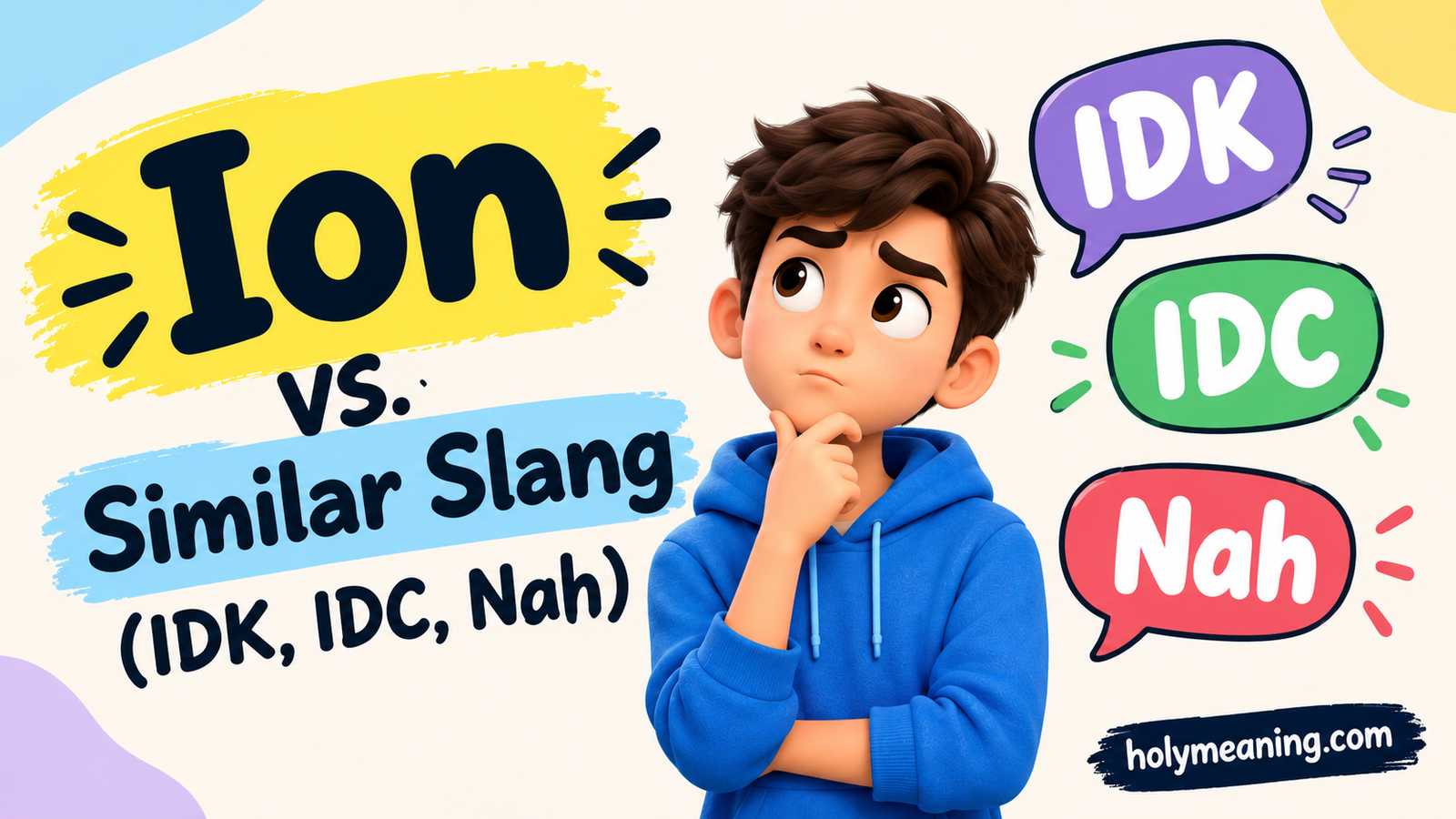
Texting is full of shorthand for saying “no” or “I don’t know” in some form, and it helps to know how “ion” actually differs from its closest relatives. This is a section a lot of competing guides skip entirely, but it’s one of the more useful comparisons you can make.
| Slang | Full Meaning | Flexibility | Example |
|---|---|---|---|
| ion | I don’t | High — works before almost any verb | “ion want to” |
| idk | I don’t know | Low — specific to not knowing something | “idk what time we’re leaving” |
| idc | I don’t care | Low — specific to indifference | “idc what we watch” |
| nah | No | Medium — general refusal, not a full contraction | “nah, I’m good” |
The key difference: idk and idc are locked to specific meanings. “Idk” only ever means “I don’t know.” “Idc” only ever means “I don’t care.” Ion, by contrast, is a flexible stand-in for “I don’t” that works in front of any verb — “ion want,” “ion trust,” “ion agree,” “ion feel like it.” That flexibility is a big part of why it caught on so widely as texting slang. One short word does the job of several different phrases, depending on what follows it.
If you’re trying to remember the distinction: idk and idc are complete phrases shortened into letters. Ion is a live, reusable building block you attach to whatever verb you need.
Where You’ll See It (Platform Notes)
You’ll run into this term across pretty much every major social media platform and messaging app, but a few spots stand out:
- TikTok — extremely common in captions and comment sections, often paired with the “in other news” meaning to introduce a random thought mid-video.
- X (formerly Twitter) — one of the earliest mainstream homes for the term, still widely used in replies and quote-tweets.
- Instagram — shows up constantly in comments and captions, especially among younger users.
- Group texts and DMs — this is where the “I don’t” version is most common, since it’s replacing everyday spoken phrases in casual back-and-forth chat.
There isn’t a dramatic difference in meaning from platform to platform — ion texting works the same whether you’re on Snapchat or in an iMessage thread. What changes is frequency and audience. It’s heavily tied to Gen Z texting habits and youth language more broadly, so you’re far more likely to encounter it in spaces where younger users dominate the conversation.
Why It Spreads So Fast Through Social Platforms
Social media rewards brevity. Character limits, fast scrolling, and short attention spans all push online communities toward compressed language, and “ion” fits that environment perfectly — it does the job of two full words in three letters. That efficiency is a big part of why it moved from spoken AAVE into social platforms so quickly once digital communication took over as the primary way younger users talk to each other.
There’s also a network effect at play. Slang spreads fastest through repetition inside trusted circles — friend groups, comment sections, reply threads — before it crosses over into wider internet culture. Once a term shows up often enough in captions and comments, newer users pick it up simply through exposure, without ever needing an explicit definition. That’s exactly how “ion” went from a regional speech pattern to a term recognized across online communities nationwide, and increasingly, internationally.
Is It Rude or Unprofessional?
Short answer: it’s not rude, but it is unprofessional.
Among friends, in group chats, or on social platforms, “ion” reads as completely normal — it’s just casual communication, no different from saying “gonna” instead of “going to.” Nobody’s going to be offended by it.
Where it doesn’t belong: work emails, school assignments, formal messages to someone you don’t know well, or any situation where you’d normally reach for complete sentences and proper grammar. Using “ion” in a professional Slack message or a cover letter would come across the same way as texting your boss “wyd” — it signals a level of informality that clashes with the setting.
There’s also a tone consideration worth flagging. Because “ion” often carries a flat, matter-of-fact energy, it can come across as dismissive in a serious or emotional conversation. “ion care” lands very differently in a lighthearted joke than it does in the middle of an argument. The words are the same; the context changes everything.
Quick guideline:
- ✅ Group chats, close friends, casual social posts
- ✅ Comment sections, meme captions, light banter
- ❌ Work emails, school papers, formal messages
- ❌ Serious or emotionally heavy conversations, where it can sound dismissive
How to Reply When Someone Texts You “Ion…”
This part is simpler than people expect. You don’t need to match someone’s slang to respond naturally — plain English works perfectly fine as a reply.
If your friend texts “ion know what to do tonight,” you can just respond normally: “Let’s just grab food and figure it out.” No need to force “ion” into your own reply if it’s not how you naturally text.
If you’re genuinely unsure which meaning was intended — the “I don’t” version or the “in other news” version — it’s completely fine to ask. Something like “wait, you don’t want to go, or you’re changing the subject?” isn’t awkward or embarrassing. Slang confusion happens to everyone, and asking for clarification is a lot more natural than guessing wrong and responding to the wrong thing entirely.
A few practical reply tips:
- Match the tone, not necessarily the vocabulary. You can stay casual without copying the exact abbreviation.
- If the message is ambiguous, ask a quick clarifying question rather than assuming.
- Don’t overthink it — in the vast majority of cases, context alone tells you which meaning applies.
Common Mistakes With “Ion”
Even though the ion definition itself is simple, a few usage errors and texting mistakes show up often enough to be worth flagging.
Capitalization mistakes. As covered earlier, capitalization isn’t a reliable signal on its own, since most people don’t type consistently on mobile keyboards. Relying purely on uppercase versus lowercase to determine meaning is one of the more common common errors — context should always be the deciding factor, not casing.
Confusing it with the chemistry term. This one’s rare among people already familiar with internet abbreviations, but it does happen, especially to anyone encountering the slang for the first time. If a sentence about atoms and electrons doesn’t make sense, and the sentence is clearly about opinions, plans, or feelings, it’s the slang usage — not the science term.
Using it in the wrong setting. Dropping “ion” into a professional email or a formal message is one of the more noticeable texting mistakes people make once a piece of informal expressions slang becomes part of their everyday modern texting habits. It’s easy to forget which register you’re writing in when a term feels this natural.
Mid-sentence placement. Because “ion” functions as a stand-in for “I don’t,” placing it anywhere except right before a verb tends to read as unnatural or confusing to fluent users. Stick to the pattern: subject position, right before the verb it’s negating.
Assuming it’s brand-new slang. It’s easy to treat terms like this as a fresh 2026 invention, but as covered earlier, its roots go back through years of AAVE speech patterns. Treating it as disconnected from that origin misses part of the picture.
ALSO READ:https://holymeaning.com/ssa-meaning/
Related Slang You Should Know
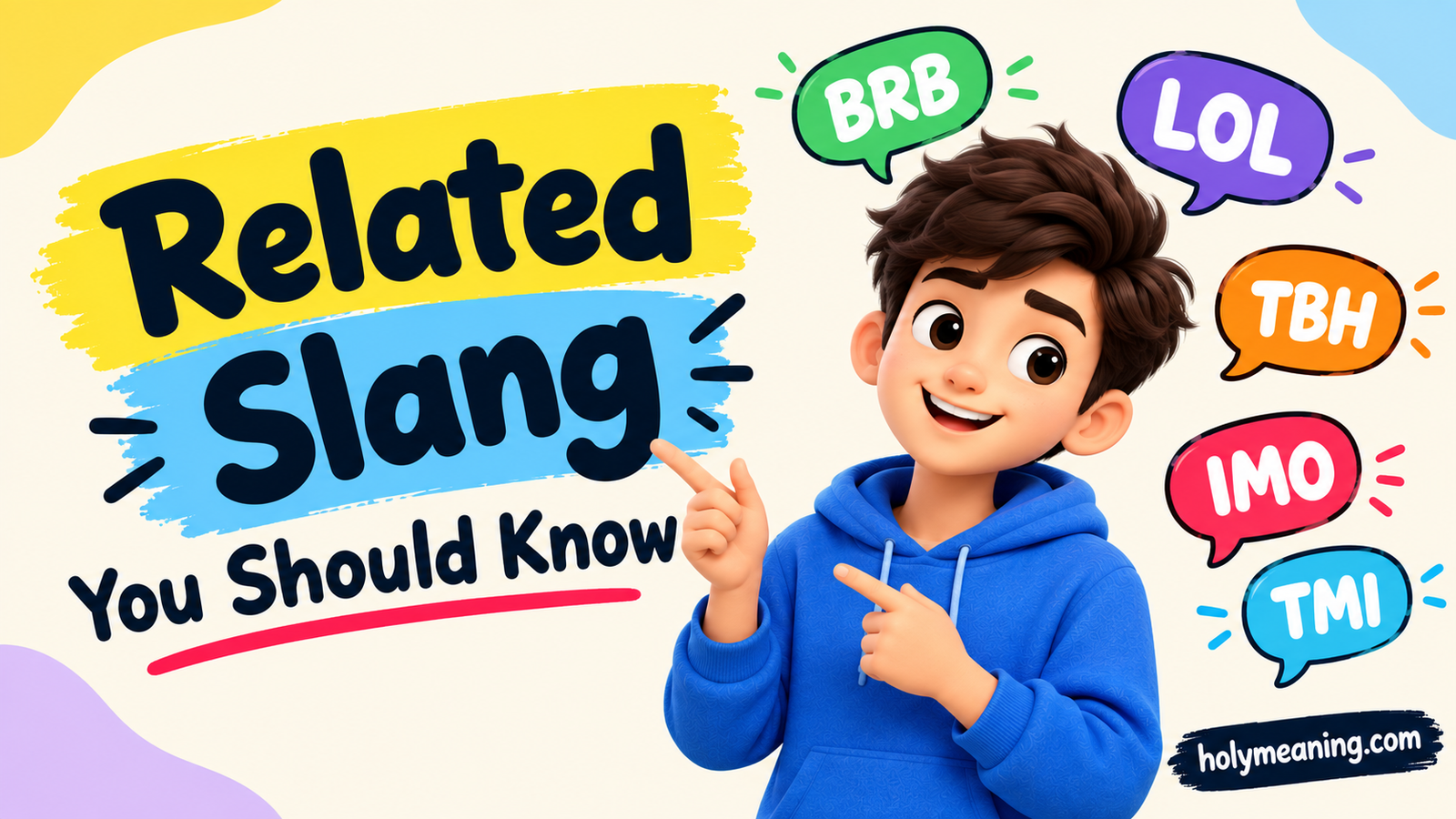
Ion doesn’t exist in isolation — it’s part of a much broader ecosystem of slang terms and chat abbreviation patterns that share similar roots or serve similar purposes. Here’s a quick reference table of related slang worth knowing if you’re trying to keep up with modern texting:
| Term | Meaning | Notes |
|---|---|---|
| idk | I don’t know | Specific, not flexible like “ion” |
| idc | I don’t care | Specific to indifference |
| finna | Going to / about to | Also rooted in AAVE |
| tbh | To be honest | Common conversational filler |
| ngl | Not gonna lie | Signals honesty or admission |
| fr | For real | Emphasis or agreement |
| lowkey / highkey | Somewhat / definitely | Degree modifiers |
| bet | Okay / agreed | Confirmation, agreement |
Recognizing these together helps you read casual texts more fluently overall, rather than decoding one term at a time. A lot of digital slang shares the same underlying pattern: take a common spoken phrase, compress it, and spell it the way it sounds when said quickly.
FAQs
What does “ion” mean in text?
“Ion” is casual slang for “I don’t,” used to quickly express refusal, disagreement, or negation in everyday texting.
Does “ION” always mean “I don’t”?
No — capitalized “ION” usually means “in other news” and signals a topic change, while lowercase “ion” means “I don’t.”
Where did the slang “ion” come from?
It originated from African American Vernacular English, where “I don’t” naturally contracts into a fast, one-syllable sound.
Is it okay to use “ion” in professional messages?
No, it’s strictly casual slang best kept to texts, DMs, and social media — avoid it in emails, school work, or formal writing.
Is “ion” only used by Gen Z?
It’s most common among Gen Z texting habits, but millennials active on the same platforms use it too, making it widespread across younger online communities in 2026.
conclusion
The ion meaning in text really comes down to one simple idea. It’s a quick, casual way to say “I don’t.” Capitalized, it shifts to “in other news.” Context always makes the difference clear. Once you know this, texts stop feeling confusing.
Knowing the ion meaning in text helps you read messages faster and reply with confidence. It’s casual, friendly, and everywhere online. Just keep it out of formal writing. Use it with friends, and you’ll fit right into modern texting culture.