Tried and true describes something tested repeatedly and proven reliable — not through hype, but through actual results over time. It’s the difference between a promise and a track record.
Some things earn trust the slow way: a recipe passed down three generations, a pair of boots that’s survived a decade of trails, advice that keeps working no matter who follows it. That’s the quiet power behind this phrase.
This guide breaks down where tried and true meaning comes from, how to punctuate it correctly, when it works as high praise, and when it can backfire. You’ll walk away using it with total confidence.
What Does “Tried and True” Mean?
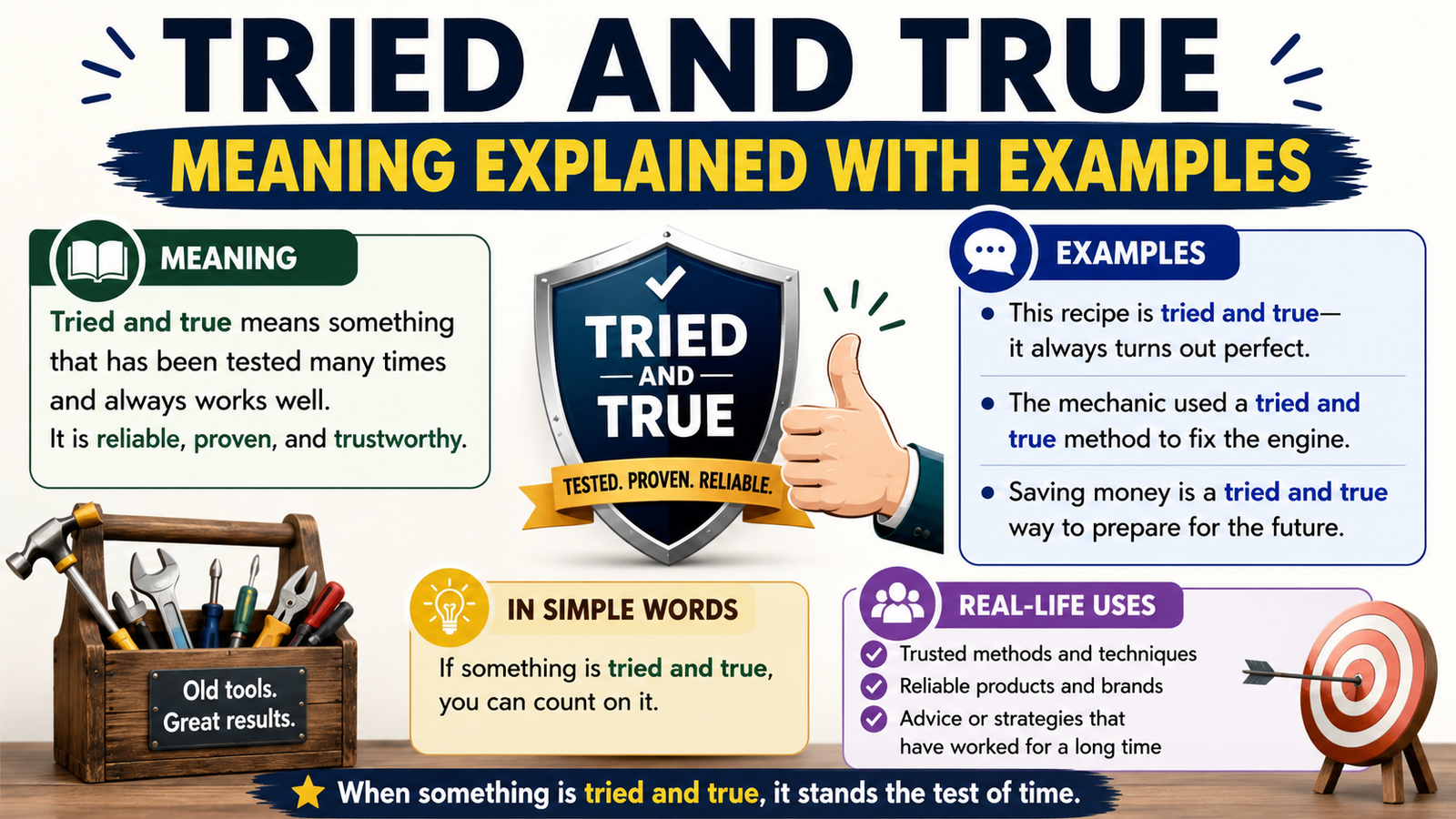
At its heart, the meaning of tried and true boils down to one idea: something has earned trust through actual use, not through marketing spin or wishful thinking. You don’t call something tried and true because it might work. You call it that because it already has, over and over, in front of witnesses.
Simple Definition
The tried and true definition most dictionaries settle on is something like this: adjective phrase describing a person, method, product, or idea that has been tested over time and consistently found to be dependable. It’s the linguistic equivalent of a thumbs-up backed by a track record.
Here’s a plain-English way to think about it: if “new and exciting” is a promise, tried and true is a receipt.
Part of Speech, Pronunciation, and Word Origin at a Glance
| Feature | Detail |
|---|---|
| Part of speech | Adjective phrase (functions as a compound adjective before a noun) |
| Pronunciation | /tried and trueː/ |
| Origin | Middle English roots — “tried” from tryen (to test), “true” from trewe (faithful, accurate) |
| Word form | Fixed idiom — words rarely swapped or reordered |
| Register | Neutral to slightly informal; common in speech and writing alike |
Notice that both halves of the phrase pull their own weight. “Tried” points to the testing process. “True” points to the outcome — accuracy, faithfulness, reliability. Together, they form a phrase that’s more convincing than either word alone.
Where Does “Tried and True” Come From?
Every idiom has a backstory, and this one’s is rooted in some genuinely old English.
Origin: The Original Sense of “Tested and Proven”
The tried and true origin connects to two separate word histories that eventually merged into a single expression. “Tried” comes from the verb try, which in earlier English carried a stronger sense of testing, sifting, or separating the genuine from the fake — think of trying metal by fire to separate pure gold from impurities. “True,” meanwhile, descends from Old English trēowe, meaning faithful, loyal, or accurate.
Put those two ideas together, and you get a phrase that literally means “tested and found to be genuine.” That’s not just poetic — it’s practically the dictionary definition still in use today.
First Recorded Use
Pinning down the exact first recorded use of “tried and true” is tricky, since idioms tend to circulate in speech long before anyone writes them down. What linguists and dictionary editors generally agree on is that the phrase was well-established in English by the 18th and 19th centuries, appearing in literature, sermons, and everyday writing as a way to praise something’s reliability. Collins English Dictionary lists it alongside close cousins like “tried and tested” and “tried and trusted,” which suggests all three phrases developed as variations on the same theme around a similar period.
If you want the deepest dive on documented usage, Etymonline and the Oxford English Dictionary are the best starting points — both track word history with citations you can actually check.
How the Meaning Evolved Over Time
Early uses of the phrase leaned heavily on the testing half of the meaning — something had literally been put through trials. Over the centuries, as English speakers used it more loosely, the phrase softened into a general stamp of approval. Today, you’ll hear it applied to everything from a recipe your aunt has made for thirty years to a software framework developers trust because it hasn’t broken in a decade.
This is a common pattern in word history: a phrase starts specific and technical, then broadens until it becomes a flexible, everyday compliment.
Is “Tried and True” an Idiom?
Yes — and understanding why helps you use it correctly.
Why It’s Classified as an Idiom
An idiom is a phrase whose meaning isn’t obvious just from its individual words. “Tried and true” qualifies because you can’t fully guess its meaning by translating “tried” and “true” separately. Nobody’s literally putting something on trial in a courtroom. Instead, the phrase works as a single unit, carrying the combined weight of “tested” and “genuine” in a way that’s become fixed through centuries of repeated use.
This is why linguists group it with other idiomatic phrase structures rather than treating it as two independent adjectives that happen to sit next to each other.
The Difference Between Saying Something Is “Tried” vs. “Tried and True”
Here’s a subtle distinction that trips people up: calling something “tried” just means someone attempted or tested it. That’s neutral — a tried method might have failed. Add “and true,” though, and you’ve confirmed the outcome. The test succeeded. The thing held up.
So while “tried” alone is a statement of effort, “tried and true” is a statement of result. That two-word addition changes everything.
Hyphenation: “Tried and True” vs. “Tried-and-True”
This is one of the most searched grammar questions tied to the phrase, and honestly, it’s simpler than most style guides make it sound.
When to Hyphenate (Compound Modifier Before a Noun)
Standard English hyphenation rules say you hyphenate compound modifiers when they sit directly before the noun they’re describing. So when “tried and true” acts as a single descriptive unit right before a noun, it becomes tried-and-true.
Example: “She stuck with a tried-and-true strategy.”
When Not to Hyphenate (After a Verb)
When the phrase follows a linking verb like “is,” “was,” or “seems,” it stays open — no hyphens needed.
Example: “Her strategy was tried and true.”
The 5-Second Test to Check Which One You Need
Ask yourself one question: is the phrase sitting right before a noun, describing it directly? If yes, hyphenate. If the phrase comes after the noun and a verb instead, leave it open. This mirrors standard style guide conventions used by AP, Chicago, and most editors.
Example Sentences for Each
| Hyphenated (before noun) | Open (after verb) |
|---|---|
| We used a tried-and-true recipe for dinner. | This recipe is tried and true. |
| He offered some tried-and-true advice. | The advice was tried and true. |
| It’s a tried-and-true method for saving money. | This method has proven tried and true over decades. |
Is “Tried and True” a Compliment?
Almost always — but not without exceptions worth knowing.
Positive Connotation: Reliability, Trust, and Proven Success
In most contexts, calling something tried and true is high praise. It signals dependable, trustworthy, and proven reliable — qualities people actively look for in products, advice, relationships, and methods. When someone says your approach is tried and true, they’re telling you it’s earned its stripes.
When It Can Read as Dated, Unoriginal, or Dismissive
Here’s the twist: in industries built on novelty — tech, fashion, cutting-edge design — “tried and true” can sound like a polite way of saying “old” or “unoriginal.” If a startup pitches a “tried and true business model” to investors hunting for disruption, that phrase might work against them rather than for them.
Context Clues That Change the Tone
Pay attention to what surrounds the phrase. Words like “reliable,” “trusted,” and “proven” nearby tend to reinforce the positive reading. Words like “outdated,” “boring,” or “same old” nearby tend to flip the tone toward criticism. The phrase itself is neutral-to-positive; the company it keeps often decides the final verdict.
“Tried and True” in Everyday Conversation
This phrase shows up constantly in daily speech and spoken English, largely because it packs a lot of meaning into three short words.
Common Sentence Patterns
You’ll typically see it in one of these structures:
- [Tried-and-true] + noun — “a tried-and-true system”
- Noun + [is/was] + tried and true — “the system is tried and true”
- [Tried-and-true] + way to + verb — “a tried-and-true way to save money”
15+ Example Sentences Across Different Contexts
Cooking and food:
- My mom’s tried-and-true lasagna recipe never fails at family dinners.
- This bread technique is tried and true — I’ve used it for fifteen years.
Relationships and advice:
3. His tried-and-true advice about job interviews actually worked.
4. Grandma’s parenting wisdom is tried and true, even decades later.
Work and productivity:
5. We went with the tried-and-true project management method instead of the new software.
6. That sales pitch is tried and true — it’s closed hundreds of deals.
Health and fitness:
7. Walking every morning is her tried-and-true way to stay energized.
8. The doctor recommended a tried-and-true treatment over an experimental one.
Tools and technology:
9. Developers still rely on this tried-and-true programming language for stability.
10. The mechanic used a tried-and-true trick to fix the engine noise.
General life advice:
11. Honesty is a tried-and-true approach to building trust.
12. Saving ten percent of every paycheck is tried and true financial advice.
13. He wore his tried-and-true hiking boots on the trip.
14. This study method is tried and true for exam preparation.
15. Their tried-and-true customer service approach keeps clients coming back.
16. It’s a tried-and-true joke that still gets laughs every time.
These example sentences show how flexible the phrase really is — it fits recipes, relationships, tools, and advice equally well.
“Tried and True” in Marketing and Branding
Why Brands Reach for This Phrase
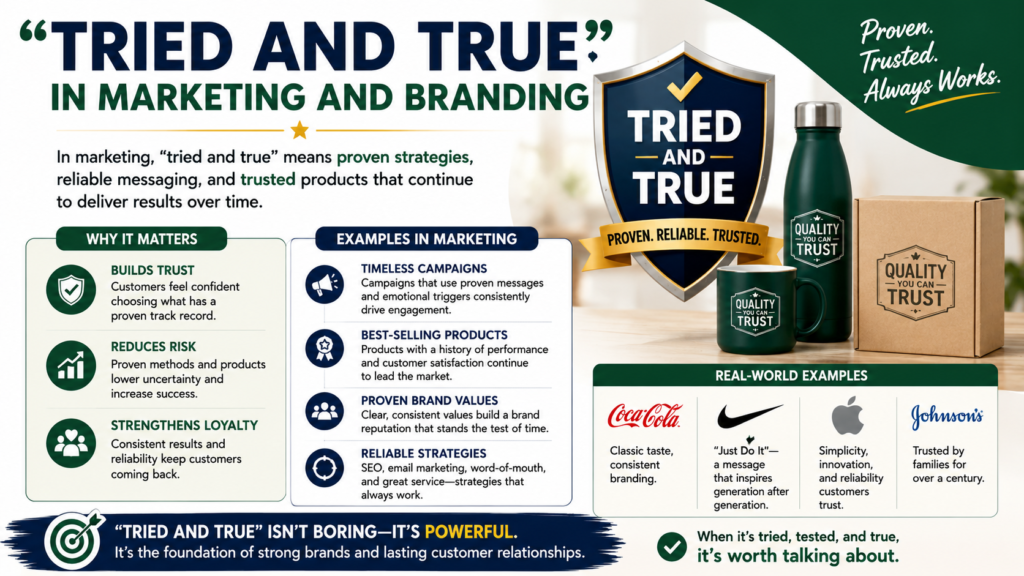
Marketers love tried and true because it does something difficult in a single phrase: it builds trust without sounding like a sales pitch. Instead of saying “trust us,” a brand can say “this has already been trusted by thousands,” which feels less like persuasion and more like fact. That’s powerful brand messaging — it borrows credibility from history rather than manufacturing it from scratch.
Real Examples from Ad Copy and Product Descriptions
You’ll spot this phrase constantly in product descriptions, especially for household staples, cleaning products, and legacy food brands. A detergent ad might promise a formula that keeps colors bright using a tried-and-true process. A recipe box brand might lean on tried-and-true family classics. The phrase signals continuity — “we haven’t changed what already works.”
Overuse Risk: When It Starts to Sound Like a Cliché in Copywriting
Here’s the catch: because the phrase works so well, it gets used constantly — and overused phrases lose their punch fast. When every competitor in a category claims to be “tried and true,” the phrase stops standing out and starts blending into background noise. Good promotional writing treats it like a spice, not a base ingredient. Sprinkle it in where it genuinely fits; don’t build an entire campaign around it.
A smart alternative? Show the proof instead of just claiming it. “Trusted by families since 1952” does the same job as “tried and true” while sounding more specific and less like stock copy.
“Tried and True” vs. Similar Phrases
Several nearby phrases get tangled up with tried and true, so let’s untangle them.
vs. “Tried and Tested”
Tried and tested is nearly a twin of tried and true, and in British English especially, it’s the more common version. The meaning overlaps heavily — both signal reliability through repeated use. The main difference is regional preference: American English leans toward “tried and true,” while British English leans toward tried and tested.
vs. “Time-Tested”
Time-tested emphasizes duration specifically — the passage of years or decades — rather than repeated trials. Something can be tried and true after just a handful of successful uses, but “time-tested” implies it’s survived the test of actual time, often generations.
vs. “Proven”
Proven is the bare-bones version — a single word doing the job of a whole phrase. It’s more clinical and less colorful. “A proven method” sounds a bit more technical or scientific than “a tried-and-true method,” which carries warmer, more folksy overtones.
vs. “Battle-Tested”
Battle-tested borrows military imagery to suggest something survived not just repetition, but genuine stress or hardship. You’ll hear this one a lot in tech and business writing — “battle-tested infrastructure” implies the system held up under real pressure, not just routine use.
Comparison Table
| Phrase | Emphasis | Typical Register | Best Used For |
|---|---|---|---|
| Tried and true | Repeated success | Everyday, warm | Recipes, advice, general reliability |
| Tried and tested | Testing process | Everyday, slightly formal | British English contexts, products |
| Time-tested | Duration over years | Formal, reflective | Traditions, long-standing methods |
| Proven | Verified outcome | Clinical, technical | Science, data, formal claims |
| Battle-tested | Survived hardship | Business, tech | Software, systems under stress |
This side-by-side comparison should make it easier to pick the right phrase for the right tone.
Synonyms and Antonyms
Synonyms
If you’re hunting for a tried and true synonym, here are solid options depending on tone:
- Reliable
- Dependable
- Trustworthy
- Time-honored
- Established
- Proven
- Foolproof
- Old faithful (informal)
- Surefire
Antonyms
On the flip side, if you need the opposite meaning:
- Untested
- Unproven
- Experimental
- Novel
- Unreliable
- Untried
- Speculative
Common Mistakes When Using “Tried and True”
Even native speakers stumble over this phrase more often than you’d expect.
Misquoting It as “Tried and Truth” or “Try and True”
These are two of the most frequent grammar mistakes tied to the phrase. “Tried and truth” swaps the adjective “true” for the noun “truth,” which breaks the grammar entirely. “Try and true” drops the past tense, which sounds like a typo more than an idiom. Neither variation is correct — stick with tried and true.
Hyphenation Errors
As covered earlier, forgetting to hyphenate before a noun (or hyphenating unnecessarily after a verb) is a common slip. It’s a small detail, but it’s the kind of thing sharp editors and careful readers notice immediately.
Using It in Contexts That Call for Something Newer or Unproven
Using “tried and true” to describe something genuinely experimental sends a mixed signal. If a product is brand-new and unproven, calling it tried and true isn’t just inaccurate — it can come across as misleading, especially in marketing or journalism where precision matters.
Quick Reference: Right vs. Wrong Usage
| ✅ Correct | ❌ Incorrect |
|---|---|
| tried and true | tried and truth |
| tried-and-true method | try and true method |
| a tried-and-true approach | a tried and-true approach |
| The plan is tried and true. | The plan is tried-and-true. |
Real-World Examples in Media and Literature
Notable Uses in Print, Film, or Song Titles
The phrase shows up regularly across English idiom collections and pop culture references, often in headlines, self-help book titles, and casual dialogue. Writers reach for it when they want to signal reliability quickly without slowing the pace of a sentence — it’s compact, familiar, and instantly understood by readers.
How Headlines Use It to Signal Trust
Journalists and copywriters both favor this phrase in headlines because it front-loads trust before the reader even finishes the sentence. A headline like “5 Tried-and-True Tips for Better Sleep” promises the reader something low-risk — advice that’s already been vetted, not a fresh experiment they’ll have to test themselves.
How to Decide When “Tried and True” Is the Right Choice
Use It When…
- You want to emphasize reliability over novelty
- The subject genuinely has a track record — recipes, methods, tools, advice
- You’re writing in a warm, conversational tone
- You want to build trust quickly, especially in marketing or instructional writing
Skip It When…
- You’re describing something innovative, experimental, or brand-new
- The audience values disruption over tradition (startups, cutting-edge tech pitches)
- You’ve already used the phrase recently in the same piece — variety matters
- A more specific claim (with data or history) would carry more weight than the idiom alone
FAQs
Is “tried and true” one word or two?
It’s a three-word phrase. Hyphenate it as tried-and-true only when it directly precedes a noun.
What’s the difference between “tried and true” and “tried and tested”?
They’re nearly interchangeable. “Tried and true” is more common in American English, while “tried and tested” dominates in British English.
Can you say “tried and truly”?
No — that’s incorrect. The standard, accepted phrase is always tried and true, using the adjective “true.”
Is “tried and true” still commonly used today?
Yes, it remains widely used in everyday speech, marketing copy, and writing, especially to signal reliability over novelty.
What’s a good synonym for “tried and true”?
Reliable, dependable, proven, and time-honored all capture a similar meaning, depending on tone.
conclusion
At its core, the tried and true meaning comes down to trust earned through repetition. It’s not about hype or promises. It’s about results that hold up, again and again. Whether it’s a recipe, a method, or a piece of advice, calling something tried and true tells people it’s already been tested — and it worked.
Now that you know the tried and true meaning, you can use it with confidence. Get the hyphenation right, pick it over similar phrases when it fits best, and watch how much trust those three small words can build.