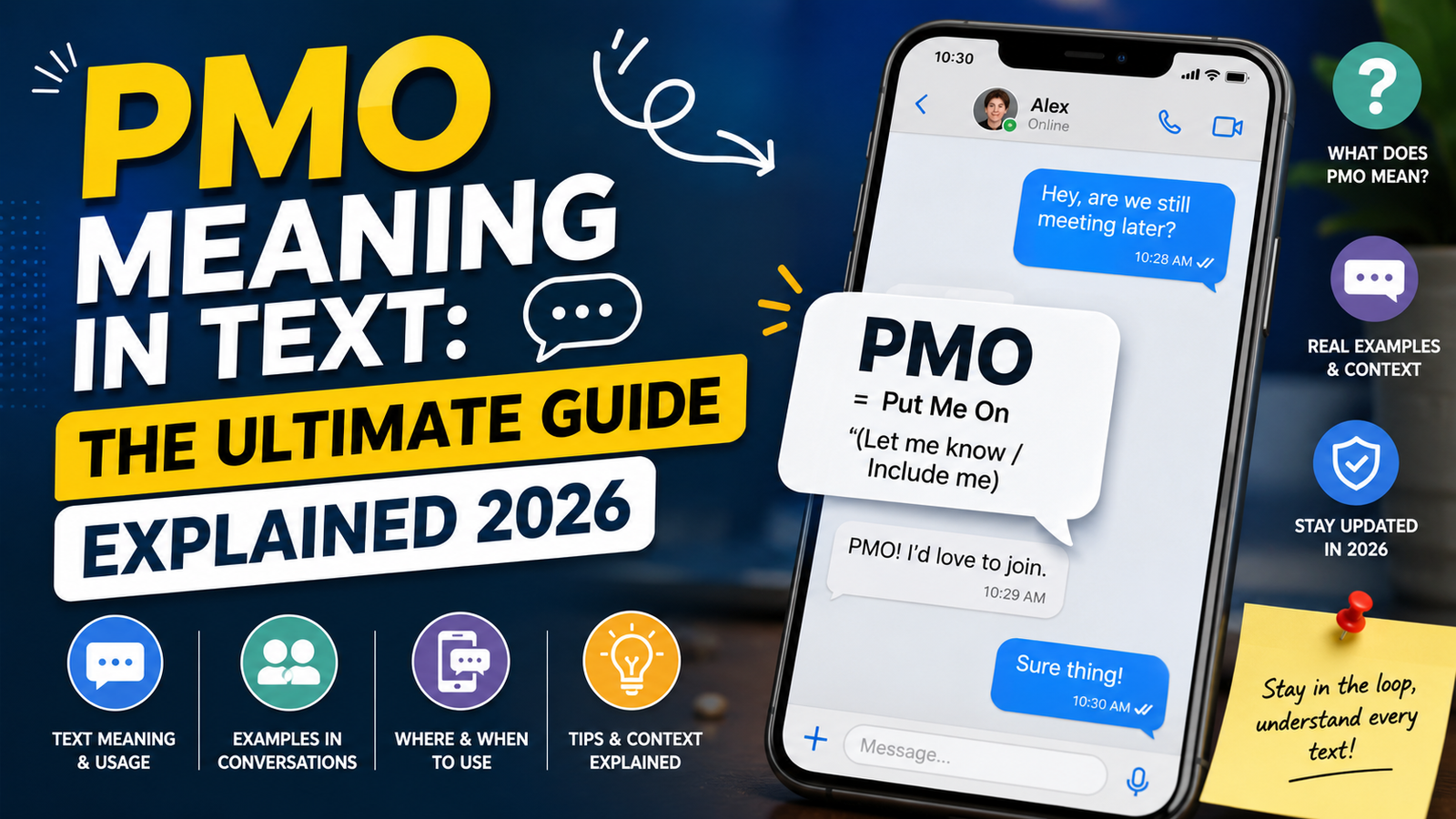
PMO meaning in text almost always points to one of two things: “piss me off,” used to express frustration or annoyance, or “put me on,” used to ask for a recommendation. Both share the same three letters but carry completely opposite emotional weight.
Picture this: a text lands with just “pmo” and nothing else, and suddenly you’re stuck guessing whether your friend is furious or just wants a song recommendation. That tiny mix-up has derailed more group chats than anyone likes to admit.
Beyond texting, PMO shifts again. It stands for Project Management Office in corporate settings, Prime Minister’s Office in government news, and something entirely different inside wellness and recovery communities online.
What Does PMO Mean? Quick Answer
If you just need the fast answer before you reply to that text, here it is:
| Context | PMO Meaning | Example |
|---|---|---|
| Casual texting (annoyed) | “Piss me off” / “pisses me off” | “The wifi keeps cutting out, pmo” |
| Casual texting (requesting) | “Put me on” | “Pmo to that new show everyone’s watching” |
| Business/corporate | Project Management Office | “The PMO approved the new project timeline” |
| Government | Prime Minister’s Office | “The PMO released a statement this morning” |
| Health/recovery forums | Porn, Masturbation, Orgasm | “I’ve been PMO-free for 30 days” |
PMO meaning shifts entirely based on where you encounter it. A text from your friend, an email from your manager, and a headline about a government announcement are three completely different contexts — and PMO carries a different PMO definition in each one. The rest of this guide walks through every version in detail, starting with the two meanings you’ll run into most while texting.
Meaning #1: PMO Means “Piss Me Off” — The Frustration Slang
This is the PMO meaning most people encounter first, and it’s the one that shows up most often across social media platforms and group chats. When someone types “pmo,” “PMO,” or even “pmoo” with extra letters for emphasis, they’re usually venting.
Piss me off, pisses me off, and pissing me off all collapse into the same three letters. It’s a flexible piece of internet terminology — it can function almost like a verb in a sentence, which is unusual for an acronym. You’ll see it used like this:
- “This traffic pmo so bad right now”
- “He canceled on me again, pmo”
- “Slow loading screens pmo me more than anything”
Notice that PMO isn’t just tacked onto the end of a sentence as an afterthought. It slots directly into the grammar, standing in for “annoys me” or “makes me angry.” That’s part of what makes it distinct from a lot of other text abbreviations — most acronyms (like LOL or BRB) sit outside the sentence structure, while PMO often sits inside it.
The Tone Can Range From Serious to Playful
One thing that trips people up: PMO doesn’t always mean someone is genuinely upset. Like a lot of chat slang, it gets used for comedic exaggeration just as often as real irritation.
- Genuine frustration: “My package got lost in shipping again, this pmo so bad”
- Playful exaggeration: “Bro forgot my birthday LMAOOO pmo 😭”
The emoji attached to the message usually tells you which one you’re dealing with. An angry-face emoji (😡, 🙄) signals real annoyance. A crying-laughing emoji (😭, 💀) usually means the person is joking around, even while using a word that technically means frustrated.
“PMO is one of those terms that packs a lot of feeling into a tiny package, similar to how SMH expresses disappointment in just three letters.”
That comparison is a useful way to think about it. PMO belongs to a broader family of messaging slang built entirely around compressing emotion into the smallest possible space — because typing “this is genuinely pissing me off right now” takes six times as long as typing “pmo.”
Meaning #2: PMO Means “Put Me On” — The Recommendation Request
The second major PMO meaning flips the emotional register entirely. Instead of frustration, “put me on” is a request. It means introduce me, connect me, or show me something new — usually music, but it stretches to shows, restaurants, job opportunities, or basically anything worth recommending.
This use of PMO grew out of older slang, “put me on,” which has roots in hip-hop and music culture long before it got compressed into an acronym for texting. “Put me on” as a full phrase has been used for decades to mean “introduce me to something good” — think of an artist thanking someone who helped their career take off, or a friend asking to be looped into a new trend.
When it shifted into texting terms, the meaning carried over intact. You’ll see it phrased as:
- “Pmo to some new music, I’m bored of my playlist”
- “Can you pmo to a good barber near you?”
- “Ngl you gotta pmo to that anime you were talking about”
How to Recognize This Version
The clearest signal is sentence structure. “Put me on” almost always appears as part of a request, frequently starting with “can you” or paired with “to” (as in “pmo to X”). It’s asking for music recommendations, a plug, a connection, or access to something the other person already has.
Compare these two texts side by side:
| Text | Meaning |
|---|---|
| “This show pmo, they killed off my favorite character” | Piss me off |
| “Pmo to that show you keep talking about” | Put me on |
Same three letters. Completely opposite intent. The word “to” right after PMO is a strong giveaway for the “put me on” meaning — you rarely see “piss me off” phrased with “pmo to” attached.
How to Tell Which One Someone Means: A Simple Framework
Since PMO carries two nearly opposite meanings in casual online slang, mixing them up is an easy way to send a confusing reply. Here’s a straightforward way to figure out which one you’re looking at.
Step 1: Check if it sounds like a request or a complaint. Requests ask for something. Complaints vent about something. “Pmo to good coffee shops” is a request. “This coffee shop pmo” is a complaint.
Step 2: Look at the words right before and after PMO. If “to” follows PMO, it’s almost certainly “put me on.” If PMO follows a subject that’s clearly annoying (traffic, a person, a situation), it’s “piss me off.”
Step 3: Read the emotional tone of the rest of the message. Exclamation points, angry emojis, or complaint-adjacent words nearby (“ugh,” “so annoying,” “can’t stand”) point to frustration. Curiosity-driven language (“been looking for,” “need,” “any good”) points to a request.
Here’s the decision process laid out as a quick flow:
- Does the sentence ask for something? → Put me on
- Does the sentence complain about something? → Piss me off
- Still unsure? → Look at the emoji or ask the person directly
Most native users of this slang switch between meanings instinctively, the same way English speakers instantly know whether “that’s sick” is a compliment or a complaint based on tone. If you’re new to the term, it takes a few examples before the pattern-matching becomes automatic — but it clicks fast.
Where PMO Came From: A Brief History
PMO as “pisses me off” traces back to earlier text-speak and forum culture from the 2000s and 2010s, part of a much larger wave of abbreviation-heavy communication that grew out of SMS character limits and early messaging platforms. When every text cost money or counted against a character cap, compressing emotional phrases into acronyms wasn’t just stylistic — it was practical. IDK, TBH, SMH, and PMO all emerged from roughly the same pressure: say more with less.
According to the Wikipedia glossary of 2020s slang, PMO is documented as internet slang for “piss me off,” reflecting how the term has been formally tracked as part of the broader vocabulary of modern digital language.
“Put me on,” on the other hand, didn’t start as an acronym at all. It began as a full phrase in music and hip-hop culture, where an established artist “putting on” a newer one meant giving them exposure, a feature, or a career boost. Over time, everyday speakers borrowed the phrase for smaller, everyday favors — “put me on to that restaurant,” “put me on to that job opening” — and eventually, it got shortened to fit into texting the same way “piss me off” did.
What’s interesting is that these two phrases, with completely unrelated origins, ended up sharing the exact same three-letter abbreviation. That’s not uncommon in internet slang — acronyms tend to collide when they’re short and the source phrases are common enough. Context has always had to do the heavy lifting for words like this, and PMO is a textbook example.
PMO’s Other Meaning: Porn, Masturbation, Orgasm
Here’s where a lot of guides on this topic stop short — but it’s worth covering, because if someone searches “PMO meaning” outside of a texting context, this is very likely what they’re looking for.
In health, wellness, and recovery communities, particularly the NoFap community, PMO stands for porn, masturbation, orgasm. It’s used as shorthand to describe the cycle that members of these communities are trying to abstain from, usually as part of a self-directed effort to reduce pornography use.
NoFap itself started in 2011 as a small online discussion and grew into a much larger movement. As one interview with NoFap’s founder, Alexander Rhodes, explained it directly:
“Fap = slang for masturbation. PMO = porn, masturbation, orgasm.”
This meaning shows up constantly across Reddit threads, recovery forums, and accountability apps where users track “PMO-free” streaks — days spent abstaining from the cycle the acronym describes. You’ll see phrases like:
- “Day 45 PMO-free”
- “Relapsed on PMO after 3 weeks”
- “Looking for an accountability partner for my PMO recovery journey”
It’s worth being clear that this meaning has zero overlap with the texting slang versions. Nobody texting a friend about a canceled dinner plan is invoking the NoFap definition, and nobody posting in a recovery forum is asking to be “put on” to new music. The context — a wellness or recovery-focused forum versus a casual group chat — makes the distinction immediate and unambiguous. It’s a good reminder that PMO stands for wildly different things depending entirely on where you encounter it, and it’s precisely why guides like this one need to cover the full range rather than just the version that’s trending on TikTok.
PMO in Professional and Institutional Contexts
Outside of slang and wellness spaces entirely, PMO carries two well-established, formal meanings that show up constantly in business operations and government coverage.
PMO in Business: Project Management Office
In corporate settings, a Project Management Office — often just called “the PMO” or PMO office — is a department or team responsible for setting and maintaining standards around project management across an organization. A PMO typically handles:
- Defining project governance standards and methodology
- Training and supporting project managers across departments
- Tracking project performance, timelines, and budgets
- Ensuring projects align with overall business strategy
- Providing centralized reporting to leadership
Large organizations, especially in construction, IT, consulting, and manufacturing, rely on a PMO to prevent projects from running independently with no shared standards. Depending on the company, a PMO might have direct authority to approve or reject projects (a “directive” PMO), or it might operate purely as a support and consulting resource (a “supportive” PMO), with a “controlling” PMO sitting somewhere in between.
If you’re in a work email and someone references “the PMO,” they are, without much doubt, talking about this — not the slang term, and not the government office. Workplace context makes the meaning obvious almost instantly.
PMO in Government: Prime Minister’s Office
In government and news coverage, PMO typically refers to the Prime Minister’s Office — the administrative body that supports a head of government’s day-to-day operations, communications, and policy coordination. This usage is especially common in countries with parliamentary systems, including India, the United Kingdom, Canada, and other Commonwealth nations.
News headlines referencing “the PMO” are almost always talking about official government administration, not internet slang. A sentence like “the PMO issued a statement on the new trade policy” belongs entirely to the world of executive office communications and public sector governance — worlds away from a group chat.
Why These Meanings Rarely Cause Confusion
Unlike the “piss me off” versus “put me on” mix-up, the professional and slang meanings of PMO almost never overlap in practice. Nobody reads a news article about a Prime Minister’s Office announcement and wonders if it means “put me on.” The setting does all the disambiguating work automatically — a work email, a government news story, and a text from a friend are different enough environments that your brain sorts the meaning out without conscious effort.
PMO Across Different Platforms
While the core meanings of PMO stay consistent, usage does skew slightly depending on where you’re seeing it. Here’s a quick breakdown of where each meaning tends to show up more often.
| Platform | Common PMO Usage |
|---|---|
| Both meanings appear in comments and DMs; “put me on” often shows up under posts about music or fashion finds | |
| TikTok | “Put me on” is especially common in comment sections asking for song names or recommendations |
| Snapchat | Mostly casual, frustration-based use between friends in private chats |
| Twitter/X | Frustration-based PMO dominates, often attached to venting about news, sports, or daily annoyances |
| Discord | Both meanings appear frequently, especially in gaming servers where “pmo” gets used for in-game frustration or asking to be put on to new games |
There isn’t a dramatic difference in meaning from platform to platform — PMO doesn’t change definitions depending on the app. What changes is frequency. Music- and trend-driven platforms like TikTok see more “put me on” requests, while faster-paced, reaction-heavy platforms like Twitter/X lean more toward the frustration meaning.
Real Conversation Examples: PMO in Action
Seeing PMO used naturally in context is the fastest way to get comfortable with it. Here are a handful of realistic exchanges covering both slang meanings.
Frustration example:
Person A: “Did you hear back about the apartment?” Person B: “Yeah they gave it to someone else after telling me I had it locked in. Literally pmo”
Request example:
Person A: “What are you listening to right now?” Person B: “Some new artist my cousin showed me, one sec, lemme pmo”
Mixed conversation:
Person A: “Ngl this new update to the app pmo, everything’s slower now” Person B: “Fr, also can you pmo to any apps that actually work well”
Playful/exaggerated tone:
Person A: “He said pineapple belongs on pizza” Person B: “PMOOOO 😭😭 unfollow him”
Each of these examples shows how much weight the surrounding words carry. Strip away the sentence around “pmo” and the word alone gives you almost nothing to work with — it’s the sentence pattern, punctuation, and emoji choice doing the actual communicating.
PMO Compared to Other Internet Slang
PMO isn’t the only acronym doing double duty in modern texting. Here’s how it stacks up against a few similar terms.
| Term | Meaning | Similar To PMO Because |
|---|---|---|
| SMH | Shaking my head (disbelief/disappointment) | Compresses a strong reaction into a few letters |
| NGL | Not gonna lie | Often paired with PMO for emphasis (“ngl this pmo”) |
| ISTG | I swear to god | Frequently combined with PMO to intensify frustration |
| Plug me | Similar to “put me on” | Alternative phrasing for the same recommendation request |
| SMDH | Shaking my darn head | Stronger version of SMH, same emotional family as frustrated PMO |
You’ll often see PMO stacked with these other terms rather than used alone. “Ngl this pmo” or “istg this pmo so bad” are extremely common combinations — layering one acronym on top of another to push the emotional intensity higher, which is a pattern common across a lot of messaging slang built for speed over precision.
Is PMO Appropriate to Use? A Practical Guide
Because “piss me off” contains language some people consider mildly vulgar, PMO isn’t universally appropriate. Here’s a rough breakdown of where it fits and where it doesn’t.
Fine to use:
- Texting friends or close contacts
- Casual comments on social media
- Gaming chats and Discord servers among peers
Use with caution:
- Texting someone significantly older or unfamiliar with online abbreviations — they may not know either meaning and could misread the tone
- Semi-formal group chats (school clubs, community groups) where tone expectations are unclear
Avoid entirely:
- Professional emails or workplace Slack messages, where “PMO” is more likely to be read as Project Management Office anyway, creating real confusion
- Formal writing, cover letters, or any context requiring standard English
- Messages to someone who might take the underlying phrase (“piss me off”) as genuinely rude, even if you mean it lightly
A good general rule: if you wouldn’t say the full phrase “pisses me off” out loud in that setting, don’t type PMO either. The abbreviation shortens the typing, not the tone.
Alternative Ways to Express the Same Thing
If PMO doesn’t feel like the right fit for a particular conversation, there are plenty of alternatives that land the same message.
For frustration:
- “This is so annoying”
- “That’s driving me crazy”
- “I’m so irritated right now”
- SMH, ugh, or a simple 😤
For a recommendation request:
- “Put me on” (spelled out in full)
- “Show me some good ones”
- “Send me a link”
- “What should I check out?”
None of these alternatives carry the same compact, casual energy PMO has, which is exactly why the abbreviation caught on in the first place. But they’re useful fallback options for contexts where the acronym might not land the way you intend.
FAQs
What does PMO mean in text?
PMO usually means “piss me off” (frustration) or “put me on” (asking for a recommendation). Context and sentence structure tell you which one applies.
Is PMO still commonly used in 2026?
Yes, it remains active slang across Instagram, TikTok, Snapchat, Discord, and Twitter/X, with “put me on” especially common in comment sections asking for music or product recommendations.
Does PMO mean the same thing in a work email?
No. In professional and corporate contexts, PMO almost always refers to a Project Management Office, not the texting slang.
What does PMO mean in government or news headlines?
It refers to the Prime Minister’s Office, the administrative body supporting a head of government — common in coverage from India, the UK, Canada, and other parliamentary nations.
Is PMO used in health or recovery communities?
Yes. In NoFap and similar recovery forums, PMO stands for porn, masturbation, orgasm, and is used to track abstinence streaks — a meaning completely unrelated to the texting slang.
conclusion
PMO meaning in text really comes down to context. It’s either “piss me off” or “put me on,” and the sentence around it tells you which one fits. Once you spot the pattern, you’ll never mix them up again.
Outside of texting, PMO meaning in text doesn’t even apply. It shifts to Project Management Office at work, Prime Minister’s Office in the news, or something else entirely in recovery communities. Three letters, many meanings. Context is always the key.